DiscoverOrg vs Mattermark: Which B2B Data Tool Wins in 2026?
One got absorbed into ZoomInfo. The other quietly disappeared. Here is what DiscoverOrg and Mattermark actually did, what each cost, and which modern tool now does that job better and cheaper.
TL;DR
- Neither product exists the way you remember it. DiscoverOrg absorbed ZoomInfo in 2019 and retired its own brand; Mattermark was acquired by FullContact in 2017, changed hands again, and no longer operates as a serious standalone product.
- They never really competed. DiscoverOrg sold verified contact data (emails, direct dials, org charts) to enterprise sales teams. Mattermark sold company signals (funding, headcount growth, web traffic) to VCs and startup sellers.
- If you searched "DiscoverOrg vs Mattermark" you actually have two separate jobs to solve: who to contact and which companies are worth contacting.
- Modern replacement stack: ZoomInfo or a lean email-finder for contacts, Crunchbase or a signals feed for account selection. You almost never need both at enterprise pricing.
- Budget reality: the DiscoverOrg lineage still starts around $15,000–$25,000/year on annual contracts. A per-lookup email finder covers the same "get me a valid email" job from $49/month.
What were DiscoverOrg and Mattermark, exactly?#
DiscoverOrg launched in 2007 as a human-verified contact database. Its pitch was research quality: real analysts phoning companies to confirm titles, reporting lines, direct dial numbers, and installed technology. Sales teams selling into IT departments loved it because the org charts were genuinely accurate at a time when most B2B data was scraped garbage.
Mattermark launched in 2012 with a completely different premise. It did not care much who worked at a company. It cared whether that company was growing: funding rounds, employee count trajectory, web traffic, mobile downloads, news mentions. It rolled those into a "Mattermark Growth Score" and let you filter thousands of private companies by momentum. VCs used it for deal sourcing. Startup AEs used it to find accounts that had just raised money and therefore had budget.
So the honest framing of DiscoverOrg vs Mattermark is not "which one is better." It is: contact data versus account intelligence. One tells you the CTO's mobile number. The other tells you which CTOs just got $20M to spend.
What happened to both companies?#
This is the part most comparison pages skip, and it is the only part that changes your buying decision.
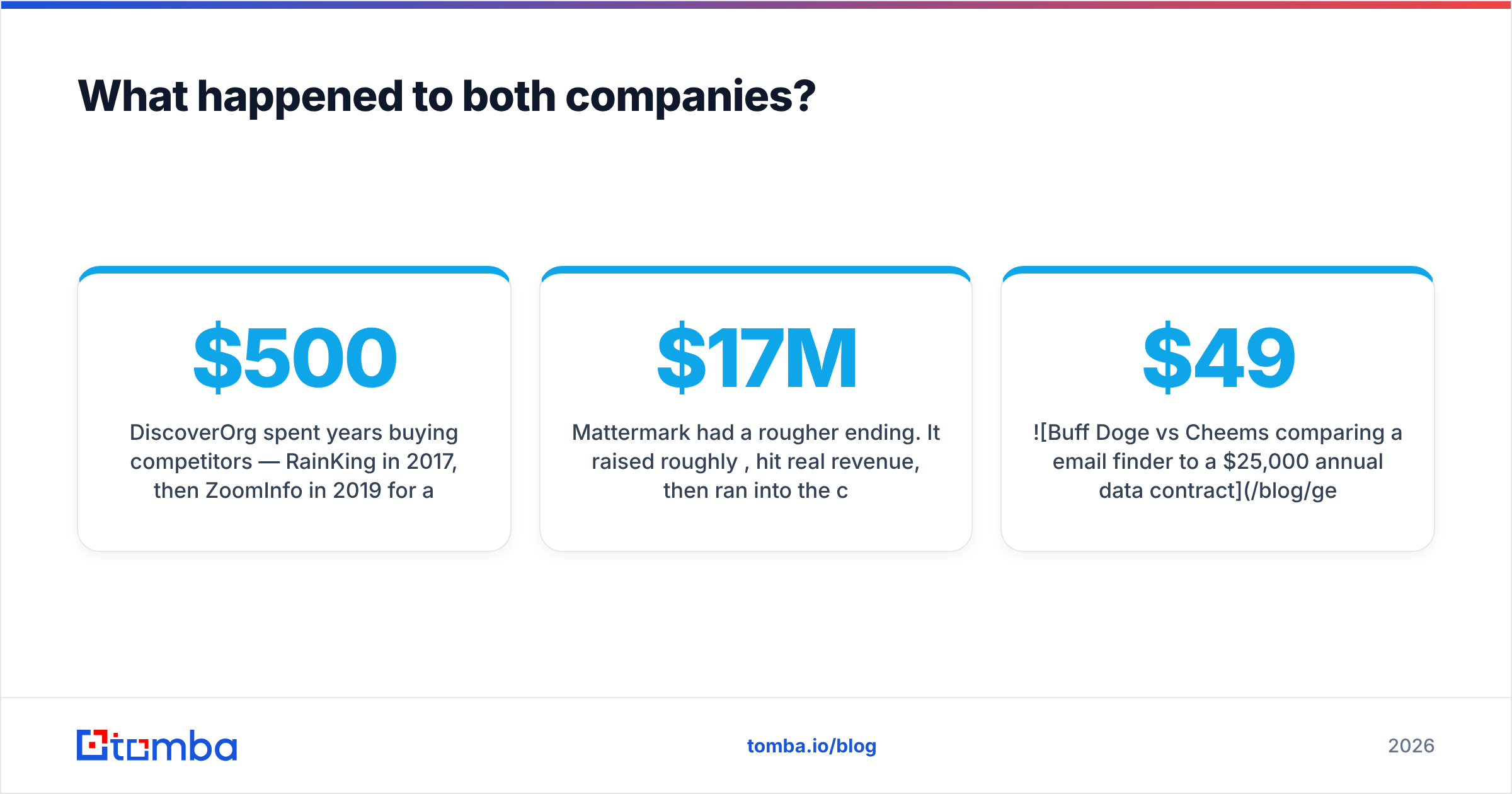
DiscoverOrg spent years buying competitors — RainKing in 2017, then ZoomInfo in 2019 for a reported figure north of $500 million. In an unusual move, the acquirer took the acquired company's name: the combined business rebranded as ZoomInfo and went public in 2020. The DiscoverOrg product line was folded into ZoomInfo's platform. If a rep pitches you "DiscoverOrg" today, they are pitching you ZoomInfo with legacy branding.
Mattermark had a rougher ending. It raised roughly $17M, hit real revenue, then ran into the classic data-business problem: the underlying signals kept getting commoditized by free sources. FullContact acquired it in 2017, and the product was later sold on again. Today Mattermark is not a product you can meaningfully buy, evaluate, or build a workflow on. Its category — company signals — was largely eaten by Crunchbase, LinkedIn Sales Navigator filters, and the intent-data vendors.

How did DiscoverOrg and Mattermark compare head to head?#
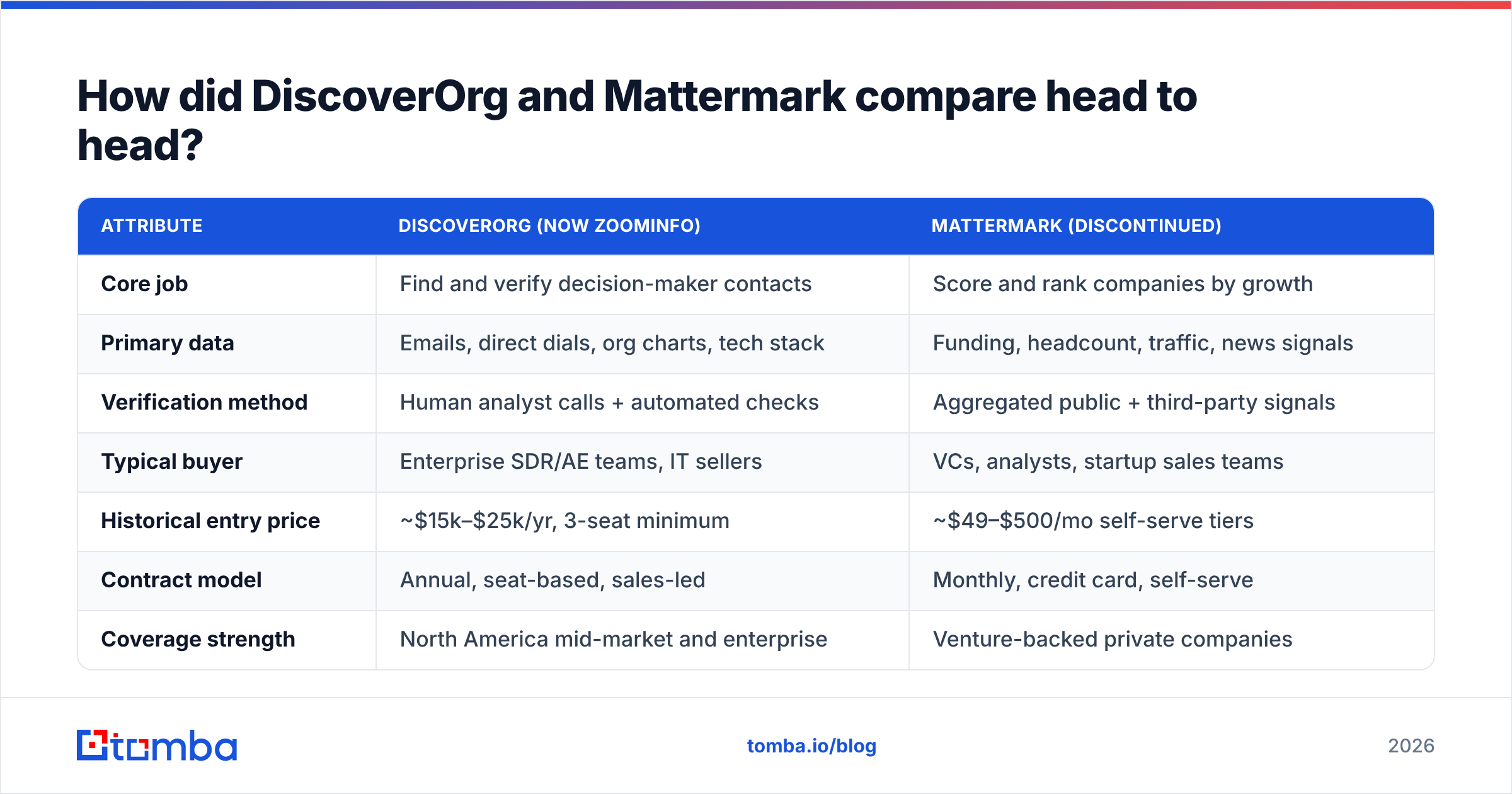
Here is the honest side-by-side, using each product at its peak rather than its zombie state.
| Attribute | DiscoverOrg (now ZoomInfo) | Mattermark (discontinued) |
|---|---|---|
| Core job | Find and verify decision-maker contacts | Score and rank companies by growth |
| Primary data | Emails, direct dials, org charts, tech stack | Funding, headcount, traffic, news signals |
| Verification method | Human analyst calls + automated checks | Aggregated public + third-party signals |
| Typical buyer | Enterprise SDR/AE teams, IT sellers | VCs, analysts, startup sales teams |
| Historical entry price | ~$15k–$25k/yr, 3-seat minimum | ~$49–$500/mo self-serve tiers |
| Contract model | Annual, seat-based, sales-led | Monthly, credit card, self-serve |
| Coverage strength | North America mid-market and enterprise | Venture-backed private companies |
| Weakness | Cost, rigid contracts, stale long-tail records | Thin contact data, signal noise |
| Status in 2026 | Alive as ZoomInfo | Effectively dead |
The pricing row is the one that matters. DiscoverOrg was never a tool you tried on a Tuesday afternoon. It was a procurement event with a demo, a security review, and a twelve-month commitment. Mattermark was the opposite: a credit card and a filter panel. That difference in go-to-market explains a lot about who survived — enterprise contracts are durable, self-serve signal products are not.
Which one actually had better data?#
Neither, because they measured different things. But it is worth being precise about what "accurate" meant for each.
DiscoverOrg's accuracy claim was about contactability. Does this email deliver? Does this phone number reach a human? Is this person still in the role? Human verification made those fields unusually reliable for covered accounts — and unusually expensive to maintain, which is why coverage outside their focus segments got thin fast.
Mattermark's accuracy claim was about directionality. Is this company growing? A Growth Score does not need to be exact to be useful; it needs to rank correctly. The problem was that once everyone had the same public signals, ranking stopped being a moat.

For contact accuracy specifically, the modern benchmark has moved. Bounce rates below 3% are table stakes, and any provider that cannot show you a confidence score plus the evidence for a given address is asking for blind trust. That is why pairing any finder with a real email verifier step before send is now standard practice rather than an optional extra.
What should you use instead in 2026?#
Split the original question into the two jobs it hides, then buy the cheapest credible tool for each.
- Account selection (the Mattermark job). Crunchbase for funding and firmographics, LinkedIn Sales Navigator for headcount and hiring signals, or a job-posting scraper if you sell into specific teams. Free-to-cheap covers 90% of what Mattermark did.
- Contact discovery (the DiscoverOrg job). An email finder that resolves name + domain to a verified address, ideally with an API so it runs inside your workflow instead of a CSV shuttle.
- Verification before send. Never trust a found address blindly. Verify, drop the unknowns, and keep catch-all domains in a separate bucket with lower send volume.
- Enrichment on inbound. When a form fill or website visit happens, enrich it server-side rather than paying for a full static database you refresh quarterly.
- Direct dials, only if you actually call. Phone data carries the highest price premium of any B2B field. If your team does not dial daily, do not pay for it.
Run that stack and you will spend a fraction of a legacy DiscoverOrg contract while getting fresher data, because per-lookup providers verify at request time instead of serving you a record that was checked eight months ago.
How do the modern alternatives compare on price and fit?#

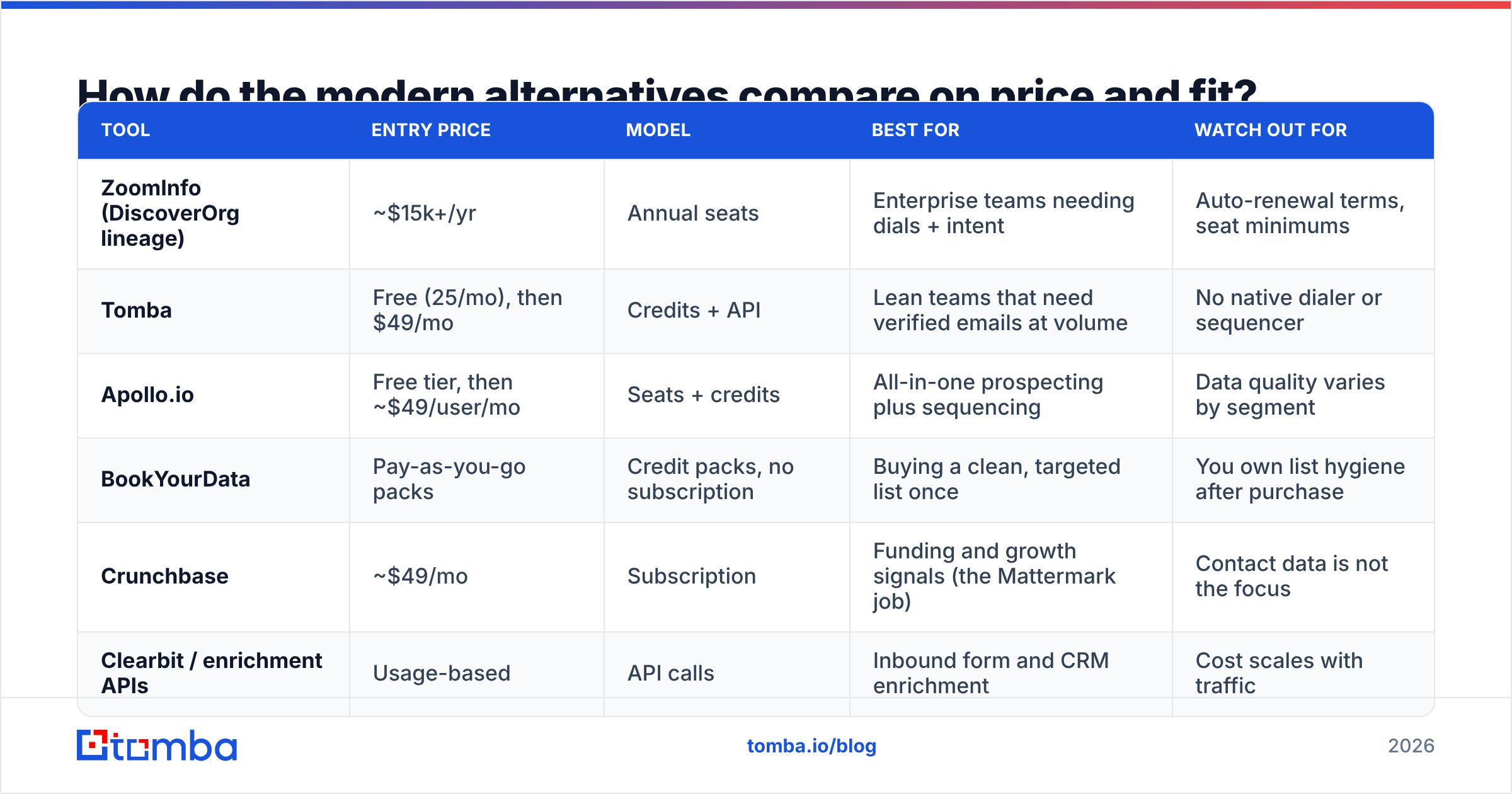
| Tool | Entry price | Model | Best for | Watch out for |
|---|---|---|---|---|
| ZoomInfo (DiscoverOrg lineage) | ~$15k+/yr | Annual seats | Enterprise teams needing dials + intent | Auto-renewal terms, seat minimums |
| Tomba | Free (25/mo), then $49/mo | Credits + API | Lean teams that need verified emails at volume | No native dialer or sequencer |
| Apollo.io | Free tier, then ~$49/user/mo | Seats + credits | All-in-one prospecting plus sequencing | Data quality varies by segment |
| BookYourData | Pay-as-you-go packs | Credit packs, no subscription | Buying a clean, targeted list once | You own list hygiene after purchase |
| Crunchbase | ~$49/mo | Subscription | Funding and growth signals (the Mattermark job) | Contact data is not the focus |
| Clearbit / enrichment APIs | Usage-based | API calls | Inbound form and CRM enrichment | Cost scales with traffic |
Two notes on that table. First, BookYourData is genuinely the right answer when you need a defined list — a one-time pack with no subscription beats renting a database you query twice a quarter. Second, the ZoomInfo row is not a knock; if you sell six-figure deals into the Fortune 1000 and your reps live on direct dials, the contract can pay for itself. The mistake is buying it because a competitor did.

Is a lean email finder really enough to replace DiscoverOrg?#
For the specific job of "get me a valid, deliverable email for this person at this company," yes — and the economics are not close.
A legacy contract buys you a static database plus seats. A modern email finder buys you resolution at the moment you ask, which is when freshness actually matters. You give it a name and a domain, or just a domain, and it returns candidates with confidence scores and the sources behind them. Volume work runs through the Tomba API or a bulk upload rather than a rep clicking through a UI.
What you give up is real: no dialer, no intent data, no conversation intelligence, no org charts drawn by an analyst. If your buying committee mapping depends on knowing that the VP of Infrastructure reports to the CIO who reports to the COO, ZoomInfo still has something a finder does not.
What you gain is control over spend. Tomba pricing starts free at 25 searches per month, then $49/month for Starter, $99/month for Growth, and $249/month for Pro — monthly, no seat minimum, no procurement cycle. Three years of Growth costs less than one year of a mid-tier enterprise data contract.
The honest test: list every field your team touched in the last 90 days. If it is email, title, company, and industry, you are paying enterprise prices for a lookup. If it is buying-committee maps, intent surges, and mobile numbers, you are not.
What did the Mattermark story teach data buyers?#
Three lessons that still apply when you evaluate any B2B data vendor in 2026.
- Signals commoditize; verification does not. Anyone can scrape a funding announcement. Confirming that an inbox accepts mail today requires infrastructure and ongoing cost. Pay for the second thing.
- Self-serve without stickiness dies. Mattermark's monthly customers could leave any month, and eventually did. That is a vendor risk, not just a business-model footnote — check whether the tool you are adopting has revenue durability before you build a workflow on it.
- Bundles absorb point solutions. LinkedIn added growth filters. Crunchbase added scores. The category collapsed into products that already had distribution. Prefer vendors whose core job is hard to bolt onto someone else's roadmap.
Apply the same lens to your current stack. Any tool whose entire value is "we aggregate public data and rank it" is one platform feature away from irrelevance. Tools whose value is verified, permissioned, continuously refreshed contact data have a harder job and a longer life.
How should you actually run the replacement workflow?#
A practical sequence that mirrors what the two old tools did, at roughly 5% of the combined cost:
- Build the account list. Filter Crunchbase or Sales Navigator for the growth signals Mattermark used to surface — recent raise, headcount up 20%+, hiring for the function you sell to.
- Resolve the companies to domains. Clean domains are the input everything else depends on; strip subdomains and redirects first.
- Pull contacts by domain. Run a domain search to get every discoverable address at the company plus its email pattern, then filter to the titles you care about.
- Verify and segment. Valid goes to the main sequence, catch-all goes to a low-volume test batch, invalid gets dropped. Never merge these three.
- Enrich what converts. Add firmographics and phone data only for accounts that reply. Enriching everything up front is how data budgets get eaten.
- Refresh quarterly. Re-verify anything older than 90 days before it re-enters a sequence.
That workflow takes an afternoon to set up and gives you the DiscoverOrg outcome — a list of real people you can actually reach — without the annual commitment. Add data enrichment only at step five, where the spend is tied to demonstrated interest.
The verdict#
DiscoverOrg vs Mattermark is a settled question: DiscoverOrg survived by becoming ZoomInfo, Mattermark did not survive at all. Neither name should appear on your 2026 shortlist as-is.
Buy the enterprise platform only if you need direct dials, org charts, and intent data badly enough to sign an annual contract. Otherwise, split the job — free or cheap signals for account selection, a per-lookup finder for contacts, verification before every send — and keep the difference.
If your bottleneck is simply getting accurate, deliverable email addresses for the accounts you already know you want, start with the Tomba Email Finder. The free tier covers 25 searches a month so you can benchmark it against whatever quote is sitting in your inbox, and Starter is $49/month with no seat minimum. Test it against 100 contacts you already have verified, compare the hit rate, and let the numbers decide instead of the sales cycle. Independent reviews on G2 are a useful sanity check before you commit to any of them.
Related guides#
Ready to find emails that actually work?
Join 150,000+ professionals who stopped guessing and started sending. Free credits on signup — no credit card required.
Get the Tomba newsletter
Practical outbound tactics and product updates — once every two weeks.
About the author