DiscoverOrg vs Ocean.io: B2B Data Platforms Compared 2026
DiscoverOrg is now ZoomInfo, and Ocean.io never competed on contact volume in the first place. Here is what each platform actually does in 2026, what they cost, and which one belongs in your stack.
DiscoverOrg vs Ocean.io is a strange matchup. One brand no longer exists on its own. The other never sold the same thing. Here is what each one is in 2026, what it costs, and which one you should buy.
TL;DR
- DiscoverOrg is gone as a standalone product. It merged with ZoomInfo in 2019 and the brand was retired. When a vendor or a listicle says "DiscoverOrg" in 2026, they mean ZoomInfo's contact database.
- Ocean.io is not a true rival. It sells account discovery — lookalike company search and ICP modeling. Contact data is a side dish.
- Both sides of DiscoverOrg vs Ocean.io are annual contracts. Expect seat pricing, a platform fee, and a sales cycle measured in weeks.
- Neither is cheap for simple work. If you just need verified work emails for people you already know, a per-credit email finder does that job for far less.
- Best stack for most mid-market teams: a targeting layer, a contact layer (Tomba, ZoomInfo, or BookYourData), and a verification step before anything hits your sequencer.
What happened to DiscoverOrg, and what is it in 2026?#
DiscoverOrg was based in Vancouver, Washington. It built its name on human-verified org charts for IT, marketing, finance, and HR teams. Real analysts called into companies to confirm reporting lines, budgets, and tech installs. That research depth was the product.
In February 2019, DiscoverOrg bought ZoomInfo and took the ZoomInfo name. The combined company went public in 2020. The discoverorg.com domain now redirects. The logo is gone from the product. The old research method is just one input into a much larger machine-collected dataset.
This matters in a concrete way. If you are reading a "DiscoverOrg vs Ocean.io" comparison written before 2020, it describes a product that no longer ships. And if a reseller offers you "DiscoverOrg data," you are buying a ZoomInfo contract.
What you actually get today under that lineage:
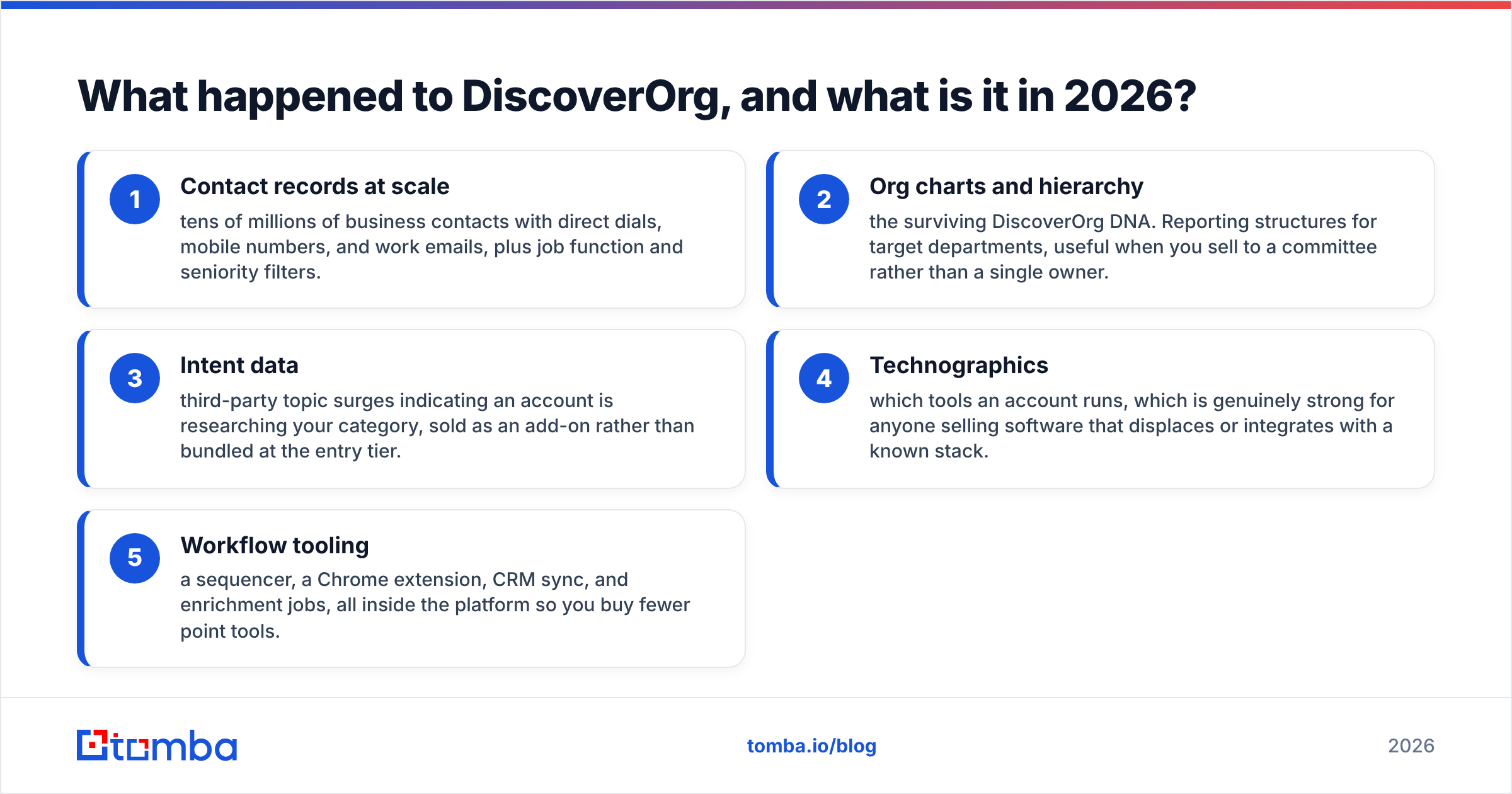
- Contact records at scale — tens of millions of business contacts, with direct dials, mobile numbers, and work emails. You can filter by job function and seniority.
- Org charts and hierarchy — the surviving DiscoverOrg DNA. Useful when you sell to a committee rather than a single owner.
- Intent data — third-party topic surges that hint an account is shopping your category. Sold as an add-on, not bundled at the entry tier.
- Technographics — which tools an account runs. Genuinely strong if your software replaces or plugs into a known stack.
- Workflow tooling — a sequencer, a Chrome extension, CRM sync, and enrichment jobs, all in one platform. You buy fewer point tools.
The trade is simple. You get the widest commercial B2B dataset on the market, wrapped in enterprise contract terms.
What is Ocean.io, and who is it built for?#
Ocean.io is a company data platform based in Copenhagen. It answers a different question. ZoomInfo tells you who works at a company and how to reach them. Ocean.io tells you which companies to target in the first place.
Its core trick is lookalike search. You feed in a seed list — your best customers, your closed-won accounts, a competitor's logo wall. The platform then finds companies that resemble them. It reads website copy, business descriptions, and firmographic signals instead of leaning on SIC codes.
That difference is the whole pitch. Standard industry codes put a fintech lender and a regional credit union in the same bucket. Semantic matching does not.
Ocean.io does layer contact data on top of that account list. But nobody buys it for contact depth. They buy it because their ICP is hard to describe with dropdown filters.
Typical fit: a company selling something narrow, like compliance software for medical device makers or logistics tools for cold-chain operators. The total market is a few thousand companies, and finding them is harder than emailing them.
DiscoverOrg vs Ocean.io: how do they compare head to head?#
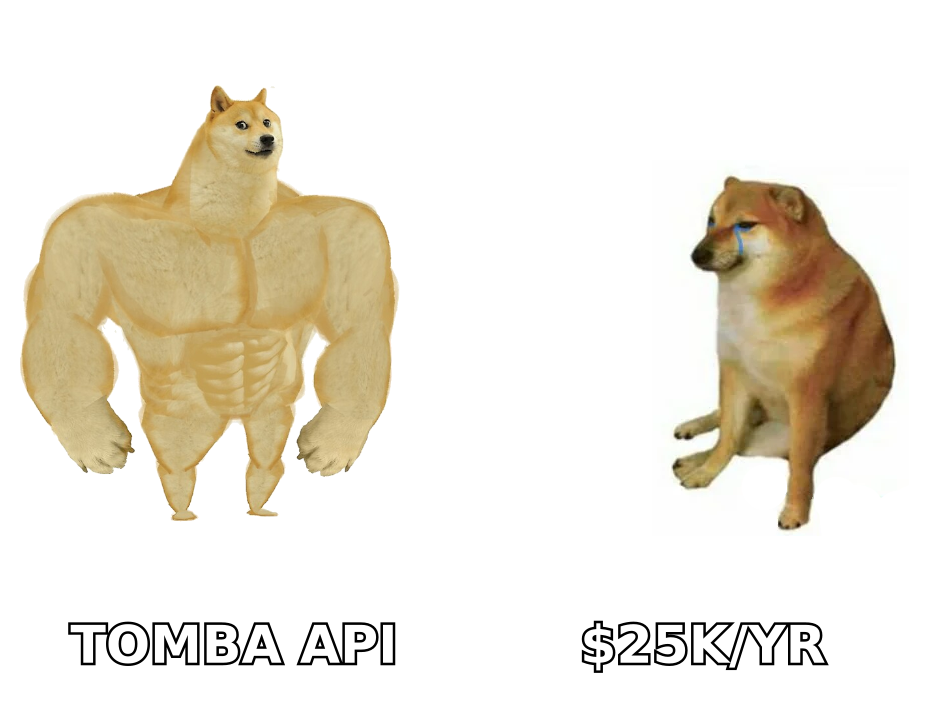
| Attribute | DiscoverOrg (now ZoomInfo) | Ocean.io | Tomba |
|---|---|---|---|
| Primary job | Contact database + go-to-market platform | Account discovery and ICP modeling | Email finding and verification |
| Core strength | Direct dials, org charts, technographics | Semantic lookalike company search | Per-domain email discovery at low cost |
| Contact volume | Very high (tens of millions) | Moderate, secondary to company data | High for work emails, no direct-dial depth |
| Company records | Large, taxonomy-driven filters | Large, semantic and website-driven | Domain-level via domain search |
| Intent data | Yes, paid add-on | Limited | No |
| Pricing model | Annual contract, seat-based + platform fee | Annual or monthly subscription tiers | Monthly self-serve, credit-based |
| Published entry price | Not published; quotes commonly five figures/yr | Not fully published; quotes vary by seats | $49/mo Starter, free tier available |
| Free tier | No (trial only, gated) | No (demo/trial, gated) | Yes — 25 searches/mo |
| Time to first value | Weeks (demo, negotiation, onboarding) | Days to weeks | Minutes |
| API access | Yes, tiered | Yes | Yes, on all paid plans |
| Best for | Enterprise SDR teams with committee sales | Niche ICPs that filters cannot describe | Teams who already know their targets |
The table makes the real answer obvious. These are not substitutes. The DiscoverOrg vs Ocean.io decision is a choice between a contact problem and a targeting problem. Most teams have both. Most teams can only fund one.
Which one has better data coverage and accuracy?#
Coverage is where DiscoverOrg vs Ocean.io stops being a brand debate. Do not take either vendor's accuracy claim at face value. Neither number can be checked without your own test. Here is a test that settles it.
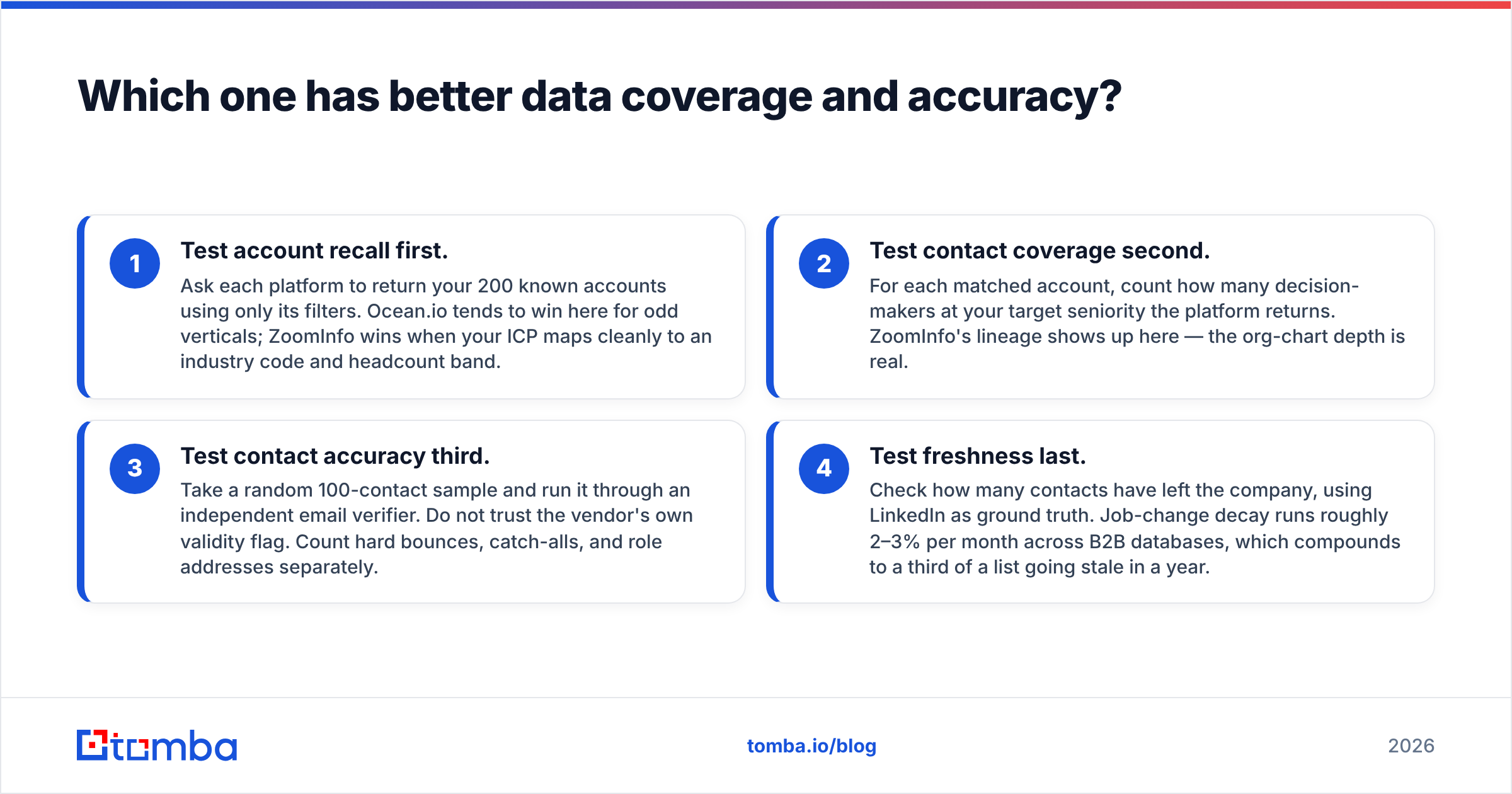
Pull 200 accounts you already know well. Closed-won and closed-lost deals from the last 18 months work best, because you already hold verified contacts in your CRM. Then run four checks.
- Test account recall first. Ask each platform to return your 200 known accounts using only its filters. Ocean.io usually wins for odd verticals. ZoomInfo wins when your ICP maps cleanly to an industry code and a headcount band.
- Test contact coverage second. For each matched account, count the decision-makers returned at your target seniority. The ZoomInfo org-chart depth is real, and it shows up here.
- Test contact accuracy third. Take a random sample of 100 contacts. Run it through an independent email verifier. Do not trust the vendor's own validity flag. Count hard bounces, catch-alls, and role addresses separately.
- Test freshness last. Check how many contacts have left the company, using LinkedIn as the source of truth. Job-change decay runs about 2–3% per month. Over a year, that stales roughly a third of a list.
Buyers who review both on G2 report the same split. ZoomInfo is strongest in North America and thinner in EMEA and APAC. Ocean.io's European coverage is better, because Europe is its home market. If you sell into Germany or the Nordics, that gap is not a rounding error.
One caveat applies to both: catch-all domains. Many enterprise mail servers accept every address at the SMTP layer. No provider can confirm that a specific mailbox exists there. A "valid" flag on a catch-all domain is a guess dressed as a fact. Run those records through a dedicated catch-all verifier before you sequence them, whatever platform sourced them.
DiscoverOrg vs Ocean.io pricing: what do they actually cost?#
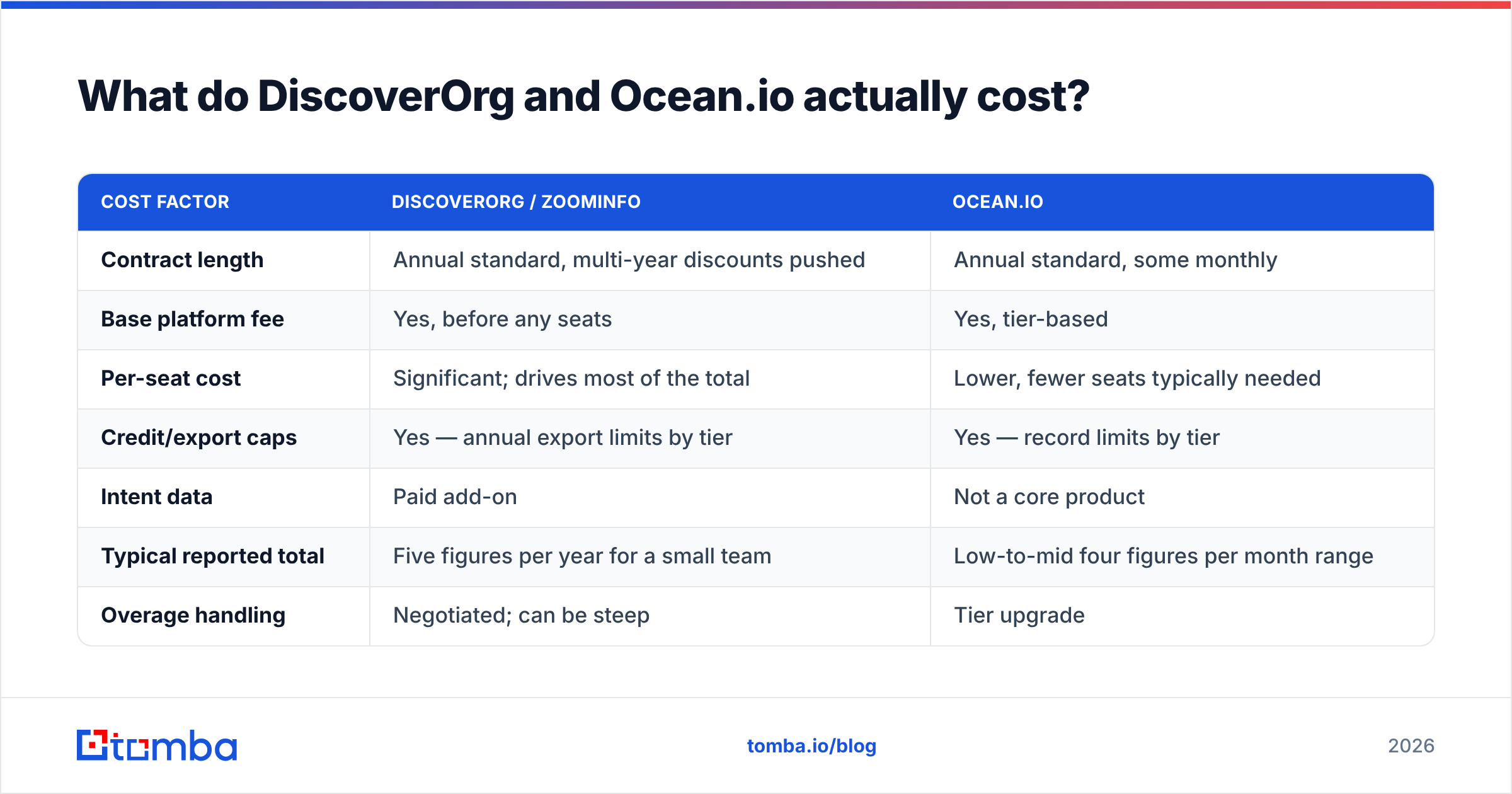
Neither vendor publishes a full price list. That is itself a data point. Here is what is publicly known and commonly reported. Quotes still vary a lot by seat count, region, and how hard you push.
| Cost factor | DiscoverOrg / ZoomInfo | Ocean.io |
|---|---|---|
| Contract length | Annual standard, multi-year discounts pushed | Annual standard, some monthly |
| Base platform fee | Yes, before any seats | Yes, tier-based |
| Per-seat cost | Significant; drives most of the total | Lower, fewer seats typically needed |
| Credit/export caps | Yes — annual export limits by tier | Yes — record limits by tier |
| Intent data | Paid add-on | Not a core product |
| Typical reported total | Five figures per year for a small team | Low-to-mid four figures per month range |
| Overage handling | Negotiated; can be steep | Tier upgrade |
| Self-serve option | No | No |
Two things burn buyers on both platforms. First, export caps. Your contract limits how many records you can pull out per year. The "unlimited search" from the demo means unlimited browsing, not unlimited downloading.
Second, auto-renewal. Read the notice window. Opt-out clauses of 30 to 60 days are standard, and missing one costs you another full year.
Now compare that to credit-based tooling. Tomba pricing starts with a free tier at 25 searches a month. Starter is $49/mo, Growth is $99/mo, and Pro is $249/mo, all self-serve.
This is not a like-for-like swap. You get no intent data and no org charts. But it reframes the question. If 80% of your work is "find and verify one email for one named person at one named company," you are paying enterprise rates for a commodity lookup.

DiscoverOrg vs Ocean.io: which is better for outbound teams?#
For classic outbound, ZoomInfo wins, and it is not close. Think SDRs working a set territory, dialing and emailing at volume. Direct dials matter. Org charts matter when you need three contacts per account. The built-in sequencer removes a tool from the stack.
For a founder-led or account-based motion, Ocean.io wins. There, the hard part is picking which 300 companies deserve attention this quarter. Hand a rep 5,000 loosely qualified accounts from a huge database and results get worse, not better. Three hundred close matches beat them, and every rep who has worked both knows it.
A quick test: ask your team where deals die. If they die at "no answer, wrong number, contact left," you have a contact-data problem. Look at ZoomInfo. If they die at "interesting, but we are not the buyer," you have a targeting problem. Ocean.io is the better spend.
When should you skip both platforms entirely?#
Skip both if any of these describe you:
- You already know your accounts. Inbound-heavy businesses, partner referrals, and event-driven pipelines build their own target lists. You need contact data on demand, not a database subscription.
- Your list-building is event-triggered. Hiring signals, funding rounds, conference lists, podcast guests. You source these outside any platform, then enrich them. That is a data enrichment workflow, not a database workflow.
- You are under 10 seats. Platform fees spread badly across small teams. Two SDRs on a $30k contract is $15k per rep before commission.
- You need one region deeply. Regional specialists often beat generalists. For US-heavy prospecting with pay-per-record pricing, BookYourData is worth quoting next to the big platforms. It sidesteps the annual commitment entirely.
- You want to test before you commit. Free tiers and credit packs let you check data quality against your own accounts before you sign anything.
How do you build a stack that uses the right layer for each job?#
The teams that get this right stop treating it as one vendor decision. They split it into three layers.
- Targeting layer — decide who to chase. Use Ocean.io if your ICP resists filters. Use your own closed-won analysis if it does not. Refresh this quarterly, not daily.
- Contact layer — get names and reachable details. ZoomInfo gives direct dials and org depth at enterprise scale. A per-credit email finder or domain search covers work emails for known targets at a fraction of the cost.
- Verification layer — never skip it. Verify every record right before you send. Bounce rate drives sender reputation, and sender reputation decides whether any of the above mattered.
Wire the layers together with an API instead of CSV exports. The Tomba API exposes its lookups directly, so enrichment can run the moment a CRM record is created. No monthly batch job for someone to forget.
The cost math tends to surprise people. A split stack usually lands cheaper than one all-in-one contract, and the data is fresher, because verification runs at send time rather than at import time.
What is the verdict on DiscoverOrg vs Ocean.io?#
Buy ZoomInfo (the DiscoverOrg lineage) if you run a real outbound team in North America. You need direct dials and org charts, you sell into buying committees, and you can absorb a five-figure annual commitment plus add-ons.
Buy Ocean.io if your market is small and hard to describe, European coverage matters, and your bottleneck is picking accounts rather than reaching people.
Buy neither if you already know who you want to reach. That is the most common situation, and it is the one both vendors would rather you did not notice.
Before you sign, run the 200-account test above against both platforms and against a cheap credit-based option. Vendors will let you sample data during an evaluation. Use it, and score the results yourself instead of trusting a slide.
If the leak in DiscoverOrg vs Ocean.io is step three — good targets, right people, unreachable inboxes — start there. The Tomba Email Finder finds professional email addresses by domain, name, or company. The free tier gives you 25 searches a month, and Starter is $49/mo. Test it on a hundred accounts you already know, compare the hit rate to the quote sitting in your inbox, and let the numbers pick the contract.
Related guides#
Ready to find emails that actually work?
Join 150,000+ professionals who stopped guessing and started sending. Free credits on signup — no credit card required.
Get the Tomba newsletter
Practical outbound tactics and product updates — once every two weeks.
About the author