DiscoverOrg vs OneMoreLead: Which B2B Data Tool Wins in 2026?
DiscoverOrg (now ZoomInfo) sells enterprise org charts at enterprise prices. OneMoreLead sells cheap bulk lists. Here's which one actually fits your team — and when neither is the right answer.
Short answer: DiscoverOrg vs OneMoreLead is a choice between depth and price. DiscoverOrg, now part of ZoomInfo, maps who reports to whom. OneMoreLead hands you cheap bulk lists. Many teams need neither. Here is how to tell which camp you are in.
TL;DR
- DiscoverOrg is not a product you can buy. It merged with ZoomInfo in 2019. Ask a vendor for "DiscoverOrg" and you get ZoomInfo SalesOS. Most deals run $15,000 to $40,000 a year.
- OneMoreLead is the cheap bet. It is a self-serve B2B list tool. Big database, published prices, no seat minimums. It is built for volume, not depth.
- They are not true rivals. ZoomInfo sells research depth: reporting lines, tech stacks, buying signals. OneMoreLead sells reach at a low price per record.
- Both go stale. Any static database decays 22-30% a year. You need a live check before you send.
- Know your targets by name? A per-lookup tool like Tomba at $49/mo beats both on cost per usable contact. It pairs fine with either one.
What happened to DiscoverOrg?#
DiscoverOrg was the first human-checked B2B contact database. Its researchers called into IT teams by hand. They mapped who reported to whom. They logged the software each team ran. They tracked when contracts came up for renewal.
In 2019, DiscoverOrg bought ZoomInfo and took its name. By 2021 the old product line sat inside ZoomInfo SalesOS.
That matters for one simple reason. Search "DiscoverOrg pricing" in 2026 and you research a product you cannot buy. What you can buy is ZoomInfo. It kept the research method and added a much larger, less hand-curated pool of data.
The DiscoverOrg DNA still shows up in three places:
- Org charts. You can see that the VP of Infrastructure reports to the CIO. You can see her three directors too. This is still the top reason big teams pay.
- Tech stacks. Which CRM, cloud host, and security tools a company runs.
- Human checks. A research team re-checks high-value records on a rolling basis. Crawlers alone do not decide.
What is OneMoreLead?#
OneMoreLead sits at the other end of the market. It is a self-serve B2B contact tool. It markets a database in the tens of millions. You filter by industry, company size, job title, and country. Then you export a CSV and load it into your sequencer.
The pitch is price per record. ZoomInfo charges contract money for depth. OneMoreLead charges list-tool money for breadth. Prices are public. Month-to-month plans exist. There is no purchase cycle to sit through.
Say a two-person agency needs 10,000 marketing directors in the US to test an offer. That is a smart buy.
The trade-off is just as clear. You get no reporting lines. You get no buying signals. You get no renewal dates. You get names, titles, companies, and contact fields. Checking them is your job.

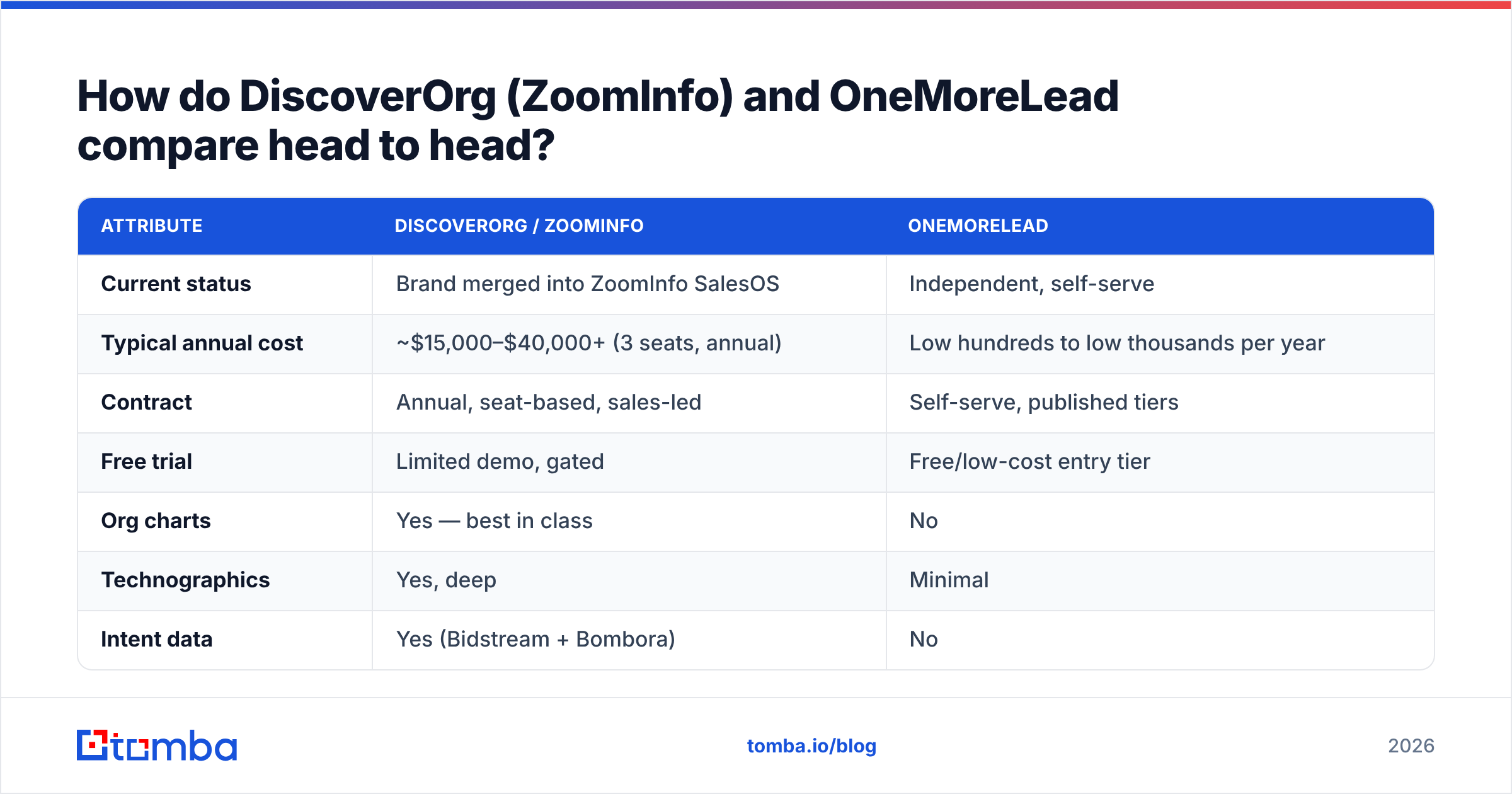
DiscoverOrg vs OneMoreLead: the head-to-head table#
| Attribute | DiscoverOrg / ZoomInfo | OneMoreLead |
|---|---|---|
| Current status | Brand merged into ZoomInfo SalesOS | Independent, self-serve |
| Typical annual cost | ~$15,000–$40,000+ (3 seats, annual) | Low hundreds to low thousands per year |
| Contract | Annual, seat-based, sales-led | Self-serve, published tiers |
| Free trial | Limited demo, gated | Free/low-cost entry tier |
| Org charts | Yes — best in class | No |
| Technographics | Yes, deep | Minimal |
| Intent data | Yes (Bidstream + Bombora) | No |
| Direct dials | Yes, large volume | Limited |
| Database size claim | 100M+ contacts | Tens of millions |
| Verification model | Research team + automated refresh | Bulk-cleaned, periodic |
| Best fit | Enterprise ABM, complex org navigation | High-volume SMB prospecting |
| Worst fit | Small teams, single-product outbound | Multi-threaded enterprise deals |
The table shows a fork, not a ranking. You pick depth per account or cost per record. Most complaints about either tool come from buyers who picked the wrong side.
Which one has better data accuracy?#
Neither vendor's headline number survives a real send. Five things decide whether a record works.
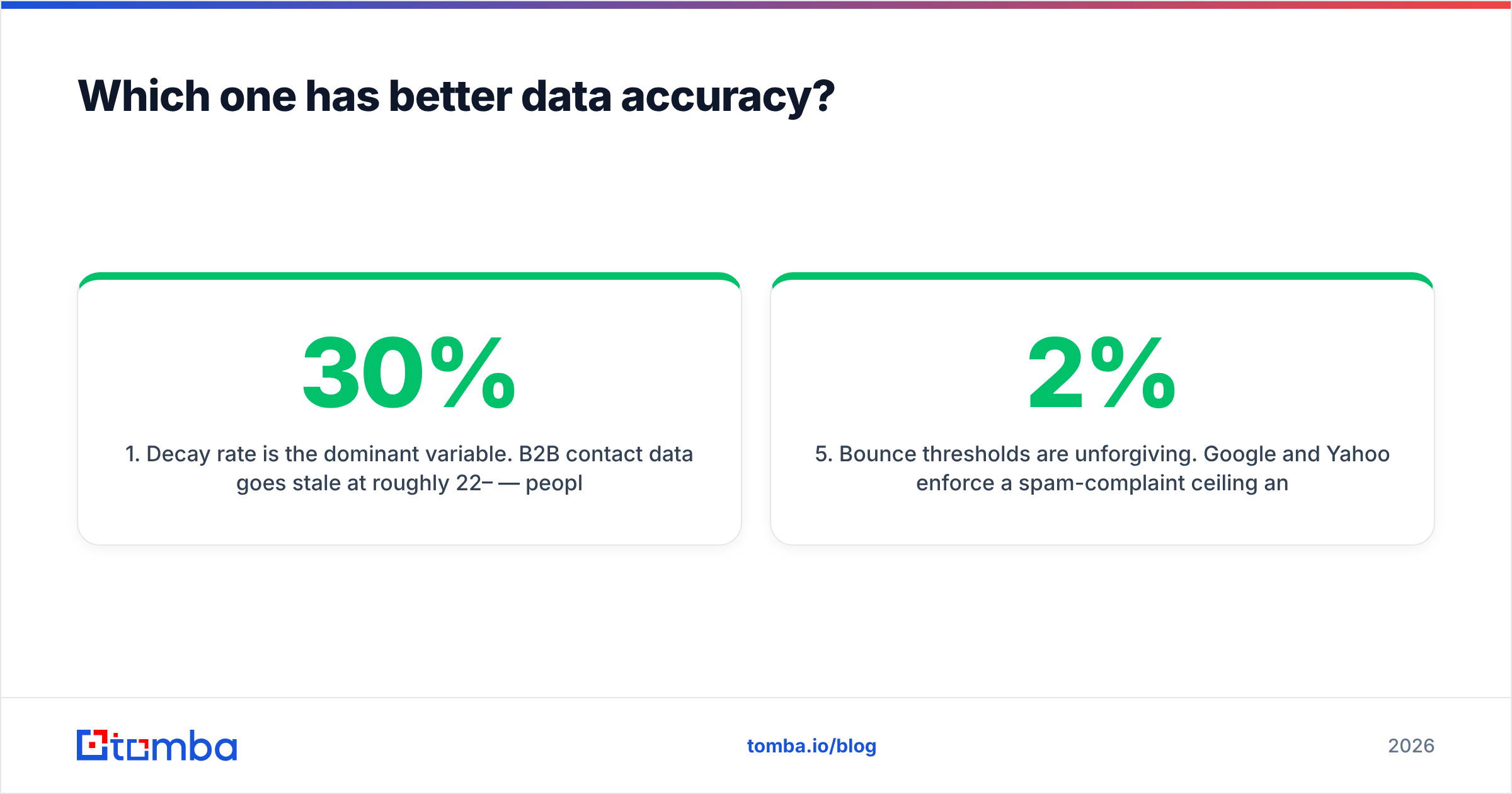
- Decay is the big one. B2B contact data rots 22-30% a year. People move jobs. Firms rebrand. Mail servers change. A database refreshed each quarter already carries 5-7% rot on export day.
- Recency beats size. Say your 500 records were last checked 14 months ago. A 20M database checked last week beats a 100M database that stale. Ask for record-level check dates, not blanket accuracy claims.
Those two points settle most DiscoverOrg vs OneMoreLead debates on their own. The next three decide how much you clean up later.
- Catch-all domains hide failures. Many company domains accept every address at the mail layer. So neither vendor can prove a mailbox exists. A catch-all verifier earns its keep here. It reads pattern confidence and side signals instead of a blunt ping.
- Role accounts pad the count.
info@,sales@, andcontact@records swell totals. They convert near zero. They also drag down your sender score. - Bounce limits are strict. Google and Yahoo cap spam complaints. Mailbox hosts punish hard-bounce rates above 2%. One bad 5,000-record import can cost you a domain.
ZoomInfo tends to win on direct dials and senior records, because a person touched them. OneMoreLead tends to win on price when you filter broadly and clean the list yourself. Both need a verification pass before the first send. Treat that as a rule, not a nice-to-have.
What does each one cost in 2026?#
ZoomInfo does not publish prices. Public deal reports and G2 reviews point to mid-five figures a year for three seats. Intent data and integrations cost extra. Credits are the hidden trap. Exports burn them. Run out mid-quarter and you get an upsell call you did not budget for.
OneMoreLead publishes tiers and sells month to month. That is the whole point of the product. Your risk is not the invoice. It is the cleaning work and the bounce exposure on records you never checked.
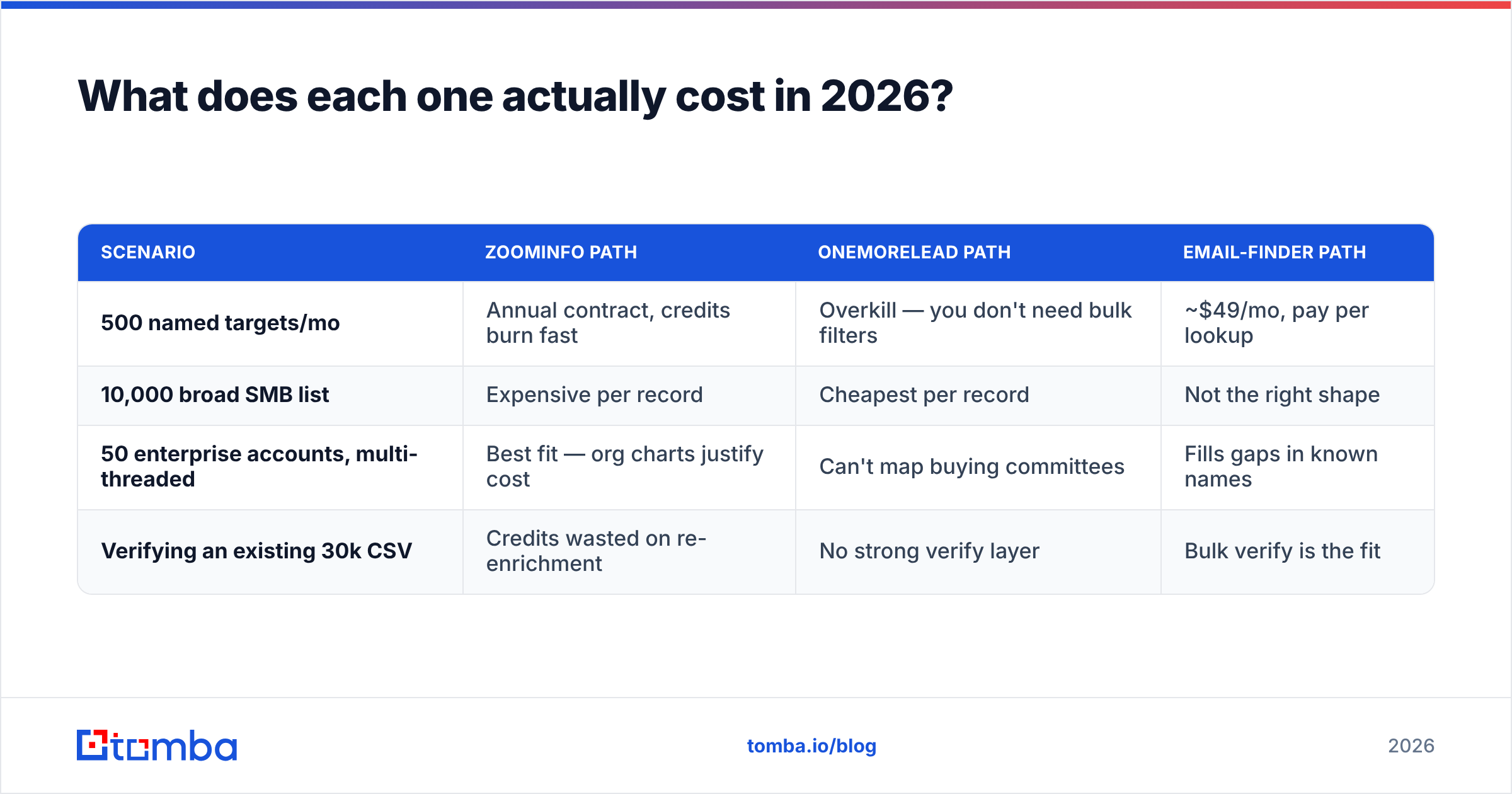
Here is the view most buyers need. What does it cost to end up with usable, verified contacts?
| Scenario | ZoomInfo path | OneMoreLead path | Email-finder path |
|---|---|---|---|
| 500 named targets/mo | Annual contract, credits burn fast | Overkill — you don't need bulk filters | ~$49/mo, pay per lookup |
| 10,000 broad SMB list | Expensive per record | Cheapest per record | Not the right shape |
| 50 enterprise accounts, multi-threaded | Best fit — org charts justify cost | Can't map buying committees | Fills gaps in known names |
| Verifying an existing 30k CSV | Credits wasted on re-enrichment | No strong verify layer | Bulk verify is the fit |
Column three is the one teams skip. Maybe you already know who you want to reach. Maybe you pulled them from LinkedIn, a conference list, or your own research. Then you are not buying a database. You are buying a lookup. That is a much cheaper product.
When is neither tool the right answer?#
Skip both if any of these fit you.
- You already have a named-account list. You need email lookup, not discovery. A domain search plus per-contact lookup covers it for far less.
- Your ICP is under 5,000 companies. Big databases charge for breadth you will never touch. You pay for 100M records to reach 4,000.
The next three tend to bite after you sign.
- Your market sits outside North America. Both lean US-heavy. For EMEA and APAC mid-market, gaps show up fast. Test a sample first.
- Compliance is a hard gate. GDPR outbound needs a lawful basis and clear source lineage. Read each vendor's data sourcing notes before you commit.
- You need contacts inside a workflow. Say enrichment should fire when a form comes in or a row lands in your CRM. An email finder API beats any export-and-import loop.

How should you build a 2026 prospecting stack?#
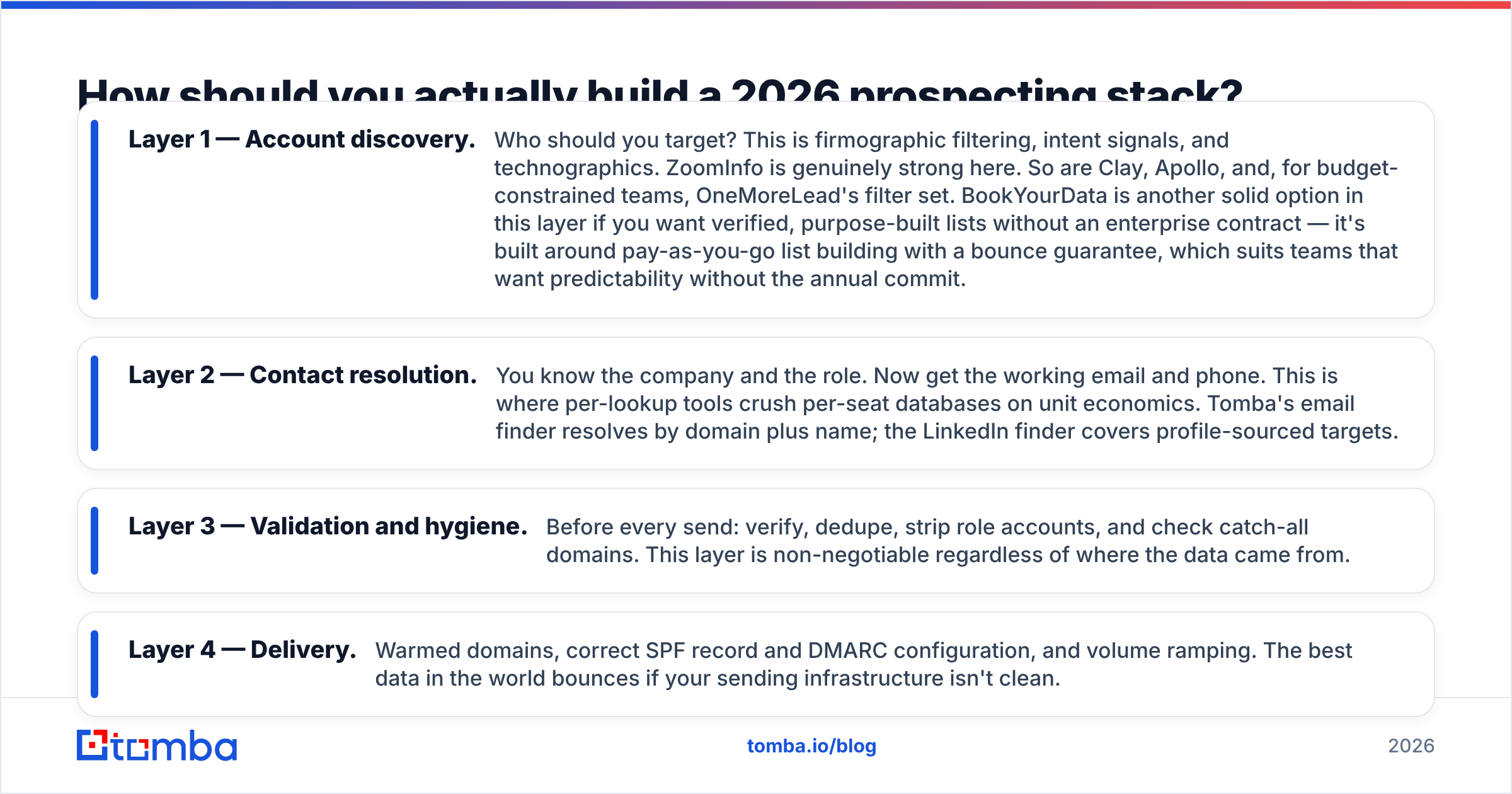
Stop asking "which database" and start thinking in layers. Teams with the best cost per meeting run four parts. No single vendor is best at all four.
- Layer 1 — Account discovery. Who should you target? This is firm data, buying signals, and tech stacks. ZoomInfo is strong here. So are Clay and Apollo. OneMoreLead's filters work for tight budgets. BookYourData is another good pick in this layer. It sells pay-as-you-go lists with a bounce guarantee, so costs stay predictable without an annual commit.
- Layer 2 — Contact resolution. You know the company and the role. Now get the work email and phone. Per-lookup tools beat per-seat databases on unit cost here. Tomba's email finder works from domain plus name. The LinkedIn finder covers profile-sourced targets.
Layers three and four are the ones buyers assume a contract covers.
- Layer 3 — Validation. Before every send: verify, dedupe, drop role accounts, and flag catch-all domains. This holds no matter where the data came from.
- Layer 4 — Delivery. Warm domains, a correct SPF record, and DMARC set up right. Ramp volume slowly. The best data still bounces if your sending setup is dirty.
A $30,000 contract does not cover all four. ZoomInfo will not fix your DNS. OneMoreLead will not tell you when a VP changes jobs.
What do reviewers say about each?#
Read public review sites, not vendor case studies. On Capterra and G2 the same themes repeat.
ZoomInfo (DiscoverOrg lineage). Praised for org charts, direct dials, and deep Salesforce sync. Faulted for hard renewal terms, credit burn, auto-renew clauses, and thin data outside US tech. The top complaint is not accuracy. It is that the contract is hard to leave.
OneMoreLead. Praised for price and speed to a first list. Faulted for bounce rates on raw exports and thin coverage in niche markets. Reviewers agree on one fix. Run every export through an outside verifier.
Both complaints point at the same missing layer. Neither product is built to be your last stop before you hit send.
The DiscoverOrg vs OneMoreLead decision rule#
Answer three questions in order.
- Do you need to map buying groups inside large accounts? If yes, budget for ZoomInfo. Push back hard on the auto-renew clause. Nothing cheaper does org charts well.
- Do you need tens of thousands of records at the lowest unit cost? Can you absorb the cleaning work? If yes, OneMoreLead or a similar list vendor is a fair buy. Fund verification from day one.
- Do you already know your targets by name? If yes, skip both. Buy lookups, not a database. This is the largest over-served group in B2B sales tooling.
Most teams weighing DiscoverOrg vs OneMoreLead sit in bucket three and miss it. They have done the ICP work. They have a target list in a spreadsheet. They shop for a database when they need 2,000 verified emails this month.
Ready to test the cheapest path first?#
Run the control test before you sign anything. Take 100 target contacts you already want. Pull the names and companies from your ICP list. Then resolve their work emails with the Tomba Email Finder. The free tier gives you 25 searches to check accuracy. Paid plans start at $49/mo, and Growth runs $99/mo. Both are listed on the Tomba pricing page. Measure connect rate and bounce rate against what the demo promised.
If that covers your pipeline need, you just saved five figures. If it does not, you still learn something. Maybe you truly need org charts and intent data across hundreds of accounts. Then you walk into the ZoomInfo talk knowing the exact gap you pay to close. That beats buying on a demo.
Related guides#
Ready to find emails that actually work?
Join 150,000+ professionals who stopped guessing and started sending. Free credits on signup — no credit card required.
Get the Tomba newsletter
Practical outbound tactics and product updates — once every two weeks.
About the author