DiscoverOrg vs PrivCo (2026): Which B2B Data Tool Wins?
DiscoverOrg (now ZoomInfo) sells org charts and direct dials. PrivCo sells private-company financials. They barely overlap — and picking wrong costs you five figures a year.
DiscoverOrg vs PrivCo is a common search. It is also the wrong fight. One tool finds people to call. The other sizes up private firms. Here is which one fits your job — and when neither does.
TL;DR
- DiscoverOrg is gone as a standalone product. It merged with ZoomInfo in 2019. The brand now sits inside ZoomInfo SalesOS. Buy "DiscoverOrg" today and you sign a ZoomInfo contract.
- PrivCo is not a sales tool. It is a research database for private firms: revenue, funding, owners, deal history. Its users are bankers, PE teams, and corp dev — not SDRs.
- The two fight for budget, not for jobs. A feature-by-feature check steers you wrong. Ask one question. Do you need who to call or how big is this firm?
- Both cost a lot, and both want a year up front. ZoomInfo runs $15K–$40K a year for a small team. PrivCo starts near $2.4K a year for one seat.
- Most teams in the DiscoverOrg vs PrivCo debate only need contact data. If that is you, an email finder at $49/mo does the job for far less.
Why do people compare DiscoverOrg vs PrivCo at all?#
Both sit in the same "B2B data" bucket on G2. Both show up when a RevOps lead hunts for a private company database.
That is where it ends. DiscoverOrg answers one question: who owns the buying call here, and what is their direct dial? PrivCo answers a different one: what does this private firm earn, who backed it, and what is it worth?
One is a sales tool. The other is a research desk. Mix them up and you find out three months into a one-year deal.
The name confuses people too. DiscoverOrg bought ZoomInfo in 2019. It kept the ZoomInfo name and dropped its own. The good parts stayed. Verified org charts, tech stack data, and hand-checked contacts now live in ZoomInfo. So DiscoverOrg vs PrivCo in 2026 really means ZoomInfo contact data vs PrivCo financials.

What does DiscoverOrg (now ZoomInfo) actually give you?#
Human checks were the edge. Rivals scraped and guessed. DiscoverOrg paid people to phone firms and confirm the facts. That is why large sales teams paid up.
Here is what you get today under ZoomInfo:
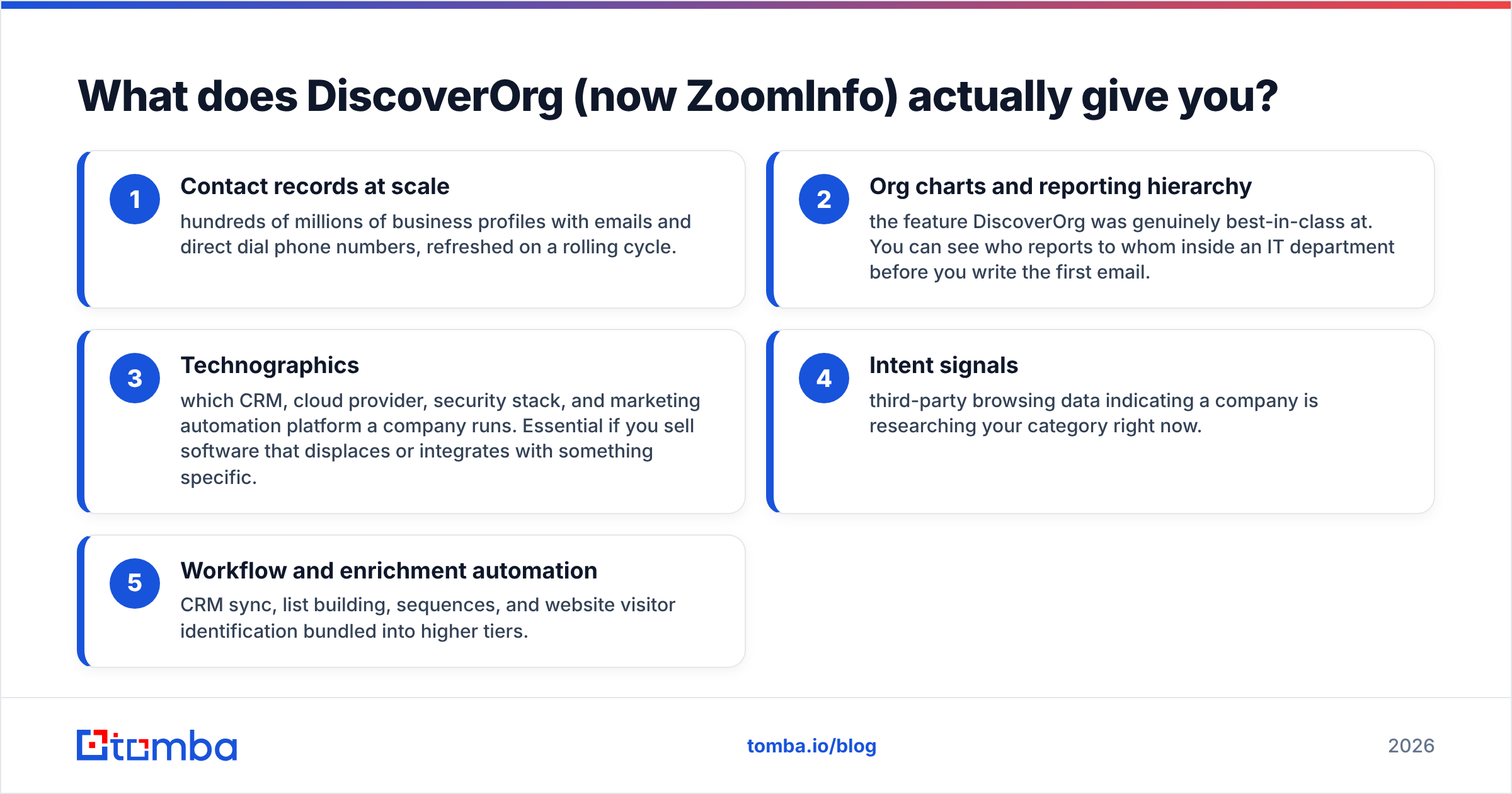
- Contacts at scale — hundreds of millions of profiles, with emails and direct dials. Records refresh on a rolling cycle.
- Org charts — the old DiscoverOrg star feature. You can see who reports to whom before you write a word.
- Tech stack data — the CRM, cloud, and security tools a firm runs. Key if your product swaps one out.
- Intent signals — third-party data that flags firms reading up on your category.
- Workflow tools — CRM sync, list building, sequences, and site visitor ID on higher tiers.
The gap is easy to guess at this size. Coverage leans hard toward North American tech. Sell to small firms in Europe, or to plants and shops? Hit rates drop. The bill does not.
What is PrivCo and who is it built for?#
PrivCo tracks private firms. These firms skip SEC filings. So they show up bare in Bloomberg or CapIQ. PrivCo builds revenue estimates, logs funding rounds, maps owners, and tracks M&A.
Its core users:
- Bankers who source targets and build comps.
- PE and VC teams who screen firms by revenue band.
- Corp dev teams who build buy lists.
- Sales teams with big deal sizes, where revenue is the gate. Think ERP, fractional CFOs, or business insurance.
That last group is the one real overlap in the DiscoverOrg vs PrivCo debate. Say your buyers are US private firms at $10M–$100M. PrivCo finds them. DiscoverOrg tells you who to call. They pair well. They do not swap.
One honest limit. Revenue for quiet private firms is an estimate. Some come from filings, press, or the firm itself, and those hold up. Others are modeled. Read them as a signal, not as audited books.
How do DiscoverOrg and PrivCo compare head to head?#
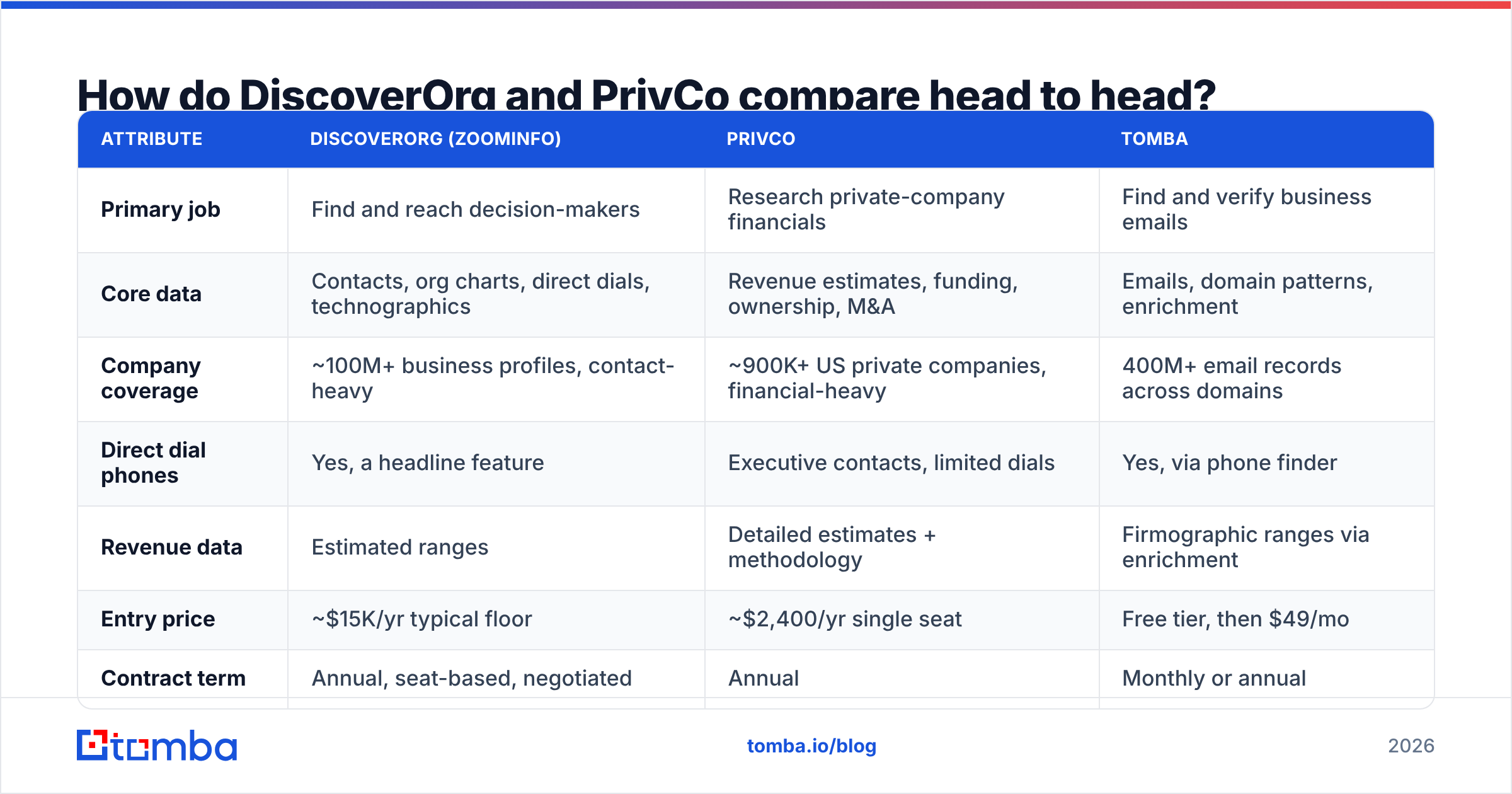
| Attribute | DiscoverOrg (ZoomInfo) | PrivCo | Tomba |
|---|---|---|---|
| Primary job | Find and reach decision-makers | Research private-company financials | Find and verify business emails |
| Core data | Contacts, org charts, direct dials, technographics | Revenue estimates, funding, ownership, M&A | Emails, domain patterns, enrichment |
| Company coverage | ~100M+ business profiles, contact-heavy | ~900K+ US private companies, financial-heavy | 400M+ email records across domains |
| Direct dial phones | Yes, a headline feature | Executive contacts, limited dials | Yes, via phone finder |
| Revenue data | Estimated ranges | Detailed estimates + methodology | Firmographic ranges via enrichment |
| Entry price | ~$15K/yr typical floor | ~$2,400/yr single seat | Free tier, then $49/mo |
| Contract term | Annual, seat-based, negotiated | Annual | Monthly or annual |
| Free trial | Demo-gated | Limited free search | 25 free searches/mo |
| API access | Enterprise tier add-on | Higher tiers only | All paid plans |
| Best for | Enterprise SDR teams in tech | Bankers, PE, corp dev | Any team that needs verified emails |
Read that table with one question in mind. Which column matches your reason to buy? "We need more meetings" rules out the middle column. "We need to screen 4,000 private targets by revenue" rules out the left one.
What do these tools actually cost in 2026?#
Neither firm posts list prices. That tells you something on its own. Here is what buyers report.
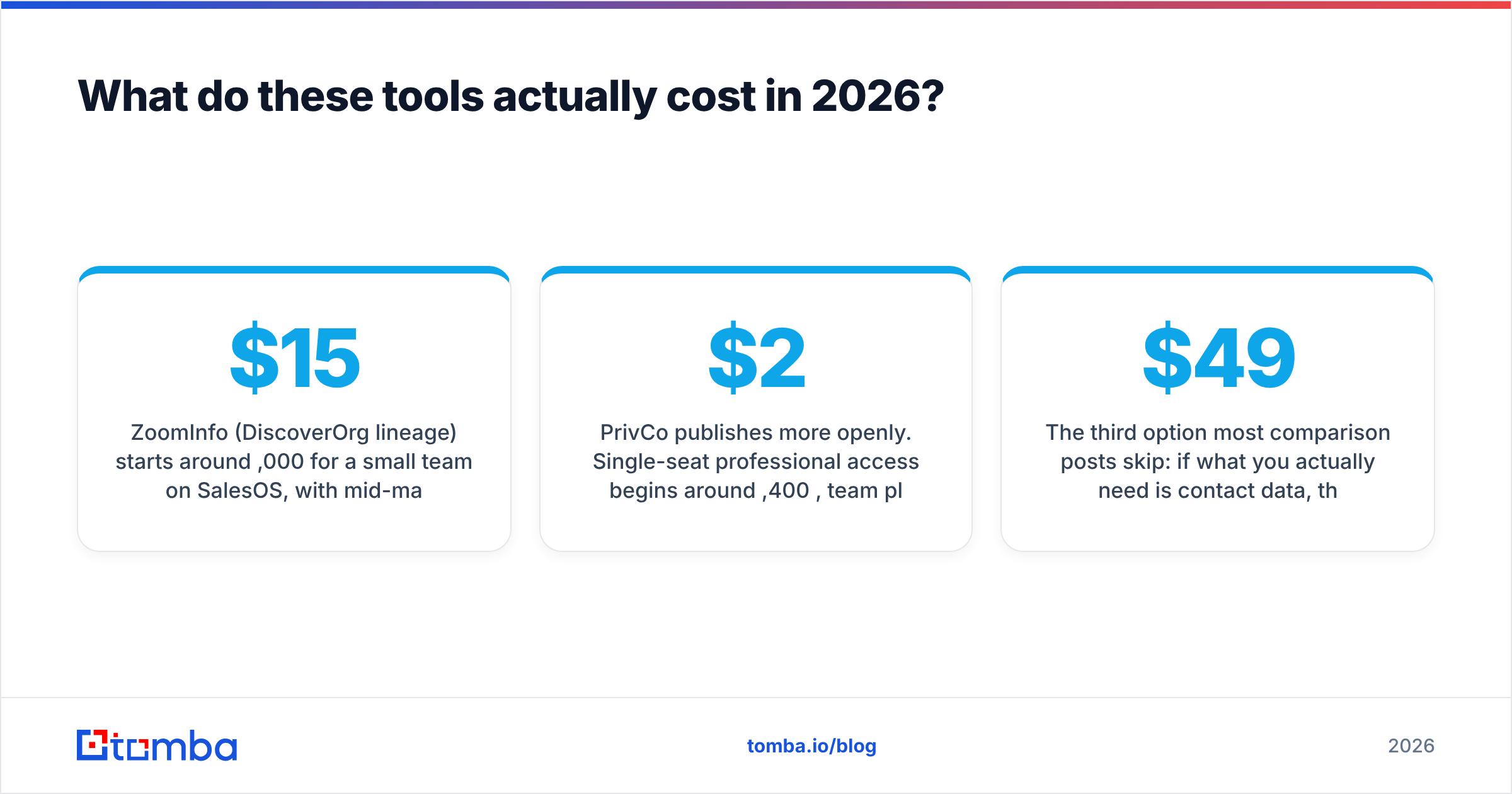
ZoomInfo (the DiscoverOrg line) starts near $15,000 a year for a small team on SalesOS. Mid-market deals land between $25,000 and $40,000. Intent data, extra credits, and more seats drive that jump.
Credits are metered. Exports, enrichment, and bulk jobs all draw from one pool. The overage talk tends to hit in month nine. Deals renew on their own unless you send written notice. Scan G2 reviews and renewal terms top the gripe list, well ahead of data quality.
PrivCo is more open. One pro seat starts near $2,400 a year. Team plans reach five figures. API and bulk export sit at the top tier. For a two-person corp dev team, that is a rounding error against one deal. For a floor of 12 reps it makes no sense. PrivCo is not built or priced per rep.
The third option most comparison posts skip: contact data alone costs far less. Tomba pricing starts free at 25 searches a month. Starter is $49/mo, Growth $99/mo, Pro $249/mo. Every paid plan includes the API. There is no year-long deal to sign. That is roughly what one ZoomInfo seat costs per week.

Which one should you buy for your use case?#
Match the tool to the job, not to the category.
- You run an SDR team selling software to US mid-market. ZoomInfo holds up, if the budget does. Its org charts and intent data have no cheap twin. Push back on credits. Put the notice date in your calendar on day one.
- You source private M&A targets. PrivCo, with no real debate. No sales tool models private revenue this deeply. Add a contact tool once the list is short.
- You sell services gated by company revenue. Build the list in PrivCo. Then use a cheap contact layer to find the people. ZoomInfo for that second step is overkill.
- You are a startup, agency, or lean team that needs emails. Neither. Use a fast domain search plus an email verifier. Spend the saved $20K on sending and copy.
- You need Europe, APAC, or non-tech coverage. Test both on a real list first. Both lean US. Vendor stats rarely match your slice.
What are the realistic alternatives to both?#
The DiscoverOrg vs PrivCo frame assumes two costly annual deals are your only choice. In 2026 the market is far more split up than that.
For contact data: Apollo, Lusha, Cognism, RocketReach, and Tomba each sell a slice of the old bundle. Have the company list already? Then a full ZoomInfo seat can cost 10–50x too much. See the Apollo alternative and RocketReach alternative notes for a like-for-like on credits and accuracy.
For verified lists by vertical: BookYourData works well when you want to buy a ready-made list by industry and title. It is a different buying model. It suits one-off campaigns.
For private-company financials: PitchBook and Crunchbase Pro both overlap with PrivCo. PitchBook goes deeper on deal flow and costs much more. Crunchbase is broad on funded startups but thin on the rest.
For enrichment in your own stack: maybe your CRM holds the accounts and you just need the gaps filled. Data enrichment by API costs a fraction of a seat. Nobody has to learn a new tool.
How should you actually run the evaluation?#
Skip the polished demo data. Run this test instead. It takes under a week.
- Export 200 real accounts from your CRM. Use your true ICP. Keep the messy rows.
- Ask each vendor to enrich that exact file during the trial. A refusal is an answer about coverage.
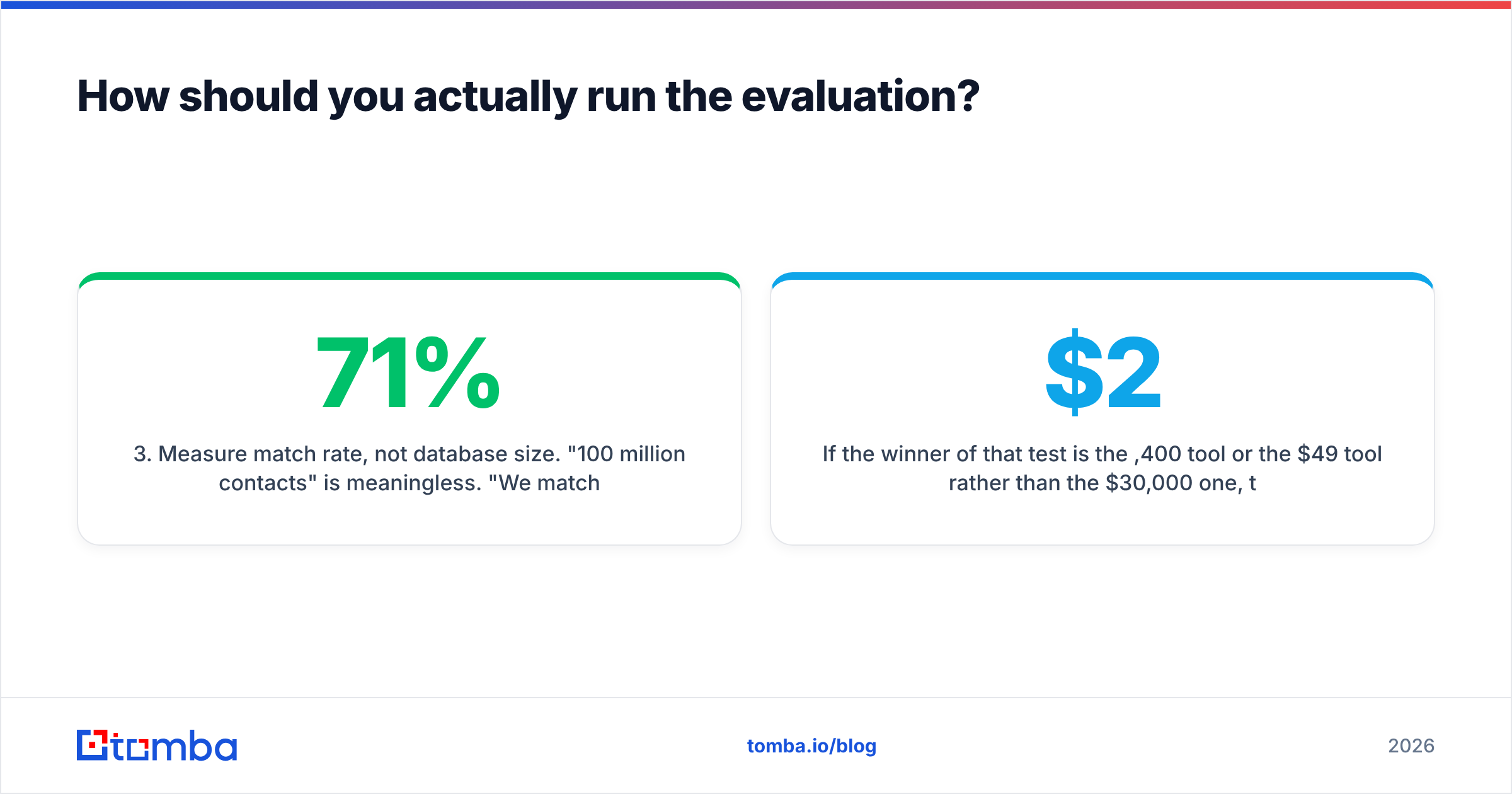
- Measure match rate, not database size. "100 million contacts" means nothing. "We matched 71% of your 200 accounts" predicts your pipeline.
- Check a sample yourself. Run 50 returned emails through a neutral free email checker before you trust the vendor score.
- Price the real workflow. Multiply your monthly export volume by credit cost. The seat price is not the bill.
- Read the renewal clause first. Auto-renew with 60-day notice is the norm here. It is where buyer regret starts.
If the $2,400 tool or the $49 tool wins that test, it is a real result. It does not mean you tested wrong.
The verdict#
DiscoverOrg vs PrivCo is a false choice for most buyers. DiscoverOrg now lives inside ZoomInfo. It serves large SDR teams that need org charts, dials, and intent data — and can pay for them. PrivCo serves researchers who need private revenue and owner data. That data is hard to find elsewhere at this depth. Few firms need both. Plenty need neither.
Get honest about the job before you sign. Say the job is "reach the right people at firms we already know." That is a contact data problem, not a platform problem. And contact data costs a hundred times less.
Start with the cheap test. Run your target domains through the Tomba Email Finder on the free tier. That is 25 searches a month, no card, no demo call. Does the match rate hold on your own list? Then you just settled DiscoverOrg vs PrivCo by needing neither. If it does not hold, you walk into those vendor calls with a real number. That beats a sales deck, and it makes the price talk much easier.
Related guides#
Ready to find emails that actually work?
Join 150,000+ professionals who stopped guessing and started sending. Free credits on signup — no credit card required.
Get the Tomba newsletter
Practical outbound tactics and product updates — once every two weeks.
About the author