DiscoverOrg vs ProsperFleet Valgen: 2026 Data Comparison
DiscoverOrg is now ZoomInfo, and ProsperFleet Valgen is the kind of niche vendor that never publishes a price. Here is how the two actually compare on coverage, contracts, and accuracy — and when neither is the right buy.
TL;DR
- DiscoverOrg no longer exists as a standalone product. It merged with ZoomInfo in 2019 and the brand was folded into the ZoomInfo platform — so when a rep pitches you "DiscoverOrg," you are buying ZoomInfo.
- ProsperFleet Valgen sits at the opposite end: a small, quote-only B2B data vendor with almost no public documentation, pricing page, or independent review volume. That is a risk, not automatically a dealbreaker.
- The real difference is not data quality on a slide. It is contract shape: enterprise seat-and-credit annual commitments versus a smaller vendor whose renewal leverage and data refresh cadence you cannot verify from the outside.
- Most teams comparing these two do not need either. If your actual job is "get verified work emails for a list of companies," a per-credit email finder does the same job for a fraction of the spend.
- Run the same 200-record accuracy test against both before you sign anything. Vendor-published accuracy numbers are marketing, not measurement.
Who are DiscoverOrg and ProsperFleet Valgen?#
Short answer: one is a legacy enterprise brand that got absorbed, the other is a niche vendor that never got big. Comparing them head-to-head only makes sense if you understand that asymmetry first.
DiscoverOrg launched in 2007 as a human-verified org-chart and technographic database aimed squarely at enterprise IT sales. Its selling point was never volume — it was depth: named IT decision-makers, reporting lines, installed technology, budget cycles. Researchers called companies and confirmed records by phone. That made it expensive and slow to scale, but genuinely differentiated in a market full of scraped lists.
In February 2019, DiscoverOrg acquired ZoomInfo and later took the ZoomInfo name for the combined company, which went public in 2020. The DiscoverOrg product line was progressively merged into the ZoomInfo platform. Today "DiscoverOrg" is effectively a legacy label — you will still see it in old comparison posts, old contracts, and old RFPs, but the buying motion is ZoomInfo's.
ProsperFleet Valgen is a different animal. It shows up in vendor directories and procurement shortlists as a B2B contact-and-account data provider, typically positioned around enriched account intelligence for mid-market outbound teams. What it does not have is a public pricing page, a large independent review corpus, or a documented refresh methodology. Be blunt about that when you evaluate it: absence of public evidence is not proof of bad data, but it does shift all the verification burden onto you.
That asymmetry drives everything below. With ZoomInfo/DiscoverOrg you are negotiating against a well-documented, heavily-reviewed incumbent. With ProsperFleet Valgen you are underwriting an unknown, which means your trial has to be more rigorous, not less.
What does DiscoverOrg (now ZoomInfo) actually sell in 2026?#
You are buying a platform, not a database lookup. That distinction is where most of the cost lives.
The modern stack bundles a contact and company database, intent signals, a Chrome extension, CRM sync, conversation intelligence, and — increasingly — sequencing and dialer modules. Pricing is quote-based and typically structured as an annual commitment with a per-seat license plus a bucket of export credits. Credits are the part that bites: teams routinely burn their annual allocation in five months and pay overage or upgrade mid-term.
Real strengths that survive scrutiny:
- Org-chart depth in enterprise IT. The DiscoverOrg research heritage is still visible in how well large-account hierarchies and reporting lines are mapped. If you sell six-figure deals into IT departments, that context is worth money.
- Direct dials. Mobile and direct-line coverage is a genuine differentiator versus tools that only return emails.
- Intent data. Topic-level intent from a large publisher co-op, wired into your CRM, is hard to replicate cheaply.
- Integration surface. Native, mature connectors into Salesforce, HubSpot, Outreach and Salesloft — not webhook duct tape.
Real weaknesses, equally documented across public review sites:
- Contract rigidity. Annual terms, auto-renew clauses, and seat minimums are the top complaint theme in sales intelligence reviews on G2.
- Credit anxiety. Reps ration exports instead of prospecting freely, which quietly defeats the point.
- Decay outside the core. Coverage of small companies, non-US markets, and non-tech verticals is noticeably thinner than the enterprise-IT core.
- Overbuying. Most teams license modules they never activate.

What is ProsperFleet Valgen and who is it for?#
Treat it as a challenger you must verify yourself. The pitch for vendors in this tier is usually the same three things: cheaper than the incumbent, more flexible contracts, and a human on the other end of the support email who actually replies. Those are real advantages when they hold.
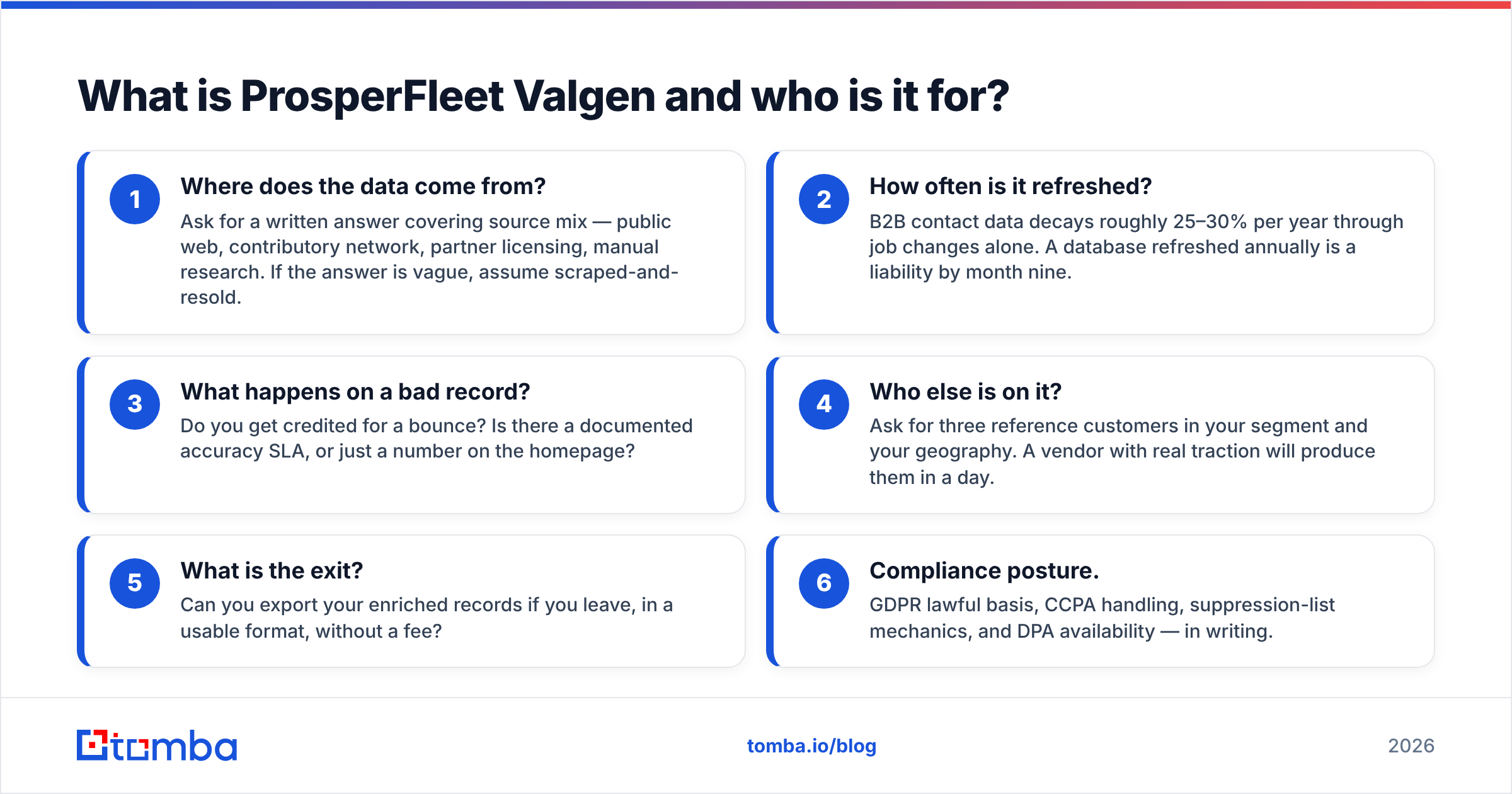
The evaluation questions that matter, in order:
- Where does the data come from? Ask for a written answer covering source mix — public web, contributory network, partner licensing, manual research. If the answer is vague, assume scraped-and-resold.
- How often is it refreshed? B2B contact data decays roughly 25–30% per year through job changes alone. A database refreshed annually is a liability by month nine.
- What happens on a bad record? Do you get credited for a bounce? Is there a documented accuracy SLA, or just a number on the homepage?
- Who else is on it? Ask for three reference customers in your segment and your geography. A vendor with real traction will produce them in a day.
- What is the exit? Can you export your enriched records if you leave, in a usable format, without a fee?
- Compliance posture. GDPR lawful basis, CCPA handling, suppression-list mechanics, and DPA availability — in writing.
If ProsperFleet Valgen answers all six clearly, it is a legitimate option for a mid-market team that finds ZoomInfo's contract shape unworkable. If it dodges two or more, walk. The same test applies to every boutique data vendor you will ever shortlist, which is why it is worth writing down once.
DiscoverOrg vs ProsperFleet Valgen: how do they compare?#
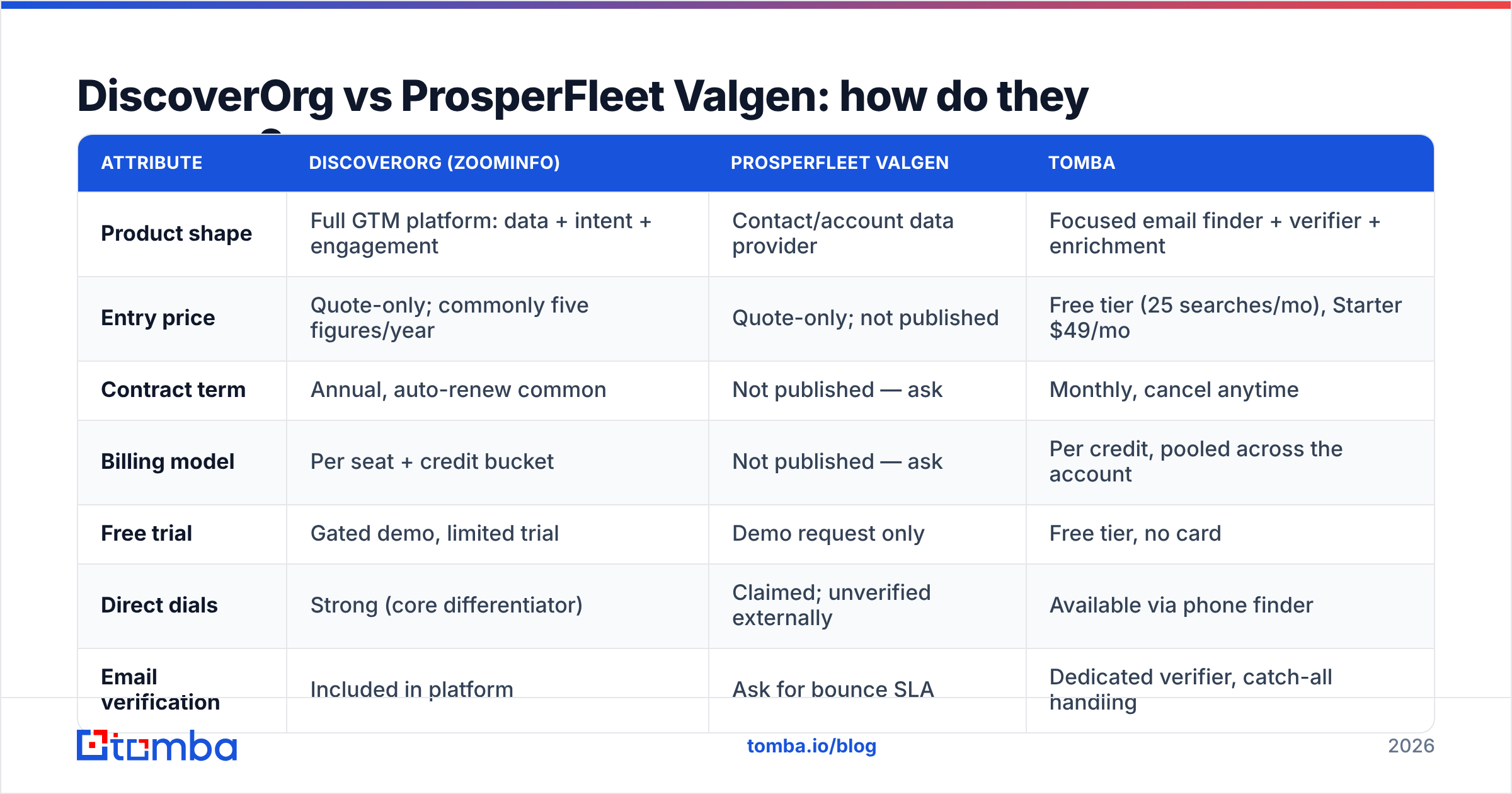
Here is the honest side-by-side. Where a vendor does not publish a figure, this table says so rather than inventing one — and a third column shows what a focused, per-credit tool costs for the same core job.
| Attribute | DiscoverOrg (ZoomInfo) | ProsperFleet Valgen | Tomba |
|---|---|---|---|
| Product shape | Full GTM platform: data + intent + engagement | Contact/account data provider | Focused email finder + verifier + enrichment |
| Entry price | Quote-only; commonly five figures/year | Quote-only; not published | Free tier (25 searches/mo), Starter $49/mo |
| Contract term | Annual, auto-renew common | Not published — ask | Monthly, cancel anytime |
| Billing model | Per seat + credit bucket | Not published — ask | Per credit, pooled across the account |
| Free trial | Gated demo, limited trial | Demo request only | Free tier, no card |
| Direct dials | Strong (core differentiator) | Claimed; unverified externally | Available via phone finder |
| Email verification | Included in platform | Ask for bounce SLA | Dedicated verifier, catch-all handling |
| API access | Enterprise tiers | Not documented publicly | On all paid plans |
| Best fit | Enterprise IT sales, ABM at scale | Mid-market teams wanting a cheaper contract | Teams that need verified emails, not a platform |
| Main risk | Overbuying and credit lock-in | Unverifiable data provenance | Not a full engagement platform |
Read that table twice. The two named vendors differ mostly on procurement risk, not on capability claims — because capability claims from a quote-only vendor are unverifiable until you run data through them.
Which one has better data accuracy?#
Nobody can answer that for you from the outside, and any post that claims to is guessing. What you can do is measure it in an afternoon.
Build a 200-record control list before you talk to either vendor. Pick companies you already know: 100 in your ICP core, 50 adjacent, 50 deliberately awkward (non-English domains, sub-20-employee firms, recently acquired companies). Then request the same 200 from each vendor and score four things:
- Match rate. What percentage returned a contact at all? Enterprise tools often win here on paper because they return something for nearly everything.
- Verified rate. Of the returned emails, how many pass an independent email verifier? Run this through a third party, not through the vendor's own checker — grading your own homework is not a benchmark.
- Role accuracy. Is the person still in the role the record claims? Spot-check 30 against LinkedIn. This is where stale databases fall apart.
- Bounce reality. Send 50 real emails per vendor from a warmed domain and count hard bounces. That number is the only one that touches your sender reputation.
A vendor claiming 95% accuracy that delivers a 71% verified rate on your awkward segment is not lying, exactly — it is quoting a global average that does not describe your ICP. Averages hide the segments where you actually sell.
One more thing the test reveals: catch-all domains. A large share of B2B domains accept all mail, so a naive verifier marks them "valid" and a naive vendor counts them as a win. Check how each provider handles catch-alls specifically — a proper catch-all verifier distinguishes a deliverable catch-all from a coin flip, and the difference shows up directly in your bounce rate.
How does pricing really work for quote-only vendors?#
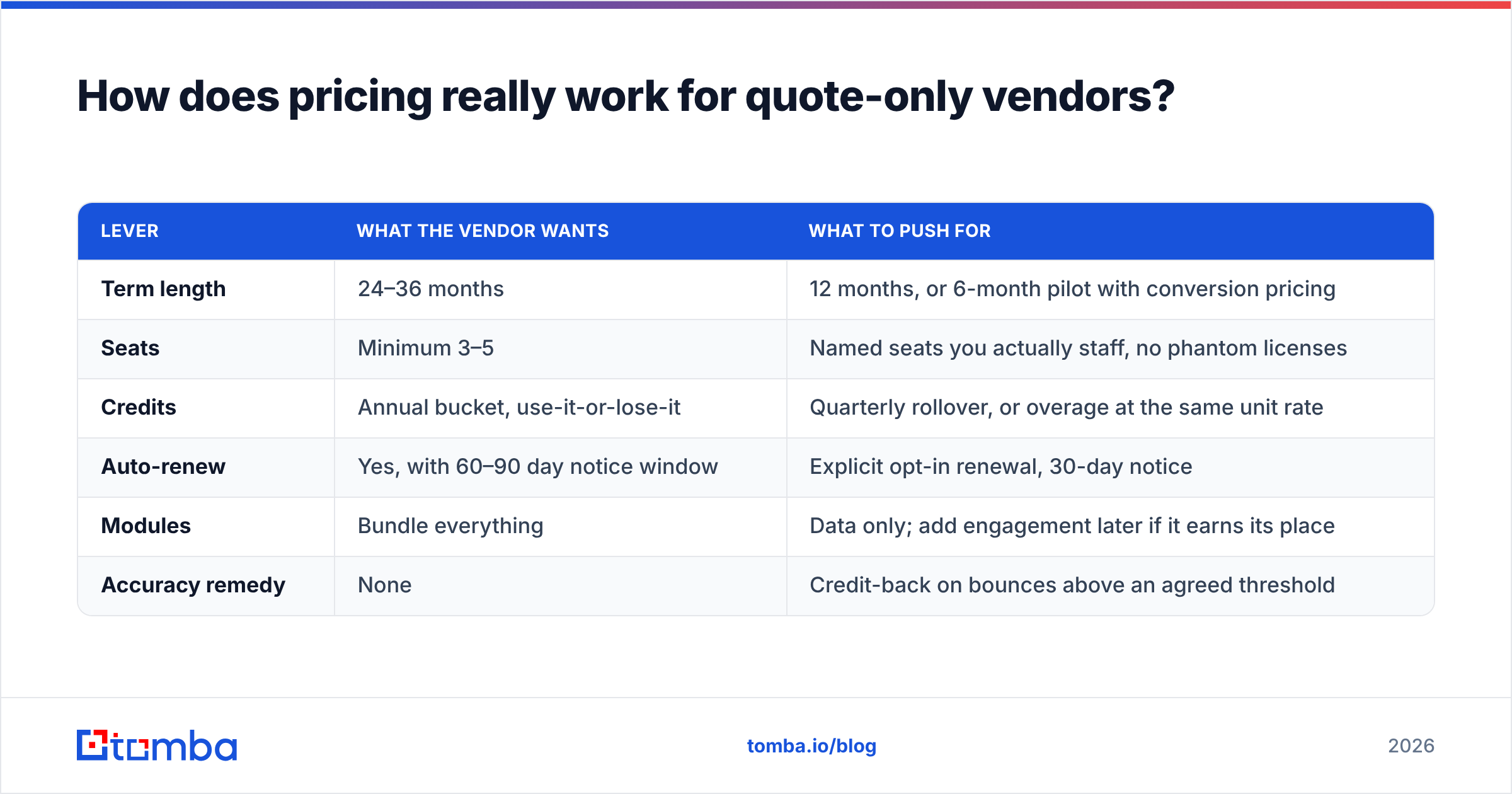
Assume the first number is not the number. Quote-based B2B data pricing has predictable levers, and knowing them is worth more than any comparison chart.
| Lever | What the vendor wants | What to push for |
|---|---|---|
| Term length | 24–36 months | 12 months, or 6-month pilot with conversion pricing |
| Seats | Minimum 3–5 | Named seats you actually staff, no phantom licenses |
| Credits | Annual bucket, use-it-or-lose-it | Quarterly rollover, or overage at the same unit rate |
| Auto-renew | Yes, with 60–90 day notice window | Explicit opt-in renewal, 30-day notice |
| Modules | Bundle everything | Data only; add engagement later if it earns its place |
| Accuracy remedy | None | Credit-back on bounces above an agreed threshold |
End-of-quarter matters more with enterprise vendors than with small ones — a January quote and a December quote for identical scope can differ by a third. With a boutique vendor like ProsperFleet Valgen, the flexibility usually shows up in term length instead of headline price, so trade there.
And run the math per useful record, not per month. A $30,000 annual contract that yields 8,000 verified, in-ICP, still-employed contacts costs $3.75 per usable record. A $99/mo plan yielding 5,000 verified emails costs $0.24. Those are different businesses, and the expensive one only wins if intent data and direct dials are genuinely closing deals for you — not just sitting in a tab.

Is a full data platform overkill for your team?#
For most outbound teams under 20 reps, yes — and this is the part vendors never say out loud.
Ask what job you are actually hiring the tool to do. If the honest answer is "take a list of target companies and give me verified work emails for the right people," you are buying a Ferrari to fetch groceries. Platform value comes from intent, org charts, conversation intelligence, and CRM-wide workflow. If your team is not operationally mature enough to act on intent signals within 48 hours, that module produces nothing but a dashboard.
The lean alternative stack looks like this:
- Company list — from your CRM, a B2B database, or a conference exhibitor page.
- Contact discovery — domain search to pull the people at each company, filtered by department and seniority.
- Email resolution — an email finder to resolve name plus domain into a real address, with the email pattern inferred per company.
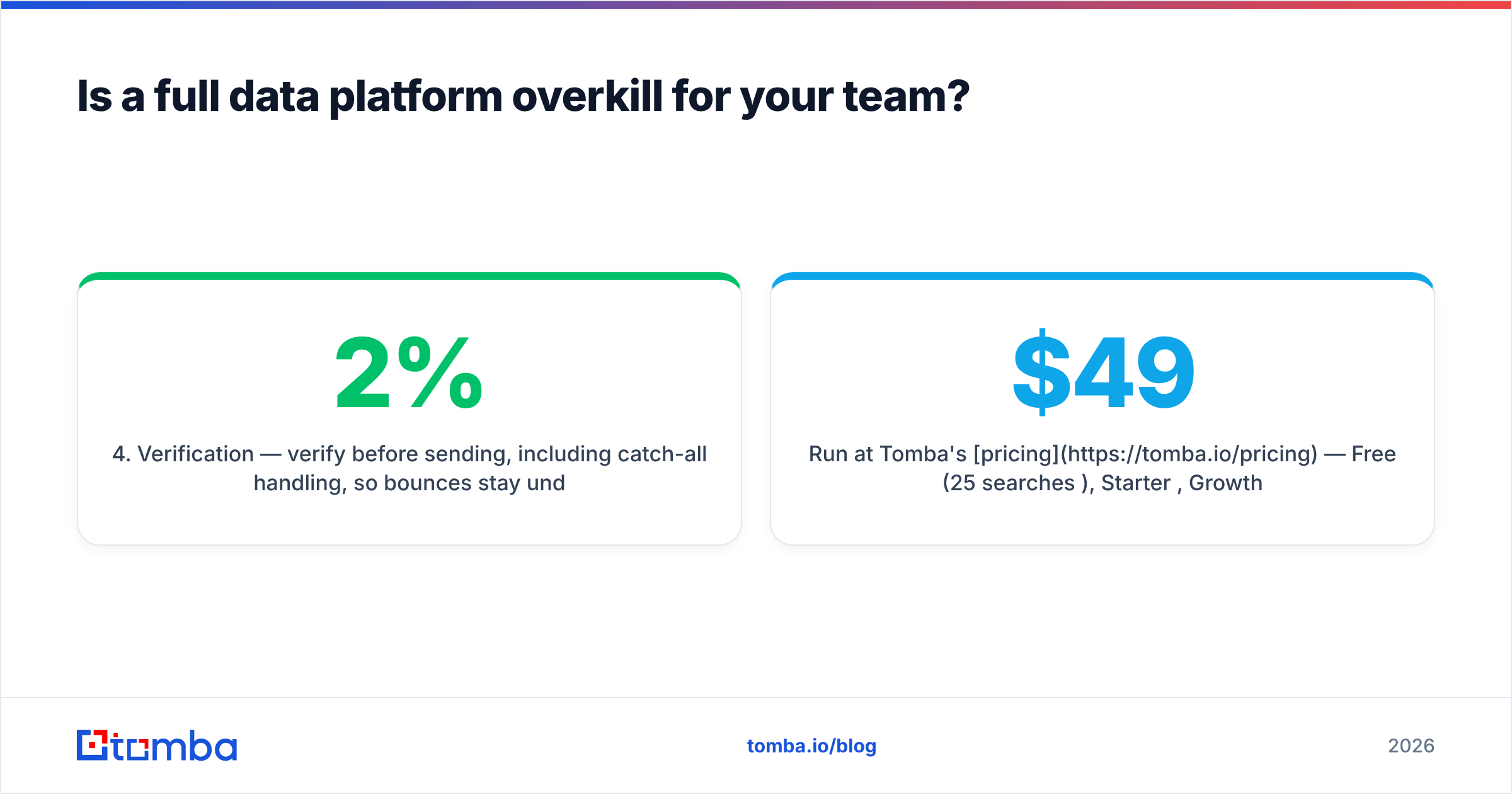
- Verification — verify before sending, including catch-all handling, so bounces stay under 2%.
- Enrichment — data enrichment to fill in title, company size, and social profiles for personalization.
- Delivery — your existing sequencer. You almost certainly already pay for one.
Run at Tomba's pricing — Free (25 searches/mo), Starter $49/mo, Growth $99/mo, Pro $249/mo — that whole stack costs less per year than a single enterprise seat, with monthly terms. The tradeoff is real and worth stating plainly: you do not get intent data, you do not get org charts, and you do not get a dedicated CSM. If those three things drive your pipeline, pay for the platform.
Which should you choose?#
Choose DiscoverOrg/ZoomInfo if: you sell enterprise deals into IT or large accounts, you need direct dials at volume, intent data is already part of a working play, and you have the budget plus the ops maturity to consume a platform. Negotiate hard on term and credit rollover.
Choose ProsperFleet Valgen if: it clears all six diligence questions above, wins your 200-record test in your specific segment, offers a term under 12 months, and quotes meaningfully below the incumbent. Get the accuracy remedy in the contract.
Choose neither if: your bottleneck is verified email addresses, not intelligence. That is the majority case, and it is not a downgrade — it is scope discipline. Teams routinely cut data spend by 80% and see outbound performance hold, because the platform features they were paying for were never in the critical path.
Whatever you pick, benchmark it again in six months. Data vendors degrade quietly, and the renewal conversation is the only leverage point you get.
Ready to test the cheaper path first?#
Before you sit through two demo cycles, spend twenty minutes proving how much of the problem is just email resolution. Run 25 of your target companies through the Tomba Email Finder on the free tier, verify the results, and compare the verified rate against whatever number a sales rep quotes you next week. If the lean stack covers 80% of the job at $49/mo, you have just changed your negotiating position on every quote that follows — and if it does not, you will know exactly which platform feature is actually worth the contract.
Related guides#
Ready to find emails that actually work?
Join 150,000+ professionals who stopped guessing and started sending. Free credits on signup — no credit card required.
Get the Tomba newsletter
Practical outbound tactics and product updates — once every two weeks.
About the author