DiscoverOrg vs ReachFast: Which B2B Data Tool Wins in 2026
DiscoverOrg is now ZoomInfo, ReachFast is a self-serve lookup tool, and they solve different problems at wildly different prices. Here is the honest breakdown of coverage, accuracy, contracts, and who should pick what.
TL;DR
- DiscoverOrg no longer exists as a standalone product. It bought ZoomInfo in 2019, took the ZoomInfo name, and what you buy today is a ZoomInfo contract — usually annual, quote-only, and five figures.
- ReachFast sits at the opposite end: self-serve, credit-based, no sales call, built around looking up a specific person's email or phone rather than building whole territory lists.
- If you are comparing the two seriously, you are probably comparing two different categories: a full sales-intelligence platform against a point-solution contact finder.
- Accuracy claims from both sides are marketing numbers. The only figure that matters is your bounce rate on your ICP, which you measure by verifying a sample before you sign.
- Most teams under 50 reps do not need either tier. A focused email finder plus a verifier covers 80% of the job at a fraction of the cost.
What are DiscoverOrg and ReachFast, exactly?#
DiscoverOrg started as a research-heavy B2B database. Its pitch was human-verified org charts: not just a name and an email, but who reports to whom, which technologies a department runs, and which projects are budgeted. Sales teams selling into IT departments loved it because the data was researched rather than scraped.
In February 2019 DiscoverOrg acquired ZoomInfo and then adopted the acquired company's brand. Since then the product has been sold, documented, and priced as ZoomInfo, with the DiscoverOrg name surviving mostly in old contracts, legacy logins, and search queries like the one that brought you here. The company history is worth a glance if you inherited a renewal document that still says DiscoverOrg on it.
ReachFast is a different animal. It is a self-serve contact lookup tool: you give it a name and a company, or a LinkedIn profile, and it returns a work email and often a phone number. There is no org chart, no intent data, no territory planning module. You buy credits, you spend credits, you stop when the credits run out.
That difference matters more than any feature checklist. One is a platform you commit a year of budget to. The other is a tool you expense on a card.
Why does the DiscoverOrg name still show up in 2026?#
Three reasons, and each one changes how you should read a comparison.
- Legacy contracts. Enterprises signed multi-year DiscoverOrg deals, and procurement systems still carry the old vendor name. The renewal quote you receive will be a ZoomInfo quote.
- Review-site inertia. Older listings and roundups on sites like G2 still reference DiscoverOrg, so the term keeps generating traffic and keeps getting written about.
- Genuine product differences people remember. DiscoverOrg's hand-researched org charts were tighter than the broader, more automated database ZoomInfo runs today. Long-time users noticed the shift and still describe the old product as a separate thing.
So when someone asks "DiscoverOrg vs ReachFast," the practical question is: do I need a full sales-intelligence platform on an annual contract, or a pay-as-you-go lookup tool?

How do DiscoverOrg and ReachFast compare head to head?#
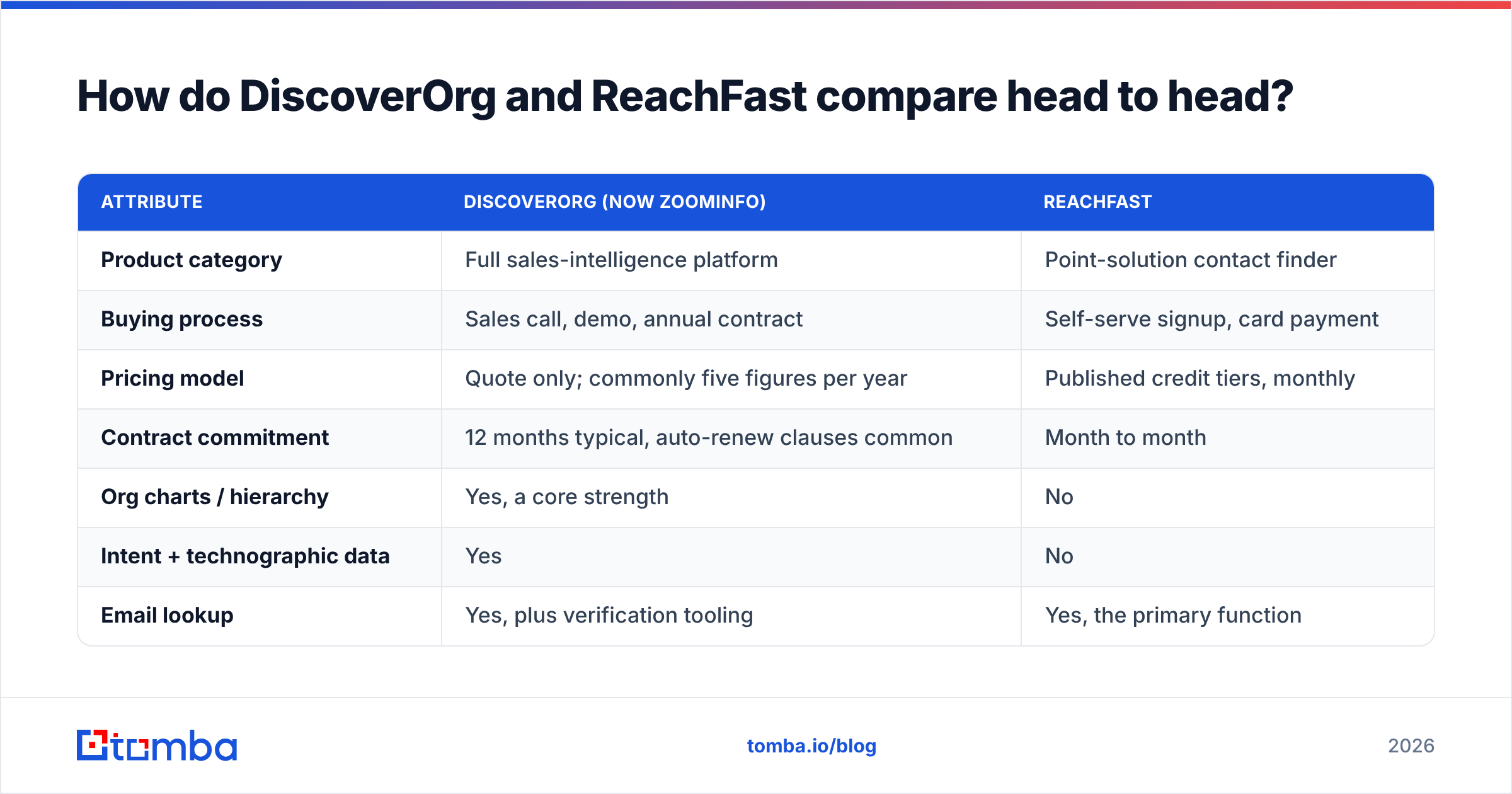
Here is the shape of the decision. Where a vendor does not publish a number, this table says so rather than inventing one — verify current figures on the vendor's own pricing page before you commit anything.
| Attribute | DiscoverOrg (now ZoomInfo) | ReachFast |
|---|---|---|
| Product category | Full sales-intelligence platform | Point-solution contact finder |
| Buying process | Sales call, demo, annual contract | Self-serve signup, card payment |
| Pricing model | Quote only; commonly five figures per year | Published credit tiers, monthly |
| Contract commitment | 12 months typical, auto-renew clauses common | Month to month |
| Org charts / hierarchy | Yes, a core strength | No |
| Intent + technographic data | Yes | No |
| Email lookup | Yes, plus verification tooling | Yes, the primary function |
| Phone / mobile numbers | Yes, large mobile dataset | Yes, depending on plan |
| CRM sync (Salesforce, HubSpot) | Native, deep, bidirectional | Limited; export-driven |
| API access | Yes, usually a paid add-on | Yes on higher tiers |
| Best fit team size | 50+ reps with a data budget | 1–10 reps, founder-led sales |
| Ramp time | Weeks: onboarding, admin config, training | Minutes |
Read that table as two columns that rarely belong in the same evaluation. If you have a defined territory, a RevOps team, and a mandate to build account hierarchies, ReachFast will feel thin within a week. If you are three people trying to book 20 meetings this month, a ZoomInfo contract is a budget event you cannot justify yet.

Which one has better data accuracy?#
Neither vendor's published accuracy number should decide this for you, because the number is measured on their sample, not yours.
Accuracy in contact data is not one metric. It splits into at least four:
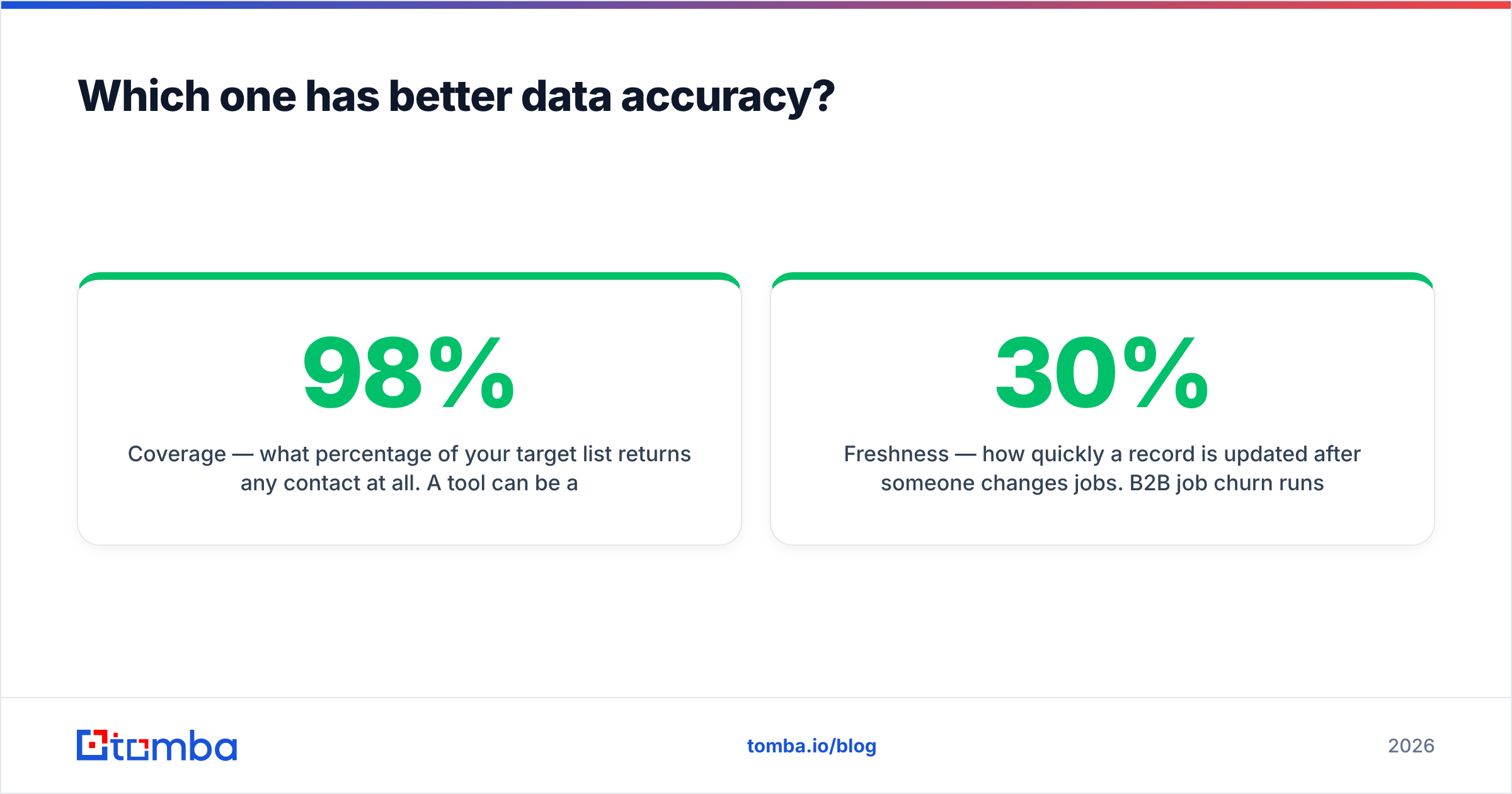
- Coverage — what percentage of your target list returns any contact at all. A tool can be 98% accurate on the 30% of rows it answers and still be useless.
- Deliverability — of the emails returned, how many actually accept mail. This is the number your sending reputation cares about.
- Freshness — how quickly a record is updated after someone changes jobs. B2B job churn runs roughly 20–30% annually, so a two-year-old record is a coin flip.
- Role correctness — whether the title attached to the person is still their real title. Enterprise platforms tend to win here; lightweight lookup tools often lag.
DiscoverOrg's historical advantage was freshness and role correctness, because humans re-verified records. Post-merger, coverage went up and the human-research proportion went down. ReachFast, like most self-serve finders, leans on pattern inference plus verification, which produces good results on well-known domains and thinner results on small companies, catch-all domains, and non-US regions.

The only test that settles it: take 200 rows of your real ICP — not a demo list the vendor hands you — run them through each trial, then push every returned address through an independent email verifier. Count valid, count catch-all, count invalid. Whichever tool gives you more deliverable addresses per dollar on your list wins, regardless of what the homepage claims.
What do DiscoverOrg and ReachFast actually cost?#
ZoomInfo pricing is negotiated, not published. Public reports from buyers consistently put entry platform deals in the low five figures annually, climbing quickly once you add seats, mobile-number credits, intent data, or API access. Credits are typically capped per seat per year, and overage is a separate conversation.
ReachFast publishes tiered credit plans you can buy without talking to anyone. Check the current tiers on their site, because self-serve vendors change them often. The important structural point: you can start and stop whenever you want, and there is no procurement cycle.
The cost comparison people get wrong is the one below the line item:
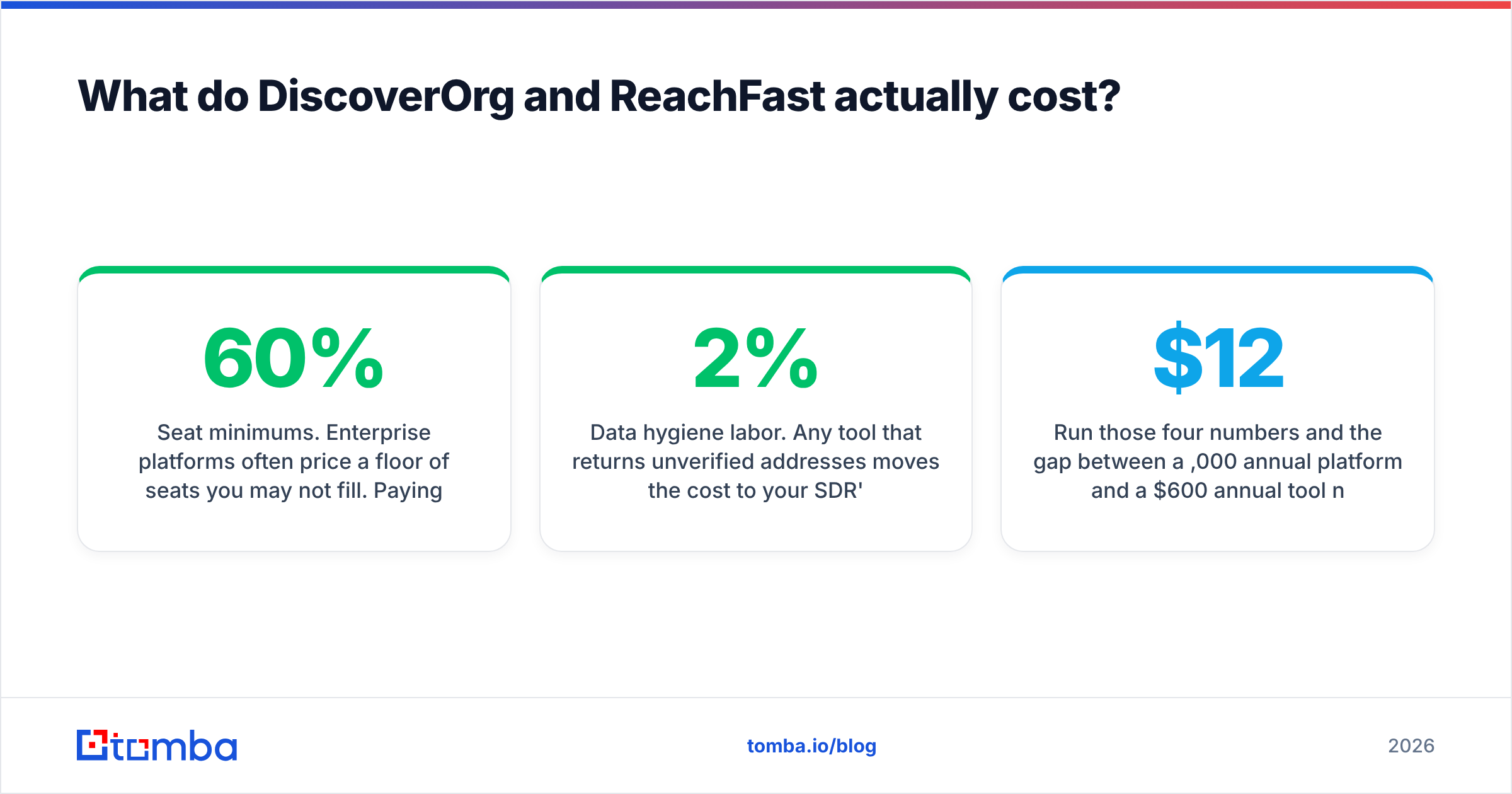
- Seat minimums. Enterprise platforms often price a floor of seats you may not fill. Paying for 10 seats to use 4 is a 60% effective price increase.
- Credit expiry. Annual credits that reset unused are a real cost. Monthly credit tools waste less.
- Data hygiene labor. Any tool that returns unverified addresses moves the cost to your SDR's time and your domain reputation. Bounces above roughly 2% start hurting email deliverability, and repairing sender reputation costs far more than credits.
- Integration work. Native CRM sync is a genuine platform advantage. Export-and-import workflows burn ops hours every week, and those hours are invisible in the contract.
Run those four numbers and the gap between a $12,000 annual platform and a $600 annual tool narrows or widens dramatically depending on your team's shape.
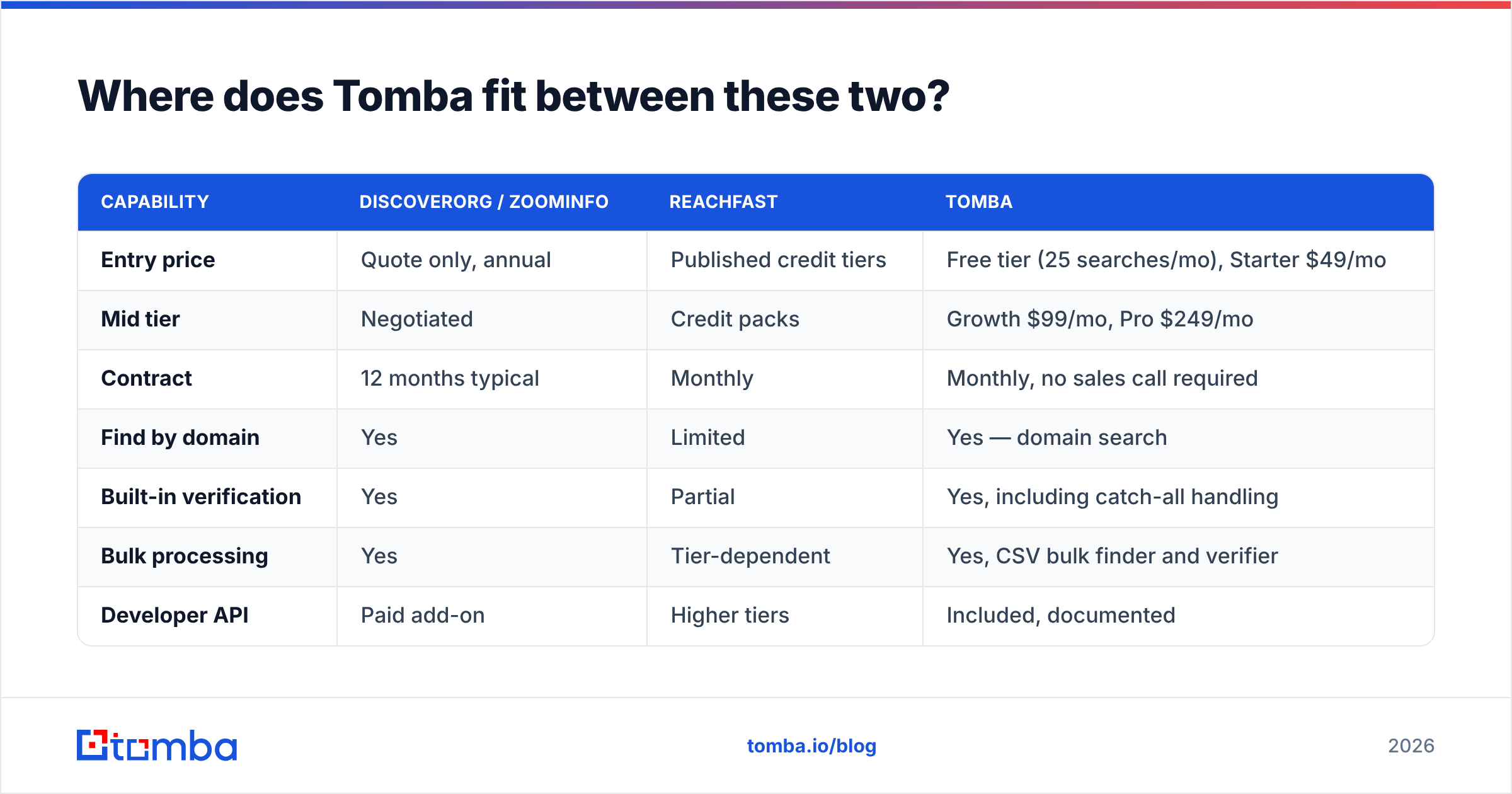
Where does Tomba fit between these two?#
Between them, honestly. Tomba is not a sales-intelligence platform and does not pretend to replace org charts, intent scoring, or territory planning. It is a contact-data layer: find the address, verify the address, enrich the record, and push it wherever your workflow lives.
That makes it the right comparison point for the ReachFast side of this decision, and a reasonable partial substitute for the platform side when what you actually needed from the platform was emails.
| Capability | DiscoverOrg / ZoomInfo | ReachFast | Tomba |
|---|---|---|---|
| Entry price | Quote only, annual | Published credit tiers | Free tier (25 searches/mo), Starter $49/mo |
| Mid tier | Negotiated | Credit packs | Growth $99/mo, Pro $249/mo |
| Contract | 12 months typical | Monthly | Monthly, no sales call required |
| Find by domain | Yes | Limited | Yes — domain search |
| Built-in verification | Yes | Partial | Yes, including catch-all handling |
| Bulk processing | Yes | Tier-dependent | Yes, CSV bulk finder and verifier |
| Developer API | Paid add-on | Higher tiers | Included, documented |
| Org charts / intent | Yes | No | No |
| Spreadsheet add-ins | Limited | No | Google Sheets and Excel |
Two honest caveats. First, if your motion depends on knowing that a VP of Infrastructure reports to a CIO who just budgeted a migration, a focused email finder will not give you that — buy the platform. Second, if you need website visitor identification, buyer intent, and conversation intelligence in one login, you are shopping for a suite, and this comparison is the wrong one.

Which tool fits which team?#
Pick by team shape, not feature count.
- Founder or solo seller, under 500 contacts a month. Start free, upgrade to a $49/mo tier. Neither an annual platform nor a mid-tier credit pack earns its keep at this volume. Verify everything before you send.
- 2–10 rep team, defined ICP, outbound-led. A self-serve finder plus a verifier plus a sequencer. Spend the saved budget on more sending domains and better copy, which move reply rate more than data breadth does.
- 10–50 reps with a RevOps function. This is the genuine crossover zone. Audit how much of your platform spend is used for emails only. If it is most of it, an API-first data layer plus your CRM is often cheaper and faster.
- 50+ reps, multi-segment, ABM programs. Buy the platform. You need hierarchy data, intent signals, and native CRM enrichment, and the labor savings justify the contract.
- Developers or data teams building internal tooling. Skip both interfaces and evaluate on API quality, rate limits, and per-call pricing. A clean email finder API beats a GUI you have to scrape around.
- Agencies serving many clients. Monthly, per-seat-flexible tools win. Annual seat minimums do not survive client churn.
What are the questions to ask on the demo call?#
If you do end up on a ZoomInfo call, these are the five that change the price or the outcome:
- What is the seat minimum, and can I start below it? Ask twice.
- Do credits roll over, and what is the overage rate per contact?
- Is API access included in this quote or a separate line item?
- What is your published refresh cadence for records in my target segment and region?
- What happens at renewal — is there an auto-renew clause and what notice window applies?
For a self-serve tool like ReachFast, the equivalent test is faster: sign up, run 200 real rows, check the results against an independent verifier, cancel if the deliverable-per-dollar number does not clear your bar. That takes an afternoon and no legal review.
What is the verdict on DiscoverOrg vs ReachFast?#
They are not competitors, and treating them as one will cost you either money or pipeline.
DiscoverOrg — meaning ZoomInfo today — wins when your problem is understanding accounts: hierarchy, intent, technographics, and enrichment that flows into a CRM other teams depend on. It is a real platform with a real price, and teams above roughly 50 reps generally get their money back.
ReachFast wins when your problem is reaching one person now: no contract, no onboarding, no procurement. It is a tool, priced like a tool, and that is a feature.
If you look at your own usage and realize that what you actually buy either product for is deliverable email addresses, then both are the wrong shape — one is too heavy, the other too narrow. That middle is where a dedicated contact-data layer belongs: domain-level search, verification built into the same workflow, bulk processing, and an API, on a monthly plan you can leave.
Start with 25 free searches on the Tomba Email Finder, run your own 200-row accuracy test against whatever you are considering, and let the bounce rate pick the winner. Full Tomba pricing is published — Free, Starter $49/mo, Growth $99/mo, Pro $249/mo — so you can compare it against a quote instead of guessing.
Related guides#
Ready to find emails that actually work?
Join 150,000+ professionals who stopped guessing and started sending. Free credits on signup — no credit card required.
Get the Tomba newsletter
Practical outbound tactics and product updates — once every two weeks.
About the author