DiscoverOrg vs Revli: Which B2B Data Tool Wins in 2026?
DiscoverOrg is now ZoomInfo and priced like an enterprise platform. Revli is self-serve and cheap. Here is the honest comparison — coverage, accuracy, contracts — plus who should skip both.
TL;DR
- DiscoverOrg no longer exists as a standalone product. It merged with ZoomInfo in 2019 and the brand was retired — if a rep pitches you "DiscoverOrg," you are buying ZoomInfo.
- ZoomInfo (ex-DiscoverOrg) is an enterprise sales-intelligence platform: deep org charts, intent data, annual contracts, seat-based pricing that typically starts in the five figures.
- Revli sits at the opposite end: self-serve, low monthly cost, contact lookup and list building with no procurement cycle. Smaller dataset, thinner firmographics, far less risk.
- Most teams comparing DiscoverOrg vs Revli actually need neither. They need accurate, verified emails on a per-contact basis without a platform tax.
- If your real job is "get me a valid work email for this person or domain," a focused email finder plus email verification beats both on cost-per-usable-contact.
What happened to DiscoverOrg?#
DiscoverOrg bought ZoomInfo in February 2019 and, in 2020, took the combined company public under the ZoomInfo name. The DiscoverOrg product line was folded into ZoomInfo's platform and the brand was sunset. You can read the corporate history on ZoomInfo's own site or the summary on Wikipedia.
That matters for this comparison because most "DiscoverOrg" reviews you will find are five to seven years old. They describe a product that was famous for one thing: human-researched org charts in IT, marketing, finance, and HR departments, refreshed on a cycle by actual analysts calling actual companies. That research discipline still shows up in ZoomInfo's technographic and org-chart data, but the pricing, packaging, and contract structure are entirely ZoomInfo's now.
So when you evaluate DiscoverOrg vs Revli in 2026, you are really evaluating:
- ZoomInfo (the DiscoverOrg successor) — a full go-to-market platform with contact data, firmographics, technographics, intent signals, conversation intelligence, and workflow automation bolted on.
- Revli — a self-serve B2B contact and company lookup tool aimed at founders, freelancers, and small sales teams who want records without a sales call.
They are not the same category. Pretending otherwise is how teams end up with a $30,000 annual contract to send 400 emails a month.
What is Revli and who is it actually for?#
Revli is a lightweight B2B data tool: you search a company or a person, it returns contact records and company details, and you export them. Check revli.com for current packaging, because self-serve tools in this space change credits and tiers frequently — anything I quote here should be verified against their live pricing page before you buy.
The value proposition is straightforward: no demo, no annual commitment, no seat minimum, no "talk to sales to see a price." For a solo founder doing 200 outbound touches a month, that model is objectively better than a platform contract, even if the underlying dataset is smaller.
Where Revli gets thin is exactly where DiscoverOrg was strong:
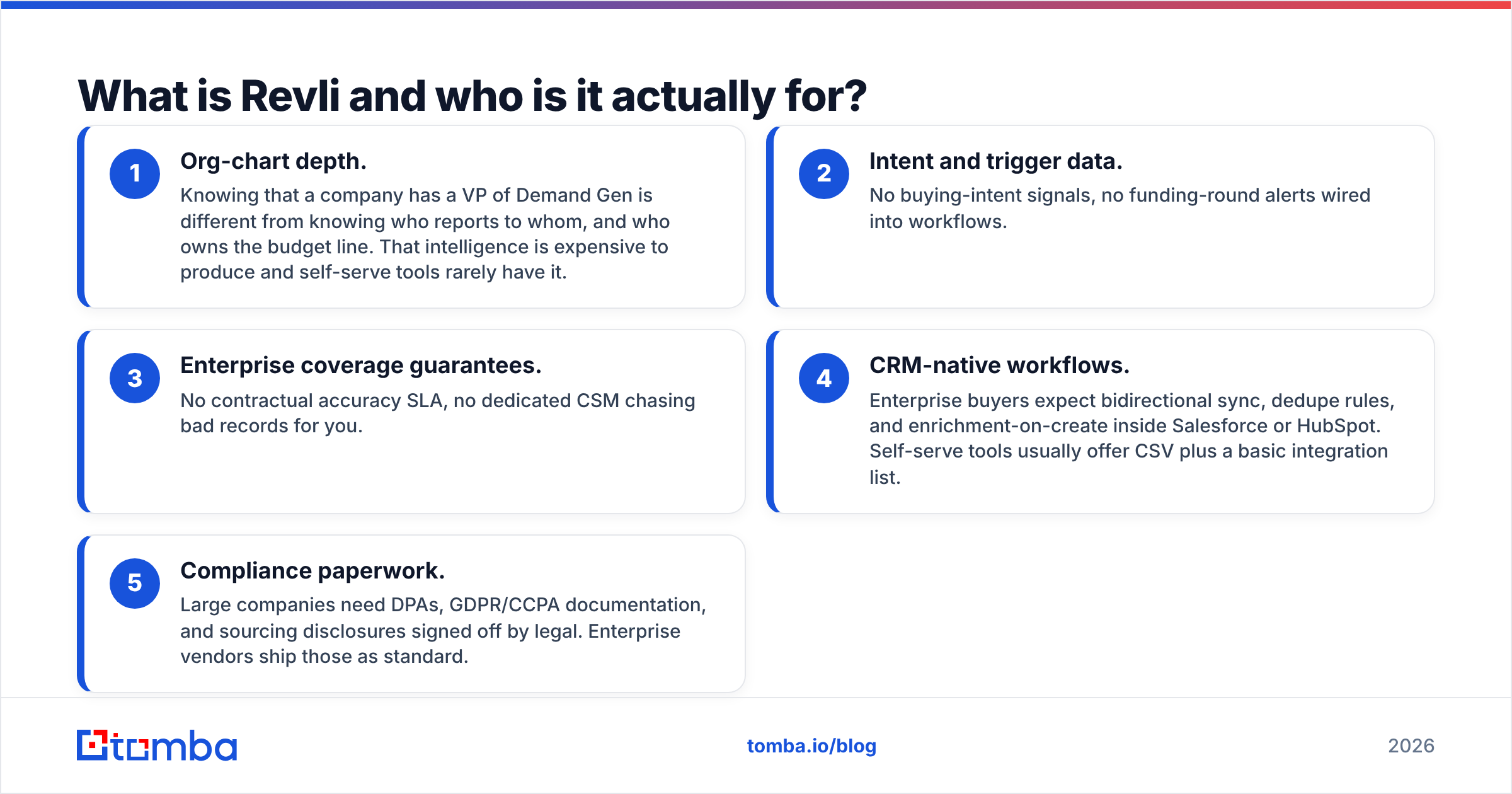
- Org-chart depth. Knowing that a company has a VP of Demand Gen is different from knowing who reports to whom, and who owns the budget line. That intelligence is expensive to produce and self-serve tools rarely have it.
- Intent and trigger data. No buying-intent signals, no funding-round alerts wired into workflows.
- Enterprise coverage guarantees. No contractual accuracy SLA, no dedicated CSM chasing bad records for you.
- CRM-native workflows. Enterprise buyers expect bidirectional sync, dedupe rules, and enrichment-on-create inside Salesforce or HubSpot. Self-serve tools usually offer CSV plus a basic integration list.
- Compliance paperwork. Large companies need DPAs, GDPR/CCPA documentation, and sourcing disclosures signed off by legal. Enterprise vendors ship those as standard.
None of that makes Revli bad. It makes it a different tool for a different budget. The mistake is comparing them on a single "which is better" axis.

How do DiscoverOrg (ZoomInfo) and Revli compare head to head?#
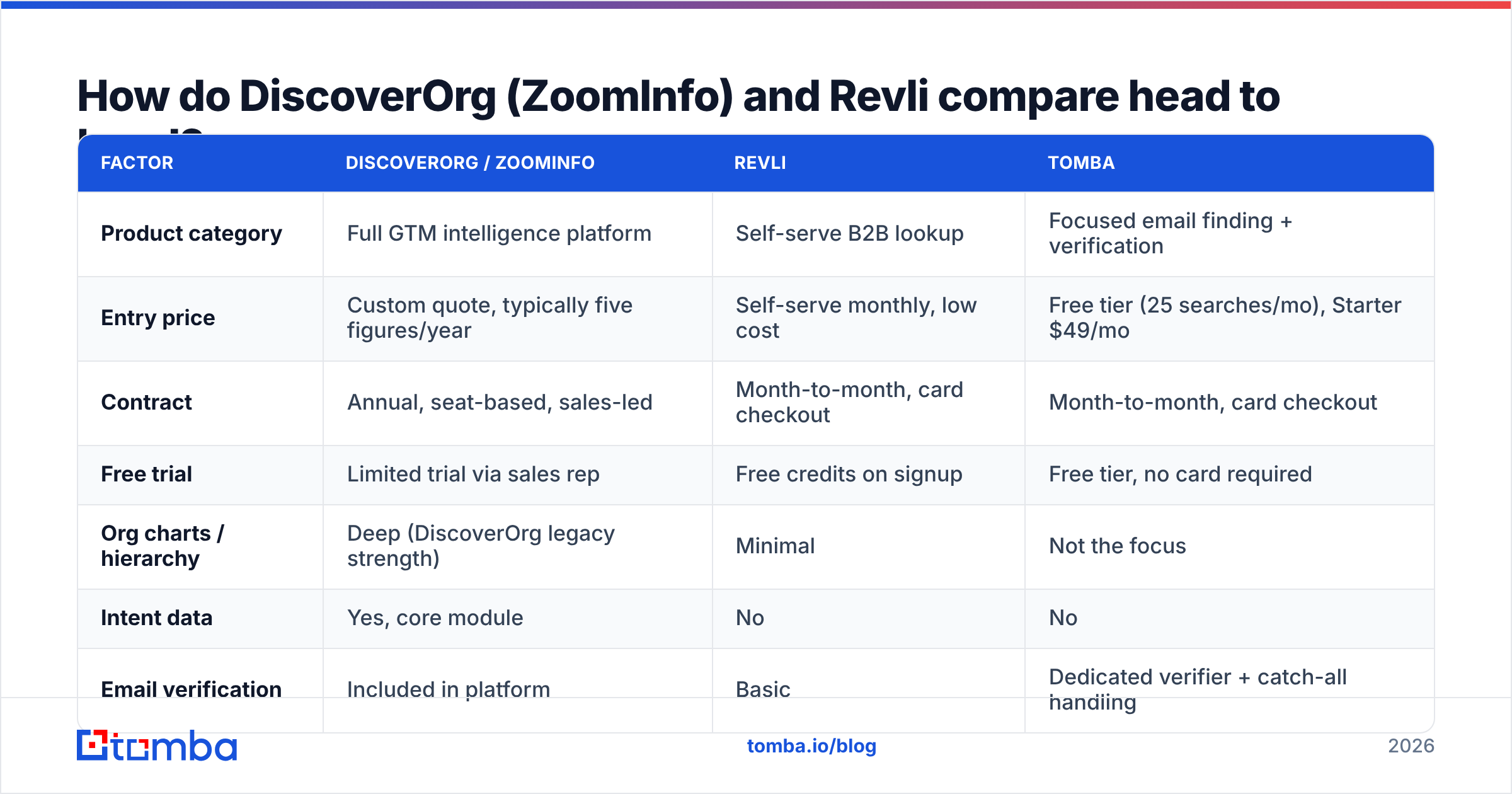
Here is the practical comparison. Treat the pricing column as directional — ZoomInfo quotes are custom and vary wildly by seat count, module mix, and negotiation, and self-serve vendors adjust tiers often.
| Factor | DiscoverOrg / ZoomInfo | Revli | Tomba |
|---|---|---|---|
| Product category | Full GTM intelligence platform | Self-serve B2B lookup | Focused email finding + verification |
| Entry price | Custom quote, typically five figures/year | Self-serve monthly, low cost | Free tier (25 searches/mo), Starter $49/mo |
| Contract | Annual, seat-based, sales-led | Month-to-month, card checkout | Month-to-month, card checkout |
| Free trial | Limited trial via sales rep | Free credits on signup | Free tier, no card required |
| Org charts / hierarchy | Deep (DiscoverOrg legacy strength) | Minimal | Not the focus |
| Intent data | Yes, core module | No | No |
| Email verification | Included in platform | Basic | Dedicated verifier + catch-all handling |
| Phone / direct dials | Extensive | Limited | Phone finder available |
| API access | Enterprise tier | Limited | Full API on paid plans |
| Best for | 20+ seat sales orgs with a GTM budget | Solo founders, small teams | Teams who need accurate emails at volume |
The pattern is obvious once it is laid out. ZoomInfo wins on breadth. Revli wins on friction and price. Neither is optimised for the single most common job in outbound: turning a name and a domain into an email address that does not bounce.
Is DiscoverOrg's data accuracy worth the price premium?#
Sometimes. Here is the honest version.
ZoomInfo's contact records benefit from a genuinely large collection engine — community contribution, public sources, partnerships, and human research inherited from DiscoverOrg's analyst model. In enterprise IT, that depth is hard to replicate. If your ICP is "VP of Infrastructure at 5,000+ employee manufacturers in DACH," a self-serve tool will leave gaps that cost you more in missed pipeline than the license costs.
But two things erode that premium fast:
Decay is universal. B2B contact data decays roughly 2–3% per month as people change roles. No vendor is immune. A record sourced eighteen months ago is a coin flip regardless of who sold it to you. That is why verification at send time matters more than database size — and why you should treat any vendor's headline "95% accurate" claim as a marketing number until you test it on your own list.
Credit models punish exploration. Enterprise platforms meter exports. When every reveal costs a credit from a fixed annual pool, reps stop exploring accounts and start hoarding. You paid for breadth and then rationed it.

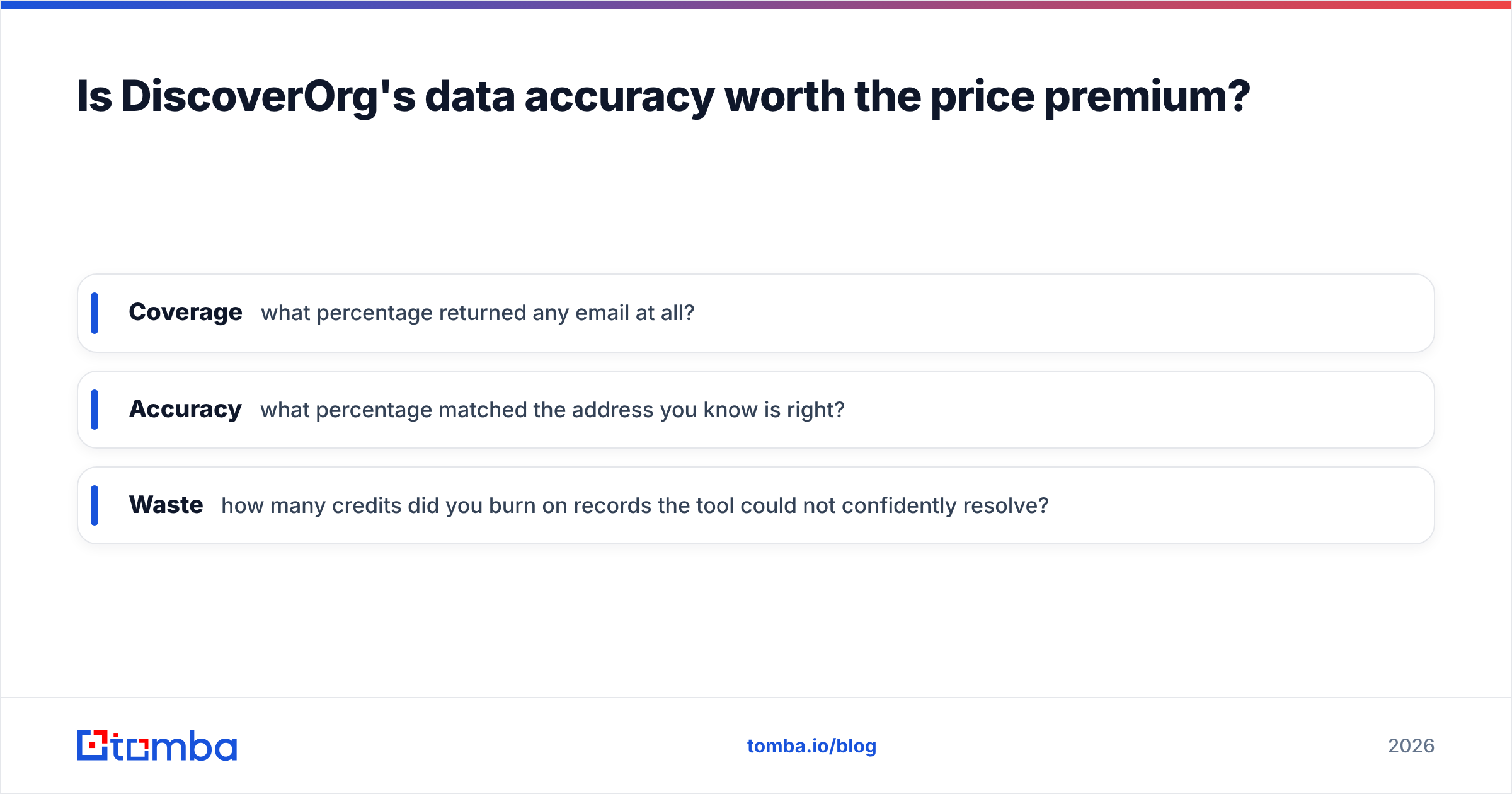
The practical test is simple and takes an afternoon: pull 100 contacts you already know are correct — current customers, people you have emailed this quarter — and run them through each tool's trial. Score three things:
- Coverage: what percentage returned any email at all?
- Accuracy: what percentage matched the address you know is right?
- Waste: how many credits did you burn on records the tool could not confidently resolve?
Vendors will not run that test for you, because the third number is the one that decides whether the contract is worth it. Run it yourself before you sign anything with a twelve-month term.
When should you skip both and use a focused email finder?#
Skip the platform comparison entirely if your workflow looks like this:
- You already know which companies you want to reach — from a conference list, a funding database, LinkedIn Sales Navigator, a partner referral, or your own ICP research.
- You need the email address, not a discovery engine.
- Your monthly volume is measured in hundreds or low thousands of contacts, not tens of thousands.
- You cannot justify a procurement cycle to your CFO for an outbound experiment.
That is the majority of B2B teams under 50 people, and it is where a focused tool wins on math rather than on features. A domain search that returns every published address at a company, run against a list you already trust, produces usable contacts at a fraction of the cost-per-record of a platform seat.
The full comparison across the focused-tool category looks like this:

Worth naming the honest tradeoff: focused tools will not tell you which accounts are in-market this week. If intent data is genuinely driving your territory planning — and you can prove it with pipeline numbers, not vibes — ZoomInfo's premium is defensible. If intent data is a slide in the vendor's deck that nobody on your team has opened since onboarding, you are paying for shelfware.
What does each option really cost per usable contact?#
Cost-per-seat is the wrong metric. Cost-per-usable-contact is the right one, and it changes the ranking.
Run the arithmetic with your own numbers:
- Total annual spend — license plus onboarding plus the internal hours spent on procurement and admin.
- Contacts actually exported — not credits purchased, contacts your reps pulled and used.
- Valid rate after verification — the percentage that survive a bounce check.
- Divide. Spend ÷ (contacts × valid rate) = your true cost per deliverable contact.
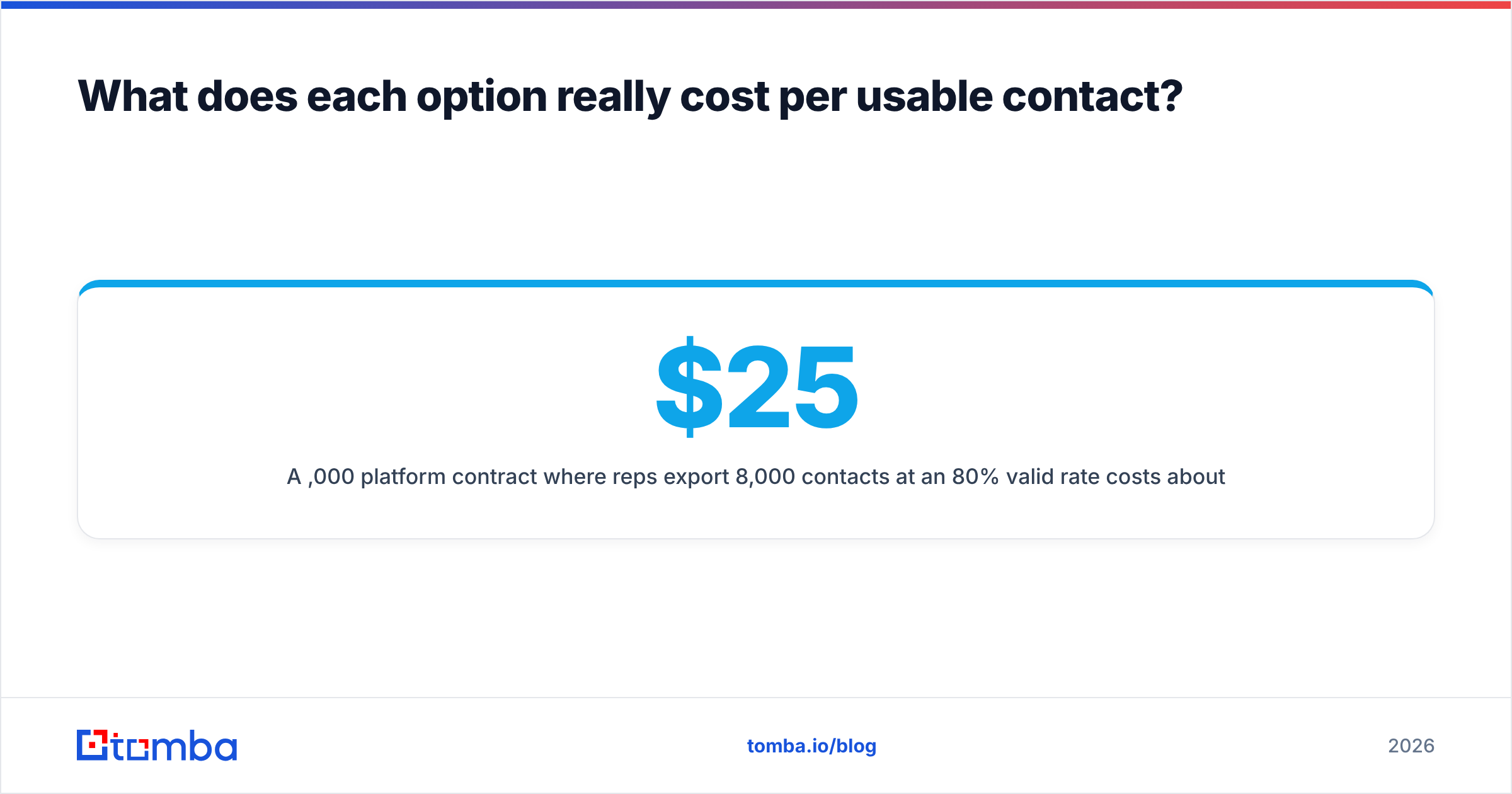
A $25,000 platform contract where reps export 8,000 contacts at an 80% valid rate costs about $3.90 per deliverable contact. A $49/month tool producing 500 verified contacts costs under $0.15. The platform is not automatically wrong — it may be surfacing accounts you would never have found — but you should know the ratio before renewal, not after.
Two line items that quietly wreck the enterprise math:
- Unused seats. Seat-based contracts assume every licensed rep logs in weekly. Audit your last quarter. If half your seats show near-zero exports, your effective per-contact cost doubles.
- Bounce cleanup. Every bad address costs sender reputation, not just a credit. Running exports through a bulk verifier before import is cheap insurance regardless of which vendor sourced the record.

Which should you choose in 2026?#
Pick by shape of team, not by feature count.
Choose ZoomInfo (the DiscoverOrg successor) if: you have 20+ quota-carrying reps, a defined GTM budget, an ops person who will own the integration, and a genuine need for org charts and intent signals across a large enterprise TAM. Get a multi-year discount, negotiate the credit pool hard, and insist on a pilot with your own test list before signing. Cross-check current user sentiment on G2 — the sales-intelligence category has a lot of churn and the reviews from the last two quarters are the only ones worth reading.
Choose Revli if: you are a founder or a two-to-five person team, you want records today without a sales call, and your outbound volume does not justify a contract. It does what it says at a price that will not hurt if it does not work out.
Choose a focused email-finding stack if: your bottleneck is deliverable addresses rather than account discovery. Combine list sources you already have with a finder, a verifier, and a catch-all verifier for the domains that accept everything and tell you nothing. Add data enrichment only for the fields you will actually personalise on — job title and company size beat a 40-column export nobody reads.
One last piece of advice that applies whichever way you go: never buy annual on a first contract in this category. Data quality is territory-specific, and the only reliable test is your own ICP against your own known-good list. A vendor confident in their coverage will let you run that test. One that will not is telling you something.
Ready to test coverage on your own list? Start with the Tomba Email Finder — the free tier gives you 25 searches a month with no card, enough to benchmark accuracy against whatever quote is sitting in your inbox. Paid plans start at $49/month with full API access, and you can see the full breakdown on Tomba pricing. Run the 100-contact test, compare the cost-per-deliverable-contact, and let the numbers decide instead of the demo.
Related guides#
Ready to find emails that actually work?
Join 150,000+ professionals who stopped guessing and started sending. Free credits on signup — no credit card required.
Get the Tomba newsletter
Practical outbound tactics and product updates — once every two weeks.
About the author