DiscoverOrg vs RocketReach: Pricing, Data, and Accuracy
DiscoverOrg no longer exists as a standalone product — it is ZoomInfo now. Here is how that platform actually stacks up against RocketReach on price, data depth, contracts, and accuracy, plus a cheaper third option.
TL;DR
- DiscoverOrg is not a product you can buy anymore. ZoomInfo acquired it in 2019 and folded the brand in — when someone says "DiscoverOrg," they mean ZoomInfo's enterprise data platform.
- RocketReach is a self-serve contact lookup tool. You can sign up with a credit card, get emails and phone numbers in minutes, and cancel whenever. No sales call required.
- The real gap is buying model, not data. ZoomInfo (ex-DiscoverOrg) sells annual contracts that typically land in the $15,000–$40,000+ range. RocketReach sells seats starting around $39–$80/month depending on billing term.
- Neither is optimized for the job most outbound teams actually have: getting a verified work email for a named person at a named company, at low cost per lookup.
- If that is your job, a focused email finder at $49/mo does it without a procurement cycle — and you can run all three in parallel before committing.
What happened to DiscoverOrg?#
DiscoverOrg stopped existing as a separate product in 2019. ZoomInfo — then a competitor — was acquired by DiscoverOrg's parent, the combined company took the ZoomInfo name, and the DiscoverOrg platform was merged into what is now sold as ZoomInfo Copilot, SalesOS, and the various data modules on zoominfo.com.
This matters more than it sounds. If you are comparing DiscoverOrg vs RocketReach in 2026, you are really comparing:
- A modern enterprise data platform that inherited DiscoverOrg's org-chart depth, technographic tagging, and human-verified research process — sold on annual contract with a mandatory demo.
- A self-serve lookup tool that lets an individual rep pay by card and start pulling contacts the same afternoon.
Those are not the same category of purchase. One is a budget line item your CFO reviews. The other is something a sales manager expenses.
The DiscoverOrg DNA that survived the merger is worth naming, because it explains why ZoomInfo still costs what it costs:
- Human-verified org charts. DiscoverOrg's original pitch was researchers phoning companies to confirm reporting structures. Traces of that remain in ZoomInfo's org-chart and department views.
- Technographics. What software a company runs, sourced from job posts, page tags, and partner data.
- Intent signals. Third-party behavioral data suggesting a company is in-market. This is now a large part of ZoomInfo's upsell motion.
- Deep firmographic filters. Revenue bands, employee counts, location, industry, and subsidiary structure — the stuff account-based teams build territory maps on.
RocketReach's origin is the opposite: a search box for finding a specific person's contact details, built for individual users, later extended with lists, bulk lookups, and an API.

What is RocketReach and who is it for?#
RocketReach indexes hundreds of millions of professional profiles and returns emails, phone numbers, and social links for people you search by name, company, or job title. Its core loop is simple: search a person → reveal contacts → export or push to CRM.
It fits well when:
- You are a recruiter, founder, or solo AE who needs contacts for a specific short list of people.
- You do not want a procurement process or an annual commitment.
- Your volume is measured in hundreds of lookups per month, not tens of thousands.
- You want a Chrome extension that works on LinkedIn profiles.
It fits badly when:
- You need territory-wide account lists with revenue and headcount precision.
- You need org charts and reporting lines to run a multi-threaded enterprise deal.
- You need intent data to prioritize accounts.
- Your compliance team requires documented consent trails and regional data controls at enterprise grade.
One recurring complaint in G2 reviews across contact-data tools generally — RocketReach included — is credit burn: a lookup consumes a credit whether or not the returned email is deliverable. That is the single biggest hidden cost in this category, and it applies to almost every vendor here.
How do DiscoverOrg (ZoomInfo) and RocketReach compare on price?#
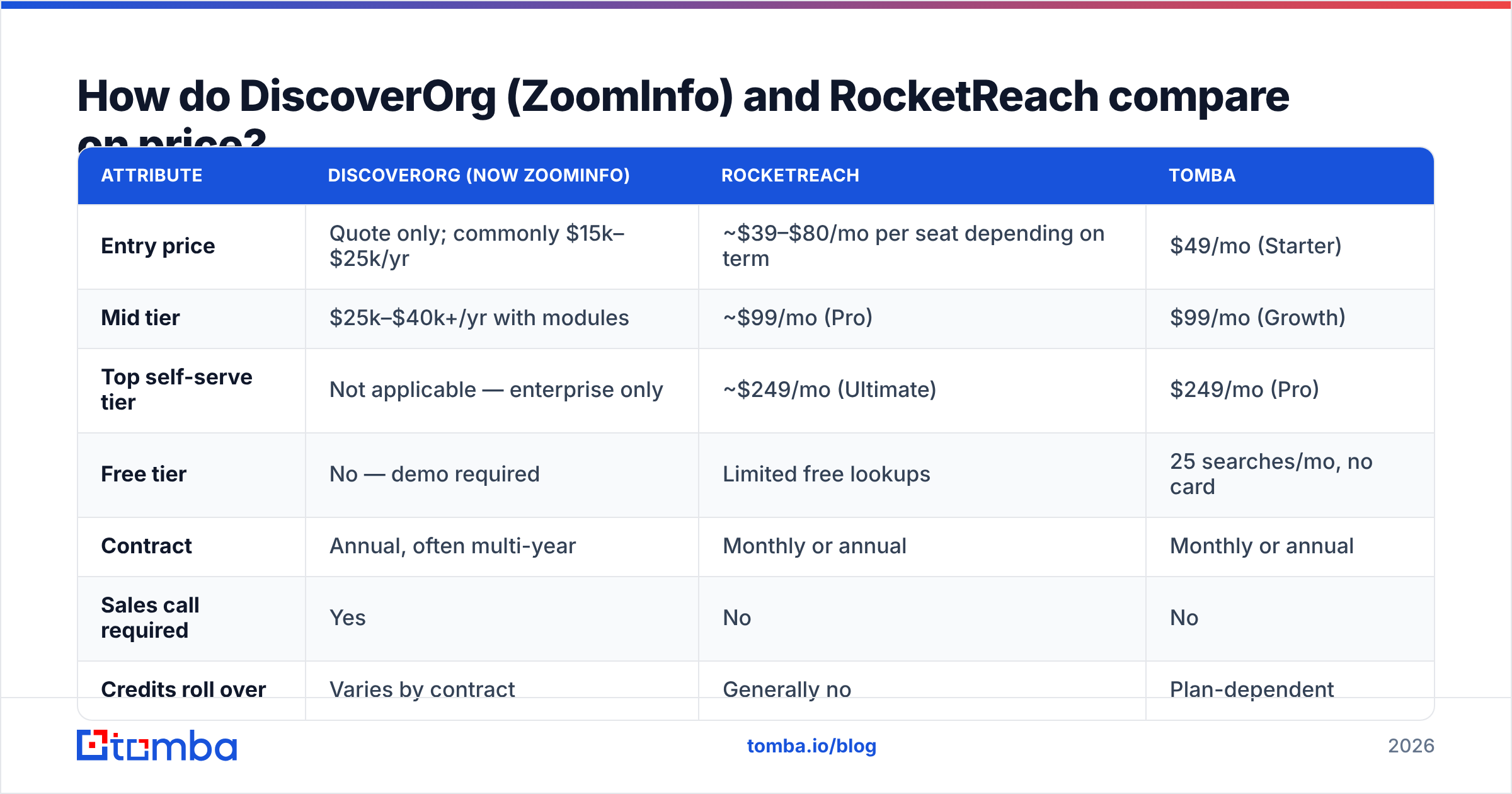
ZoomInfo does not publish pricing. RocketReach does, though its numbers shift with billing term and occasional promotions. The table below reflects publicly observable list pricing and widely reported contract ranges as of early 2026 — always confirm against the vendor's own page before you budget.
| Attribute | DiscoverOrg (now ZoomInfo) | RocketReach | Tomba |
|---|---|---|---|
| Entry price | Quote only; commonly $15k–$25k/yr | ~$39–$80/mo per seat depending on term | $49/mo (Starter) |
| Mid tier | $25k–$40k+/yr with modules | ~$99/mo (Pro) | $99/mo (Growth) |
| Top self-serve tier | Not applicable — enterprise only | ~$249/mo (Ultimate) | $249/mo (Pro) |
| Free tier | No — demo required | Limited free lookups | 25 searches/mo, no card |
| Contract | Annual, often multi-year | Monthly or annual | Monthly or annual |
| Sales call required | Yes | No | No |
| Credits roll over | Varies by contract | Generally no | Plan-dependent |
| Time to first contact | 1–4 weeks (demo → contract → onboarding) | Under 10 minutes | Under 5 minutes |
The most important row is the last one. If your team needs to test a hypothesis about a new segment this quarter, a four-week procurement cycle is not a pricing detail — it is a strategy constraint.

Which one has better data accuracy?#
Accuracy is the wrong single question. Break it into three:
1. Coverage — does the tool have the person at all? ZoomInfo's inherited DiscoverOrg research process gives it the edge on mid-market and enterprise North American companies, especially in tech, healthcare, and finance. RocketReach has broader long-tail and international profile coverage but thinner firmographic context around each person.
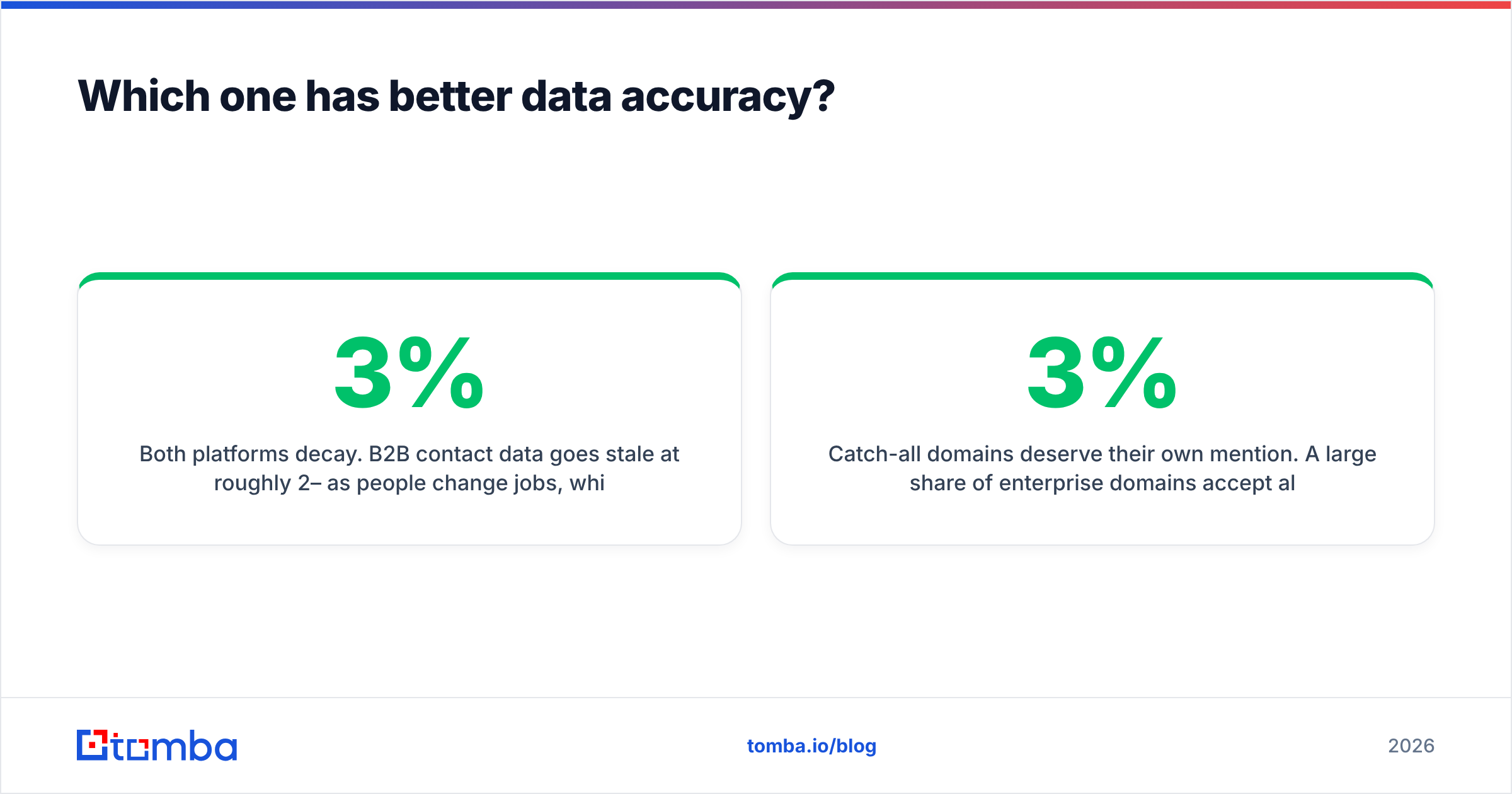
2. Freshness — is the record current? Both platforms decay. B2B contact data goes stale at roughly 2–3% per month as people change jobs, which compounds to a quarter or more of a list being wrong within a year. ZoomInfo refreshes aggressively at the account level; RocketReach re-crawls profile sources. Neither guarantees a given email is deliverable today.
3. Deliverability — will the email actually land? This is where both tools leak. A record can exist, be current, and still bounce because the mailbox is deactivated, the domain is catch-all, or the pattern was inferred rather than confirmed. Every serious outbound team runs a separate verification pass before sending, regardless of source. Running exports through an email verifier before they hit your sequencer is the cheapest insurance in the stack — a bounce costs you sender reputation, and reputation is far more expensive to rebuild than a credit is to spend.
Catch-all domains deserve their own mention. A large share of enterprise domains accept all mail at the SMTP layer, so standard verification returns "unknown." That is not a defect in your data provider; it is a property of the domain. A catch-all verifier that goes further than a basic SMTP handshake is what separates a 3% bounce rate from a 12% one.
What does the feature comparison actually look like?#

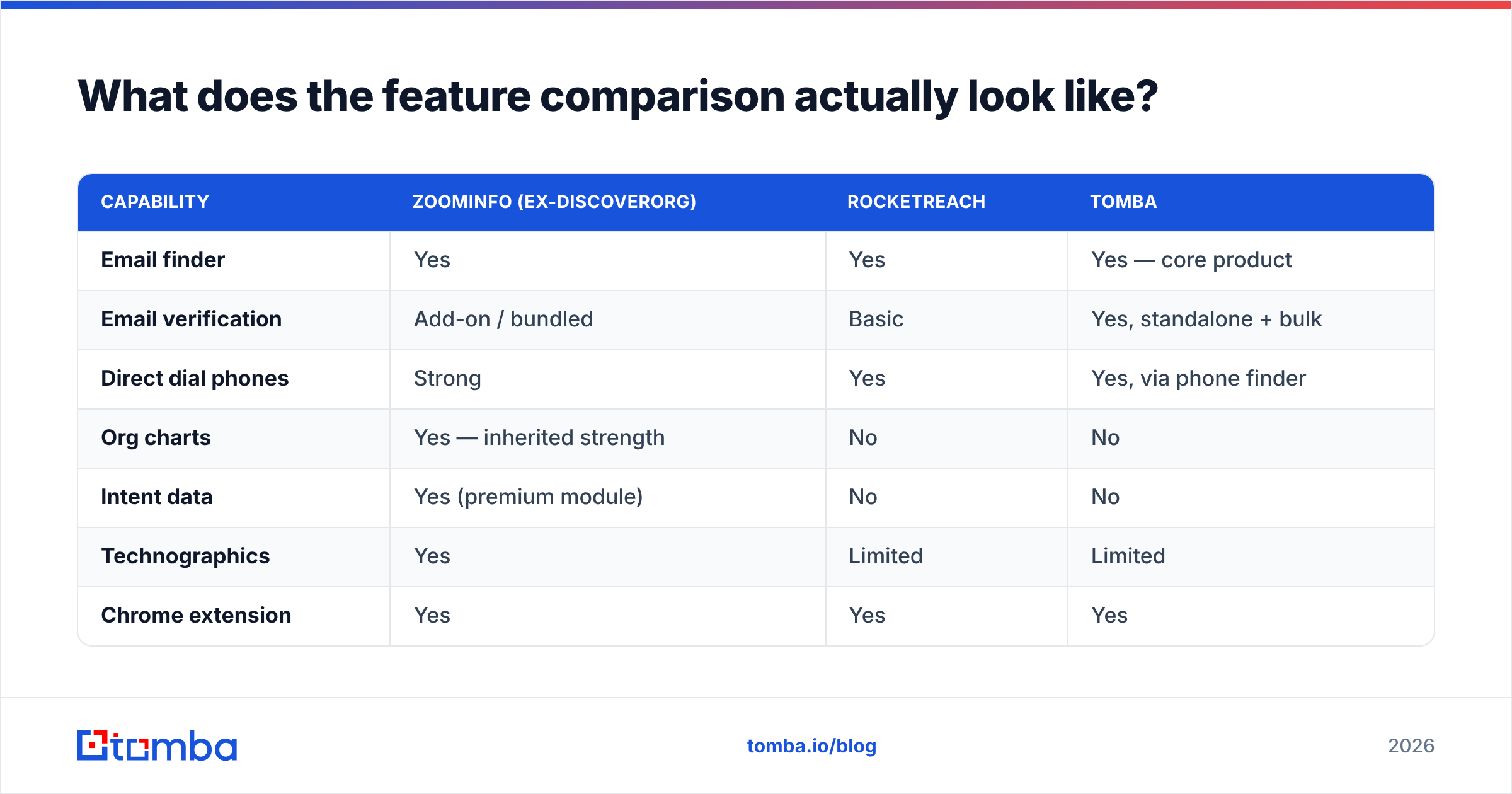
| Capability | ZoomInfo (ex-DiscoverOrg) | RocketReach | Tomba |
|---|---|---|---|
| Email finder | Yes | Yes | Yes — core product |
| Email verification | Add-on / bundled | Basic | Yes, standalone + bulk |
| Direct dial phones | Strong | Yes | Yes, via phone finder |
| Org charts | Yes — inherited strength | No | No |
| Intent data | Yes (premium module) | No | No |
| Technographics | Yes | Limited | Limited |
| Chrome extension | Yes | Yes | Yes |
| API access | Enterprise tier | Yes | All paid plans |
| Bulk CSV enrichment | Yes | Yes | Yes |
| Free plan | No | Limited | 25 searches/mo |
| Self-serve signup | No | Yes | Yes |
Read that table honestly and the split is obvious. ZoomInfo wins on account intelligence. RocketReach and Tomba win on contact accessibility. If your bottleneck is "which accounts should we go after and who sits where in the org," the enterprise platform earns its price. If your bottleneck is "we know exactly who we want to email and we need their address," you are paying five figures for features you will never open.
What are the hidden costs on each side?#
ZoomInfo / DiscoverOrg lineage:
- Annual commitment with limited exit. Contracts commonly auto-renew unless you cancel inside a notice window. Budget for a full year even if adoption stalls in month three.
- Module pricing. Intent, technographics, workflows, and the conversational modules are frequently separate line items. The demo price and the invoice price diverge.
- Credit caps per seat. Export limits are real, and overage negotiations happen mid-contract when you have no leverage.
- Implementation time. CRM mapping, dedupe rules, and admin training are weeks of RevOps effort nobody put in the business case.
RocketReach:
- Credits burned on misses. A lookup that returns nothing or returns an undeliverable address still costs you.
- Per-seat economics. Five reps means five subscriptions. The math stops being cheap around seat six or seven.
- No account-level intelligence. You will end up buying a second tool for firmographics, which erases the savings.
- Export ceilings on lower tiers. Bulk workflows push you up the pricing ladder faster than the sticker suggests.

Which tool fits which team?#
- Enterprise ABM team, 20+ reps, defined territories. ZoomInfo. The org charts, intent, and firmographic depth are genuinely hard to replicate, and at that headcount the per-rep cost is defensible.
- Recruiter or agency doing person-level sourcing. RocketReach. Broad profile coverage, no contract, works on LinkedIn out of the box.
- Founder-led or small outbound team, email-first. A dedicated email finder. You already know your ICP; you need addresses that do not bounce, cheaply, with an API you can wire into your own workflow.
- RevOps enriching an existing CRM. Whichever tool has the better bulk and API story per dollar. Enrichment is a volume problem, and volume pricing is where enterprise contracts and per-seat tools both get painful.
- Agency serving many clients. Per-seat pricing is the wrong shape. Look for credit pools you can spread across accounts and a bulk email finder workflow.
Is there a better alternative for email-first outbound?#
For a large share of teams evaluating DiscoverOrg vs RocketReach, the honest answer is that neither is the right shape.
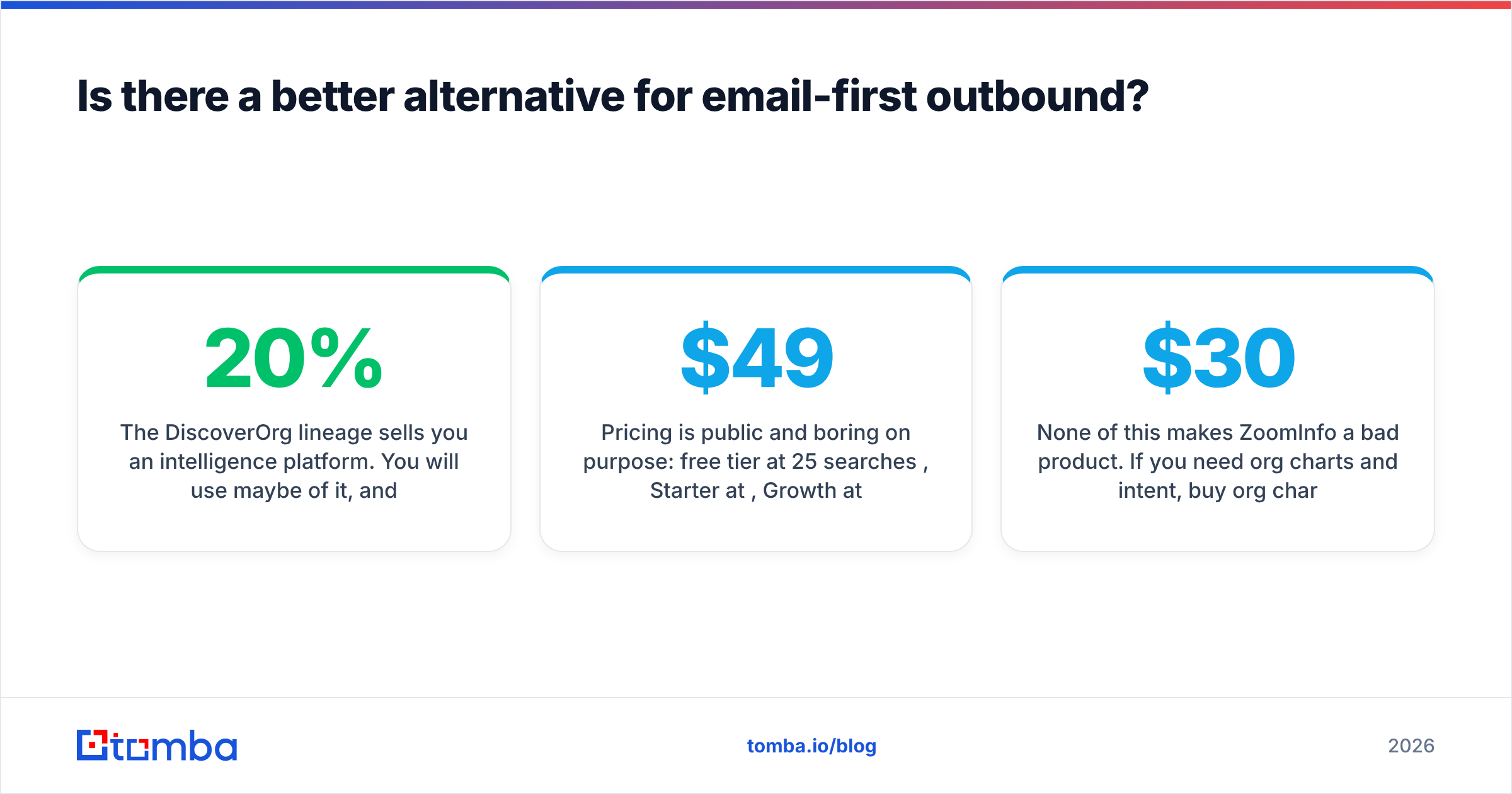
The DiscoverOrg lineage sells you an intelligence platform. You will use maybe 20% of it, and you will pay for 100%, annually, after a demo. RocketReach sells you a lookup box, priced per seat, which stops scaling the moment you have a team.
What most outbound teams actually need is narrower: given a company domain and a person's name, return a verified work email, at a predictable cost, through an interface a script can call. That is a focused problem with a focused answer.
Tomba is built around exactly that. Domain search pulls every discoverable address at a company plus the detected email pattern. The email finder resolves a specific name against a domain. The verifier — including catch-all handling — runs before anything reaches your sequencer. The Tomba API is available on every paid plan rather than gated behind an enterprise SKU, which matters if you are building enrichment into your own pipeline instead of clicking through a UI.
Pricing is public and boring on purpose: free tier at 25 searches/month, Starter at $49/mo, Growth at $99/mo, Pro at $249/mo, Enterprise on request. Full Tomba pricing is on the site — no demo gate. If you are specifically weighing the self-serve side of this comparison, the RocketReach alternative breakdown goes deeper on the feature-by-feature differences.
None of this makes ZoomInfo a bad product. If you need org charts and intent, buy org charts and intent. Just do not sign a $30,000 annual contract to solve a $49/month problem.
How should you actually run the evaluation?#
Do not compare marketing pages. Compare outputs on your own list.
- Build a 100-row test set from your real ICP. Include a mix of company sizes, at least 20% non-US domains, and a few catch-all domains you already know about.
- Run the same list through each tool. Record match rate (how many returned anything) separately from accuracy (how many were correct).
- Verify every result with a third-party checker. Never accept a vendor's own confidence score as proof. A free email checker is enough for a spot audit.
- Send a small real campaign — 50 contacts per source — and compare actual bounce rates. This is the only number that matters.
- Calculate cost per verified, deliverable contact. Not cost per credit. Not cost per seat. A tool at half the price with a 40% miss rate is more expensive than it looks.
Most teams that run this test find the gap between vendors on match rate is smaller than the marketing implies, and the gap on price is far larger.
Ready to test it against your own list?#
Start with the free tier — 25 searches, no credit card, no demo call. Run your hardest 25 prospects through Tomba Email Finder, verify the results, and compare them to whatever quote ZoomInfo sent you and whatever RocketReach returned. If the verified-contact count holds up, you just replaced a five-figure line item with a $49/month one. If it does not, you have lost nothing but ten minutes — and you will have real numbers to negotiate with instead of a vendor's slide.
Related guides#
Ready to find emails that actually work?
Join 150,000+ professionals who stopped guessing and started sending. Free credits on signup — no credit card required.
Get the Tomba newsletter
Practical outbound tactics and product updates — once every two weeks.
About the author