DiscoverOrg vs SalesIntel: Which B2B Data Wins in 2026?
DiscoverOrg no longer exists as a standalone product — it became ZoomInfo. So what are you actually comparing when you evaluate DiscoverOrg vs SalesIntel in 2026? Here's the honest breakdown of data quality, coverage, contracts, and cost.
DiscoverOrg vs SalesIntel is the wrong fight in 2026, and the reason changes how you should buy. Here is the short version.
TL;DR
- DiscoverOrg vs SalesIntel is a trick match-up. DiscoverOrg is no longer a standalone product. It merged with ZoomInfo in 2019, and the brand was folded into ZoomInfo. If a rep pitches you "DiscoverOrg," you are buying ZoomInfo.
- SalesIntel sells human-verified contacts. A research team re-checks records on a rolling cycle. It will also go find contacts the database does not hold yet.
- ZoomInfo wins on raw coverage, intent data, and platform depth. SalesIntel wins on verified contacts, mid-market pricing, and unlimited-user plans.
- Both are annual contracts. Expect five figures, a procurement cycle, and an auto-renewal clause.
- Need accurate work emails and nothing else? A focused tool like Tomba's email finder does that job for far less.
DiscoverOrg vs SalesIntel: what actually happened to DiscoverOrg?#
DiscoverOrg bought ZoomInfo in February 2019. It then took the ZoomInfo name for the merged company. The DiscoverOrg product was famous in the 2010s for hand-researched org charts and IT maps. That work now lives inside ZoomInfo SalesOS. There is no separate DiscoverOrg login, pricing page, or roadmap.
That matters in three concrete ways:
- You are comparing a suite against a database. ZoomInfo bundles contact data, intent signals, call recording, website visitor ID, and workflow tools. SalesIntel is narrower, and it knows it.
- The old DiscoverOrg strength is still there, but thinner. The hand-checked IT and org-chart data lives on inside ZoomInfo. Most records now come from machines and from the contributory network. Far fewer records get touched by a researcher than in the old DiscoverOrg days.
- SalesIntel was built for that gap. Its pitch is the old DiscoverOrg promise at mid-market prices. Human checks are the product, not a legacy feature.
So the real question is not DiscoverOrg vs SalesIntel. It is simpler than that. Do you want the widest coverage with mixed checks, or narrower coverage you can trust record by record?
What is SalesIntel, and how is its data built?#
SalesIntel blends three streams. First, an automated collection layer. Second, a human research team that re-checks contacts on a rolling cycle; the marketing claim is every 90 days. Third, "Research on Demand." You ask for contacts the database lacks, and researchers go find them, usually within a few business days.
Buyers underrate that third stream. Say you sell into a long-tail market: regional health systems, credit unions, niche manufacturers. One database has 70% of your market. The other will go build the missing 30% for you. That gap is the difference between a working list and a dead quarter.
SalesIntel also offers firmographic and technographic filters, intent data through a Bombora partnership, and a Chrome extension for LinkedIn. Coverage is strongest in North America. If you sell into EMEA or APAC, test that region hard before you sign.

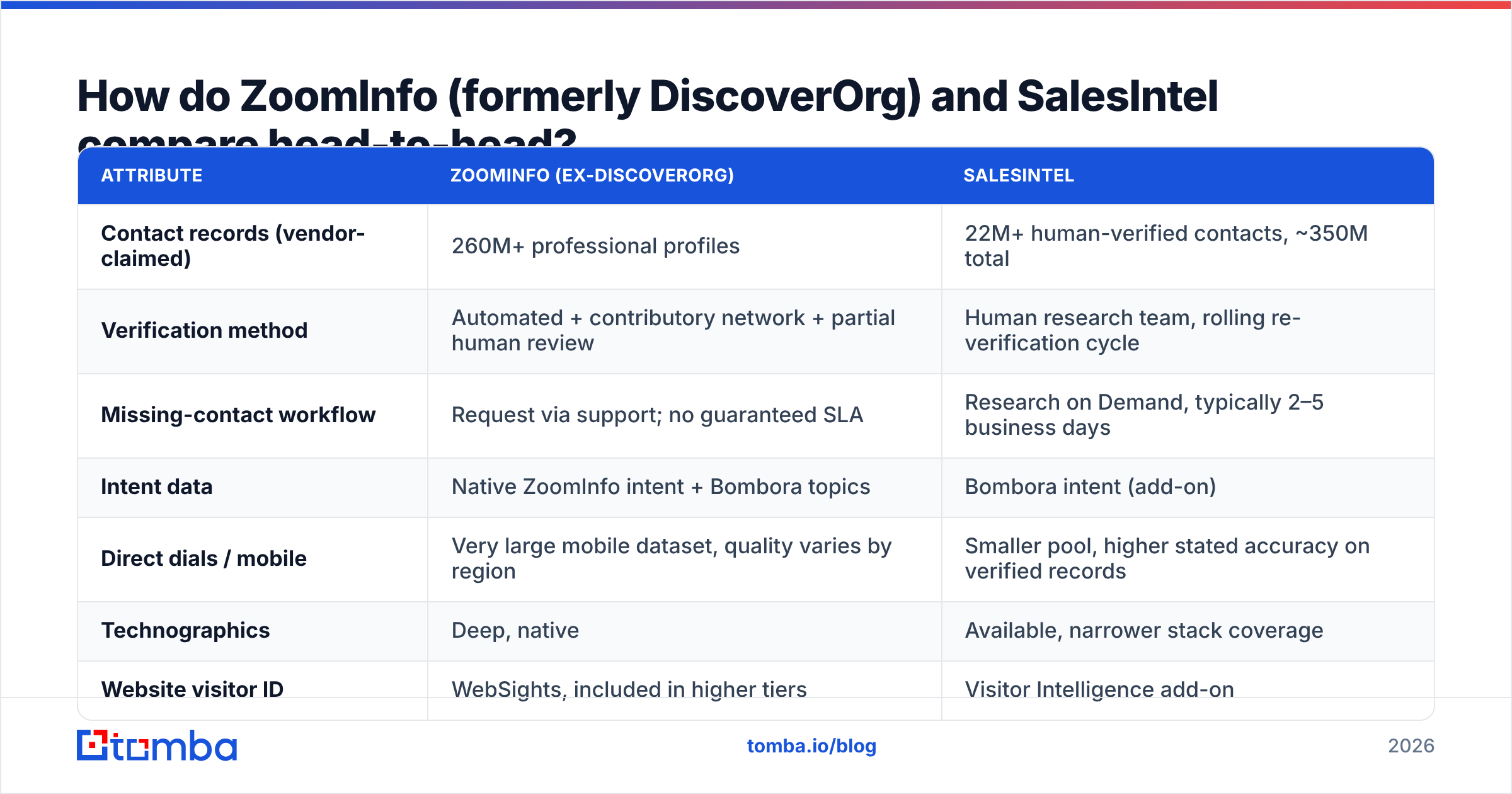
DiscoverOrg vs SalesIntel: how do they compare head-to-head?#
Remember that the DiscoverOrg column is really ZoomInfo today.
| Attribute | ZoomInfo (ex-DiscoverOrg) | SalesIntel |
|---|---|---|
| Contact records (vendor-claimed) | 260M+ professional profiles | 22M+ human-verified contacts, ~350M total |
| Verification method | Automated + contributory network + partial human review | Human research team, rolling re-verification cycle |
| Missing-contact workflow | Request via support; no guaranteed SLA | Research on Demand, typically 2–5 business days |
| Intent data | Native ZoomInfo intent + Bombora topics | Bombora intent (add-on) |
| Direct dials / mobile | Very large mobile dataset, quality varies by region | Smaller pool, higher stated accuracy on verified records |
| Technographics | Deep, native | Available, narrower stack coverage |
| Website visitor ID | WebSights, included in higher tiers | Visitor Intelligence add-on |
| Seat model | Per-seat, credits per seat | Unlimited-user options on some plans |
| Best geography | Global, strongest in NA | North America |
| Typical contract | Annual, multi-year discounts, auto-renew | Annual, more negotiable at mid-market |
| Entry price (reported) | ~$15K–$30K+/yr for a small team | ~$8K–$20K/yr depending on seats and credits |
Neither vendor posts list pricing. Treat those last two rows as reported ranges from buyer reviews on G2 and Capterra, not rate-card facts. Both quote per deal. Both quote higher once you share your headcount or funding.
DiscoverOrg vs SalesIntel: which one has more accurate data?#
Accuracy is not one number. Split it into three parts.
Email deliverability. ZoomInfo's volume means more matches. But plenty of records are stale or role-based. SalesIntel's verified subset bounces less, though the subset is smaller. Both slip fast in high-churn fields such as agencies, startups, and retail.
Direct dial accuracy. ZoomInfo has the largest mobile pool in the market. That is the main reason enterprise SDR teams renew. SalesIntel's dial pool is smaller, so heavy phone teams tend to rate ZoomInfo higher.
Title and seniority freshness. Here human checks earn their price. A machine-built record can still show a VP who left 14 months ago. SalesIntel's re-check cycle catches more of those. That matters when your buyer is a title, not a department.
The practical move is the same for both vendors. Run a paid trial on 500 rows of your real target list. Push the emails through an independent email verifier. Then count the hard bounces yourself. Vendors grade accuracy against their own definition of valid, and catch-all domains hide inside that number.
One more caution. Both platforms count a "match" loosely. Export 1,000 companies, get 1,000 contacts back, then check how many are the real buyer. A generic ops coordinator is not your persona. Match rate and useful match rate are different numbers, and only one of them builds pipeline.
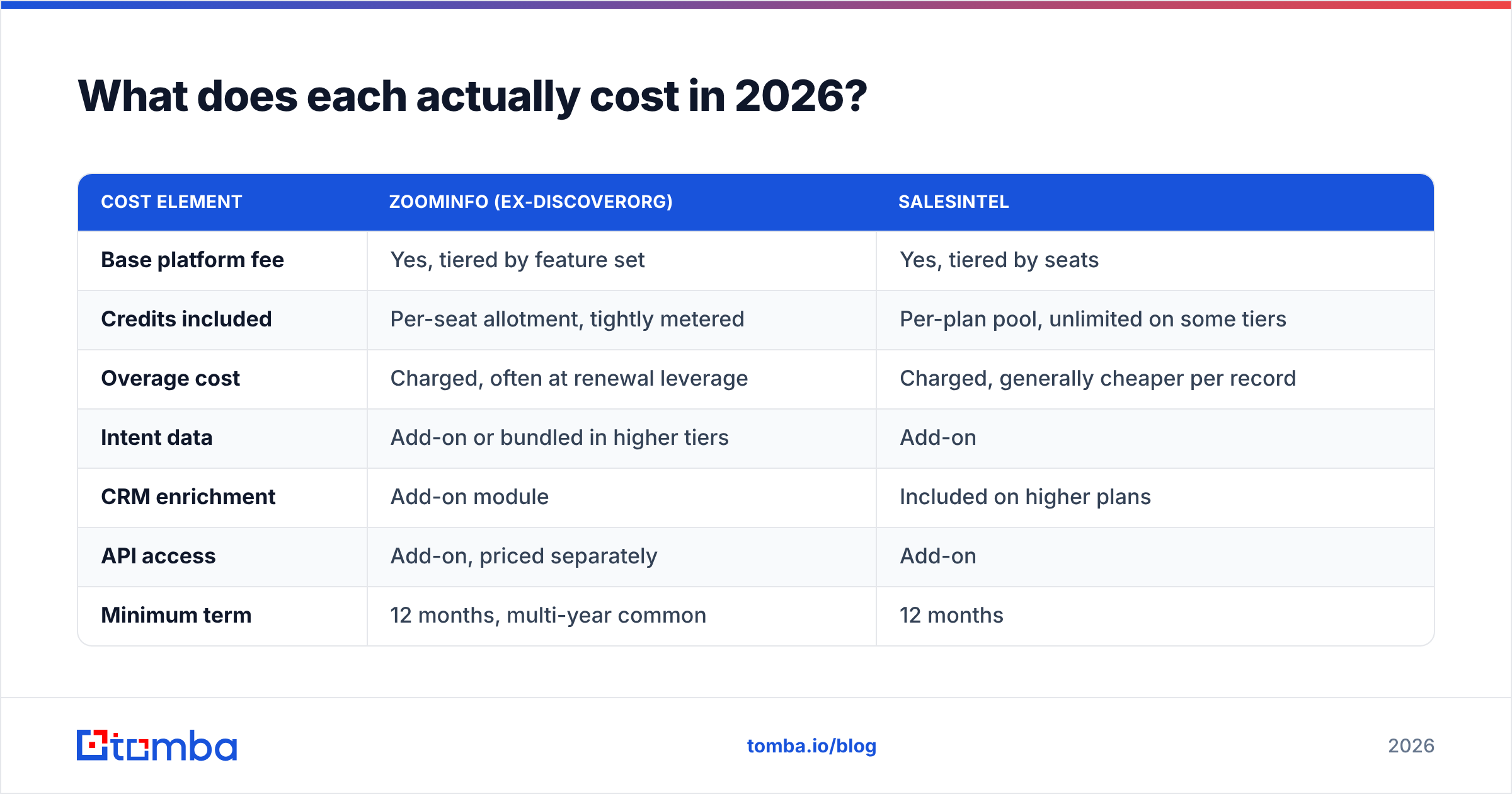
What does each one actually cost in 2026?#
| Cost element | ZoomInfo (ex-DiscoverOrg) | SalesIntel |
|---|---|---|
| Base platform fee | Yes, tiered by feature set | Yes, tiered by seats |
| Credits included | Per-seat allotment, tightly metered | Per-plan pool, unlimited on some tiers |
| Overage cost | Charged, often at renewal leverage | Charged, generally cheaper per record |
| Intent data | Add-on or bundled in higher tiers | Add-on |
| CRM enrichment | Add-on module | Included on higher plans |
| API access | Add-on, priced separately | Add-on |
| Minimum term | 12 months, multi-year common | 12 months |
| Auto-renewal | Standard, with notice window | Standard, with notice window |
Two line items cause most of the regret in this category.
The first is credit metering. Enrichment jobs, exports, and API calls all burn credits. Teams often spend a full year's allotment in five months. The overage talk then lands right before renewal, when you have the least leverage.
The second is the auto-renewal notice window. Both vendors ask for written notice 30–60 days before the term ends. Diary that date the day you sign. Miss it and you fund a second year of a tool you stopped using in month seven.
Which platform fits which team?#
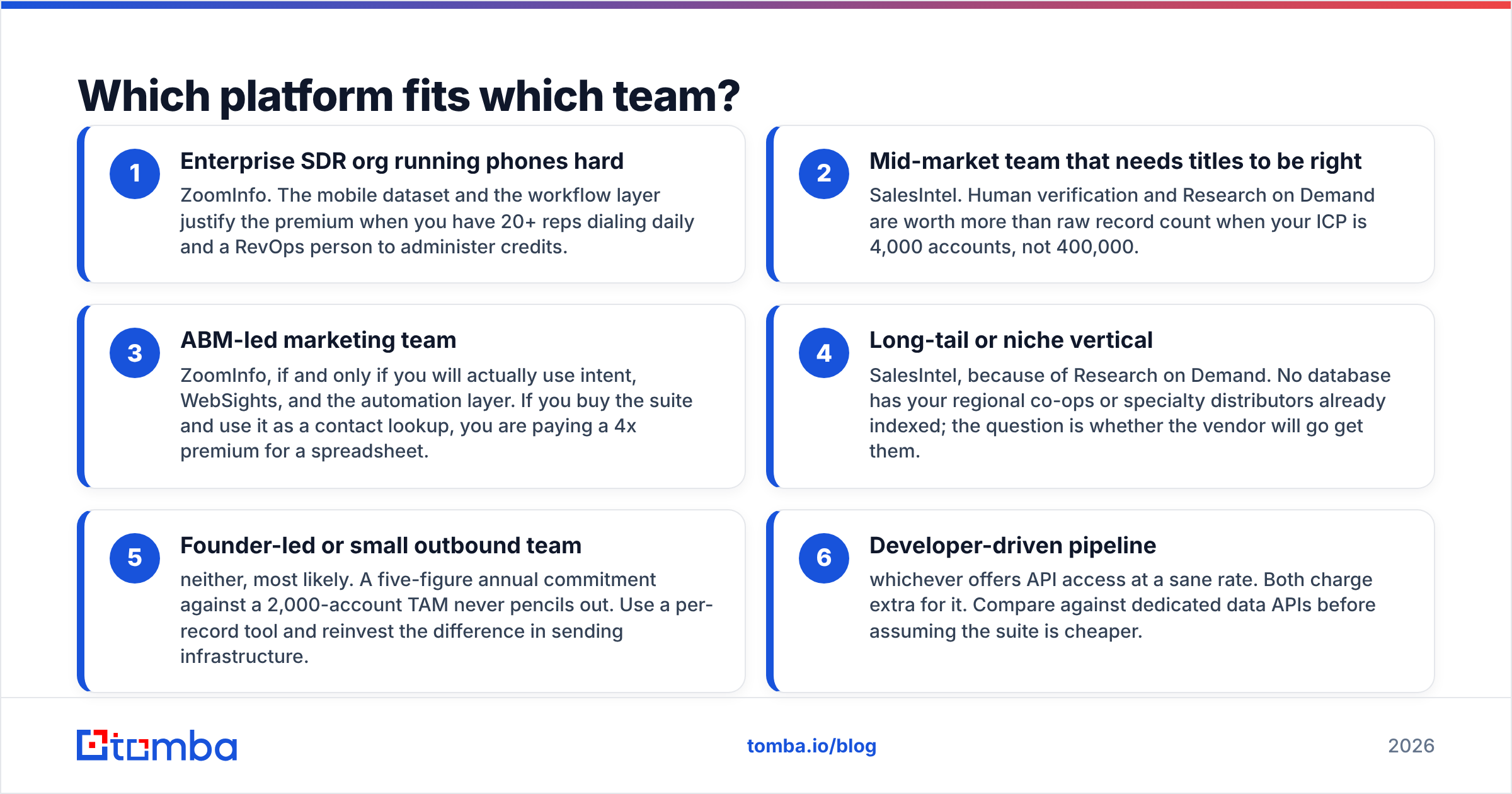
- Enterprise SDR org running phones hard — ZoomInfo. The mobile dataset and the workflow layer earn the premium. That holds when you have 20+ reps dialing daily and a RevOps person to watch credits.
- Mid-market team that needs titles to be right — SalesIntel. Human checks and Research on Demand beat raw record count. Your target list is 4,000 accounts, not 400,000.
- ABM-led marketing team — ZoomInfo, but only if you will use intent, WebSights, and the automation layer. Buy the suite and use it as a lookup tool, and you pay 4x for a spreadsheet.
The next three profiles are the ones sales reps rarely flag for you.
- Long-tail or niche vertical — SalesIntel, thanks to Research on Demand. No database has your regional co-ops or specialty distributors indexed already. The question is whether the vendor will go get them.
- Founder-led or small outbound team — neither, in most cases. A five-figure yearly commitment against a 2,000-account market never pencils out. Use a per-record tool and put the rest into sending infrastructure.
- Developer-driven pipeline — whichever one offers API access at a sane rate. Both charge extra for it. Compare dedicated data APIs first.
Where does a lighter tool like Tomba fit?#
Be honest about the job you are hiring a tool to do. If you need org charts, intent scoring, call recording, and a warehouse sync, you need a suite. In that case the choice really is ZoomInfo or SalesIntel.
But maybe your need is smaller. Given a company and a person, return a verified work email. That job should cost much less. This is where a focused email-finding stack earns its place. Tomba pricing starts free at 25 searches a month, then Starter at $49/mo, Growth at $99/mo, and Pro at $249/mo. No annual lock-in, no seat minimums, no credit renegotiation.
The practical stack for a small outbound team looks like this:
- Build the account list from your own research, a niche directory, or a scraped source.
- Find the contacts with domain search, which returns every address on the domain plus role and confidence score.
- Verify before sending so bounces never touch your sender reputation. Catch-all domains get flagged, not passed off as valid.
- Enrich what matters — job title, company size, social profiles — with data enrichment instead of a full platform you open twice a month.
- Automate the boring part through the Tomba API, a Sheets add-on, or a Chrome extension.
This will not replace ZoomInfo for a 50-rep enterprise team. It replaces it well for the thousands of teams that bought ZoomInfo, used 8% of it, and renewed out of habit. Auditing what you use before renewal is the highest-ROI hour in RevOps.
What should you check before signing either contract?#
Run this checklist during the trial, not after:
- Sample against your real target list. Not a demo list the vendor picked. Your 500 accounts.
- Measure bounce rate yourself. Send a small verified batch and count the hard bounces.
- Test the region you sell into. North American accuracy tells you nothing about DACH or the Nordics.
- Ask what happens when a contact is missing. Get the SLA in writing, or note that there is none.
- Price the overage, not the base. Get the per-credit overage rate into the contract, not an email.
- Diary the cancellation window. On signing day, put the notice deadline in three calendars.
- Confirm export rights on termination. Some contracts limit what you may keep. Read that clause.
- Check CRM sync direction. One-way enrichment into your CRM is common. Two-way sync often costs extra.
DiscoverOrg vs SalesIntel: so which one wins?#
Verdict: for most mid-market teams in 2026, SalesIntel is the better value. For enterprise phone-heavy orgs, ZoomInfo is still the default.
ZoomInfo absorbed DiscoverOrg, and it wins on coverage, mobile numbers, intent, and ecosystem depth. You pay a premium for all of that. You only get it back if you use more than the contact database.
SalesIntel wins when confidence beats count. Cleaner titles. A research team that fills gaps. Unlimited-user tiers that do not punish you for adding a rep. A friendlier posture in a mid-market negotiation.
And if you read this whole DiscoverOrg vs SalesIntel comparison thinking "I just need emails that don't bounce," you have your answer. It is neither of them. Start with the Tomba Email Finder, verify every address before it hits your sequencer, and spend the $20K you saved on a second SDR.
Related guides#
Ready to find emails that actually work?
Join 150,000+ professionals who stopped guessing and started sending. Free credits on signup — no credit card required.
Get the Tomba newsletter
Practical outbound tactics and product updates — once every two weeks.
About the author