DiscoverOrg vs SeamlessAI: Which B2B Data Tool Wins in 2026?
DiscoverOrg (now ZoomInfo) sells curated enterprise org charts. Seamless.AI sells unlimited AI-sourced contacts. We compare accuracy, pricing, contracts, and who each one actually fits.
TL;DR
- DiscoverOrg vs SeamlessAI starts with a catch: DiscoverOrg no longer exists as a standalone product. It merged with ZoomInfo in 2019. The brand now survives as ZoomInfo's curated org-chart and technographic data layer. If a rep pitches you "DiscoverOrg," you are buying a ZoomInfo contract.
- Seamless.AI sells volume, DiscoverOrg/ZoomInfo sells depth. Seamless generates contacts on demand with an AI search engine. DiscoverOrg's differentiator was human-researched org charts refreshed on a cycle.
- Both use annual contracts with credit caps. "Unlimited" on Seamless.AI is bounded by daily throttles and per-seat limits; ZoomInfo quotes typically land in the $15K–$40K/year range for small teams.
- Accuracy is the real battleground. Curated data decays slower but costs 20–50x more per contact. AI-generated data is cheap but needs a verification layer before you send.
- Most teams under 20 reps do not need either. A focused email finder plus verification covers the same job at $49–$99/month.
DiscoverOrg vs SeamlessAI is not a fair fight on paper, and the framing is the first thing to fix. These are not two peers on a shelf. One is a legacy enterprise data brand, now folded into the largest B2B data vendor on the market. The other is a fast, self-serve contact engine that grew by undercutting that kind of vendor. So the real choice is between two views of where B2B contact data comes from.
What is DiscoverOrg in 2026?#
DiscoverOrg launched as a research-first data company. Its pitch was human beings on the phone, verifying who reports to whom, what tech stack a department runs, and which budget line a project sits under. The result was an org chart you could navigate. Not just a list of titles, but a map: the VP of IT, the three directors under her, and the security tools they had bought.
In February 2019, DiscoverOrg bought ZoomInfo and later took its name. Today the DiscoverOrg research method lives inside ZoomInfo as its premium curated tier. You cannot buy DiscoverOrg on its own.
What survived the merger:
- Deep org charts — reporting structures for enterprise IT, finance, HR, and marketing departments, refreshed on a research cycle rather than scraped once.
- Technographics — which vendors a company has installed, sourced partly from human interviews rather than only from JavaScript tag detection.
- Intent and scoops — early signals like "this company just budgeted for a CRM replacement," which came from DiscoverOrg's analyst calls.
- Enterprise account coverage — strongest in mid-market and enterprise North American accounts, weakest in SMB and non-US markets.
- Annual contracts with seat-based pricing — the commercial model came along with the data.
If your buying committee has six people across three departments and you need to know who signs, that lineage still matters.
What is Seamless.AI and how is it different?#
Seamless.AI took the opposite approach. Instead of paying researchers, it built a real-time search engine. It builds each contact record at query time from public web sources, then checks it on the fly. You type a company and a title, and the system constructs an answer instead of looking one up in a pre-built warehouse.
The commercial hook is "unlimited" credits on higher tiers. In practice unlimited means governed by fair-use throttles — daily lookup ceilings, per-seat caps, and rate limits on the Chrome extension. Reviews on G2 repeat the same two themes: reps love the volume and speed, and ops leaders complain about bounce rates and renewal terms.
That trade is the whole comparison. Curated data is costly and slow to change. Generated data is cheap and arrives at once. But a real share of it is a good guess that happens to be wrong.
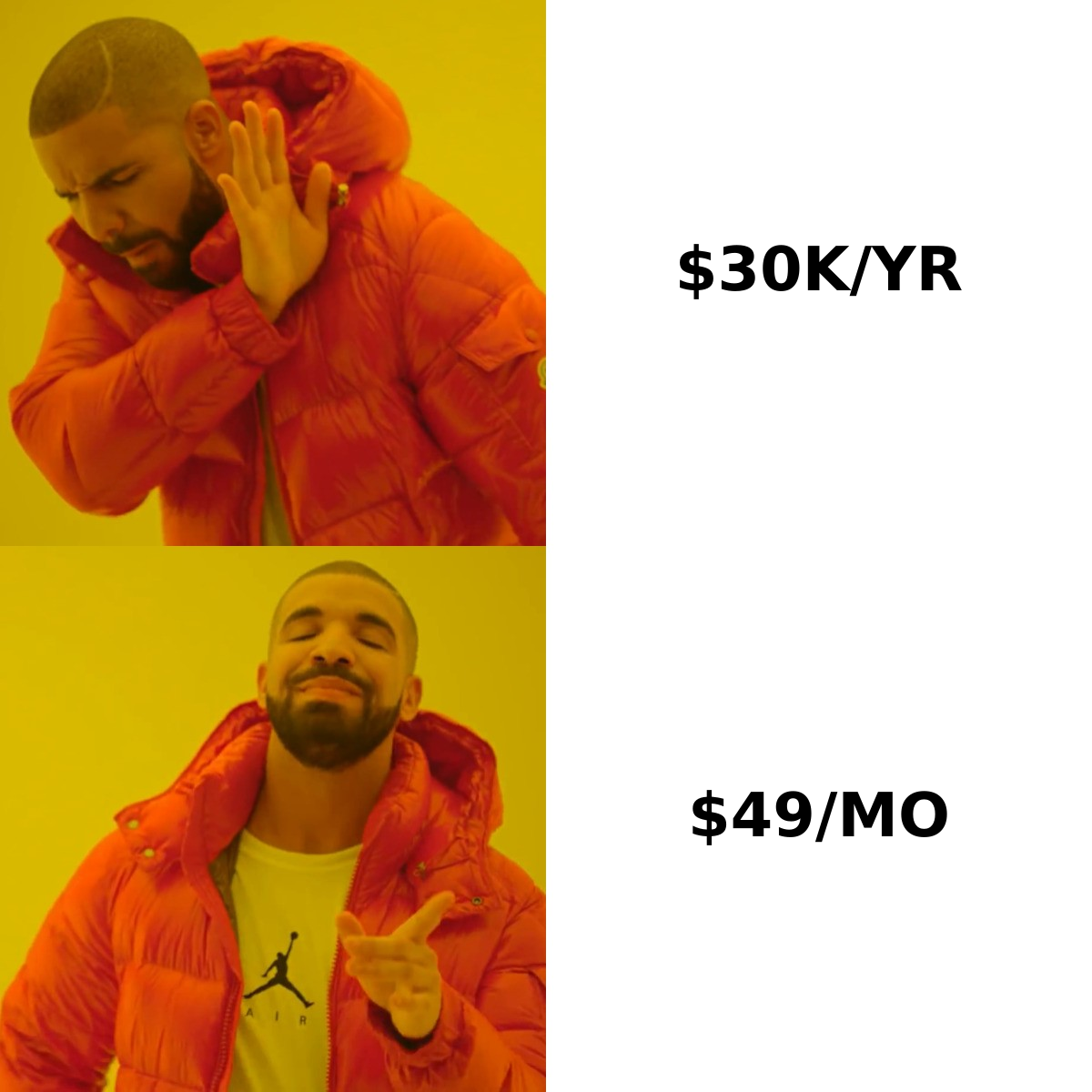
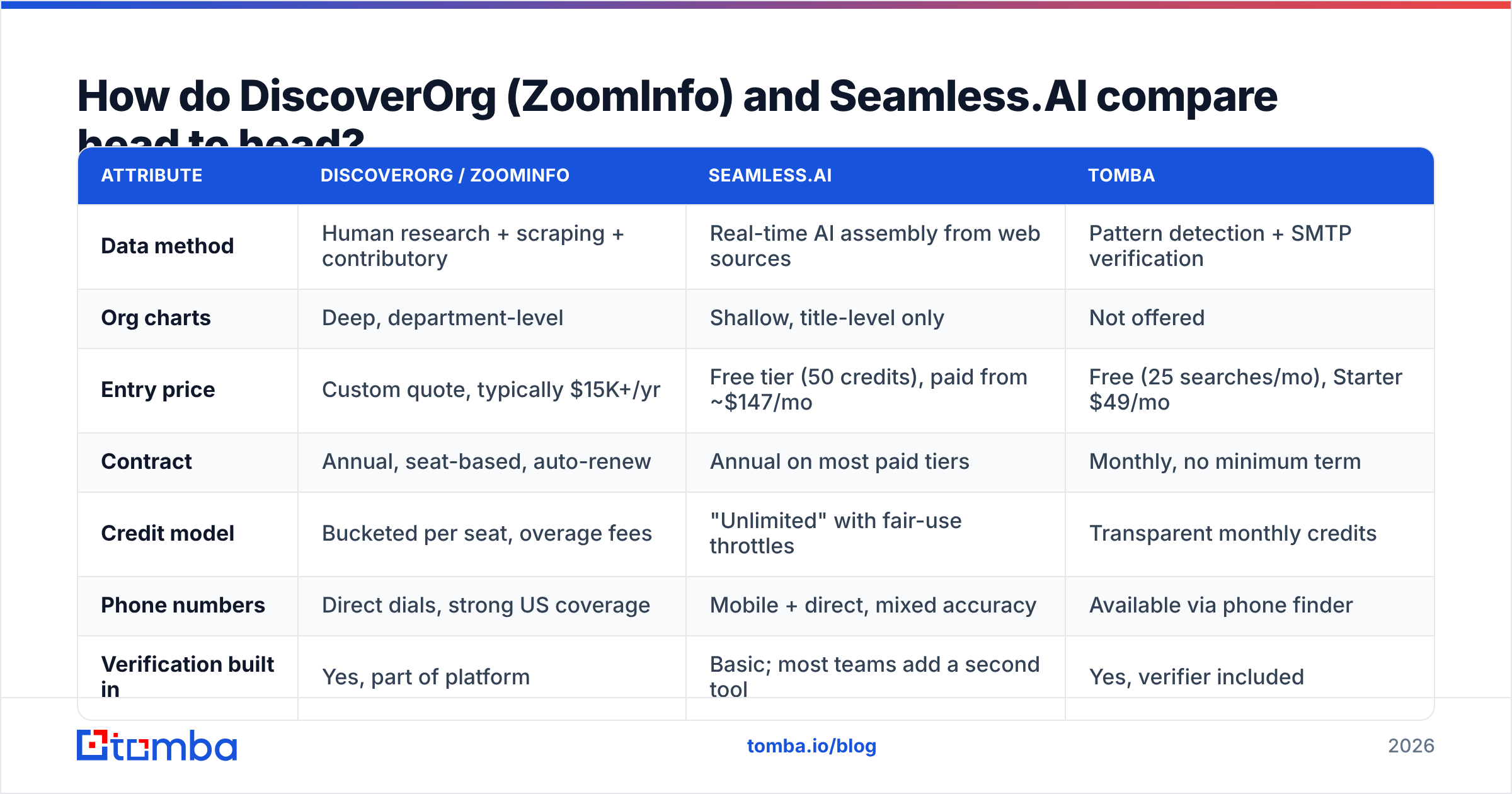
DiscoverOrg vs SeamlessAI: how do they compare head to head?#
| Attribute | DiscoverOrg / ZoomInfo | Seamless.AI | Tomba |
|---|---|---|---|
| Data method | Human research + scraping + contributory | Real-time AI assembly from web sources | Pattern detection + SMTP verification |
| Org charts | Deep, department-level | Shallow, title-level only | Not offered |
| Entry price | Custom quote, typically $15K+/yr | Free tier (50 credits), paid from ~$147/mo | Free (25 searches/mo), Starter $49/mo |
| Contract | Annual, seat-based, auto-renew | Annual on most paid tiers | Monthly, no minimum term |
| Credit model | Bucketed per seat, overage fees | "Unlimited" with fair-use throttles | Transparent monthly credits |
| Phone numbers | Direct dials, strong US coverage | Mobile + direct, mixed accuracy | Available via phone finder |
| Verification built in | Yes, part of platform | Basic; most teams add a second tool | Yes, verifier included |
| Best for | Enterprise ABM, 50+ reps | High-volume SDR teams, SMB targets | Focused prospecting, dev teams, agencies |
| Worst for | Small teams, tight budgets | Regulated industries, EU targets | Deep org-chart mapping |
Two rows in that table decide most deals: entry price and contract. The rest is a feature debate you can work around. A $15,000 annual commitment is not something you can work around when your whole outbound budget is $12,000.
Which one has better data accuracy?#
Neither publishes an audited number you can trust at face value, so judge them by mechanism.
DiscoverOrg-lineage data ages predictably. A researched record has a known last-verified date. When a VP of Engineering leaves, the record does not update that same afternoon. The refresh cycle catches it later. Expect strong accuracy on enterprise North American accounts. Expect weaker coverage on companies under 50 employees, EU-based firms, and anything that changed hands last quarter.
Seamless.AI data is fresh but unstable. Records are built at query time, so you sometimes get a contact that a warehouse-based tool has never heard of. That is useful for new companies and recent hires. You also get pattern-guessed addresses shown with the same confidence as verified ones. The usual failure mode is a list that looks complete and bounces at 15–25%.
The fix is the same either way: run every list through an email verifier before it touches your sending domain. Bounce rate is the fastest way to wreck email deliverability, and no vendor's marketing number protects you from it. Catch-all domains deserve extra care. A catch-all verifier tells you whether an "accepted" response really means the mailbox exists.
What do they actually cost?#
Here is where the comparison gets uncomfortable for both vendors.
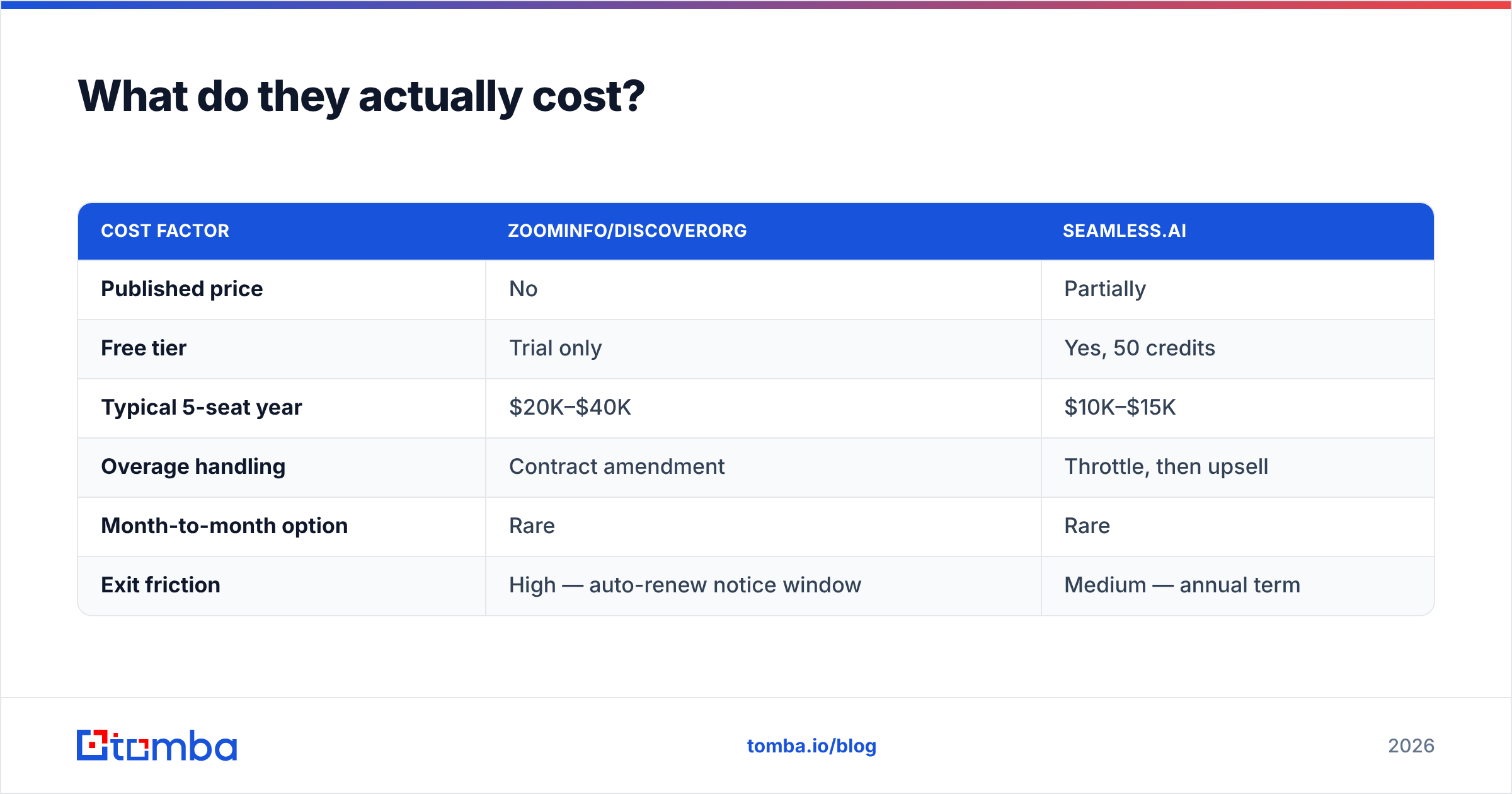
ZoomInfo (DiscoverOrg lineage) does not publish pricing. Quotes reported by buyers on review sites and procurement forums cluster around $15,000–$25,000/year for a small team of 3–5 seats. They rise past $40,000 once you add intent data, Engage, or the WebSights visitor module. Credits are bucketed per seat. Going over them mid-year means an amendment, not a self-serve upgrade. Auto-renewal clauses with 30–60 day notice windows are standard, and they are the most common complaint in public reviews.
Seamless.AI offers a free tier and publishes a Pro tier, but the number you see rarely matches the number you sign. Sales-assisted pricing is the norm above the entry plan, and annual commitment is expected. The "unlimited" label sits on top of throttles that reps discover in week three. Budget $10,000–$15,000/year for a 5-seat team as a realistic planning figure.
| Cost factor | ZoomInfo/DiscoverOrg | Seamless.AI |
|---|---|---|
| Published price | No | Partially |
| Free tier | Trial only | Yes, 50 credits |
| Typical 5-seat year | $20K–$40K | $10K–$15K |
| Overage handling | Contract amendment | Throttle, then upsell |
| Month-to-month option | Rare | Rare |
| Exit friction | High — auto-renew notice window | Medium — annual term |
Compare that to transparent Tomba pricing: free for 25 searches a month, $49/mo Starter, $99/mo Growth, $249/mo Pro. Cheaper is not automatically better. But you should know what a data problem costs before a procurement cycle tells you.
Who should choose DiscoverOrg/ZoomInfo?#
Pick it when all of the following are true:
- You sell into enterprise accounts where the buying committee has 5+ stakeholders and you need reporting lines, not just names.
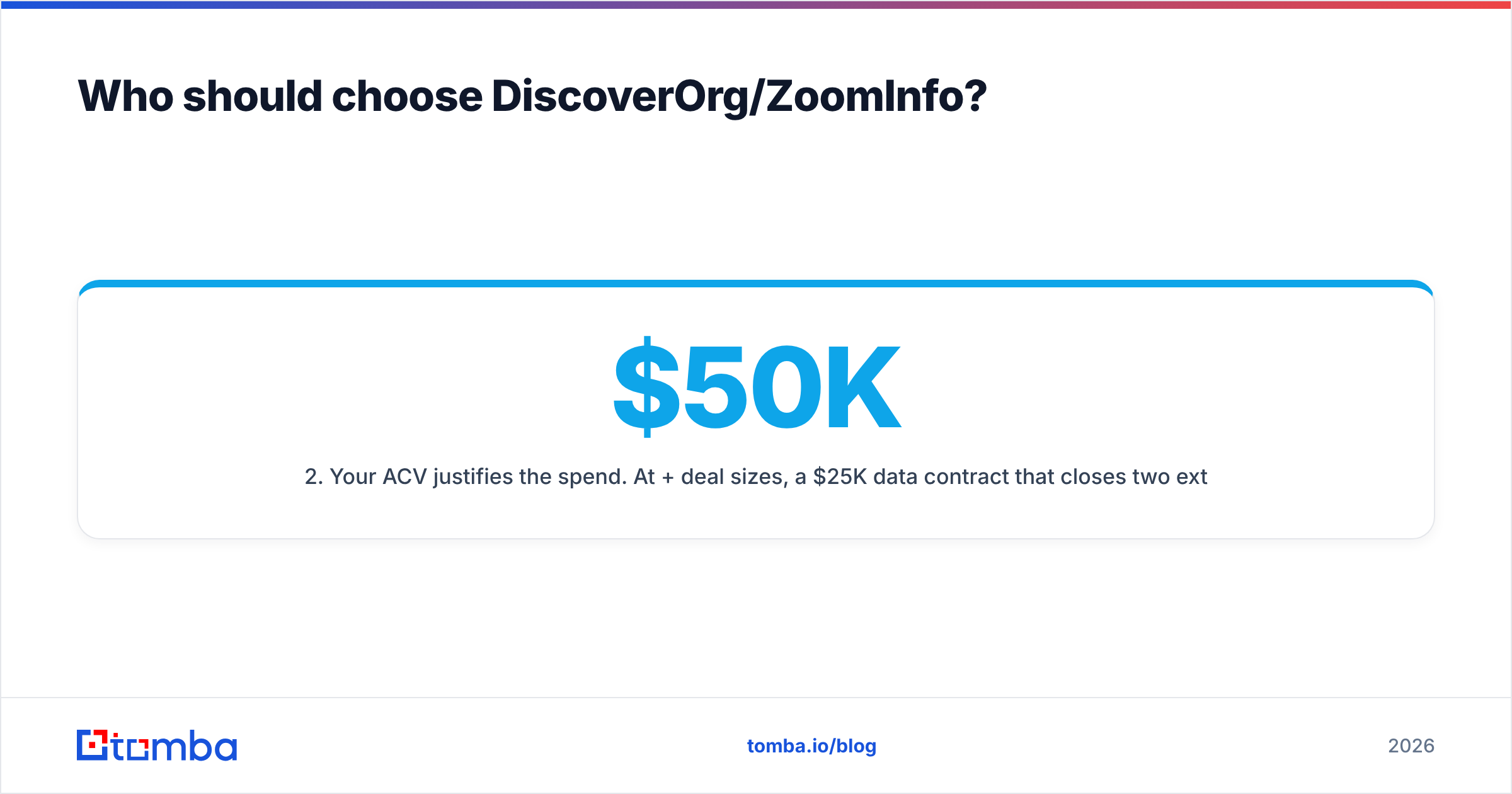
- Your ACV justifies the spend. At $50K+ deal sizes, a $25K data contract that closes two extra deals pays for itself. At $5K ACV it does not.
- You need intent signals integrated with the contact data rather than bolted on from a third vendor.
- You have a RevOps function to administer credits, run the Salesforce integration hygiene, and manage the renewal.
- North American coverage is your priority. Coverage outside the US and Canada thins noticeably.
If two or more of those are false, you are buying capability you will not use.
Who should choose Seamless.AI?#
Pick it when:
- Volume matters more than precision. You run high-touch-count SDR motions where a 15% bounce rate is annoying but survivable — and you have a separate verification step.
- Your targets are SMB and mid-market. Seamless tends to surface contacts at smaller companies that curated databases missed entirely.
- You want reps self-serving inside the browser rather than pulling lists through ops.
- Your budget is five figures, not six.
Skip it if you sell into regulated industries or European accounts. There, data provenance comes up in security review, and "assembled from public sources by AI" is a harder answer to defend than a documented research process.
Is there a third option that fits most teams?#
Yes, and it is worth naming plainly: most teams comparing these two are over-buying.
The honest question is what job you are hiring the tool for. Say the job is "find and verify the work email of a specific person at a specific company, thousands of times a month." Then you are paying enterprise-platform prices for a lookup function. That is the gap tools like Tomba, Findymail, and BookYourData fill from different angles — BookYourData with pay-as-you-go verified list purchases, Tomba with a search-and-verify API you run yourself.
A workable stack for a 5–15 rep team:
- Domain search to pull every published address at a target company, with pattern confidence scores.
- Bulk email finder to process a CSV of names and companies in one pass.
- Verification on everything before it enters your sequencer.
- Tomba API if you want enrichment inside your own product or CRM workflow instead of a separate UI.
That runs $49–$249/month with no annual commitment. It does not give you org charts or intent data. If you truly need those, buy ZoomInfo. If you have been telling yourself you need them for two renewal cycles without using them, you have your answer.
What should you test before signing either contract?#
Run the same evaluation on both, with your own accounts:
- Build a 100-row control list of contacts you already know are correct — customers, past deals, people you have emailed this quarter.
- Query both tools for those exact contacts. Score exact match, partial match, and miss.
- Pull 200 net-new contacts from your actual ICP in each tool, then run them through independent verification. Record the invalid rate.
- Check coverage of your hardest segment — smallest companies, non-US geographies, most recently founded firms. Averages hide the gaps that matter.
- Ask for the renewal terms in writing before the demo ends: notice window, overage rate, seat reduction policy, and what happens to exported data after termination.
Step five kills more deals than step three, and it should. Gartner research on sales technology finds that most underperforming stack investments fail on adoption and contract structure, not on feature gaps.
The verdict#
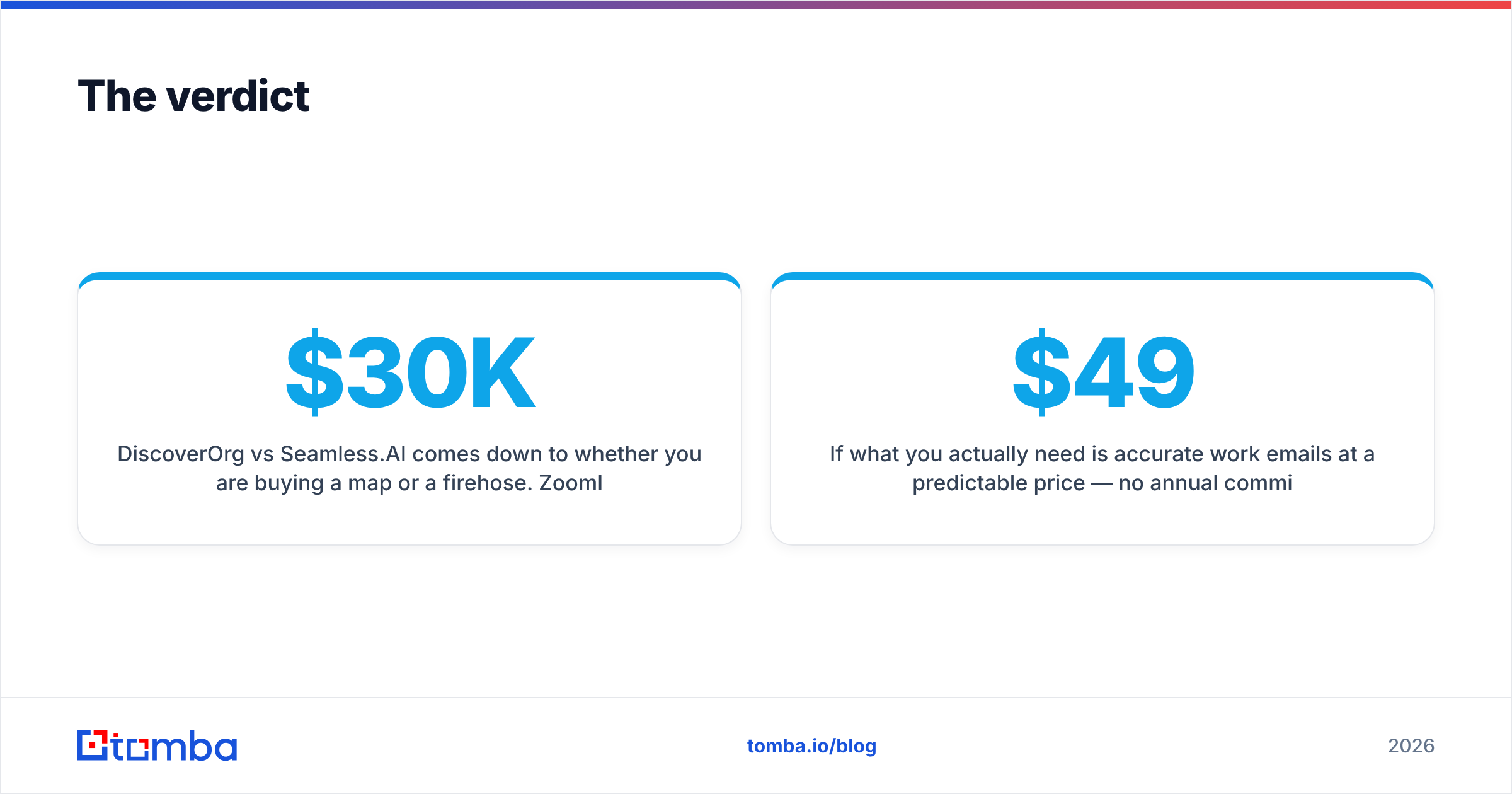
DiscoverOrg vs SeamlessAI comes down to whether you are buying a map or a firehose. ZoomInfo's DiscoverOrg lineage gives you a researched map of enterprise buying committees. That map only makes sense above roughly $30K ACV. Seamless.AI gives you a firehose of contacts at a fraction of the cost, on the understanding that you filter it yourself.
Both lock you into an annual term. Both will quote higher than you expect. Neither is the right first purchase for a team that has not yet proven its outbound motion converts.
If what you need is accurate work emails at a predictable price — no annual commitment, no credit negotiation, no procurement cycle — start with the Tomba Email Finder. The free tier gives you 25 searches a month to test against your own control list, and Starter is $49/mo when you are ready to scale. Run the same 100-row accuracy test you would run on a $25,000 contract, and let the numbers decide.
Related guides#
Ready to find emails that actually work?
Join 150,000+ professionals who stopped guessing and started sending. Free credits on signup — no credit card required.
Get the Tomba newsletter
Practical outbound tactics and product updates — once every two weeks.
About the author