DiscoverOrg vs SellHack: Which B2B Data Tool Wins in 2026?
DiscoverOrg (now ZoomInfo) and SellHack sit at opposite ends of the B2B data market: enterprise org charts versus a cheap Chrome-extension email finder. Here's which one fits your team — and where a third option beats both.
TL;DR
- DiscoverOrg no longer exists as a standalone product. It merged with ZoomInfo in 2019 and the brand was folded into ZoomInfo SalesOS. Buying "DiscoverOrg" in 2026 means buying a ZoomInfo contract — typically $15,000–$40,000/year with an annual commitment.
- SellHack is the opposite bet: a lightweight Chrome extension and bulk email lookup tool priced under $100/month, aimed at solo sellers and small agencies who want addresses, not org charts.
- These tools barely compete. DiscoverOrg/ZoomInfo sells intelligence (technographics, org hierarchy, intent signals). SellHack sells contact discovery. Choosing between them is really choosing between two different budgets and two different jobs.
- Accuracy is the deciding factor for most buyers. Neither tool publishes an independently audited bounce rate, so you should run a 200-contact bake-off before signing anything.
- If your actual need is "find and verify work emails at scale," a dedicated finder-verifier like Tomba at $49/mo covers it without an enterprise contract or a per-seat extension license.
What happened to DiscoverOrg?#
DiscoverOrg was acquired by — and then merged with — ZoomInfo. The combined company kept the ZoomInfo name and retired DiscoverOrg as a separate SKU. If a rep or a blog post tells you they're "comparing DiscoverOrg," what they mean in 2026 is ZoomInfo's contact and company database, sold under SalesOS, MarketingOS, or the newer copilot bundles.
That matters for this comparison for three reasons:
- Pricing moved up. DiscoverOrg was already an enterprise product. Post-merger ZoomInfo contracts commonly land in the $15,000–$40,000/year range depending on seats, credits, and modules. Public reviews on G2 repeatedly cite cost and rigid renewals as the top complaints.
- The data promise changed. DiscoverOrg's original differentiator was human-verified org charts in IT, marketing, finance, and HR — researchers literally calling companies to map reporting lines. ZoomInfo scaled that with automated collection, which broadened coverage but diluted the "every record touched by a human" claim.
- The buying motion is enterprise. Annual contract, procurement review, security questionnaire, seat minimums. You don't swipe a card and start.
SellHack, by contrast, has stayed exactly what it was: a scrappy tool that guesses and checks email addresses from a name and a domain, plus a browser extension for LinkedIn profiles.
What is SellHack, and who actually uses it?#
SellHack is a contact-discovery utility. You give it a first name, last name, and company domain; it generates likely permutations, checks them against mail servers, and returns the address it believes is deliverable. The Chrome extension does the same thing from a LinkedIn profile page, and there's a bulk CSV upload for list work.
Its user base skews toward:
- Solo founders doing their own outbound, 50–200 emails a week
- Small agencies building prospect lists for clients
- Recruiters sourcing candidates off LinkedIn
- Anyone who tried ZoomInfo's quote and closed the tab
What SellHack does not do: intent data, org charts, technographics, CRM enrichment workflows, ABM scoring, or conversation intelligence. It finds emails. That's the whole product, and for a meaningful slice of buyers that's the whole need.
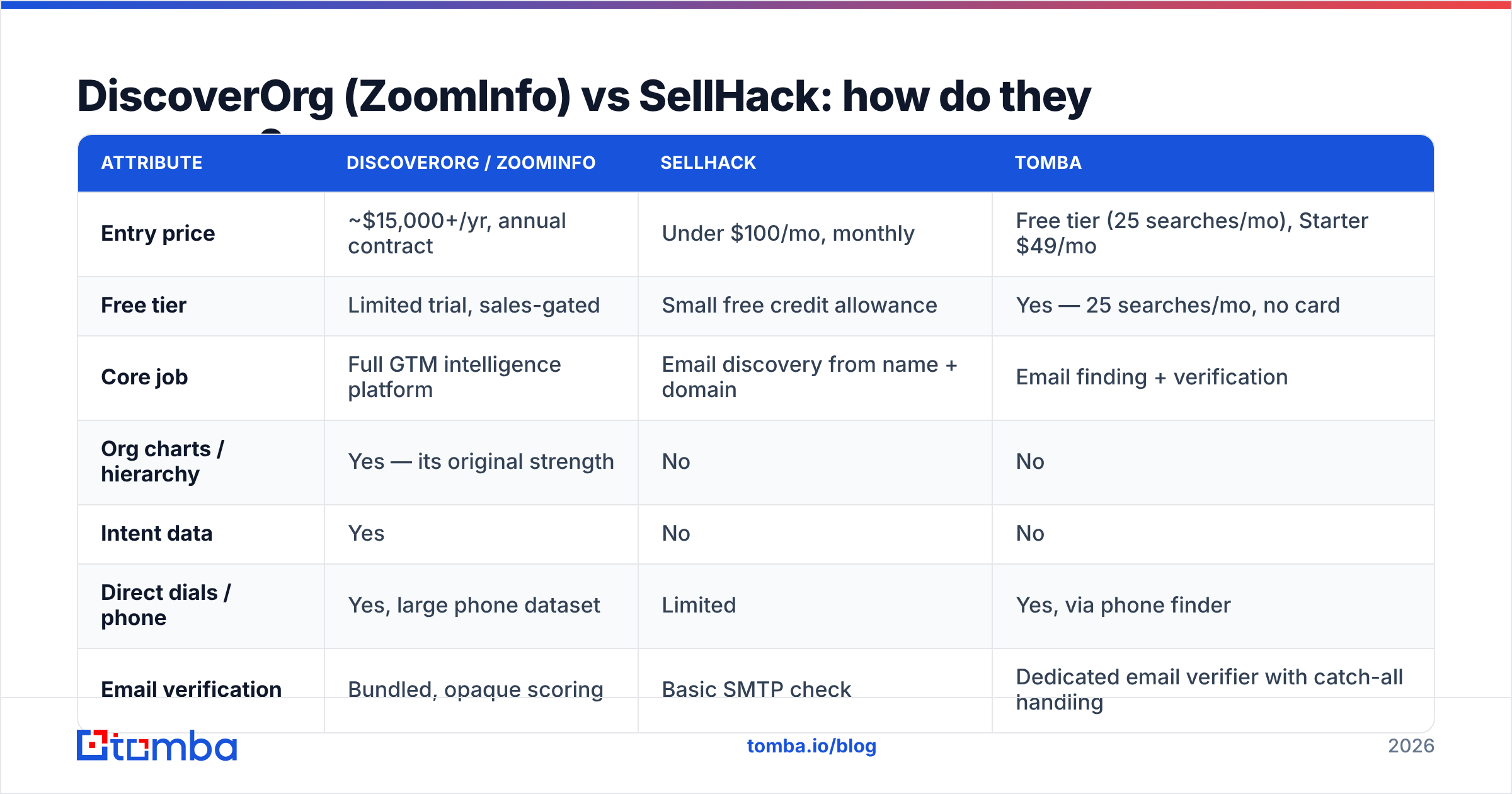
DiscoverOrg (ZoomInfo) vs SellHack: how do they compare?#
| Attribute | DiscoverOrg / ZoomInfo | SellHack | Tomba |
|---|---|---|---|
| Entry price | ~$15,000+/yr, annual contract | Under $100/mo, monthly | Free tier (25 searches/mo), Starter $49/mo |
| Free tier | Limited trial, sales-gated | Small free credit allowance | Yes — 25 searches/mo, no card |
| Core job | Full GTM intelligence platform | Email discovery from name + domain | Email finding + verification |
| Org charts / hierarchy | Yes — its original strength | No | No |
| Intent data | Yes | No | No |
| Direct dials / phone | Yes, large phone dataset | Limited | Yes, via phone finder |
| Email verification | Bundled, opaque scoring | Basic SMTP check | Dedicated email verifier with catch-all handling |
| Chrome extension | Yes | Yes — the main interface | Yes |
| API access | Yes, enterprise-tier | Limited | Yes, on all paid plans |
| Bulk processing | Yes, credit-metered | CSV upload | Bulk email finder |
| Contract flexibility | Annual, auto-renew, seat minimums | Cancel anytime | Monthly or annual |
| Best for | 20+ seat sales orgs with a data budget | Solo sellers and micro-agencies | Teams that need accurate emails without a platform contract |
The table makes the real question obvious. You are not choosing between two email tools. You are choosing between a platform and a utility.
Which one is more accurate?#
Neither vendor publishes an independently audited accuracy figure, so treat any number you see — including theirs — as marketing until you test it.
Here's what the evidence actually supports:
- ZoomInfo has the deeper dataset. Hundreds of millions of professional profiles, refreshed continuously. On coverage — "does this person exist in the database at all?" — it wins against almost anything, particularly for North American mid-market and enterprise accounts.
- Coverage is not the same as deliverability. A record that exists can still be stale. Reviews consistently flag ZoomInfo records for people who left the company months earlier. Big database, real decay.
- SellHack's model is inference, not a database. It builds candidate addresses from patterns and validates them. That means it can find people who aren't in any database — but it also means results are only as good as the pattern engine and the SMTP check behind it. On catch-all domains, where the mail server accepts everything, pattern-based tools degrade badly.
- Catch-all handling is where most tools quietly fail. Roughly a fifth of business domains are catch-all. If a tool returns "valid" for every address on those domains, your bounce rate absorbs the difference. This is precisely why catch-all verification is a separate capability rather than a checkbox.
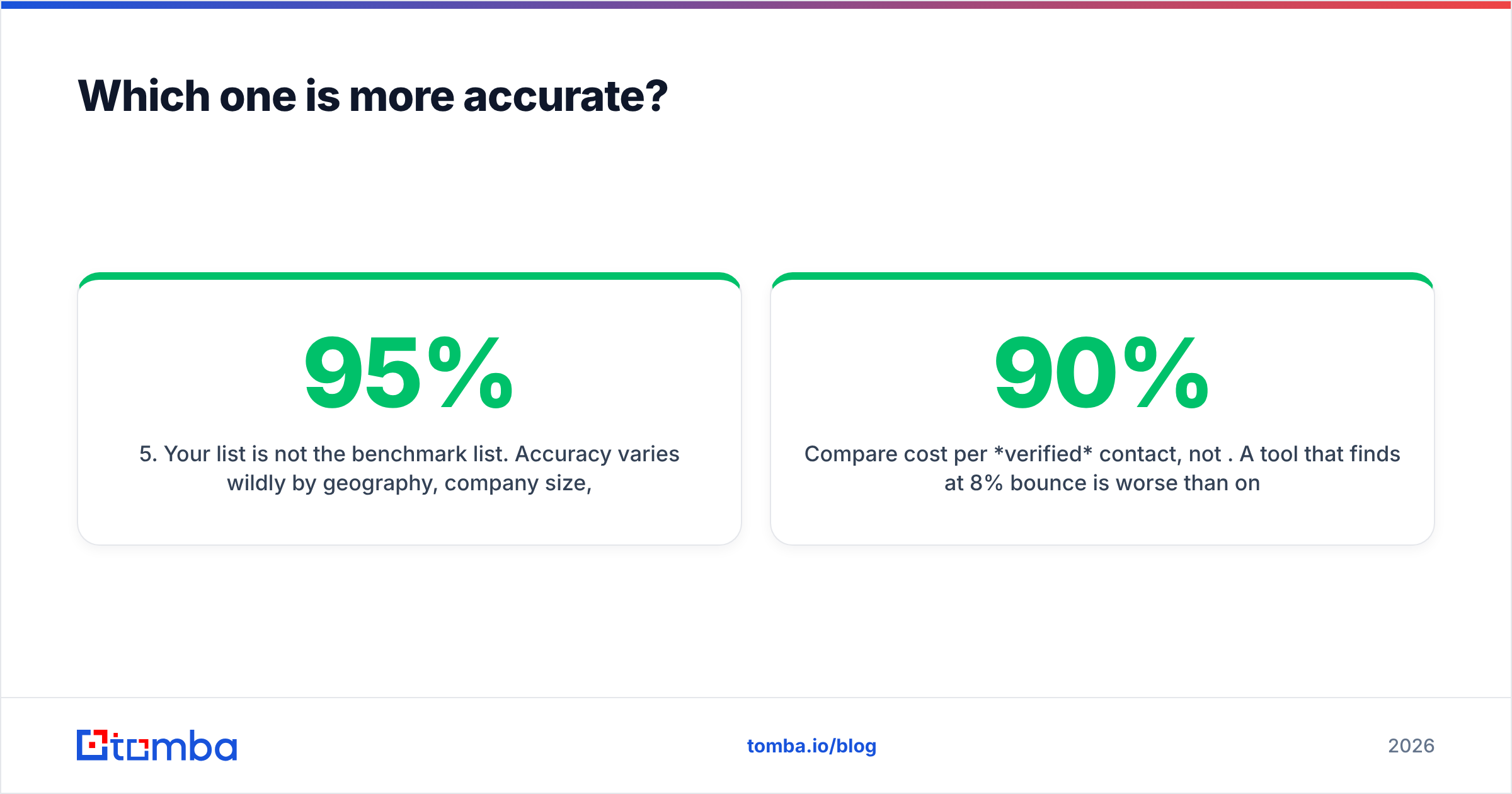
- Your list is not the benchmark list. Accuracy varies wildly by geography, company size, and vertical. A tool that hits 95% on US SaaS VPs might hit 60% on European manufacturing plant managers.
How to run your own 200-contact bake-off#
Do this before you sign anything. It takes an afternoon.
- Build a control list. Take 200 real prospects from your ICP, scraped from LinkedIn or a conference attendee list. Do not use a vendor-supplied sample.
- Run all candidates blind. Push the same 200 through each tool. Record found/not-found, plus the confidence score each tool returns.
- Send a real campaign. Use a warmed domain and a plain-text one-liner. The only metric that matters is hard bounce rate.
- Score three numbers. Match rate (how many it found), bounce rate (how many were wrong), and cost per verified contact (total spend ÷ contacts that didn't bounce).
- Compare cost per verified contact, not per credit. A tool that finds 90% at 8% bounce is worse than one that finds 75% at 1% bounce.
Cost per verified contact is the only number that survives a procurement conversation.
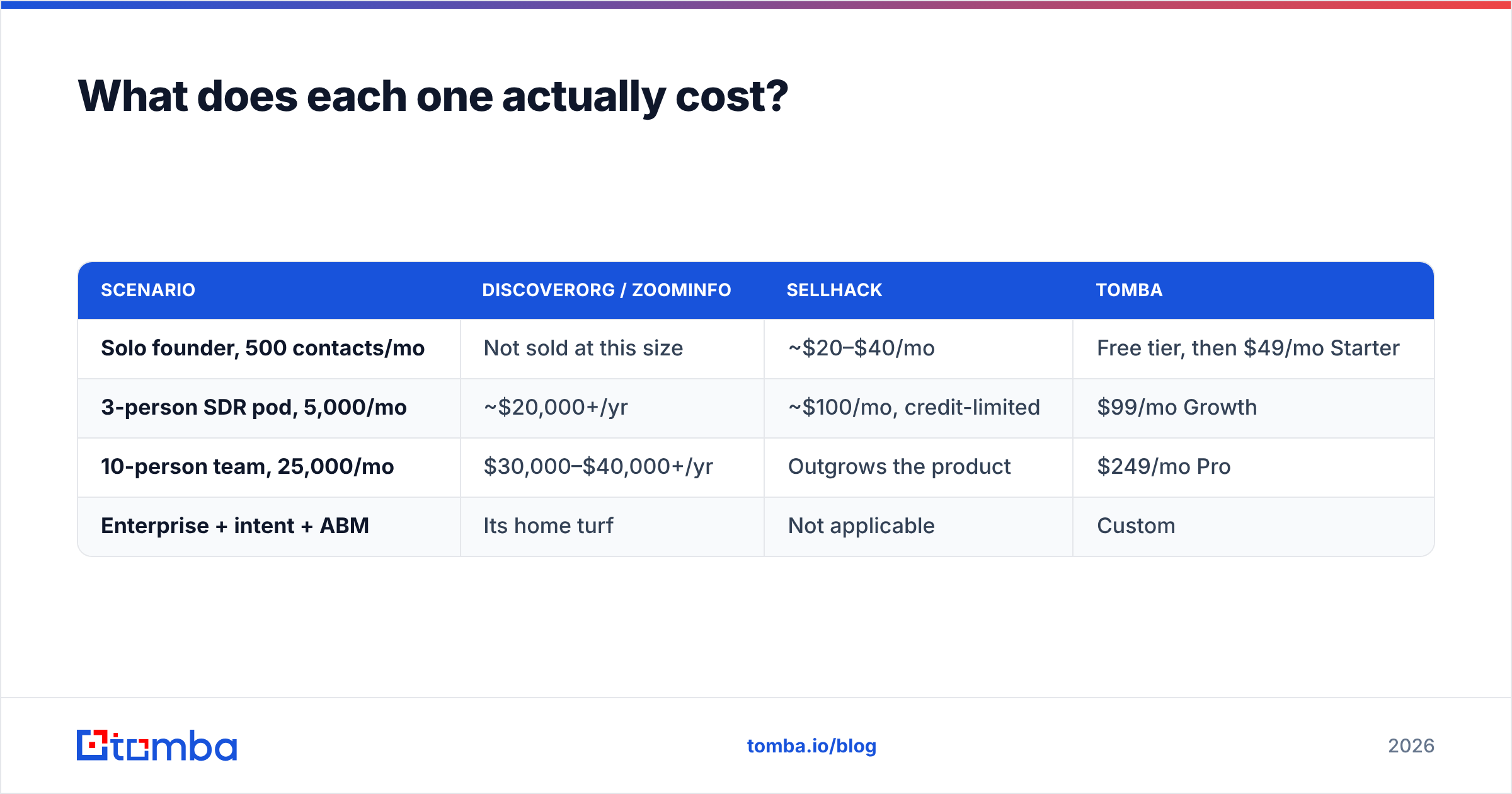
What does each one actually cost?#
| Scenario | DiscoverOrg / ZoomInfo | SellHack | Tomba |
|---|---|---|---|
| Solo founder, 500 contacts/mo | Not sold at this size | ~$20–$40/mo | Free tier, then $49/mo Starter |
| 3-person SDR pod, 5,000/mo | ~$20,000+/yr | ~$100/mo, credit-limited | $99/mo Growth |
| 10-person team, 25,000/mo | $30,000–$40,000+/yr | Outgrows the product | $249/mo Pro |
| Enterprise + intent + ABM | Its home turf | Not applicable | Custom |
Two honest caveats.
For ZoomInfo: the sticker price buys more than emails. If your team genuinely uses intent signals, org charts, and CRM sync to build territory plans, the per-seat math can work. Companies with a real RevOps function and a 20+ seat sales floor are the intended buyer, and they aren't overpaying — they're buying a different product.
For SellHack: cheap is only cheap if the data holds. Credit-metered tools that return unverified guesses transfer the cost to your sender reputation, and a burned domain costs more than any subscription. Check whether the credits you're buying include verification or just lookups.
If you want the full breakdown of what per-credit pricing looks like without an annual commitment, Tomba pricing is published on the site — no demo call required to see a number.

When should you pick DiscoverOrg/ZoomInfo?#
Pick it when all of these are true:
- You have 15+ quota-carrying reps and a budget line for data
- Your motion is account-based, and you need to map buying committees, not just find one contact
- Intent data will actually change what your reps do on Monday morning — not just sit in a dashboard
- You have someone in RevOps who will own hygiene, dedupe, and CRM sync
- You're targeting North American mid-market/enterprise, where its coverage is strongest
If two or more of those are false, you're paying platform prices for a lookup tool. That's the single most common buying mistake in this category, and it's why the Apollo alternative and ZoomInfo-alternative searches are perennially high volume.
When should you pick SellHack — or something else?#
SellHack makes sense when your volume is genuinely small, your targets are easy-to-pattern domains, and your budget is a personal card rather than a PO. It's a fine tool for what it is.
Where it strains:
- Scale. Bulk work beyond a few thousand rows a month hits credit ceilings and throughput limits.
- Catch-all domains. Pattern inference plus a basic SMTP ping is the weakest configuration against catch-alls.
- Team workflows. No meaningful shared workspace, seat management, or audit trail.
- Integrations. If you need data to land in HubSpot or Salesforce automatically rather than via CSV, you'll be building glue yourself.
There's also a middle path most comparison posts skip. Neither an enterprise platform nor a browser-extension utility — a purpose-built finder-verifier with an API, bulk processing, and real catch-all logic.
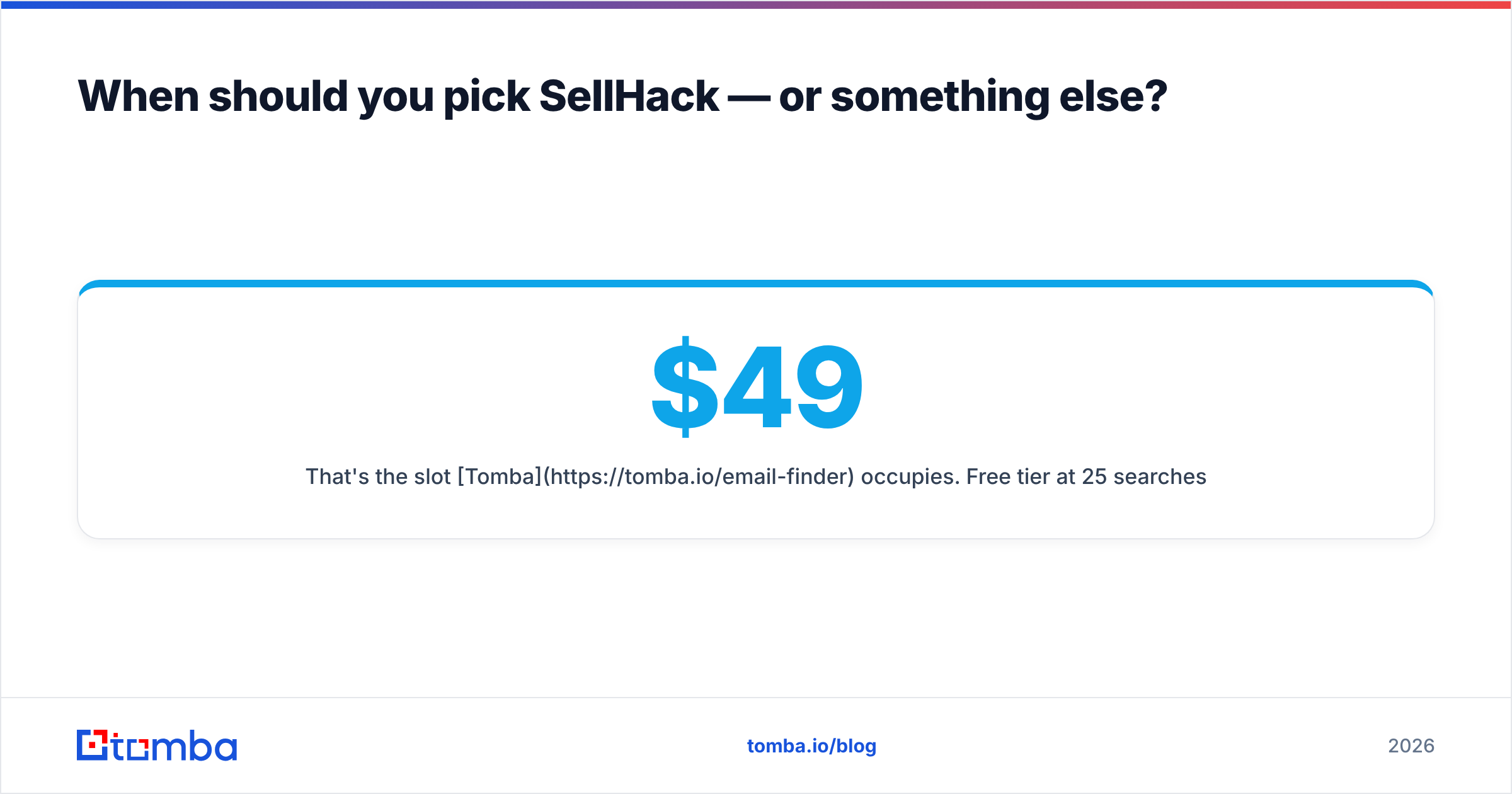
That's the slot Tomba occupies. Free tier at 25 searches/month, Starter at $49/mo, Growth at $99/mo, Pro at $249/mo, all month-to-month. Domain search pulls every public address at a company, the verifier runs deliverability checks including catch-all detection, and the Tomba API means you can wire enrichment into your own workflows instead of exporting CSVs.
It's also worth naming honest peers rather than pretending one tool wins everything. BookYourData takes a different and legitimate approach — pay-as-you-go prebuilt B2B lists with a bounce guarantee, which suits teams that want a finished list rather than a lookup engine. Different job, real option, worth a look if list-buying fits your motion better than per-contact discovery.
What about data compliance and sourcing?#
This is the section most comparisons skip, and it's the one that gets deals killed in procurement.
Any B2B data vendor you evaluate should answer four questions in writing:
- Where does the data come from? Public web, opt-in contribution networks, licensed partners, or user-contributed contact books? Contributory networks — where the tool reads users' address books — carry more GDPR exposure than public-web collection.
- What's the deletion process? Under GDPR and CCPA, a subject can demand removal. How fast, and does removal propagate to exports you already made?
- Is there a DPA? A signed Data Processing Agreement is table stakes for EU-targeting teams.
- What's the legitimate-interest basis? For B2B outreach in the EU, you're leaning on legitimate interest, which requires the vendor's sourcing to be defensible.
ZoomInfo publishes detailed compliance documentation and has a formal privacy center — a genuine advantage of buying enterprise. Smaller tools vary. Tomba documents where its data comes from publicly. For background on the underlying legal framework, the GDPR overview is a reasonable starting point before you talk to counsel.
Whatever you buy, get the answers before the contract, not after your first complaint.
So which one wins?#
There's no single winner, because they aren't playing the same game. Here's the decision in one pass:
- Choose ZoomInfo (formerly DiscoverOrg) if you're an enterprise sales org that will use org charts and intent data operationally, and you have the budget and the RevOps headcount to make the platform earn its price.
- Choose SellHack if you're one person, doing modest volume, on easy domains, and you want to spend less than a dinner per month.
- Choose a dedicated finder-verifier if you're in the large middle — a real team doing real volume that needs accurate, verified contact data without a five-figure annual commitment or a platform you'll use 15% of.
Run the 200-contact bake-off. Compare cost per verified contact. Ignore the demo deck.
Start with the data problem, not the platform. If what you actually need is verified work emails you can trust in a sequence, try the Tomba Email Finder — 25 free searches a month with no card, $49/mo when you outgrow it, catch-all detection built into the verifier, and an API that drops into whatever stack you already run. Test it against your own 200-contact control list and let the bounce rate decide.
Related guides#
Ready to find emails that actually work?
Join 150,000+ professionals who stopped guessing and started sending. Free credits on signup — no credit card required.
Get the Tomba newsletter
Practical outbound tactics and product updates — once every two weeks.
About the author