DiscoverOrg vs Snappy Leads: Which B2B Data Tool Wins?
DiscoverOrg (now ZoomInfo) and Snappy Leads sit at opposite ends of the B2B data market. Here is how they actually compare on pricing, coverage, accuracy, and contract risk — and when neither is the right call.
DiscoverOrg vs Snappy Leads comes down to one question: do you sign a five-figure annual contract, or pay monthly and cancel when you want? Here is how the two compare on price, data quality, and contract risk.
TL;DR
- DiscoverOrg no longer exists on its own. It merged with ZoomInfo in 2019, and its org-chart data now ships inside ZoomInfo SalesOS. Buying "DiscoverOrg" in 2026 means signing a ZoomInfo contract.
- Snappy Leads is the opposite bet: a light, self-serve contact finder with low monthly pricing, no annual lock-in, and much narrower coverage.
- The real choice is not feature-vs-feature. It is annual committed spend with seat minimums versus credits you can cancel next month.
- Need verified firmographics, intent signals, and org charts for enterprise ABM? The ZoomInfo lineage still wins. Need work emails at volume? It is costly overkill.
- Many teams want a third thing: an API-first email finder priced per lookup, like Tomba at $49/mo.
What are DiscoverOrg and Snappy Leads?#
DiscoverOrg built its name on human-verified data. Instead of scraping and hoping, it paid research teams to call companies and confirm reporting lines, budgets, and tech stacks. That made it the go-to for teams selling into IT. Knowing the VP of Infrastructure reports to the CIO — not the CTO — changes your pitch.
In 2019, DiscoverOrg acquired ZoomInfo and took the ZoomInfo name. The DiscoverOrg dataset now sits inside ZoomInfo's platform. You can check the history on ZoomInfo's own site or the ZoomInfo Wikipedia entry. This matters for your evaluation. Any "DiscoverOrg pricing page" you find in 2026 is a legacy artifact or an affiliate page. The buying motion is ZoomInfo's: annual contract, seat-based, credit-capped, quoted by a rep.
Snappy Leads sits at the other end. It is a self-serve tool for founders, freelancers, and small outbound teams. Search for contacts, pull emails, export a CSV, move on. There is no procurement process, no implementation call, and no org-chart layer. Coverage follows the underlying sources. In practice that means strong results for tech and SMB targets, and thin results for large enterprises, regulated industries, and non-English markets.
Neither tool is better. They solve different problems for buyers with different budgets.
DiscoverOrg vs Snappy Leads: how do they compare side by side?#
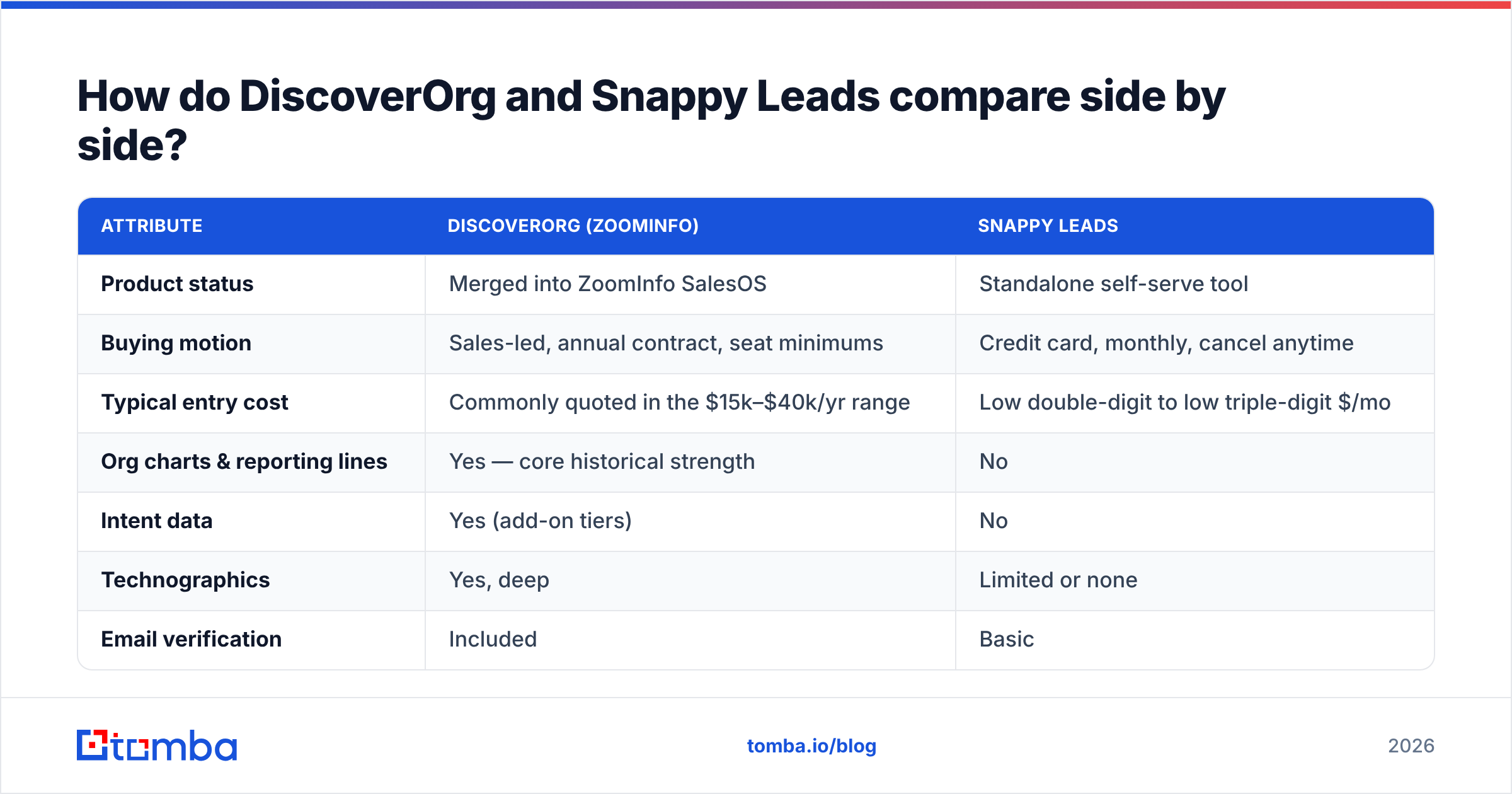
| Attribute | DiscoverOrg (ZoomInfo) | Snappy Leads |
|---|---|---|
| Product status | Merged into ZoomInfo SalesOS | Standalone self-serve tool |
| Buying motion | Sales-led, annual contract, seat minimums | Credit card, monthly, cancel anytime |
| Typical entry cost | Commonly quoted in the $15k–$40k/yr range | Low double-digit to low triple-digit $/mo |
| Org charts & reporting lines | Yes — core historical strength | No |
| Intent data | Yes (add-on tiers) | No |
| Technographics | Yes, deep | Limited or none |
| Email verification | Included | Basic |
| Phone / direct dials | Extensive | Limited |
| API access | Yes, usually gated to higher tiers | Varies by plan |
| Free trial | Demo-gated, rep-controlled | Self-serve free credits |
| Best for | Enterprise ABM, IT-focused sales | Solo founders, lean SDR teams |
| Worst for | Teams under 5 reps or under $20k budget | Enterprise coverage, compliance-heavy buyers |
Two rows decide most evaluations. The first is entry cost. ZoomInfo does not publish pricing, and quotes vary by seats, credits, and add-ons. Buyer reports on G2 still put entry contracts well into five figures a year. The second is buying motion. If finance cannot sign an annual contract this quarter, the DiscoverOrg route is off the table — however good the data is.

Which one has more accurate data?#
Accuracy is the wrong single question in a DiscoverOrg vs Snappy Leads test. Ask instead: accurate about what, and for which segment?
DiscoverOrg's edge was depth per record. One contact could carry title, direct dial, reporting line, department budget, installed tech, and the date each field was verified. For an enterprise seller in a nine-month cycle, that depth pays. One correctly mapped buying committee covers the seat.
Snappy Leads optimizes for speed. It gets you a usable work email for someone you already found on LinkedIn or a company site. Depth is shallow by design. When the target is a 40-person SaaS company, shallow is often enough.
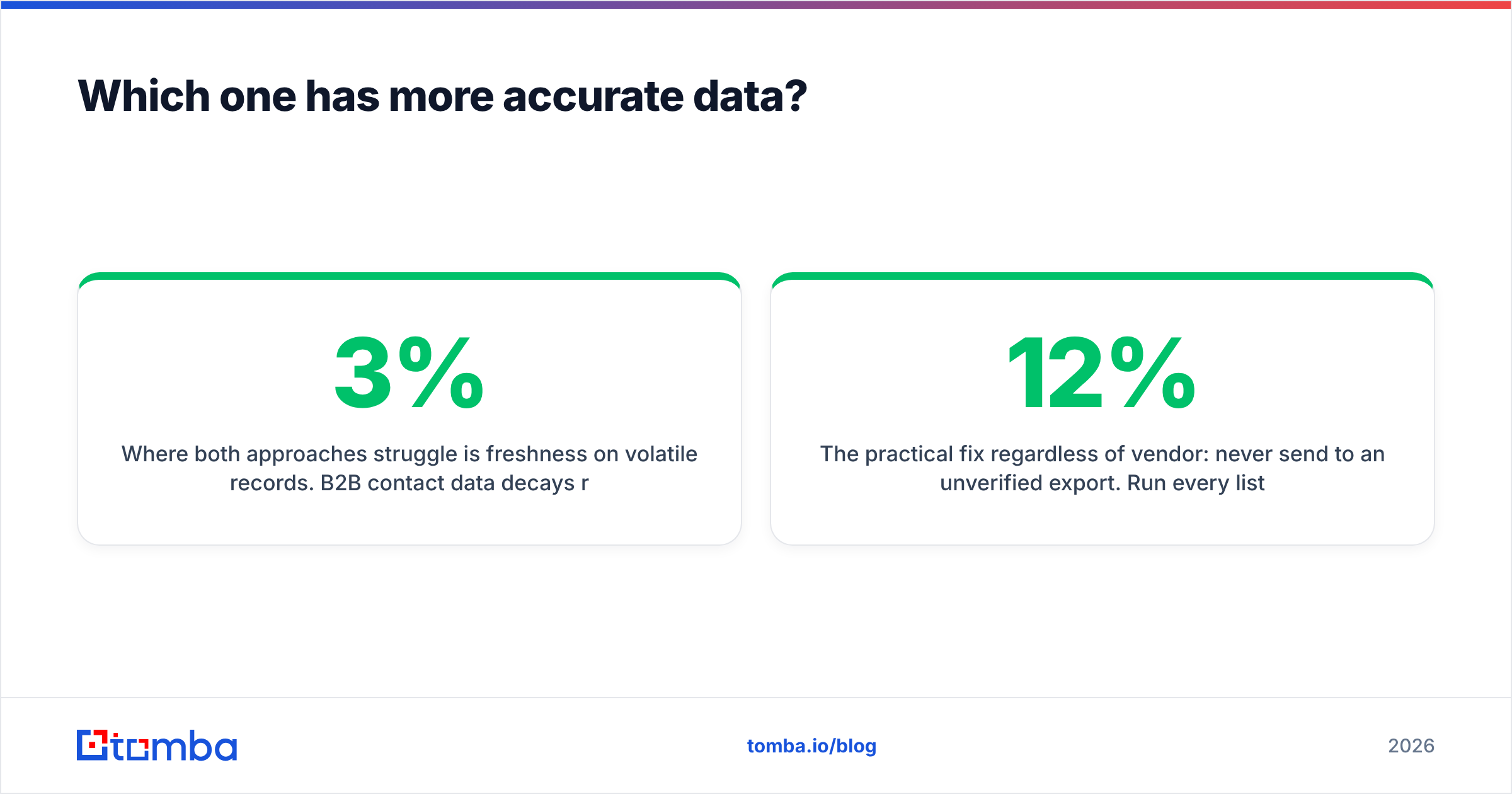
Both approaches struggle with freshness. B2B contact data decays 2–3% per month as people change jobs. That compounds to 25–30% a year. Large static databases carry that decay across the whole index. Real-time lookup tools re-verify at query time, which handles job changes better but returns nothing when the pattern cannot be resolved.

The fix is the same for every vendor: never send to an unverified export. Run every list through an email verifier before it reaches your sequencer. A 12% invalid rate on a 5,000-record export will damage your sending domain faster than any tool choice can help.
What does each actually cost you per usable contact?#
Sticker price hides the real number. Here is how to model it honestly:
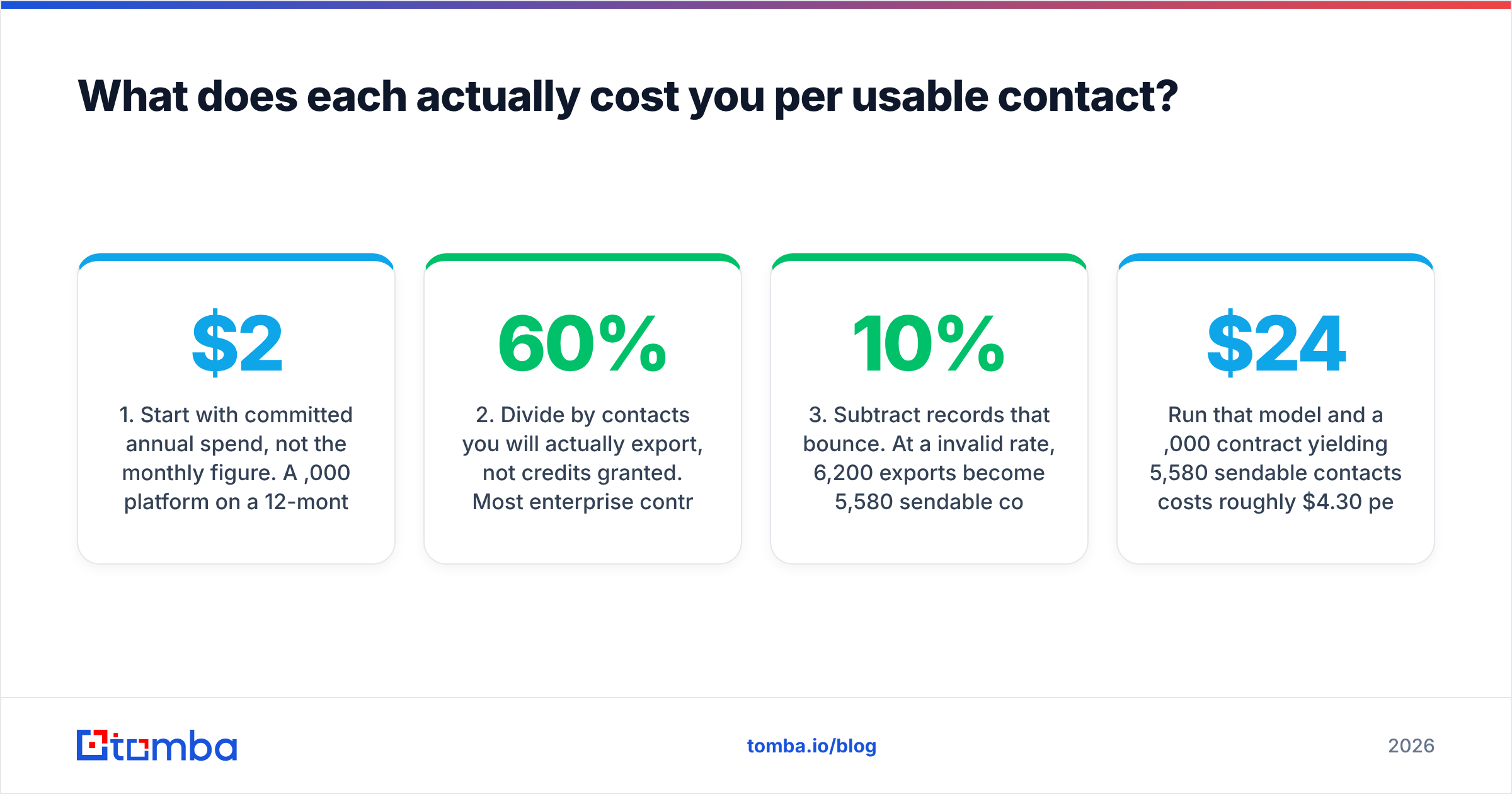
- Start with committed annual spend, not the monthly figure. A $2,000/mo platform on a 12-month contract is a $24,000 commitment on day one. A $49/mo tool is a $49 commitment.
- Divide by contacts you will actually export, not credits granted. Most enterprise contracts cap exports below what the search UI shows. Quoted 10,000 credits and used 6,200? Your cost per contact is 60% higher than the brochure math.
- Subtract records that bounce. At a 10% invalid rate, 6,200 exports become 5,580 sendable contacts. Recompute.
Then add the line items no quote mentions:
- Add the seat tax. Seat-based platforms charge per user, even when only two reps prospect daily. Credit-based tools charge for lookups instead.
- Add overage exposure. Enterprise contracts often price mid-year overages above your negotiated rate. Self-serve tools let you top up or simply stop.
- Count the ramp. Enterprise platforms need onboarding, CRM field mapping, and admin time. Budget two to four weeks of partial productivity.
Run that model. A $24,000 contract that yields 5,580 sendable contacts costs about $4.30 per usable record. A credit-based finder at $99/mo lands closer to $0.20 for the same annual volume. The enterprise premium is real. It just has to buy you something specific, like org charts and intent — not just "more data."
For reference, Tomba pricing publishes every tier: Free at 25 searches/mo, Starter $49/mo, Growth $99/mo, Pro $249/mo, and Enterprise on request. You can compute your cost per contact before you talk to anyone.
Who should pick the DiscoverOrg/ZoomInfo route?#
Choose it when at least three of these are true:
- You sell into enterprise IT and need to know who reports to whom before the first call.
- Your ACV exceeds $25,000, so one extra closed deal covers the contract.
- You run account-based marketing and need intent signals to time outreach.
- You have five or more full-time prospectors to amortize seat minimums.
- Your CRM is Salesforce or HubSpot with an admin who can maintain enrichment sync.
- Procurement can move — you have a budget line and a quarter to spend it.
If fewer than three apply, you will underuse the platform. Then you renew at a discount you resent.
Who should pick Snappy Leads — or something like it?#
Choose the lightweight path when:
- You are one to four people doing outbound alongside other work.
- Your ICP is SMB or mid-market, where public data is dense and org charts are irrelevant.
- You need to start this week, not after a procurement cycle.
- Volume is under a few thousand contacts a month.
- You want to cancel without a renewal conversation.
Here is the trade-off you accept: thinner coverage on large or non-US companies, fewer direct dials, and no intent layer. For a founder-led motion selling a $500/mo product, none of those cost you a deal.

Is there a third option that beats both for email-first outbound?#
Yes — and for many people running this comparison, it is the honest answer.
Suppose your motion is simple: find accounts, find people, get verified work emails, sequence. Then org charts and intent signals are decoration. And if a lightweight tool returns blanks on 35% of your list, you are not saving money either. You are losing pipeline quietly.
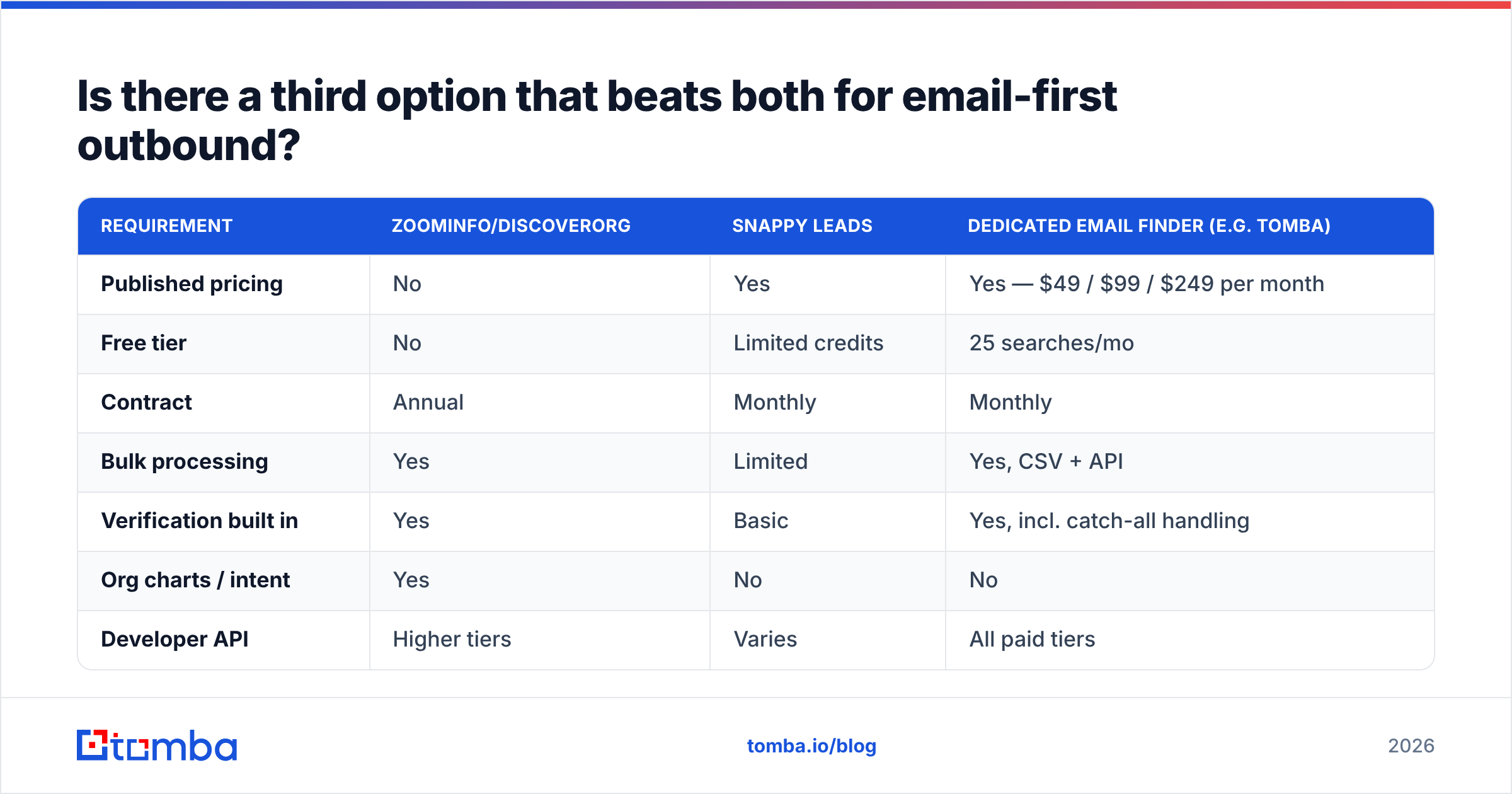
The middle path is a dedicated, API-first email finder with published per-lookup pricing:

| Requirement | ZoomInfo/DiscoverOrg | Snappy Leads | Dedicated email finder (e.g. Tomba) |
|---|---|---|---|
| Published pricing | No | Yes | Yes — $49 / $99 / $249 per month |
| Free tier | No | Limited credits | 25 searches/mo |
| Contract | Annual | Monthly | Monthly |
| Bulk processing | Yes | Limited | Yes, CSV + API |
| Verification built in | Yes | Basic | Yes, incl. catch-all handling |
| Org charts / intent | Yes | No | No |
| Developer API | Higher tiers | Varies | All paid tiers |
| Spreadsheet workflow | Native CRM sync | CSV export | Sheets, Excel, Airtable add-ons |
A specialist tool earns its place in the plumbing. Domain search returns every discoverable address at a company plus the dominant naming pattern, so you can resolve contacts the database missed. A catch-all verifier handles domains that accept every address at SMTP and would otherwise poison your bounce rate. And data enrichment fills firmographic gaps in records you already own, instead of making you re-buy them.
It will not build you an org chart. If you need one, pay for the enterprise platform. That is exactly what it is for.
How should you test both before committing?#
Run a controlled bake-off on the same 200 accounts. Do not compare vendor-supplied sample lists. They are curated.
- Build one target list of 200 real accounts from your ICP, spanning your true company-size and geography mix.
- Pull the same 200 contacts from each tool. Record the match rate: how many returned any contact at all.
- Verify every result through a neutral third party, not the vendor that supplied it. Vendors grading their own homework always score well.
- Measure hard bounce rate on a small live send of 50 addresses per source.
- Score depth: how many records included a direct dial, a correct current title, and a verified LinkedIn profile.
- Compute cost per verified, non-bouncing contact. This single number ends most debates.
Insist on this test before you sign anything annual. If a vendor will not let you test at real volume during evaluation, that tells you how the renewal conversation will go.
What is the verdict?#
The DiscoverOrg vs Snappy Leads verdict rests on your motion, not on a feature list. DiscoverOrg — meaning ZoomInfo today — is the stronger product for enterprise account-based selling. Org charts, intent, and direct dials change win rates there. It is priced for that, and the annual commitment is real. Snappy Leads is a low-risk entry point for solo operators and small teams who need contacts now and can live with coverage gaps.
The failure mode is buying the enterprise platform for an SMB motion. Teams do it because a rep promised coverage they will never use. Then they spend the year justifying the line item. If your outbound is email-first and deals close in under 60 days, buy precision at the contact level. Put the remaining $23,000 into sending infrastructure and headcount.
Ready to test the middle path? Start with the Tomba Email Finder free tier — 25 searches a month, no card, no demo call. Run it against the same 200 accounts you would hand to a ZoomInfo rep. Verify the results, then compare cost per usable contact. If the numbers favor the enterprise platform, you will have proof. If they do not, you just saved a year of committed spend.
Related guides#
Ready to find emails that actually work?
Join 150,000+ professionals who stopped guessing and started sending. Free credits on signup — no credit card required.
Get the Tomba newsletter
Practical outbound tactics and product updates — once every two weeks.
About the author