DiscoverOrg vs Soleadify: Which B2B Data Tool Wins in 2026?
DiscoverOrg (now ZoomInfo) sells enterprise-grade org charts at enterprise prices. Soleadify indexes millions of small local businesses. They barely overlap — here's which one actually fits your motion.
DiscoverOrg vs Soleadify is an odd matchup. One sells enterprise org charts. The other maps millions of small local businesses. This guide breaks down price, coverage, and data quality so you can pick fast.
TL;DR
- DiscoverOrg is gone as a standalone product. It merged with ZoomInfo in 2019 and the brand was retired. Buying "DiscoverOrg" today means buying ZoomInfo SalesOS at ZoomInfo prices — usually $15K–$40K+ per year on an annual contract.
- Soleadify plays a different game. It indexes tens of millions of small and local businesses: dentists, plumbers, agencies, restaurants. That is the long tail enterprise databases miss.
- The overlap is small. ZoomInfo wins on org charts, direct dials, and intent for 500+ employee accounts. Soleadify wins on breadth for sub-50-employee firms and niche verticals.
Two more things to weigh:
- Both are list databases, not verification engines. You still need a verifier before you send. Otherwise your bounce rate decides your domain's fate.
- Mid-market ICP? Skip both. A pay-per-use email finder like Tomba ($49/mo Starter, free tier available) beats a five-figure annual seat you will under-use.
What happened to DiscoverOrg?#
DiscoverOrg acquired ZoomInfo in 2019. The combined company then took the ZoomInfo name. Search "DiscoverOrg pricing" or "DiscoverOrg login" today and you land on zoominfo.com. The product DNA survived. DiscoverOrg was built on human-researched org charts and IT installed-technology profiles. That research layer is still what ZoomInfo charges a premium for.
This matters for your evaluation. You are not comparing a scrappy mid-market tool against Soleadify. You are comparing the largest B2B data vendor on the market against a niche SMB-coverage specialist. Enterprise contracting, seat minimums, and annual commitments come with it.
If you inherited a "DiscoverOrg" line item in your sales stack budget, check the contract. It is a ZoomInfo contract.

What is Soleadify and who is it actually for?#
Soleadify built its index by crawling business websites at scale. It does not lean on contributed contact books or opt-in networks. The result is coverage skewed hard toward the long tail: local service businesses, independent retailers, small agencies, clinics, contractors, and regional operators. None of them show up in a database built around enterprise buying committees.
Concretely, Soleadify is a fit if you sell:
- Vertical SaaS for local businesses — booking software for salons, POS for restaurants, practice management for clinics.
- Services to SMB owners — web design, bookkeeping, insurance, local marketing.
- Geographic territory plays — "every HVAC contractor within 60 miles of Phoenix."
- Franchise and multi-location targeting — where the decision-maker is an owner-operator, not a VP of Procurement.
- Market research on fragmented industries — sizing a category nobody has a clean TAM for.
It is a poor fit if your ICP is "Director of Security at a 2,000-person fintech." That person's direct dial and reporting line is what ZoomInfo's research team exists to capture. A crawl-first approach will not produce it.
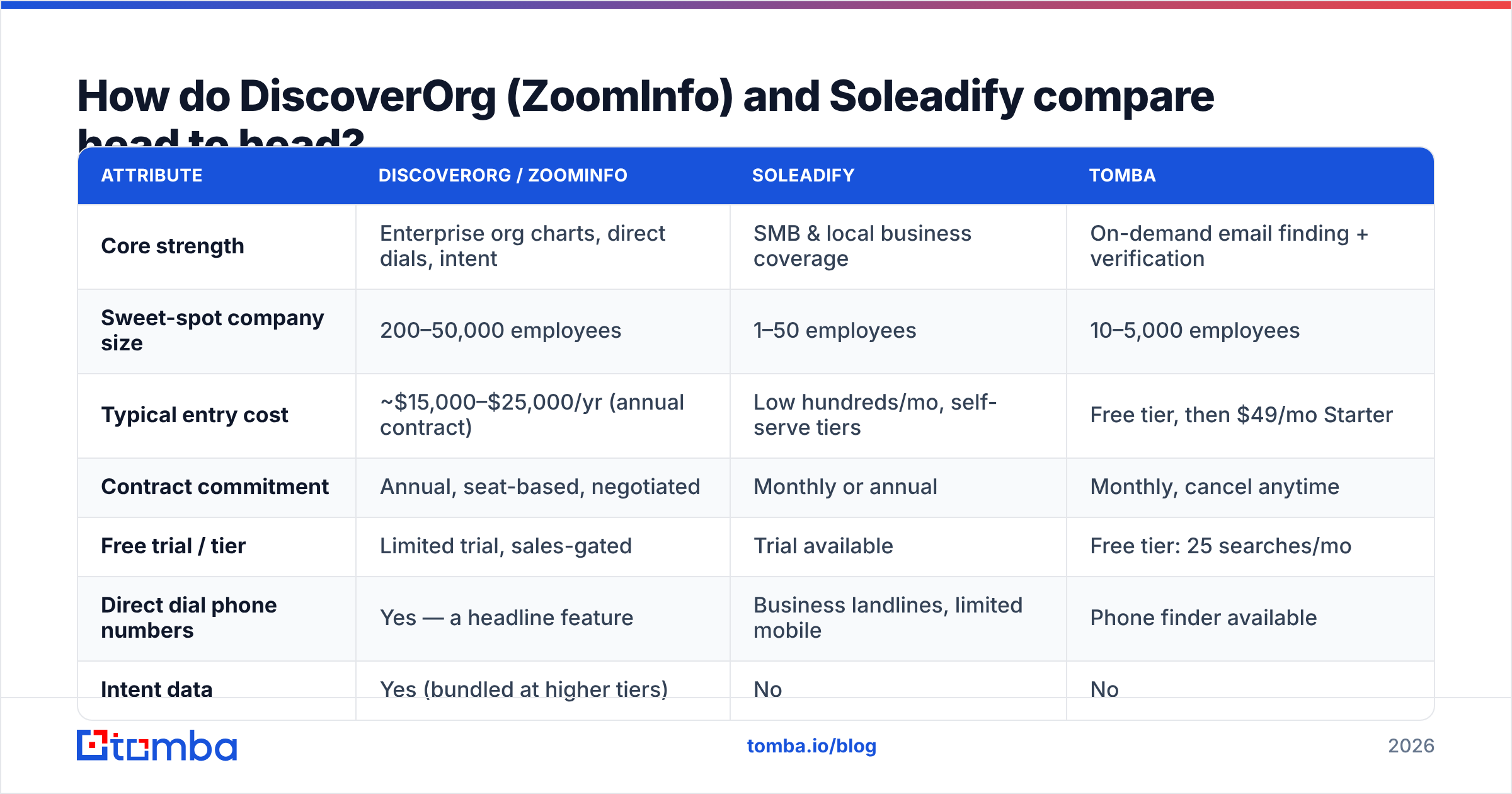
DiscoverOrg vs Soleadify: how do they compare head to head?#
| Attribute | DiscoverOrg / ZoomInfo | Soleadify | Tomba |
|---|---|---|---|
| Core strength | Enterprise org charts, direct dials, intent | SMB & local business coverage | On-demand email finding + verification |
| Sweet-spot company size | 200–50,000 employees | 1–50 employees | 10–5,000 employees |
| Typical entry cost | ~$15,000–$25,000/yr (annual contract) | Low hundreds/mo, self-serve tiers | Free tier, then $49/mo Starter |
| Contract commitment | Annual, seat-based, negotiated | Monthly or annual | Monthly, cancel anytime |
| Free trial / tier | Limited trial, sales-gated | Trial available | Free tier: 25 searches/mo |
| Direct dial phone numbers | Yes — a headline feature | Business landlines, limited mobile | Phone finder available |
| Intent data | Yes (bundled at higher tiers) | No | No |
| Email verification included | Basic | Basic | Core product, catch-all handling |
| API access | Yes, higher tiers | Yes | Yes, all paid plans |
| Best for | Enterprise ABM teams with budget | SMB/local prospecting at volume | Teams needing accurate emails without a five-figure contract |
The table makes the real decision obvious: these two tools rarely compete for the same buyer. When they do land on the same shortlist, the buyer usually has not finished defining their ICP.
Which one has better data accuracy?#
Accuracy is the wrong single question. Ask instead: accurate about what, and for whom?
ZoomInfo's edge is depth per record. One contact record can carry title, reporting line, department budget signals, installed technologies, and a direct dial. That depth comes from contributory data, public sources, and human research. It is genuinely hard to copy.
Its weakness is the long tail. B2B contact data decays at roughly 25–30% per year through job changes, layoffs, and restructures. Every database fights that entropy. The bigger the database, the more records sit un-refreshed. User reviews on G2 repeatedly flag stale contacts and phone numbers for mid-market and smaller accounts, even from otherwise happy customers.
Soleadify's edge is freshness on the crawl layer. Website-derived data updates when the website does. The weakness is the inverse. Crawled emails skew toward generic role addresses (info@, contact@, office@) instead of the named decision-maker. For SMB outreach where the owner reads info@, that works fine. For anything that needs a specific person, it is a gap.
Neither vendor guarantees deliverability of the addresses they hand you. That part is on you.
What does each one actually cost?#
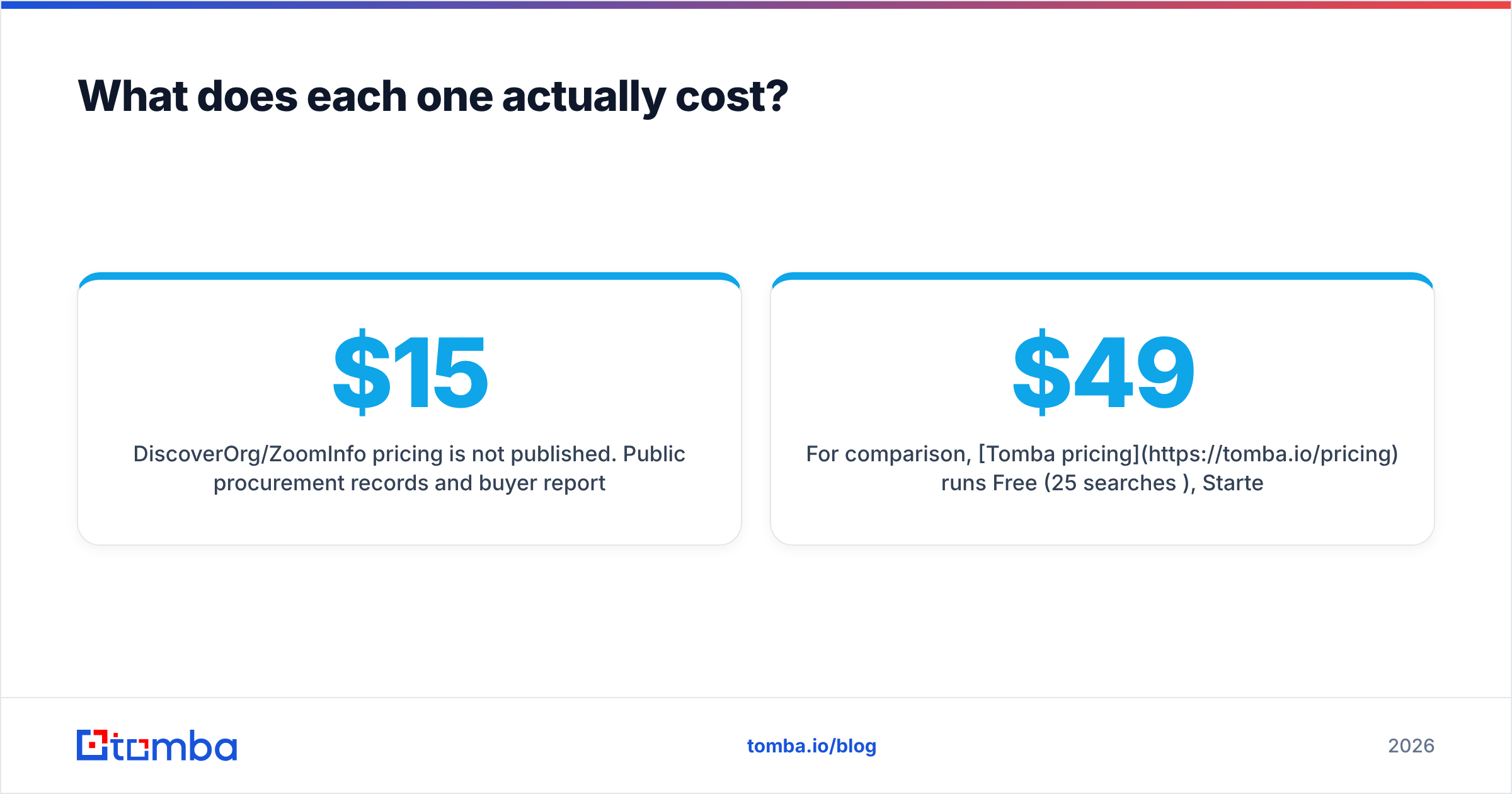
DiscoverOrg/ZoomInfo pricing is not published. Public procurement records and buyer reports put realistic entry near $15,000 a year for a small team. Mid-market deployments often land between $25,000 and $40,000 once you add credits, intent, and integrations. Credits are metered and seats are counted. Overages are a real line item. Expect a sales cycle, not a checkout page.
Soleadify publishes self-serve tiers in the low-to-mid hundreds per month, depending on export volume. That is a genuinely different budget conversation. You can start without a procurement process.
For comparison, Tomba pricing runs Free (25 searches/mo), Starter $49/mo, Growth $99/mo, Pro $249/mo, and Enterprise custom. Every plan is monthly, with no annual lock-in. Tomba does not do everything ZoomInfo does. It is priced this way because most teams weighing DiscoverOrg vs Soleadify really need accurate work emails for a defined list of companies, not an intent-data suite.

Do you actually need an enterprise database?#
Run this test before you sign anything.
Pull your last 100 closed-won deals. Count how many of them:
- Had a buying committee of four or more people
- Were at companies above 500 employees
- Required a direct dial to reach the economic buyer
- Closed faster because you knew the org chart in advance
If that number is above 40, an enterprise database earns its keep. Org charts compress discovery, and direct dials beat gatekeepers. Pay for it.
If that number is under 15 — true for most SMB and mid-market motions — you are buying a Ferrari to drive to the corner shop. What you need is simpler: a list of target companies, the right person's name, their verified email, and a sending setup that will not torch your domain.
That stack is cheap to assemble. Build the company list from your existing sources or a crawl-first tool. Get the named contact from LinkedIn. Resolve the email with a domain search or a LinkedIn finder. Then push it through an email verifier before it enters your sequence.
How do you handle the data quality gap either way?#
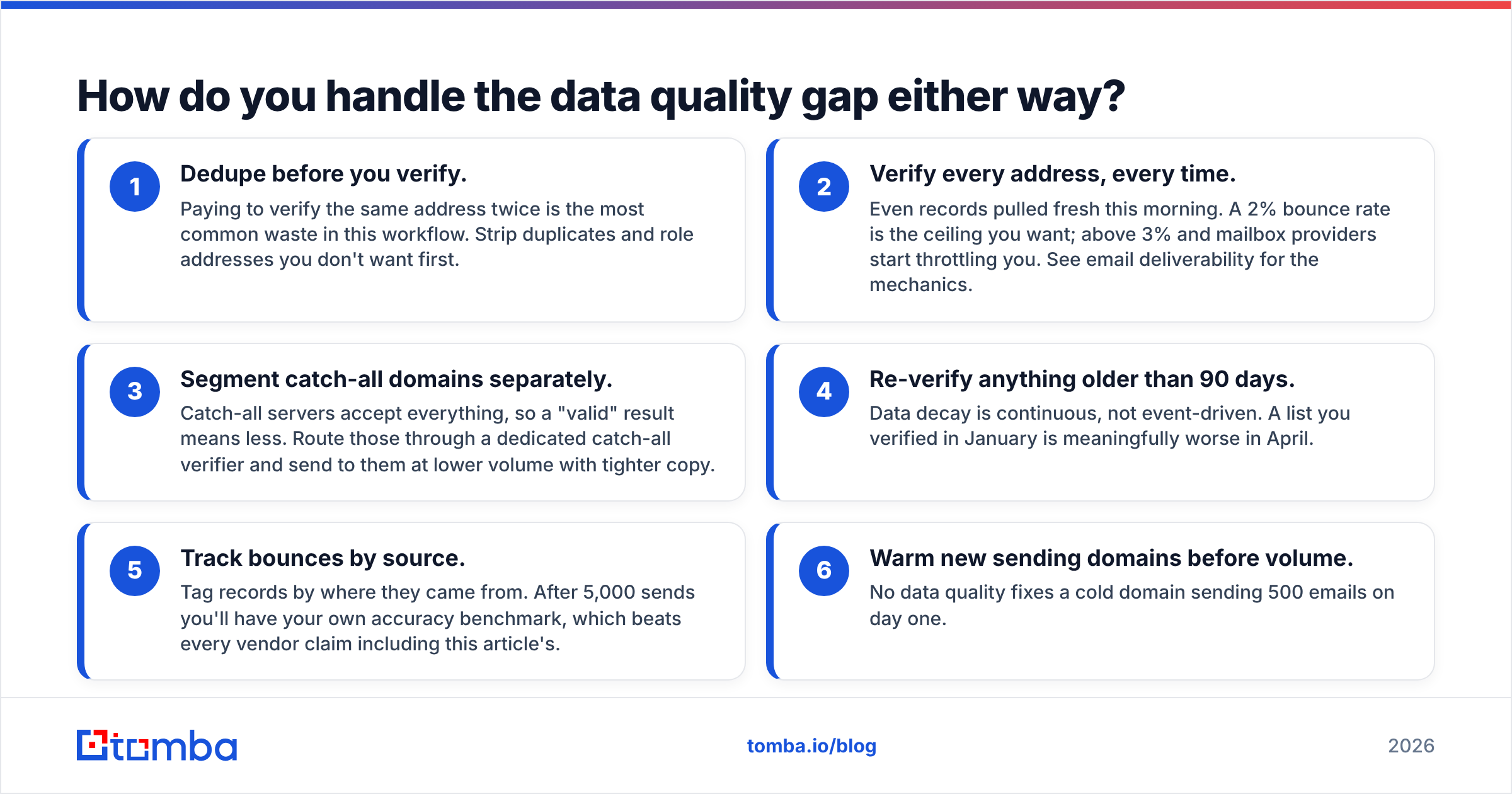
Every database, at every price point, hands you records that will bounce. Here is the workflow that protects your sender reputation, whichever vendor you picked.
Before you send:
- Dedupe before you verify. Paying to verify the same address twice is the most common waste in this workflow. Strip duplicates and unwanted role addresses first.
- Verify every address, every time. Even records pulled fresh this morning. A 2% bounce rate is the ceiling you want. Above 3%, mailbox providers start throttling you. See email deliverability for the mechanics.
- Segment catch-all domains separately. Catch-all servers accept everything, so a "valid" result means less. Route those through a dedicated catch-all verifier. Send to them at lower volume with tighter copy.
On an ongoing basis:
- Re-verify anything older than 90 days. Data decay is continuous, not event-driven. A list you verified in January is meaningfully worse in April.
- Track bounces by source. Tag records by where they came from. After 5,000 sends you will have your own accuracy benchmark, which beats every vendor claim including this article's.
- Warm new sending domains before volume. No data quality fixes a cold domain sending 500 emails on day one.
This is the part both vendors gloss over. A database sells you records. It does not sell you inbox placement. The gap between "we have this contact" and "this email reached a human" is where most outbound programs quietly fail.
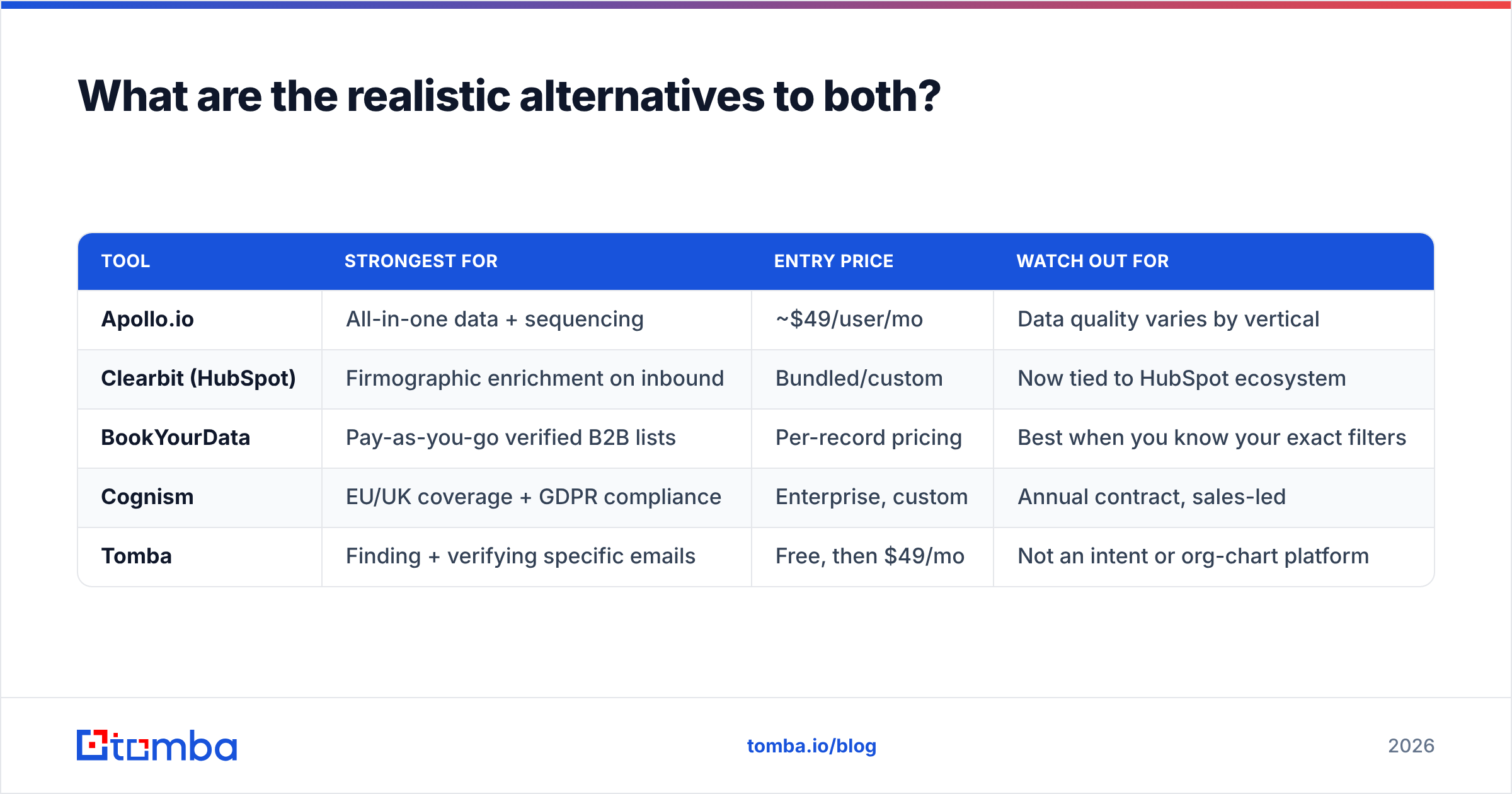
What are the realistic alternatives to both?#
If neither fits cleanly, here is the shortlist worth considering:
| Tool | Strongest for | Entry price | Watch out for |
|---|---|---|---|
| Apollo.io | All-in-one data + sequencing | ~$49/user/mo | Data quality varies by vertical |
| Clearbit (HubSpot) | Firmographic enrichment on inbound | Bundled/custom | Now tied to HubSpot ecosystem |
| BookYourData | Pay-as-you-go verified B2B lists | Per-record pricing | Best when you know your exact filters |
| Cognism | EU/UK coverage + GDPR compliance | Enterprise, custom | Annual contract, sales-led |
| Tomba | Finding + verifying specific emails | Free, then $49/mo | Not an intent or org-chart platform |
BookYourData deserves a look if your objection to ZoomInfo is the contract rather than the data. It sells verified records pay-as-you-go, so the annual commitment problem disappears and you still get a filtered list. Cognism is the stronger pick if your territory is Europe. ZoomInfo's coverage thins there, and GDPR compliance becomes a procurement blocker.
For a broader breakdown of swapping out incumbent platforms, the Apollo alternative and Clearbit alternative comparisons cover the tradeoffs in more depth.
DiscoverOrg vs Soleadify: which should you choose in 2026?#
Choose DiscoverOrg/ZoomInfo if: you sell six-figure deals to enterprises, your buying committees have five-plus stakeholders, your reps live on the phone, and you have $25K+ allocated to data. The org charts and direct dials are best-in-class, and you will use them daily.
Choose Soleadify if: your ICP is small local businesses, you need geographic and vertical coverage that enterprise databases ignore, and your outreach targets owner-operators rather than departmental buyers. Nothing else covers the long tail as well at that price.
Choose neither if: your real bottleneck is "I know exactly which 400 companies and which 3 roles I want, I just need working email addresses." That is not a database problem. It is a lookup problem, and paying database prices to solve it is the most common overspend in the modern sales stack.
Test it with real data before you commit. Take 50 companies from your ICP and run them through each option. Measure two things: how many named contacts you get, and what share of those emails survive verification. That two-column spreadsheet will end the debate faster than any vendor demo.
Ready to skip the annual contract? If your real need is finding verified work emails for a specific list of companies and people, start with the Tomba Email Finder. The free tier gives you 25 searches per month, so you can test accuracy against your own ICP. Paid plans start at $49/mo with no annual commitment. Run it head-to-head against whatever you pay now and let the bounce rate decide.
Related guides#
Ready to find emails that actually work?
Join 150,000+ professionals who stopped guessing and started sending. Free credits on signup — no credit card required.
Get the Tomba newsletter
Practical outbound tactics and product updates — once every two weeks.
About the author