DiscoverOrg vs Span Global Services: 2026 B2B Data Comparison
DiscoverOrg (now ZoomInfo) and Span Global Services sell B2B contact data in completely different ways. One is a live intelligence platform, the other a licensed list vendor. Here's which fits your motion — and what each really costs.
DiscoverOrg vs Span Global Services is a choice between two models. One rents you a live data platform. The other sells you a file, once.
TL;DR
- DiscoverOrg is no longer a standalone product. It merged with ZoomInfo in 2019. Its technographic and org-chart data now lives inside ZoomInfo SalesOS. When a vendor quotes you "DiscoverOrg," you're buying a ZoomInfo seat contract — usually $15K–$40K+ a year, on an annual commitment.
- Span Global Services is a licensed list vendor, not a platform. You buy a one-time, static file of contacts, filtered by industry, title, geography, or install base. Pricing runs per record, often $0.10–$0.50 depending on volume and append depth.
- They compete only on the surface. DiscoverOrg/ZoomInfo sells continuously refreshed intelligence with intent signals and workflow integrations. Span Global sells a file you own outright, with no seat math.
And here's what neither one fixes:
- Both decay at the same rate. B2B data goes stale by roughly 22–30% a year. Neither vendor promises a verified-at-send-time email, so you still need a verification layer before you press send.
- Most teams under 20 reps need neither. A targeted finder-plus-verifier stack (Tomba starts at $49/mo) layered on your own ICP list costs far less than a five-figure platform contract or a bulk list buy.
DiscoverOrg vs Span Global Services: what are you actually comparing?#
Two very different business models that sell the same raw material: B2B contact records.
DiscoverOrg launched in 2007 as a human-researched database built around IT org charts — who reports to whom, what stack they run, when they buy. It won its reputation on depth, not breadth. In February 2019, DiscoverOrg acquired ZoomInfo and took the ZoomInfo name. The DiscoverOrg dataset now sits inside ZoomInfo's SalesOS product. So when a rep tells you they "use DiscoverOrg" in 2026, they mean ZoomInfo with the legacy org-chart modules.
Span Global Services is a data list and marketing services company. Its model is licensing. You describe a segment — say, "Oracle NetSuite users in US manufacturing, Director+, 200–2000 employees." They quote a count and a price. You receive a file. Appended data, email campaign execution, and data cleansing are separate line items.
That difference drives everything else. One is a subscription to a living system. The other is a snapshot you buy once.
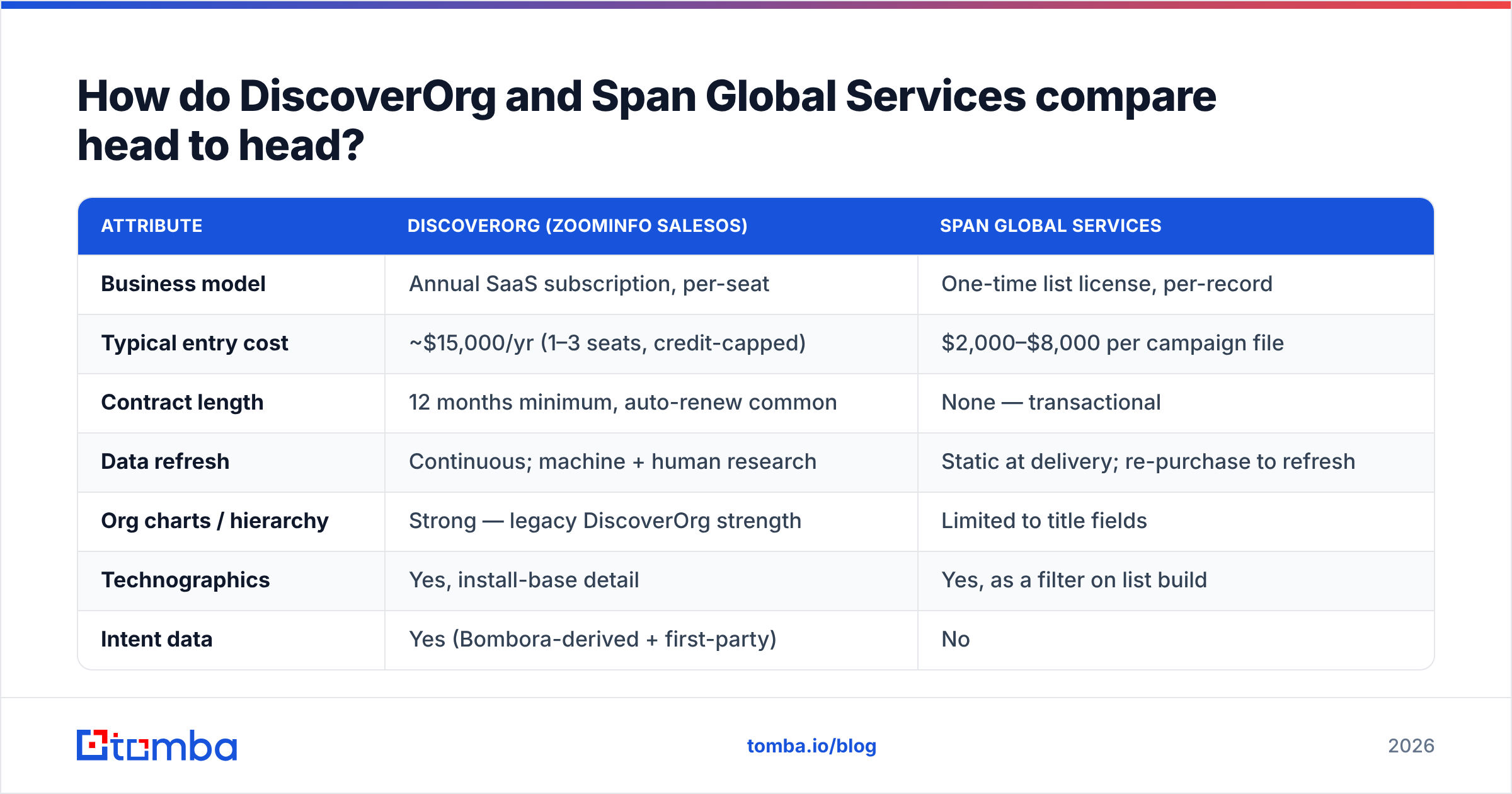
How do DiscoverOrg and Span Global Services compare head to head?#
| Attribute | DiscoverOrg (ZoomInfo SalesOS) | Span Global Services |
|---|---|---|
| Business model | Annual SaaS subscription, per-seat | One-time list license, per-record |
| Typical entry cost | ~$15,000/yr (1–3 seats, credit-capped) | $2,000–$8,000 per campaign file |
| Contract length | 12 months minimum, auto-renew common | None — transactional |
| Data refresh | Continuous; machine + human research | Static at delivery; re-purchase to refresh |
| Org charts / hierarchy | Strong — legacy DiscoverOrg strength | Limited to title fields |
| Technographics | Yes, install-base detail | Yes, as a filter on list build |
| Intent data | Yes (Bombora-derived + first-party) | No |
| Direct dials | Yes, large volume | Yes, appended (accuracy varies) |
| CRM integration | Native Salesforce, HubSpot, Outreach | CSV handoff, manual import |
| API access | Yes, enterprise tiers | Not a core offering |
| Compliance posture | GDPR/CCPA processes, notice program | Claims opt-in sourcing; verify per file |
| Best for | Enterprise SDR teams, ABM, RevOps | One-off campaigns, event lists, budget-constrained demand gen |
Read that table twice before you take a demo. Two rows decide the outcome: contract length and refresh cadence. Feature count doesn't.
Which one has better data quality?#
Neither vendor earns the accuracy claim on its homepage. Both work fine if you verify.
DiscoverOrg built its name on manually verified records and a stated re-verification cycle. After the merger, ZoomInfo's scale brought more automated collection and wider coverage — 100M+ business contacts. Reviewers on G2 keep flagging the same pattern, though: strong for large US tech companies, thin and stale outside that core. Sell into EMEA mid-market, SMB, or non-tech verticals and you'll hit coverage gaps. No amount of credits fixes them.
Span Global's quality depends on which file you buy. List vendors assemble records from many upstream sources: event registrations, publisher subscriptions, public filings, partner swaps. A tight segment with a recent build date can perform fine. A generic "all US CTOs" pull will be full of records resold a dozen times, and it will bounce hard. Ask for the build date and the source breakdown before you sign. A reputable vendor answers, and Span Global's sales team generally does.
Here's the number both sides skip. B2B contact data decays about 2–2.5% per month. That's 25–30% of a database going stale in a year — job changes, layoffs, domain migrations, rebrands. A record that was right at build time can be wrong at send time. Neither vendor checks it the moment your sequence fires.
The only reliable fix is a verification step you control. Run every list through an email verifier before it enters your sending tool — bought, scraped, or exported from a subscription. On mixed corporate domains, add a catch-all verifier. Roughly a third of enterprise domains accept every address at the SMTP layer and tell you nothing useful.
What does each one actually cost?#
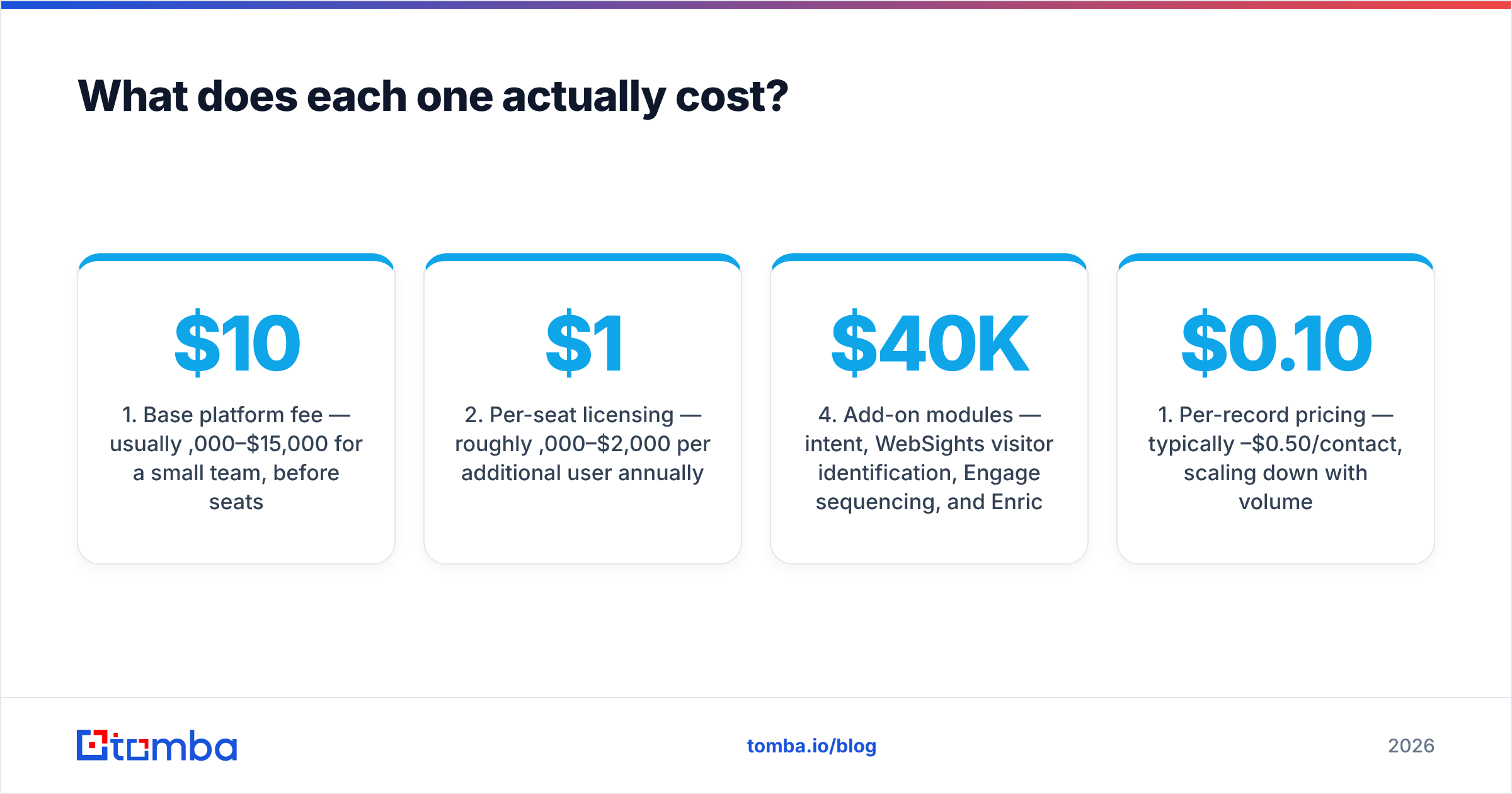
DiscoverOrg/ZoomInfo pricing isn't published, which is a signal in itself. Based on buyer reports and G2 pricing threads, the shape looks like this:
- Base platform fee — usually $10,000–$15,000 a year for a small team, before seats.
- Per-seat licensing — roughly $1,000–$2,000 per extra user, annually.
- Credit caps — exports are metered. Burn through your allotment mid-year and you get an upsell call, not a graceful overage charge.
- Add-on modules — intent, WebSights visitor identification, Engage sequencing, and Enrich each carry a line item. A full stack for a 10-rep team lands around $40K–$75K.
- Annual commitment — month-to-month isn't on the menu. Multi-year discounts pull you in further.
Span Global's math is simpler and much smaller:
- Per-record pricing — usually $0.10–$0.50 per contact, cheaper at volume.
- Append services — phone, LinkedIn, or firmographics on your existing file, priced separately.
- Minimum order — most segments start around $1,500–$2,500.
- No recurring cost — you own the file. You own its decay curve too.
The honest comparison: 25,000 targeted records from Span Global might cost $5,000 once. A ZoomInfo contract for the same team costs 3–8× that every year. In return you get refresh, workflow, and signals. Whether that premium pays back comes down to one question — do your reps live in the tool daily, or export once a quarter?
If it's once a quarter, you're renting a Ferrari to get groceries. Compare that with Tomba pricing: Free at 25 searches/mo, Starter $49/mo, Growth $99/mo, Pro $249/mo. A small team's entire annual spend lands under what ZoomInfo charges for one seat.
Is DiscoverOrg better than Span Global Services for outbound?#
For a funded SDR team with structured territories, yes — with caveats.
DiscoverOrg's surviving strength inside ZoomInfo is org-chart depth. Say you're selling a six-figure platform into a 5,000-person enterprise. Knowing that the VP of Infrastructure reports to a CIO who joined 14 months ago and owns the renewal is worth real money. Span Global can't give you that. List files give you title strings, not power maps.
The integration story matters too. Records that flow into Salesforce with enrichment rules, fire workflows in Outreach, and dedupe against existing accounts save real SDR hours. A CSV does none of that until someone builds the plumbing.
Three things break the DiscoverOrg case, though:
- Utilization. Seat-based data tools have brutal utilization curves. If half your seats log in twice a month, you're paying $2,000 a seat for a search engine.
- Territory fit. Outside US tech and US enterprise, coverage thins fast. Teams selling into European mid-market usually need a second source anyway.
- Lock-in. Annual auto-renew with a 60-day cancellation window is standard. Miss the window and you've bought another year of a tool you'd already dropped.
Span Global wins when the campaign is bounded: a webinar invite list, a trade-show follow-up, a single-vertical ABM push. You spend once, you execute, you're done. No renewal fight in month 11.
What about compliance and data sourcing?#
This is where list buys get expensive in ways procurement doesn't see up front.
Under GDPR, emailing a bought list of EU contacts puts you on legitimate-interest ground. That requires documentation: what the interest is, why it's proportionate, and how a data subject can object. The ICO's guidance on direct marketing is explicit that you remain the controller responsible for lawfulness. "The vendor said it was opt-in" is not a defense you can hide behind.
ZoomInfo runs a formal notice program and publishes its data-collection practices. Enterprise legal teams get something real to review, and that's part of what the price buys. It's a stronger posture than most list brokers manage. Span Global states opt-in sourcing, but the burden sits with you — request the provenance documents per file, and keep them.
Practical rule either way: never email an EU or UK record you can't trace to a source and a lawful basis. US-only campaigns are easier. CAN-SPAM asks for accurate headers, a real physical address, and a working unsubscribe. State-level privacy laws keep tightening, though.
There's a deliverability angle too, and it has nothing to do with law. Bought lists carry spam traps. One recycled trap in a 25,000-record file can wreck your sender reputation in a single send. If you buy a list, warm it slowly, seed-test it, and keep it off your primary domain on day one.
Are there better alternatives to both?#
For most teams under 20 reps, yes. The alternative isn't a third database. It's a different sequence of steps.
The list-vendor model assumes you don't know who you want. The platform model assumes you'll search all day. Most focused GTM teams are neither. They know their ICP, and they need contact details for a specific, finite set of companies.
That workflow looks like this:
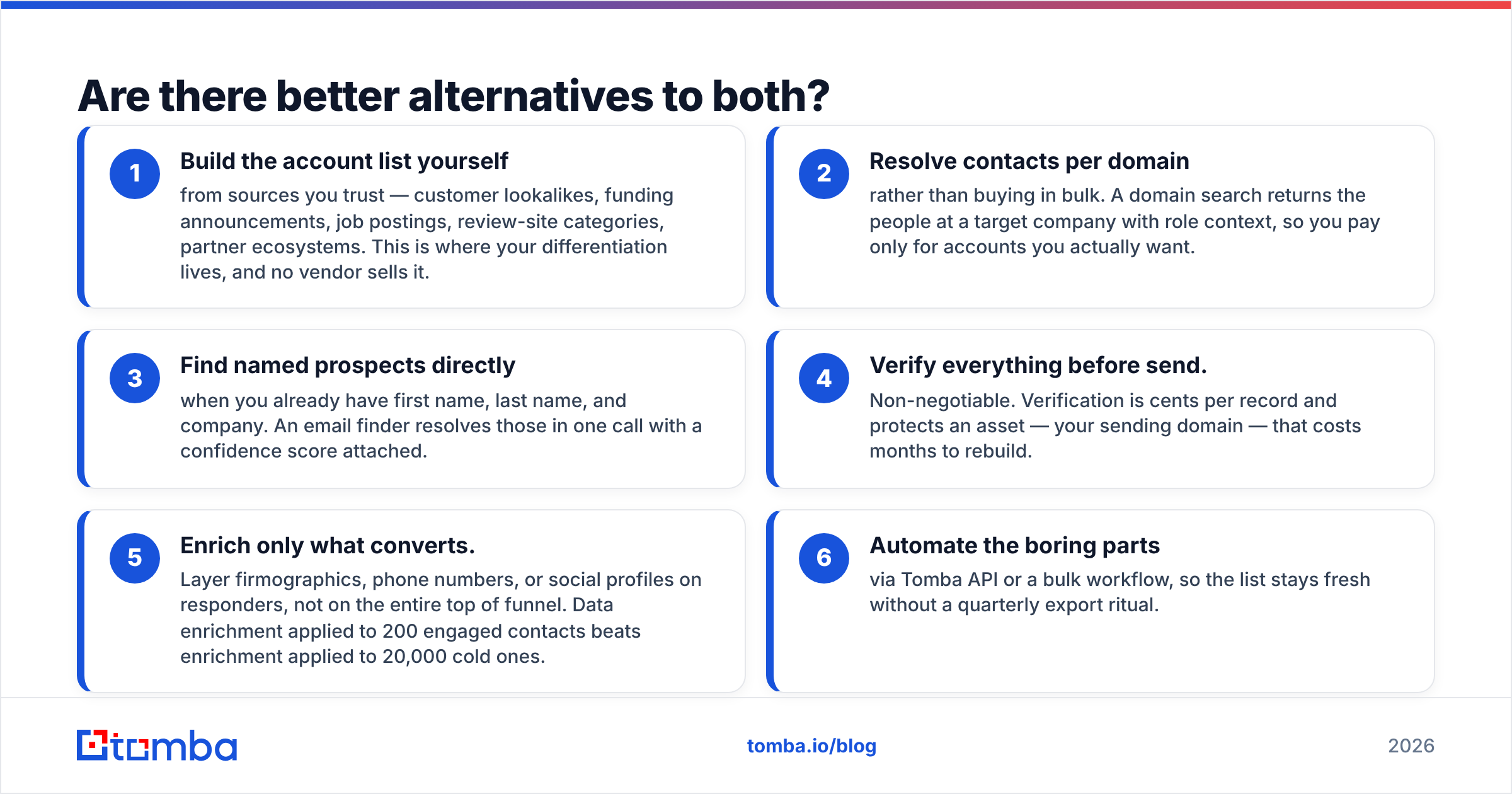
- Build the account list yourself — customer lookalikes, funding news, job postings, review-site categories, partner ecosystems. No vendor sells this. It's your edge.
- Resolve contacts per domain instead of buying in bulk. A domain search returns the people at a target company with role context, so you pay only for accounts you want.
- Find named prospects directly when you already have first name, last name, and company. An email finder returns the address with a confidence score.
- Verify before you send. Non-negotiable. It costs cents per record and protects your sending domain.
- Enrich only what converts. Data enrichment on 200 engaged contacts beats enrichment on 20,000 cold ones.
- Automate the rest with the Tomba API or a bulk workflow, so the list stays fresh.
One honest note: BookYourData plays in the same space as Span Global and does it well. Pay-as-you-go pricing, a stated accuracy guarantee. If a purchased file really is the right call for your campaign, put it on the shortlist next to Span Global.
Which should you choose?#
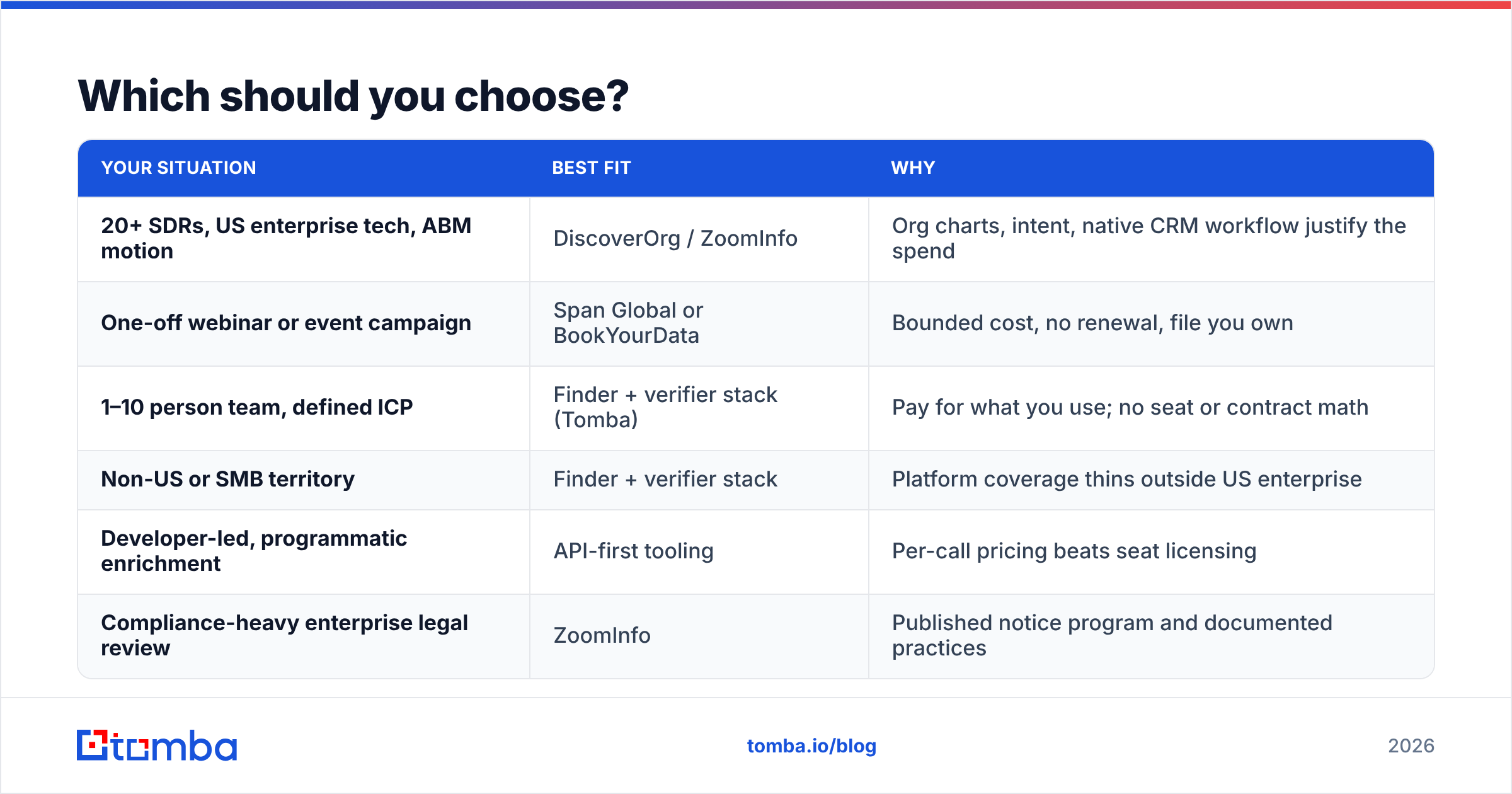
| Your situation | Best fit | Why |
|---|---|---|
| 20+ SDRs, US enterprise tech, ABM motion | DiscoverOrg / ZoomInfo | Org charts, intent, native CRM workflow justify the spend |
| One-off webinar or event campaign | Span Global or BookYourData | Bounded cost, no renewal, file you own |
| 1–10 person team, defined ICP | Finder + verifier stack (Tomba) | Pay for what you use; no seat or contract math |
| Non-US or SMB territory | Finder + verifier stack | Platform coverage thins outside US enterprise |
| Developer-led, programmatic enrichment | API-first tooling | Per-call pricing beats seat licensing |
| Compliance-heavy enterprise legal review | ZoomInfo | Published notice program and documented practices |
The real question isn't which vendor has better data. Both have decent data with real gaps. The question is which cost structure matches how often you'll use it. Subscription for daily users. Transaction for campaign users. Per-call for programmatic ones.
One more check before you sign either contract: run a sample. Ask DiscoverOrg/ZoomInfo for a trial export of 100 records in your exact ICP. Ask Span Global for a 100-record sample from the same segment. Verify both yourself. If either lands below 90% deliverable, you have leverage in the negotiation — and real data for the decision. A vendor who refuses the sample is telling you something.
The practical next step#
Before you commit five figures to a platform or four figures to a static file, test whether you need either one. Take 100 target companies you already care about. Resolve the decision-makers, verify the addresses, and run a real sequence. If your ICP is tight, that exercise shows you how much of a database you'd actually use.
Tomba Email Finder is built for that motion. Search by domain, name, or company, get a confidence score on every result, and verify before you send. The free tier gives you 25 searches a month to test the workflow, and Starter is $49/mo — about what one ZoomInfo seat costs per week. Run the DiscoverOrg vs Span Global Services comparison with your own data, not a vendor's slide deck. The answer usually shows up inside an afternoon.
Related guides#
Ready to find emails that actually work?
Join 150,000+ professionals who stopped guessing and started sending. Free credits on signup — no credit card required.
Get the Tomba newsletter
Practical outbound tactics and product updates — once every two weeks.
About the author