DiscoverOrg vs Successai: Which B2B Data Tool Wins in 2026?
DiscoverOrg (now ZoomInfo) sells enterprise-grade org charts at enterprise prices. Success.ai sells unlimited-feeling contact volume at startup prices. Here's which one actually fits your motion — and when neither does.
DiscoverOrg vs Successai comes down to one question: do you pay for depth, or for volume?
DiscoverOrg is now ZoomInfo. It sells deep account data on annual contracts. Successai — written Success.ai on its own site — sells a flat monthly fee, a huge contact list, and built-in sending. Here is the short version.
TL;DR
- DiscoverOrg no longer exists on its own. It merged into ZoomInfo in 2019. Buying "DiscoverOrg" today means buying a ZoomInfo Copilot or GTM Studio seat. That is usually a $15,000–$40,000+ annual contract with a 12-month minimum.
- Success.ai is the opposite bet. It is a low-cost sending platform with a very large contact database. Prices start around $29–$99 per month. It targets agencies and founders running high-volume cold email.
- They are not really competitors. ZoomInfo sells org charts, intent data, and CRM-grade company data. Success.ai sells volume, mailbox rotation, and sequencing. The real choice is depth versus throughput.
- The accuracy gap is real, but the price gap is bigger. ZoomInfo's direct dials and hierarchy data lead the category. Its email accuracy is good, not magic. Success.ai's database is broad but noisier, so plan to verify it yourself.
- If you mainly need verified work emails, neither is the cheapest path. A focused email finder plus your current sequencer costs a fraction of either.
What exactly are you buying when you buy DiscoverOrg in 2026?#
You're buying ZoomInfo. That is the first thing to get straight.
DiscoverOrg started in 2007 as a research-first B2B database. Human researchers phoned IT departments to map who reported to whom. It bought ZoomInfo in 2019, then took the ZoomInfo name. So when a rep says they use "DiscoverOrg," they mean a ZoomInfo seat. Old DiscoverOrg contracts now sit on the ZoomInfo platform.
That history still matters. It explains what the product is unusually good at:
- Org charts and reporting lines. You can see who the VP of Infrastructure reports to, and which three managers sit below them. Very few databases try this seriously.
- Direct dials. DiscoverOrg's original moat was phone numbers that ring a desk or a mobile, not a switchboard.
- Technographics. You can see which security stack, CRM, or cloud provider a company runs. That helps when you sell against an incumbent.
Two more pieces round out the enterprise tiers:
- Intent signals. Bombora-style topic surges are layered onto accounts. They come as an add-on or inside higher tiers.
- Enterprise plumbing. You get SOC 2, GDPR/CCPA workflows, two-way Salesforce and HubSpot sync, SSO, admin controls, and a real API.
There is a second half to the deal. You also buy an annual contract, seat-based pricing, and credit caps on exports. The sales cycle includes a demo, a quote, and usually a negotiation. There is no real self-serve tier.

What is Success.ai, and who is it actually for?#
Success.ai is a cold-outreach platform. It bundles three things most teams buy separately: a contact database, mailbox connection with warmup, and an AI-assisted sequencer.
The pitch is volume economics. You skip per-seat and per-credit pricing and pay a flat monthly fee. Quotes usually land between $29 and $99, depending on tier and billing term. In return you get a database advertised in the hundreds of millions of contacts. You can also connect a large number of sending inboxes.
That mix fits one motion well: high-volume, low-touch outbound at agencies, lead-gen shops, and bootstrapped SaaS teams. Say your model is "send 5,000 emails a week across 30 rotating inboxes and book meetings off a 1.2% reply rate." Success.ai is priced for that. ZoomInfo is priced against it.
Where it gets thinner:
- Data depth. You get name, title, company, email, and sometimes phone and LinkedIn. You do not get reliable reporting lines, funding triggers with the same rigor, or deep technographics.
- Freshness and verification. Large aggregated databases decay. Roughly 25–30% of B2B contact data goes stale each year from job changes alone. Low-cost providers also refresh less often than premium ones. Run your own email verification pass before you send.
- Enterprise governance. Your legal team may want a DPA, audited compliance, and named data-provenance docs. The enterprise vendors are further along there.
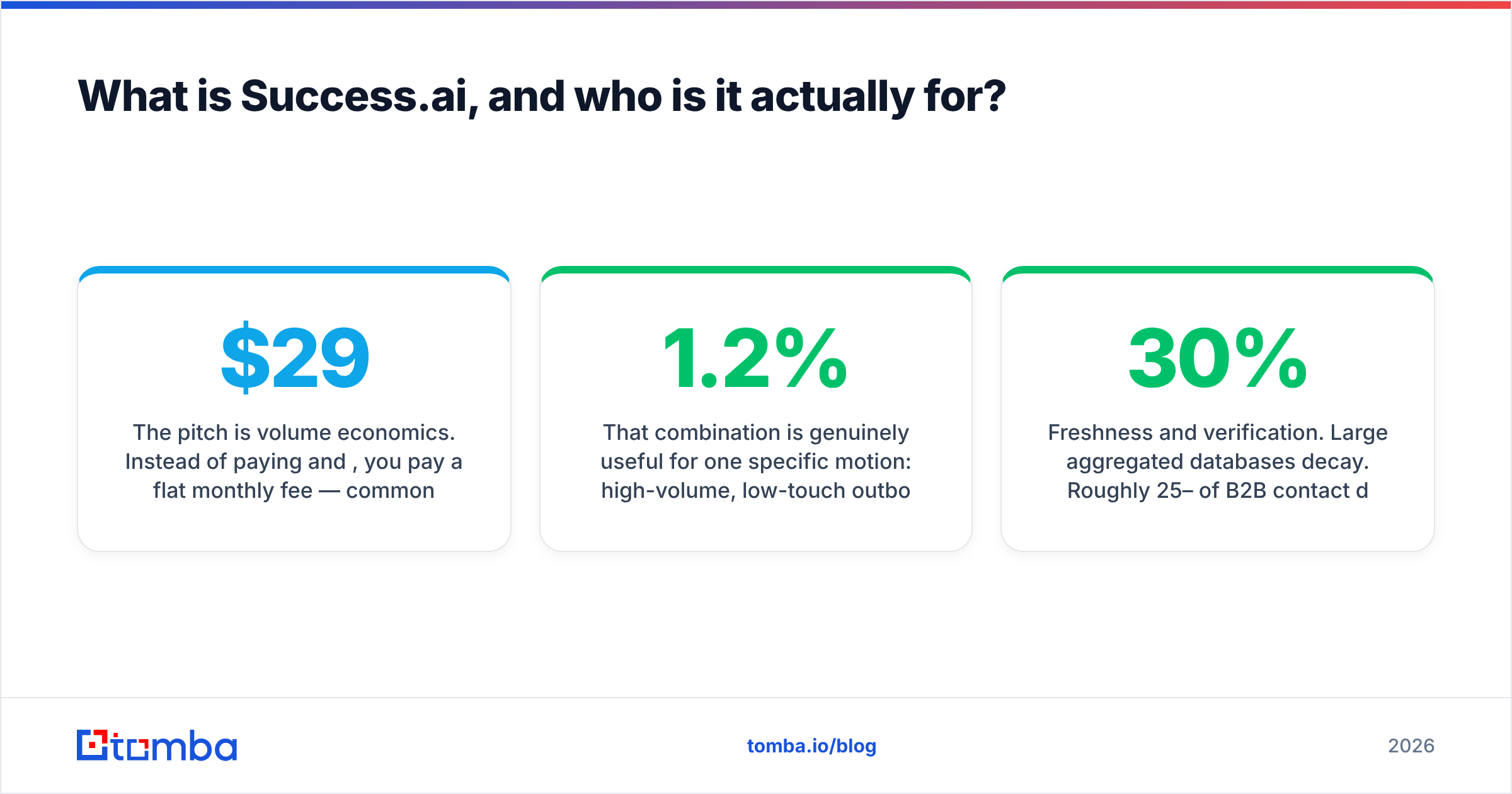
How do DiscoverOrg (ZoomInfo) and Success.ai compare head to head?#
| Dimension | DiscoverOrg / ZoomInfo | Success.ai |
|---|---|---|
| Entry price | ~$15,000+/yr, annual contract | ~$29–$99/mo, monthly or annual |
| Free option | Limited free trial, gated by demo | Free tier with capped credits |
| Contract | 12-month minimum, seat-based | Month-to-month available |
| Database size | ~100M+ contacts, deeply enriched | 700M+ contacts claimed, thinner per record |
| Org charts / hierarchy | Best in class | Not a real feature |
| Direct dials | Strong, category-leading | Limited coverage |
| Intent data | Yes (add-on or higher tiers) | Basic signals only |
| Built-in email sending | No (integrates with sequencers) | Yes — core feature, multi-inbox rotation |
| Warmup included | No | Yes |
| CRM sync | Native Salesforce/HubSpot, bidirectional | Lighter integrations, Zapier-heavy |
| API | Mature, documented | Available, less mature |
| Best fit | Enterprise AE/SDR teams, ABM, complex sales | Agencies, founders, volume outbound |
| Worst fit | Anyone under 5 reps or under $50K ACV | Anyone needing hierarchy or compliance depth |
The table makes the real conclusion obvious: these tools answer different questions. ZoomInfo answers one of them: who are the eleven people in this six-figure decision, and how do they relate? Success.ai answers another: how do I get 50,000 plausible contacts into a sequence this quarter without burning my domain?
Is DiscoverOrg's data actually more accurate than Success.ai's?#
Yes. But on email, the gap is much smaller than the price gap suggests.
Break "accuracy" into three separate things, because vendors blur them on purpose:
- Coverage — how much of your target list the tool returns any contact for.
- Deliverability — how many of those emails don't bounce.
- Correctness — is this the right person, in the right role, at the right company, today?
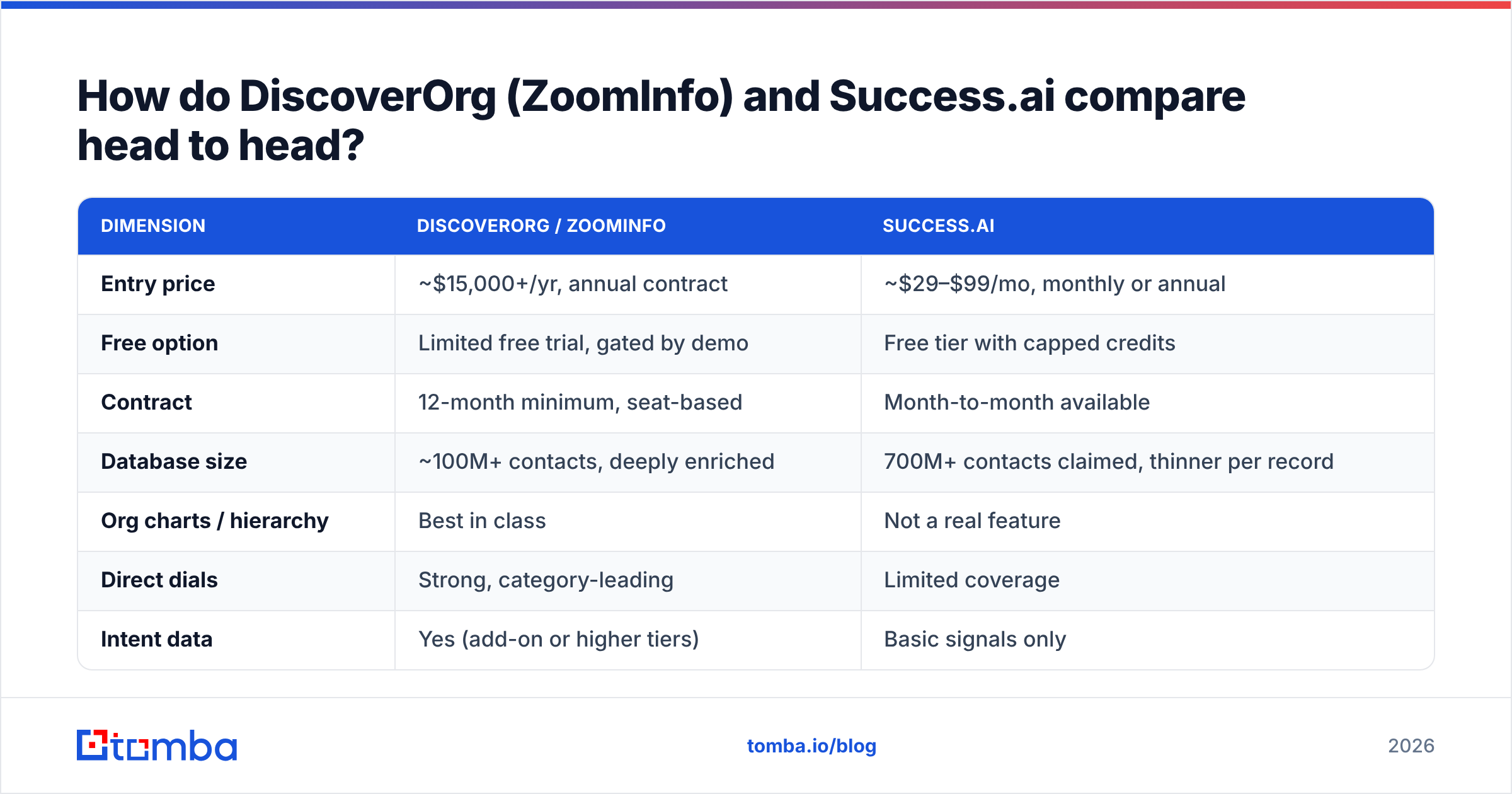
ZoomInfo wins clearly on #3. It runs its own research team, collects data from users, and refreshes often. So titles and reporting lines stay more current than in aggregated databases.
On #1 it is strong in North American mid-market and enterprise. It is weaker in SMB and outside English-speaking regions. On #2 it is solid but not exceptional. Bounce tests from G2 reviews and practitioner benchmarks put premium providers in the 90–95% deliverable range, not 99%.
Success.ai's numbers swing by segment. Well-covered verticals return usable data: US SaaS, agencies, e-commerce. Long-tail industries, EMEA mid-market, and niche titles degrade fast. Bounce rates on unverified exports often land in the 5–12% range. That is enough to hurt your sender reputation if you send blind.
The practical takeaway: whichever you pick, verify before you send. Vendor-side checks do not replace a real verification step. A catch-all domain will fool both tools unless you run a catch-all verifier against it.
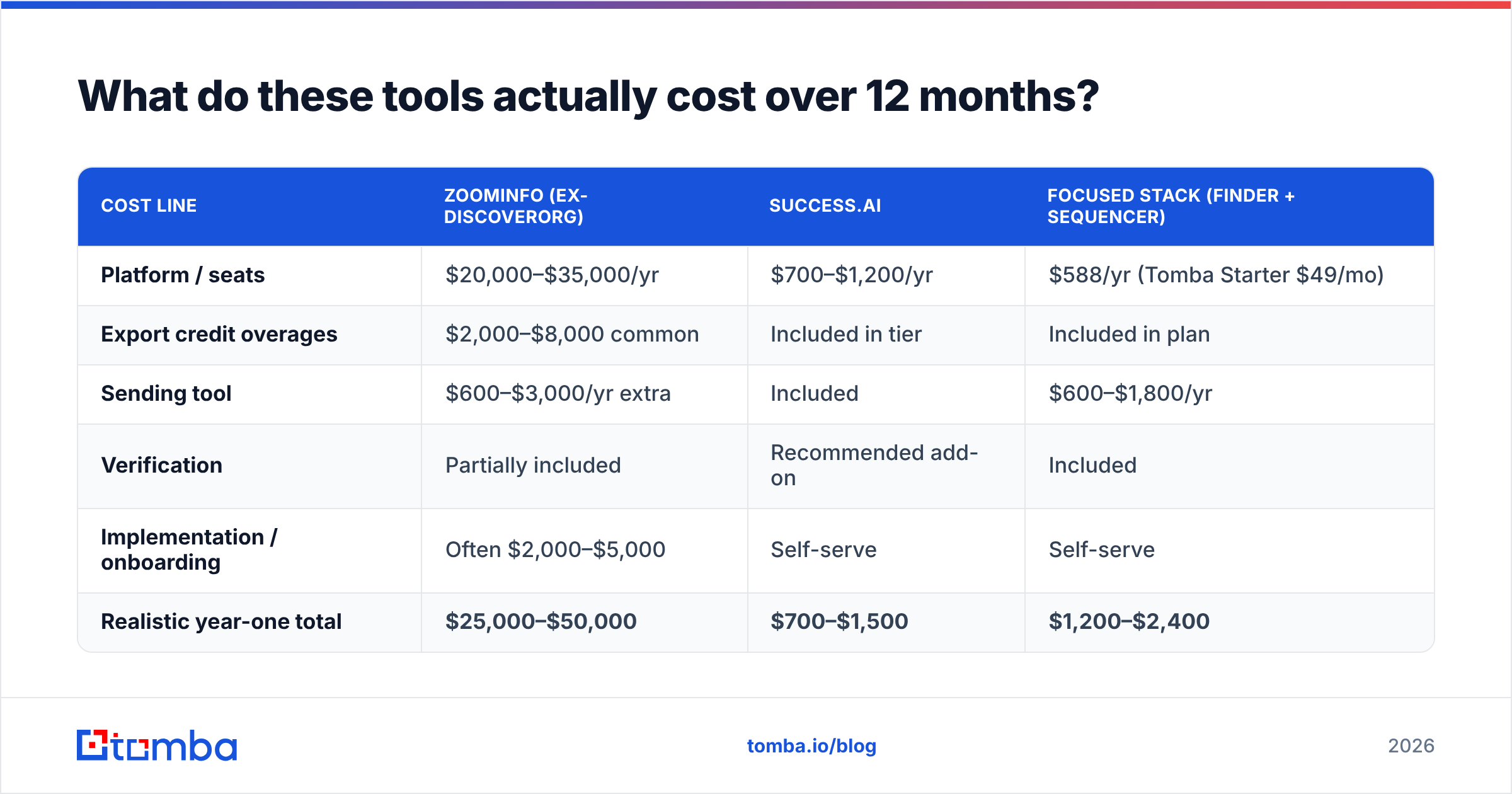
What do these tools actually cost over 12 months?#
Sticker price is not the comparison that matters. Here is the full picture for a five-person outbound team.
| Cost line | ZoomInfo (ex-DiscoverOrg) | Success.ai | Focused stack (finder + sequencer) |
|---|---|---|---|
| Platform / seats | $20,000–$35,000/yr | $700–$1,200/yr | $588/yr (Tomba Starter $49/mo) |
| Export credit overages | $2,000–$8,000 common | Included in tier | Included in plan |
| Sending tool | $600–$3,000/yr extra | Included | $600–$1,800/yr |
| Verification | Partially included | Recommended add-on | Included |
| Implementation / onboarding | Often $2,000–$5,000 | Self-serve | Self-serve |
| Realistic year-one total | $25,000–$50,000 | $700–$1,500 | $1,200–$2,400 |
Two caveats before anyone screenshots that table.
First, ZoomInfo's cost makes sense when your deals are large. Say one closed deal is worth $80,000, and better org-chart data adds two closed deals a year. A $30,000 contract is then a rounding error. Vendors who attack ZoomInfo on price alone are usually selling to buyers ZoomInfo should never have courted.
Second, Success.ai's price only works if your motion tolerates noise. If your ICP is 400 companies, every contact matters. Cheap-and-broad is the wrong shape of tool there. You need precision, and you need it per record.

When should you pick neither?#
There is a third path most comparison posts skip, because it breaks the "A vs B" frame: buy the one capability you need, not the platform.
Most teams weighing DiscoverOrg vs Successai do not need a 60-field enrichment record or a 700M-row database. They need:
- Verified work emails for a list they already have. That is an email-finding problem, not a database problem. Upload domains and names, then get checked addresses back.
- Contacts at a set of target accounts. Domain search returns everyone findable at a company, with role and confidence scoring. No seat license required.
- Enrichment on inbound signups. Data enrichment on a webhook beats a bulk export you refresh every quarter.
- Bulk processing without contract minimums. A bulk email finder run costs credits, not a renewal negotiation.
This is where Tomba fits honestly. It is not an ABM platform, and it does not build org charts. If you need reporting lines for a nine-stakeholder deal, ZoomInfo is genuinely better, and you should buy it. But maybe your bottleneck is simpler: you have 3,000 target contacts and you need their real emails to be real. A $49/mo Starter plan solves that, and a free 25-search tier lets you test first. No procurement cycle needed.
One more option, for completeness. BookYourData sits in a useful middle ground. It sells pay-as-you-go B2B lists with a bounce guarantee and no annual commitment. Coverage is strong in verticals where the big platforms thin out. If you want purchasable list data without a subscription, it belongs on your shortlist.
DiscoverOrg vs Successai: which one should your team choose?#
Use these decision rules instead of a feature checklist.
- ACV above $50,000 and multi-stakeholder deals → ZoomInfo. You need hierarchy, intent, and direct dials. The contract pays for itself or it doesn't, and you will know within two quarters.
- Agency or lead-gen shop billing per meeting → Success.ai. Volume pricing, inbox rotation, and included warmup match your cost structure.
- Seed-to-Series-A SaaS with 1–3 reps → neither, at first. Buy a finder, a verifier, and a sequencer separately. That runs under $200/mo with no contract, and you can swap any layer later.
Three more rules cover the edge cases:
- RevOps building an enrichment pipeline → go API-first, not UI-first. Judge tools on rate limits, response schema, and cost per call. A documented email finder API beats a pretty dashboard you never open.
- Compliance-heavy industry (health, finance, EU-regulated) → ZoomInfo or a similar enterprise vendor. You need data provenance docs. Low-cost aggregators usually cannot produce them.
- You just want to stop guessing email formats → run a free tool. The company email pattern checker answers that in ten seconds, with nothing to buy.
What are the common mistakes teams make in this evaluation?#
Buying database size. "700 million contacts" and "100 million contacts" are marketing numbers. They count rows, not usable records for your ICP. Ask both vendors to run your real target list of 200 accounts, then report match rate and bounce rate. The vendor who refuses is telling you something.
Ignoring the sequencer question. ZoomInfo's price excludes sending. Success.ai's includes it. Compare like with like, or the gap looks bigger than it is.
Skipping verification because "the data is verified." Every vendor says this. Every vendor's data still decays between their last refresh and your send. A verification pass costs cents per record, and it protects a domain reputation that takes months to rebuild. HubSpot's own email deliverability research is blunt here: bounce rates above 2% start throttling inbox placement.
Signing annual before piloting. Both vendors will let you test. ZoomInfo's trial sits behind a demo, but it exists. Success.ai has a free tier. Run both against the same 200-account list in the same week, then compare outputs side by side. That one exercise beats every review-site average.
Confusing intent data with intent. Topic surge signals are directional at best. Teams often justify a five-figure contract on intent data, then never build a play that acts on the signal within 48 hours. If you won't act on it, don't pay for it.
Ready to test the cheap path first?#
Before you sit through a ZoomInfo demo, settle DiscoverOrg vs Successai with an experiment. Take 100 target accounts. Pull contacts with the Tomba Email Finder. Then check the bounce rate on a small send. The free tier gives you 25 searches, and Starter is $49/mo with no annual commitment.
If match rate and deliverability clear your bar, you just saved five figures. If they don't — because you need org charts, direct dials, and stakeholder mapping — you now have a hard benchmark to hold against the enterprise quote. That beats a demo and a gut feeling.
Related guides#
Ready to find emails that actually work?
Join 150,000+ professionals who stopped guessing and started sending. Free credits on signup — no credit card required.
Get the Tomba newsletter
Practical outbound tactics and product updates — once every two weeks.
About the author