DiscoverOrg vs The Data City: B2B Data Compared (2026)
One is a retired brand now living inside ZoomInfo's enterprise stack. The other is a UK-first company dataset built for market mapping, not cold outreach. Here's which one actually fits your workflow in 2026.
DiscoverOrg vs The Data City is a strange match-up. One is a retired US sales brand. The other is a UK company dataset. This guide covers what each tool does, what it costs, and which one fits your team.
TL;DR
- DiscoverOrg is gone as a standalone product. It merged with ZoomInfo in 2019. A "DiscoverOrg" pitch in 2026 is really ZoomInfo Sales.
- The Data City is a UK company dataset. It is built for analysts, policy teams, and investors, not for SDRs building call lists.
- Both tools map a market. Only ZoomInfo gives you direct dials and verified work emails at scale.
- Price is the sharpest split in DiscoverOrg vs The Data City. ZoomInfo runs to five figures a year with seat minimums. The Data City costs far less and ships no contact data.
- Most teams overpay for contacts. Pair a company dataset with an email finder at $49/mo instead.
What happened to DiscoverOrg, and does it still exist in 2026?#
DiscoverOrg is a legacy brand. In February 2019, DiscoverOrg bought ZoomInfo. By 2020 the merged firm had moved everything under the ZoomInfo name and gone public. The DiscoverOrg platform, its org-chart research team, and its OppAlerts intent product all became part of ZoomInfo Sales.
That history still shapes the product. DiscoverOrg never won on raw volume. It won on human-checked org charts and tech stacks inside mid-market and enterprise teams. Researchers phoned companies and confirmed who reported to whom. That work lives on in ZoomInfo's strong department maps and direct dials in North America.
What did not survive is the price. DiscoverOrg was always an enterprise sale. ZoomInfo kept that stance: annual deals, seat minimums, credit caps, and paid add-ons. Buyers on G2 flag the same two points. The US data is genuinely good. The renewal talk is genuinely painful.
So DiscoverOrg vs The Data City is really a big American sales platform against a small British data specialist. They are not swaps for each other. Knowing why saves you from a bad purchase order.

What is The Data City, and who is it built for?#
The Data City is a UK company-data platform based in Leeds. Its core idea is simple. Standard industry codes (SIC) are old and too broad to describe modern firms. A company filed in 2007 as "other business support activities" may in fact be a battery-recycling startup. SIC will never tell you that.
The Data City's fix is live classification. It crawls company websites. It reads what each business says about itself. Then it builds machine-learned sectors — "RTICs" — that you can create on demand. Want every UK firm working on hydrogen electrolysis, vertical farming, or quantum sensing? That is the product. It also joins Companies House filings, headcount, turnover estimates, funding, and website signals onto each record.
Its buyers are growth agencies, universities, government teams, investors mapping a market, and strategy teams sizing a new sector. Some sales teams use it to find UK accounts, and it works well for that. But you will not find a "direct dial" column. The company does not sell one.
That is the crux of DiscoverOrg vs The Data City. One tool answers who do I call today. The other answers which UK firms do this thing.
DiscoverOrg vs The Data City: how do they compare head to head?#
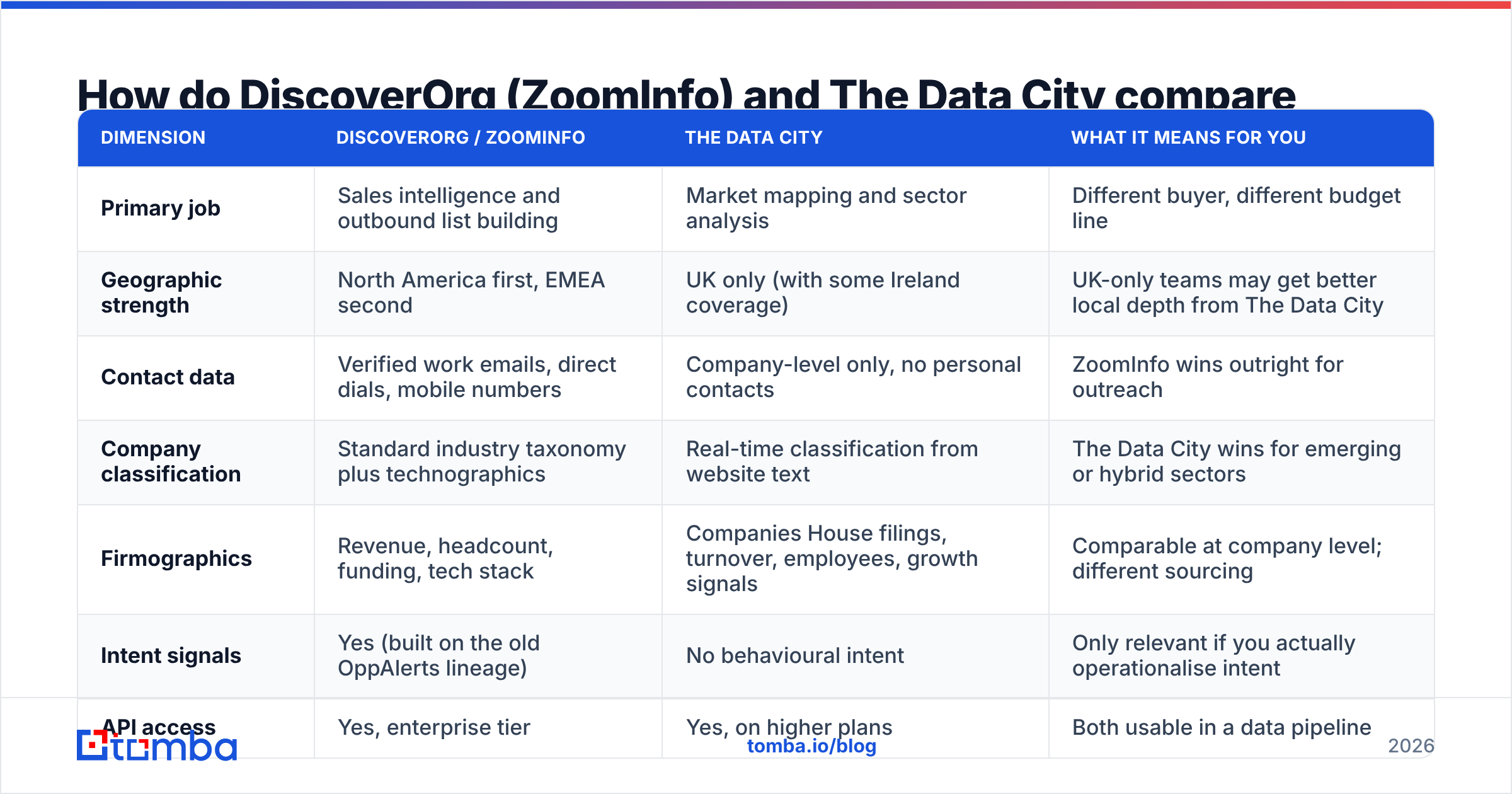
| Dimension | DiscoverOrg / ZoomInfo | The Data City | What it means for you |
|---|---|---|---|
| Primary job | Sales intelligence and outbound list building | Market mapping and sector analysis | Different buyer, different budget line |
| Geographic strength | North America first, EMEA second | UK only (with some Ireland coverage) | UK-only teams may get better local depth from The Data City |
| Contact data | Verified work emails, direct dials, mobile numbers | Company-level only, no personal contacts | ZoomInfo wins outright for outreach |
| Company classification | Standard industry taxonomy plus technographics | Real-time classification from website text | The Data City wins for emerging or hybrid sectors |
| Firmographics | Revenue, headcount, funding, tech stack | Companies House filings, turnover, employees, growth signals | Comparable at company level; different sourcing |
| Intent signals | Yes (built on the old OppAlerts lineage) | No behavioural intent | Only relevant if you actually operationalise intent |
| API access | Yes, enterprise tier | Yes, on higher plans | Both usable in a data pipeline |
| Typical annual cost | High five figures is common for multi-seat teams | Low four to five figures depending on tier | An order-of-magnitude gap |
| Contract style | Annual, seat minimums, credit caps | Annual subscription, simpler tiers | Budget predictability differs sharply |
| Best fit | US-focused outbound and RevOps teams | UK analysts, investors, policy, strategy | Rarely the same person |
Read that table twice before you take either demo. Half the teams that shortlist both have not yet decided what they are buying. Is it a prospecting tool or a research tool? Vendors are happy to let that question ride until the contract is signed.
DiscoverOrg vs The Data City: which has better data coverage?#
They measure different things, so "accuracy" means different things too.
ZoomInfo's accuracy claim sits at the contact level. Its marketing has long cited high match rates. In the United States, the direct dials really are strong. That is the DiscoverOrg research heritage paying off.
Outside North America, quality drops. Ask any European SDR who has dialled a ZoomInfo mobile for a French or German prospect. Job changes are the other tax. B2B contact data goes stale at roughly 25–30% a year, and no vendor escapes it. Run email verification on any list older than a quarter. Skip it and your bounce rate will tell you before your CRM does.
The Data City's accuracy claim sits at the sector level. The question is not "does this email work". It is "is this firm really in the sector you say it is". RTICs come from live website text, not a code a founder ticked at sign-up. So the sector lists stay much fresher than SIC lists.
The trade-off is real. A company with a thin or old website gets a thin label. Firms in stealth are hard to place. So are firms that describe themselves in vague marketing terms.
Here is a practical rule. Judge ZoomInfo on connect rate and bounce rate. Judge The Data City on false positives and false negatives in a sector you know well. Build a 50-company control set from your own knowledge before either trial starts. Then score both against it. Vendor accuracy numbers are marketing. Your control set is evidence.
DiscoverOrg vs The Data City: what does each one cost?#
Neither vendor posts a full price list. Treat these as buyer-reported ranges, not rate cards.
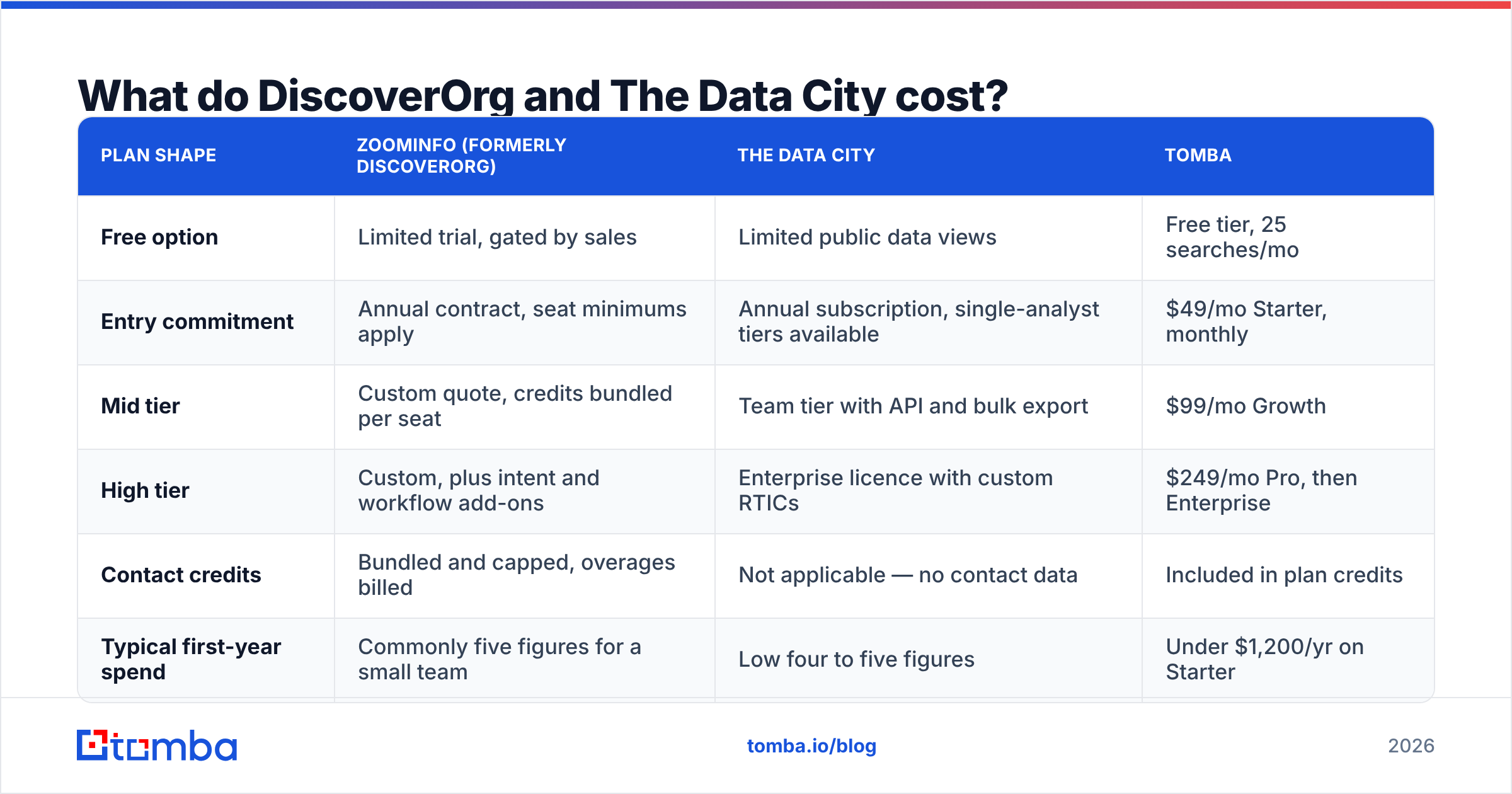
| Plan shape | ZoomInfo (formerly DiscoverOrg) | The Data City | Tomba |
|---|---|---|---|
| Free option | Limited trial, gated by sales | Limited public data views | Free tier, 25 searches/mo |
| Entry commitment | Annual contract, seat minimums apply | Annual subscription, single-analyst tiers available | $49/mo Starter, monthly |
| Mid tier | Custom quote, credits bundled per seat | Team tier with API and bulk export | $99/mo Growth |
| High tier | Custom, plus intent and workflow add-ons | Enterprise licence with custom RTICs | $249/mo Pro, then Enterprise |
| Contact credits | Bundled and capped, overages billed | Not applicable — no contact data | Included in plan credits |
| Typical first-year spend | Commonly five figures for a small team | Low four to five figures | Under $1,200/yr on Starter |
The pattern holds across every buyer chat. The costly part of ZoomInfo is not the company records. It is the contact layer plus the per-seat model. The Data City is cheaper because it chooses not to sell that layer.
That leaves an obvious gap, and many teams already use it. Take a cheap or free company source. Then buy contact discovery on its own. Full Tomba pricing is public, monthly, and needs no procurement cycle.
Which should you buy for outbound prospecting in 2026?#
Work through these in order. Stop at the first one that sounds like you.
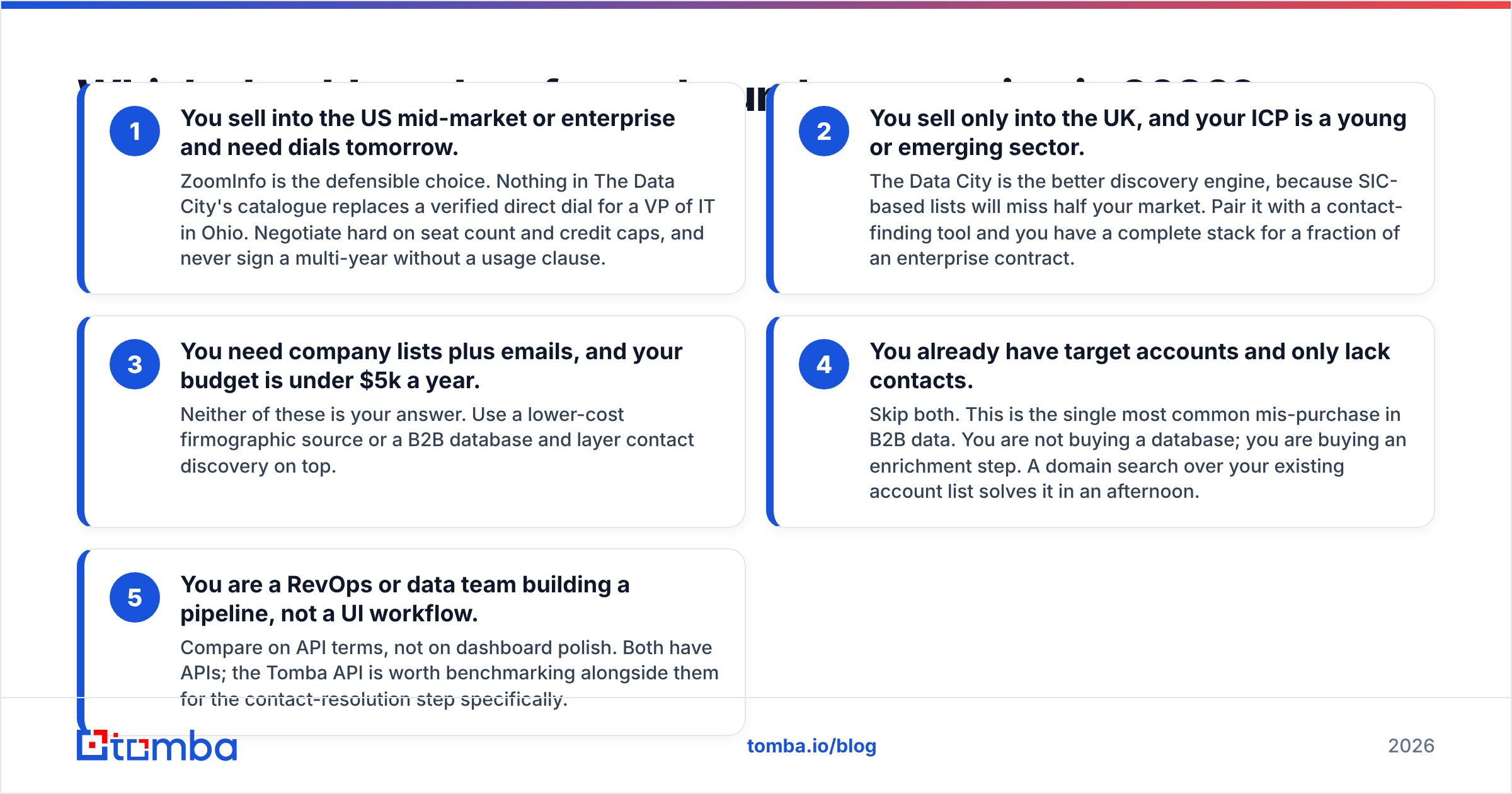
- US mid-market or enterprise, dials needed now. ZoomInfo is the safe pick. Push hard on seat count and credit caps.
- UK only, young or emerging sector. The Data City finds what SIC lists miss. Add a contact tool for a full stack.
- Company lists plus emails on under $5k a year. Use a cheaper source or a B2B database, then layer contact discovery on top.
- You have accounts but no contacts. Skip both. A domain search over your account list solves it in an afternoon.
- RevOps building a pipeline, not a UI workflow. Compare API terms. Benchmark the Tomba API for the contact step.

Is there a cheaper stack that does the same job?#
For most outbound teams, yes. The reason is structural, not just about price.
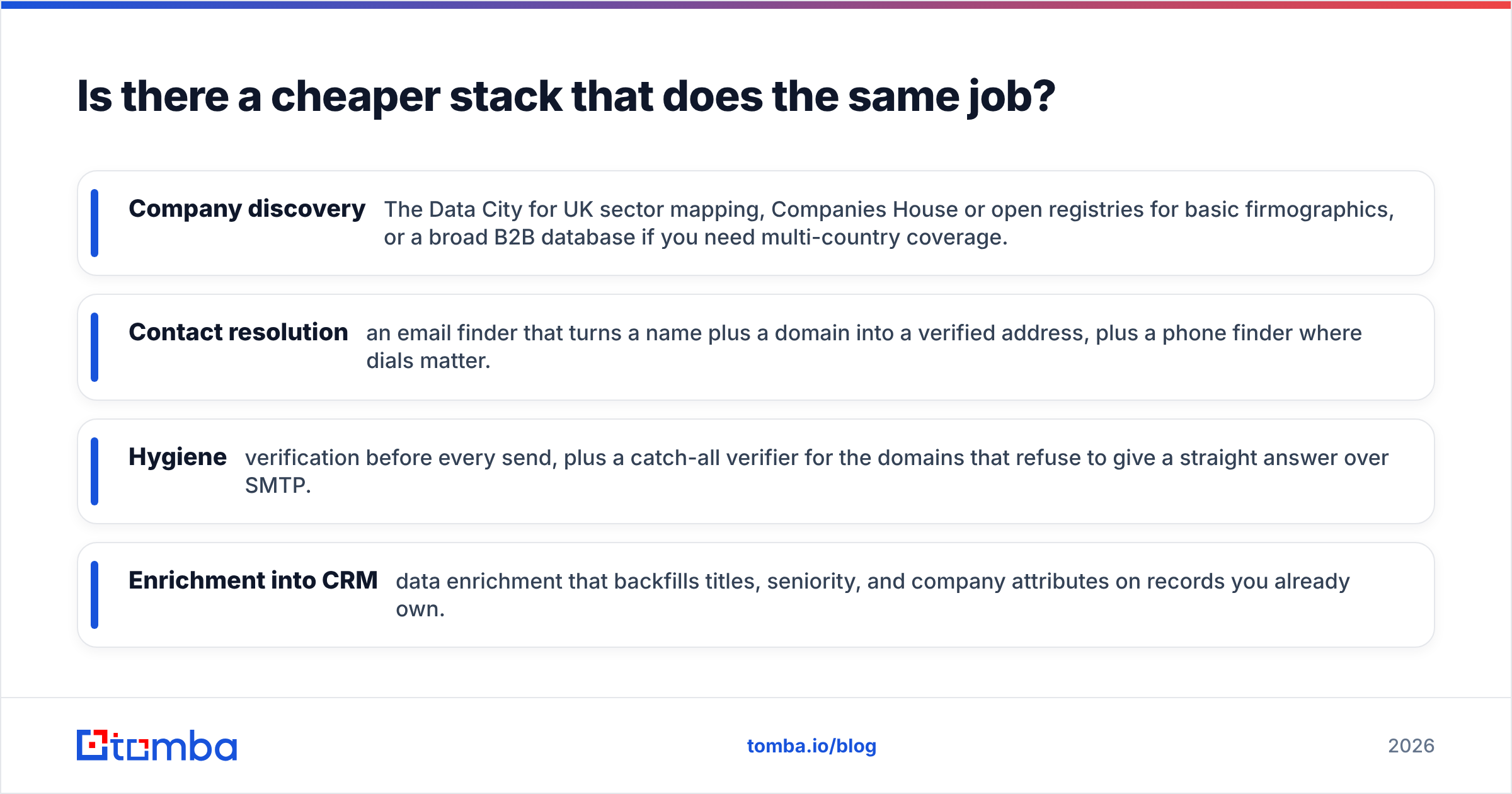
Enterprise sales platforms bundle three separate things: a company graph, a contact graph, and a workflow layer. You pay for all three even when you need one. The Data City sells one of the three, cleanly. That is why it is affordable. The unbundled stack looks like this:
- Company discovery — The Data City for UK sectors, Companies House for basic firmographics, or a broad B2B database for multi-country reach.
- Contact resolution — an email finder that turns a name plus a domain into a verified address, plus a phone finder when dials matter.
- Hygiene — verify before every send. Add a catch-all verifier for domains that dodge a straight SMTP answer.
- Enrichment into CRM — data enrichment that fills in titles, seniority, and company fields on records you own.
The case for staying bundled is real. One contract, one support line, one field mapping. If your ops team is thin, that is worth money. But it is worth some money, not any amount. The gap between a five-figure deal and a $49/mo tool is a lot of budget to defend on convenience alone.
Check one more thing before you sign. Run a live bounce test. Pull 200 contacts from a trial. Verify them yourself. Then send a small campaign. Vendors quote accuracy at the record level. Your mail server quotes it at the inbox level. Only one of those pays your rent. High bounce rates hurt sender reputation long after you churn off the tool that caused them.
What's the verdict on DiscoverOrg vs The Data City?#
They are not really rivals. Treating them as rivals is how teams end up with the wrong tool.
Buy ZoomInfo (the platform DiscoverOrg became) if your revenue depends on reaching named people in North America at volume. You also need the budget and the ops maturity to use intent and workflows.
Buy The Data City if your job is to understand a UK market. Which firms exist, what they really do, how fast the sector is growing. Contact details are a later problem.
Most growing B2B teams land in the middle. If that is you, unbundle. Use whichever source maps your market best. Then handle contacts with a tool that bills monthly and posts its prices.
That is where Tomba fits in DiscoverOrg vs The Data City. Start with the Tomba Email Finder on the free tier. You get 25 searches a month, no sales call, no annual lock-in. Run it against 50 accounts you already know. If the hit rate holds, you have replaced the priciest line in an enterprise data contract for $49/mo.
Related guides#
Ready to find emails that actually work?
Join 150,000+ professionals who stopped guessing and started sending. Free credits on signup — no credit card required.
Get the Tomba newsletter
Practical outbound tactics and product updates — once every two weeks.
About the author