DiscoverOrg vs Thomson Data: B2B Data Compared for 2026
DiscoverOrg lives inside ZoomInfo now. Thomson Data sells you a list and walks away. Here's how the two actually compare on accuracy, pricing, contracts, and what a leaner stack costs instead.
TL;DR
- DiscoverOrg no longer exists as a standalone product. It merged into ZoomInfo after the 2019 acquisition, so "buying DiscoverOrg" in 2026 means signing a ZoomInfo contract — typically annual, typically five figures, typically with seat minimums.
- Thomson Data is a list vendor, not a platform. You brief them on a target segment, they deliver a CSV. No live UI, no refresh cycle, no API you build workflows on.
- The two are not really competitors. One sells continuous intelligence at enterprise pricing; the other sells one-off data at per-record pricing. Choosing between them is really choosing between subscription and transaction.
- Both share the same failure mode: data decays roughly 2-3% per month, and neither model guarantees the record is still good on the day you send. Verification is on you either way.
- If you need 500-5,000 accurate contacts a month rather than a 200,000-row database, a targeted email finder plus a verifier usually beats both on cost per usable contact.
What is DiscoverOrg in 2026?#
DiscoverOrg was a B2B contact and technographic database that built its reputation on human-researched org charts — who reports to whom, which tools a company runs, which budget owner signs off. Sales teams selling into IT and finance liked it because the data went deeper than a job title and an email.
That product line no longer sells under its own name. DiscoverOrg acquired ZoomInfo in 2019 and adopted the ZoomInfo brand, and the two datasets were consolidated. What survives today is inside ZoomInfo — the intent signals, the org charts, the technographics, the Copilot-style AI layer, and the CRM integrations. If a rep tells you they're evaluating DiscoverOrg, they're evaluating ZoomInfo.
That matters for three practical reasons:
- Pricing moved up, not down. The legacy DiscoverOrg mid-market packages were absorbed into ZoomInfo's tiering, which is quote-only and generally starts in the five figures annually for a small team.
- Credits became the unit of consumption. Exports are metered. Running out mid-quarter is a real budgeting problem, not a theoretical one.
- Contracts are annual. Public reviews on G2 repeatedly flag auto-renewal terms and the difficulty of downgrading mid-term. Read the renewal clause before you sign, not after.
What is Thomson Data and how does it actually work?#
Thomson Data sits in a completely different category: it's a B2B mailing-list and database vendor. You tell a sales rep the segment you want — "US healthcare CIOs, 500+ employees" — and they scope a count, quote a price, and deliver a file. Email, phone, mailing address, firmographics, sometimes NAICS/SIC codes.
The model is transactional. You pay per record or per list, you own the file, and there's no seat licence hanging over your head. For teams that need direct-mail addresses, event lists, or an ABM seed list for a one-time campaign, that's genuinely useful and genuinely cheaper up front.
The trade-offs are structural, not incidental:
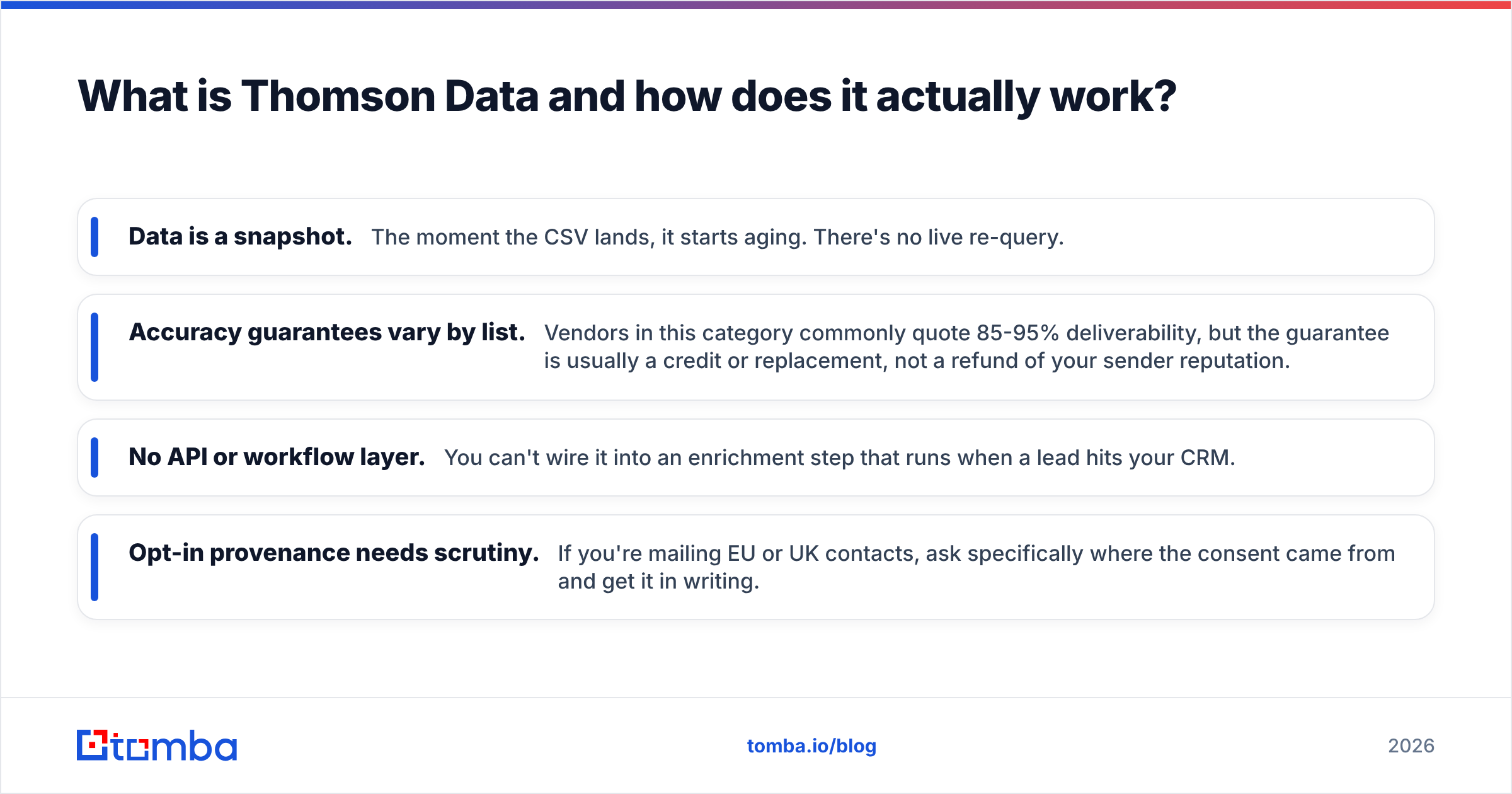
- Data is a snapshot. The moment the CSV lands, it starts aging. There's no live re-query.
- Accuracy guarantees vary by list. Vendors in this category commonly quote 85-95% deliverability, but the guarantee is usually a credit or replacement, not a refund of your sender reputation.
- No API or workflow layer. You can't wire it into an enrichment step that runs when a lead hits your CRM.
- Opt-in provenance needs scrutiny. If you're mailing EU or UK contacts, ask specifically where the consent came from and get it in writing.
DiscoverOrg vs Thomson Data: how do they compare head-to-head?#
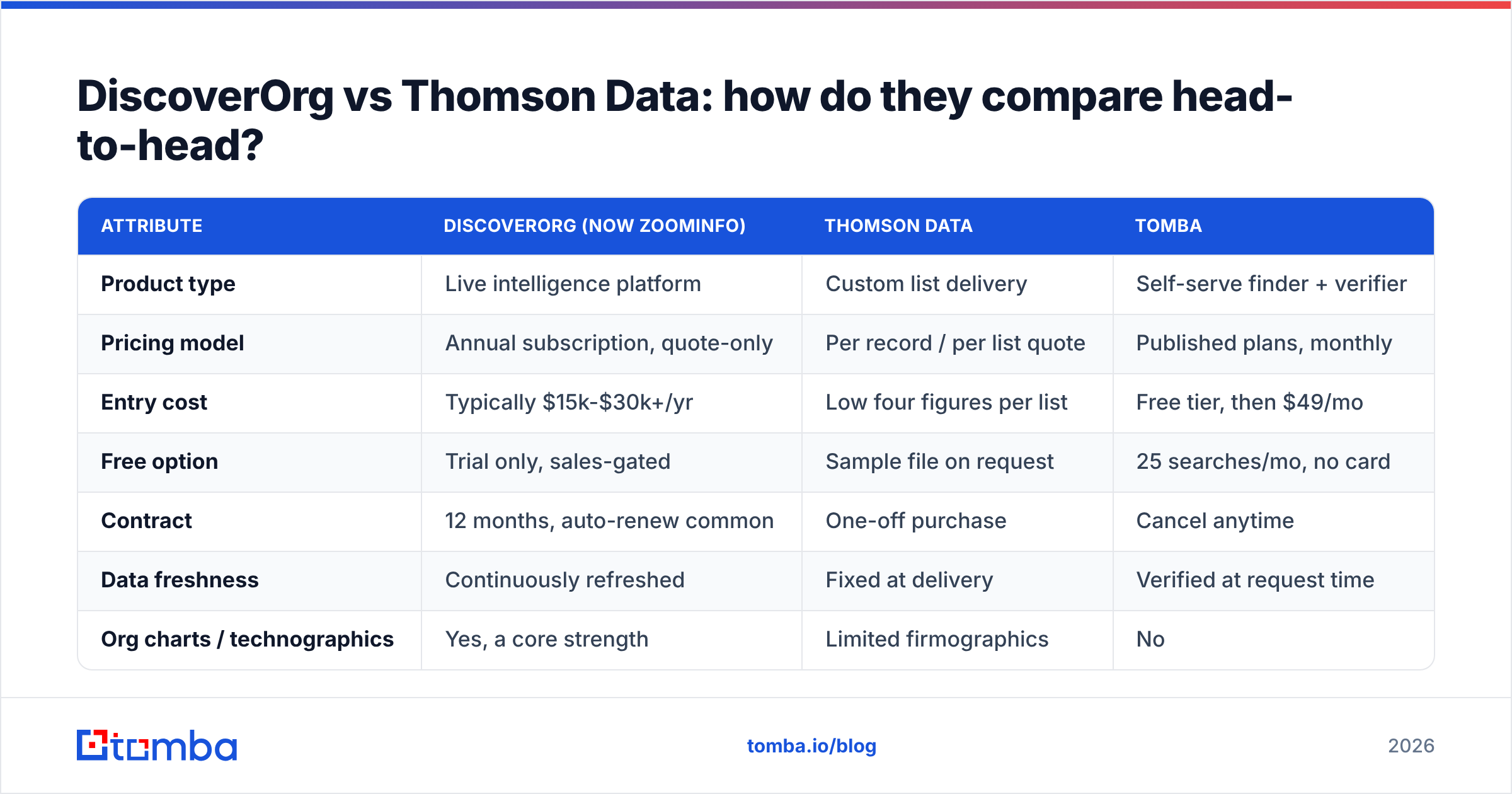
| Attribute | DiscoverOrg (now ZoomInfo) | Thomson Data | Tomba |
|---|---|---|---|
| Product type | Live intelligence platform | Custom list delivery | Self-serve finder + verifier |
| Pricing model | Annual subscription, quote-only | Per record / per list quote | Published plans, monthly |
| Entry cost | Typically $15k-$30k+/yr | Low four figures per list | Free tier, then $49/mo |
| Free option | Trial only, sales-gated | Sample file on request | 25 searches/mo, no card |
| Contract | 12 months, auto-renew common | One-off purchase | Cancel anytime |
| Data freshness | Continuously refreshed | Fixed at delivery | Verified at request time |
| Org charts / technographics | Yes, a core strength | Limited firmographics | No |
| Intent data | Yes | No | No |
| API access | Yes, higher tiers | Rarely | Yes, all paid tiers |
| Verification included | Partial | Vendor-side only | Yes, built in |
| Best for | Enterprise ABM teams | One-time bulk campaigns | Targeted outbound at volume |
The table exposes the real decision. These are not two versions of the same purchase. ZoomInfo is an operating system for a revenue team with an ops person to run it. Thomson Data is a procurement event. If you're comparing them line by line, you're probably in the middle — you want reliable contacts without a platform commitment or a bulk gamble.
Which one has better data accuracy?#
Neither one wins cleanly, and the honest answer depends on what you mean by "accurate."
Coverage accuracy — does the record exist and is the person real? ZoomInfo wins comfortably. Its contributory network (users sync their inboxes and contacts in exchange for credits) plus human research produces deep coverage of North American mid-market and enterprise. Thomson Data's coverage is broader in some verticals and geographies but shallower per record.
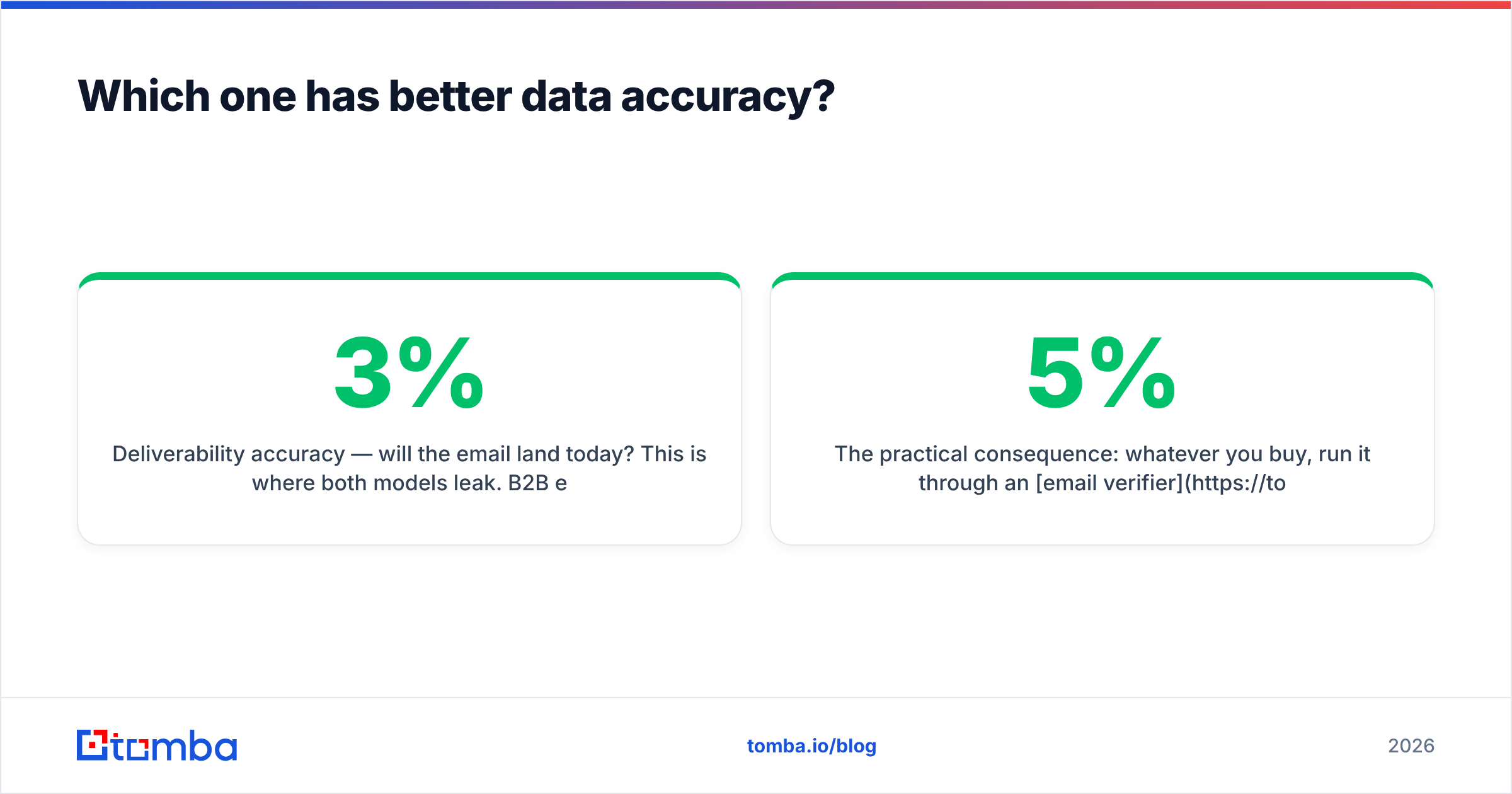
Deliverability accuracy — will the email land today? This is where both models leak. B2B email data decays at roughly 2-3% per month as people change jobs; a list that was 92% accurate in January is meaningfully worse by June. ZoomInfo re-crawls continuously, which helps, but exported records sitting in your sequencing tool are just as stale as a purchased CSV. Thomson Data has no refresh mechanism at all once the file is delivered.
The practical consequence: whatever you buy, run it through an email verifier before the first send. A 5% bounce rate is the threshold where mailbox providers start throttling you, and both a stale platform export and a six-month-old purchased list can blow past it. If your target domains are catch-all — common in enterprise IT — a dedicated catch-all verifier is the only way to separate real mailboxes from domains that accept everything.

What does each option really cost?#
Compare cost per usable contact, not cost per record. That single reframing changes most buying decisions in this category.
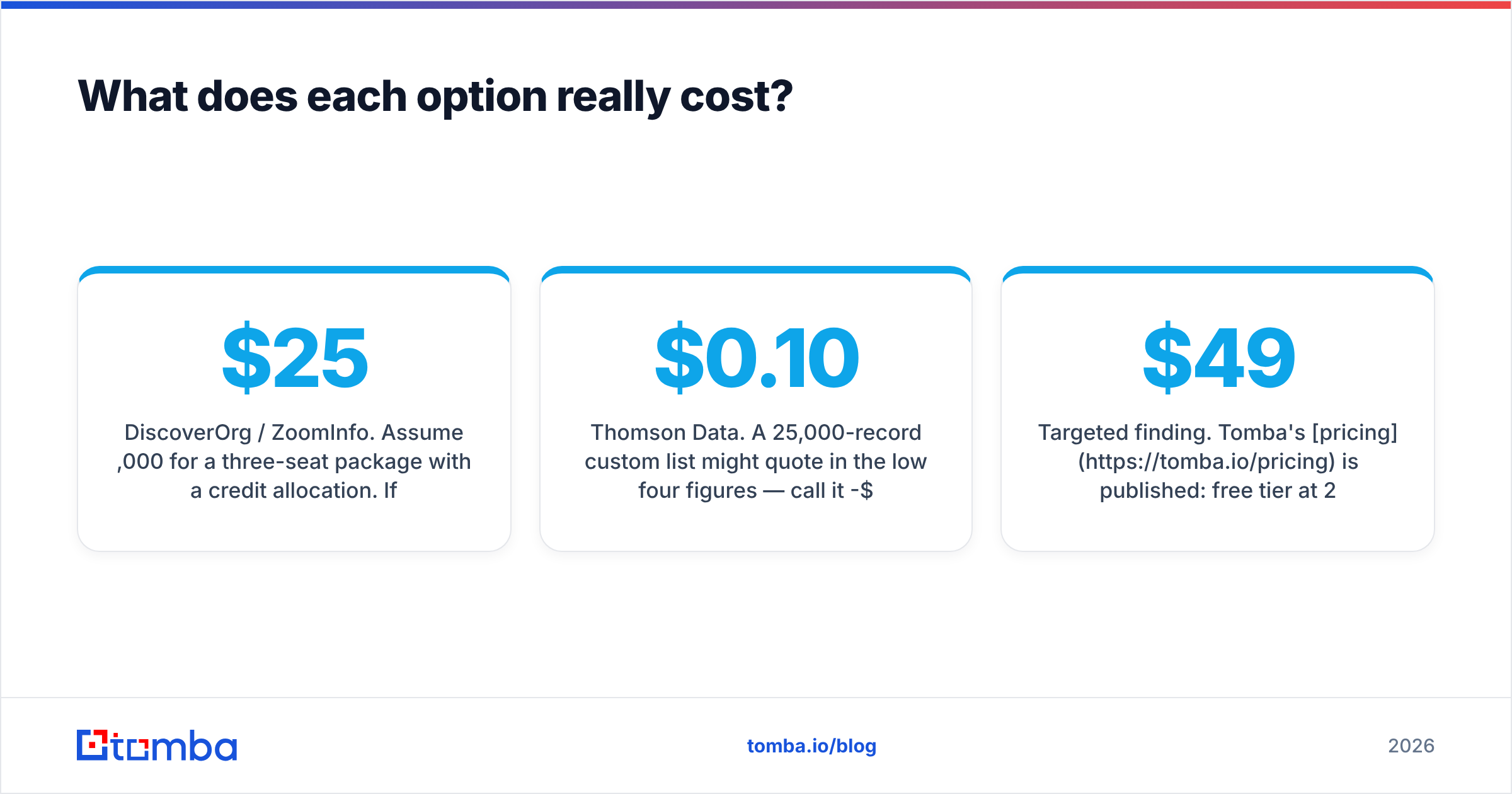
DiscoverOrg / ZoomInfo. Assume $25,000/year for a three-seat package with a credit allocation. If your team actually exports and works 10,000 contacts across the year, that's $2.50 per contact — before you account for the credits you burned on records that turned out to be wrong-fit. Teams that use the intent data, the org charts, and the CRM sync daily get real value at that price. Teams that log in twice a month to pull a list are paying platform rates for a lookup tool.
Thomson Data. A 25,000-record custom list might quote in the low four figures — call it $0.10-$0.20 per record. Cheap on paper. Now apply a realistic 20% hard-bounce and wrong-person rate, subtract the contacts outside your actual ICP that padded the count, and your effective cost per contact you'd actually email climbs to $0.30-$0.50. Still cheap, but the hidden cost is the domain reputation damage from mailing a list you didn't verify.
Targeted finding. Tomba's pricing is published: free tier at 25 searches/month, Starter $49/mo, Growth $99/mo, Pro $249/mo, Enterprise custom. At the Growth tier you're finding and verifying contacts you specifically chose, which means the denominator in "cost per usable contact" isn't inflated by records you'd never email. For a two-rep outbound team sending 1,500 emails a month, that's the difference between a $99 line item and a $2,000+ one.
The mistake teams make is buying volume they can't work. A 200,000-row database is not an asset if your team can personalize 200 emails a week. Buy the number of contacts your sequencing capacity can actually consume, then spend the savings on research and copy.
When should you pick ZoomInfo, Thomson Data, or something leaner?#
Pick ZoomInfo (the DiscoverOrg lineage) when:
- You run account-based marketing at enterprise scale. Intent signals and org charts justify the price only if someone acts on them weekly.
- You have a RevOps owner. The platform rewards configuration — scoring rules, CRM field mapping, alert workflows. Without an owner, most of the value goes unused.
- Your ACV is above ~$25k. One extra closed deal has to pay for the contract, or the math doesn't work.
- You sell into IT, security, or finance, where knowing the reporting line and the tech stack materially changes your pitch.
Pick Thomson Data when:
- You need a one-time campaign list — a conference invite, a direct-mail drop, a regional launch — and don't want a subscription.
- You need postal addresses, which platform tools often deprioritize.
- Your segment is niche or non-US and you've validated a sample file against your own knowledge of the market.
- Procurement prefers capex to opex. A single PO is easier to approve than a recurring licence in some organizations.
Pick a leaner stack when:
- Your monthly contact need is under ~5,000. Below that, platform pricing is dead weight.
- You already know your target accounts and just need the right person's email at each one. A domain search pulls the addressable contacts at a company in seconds, which is a different job than browsing a database.
- You want verification and finding in the same step, rather than exporting to a second vendor.
- You need an API in your workflow, not just a UI. The Tomba API handles enrichment on lead creation without an enterprise tier gate.
- You want to test before committing. Free tiers and monthly billing let you validate accuracy on your own ICP instead of trusting a sample file curated by a sales rep.
What should you ask before signing either contract?#
Run this list through any vendor in this category, including the ones you like:
- What's the bounce guarantee, and what's the remedy? "95% accurate" with no remedy clause is marketing copy.
- How is the data sourced, and can you document consent for EU/UK records? Get it in writing. GDPR exposure sits with you, the sender.
- What happens at renewal? Ask for the auto-renew notice period in writing, and whether you can reduce seats mid-term.
- Do unused credits roll over? Usually no. Model your usage on your slowest quarter, not your best one.
- Can I test on my own list before buying? Give both vendors 100 contacts you already know are valid and check the match rate. This one test predicts more than any demo.
- Is there an export limit? Some platform contracts cap the total records you can pull regardless of credits.
If a vendor won't answer the first or last question directly, that's your answer.
The bottom line#
DiscoverOrg vs Thomson Data isn't a fair fight because they're not the same product. ZoomInfo inherited DiscoverOrg's depth and priced it for enterprise revenue teams who'll use intent data and org charts every day. Thomson Data sells a file at a fraction of the cost, with the freshness and provenance risk that comes with any static list. Both are defensible choices for the buyer they were built for.
Most teams aren't that buyer. If your reality is a few thousand well-chosen contacts a month, a specific list of target accounts, and a bounce rate you can't afford to gamble with, the enterprise subscription is overbuilt and the bulk list is under-verified.
That's the gap the Tomba Email Finder fills. Search by domain, name, or company, get the address with a confidence score and sources, and verify it in the same request — no annual contract, no credit brinkmanship, no CSV of unknown provenance. Start on the free tier with 25 searches, run your own accuracy test against contacts you can confirm, and only upgrade to Starter at $49/mo once the data has proven itself on your ICP. Test first, then buy — the same advice we'd give you about any vendor on this page.
Related guides#
Ready to find emails that actually work?
Join 150,000+ professionals who stopped guessing and started sending. Free credits on signup — no credit card required.
Get the Tomba newsletter
Practical outbound tactics and product updates — once every two weeks.
About the author