DiscoverOrg vs UpLead in 2026: Pricing, Data, and Verdict
DiscoverOrg no longer exists as a standalone product — it is ZoomInfo now. Here is how that platform actually stacks up against UpLead on price, contracts, data accuracy, and export rights in 2026.
DiscoverOrg vs UpLead looks like a fair fight. It is not. DiscoverOrg is not sold on its own anymore. It is ZoomInfo now. So the real choice is a big enterprise contract against a cheap self-serve tool.
TL;DR
- DiscoverOrg is not a separate product. It merged with ZoomInfo in 2019 and the brand was retired. If a rep sells you "DiscoverOrg," you are buying ZoomInfo.
- UpLead is self-serve and lists its prices. Plans start near $99 a month. ZoomInfo is quote-only and sold by the seat. Small teams often see five figures a year.
- Both tools bill you for records you may never use. Credits expire. Seats are annual. Exports are capped by contract. Read those clauses before you argue about "accuracy."
- ZoomInfo wins on org-chart depth and intent data. UpLead wins on clear pricing, monthly plans, and verified emails per dollar.
- Need a work email at scale, not a whole GTM suite? A dedicated email finder does that job for a fraction of either bill.
DiscoverOrg vs UpLead: is DiscoverOrg still a product in 2026?#
No. DiscoverOrg acquired ZoomInfo in 2019. It kept the ZoomInfo name for buyers. The DiscoverOrg dataset and org-chart research moved inside it. The combined company went public in 2020 and now trades as ZoomInfo. The discoverorg.com domain redirects.
That matters here. Most "DiscoverOrg vs UpLead" searches come from one of three people:
- Someone renewing an old DiscoverOrg contract. It is a ZoomInfo contract now, with a bigger number on it.
- Someone who read a 2018 review. They still think DiscoverOrg is a cheap, tech-focused niche player. It is not. It is the top tier of the largest B2B data vendor on the market.
- Someone who heard about DiscoverOrg's deep IT org charts from a colleague.
Only the third reason still holds up. DiscoverOrg built its name on human-checked org charts for IT and engineering teams. Who reports to whom. Which team owns which budget. Phone extensions that actually ring. That research team still works inside ZoomInfo. It is the one thing UpLead does not match.
For the rest of this post, "DiscoverOrg" means ZoomInfo with the DiscoverOrg data behind it.
What is UpLead, and who is it for?#
UpLead is a self-serve B2B contact database. You search by title, industry, technology, revenue, and location. Then you export contacts with verified emails. Its edge is the check at export time. You burn a credit for a record only after the SMTP test passes.
The buyer looks nothing like a ZoomInfo buyer. UpLead sells to founders, small sales teams, agencies, and marketers. These people need a list this quarter. They do not want a long buying process. Prices sit on the website. You can start with a card and cancel later.
That posture is also the ceiling. UpLead does not sell you conversation intelligence. It does not tie website visitors to a data warehouse. You do not get a dedicated CSM to build your filters for you.

DiscoverOrg vs UpLead pricing: what do they cost?#
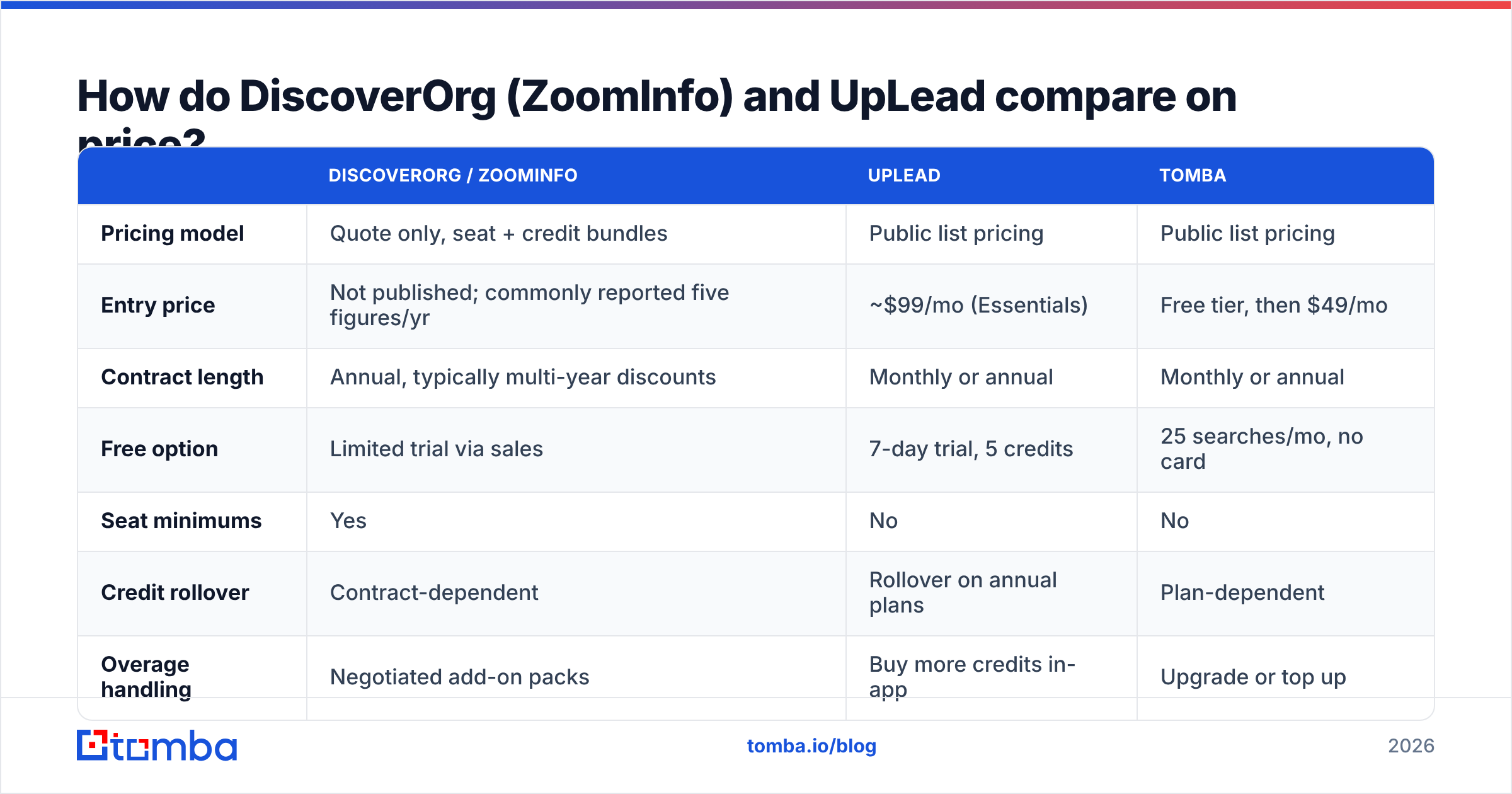
This is the fastest way to rule one out. Public prices and quote-only prices are not a small gap. The gap decides who inside your company has to sign off.
| DiscoverOrg / ZoomInfo | UpLead | Tomba | |
|---|---|---|---|
| Pricing model | Quote only, seat + credit bundles | Public list pricing | Public list pricing |
| Entry price | Not published; commonly reported five figures/yr | ~$99/mo (Essentials) | Free tier, then $49/mo |
| Contract length | Annual, typically multi-year discounts | Monthly or annual | Monthly or annual |
| Free option | Limited trial via sales | 7-day trial, 5 credits | 25 searches/mo, no card |
| Seat minimums | Yes | No | No |
| Credit rollover | Contract-dependent | Rollover on annual plans | Plan-dependent |
| Overage handling | Negotiated add-on packs | Buy more credits in-app | Upgrade or top up |
| API access | Enterprise tier | Higher tiers | All paid tiers |
Two caveats before you screenshot that table.
First, ZoomInfo's number moves a lot. It shifts with seat count and data modules such as Sales, Marketing, Talent, and Operations. It shifts again if you add intent or Copilot features. Teams report roughly $15k to well past $100k a year. Public G2 reviews are the closest thing to a price index that exists.
Second, both vendors change list prices. Check the vendor page before you budget. Then compare it with Tomba pricing if you only need the contact-data layer.
One structural point beats any dollar figure. ZoomInfo charges per seat. UpLead charges per credit. A four-rep team doing light daily lookups pays four times with ZoomInfo. A one-person growth team building a 20,000-record list pays once with UpLead and buys credits.
DiscoverOrg vs UpLead: which one has better data accuracy?#
ZoomInfo has more records. UpLead makes a stronger promise on the records it charges for. Both claims can be true at once.
ZoomInfo's edge comes from scale. It blends data from users who connect their inboxes, web crawling, public filings, and the human research layer it inherited from DiscoverOrg. The org charts, direct dials, and team hierarchies beat anything a self-serve tool ships. The cost is stale data in the long tail. You cannot recheck hundreds of millions of contacts all the time. Every heavy user has emailed someone who left two years ago.
UpLead's edge is process. It verifies the email at export. It publishes a 95% accuracy commitment. It credits you back for bounces. You pay for a smaller pool that is checked at the moment of use.
Test these four things in any trial, whatever the vendor:
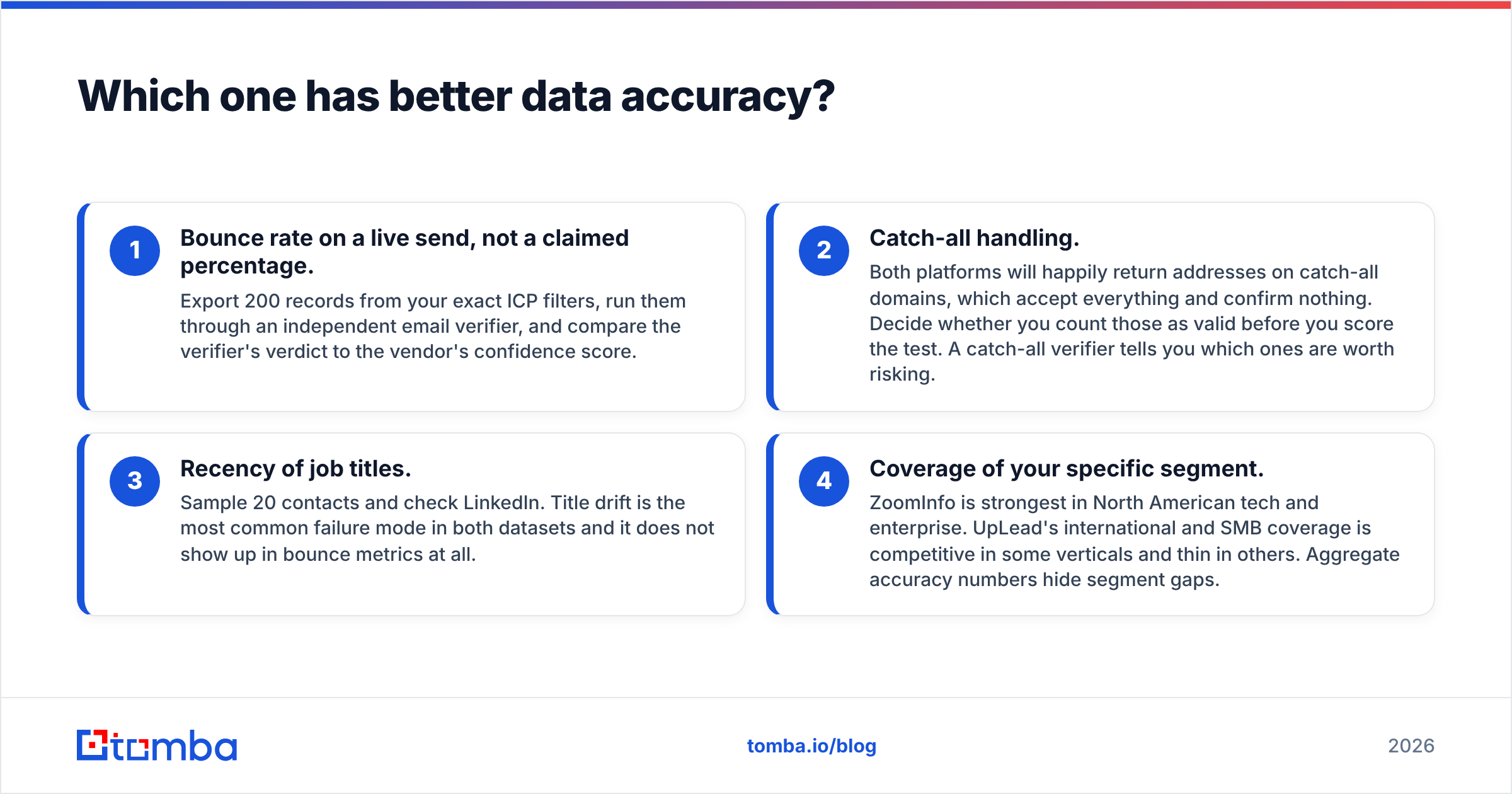
- Bounce rate on a live send, not a claimed number. Export 200 records from your exact filters. Run them through an outside email verifier. Compare that verdict with the vendor's confidence score.
- Catch-all handling. Both tools return addresses on catch-all domains. Those domains accept everything and confirm nothing. Decide whether they count as valid before you score the test. A catch-all verifier shows which ones are worth the risk.
- How fresh the job titles are. Sample 20 contacts and check LinkedIn. Title drift is the most common failure in both datasets. Bounce metrics never show it.
- Coverage of your segment. ZoomInfo is strongest in North American tech and enterprise. UpLead is competitive in some verticals and thin in others. Blended accuracy numbers hide those gaps.
How do the contracts and credits actually work?#
This part costs people more money than the accuracy debate does.
- Seats vs credits. ZoomInfo sells seats. Adding a fifth rep mid-year usually means an add-on at full rate. UpLead sells credits, and anyone on the team can spend them.
- Export caps. ZoomInfo contracts often cap bulk exports apart from views. You may see more records than you can download. Ask for that clause in writing.
- Credit expiry. Monthly credits rarely roll forward forever. UpLead rolls credits over on annual plans. ZoomInfo depends on your contract.
- Auto-renewal. Annual data deals often renew on their own. Notice windows run 30 to 60 days. Diary the date the day you sign.
- Data after you leave. Ask whether you may keep and use exported records once the deal ends. This varies, and few people read it.
- API limits. Compare rate limits and per-call cost, not headline credits. A cheap plan with 60 calls a minute is not cheap at 200,000 rows.
DiscoverOrg vs UpLead, feature by feature#
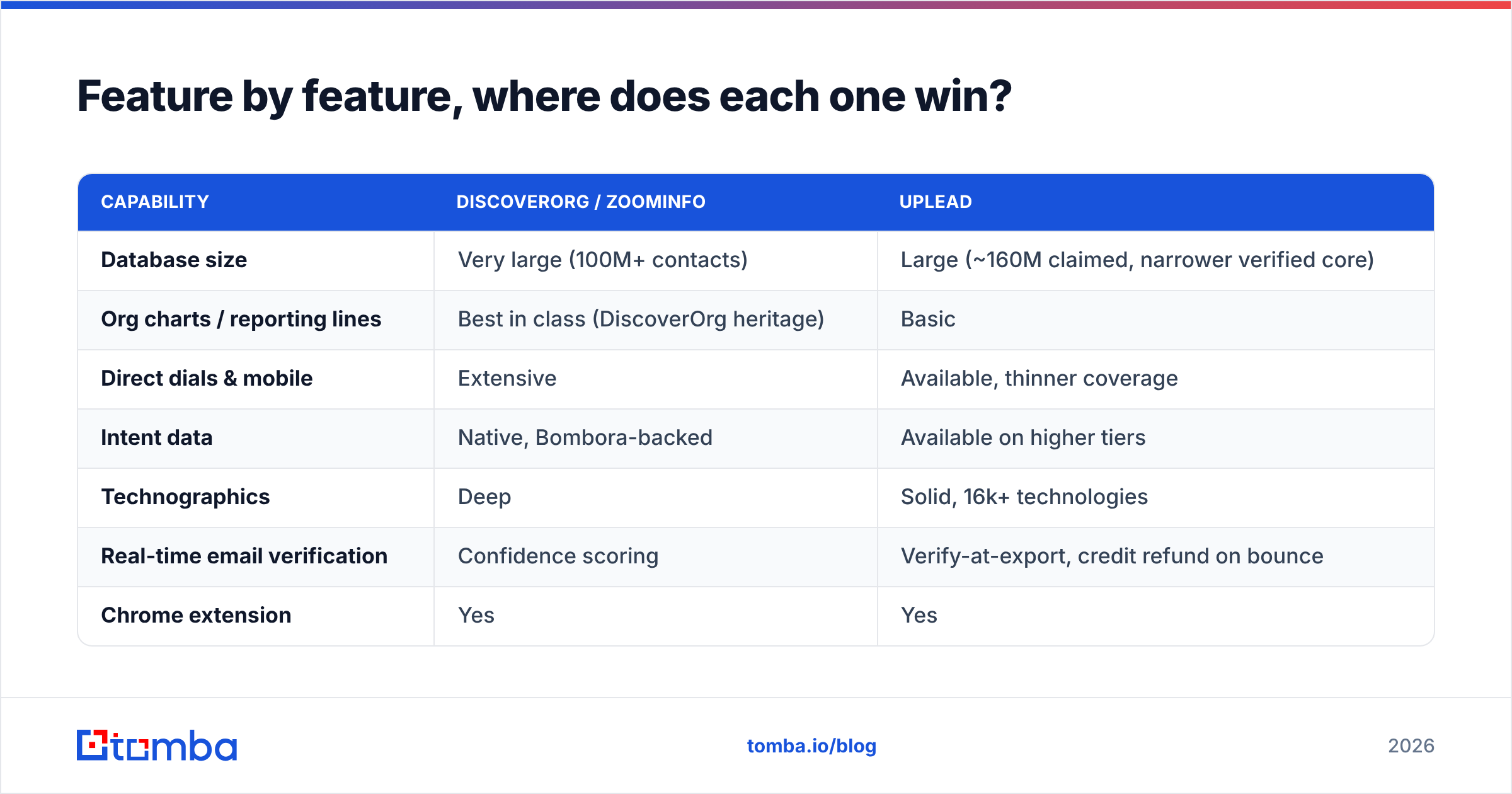
| Capability | DiscoverOrg / ZoomInfo | UpLead |
|---|---|---|
| Database size | Very large (100M+ contacts) | Large (~160M claimed, narrower verified core) |
| Org charts / reporting lines | Best in class (DiscoverOrg heritage) | Basic |
| Direct dials & mobile | Extensive | Available, thinner coverage |
| Intent data | Native, Bombora-backed | Available on higher tiers |
| Technographics | Deep | Solid, 16k+ technologies |
| Real-time email verification | Confidence scoring | Verify-at-export, credit refund on bounce |
| Chrome extension | Yes | Yes |
| CRM sync | Native Salesforce/HubSpot, deep | Native, simpler |
| Sequencing / dialer | Included in higher suites | Not included |
| Website visitor ID | Yes (WebSights) | No |
| Time to first list | Days to weeks (sales cycle) | Minutes |
| Best for | Enterprise GTM teams with budget | SMB and mid-market teams needing speed |

Here is the honest summary. ZoomInfo is a GTM platform that happens to hold a database. UpLead is a database that happens to have a Chrome extension. Judge them only on "who has better emails" and the price gap stops making any sense.
Which should you pick?#
Pick ZoomInfo (the DiscoverOrg lineage) if: you sell to enterprise IT or engineering. You need to know that the VP of Infrastructure reports to the CTO and owns a $4M budget. You want intent signals feeding an ABM program. You have five or more reps and an ops function to run the platform. You already have the budget line approved.
Pick UpLead if: you need a clean, verified list this week. You have one to five people doing outbound. You can define your target with firm and technology filters. You would rather pay for records than for seats.
Pick neither if: the real job is simple. Given a name and a company, get a work email that lands. That is a much smaller problem than either platform is priced to solve. A focused tool wins on unit cost here. A domain search plus a verification step gets the same result for a two-figure monthly bill. The Tomba API drops it into the list-building workflow you already run.
One more option, for the record. BookYourData sells lists pay-as-you-go, with no subscription at all. That suits teams who buy data in bursts rather than every month.
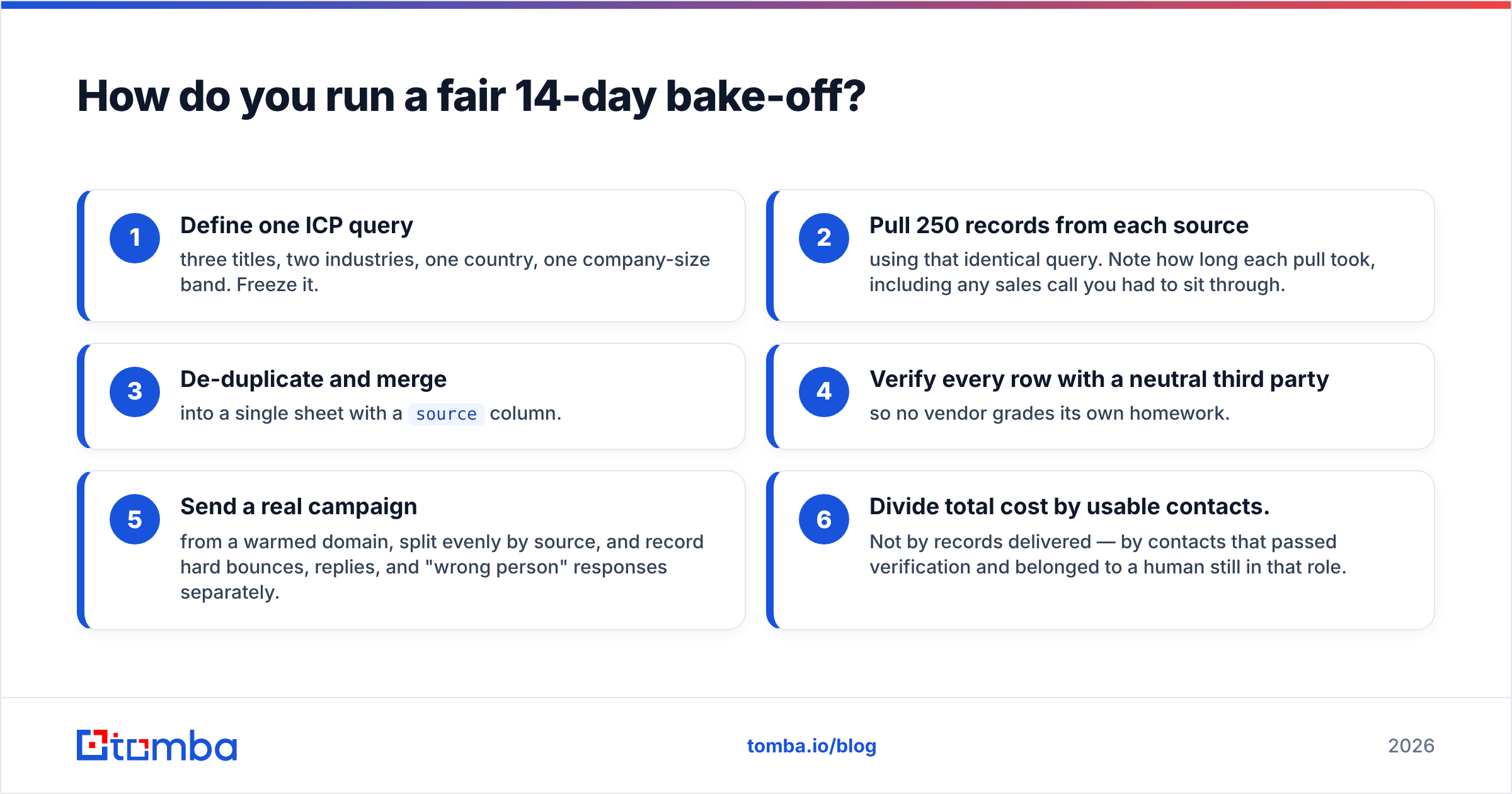
How do you run a fair 14-day bake-off?#
Do not let a vendor run the test for you. Build one control set. Score every candidate against it.
- Define one ICP query. Three titles, two industries, one country, one company-size band. Freeze it.
- Pull 250 records from each source with that same query. Note how long each pull took. Count the sales call you had to sit through.
- De-duplicate and merge into one sheet with a
sourcecolumn. - Verify every row with a neutral third party. No vendor should grade its own homework.
- Send a real campaign from a warmed domain. Split it evenly by source. Track hard bounces, replies, and "wrong person" replies apart.
- Divide total cost by usable contacts. Not by records delivered. Count only contacts that passed verification and still hold the role.
That last number is the only one worth arguing about. A DiscoverOrg vs UpLead test often ends the same way. The pricey platform wins on coverage. It loses on cost per usable contact, sometimes by five to one. The cheap platform covers 80% of the list and fails on the top 20%, where org-chart depth matters. So the right answer is often "both, but smaller." Buy one narrow enterprise seat for the accounts that earn it. Use a cheap, high-volume source for everything else.
The bottom line#
DiscoverOrg vs UpLead in 2026 is really ZoomInfo vs UpLead. It is a question about company stage, not data quality. Enterprise teams with intent data, org charts, and many tools can justify the ZoomInfo contract. Everyone else buys a lot of platform to reach a spreadsheet.
Do you just need verified work emails, by domain, by name, or in bulk? Start with the tool built for that. The Tomba Email Finder gives you 25 free searches a month with no card. It costs $49 a month once you outgrow that. Verification runs in the same call, so you never pay two vendors to answer one question. Run it against your control set, next to whatever your rep is quoting. Let the cost per usable contact decide.
Related guides#
Ready to find emails that actually work?
Join 150,000+ professionals who stopped guessing and started sending. Free credits on signup — no credit card required.
Get the Tomba newsletter
Practical outbound tactics and product updates — once every two weeks.
About the author