DiscoverOrg vs VC-Backed Data Tools: An Honest 2026 Guide
DiscoverOrg is gone as a brand, but its enterprise contract model lives on inside ZoomInfo. Here is how that model actually stacks up against the VC-backed data tools underpricing it in 2026 — on cost, coverage, and lock-in.
DiscoverOrg vs VC-backed data tools is an argument about pricing, not about data. Here is what each side costs, how they compare on accuracy, and who should buy which one in 2026.
TL;DR — the money
- DiscoverOrg is now ZoomInfo. The two merged in 2019 and the old brand was retired. The sales model stayed: annual contracts, seat licenses, and human-checked org charts.
- The challengers won on price, not depth. Apollo, Clay, Findymail, and Tomba never beat DiscoverOrg on data depth. They beat it on monthly billing and self-serve signup.
- The budget gap is wide. A ZoomInfo-class contract runs $15,000–$40,000+ a year. The challenger stack runs $49–$999 a month, with no procurement cycle.
TL;DR — the decision
- The accuracy gap has closed. On normal B2B work emails, a good finder-and-verifier stack now lands in the same 90%+ band that used to justify a five-figure contract.
- Pick by team size. Buy the enterprise contract if you need intent data, org charts, and one approved vendor. Buy the challenger stack if you run fewer than 30 reps.
What happened to DiscoverOrg?#
DiscoverOrg bought ZoomInfo in 2019. It kept the ZoomInfo name and retired its own. So when buyers weigh DiscoverOrg vs VC-backed alternatives today, they are asking one question. Does the old enterprise data model still beat the venture-funded upstarts?
DiscoverOrg never sold on record count. It sold on people. Analysts called companies and mapped who reported to whom. That research team is why the price looked the way it did, and why it still does. You can read the corporate history on ZoomInfo's own site or the neutral summary on Wikipedia.
One idea did not survive the merger. That idea was that deep contact data needs a five-figure commitment. It broke between 2020 and 2023, when a wave of funded tools rebuilt the core job on pay-as-you-go pricing. The core job is simple. Find a verified work email for a named person at a named company.
DiscoverOrg vs VC-backed: what does VC-backed mean here?#
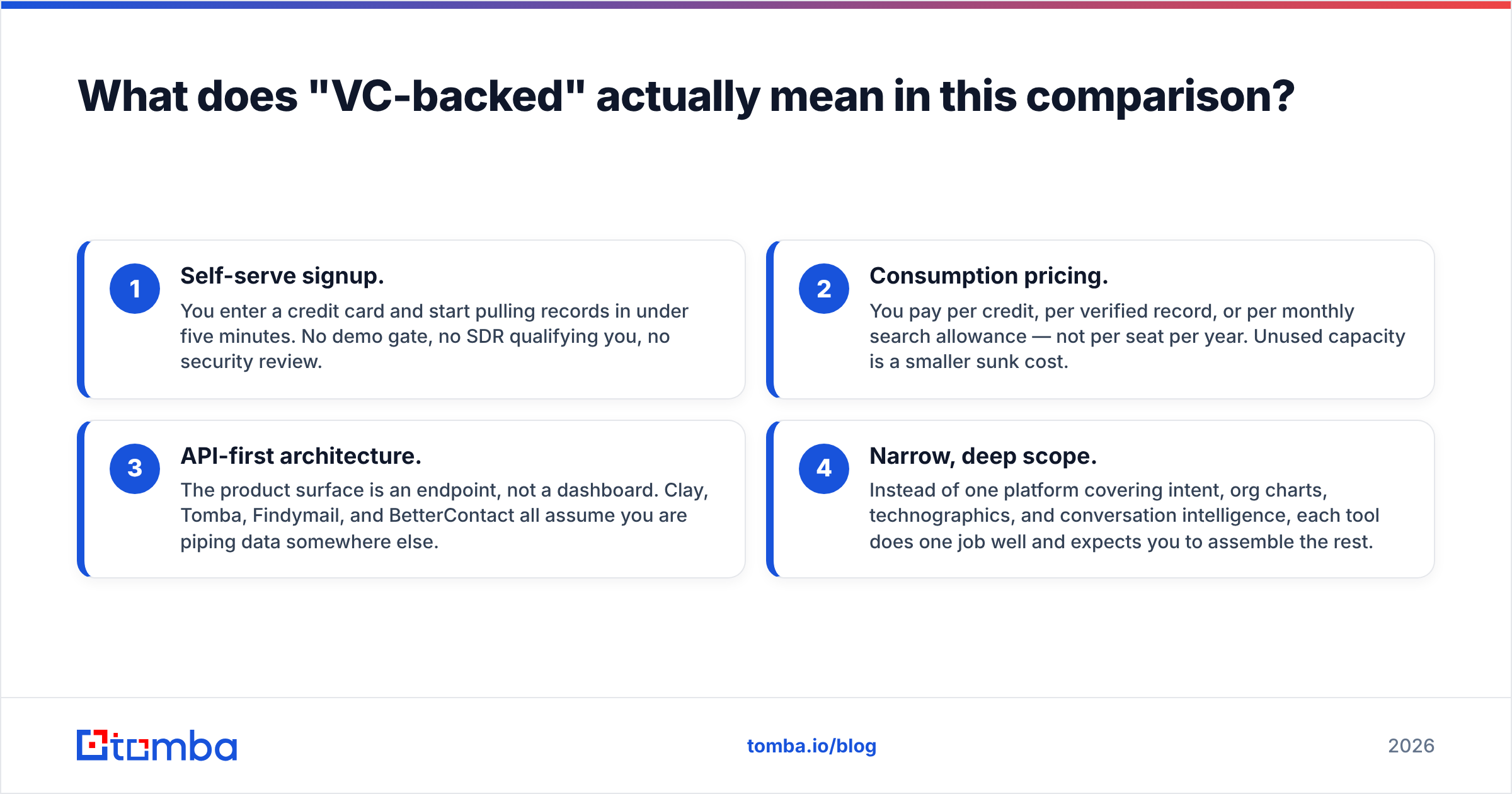
It is a category, not one rival. The VC-backed cohort shares four traits that the DiscoverOrg model does not:
- Self-serve signup. You enter a card and pull records in five minutes. No demo gate. No SDR qualifying you. No security review.
- Consumption pricing. You pay per credit, per verified record, or per monthly search allowance. You do not pay per seat per year. Unused capacity costs you less.
- API-first design. The product is an endpoint, not a dashboard. Clay, Tomba, Findymail, and BetterContact all assume you pipe data somewhere else.
- Narrow, deep scope. Each tool does one job well. You assemble the rest yourself.
That last point is the real trade. Enterprise vendors sell you one bundle. Challengers sell you parts. Neither choice is always right.

DiscoverOrg vs VC-backed pricing: what does each side cost?#
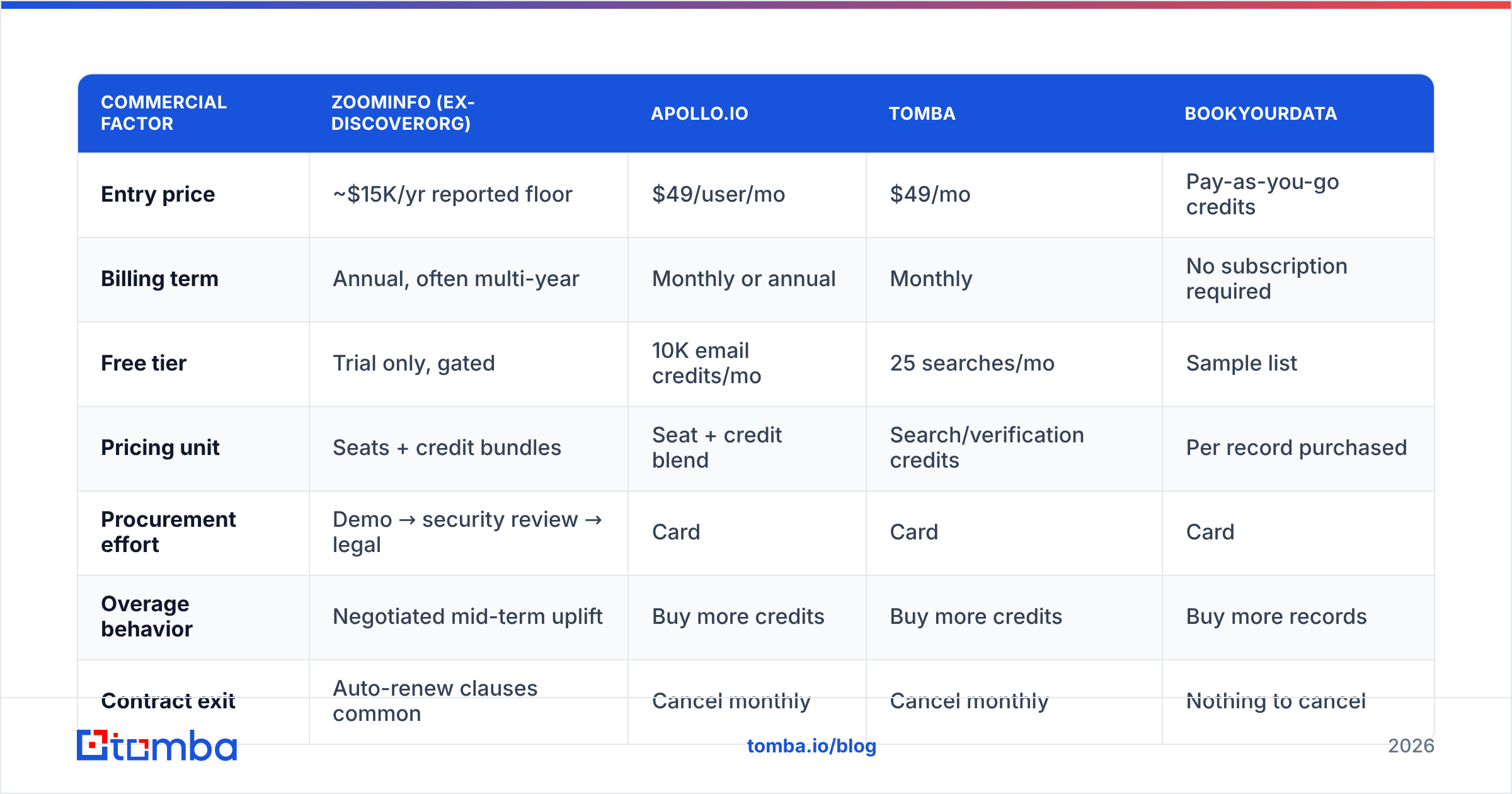
Enterprise data pricing is not published. Treat these as reported ranges from buyer reviews on G2 and public contract disclosures, not as rate cards.
| Commercial factor | ZoomInfo (ex-DiscoverOrg) | Apollo.io | Tomba | BookYourData |
|---|---|---|---|---|
| Entry price | ~$15K/yr reported floor | $49/user/mo | $49/mo | Pay-as-you-go credits |
| Billing term | Annual, often multi-year | Monthly or annual | Monthly | No subscription required |
| Free tier | Trial only, gated | 10K email credits/mo | 25 searches/mo | Sample list |
| Pricing unit | Seats + credit bundles | Seat + credit blend | Search/verification credits | Per record purchased |
| Procurement effort | Demo → security review → legal | Card | Card | Card |
| Overage behavior | Negotiated mid-term uplift | Buy more credits | Buy more credits | Buy more records |
| Contract exit | Auto-renew clauses common | Cancel monthly | Cancel monthly | Nothing to cancel |
The shock is not the headline price. It is the renewal uplift. Most multi-year data contracts include yearly increases. Seats added mid-term rarely get the first discount. A three-seat pilot that grows to twelve seats does not cost 4x. It often costs more, because the pilot rate was a promotion.
The challenger model works the other way. You pay more when volume spikes and less when it drops. If your outbound runs in campaigns or seasons, that swing is worth real money. Check current Tomba pricing against the renewal quote sitting in your inbox. The comparison is usually uncomfortable.
DiscoverOrg vs VC-backed accuracy: is the gap still real?#
This is where the legacy pitch is weakest in 2026.

DiscoverOrg's edge was human research. Analysts phoned companies, confirmed reporting lines, and refreshed records on a schedule. That built real org-chart data. You learned who reports to whom, and who owns which budget. Nothing in the challenger cohort copies it well.
But org charts and email deliverability are two different assets. Most teams mix them up. Say your job is to find the VP of Engineering at 400 companies and email them. You need three things:
- The right name mapped to the right company
- The right email pattern for the domain
- A check that catches dead mailboxes before you send
All three are commodity work now. A modern email finder resolves the pattern. A separate email verifier confirms the mailbox accepts mail. What is left is catch-all handling and how fresh the source data is. Whether an analyst phoned a switchboard in 2019 no longer decides the outcome.
Ask three questions before you sign anything:
- Bounce guarantees. Ask what rate the vendor commits to in writing, and what you get back if they miss it. Under 5% with credit refunds means something. Industry-leading accuracy does not.
- Catch-all policy. Domains that accept all mail inflate most accuracy claims. Ask whether catch-alls count as valid in the vendor's own numbers. A dedicated catch-all verifier exists because generic checks return unknown here.
- Refresh cadence. A record verified 18 months ago is a coin flip. People change jobs often enough that stale data beats poor sourcing as the main cause of errors.
DiscoverOrg vs VC-backed tools: the full feature comparison#

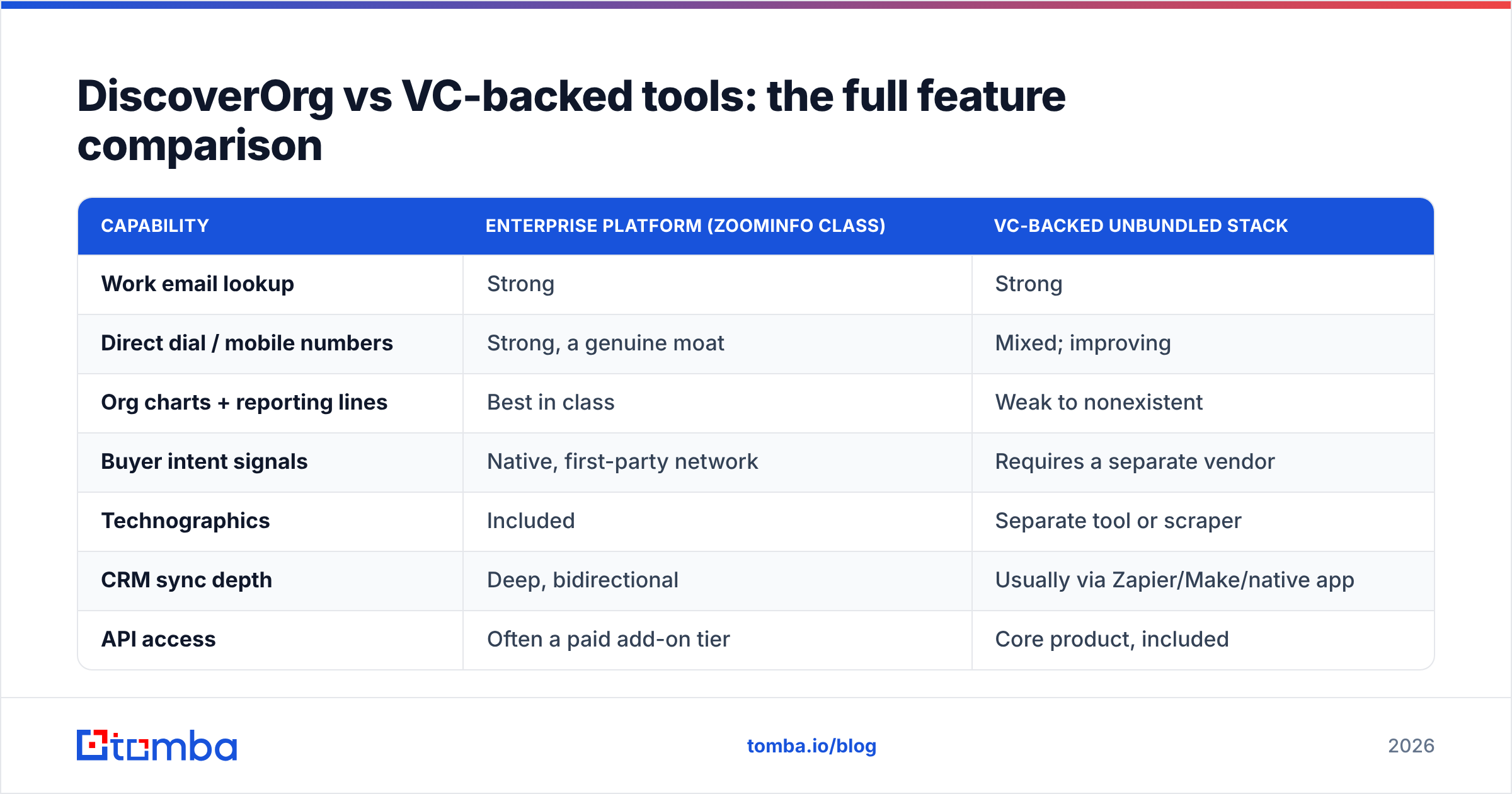
| Capability | Enterprise platform (ZoomInfo class) | VC-backed unbundled stack |
|---|---|---|
| Work email lookup | Strong | Strong |
| Direct dial / mobile numbers | Strong, a genuine moat | Mixed; improving |
| Org charts + reporting lines | Best in class | Weak to nonexistent |
| Buyer intent signals | Native, first-party network | Requires a separate vendor |
| Technographics | Included | Separate tool or scraper |
| CRM sync depth | Deep, bidirectional | Usually via Zapier/Make/native app |
| API access | Often a paid add-on tier | Core product, included |
| Time to first record | 2–6 weeks (procurement) | Same day |
| Data residency / GDPR paperwork | Mature, enterprise-ready | Varies sharply by vendor |
| Cost at 5 seats | Five figures annually | Low three to four figures annually |
The pattern holds across the table. The enterprise platform wins on breadth and on anything it collects itself, such as phones, intent, and org structure. The challenger stack wins on unit cost, speed, and developer access.
Phone coverage is closer than it used to be. A dedicated phone finder plus a validation pass covers much of what buyers once paid a platform premium for. But if mobile numbers drive your motion, test sample data on your own ICP before you assume parity.

Who should still buy the enterprise contract?#
Four cases where the legacy model still wins:
- You sell into large, matrixed enterprises. A deal may need nine stakeholders across three departments. Org-chart data is not a nice-to-have there, and the unbundled stack has no answer.
- You need intent data as a core input. Native intent networks run on their own web traffic. You cannot rebuild that from public sources at any price.
- Procurement counts vendors, not dollars. In regulated industries, six small vendors cost more in review cycles than one expensive vendor. That cost is real and often ignored.
- Your RevOps team is big enough to use the platform. Enterprise tools pay back setup work. If nobody owns the admin seat, you will use 20% of what you bought.
Who should buy the VC-backed stack instead?#
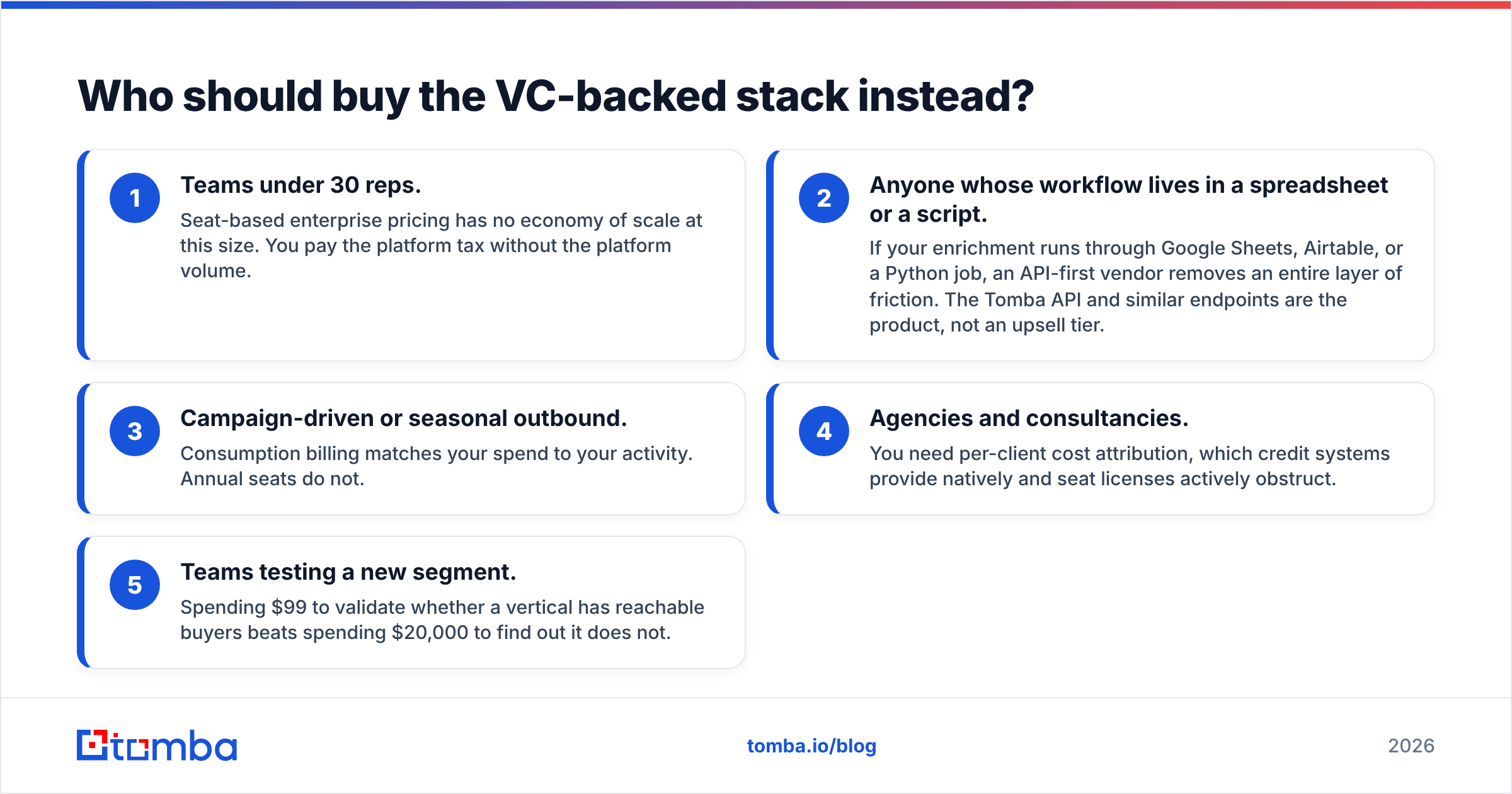
Five signs the challenger side of the DiscoverOrg vs VC-backed choice fits you:
- Teams under 30 reps. Seat pricing gives you no scale at this size. You pay the platform tax without the platform volume.
- Your workflow lives in a sheet or a script. Maybe enrichment runs through Google Sheets, Airtable, or a Python job. An API-first vendor removes a whole layer of friction. The Tomba API is the product, not an upsell tier.
- Campaign-driven or seasonal outbound. Consumption billing matches spend to activity. Annual seats do not.
- Agencies and consultancies. You need cost attribution per client. Credit systems do that natively. Seat licenses fight you.
- Teams testing a new segment. Spend $99 to learn whether a vertical has reachable buyers. That beats spending $20,000 to learn it does not.
What does a sensible hybrid look like?#
Most sharp teams in 2026 do not pick a side. They treat DiscoverOrg vs VC-backed as a tiering question and split the work:
- Tier 1 (named accounts, under 200 companies): enterprise platform, or manual research. Depth matters. Cost per record does not.
- Tier 2 (mid-market, hundreds to low thousands): finder, verifier, and enrichment, run through the CRM. Cost per verified contact is the metric.
- Tier 3 (broad, thousands): bulk processing with hard verification and low expectations. A bulk email finder with a strict verification gate keeps bounce rates survivable at volume.
The classic mistake is buying Tier 1 tooling for Tier 3 work. That is how a $30,000 contract gets spent on records a $99 tool would have found at the same accuracy. It is also the most common reason these contracts fail to renew.
One more practical note. Protect your sending domain whatever you choose. Perfect data will not save you if a bad list wrecks your email deliverability first. Verify first. Send second. Always.
The honest verdict on DiscoverOrg vs VC-backed#
DiscoverOrg's legacy is real. Human-verified org charts and enterprise breadth are still worth paying for in a narrow set of cases. But the claim that serious B2B contact data needs a five-figure yearly commitment stopped being true years ago. The accuracy argument that once backed it has largely closed too.
So if your actual job is finding verified work emails at a sane cost, start cheap and prove you have outgrown it. That beats starting expensive and finding out at renewal that you used a fraction of it.
Ready to test the cheaper half of the DiscoverOrg vs VC-backed comparison? Run your next 25 prospects through the Tomba Email Finder on the free tier. That is 25 searches a month, no card, no demo call. Compare hit rate and bounce rate against what your current vendor returns on the same list. If the numbers hold, the $49 Starter plan covers most small outbound teams. If they do not, you spent nothing finding out.
Related guides#
Ready to find emails that actually work?
Join 150,000+ professionals who stopped guessing and started sending. Free credits on signup — no credit card required.
Get the Tomba newsletter
Practical outbound tactics and product updates — once every two weeks.
About the author