DiscoverOrg vs Warpleads: B2B Data Compared for 2026
DiscoverOrg is now ZoomInfo, and Warpleads sells unlimited exports for a fraction of the price. Here is how the two actually compare on data quality, contracts, and cost per usable contact.
TL;DR
- DiscoverOrg does not exist as a standalone product anymore. It merged with ZoomInfo in 2019, and the discoverorg.com brand now points at ZoomInfo. If a rep pitches you "DiscoverOrg," you are being sold ZoomInfo.
- Warpleads is a much newer, much cheaper play: unlimited or high-volume B2B lead exports on a monthly plan, aimed at cold-email teams that burn through lists.
- The two are not really the same category. ZoomInfo sells account intelligence, intent signals, org charts, and CRM workflow. Warpleads sells volume.
- Cost per usable contact matters more than cost per record. A cheap list with 30% bounces is more expensive than it looks once your domain reputation takes the hit.
- The pragmatic setup for most teams under 50 seats: a volume or targeted source for raw records, plus a dedicated verification layer before anything touches your sending domain.
What actually happened to DiscoverOrg?#
DiscoverOrg was a well-regarded IT and org-chart data provider through the 2010s — human-researched contacts, deep technographics, and a sales team that priced accordingly. In February 2019 it acquired ZoomInfo, and in 2020 the combined company took the ZoomInfo name and went public.
That matters for your evaluation in three concrete ways:
- You cannot buy "DiscoverOrg" today. You buy a ZoomInfo Copilot / SalesOS bundle. Legacy DiscoverOrg accounts were migrated years ago.
- The pricing model came along for the ride. Annual contracts, per-seat licensing, credit blocks, and a mandatory platform fee. Public reviews on G2 consistently describe five-figure annual commitments for small teams and a hard renewal negotiation.
- The data model changed. The old DiscoverOrg differentiator was human verification at a small scale. ZoomInfo's scale is enormous by comparison, which is a genuine strength for coverage and a genuine weakness for freshness in long-tail segments.
So "DiscoverOrg vs Warpleads" is really "legacy enterprise data stack vs modern volume-export tool." Once you frame it that way, the decision gets much easier.
What is Warpleads and who is it built for?#
Warpleads launched into a specific gap: outbound teams that need a lot of records, right now, without a procurement cycle. Its pitch is unlimited (or very high-cap) exports on a flat monthly plan, plus on-demand scraping for niche lists that a static database won't cover.
Who it fits:
- Agencies running multi-client cold email who need fresh lists every month across unrelated ICPs.
- Founder-led outbound where the list is disposable and the offer is being tested, not refined.
- High-volume SDR pods that measure success in meetings booked per 10,000 sends, not per 200.
Who it does not fit:
- Enterprise ABM teams that need org charts, buying-committee mapping, and intent scoring wired into Salesforce.
- Anyone selling into heavily regulated buyers where a wrong title on a compliance contact costs you the deal.
- Teams with no verification step. Volume without a filter is how you burn a domain in six weeks.
How do DiscoverOrg (ZoomInfo) and Warpleads compare head-to-head?#
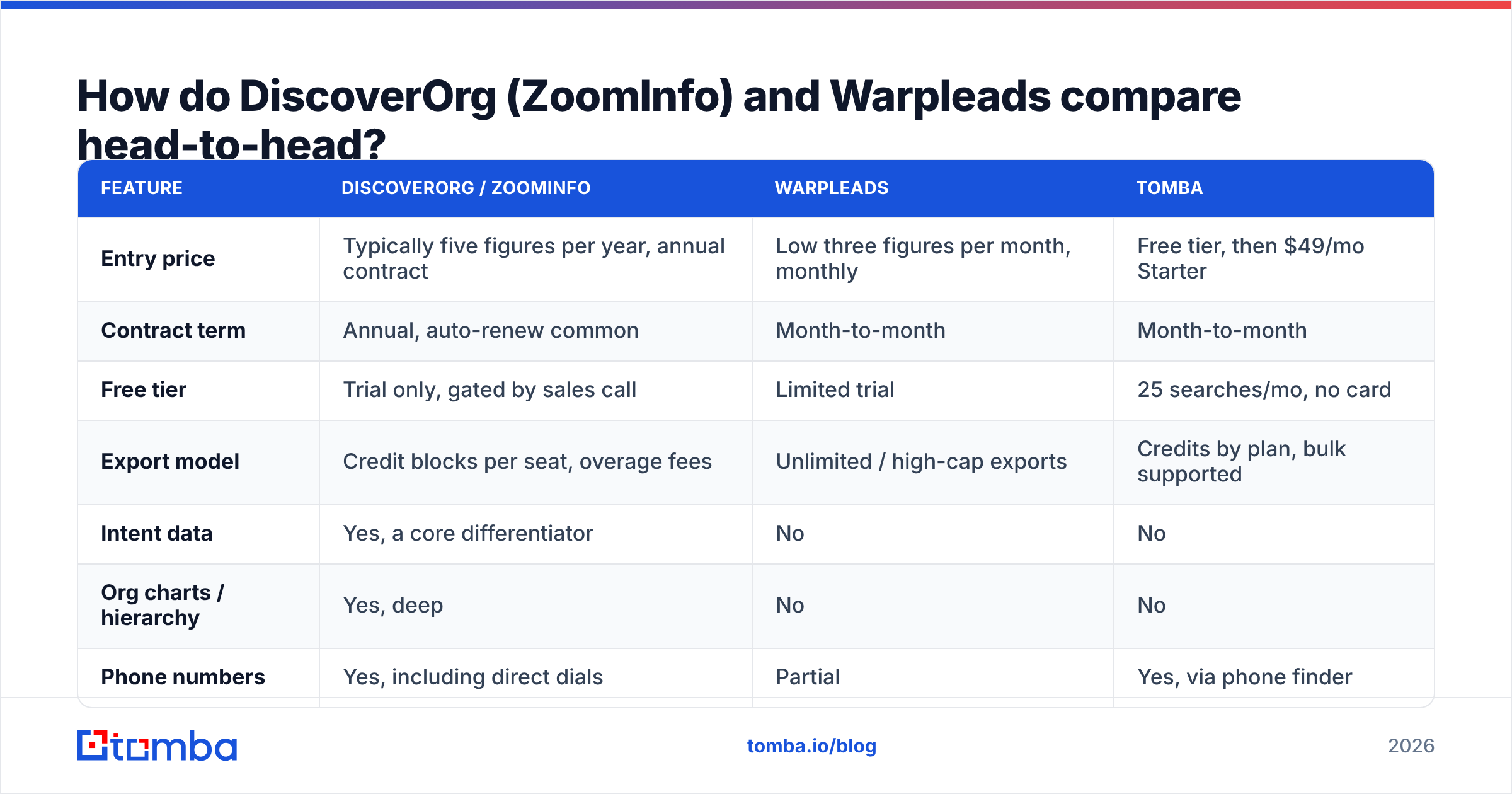
Here is the honest side-by-side. Prices for enterprise data platforms are negotiated and rarely published, so treat the ZoomInfo column as the commonly reported range rather than a rate card.
| Feature | DiscoverOrg / ZoomInfo | Warpleads | Tomba |
|---|---|---|---|
| Entry price | Typically five figures per year, annual contract | Low three figures per month, monthly | Free tier, then $49/mo Starter |
| Contract term | Annual, auto-renew common | Month-to-month | Month-to-month |
| Free tier | Trial only, gated by sales call | Limited trial | 25 searches/mo, no card |
| Export model | Credit blocks per seat, overage fees | Unlimited / high-cap exports | Credits by plan, bulk supported |
| Intent data | Yes, a core differentiator | No | No |
| Org charts / hierarchy | Yes, deep | No | No |
| Phone numbers | Yes, including direct dials | Partial | Yes, via phone finder |
| Email verification built in | Basic | Basic | Dedicated verifier + catch-all handling |
| API access | Enterprise tier | Available | All paid plans |
| Best for | Enterprise ABM, RevOps | High-volume cold email | Precision finding + verification |
The row that decides most evaluations is the second one. A month-to-month tool that is 80% as good is usually a better business decision than an annual contract that is 100% as good, because you can cancel it in 30 days when your ICP changes. Annual data contracts are a bet that your target market will not move. In 2026, that is not a bet most teams should make.

Which one has better data accuracy?#
ZoomInfo wins on breadth. Warpleads wins on recency for the segments it actively scrapes. Neither wins on the metric that actually matters to a cold-email sender: deliverable email rate after verification.
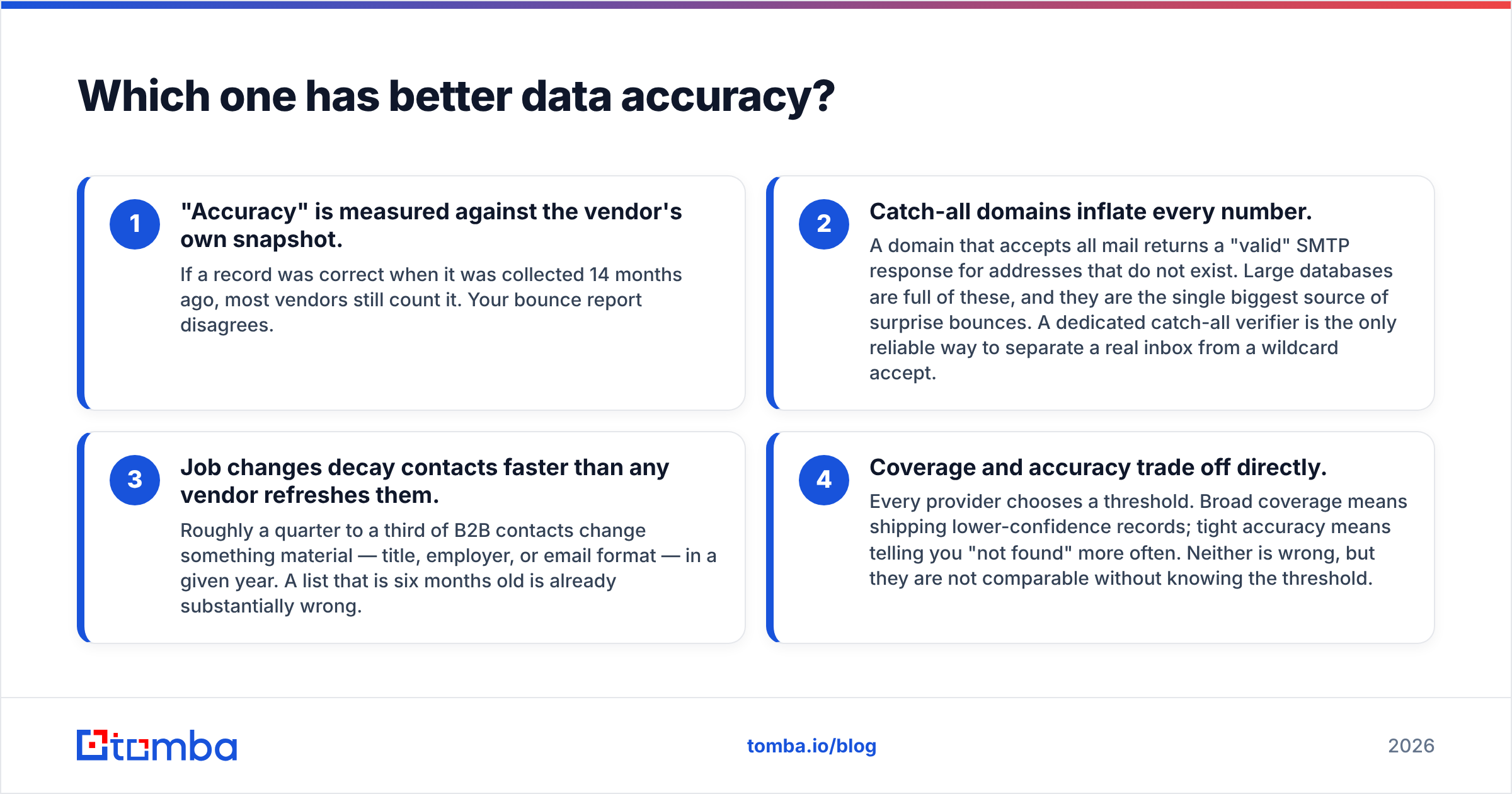
Here is why the headline accuracy claims from any vendor deserve skepticism:
- "Accuracy" is measured against the vendor's own snapshot. If a record was correct when it was collected 14 months ago, most vendors still count it. Your bounce report disagrees.
- Catch-all domains inflate every number. A domain that accepts all mail returns a "valid" SMTP response for addresses that do not exist. Large databases are full of these, and they are the single biggest source of surprise bounces. A dedicated catch-all verifier is the only reliable way to separate a real inbox from a wildcard accept.
- Job changes decay contacts faster than any vendor refreshes them. Roughly a quarter to a third of B2B contacts change something material — title, employer, or email format — in a given year. A list that is six months old is already substantially wrong.
- Coverage and accuracy trade off directly. Every provider chooses a threshold. Broad coverage means shipping lower-confidence records; tight accuracy means telling you "not found" more often. Neither is wrong, but they are not comparable without knowing the threshold.
The practical conclusion: whichever side of the DiscoverOrg vs Warpleads question you land on, run the output through an independent email verifier before it reaches your sequencer. Verification is cheap. A blacklisted sending domain is not.
What does each option actually cost per usable contact?#
Sticker price is the wrong unit. Model it per contact you can safely email.
Take a team that needs 5,000 new contacts a month:
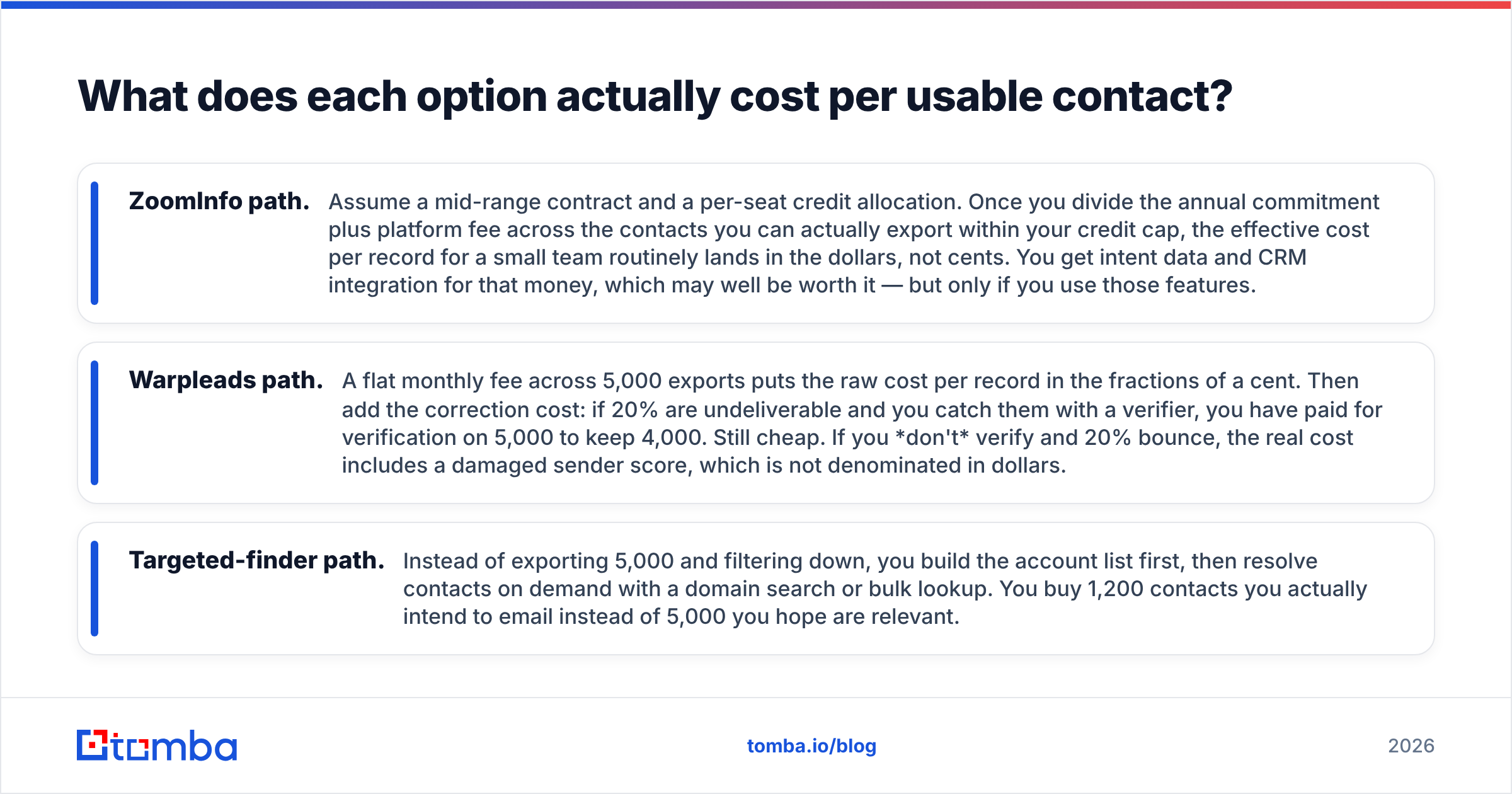
- ZoomInfo path. Assume a mid-range contract and a per-seat credit allocation. Once you divide the annual commitment plus platform fee across the contacts you can actually export within your credit cap, the effective cost per record for a small team routinely lands in the dollars, not cents. You get intent data and CRM integration for that money, which may well be worth it — but only if you use those features.
- Warpleads path. A flat monthly fee across 5,000 exports puts the raw cost per record in the fractions of a cent. Then add the correction cost: if 20% are undeliverable and you catch them with a verifier, you have paid for verification on 5,000 to keep 4,000. Still cheap. If you don't verify and 20% bounce, the real cost includes a damaged sender score, which is not denominated in dollars.
- Targeted-finder path. Instead of exporting 5,000 and filtering down, you build the account list first, then resolve contacts on demand with a domain search or bulk lookup. You buy 1,200 contacts you actually intend to email instead of 5,000 you hope are relevant.
That third path is the one most teams under-model. Export volume feels like value because the number is large, but a 5,000-record list where 800 fit your ICP is worse than an 800-record list where all 800 fit — the extra 4,200 cost you sending reputation and rep attention.

Is Warpleads a real DiscoverOrg replacement?#
For most of what small and mid-market teams do with ZoomInfo, yes. For the enterprise workflows, no. Be honest about which one you are.
Warpleads replaces ZoomInfo well when:
- Your primary use is "give me a list of people matching filters, in a CSV, this afternoon."
- Your sequencing lives in a dedicated cold-email tool, not in the data platform.
- Your ICP is defined by firmographics you can filter on — industry, size, geography, role.
Warpleads does not replace ZoomInfo when:
- You need intent signals to prioritize accounts researching your category. This is ZoomInfo's genuine moat and nothing at the volume-export price point matches it.
- You need org-chart depth to map a seven-person buying committee.
- You need CRM-native enrichment where records auto-update inside Salesforce or HubSpot. HubSpot's own research on data hygiene makes the case for why decaying CRM records are expensive; enterprise platforms solve that inside the CRM, and cheaper tools generally do not.
- Procurement and security review are non-negotiable. SOC 2, DPAs, and vendor questionnaires are table stakes at enterprise, and newer tools vary widely here. Ask before you commit.

What is the third option most teams should consider?#
Unbundle. The reason DiscoverOrg-era pricing survived so long is that everything was sold as one platform: database, enrichment, verification, intent, and workflow. In 2026 those are separate, competitive markets, and buying them separately usually costs less than a single bundled seat.
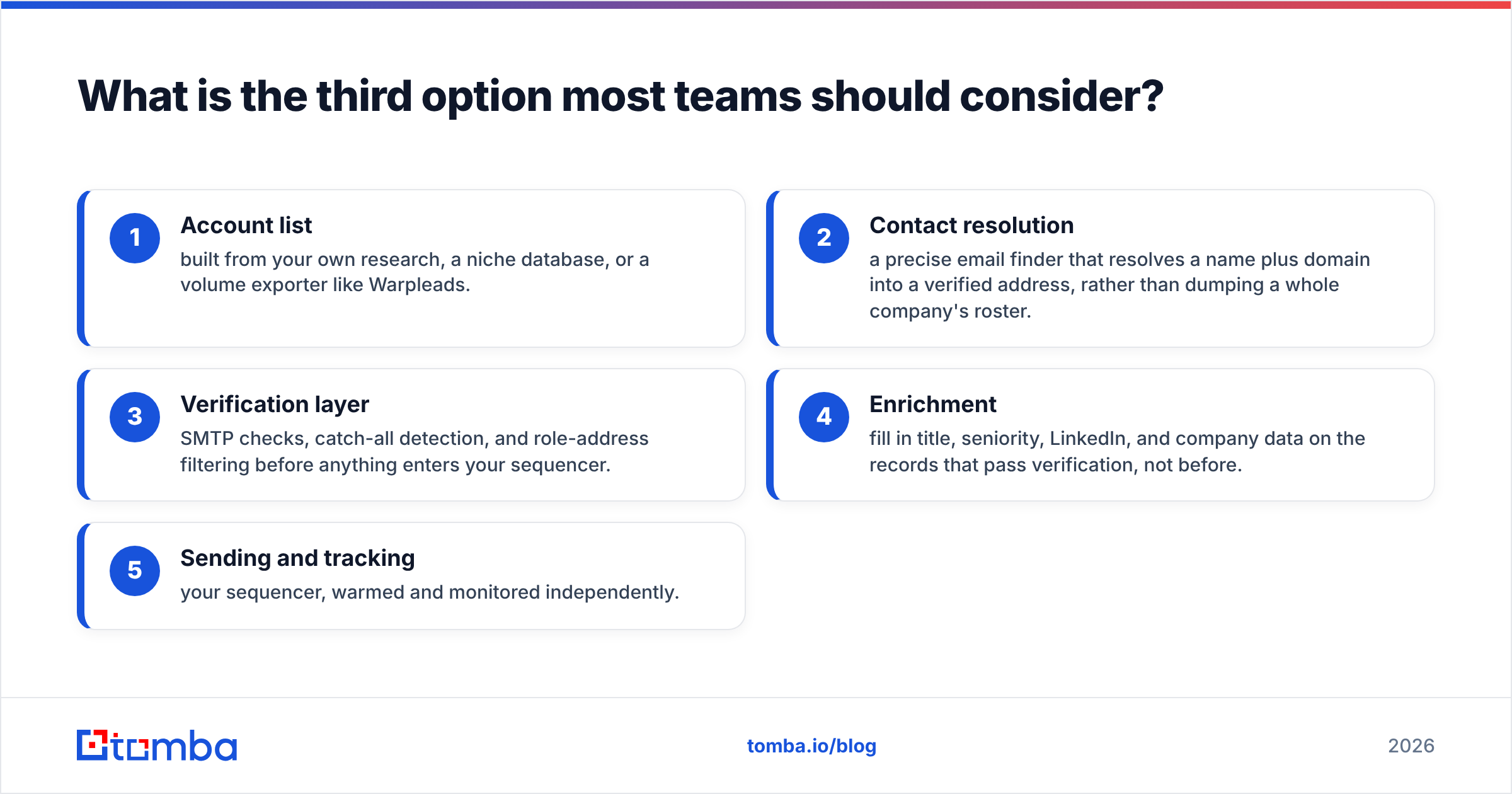
A typical unbundled stack:
- Account list — built from your own research, a niche database, or a volume exporter like Warpleads.
- Contact resolution — a precise email finder that resolves a name plus domain into a verified address, rather than dumping a whole company's roster.
- Verification layer — SMTP checks, catch-all detection, and role-address filtering before anything enters your sequencer.
- Enrichment — fill in title, seniority, LinkedIn, and company data on the records that pass verification, not before.
- Sending and tracking — your sequencer, warmed and monitored independently.
The cost of that stack for a five-person team is typically a few hundred dollars a month total. Compare that to a single enterprise data seat and the math is not close — unless you genuinely use intent data, in which case pay for it and stop reading comparison posts.
How should you run the evaluation?#
Do not evaluate on demo. Evaluate on your list.
- Build a 100-record control set of accounts you already know — current customers, closed-lost deals, people whose emails you have confirmed. Every vendor looks accurate on a random sample; only a control set catches inflated match rates.
- Measure match rate and bounce rate separately. A tool that returns 90 of 100 records with a 15% bounce rate is worse than one that returns 70 with a 1% bounce rate.
- Test the long tail. Every provider nails Fortune 500 contacts. Run 20 companies with fewer than 50 employees in your actual target vertical. That is where the differences show up.
- Price the exit. Ask what happens at renewal, whether exported data remains yours, and what the cancellation notice window is. Annual auto-renew with a 90-day notice clause is a real cost.
- Check the verification story. If the vendor cannot tell you how it handles catch-all domains, assume it does not, and budget for a separate verifier.
Run that test before you sign anything, and the DiscoverOrg vs Warpleads question usually answers itself within a week.
The verdict for 2026#
Choose ZoomInfo (the DiscoverOrg successor) if you are an enterprise or upper-mid-market team that will actually operationalize intent data and org charts inside a CRM, and you have the budget and procurement patience for an annual contract.
Choose Warpleads if you run high-volume outbound, need lists on demand across changing ICPs, and want to stay month-to-month. Pair it with real verification — that is non-negotiable at volume.
Choose neither as your whole stack. Both are sources. Neither is a substitute for a verification layer that protects the asset you cannot re-buy: your sending domain.
If your bottleneck is finding the right contact at a specific company rather than exporting ten thousand of them, start with the Tomba Email Finder. It resolves name-plus-domain into a verified professional address, flags catch-all domains instead of quietly passing them through, and runs on a free tier of 25 searches a month with paid plans starting at $49/mo — no annual contract, no procurement cycle, no renewal negotiation. See the full Tomba pricing breakdown, test it against your own control list, and let the bounce rate decide.
Related guides#
Ready to find emails that actually work?
Join 150,000+ professionals who stopped guessing and started sending. Free credits on signup — no credit card required.
Get the Tomba newsletter
Practical outbound tactics and product updates — once every two weeks.
About the author