DiscoverOrg vs Winmo (2026): Which Sales Database Wins?
DiscoverOrg is now ZoomInfo. Winmo owns advertiser and agency data. Here's how the two sales-intelligence platforms compare on coverage, pricing, and workflow fit in 2026 — and when a $49/mo email finder beats both.
DiscoverOrg vs Winmo is an odd match-up. One is a broad B2B contact database. The other is a niche tool for ad sales reps. Here is what each one does, what it costs, and which one fits your team.
TL;DR
- DiscoverOrg is gone as a product. It bought Zoom Information Inc. in 2019. The merged firm became ZoomInfo. A 2026 "DiscoverOrg" pitch is a ZoomInfo pitch.
- Winmo is not a general B2B database. It serves people who sell ads, sponsorship, and marketing services. Its edge is ad-spend data, agency rosters, and pitch alerts.
- The two rarely compete. They overlap on one thing only: decision-maker contact data.
- Both are annual, demo-gated, and seat-priced. Buyers report five figures a year for ZoomInfo. Winmo runs low-to-mid four figures per seat. Neither posts a price list.
- Need verified emails only? Tomba starts at $49/mo. That is 1–2% of a ZoomInfo deal. You give up intent data and ad-spend data.
What happened to DiscoverOrg?#
DiscoverOrg was a human-verified B2B contact database. It launched in 2007. Buyers knew it for org charts and direct dials in IT, marketing, finance, and HR. The pitch was accuracy over volume. The list was smaller. Researchers called to check records. Refresh cycles ran in months.
In February 2019, DiscoverOrg bought Zoom Information Inc. The new company kept the ZoomInfo brand. It went public in 2020 and dropped the DiscoverOrg name. That data now sits inside ZoomInfo Copilot, SalesOS, and its data-as-a-service tiers.
So a DiscoverOrg vs Winmo choice in 2026 is really a ZoomInfo choice. Three things changed:
- The accuracy story changed. DiscoverOrg sold a small, hand-checked set. ZoomInfo sells scale plus signals: hundreds of millions of contacts, intent topics, visitor tracking, and AI account summaries.
- The price floor moved up. DiscoverOrg was costly. ZoomInfo is costly and bundled. You get quoted a platform, not a contact list.
- The terms got tighter. Annual deals, seat minimums, and credit caps are the norm. Buyers on G2 flag renewal pricing and credit overages more than data quality.

What is Winmo built for?#
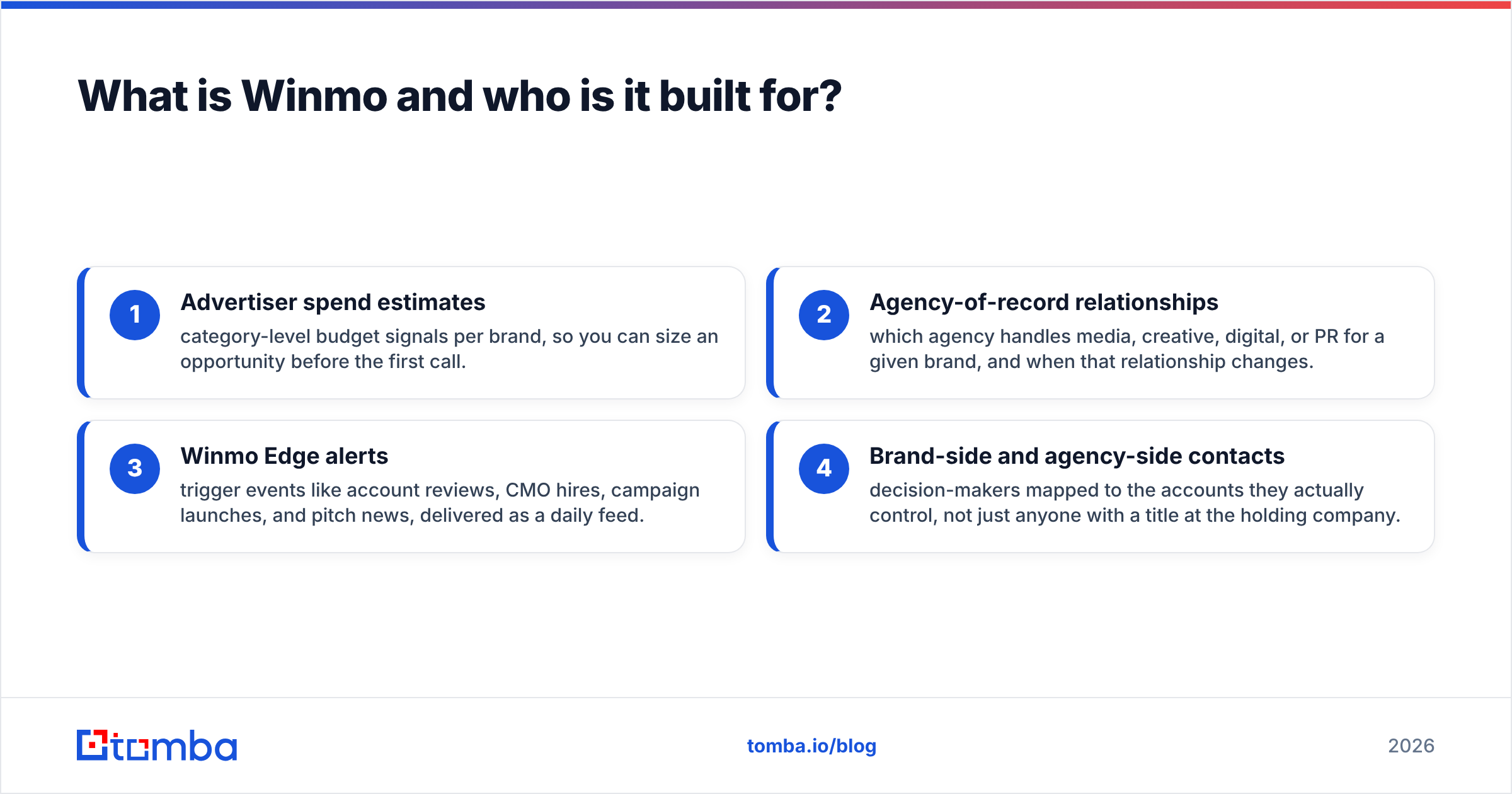
Winmo is sales intelligence for the ad and media world. Its user sells for a publisher, broadcaster, sports property, out-of-home network, martech vendor, or agency. That rep needs one answer. Which brands are spending, on what, through which agency, and who signs the check?
Winmo tracks four things a generic B2B tool skips:
- Ad spend estimates — budget signals by brand and category. You can size a deal before the first call.
- Agency-of-record data — who handles media, creative, digital, or PR for a brand. You also see when that changes.
- Winmo Edge alerts — account reviews, CMO hires, campaign launches, and pitch news, sent as a daily feed.
- Brand and agency contacts — people mapped to the accounts they control, not just anyone with a title.
Sell software to CFOs? None of that helps. Sell a sponsorship package to a QSR brand's media agency? That is the whole job.
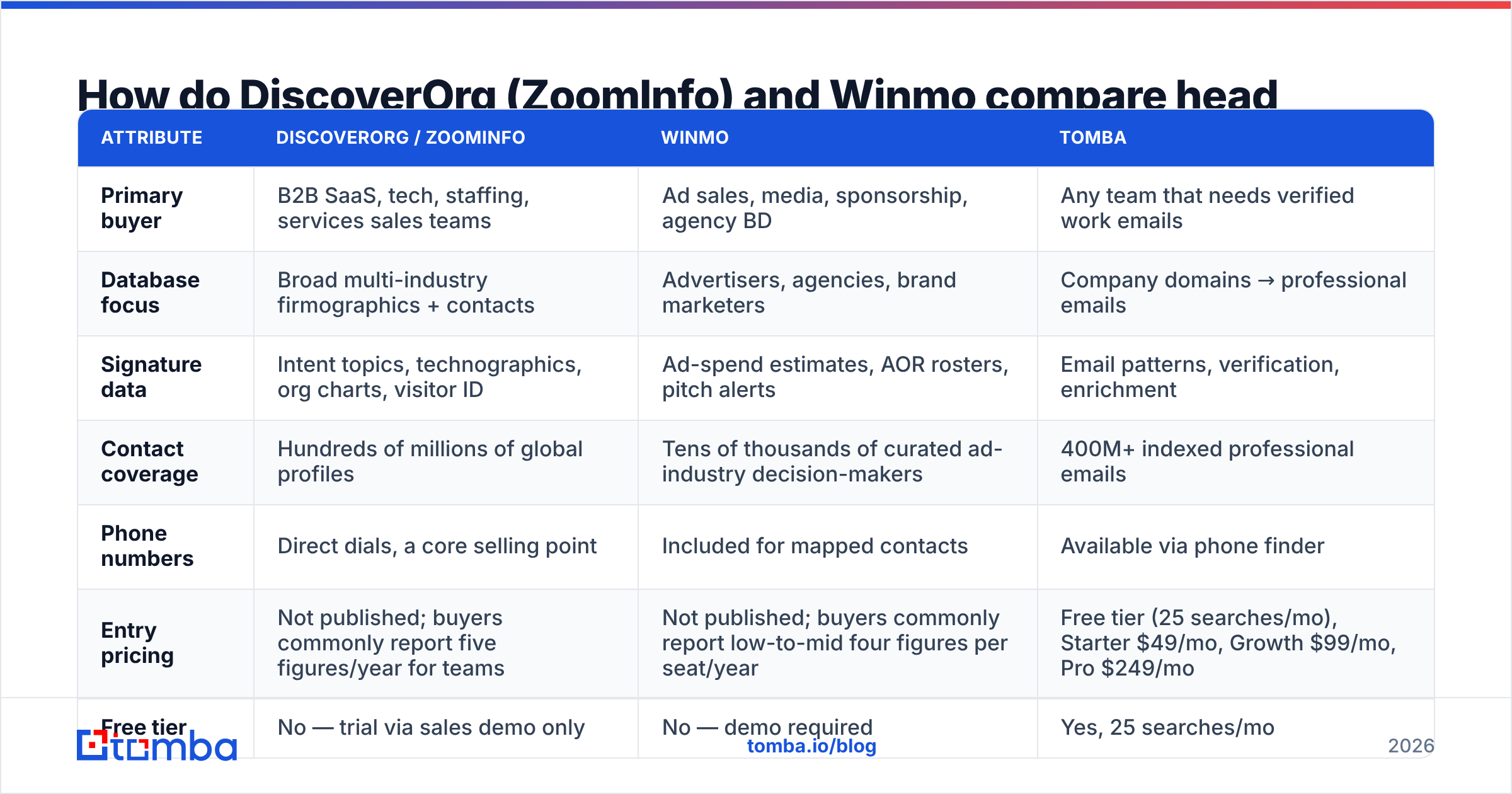
DiscoverOrg vs Winmo: head-to-head comparison#
| Attribute | DiscoverOrg / ZoomInfo | Winmo | Tomba |
|---|---|---|---|
| Primary buyer | B2B SaaS, tech, staffing, services sales teams | Ad sales, media, sponsorship, agency BD | Any team that needs verified work emails |
| Database focus | Broad multi-industry firmographics + contacts | Advertisers, agencies, brand marketers | Company domains → professional emails |
| Signature data | Intent topics, technographics, org charts, visitor ID | Ad-spend estimates, AOR rosters, pitch alerts | Email patterns, verification, enrichment |
| Contact coverage | Hundreds of millions of global profiles | Tens of thousands of curated ad-industry decision-makers | 400M+ indexed professional emails |
| Phone numbers | Direct dials, a core selling point | Included for mapped contacts | Available via phone finder |
| Entry pricing | Not published; buyers commonly report five figures/year for teams | Not published; buyers commonly report low-to-mid four figures per seat/year | Free tier (25 searches/mo), Starter $49/mo, Growth $99/mo, Pro $249/mo |
| Free tier | No — trial via sales demo only | No — demo required | Yes, 25 searches/mo |
| Contract | Annual, seat-based, credit-capped | Annual, seat-based | Monthly or annual, no seat minimum |
| API access | Enterprise tiers | Limited | Included from Starter, see Tomba API |
| Best at | Volume outbound into tech and services markets | Knowing which brand is about to spend money | Turning a known company or name into a deliverable email |
The table shows the real point. This is not a feature fight. It is a market fight. ZoomInfo is horizontal. Winmo is vertical. So "which is better" is the wrong question. Ask this instead: which market do I sell into? And how much of my budget belongs in a database rather than in outreach?
DiscoverOrg vs Winmo: which has better data accuracy?#
Neither vendor publishes an audited accuracy rate. Discount any number from a vendor's own landing page — ours included. What you can compare is how each one keeps data fresh.
ZoomInfo refreshes at scale. Users install an email-scanning extension. The platform learns from signature blocks and calendar data. Web crawling and machine checks fill the rest. The strength is reach and fast job-change detection. The weakness is decay. At that volume, stale records slip through. Buyers report the most rot in SMB and non-US records.
Winmo curates instead. A research team keeps a much smaller set of accounts. That is why its brand-to-agency mapping holds up. Inside the ad world, that data is hard to copy. Step outside it and coverage drops fast. The tool was never built for that.
A third option is real-time lookup. Tomba does not store a record and hope it still works. It resolves the address when you ask and runs SMTP checks. It will not tell you a brand is reviewing its media agency. It also will not hand you a two-year-old address. Run any bought list through an email verifier before you send. Bounces hurt your sender reputation more than a missed contact ever will.
DiscoverOrg vs Winmo pricing: what does each cost?#
Both hide pricing behind a demo. Treat public numbers as rough.
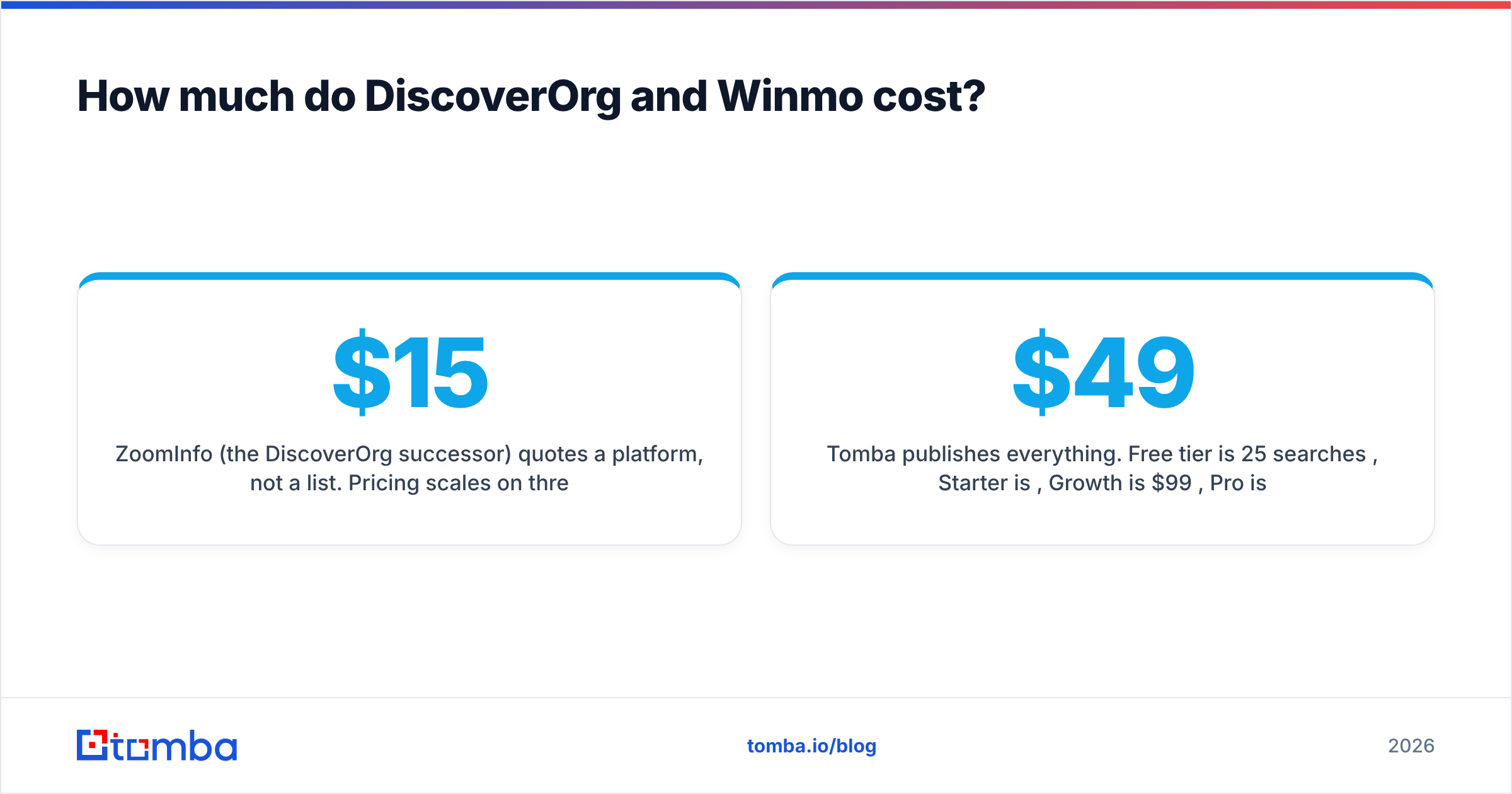
ZoomInfo quotes a platform, not a list. Price scales on three axes: seats, credits for exports and enrichment, and modules (intent, WebSights visitor ID, Copilot, workflow). Team deals reported by buyers often land between $15,000 and $40,000 a year. Single-seat packages can run lower. Credit overages and renewal step-ups are the surprises.
Winmo is simpler. It is seat-based and annual. Buyers report low-to-mid four figures per seat per year. Add-ons cover wider international data and Winmo Edge feeds. The universe is small, so you buy access, not credits.
Tomba posts every price. Free covers 25 searches a month. Starter is $49/mo. Growth is $99/mo. Pro is $249/mo. Enterprise is custom. See full Tomba pricing — no demo needed.
Here is the honest framing. ZoomInfo and Winmo sell intelligence, priced like a research subscription. Email finders sell resolution, priced like a utility. Mix the two up and you pay platform rates for lookup work. Or you buy a lookup tool and wonder why it misses a new CMO.
Which is better for ad sales and media teams?#
Winmo, and it is not close.
Does your quota ride on brand budgets? Then Winmo's spend data and agency maps are the product. ZoomInfo can give you a contact at Procter & Gamble. Winmo tells you which agency holds the media account, what the category spend looks like, and that the business went into review last month. That last fact is the reason to call.
Winmo leaves three gaps:
- Non-advertising buyers. Selling HR software to the same brands? Wrong tool.
- Volume outbound. A curated set helps targeting. It hurts if you need 10,000 contacts a quarter.
- International depth. North America is strong. EMEA and APAC are thin.
A common stack works like this. Winmo picks the accounts and the timing. A cheap bulk email finder fills the contact gaps Winmo does not map.
Which is better for B2B SaaS and tech sales?#
ZoomInfo — if you use the parts you pay for.
ZoomInfo earns its price in four ways. Intent data ranks accounts. Technographics filter for a matching stack. Visitor ID catches anonymous traffic. CRM sync keeps reps in the pipeline view. Teams that use all four win. Teams that log in to export lists are buying a Ferrari to run errands.
Ask five questions before you sign:
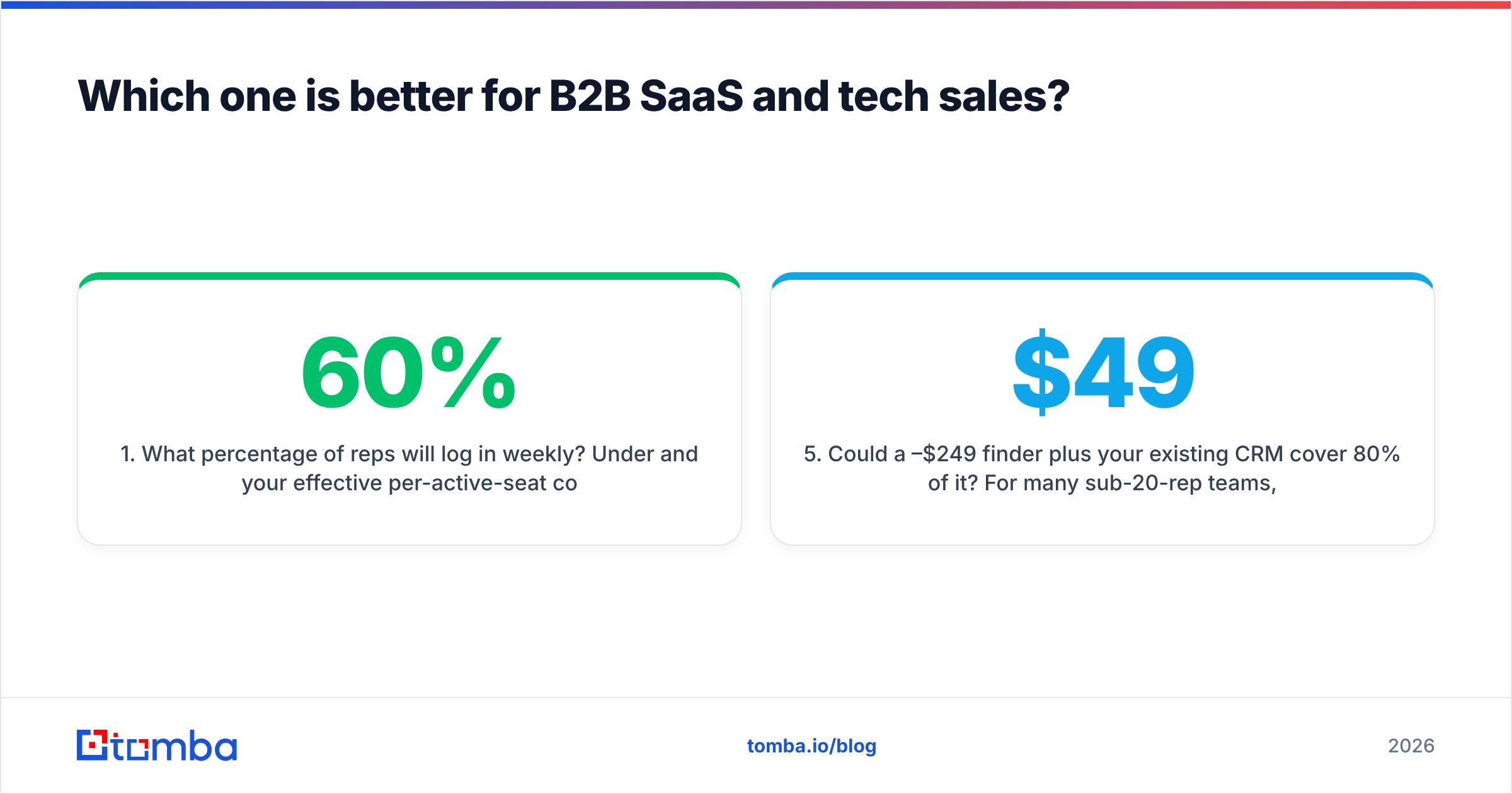
- How many reps log in weekly? Under 60% and your real per-seat cost doubles.
- Do you have a workflow for intent signals? Intent with no routing rules is a dashboard nobody opens.
- Are you export-heavy or research-heavy? Export-heavy teams burn credits fast. Model overages first.
- What is your renewal leverage? Multi-year deals lock the discount and remove your exit.
- Could a $49–$249/mo finder plus your CRM cover 80% of it? For many teams under 20 reps, yes.
That last one is where lighter tools win. Say your need is simple: 3,000 target companies, and the VP of Engineering's email at each. You do not need an intelligence platform. You need domain search and verification. Vetted list vendors like BookYourData sit in the middle. They sell pay-as-you-go lists with verification guarantees and no seat commitment. That suits teams that want volume without platform overhead.
What do buyers complain about most?#
Buyers on a DiscoverOrg vs Winmo shortlist raise very different gripes for each tool.
ZoomInfo: rigid contracts, auto-renewal terms, credits gone by mid-quarter, and patchy SMB and international data. Almost nobody knocks the size of the database. The complaints are commercial.
Winmo: narrow scope outside advertising, thin non-US data, and a UI that takes new reps a few weeks. The spend figures are estimates. Veterans treat them as directional.
Both: you cannot try either one without a sales call. For a two-person team on a Tuesday afternoon, that alone rules them out.
DiscoverOrg vs Winmo: which should you pick in 2026?#
- You sell ads, sponsorship, or marketing services → Winmo. No horizontal tool copies AOR data and pitch alerts.
- You run volume outbound in tech, services, or staffing with 15+ reps → ZoomInfo. The DiscoverOrg data lives there now. Commit only if you will really use intent, technographics, and CRM sync.
- You need contacts, not market intelligence → a dedicated email finder. Pay per lookup. Verify before you send. Spend the rest on outreach.
- You need both → pair an intelligence tool for account picking with a cheap finder for contacts. That hybrid usually beats buying more credits.
The costliest mistake here is not picking the wrong vendor. It is paying platform prices for lookup work, spotting it in month nine, and staying locked in until month twelve.
Start with the cheap layer first#
Test the cheap fix before you sit through two demos. Run your target account list through the Tomba Email Finder. The free tier gives 25 searches a month. Starter is $49/mo. Every result is verified before it reaches you. Do you hit a wall on intelligence rather than contacts? Then you know which platform to buy and what to ask for. Do you never hit that wall? You just saved five figures.
Related guides#
Ready to find emails that actually work?
Join 150,000+ professionals who stopped guessing and started sending. Free credits on signup — no credit card required.
Get the Tomba newsletter
Practical outbound tactics and product updates — once every two weeks.
About the author