DiscoverOrg vs Xverum: Which B2B Data Provider Wins in 2026?
DiscoverOrg is now ZoomInfo. Xverum sells raw web datasets by the million. They solve different problems — and cost wildly different amounts. Here's the honest breakdown, plus a cheaper third path.
Short answer on DiscoverOrg vs Xverum: they are not rivals. DiscoverOrg is now ZoomInfo, a seat-based sales platform. Xverum is a bulk data feed built for engineers. Most teams weighing DiscoverOrg vs Xverum need neither one. Here is what each costs, who it fits, and a cheaper third path.
TL;DR
- DiscoverOrg no longer exists on its own. It merged with ZoomInfo in 2019. If a rep pitches you "DiscoverOrg," you are buying ZoomInfo.
- Xverum is not a sales tool. It is a data provider. It sells bulk company and people records as files or API feeds, for enrichment, AI training, and market research.
- The two are not real competitors. ZoomInfo is a seat-based platform, and deals often run into five figures. Xverum is a data pipe priced by volume, with no app for reps.
That gap is the whole story of DiscoverOrg vs Xverum.
- Neither one promises a clean inbox. Records decay 25-30% a year, so you still have to verify.
- Need verified work emails for a set list of people or domains? A per-lookup tool like Tomba starts at $49/mo and wins on cost per usable contact.
Why does DiscoverOrg vs Xverum keep coming up?#
Because they rank for the same searches while solving different problems. That mix-up costs teams money.
DiscoverOrg built its name in the 2010s on human-checked org charts and IT install data. Researchers called companies to confirm who reported to whom. That work was slow and costly. In February 2019, DiscoverOrg bought ZoomInfo and took the ZoomInfo name. Today ZoomInfo sells the merged product. The old DiscoverOrg data lives inside it. The standalone brand is gone.
Xverum came from the other side: web-scale data extraction. It sells structured datasets — company profiles, people profiles, job posts, local business records. They refresh on a schedule and land as JSON or CSV in S3, GCS, or an API. There is no sequencing, no CRM sync, no seats for reps.
So the real question is not "which is better." It is which layer of the stack are you buying?

DiscoverOrg vs Xverum: what are the actual differences?#
Here is the head-to-head on the attributes that change your buying decision.
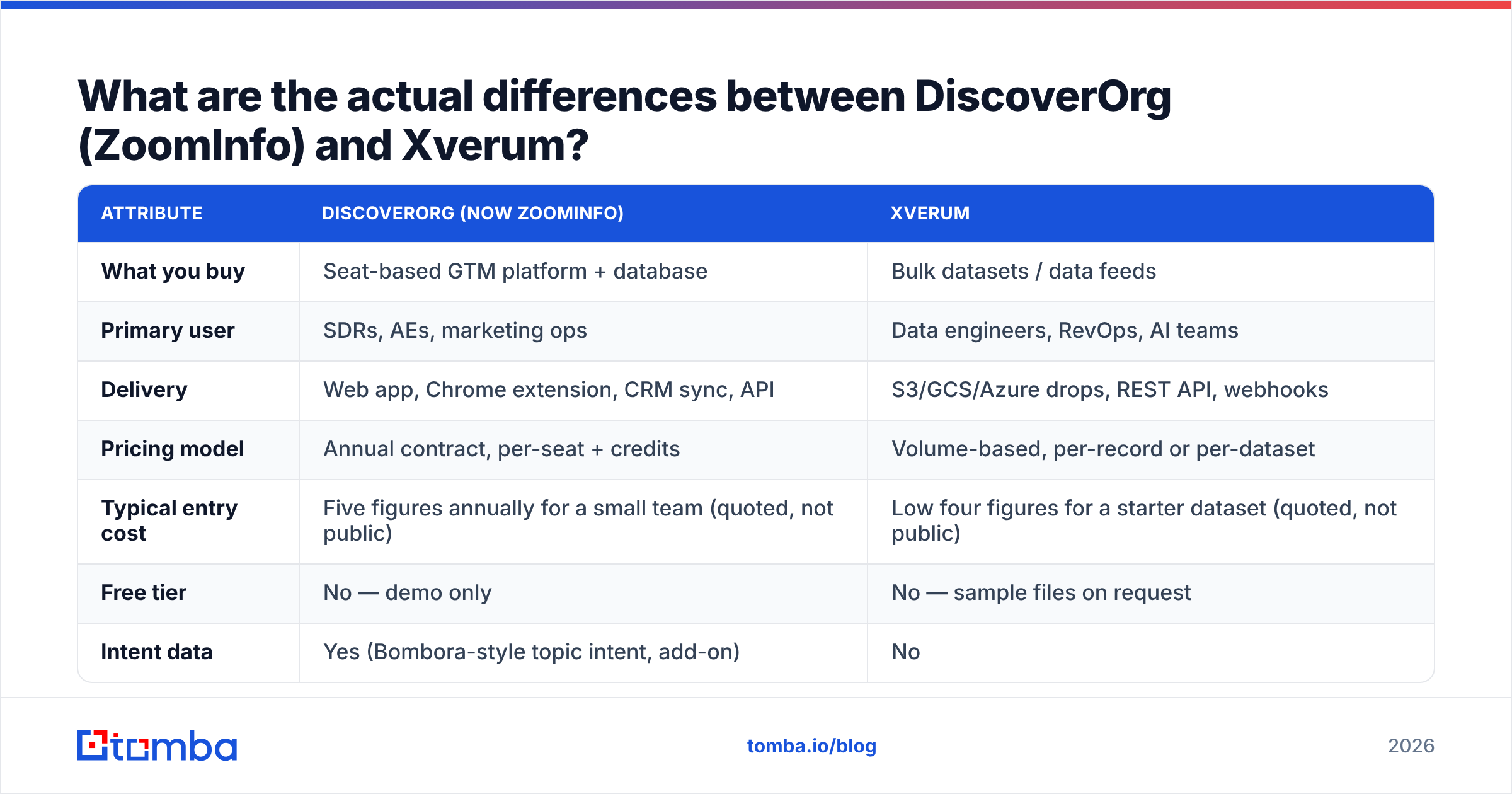
| Attribute | DiscoverOrg (now ZoomInfo) | Xverum |
|---|---|---|
| What you buy | Seat-based GTM platform + database | Bulk datasets / data feeds |
| Primary user | SDRs, AEs, marketing ops | Data engineers, RevOps, AI teams |
| Delivery | Web app, Chrome extension, CRM sync, API | S3/GCS/Azure drops, REST API, webhooks |
| Pricing model | Annual contract, per-seat + credits | Volume-based, per-record or per-dataset |
| Typical entry cost | Five figures annually for a small team (quoted, not public) | Low four figures for a starter dataset (quoted, not public) |
| Free tier | No — demo only | No — sample files on request |
| Intent data | Yes (Bombora-style topic intent, add-on) | No |
| Org charts / hierarchy | Yes, a legacy DiscoverOrg strength | Limited |
| Email verification included | Partial, platform-level scoring | No — raw records, verify yourself |
| Contract flexibility | Rigid; multi-year is common | Flexible; one-off pulls possible |
| Best for | Full-funnel outbound at scale | Enrichment pipelines, ML training sets, market mapping |
The pricing row is where most reviews go wrong. Neither vendor posts a price list. Both quote on volume, seats, and contract length. Reported ranges on G2 put ZoomInfo deals well into five figures a year, even for small teams. Credit caps reset each year. Xverum quotes per dataset and per refresh cycle. That makes it cheap for a one-time market map. It gets pricey if you need frequent refreshes across many verticals.
DiscoverOrg vs Xverum: which one has better data quality?#
Different failure modes, not different quality tiers.
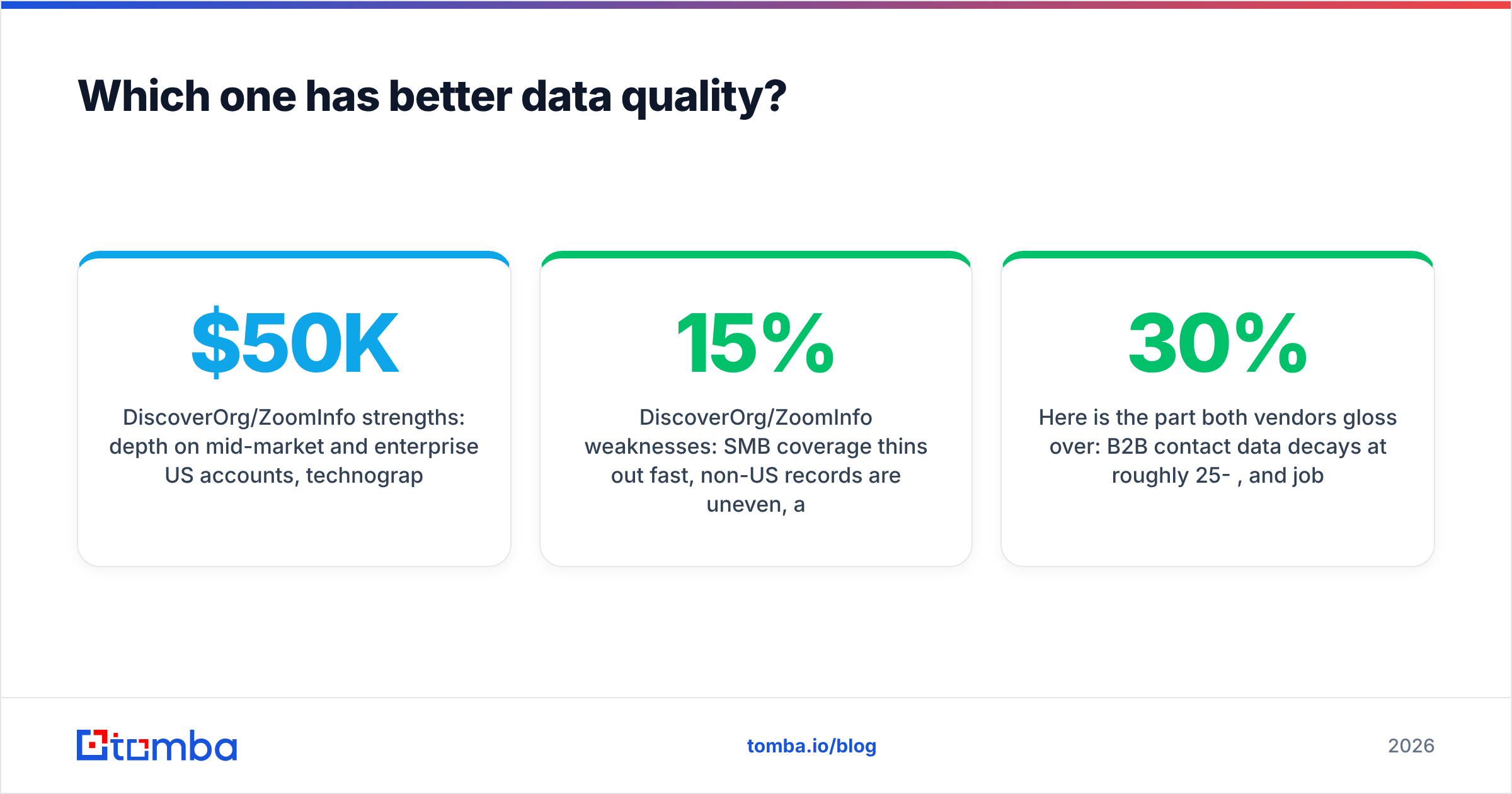
ZoomInfo (ex-DiscoverOrg) strengths: depth on US mid-market and enterprise accounts, tech stacks, org charts, and direct dials. The old DiscoverOrg research still shows in the IT and finance data. If you sell $50K+ deals into named accounts, this is the deeper file.
ZoomInfo (ex-DiscoverOrg) weaknesses: SMB coverage thins out fast. Non-US records are uneven. Some records come from users' synced address books, so they go stale. Reviewers report bounce rates of 8-15% on exported lists. That is fine for a database and fatal for cold email.
Xverum strengths: breadth. Hundreds of millions of company and people records, refreshed on a set cadence, with a clean schema that data engineers like. It is scraped from public web sources, so it catches small and non-US firms the big databases skip.
Xverum weaknesses: it is raw. Emails are often guessed from patterns, not verified. Job titles drift. You are buying a file, not a ready-to-use contact. That is exactly what its buyers want. It is not what an SDR wants.
Here is the part both vendors skip. B2B contact data decays about 25-30% a year, and job changes spiked after 2022. A list you buy in January is well off by summer. A $30K ZoomInfo contract does not change that math. Neither does a bulk Xverum drop. Only checking each address at send time does. That is why an email verifier belongs in your stack, whichever vendor you sign.

How should you choose between DiscoverOrg vs Xverum? A 5-question test#
Run your case through these five questions. Most teams have an answer by question three.
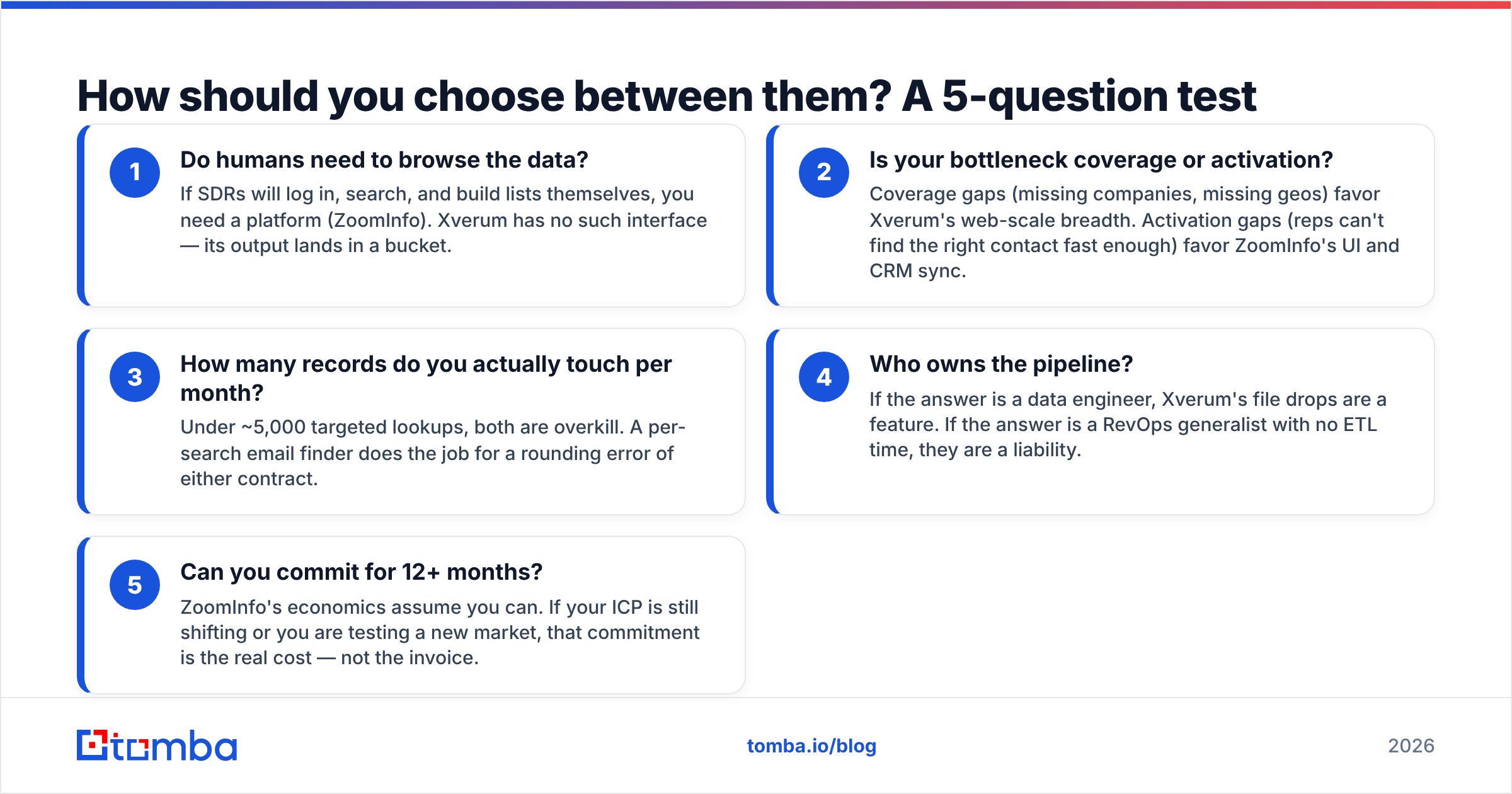
- Do humans need to browse the data? If reps will log in, search, and build lists, you need a platform (ZoomInfo). Xverum has no such screen. Its output lands in a bucket.
- Is your bottleneck coverage or activation? Missing companies or missing regions favor Xverum's web-scale breadth. Reps who cannot find the right contact fast enough favor ZoomInfo's app and CRM sync.
- How many records do you touch per month? Under ~5,000 targeted lookups, both are overkill. A per-search email finder does the job for a rounding error of either contract.
The last two questions are about ownership and risk.
- Who owns the pipeline? If a data engineer owns it, Xverum's file drops are a feature. If a RevOps generalist owns it with no time for ETL, they are a liability.
- Can you commit for 12+ months? ZoomInfo's pricing assumes you can. If your ICP is still moving, or you are testing a new market, that lock-in is the real cost — not the invoice.
Answered "browse," "activation," ">20K records," "RevOps team," and "yes"? Take ZoomInfo. Answered "pipeline," "coverage," "millions," "data engineer," and "prefer not to"? Take Xverum. Anything in between, keep reading.
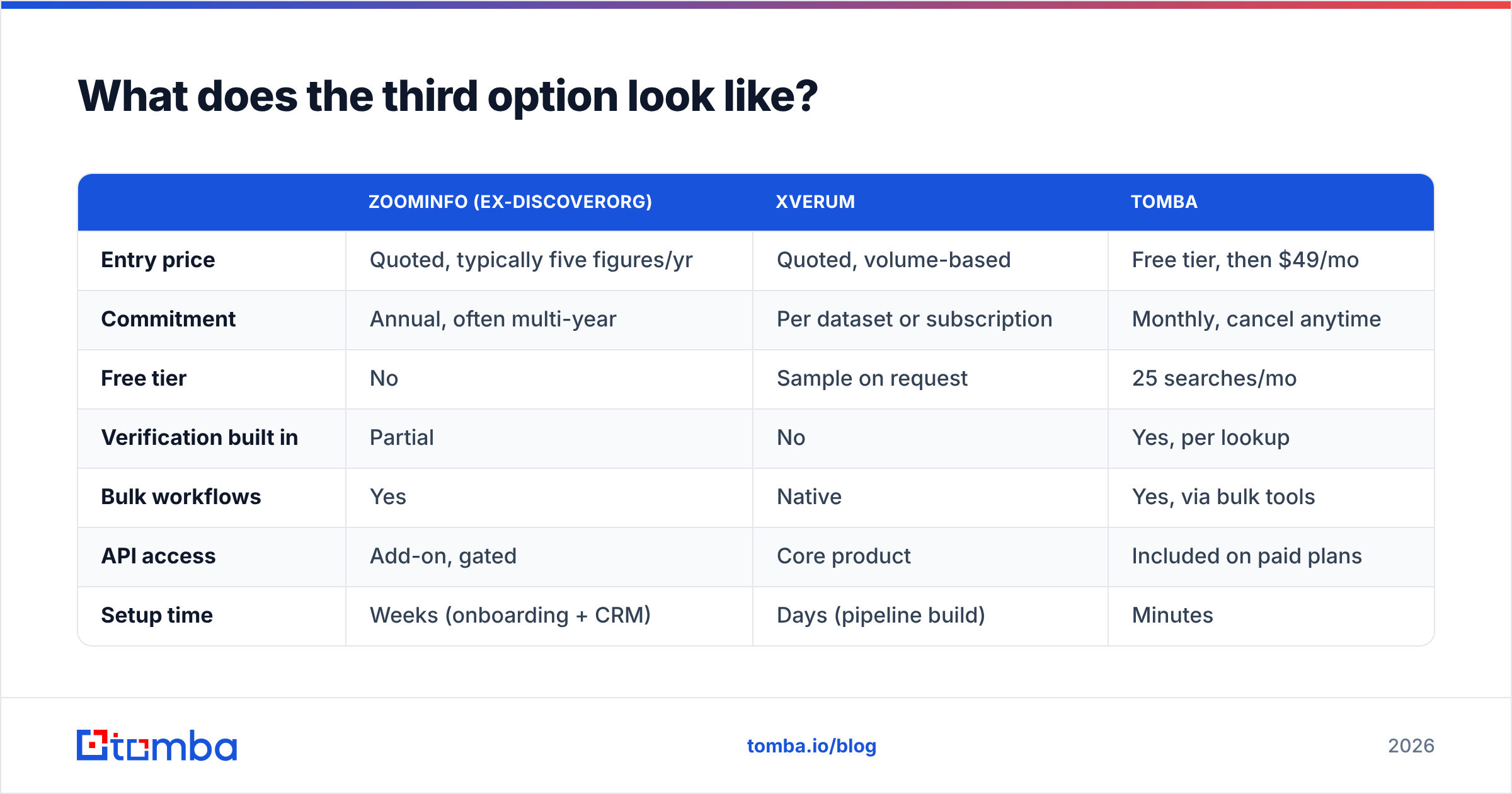
What does the third option look like?#
Most teams weighing DiscoverOrg vs Xverum need neither. They need contacts at named companies, verified, this quarter, without a long buying process.
That is a different product type: lookup on demand, not a database license. You give it a domain or a name. It returns a verified address. You pay per credit, not per seat per year.
| ZoomInfo (ex-DiscoverOrg) | Xverum | Tomba | |
|---|---|---|---|
| Entry price | Quoted, typically five figures/yr | Quoted, volume-based | Free tier, then $49/mo |
| Commitment | Annual, often multi-year | Per dataset or subscription | Monthly, cancel anytime |
| Free tier | No | Sample on request | 25 searches/mo |
| Verification built in | Partial | No | Yes, per lookup |
| Bulk workflows | Yes | Native | Yes, via bulk tools |
| API access | Add-on, gated | Core product | Included on paid plans |
| Setup time | Weeks (onboarding + CRM) | Days (pipeline build) | Minutes |
| Best fit | Enterprise outbound teams | Data/AI teams | SMB to mid-market sales teams |
Tomba's published pricing runs Free (25 searches/mo), Starter $49/mo, Growth $99/mo, Pro $249/mo, and Enterprise custom. That is not a swap for a 200-seat ZoomInfo rollout, and nobody should pretend it is. But take a five-person team that runs 2,000-5,000 lookups a month. For them it is $1,200 a year instead of $30,000. Hit rates hold up too, because each result is checked at lookup time instead of pulled from an old snapshot.
The workflow that works for most mid-market teams:
- Source the account list from wherever it is cheapest — LinkedIn Sales Navigator, a conference list, an Xverum company file, your own site traffic.
- Resolve contacts per domain with domain search. One call returns the people and email patterns for a company.
- Verify before send, always, no matter how good the source looks.
- Enrich what survives with firmographics and phone numbers via data enrichment, so reps have context on the call.
- Push to CRM and let the sequencer do its job.
That stack costs a fraction of a platform contract. It also fails gracefully. If one layer underperforms, you swap it without reopening an annual agreement.
Is Xverum a real DiscoverOrg alternative?#
Only if you have engineers. Let's be precise here, because vendor pages muddy it.
Xverum replaces the data half of ZoomInfo, not the workflow half. You get similar or wider raw coverage at a lower cost per record. You do not get the app, the list building, the intent scores, or the CRM sync that reps use daily. Teams that win with Xverum have someone who can build the ingest job, dedupe against the CRM, run verification, and feed the result into a tool reps already open.
Teams without that person end up with a huge JSON file and no pipeline.
ZoomInfo does not replace Xverum either. Its terms limit bulk export and resale, so it does not fit model training or derivative datasets. If that is your use case, the platform is the wrong shape.
So the honest verdict on DiscoverOrg vs Xverum is simple: they are complements more often than substitutes. Teams that buy both are usually big enough that price was never the real question.
What about compliance and data sourcing?#
Ask both vendors the same three questions before you sign.
- Where does each field come from? "Proprietary methods" is not an answer. Ask per field: scraped, contributed, licensed, or guessed. Guessed emails behave nothing like confirmed ones.
- What is your GDPR and CCPA posture for EU and California records? Web-scraped work data sits in a grey legal area. Get the legitimate-interest paperwork and the deletion SLA in writing.
- How often does each dataset refresh? "Continuously updated" usually means part of it is. Ask which fields refresh weekly and which refresh yearly.
Openness here is a real differentiator. Tomba publishes its data sources in the open. Every provider on your shortlist should clear that bar before you send a PO.
The bottom line#
DiscoverOrg is ZoomInfo now. It is a mature, costly, workflow-rich platform, and it earns its price when your seat count and deal sizes justify it. Xverum is a well-built data pipe for teams with the engineering to handle raw scale. In DiscoverOrg vs Xverum, neither is a mistake for the buyer it was designed for. Both are an expensive mistake for the buyer who wandered in from a comparison search.
Need verified work emails for a set list of companies, with no purchase cycle, no annual lock-in, and no ETL project? Start with the Tomba Email Finder. The free tier gives you 25 searches a month, so you can test accuracy against a list you already trust. Starter is $49/mo when you want to scale. Run 100 contacts through it next to whatever quote you are holding, compare bounce rates, and let the numbers decide instead of the demo.
Related guides#
Ready to find emails that actually work?
Join 150,000+ professionals who stopped guessing and started sending. Free credits on signup — no credit card required.
Get the Tomba newsletter
Practical outbound tactics and product updates — once every two weeks.
About the author