DiscoverOrg vs Zintlr in 2026: Data, Pricing, and Verdict
DiscoverOrg vs Zintlr is really ZoomInfo vs a low-cost challenger with personality data. Here is how the two stack up on coverage, accuracy, contracts, and real cost per usable contact.
DiscoverOrg vs Zintlr is an odd matchup in 2026. One brand no longer exists on its own. The other is a young, low-cost challenger. This guide breaks the DiscoverOrg vs Zintlr choice down by data quality, real price, and export limits.
TL;DR
- DiscoverOrg is no longer a standalone product. It merged with ZoomInfo in 2019 and the name was retired. If a rep pitches you "DiscoverOrg" in 2026, you are buying ZoomInfo.
- Zintlr is younger and much cheaper. Its hook is personality and behavior data layered on top of normal B2B contact records.
- The two are not equal rivals. ZoomInfo is an annual, seat-priced enterprise platform, and five figures a year is normal. Zintlr costs low hundreds per month, and you can sign up yourself.
- Accuracy decides it. ZoomInfo wins on org charts, intent, and depth in North America. Zintlr wins on price per record, but verify exports before you send.
- If you only need real work emails and phones, a focused email finder like Tomba costs a fraction of either and bills monthly.
What happened to DiscoverOrg, and does it still exist in 2026?#
Short answer: DiscoverOrg is ZoomInfo. In 2019 DiscoverOrg bought ZoomInfo and kept the ZoomInfo brand. The human-verified org-chart data now sits inside ZoomInfo Sales, Marketing, Talent, and Operations.
The old domain redirects. There is no DiscoverOrg SKU, no DiscoverOrg pricing page, and no separate support desk.
That matters here. Much of the "DiscoverOrg vs X" content online still describes the 2018 product: hand-built IT org charts, a tech mid-market focus, and researchers who phoned companies to confirm titles. Some of that DNA lives on inside ZoomInfo, mostly in tech buying-committee data.
But the buying experience is ZoomInfo's now. You get an annual contract, seat licenses, credit blocks, and a steady upsell into intent data and workflow tools.
So a DiscoverOrg vs Zintlr review is really a mature enterprise platform against a young, price-aggressive one. Different budgets. Different failure modes.
What is Zintlr, and who buys it?#
Zintlr is a B2B prospecting database. It sells on two things: volume at a low price, and "personality intelligence."
The second part is the unusual one. Next to the normal fields — name, title, company, work email, phone, LinkedIn URL — Zintlr adds inferred personality traits and talking points drawn from public signals. The pitch: your rep gets a read on the person, not just an address.
How useful that is depends on how much you trust inference. Treat it as a soft signal, not a fact.
For most buyers the real draw is simpler. You get a big searchable database with filters for industry, headcount, geography, title, and tech stack. The price also clears a five-person team's budget without a procurement cycle.
Zintlr buyers tend to be agencies, seed-to-Series-A startups, and teams outside the US. Most of them could not justify ZoomInfo's minimum spend. ZoomInfo buyers tend to have 10+ reps, a RevOps function, and a CRM they enrich all year.

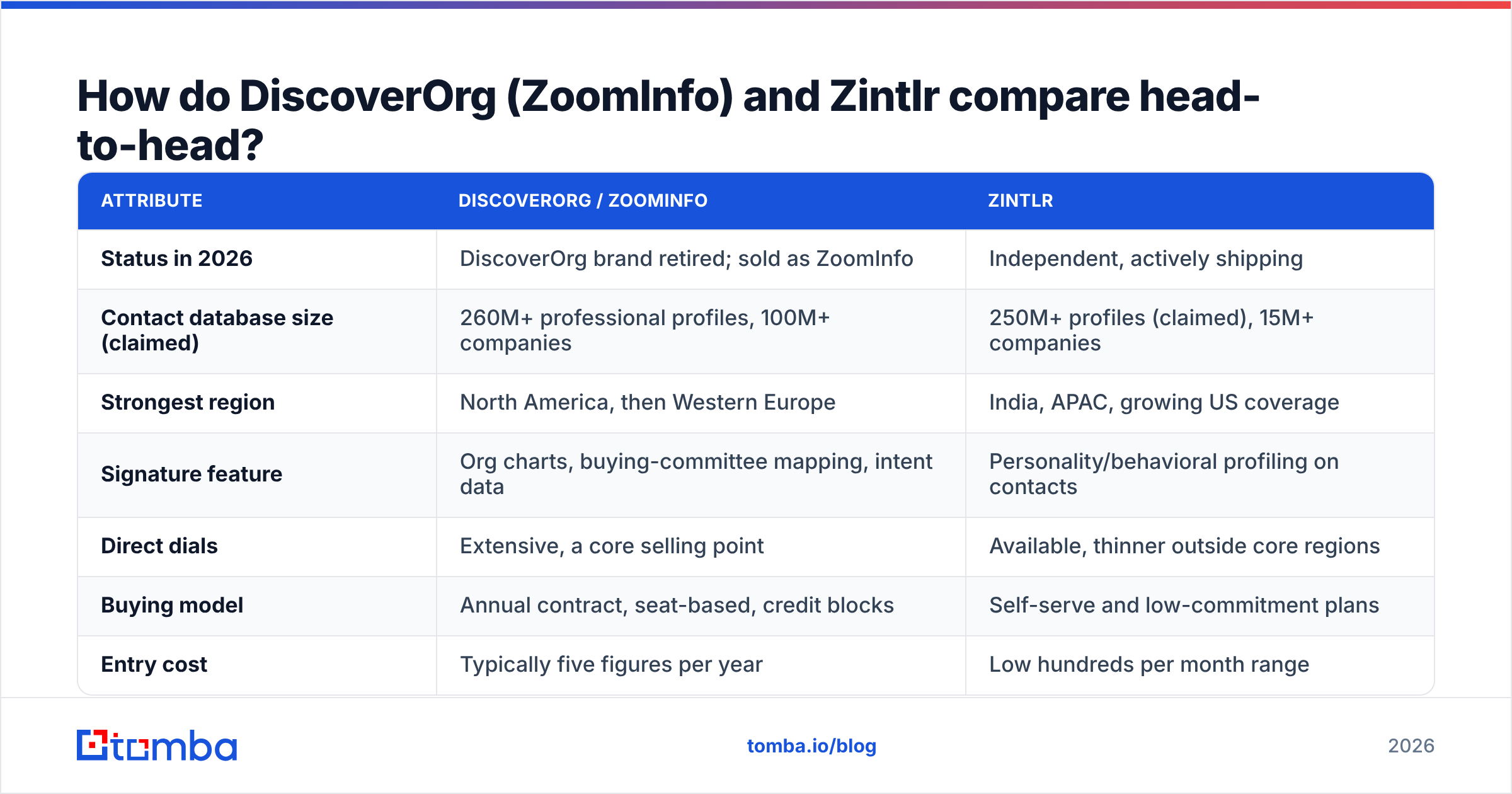
DiscoverOrg vs Zintlr: the head-to-head table#
| Attribute | DiscoverOrg / ZoomInfo | Zintlr |
|---|---|---|
| Status in 2026 | DiscoverOrg brand retired; sold as ZoomInfo | Independent, actively shipping |
| Contact database size (claimed) | 260M+ professional profiles, 100M+ companies | 250M+ profiles (claimed), 15M+ companies |
| Strongest region | North America, then Western Europe | India, APAC, growing US coverage |
| Signature feature | Org charts, buying-committee mapping, intent data | Personality/behavioral profiling on contacts |
| Direct dials | Extensive, a core selling point | Available, thinner outside core regions |
| Buying model | Annual contract, seat-based, credit blocks | Self-serve and low-commitment plans |
| Entry cost | Typically five figures per year | Low hundreds per month range |
| Free trial | Limited trial, sales-gated | Free/low-cost tier available |
| CRM sync | Native Salesforce, HubSpot, Dynamics, Marketo | Core CRM integrations plus CSV/API |
| Compliance posture | Mature GDPR/CCPA program, DPA available | Improving; review DPA before EU sending |
| Best for | Enterprise GTM teams with RevOps support | Small teams, agencies, price-sensitive outbound |
Two rows deserve extra attention.
Region. ZoomInfo's North American coverage is the deepest in the category. That is why enterprise teams keep renewing at the price. Zintlr is strongest in India and parts of APAC.
So if your ICP is US mid-market SaaS, expect a real match-rate gap. If your ICP is Indian SMBs or APAC services firms, the gap can flip.
Buying model. ZoomInfo contracts run a year, price per seat, and cap you with credits. Need more exports than your cap? You buy more credits mid-term, usually at a worse rate than the one you first agreed.
Zintlr works like a normal SaaS plan. You can cancel. That freedom is worth real money to a team that is not yet sure outbound will work.
Which one has better data accuracy?#
Accuracy is where these tools split. It is also the only metric that moves your reply rate.
ZoomInfo sources in layers. It uses contributory data from installed extensions and connected inboxes, public web crawling, and the research team it inherited from DiscoverOrg. That mix is why org charts and direct dials hold up.
It is not perfect. Every large database carries stale records for people who changed jobs. But the decay is managed, and you can usually see when a record was last updated.
Zintlr leans harder on crawling and inference. That keeps the cost low and the coverage broad. It also means more unverified rows reach your export.
So budget for a verification pass on Zintlr exports before you load a sequence. That is not a knock on Zintlr alone. It applies to almost any cheap database. It is simply a cost to add to the DiscoverOrg vs Zintlr math.

The rule is simple: never send to an unverified export, from any vendor. A 5% invalid rate on a 2,000-contact list is 100 hard bounces. That is enough to hurt sender reputation on a young domain.
Run every list through an email verifier first. Then split catch-all domains into their own segment and handle them with a catch-all verifier instead of guessing.
DiscoverOrg vs Zintlr pricing: what a usable contact really costs#
Headline pricing misleads in this category. Both vendors sell credits, not verified contacts. Here is how to model the real number.
- Start with list price, not the demo discount. ZoomInfo deals often land between $15,000 and $40,000 a year. The range depends on seats, modules, and export volume. Single-seat deals exist but are rarely advertised. Zintlr publishes self-serve tiers in the low hundreds per month.
- Divide by exportable records, not database size. A 260M-record index means little if your plan exports 10,000 rows a year. Get the export cap in writing before you sign.
- Apply your real match rate. Run 200 known-good target accounts through a trial. Count how many return a usable work email and a direct dial. A 60% match rate doubles your true cost per contact.
- Add the verification cost. If 8% of records bounce, your price per usable contact rises. So does the deliverability damage, which is harder to price.
- Add the seat tax. ZoomInfo charges per seat. Adding two SDRs mid-year is a contract amendment, not a checkbox.
- Add the exit cost. Auto-renewal clauses mean a bad fit costs you 12 months, not one.
Run that math and the raw price gap narrows. The flexibility gap widens.
ZoomInfo can be worth $30k if you have 15 reps on a defined North American territory and intent data to rank them. It is almost never worth it for a three-person team that needs 500 verified emails a month.
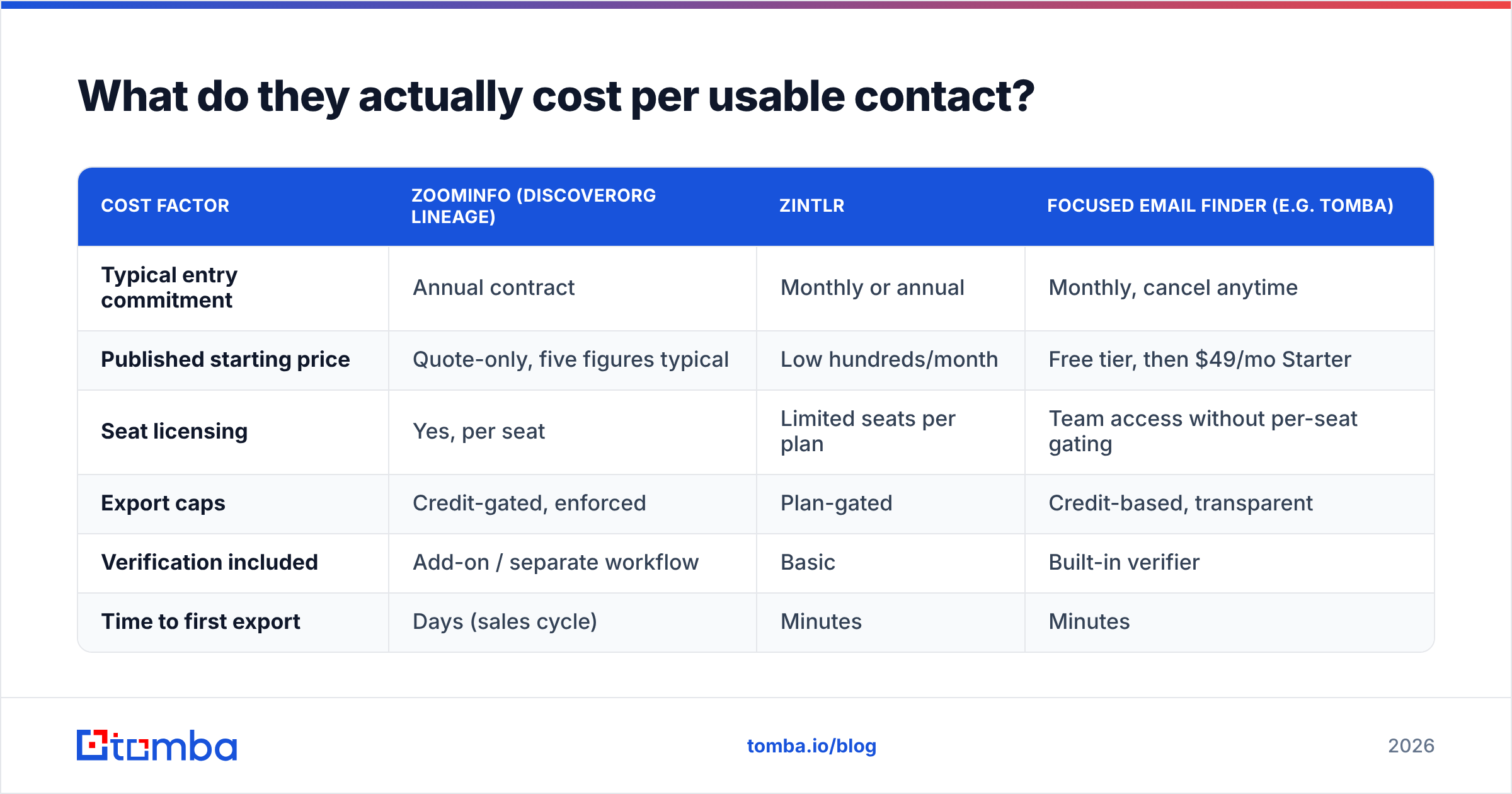
| Cost factor | ZoomInfo (DiscoverOrg lineage) | Zintlr | Focused email finder (e.g. Tomba) |
|---|---|---|---|
| Typical entry commitment | Annual contract | Monthly or annual | Monthly, cancel anytime |
| Published starting price | Quote-only, five figures typical | Low hundreds/month | Free tier, then $49/mo Starter |
| Seat licensing | Yes, per seat | Limited seats per plan | Team access without per-seat gating |
| Export caps | Credit-gated, enforced | Plan-gated | Credit-based, transparent |
| Verification included | Add-on / separate workflow | Basic | Built-in verifier |
| Time to first export | Days (sales cycle) | Minutes | Minutes |

Which should you pick for your outbound motion?#
Pick by motion, not by feature list.
- Enterprise ABM with a named-account list — ZoomInfo. You need org charts, committee mapping, and intent signals, and you have the RevOps staff to use them. Zintlr will not replace this.
- High-volume SMB outbound in APAC or India — Zintlr. The coverage plus the price makes the unit economics work where ZoomInfo's do not.
- Early-stage startup testing outbound — Neither, yet. Buy a focused email finder. Prove the channel with 500 well-researched contacts, then upgrade once you know your conversion math.
- Agency running outbound for several clients — Zintlr or a per-credit email finder. Client churn makes annual seat contracts risky, and you need clean per-client cost attribution.
- RevOps enriching a CRM of 50k records — ZoomInfo if the budget allows, otherwise a data enrichment API. Enrichment is a batch problem, not a seat problem.
- Recruiting or founder-led sales — A LinkedIn finder plus verification beats either platform on cost. You work dozens of contacts, not thousands.
Where do standalone email finders fit?#
Vendor marketing blurs a real category line. ZoomInfo and Zintlr sell databases. You search a pre-built index and export rows.
Email finders sell lookups. You supply a name and a domain, and the tool resolves and verifies the address in real time. That works even for people who are not in anyone's index yet.
Databases win when you do not know who to target and need discovery filters. Lookups win when you already have a target list — from LinkedIn, a conference roster, a customer site, a podcast guest list — and just need reachable contact data. Most teams need both. Most teams over-buy the database and under-buy the lookup.
That is where Tomba fits honestly in this comparison. It does not do intent scoring, org charts, or personality inference. If those are your requirement, buy ZoomInfo and do not look back.
What Tomba does is resolve and verify professional email addresses reliably. It adds a domain search for mapping every reachable contact at a company, a free tier of 25 searches a month, a $49/mo Starter plan, $99/mo Growth, and $249/mo Pro. No seat licensing. No annual lock-in. Full Tomba pricing is public, which is rare in a category that hides numbers behind demo forms.

A common stack works well here. Use a database for account discovery, export the company list, then run a lookup tool to resolve and verify the actual humans. You buy fewer database credits and you send to cleaner lists.
How to run a DiscoverOrg vs Zintlr trial before you sign#
Do not evaluate on the vendor's sample list. Build your own.
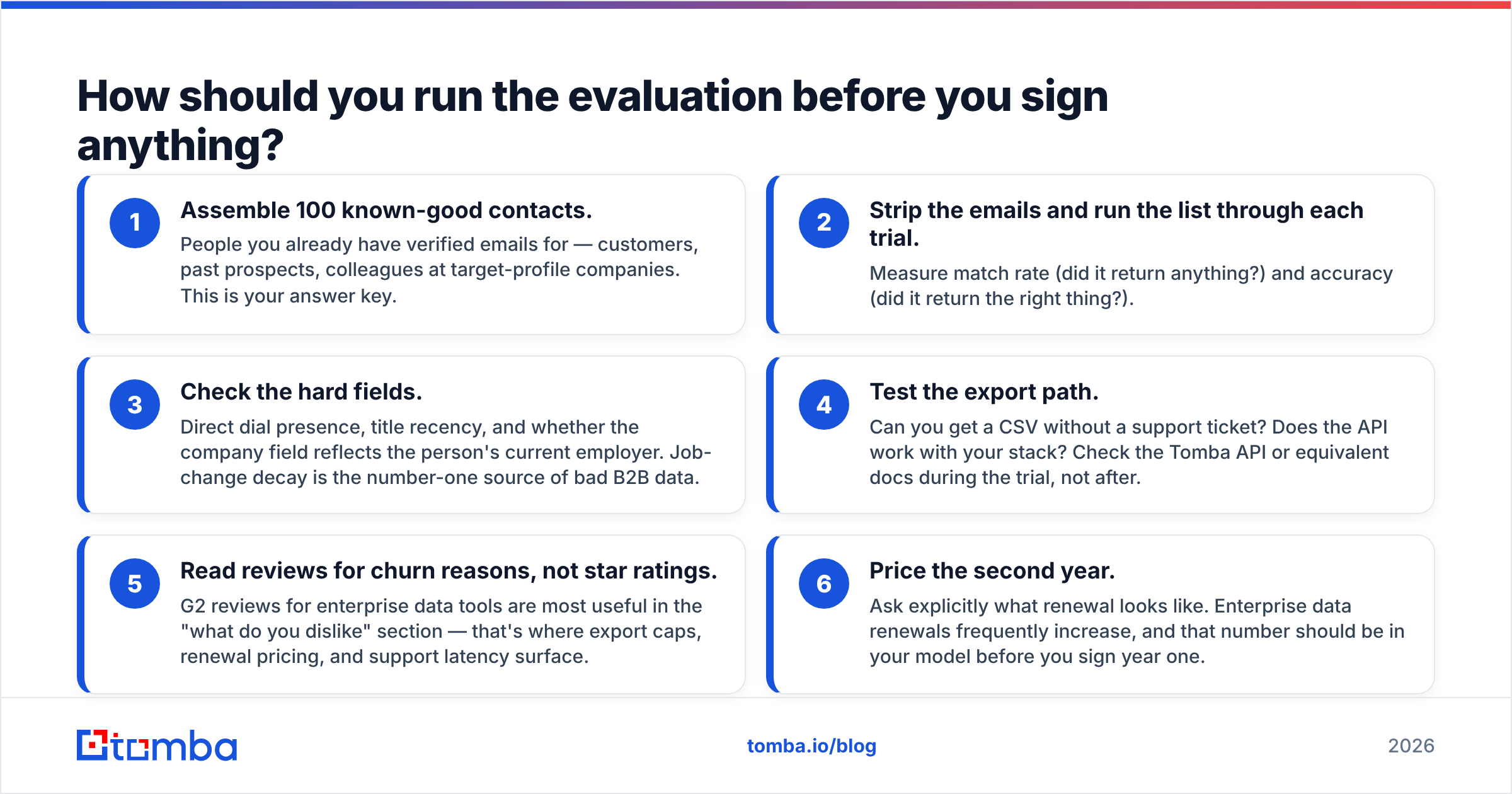
- Assemble 100 known-good contacts. Use people you already have verified emails for: customers, past prospects, colleagues at target-profile companies. This is your answer key.
- Strip the emails and run the list through each trial. Measure match rate (did it return anything?) and accuracy (did it return the right thing?).
- Check the hard fields. Look at direct dial presence, title recency, and whether the company field matches the person's current employer. Job-change decay is the top source of bad B2B data.
- Test the export path. Can you get a CSV without a support ticket? Does the API fit your stack? Read the Tomba API or equivalent docs during the trial, not after.
- Read reviews for churn reasons, not star ratings. On G2, the "what do you dislike" section is where export caps, renewal pricing, and slow support show up.
- Price the second year. Ask what renewal looks like. Data renewals often rise, and that number belongs in your model before you sign year one.
If a vendor will not let you run this test, that is your answer.
DiscoverOrg vs Zintlr: the verdict#
DiscoverOrg vs Zintlr is really ZoomInfo vs Zintlr, and your budget floor picks the winner.
ZoomInfo is the better product on coverage, org charts, direct dials, and intent. It charges accordingly. Annual contracts and per-seat pricing punish small or shifting teams.
Zintlr is the better fit if you need broad, cheap contact data, especially in India and APAC. You have to live with lower verification quality. In exchange you keep the freedom to cancel.
Neither is a good first purchase for a team that has not yet proven outbound converts.
Whichever you choose, contact data is only as good as its verification status on the day you send. Build the verification step into your workflow before you build the sequence.
If your real bottleneck is "I know who to contact, I just need their email," start with the Tomba Email Finder. Twenty-five free searches a month, $49/mo when you outgrow it, verification built in, and no annual contract to escape. Test it against your own answer-key list this week. That is the only benchmark that matters.
Related guides#
Ready to find emails that actually work?
Join 150,000+ professionals who stopped guessing and started sending. Free credits on signup — no credit card required.
Get the Tomba newsletter
Practical outbound tactics and product updates — once every two weeks.
About the author