DiscoverOrg vs ZoomInfo in 2026: What Actually Happened
DiscoverOrg vs ZoomInfo is a comparison that stopped existing in 2019 — the two merged. Here's what survived, what you actually pay in 2026, and which cheaper tools cover the same job.
TL;DR
DiscoverOrg vs ZoomInfo is a comparison that no longer exists. DiscoverOrg bought ZoomInfo in February 2019. It kept the ZoomInfo brand and retired the DiscoverOrg product name in 2020. If a vendor pitches you "DiscoverOrg" in 2026, you are looking at resold old data or a legacy contract.
What survived from DiscoverOrg is the research method: human-verified org charts and IT install data. It now sits inside ZoomInfo's higher tiers.
ZoomInfo does not publish pricing. Real contracts reported on G2 and Reddit cluster around $15,000–$40,000 a year, with seat minimums, annual commits, and credit caps.
Accuracy is strong on US enterprise accounts. It is weaker on SMB, EU, and non-English markets. That gap costs you bounces, and the platform's own confidence score does not always flag it.
Need verified work emails rather than a full GTM system? A focused email finder at $49–$249 a month does the same job for 2–5% of the spend.
What happened to DiscoverOrg?#
DiscoverOrg bought ZoomInfo. Not the other way around.
In February 2019, DiscoverOrg acquired ZoomInfo for a reported $500M+. DiscoverOrg was the Vancouver, Washington company known for human-researched org charts and IT department mapping. In 2020 the combined company took the ZoomInfo name, IPO'd on Nasdaq as ZI, and dropped the DiscoverOrg branding for good. The ZoomInfo you evaluate today is that merged entity.
So DiscoverOrg vs ZoomInfo is not a head-to-head. It is an archaeology question: which parts of DiscoverOrg's approach survived, and did the merged product get better or just pricier?
The short answer: the research discipline survived. The pricing model got worse. The product grew far past "contact data" into sequences, intent, conversation intelligence, and now AI agents. Whether that counts as an upgrade depends on one thing. Did you want a database, or a platform?
What did DiscoverOrg actually do differently?#
DiscoverOrg's original pitch was human verification, at a time when everyone else scraped. Researchers phoned into companies, confirmed reporting lines, and mapped who owned which system.
That produced a smaller dataset with unusually high trust. Coverage was strongest in IT, engineering, and finance teams at mid-market and enterprise firms.
ZoomInfo before the merger was the opposite. It built a much larger contact graph from email signature scraping through its Community Edition network, plus web crawling and public filings. Bigger, broader, noisier.
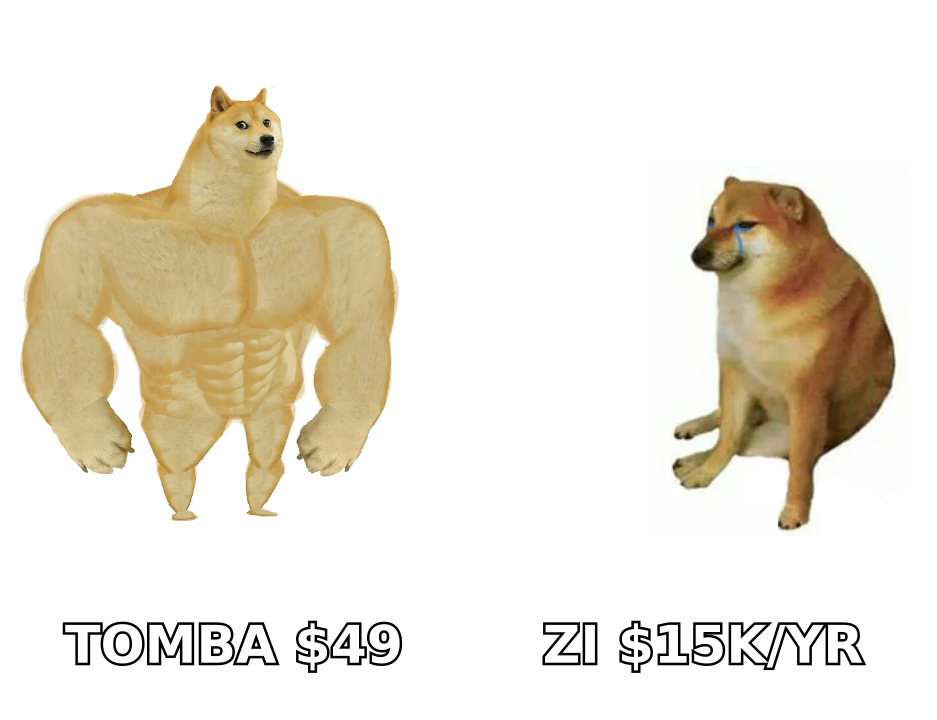
That split is the real DiscoverOrg vs ZoomInfo story, and the table shows how it resolved.
| Dimension | DiscoverOrg (pre-2019) | ZoomInfo (pre-2019) | ZoomInfo (2026, merged) |
|---|---|---|---|
| Core method | Human researchers calling accounts | Contributory email-signature network + crawling | Both, plus AI enrichment and third-party feeds |
| Coverage size | ~2M contacts, narrow and deep | ~100M+ contacts, wide and shallow | 260M+ contacts claimed, 100M+ companies |
| Standout data | Org charts, IT install base, budgets | Direct dials, broad firmographics | Intent, scoops, technographics, Copilot AI |
| Typical buyer | Enterprise IT sellers | SDR teams at any size | Enterprise RevOps and GTM leadership |
| Entry price | ~$20K/year | ~$5K–$10K/year | Reported $15K–$40K+/year |
The merged product kept DiscoverOrg's org-chart and technographic depth, then gated it. Those datasets now sit in ZoomInfo's upper tiers or cost extra as add-ons.
That is why teams who signed DiscoverOrg deals in 2018 and renewed into ZoomInfo Advanced often pay two to three times more for much the same access.
How accurate is ZoomInfo data in 2026?#
Accuracy depends on segment, and most DiscoverOrg vs ZoomInfo comparisons skip that part.
On US enterprise accounts, ZoomInfo's email accuracy holds up well. Think companies over 500 employees, with a live website and active LinkedIn profiles. Independent tests and buyer reports usually land in the 85–93% deliverable range for that slice.
Outside it, the picture changes:
SMB coverage thins fast. Companies under 50 employees often return a generic info@ address, or a contact who left two years ago. The contributory network simply sees fewer signatures from small firms.
EU and APAC data lags. GDPR suppression and thinner signature data mean European contacts are often role-based or stale. If your ICP is DACH or the Nordics, run a sample before you sign.
Job-change decay is the silent killer. B2B contact data decays 25–30% a year. A record marked "verified" may have been checked eleven months ago.
Confidence scores are directional. The score tells you how sure ZoomInfo is that the person works there. It does not tell you the mailbox accepts mail today.
Catch-all domains count as wins. A domain set to accept everything passes many providers' checks. That does not make the mailbox real. Run a dedicated catch-all verifier before any send.

The practical rule is simple. Whatever database you buy, run the export through an independent email verifier before it touches your sending domain. Vendors grade their own homework. Your bounce rate does not care.
What does ZoomInfo cost in 2026?#
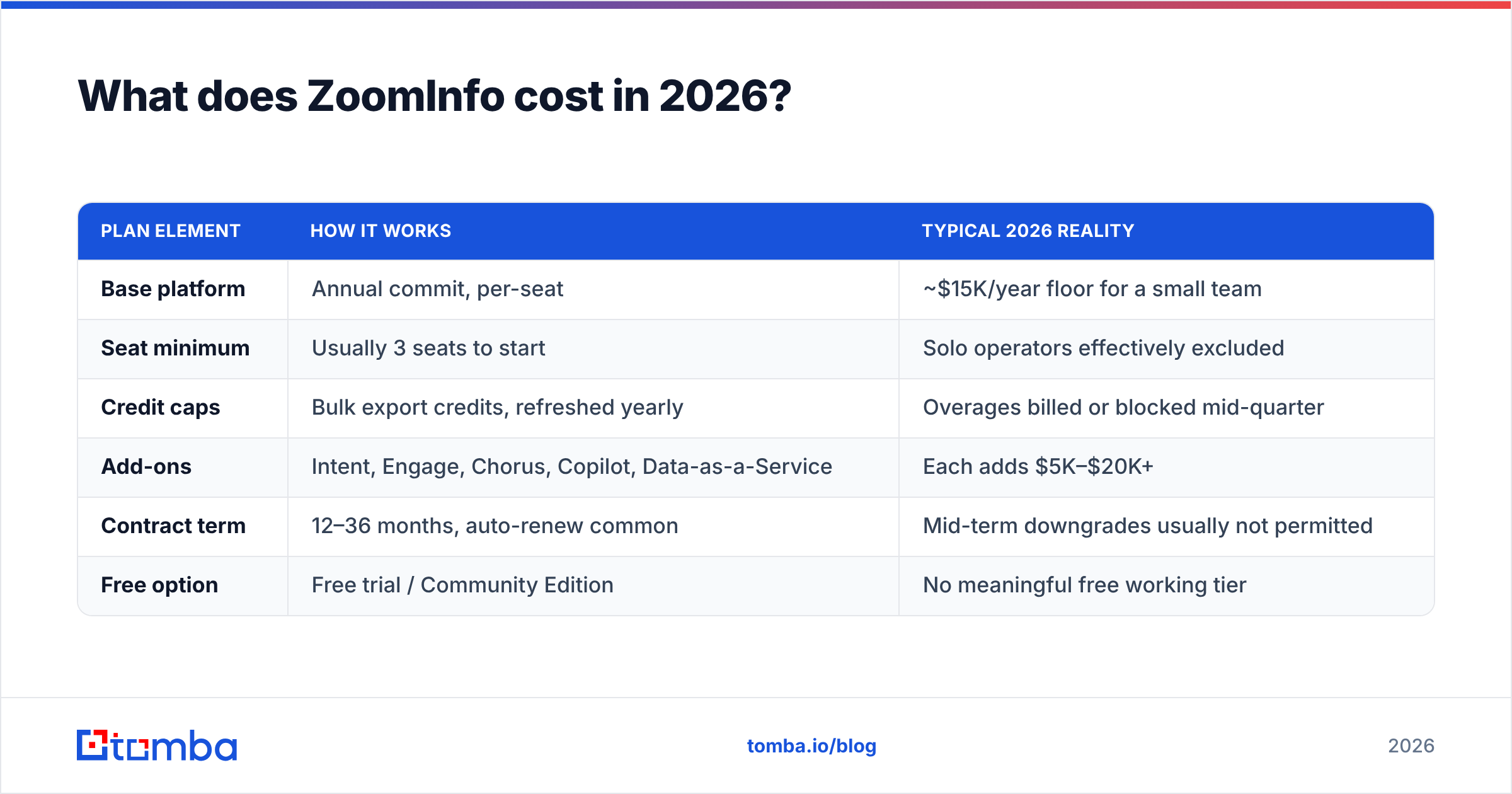
ZoomInfo does not publish prices, which is itself a data point. The numbers below come from buyer reports on G2, procurement threads, and the structure ZoomInfo's own reps walk through on discovery calls.
| Plan element | How it works | Typical 2026 reality |
|---|---|---|
| Base platform | Annual commit, per-seat | ~$15K/year floor for a small team |
| Seat minimum | Usually 3 seats to start | Solo operators effectively excluded |
| Credit caps | Bulk export credits, refreshed yearly | Overages billed or blocked mid-quarter |
| Add-ons | Intent, Engage, Chorus, Copilot, Data-as-a-Service | Each adds $5K–$20K+ |
| Contract term | 12–36 months, auto-renew common | Mid-term downgrades usually not permitted |
| Free option | Free trial / Community Edition | No meaningful free working tier |
The pattern buyers describe is consistent. The sticker feels manageable. The credit ceiling arrives in month four. Then comes the expansion conversation.
Auto-renewal clauses and multi-year terms are standard, so read the notice window before you sign. Sixty to ninety days is common, and easy to miss.
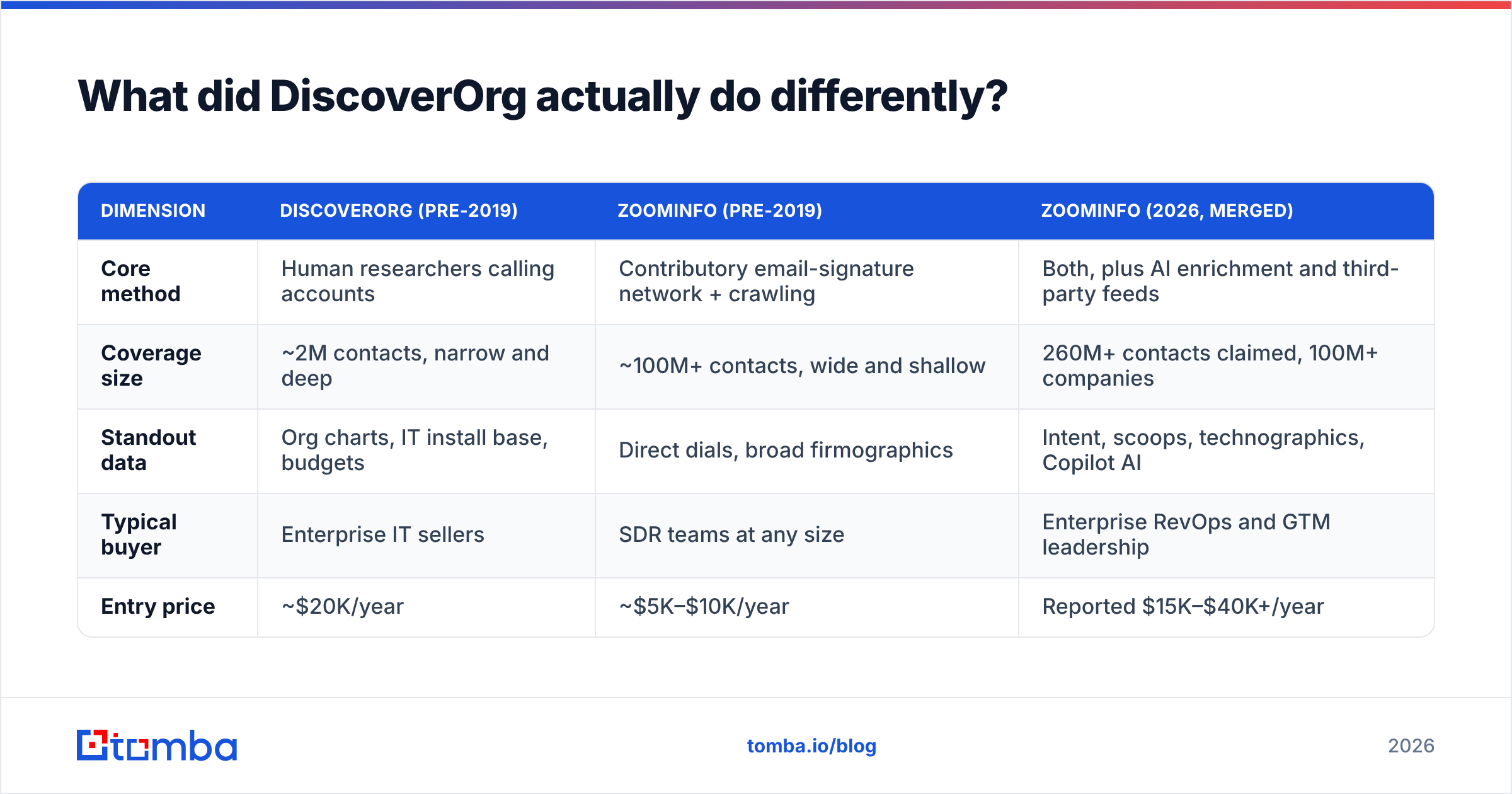
For comparison, Tomba pricing sits right on the page: a free tier with 25 searches a month, Starter at $49, Growth at $99, Pro at $249, and custom enterprise. No seat minimums. No annual lock-in. No discovery call to learn the number.
That price gap is the practical heart of any DiscoverOrg vs ZoomInfo review in 2026.
Is ZoomInfo worth it compared to focused tools?#
It depends on whether you are buying a database or an operating system.
ZoomInfo in 2026 is a real platform. You get contact and company data, buyer intent signals, website visitor identification, sequencing through Engage, call recording through Chorus, and an AI layer called Copilot that drafts outreach and surfaces accounts.
Say your revenue org has ten or more sellers, a RevOps function to run it, and a CRM underneath. That bundle can fold four vendors into one line item.
If you are a founder, a two-person outbound team, an agency, or an engineer wiring enrichment into a product, the math flips. You pay enterprise platform prices for the 15% you actually use.

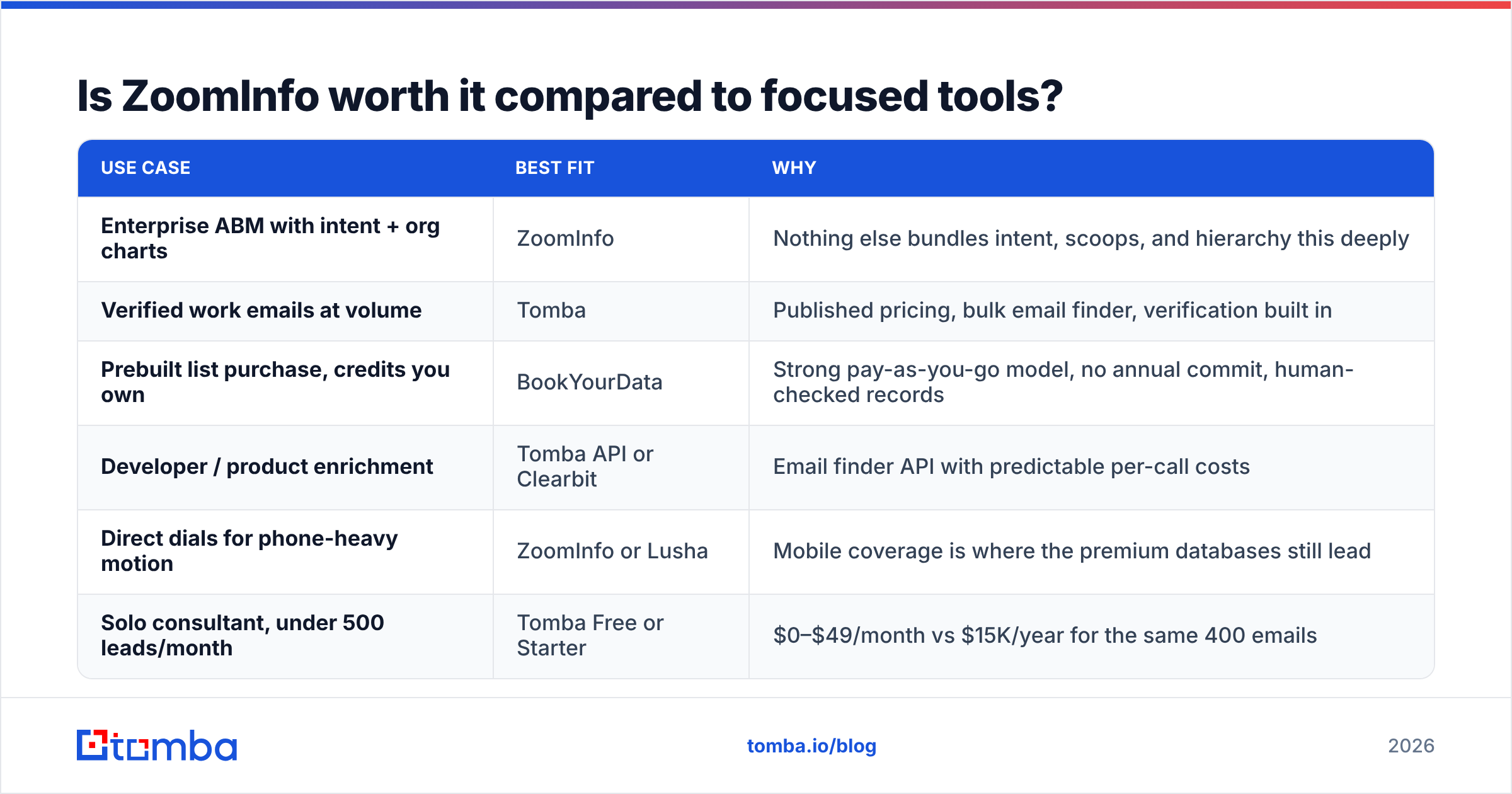
Here's the honest split by use case:
| Use case | Best fit | Why |
|---|---|---|
| Enterprise ABM with intent + org charts | ZoomInfo | Nothing else bundles intent, scoops, and hierarchy this deeply |
| Verified work emails at volume | Tomba | Published pricing, bulk email finder, verification built in |
| Prebuilt list purchase, credits you own | BookYourData | Strong pay-as-you-go model, no annual commit, human-checked records |
| Developer / product enrichment | Tomba API or Clearbit | Email finder API with predictable per-call costs |
| Direct dials for phone-heavy motion | ZoomInfo or Lusha | Mobile coverage is where the premium databases still lead |
| Solo consultant, under 500 leads/month | Tomba Free or Starter | $0–$49/month vs $15K/year for the same 400 emails |

BookYourData deserves a mention for teams who hate subscriptions. Its credit model lets you buy a list, own it outright, and walk away. That is a structurally different deal from ZoomInfo's annual commit, and a fair choice when your outbound is seasonal or campaign-driven.
Who still needs the DiscoverOrg heritage data?#
Three profiles still get real value out of the DiscoverOrg vs ZoomInfo merger:
IT and infrastructure sellers. DiscoverOrg's install-base research became ZoomInfo's technographics. If your qualifying question is "do they run Snowflake or Redshift," that data is worth real money and hard to source cheaply.
Multi-threaded enterprise deals. Accurate reporting lines across a 12-person buying committee was the original DiscoverOrg product. It is still among the best available.
Teams running intent-triggered plays. ZoomInfo's intent feed, paired with visitor identification, drives account prioritization that a plain contact database cannot match.
Everyone else is buying a Bloomberg terminal to check a stock price.
How do you replace ZoomInfo without breaking pipeline?#
Mid-contract, or weighing a non-renewal? Run this sequence instead of a cold switch.
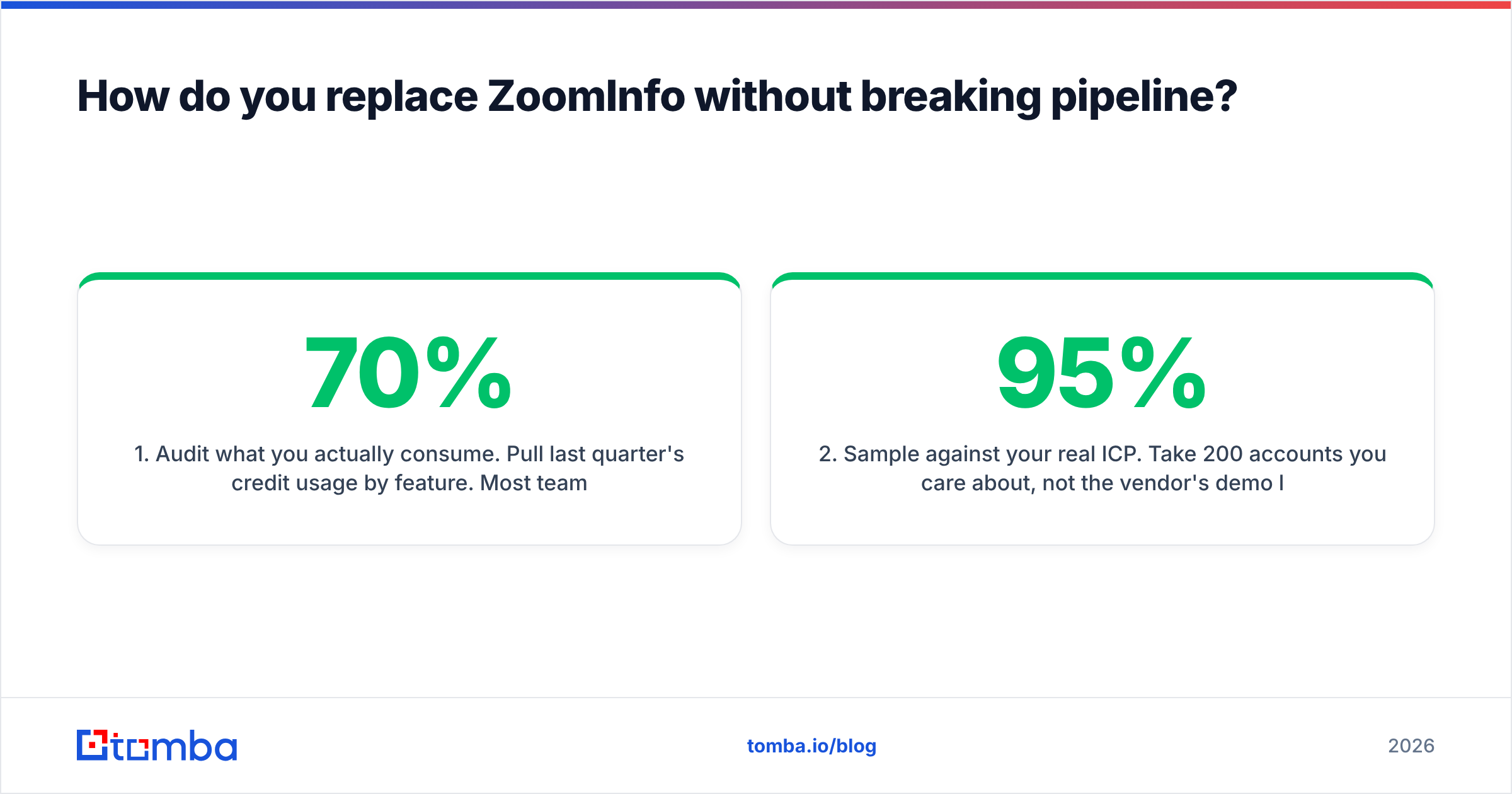
Audit what you actually use. Pull last quarter's credit usage by feature. Most teams find 70%+ of the value comes from contact lookup and export alone. Those two are the cheapest to replace.
Sample against your real ICP. Take 200 accounts you care about, not the vendor's demo list. Run them through each candidate. Measure deliverable rate, not match rate. A 95% match with 12% bounces is really an 83% tool.
Split by data type. Get emails from a focused finder. Get phone numbers from whichever provider wins your sample test. No rule says one vendor must supply both, so check phone finder coverage for your regions first.
Wire enrichment into the CRM. A HubSpot integration or Salesforce sync keeps reps on the record. That convenience was most of what the seat license bought anyway.
Verify at the point of send. Data ages between import and campaign. Verification a week before the send beats verification at list-build.
Diarize the notice window. Put the cancellation deadline in a shared calendar the day you sign. Missed notice windows are how "we're leaving" turns into another 12 months.
Deliverability sits downstream of all of this. Mailbox providers judge you on complaint and bounce rates within your first few hundred sends.
So clean data is not a nice-to-have during a migration. It decides whether the new stack works at all. Google's Postmaster guidance sets the bar you are actually graded against.
What's the verdict on DiscoverOrg vs ZoomInfo?#
There is no versus. There is one company, one platform, and one question. Do you need a full GTM data operating system, or do you need correct email addresses?
Running enterprise ABM with intent data, org charts, and a RevOps team to operate it? ZoomInfo is still the most complete product in the category, and the DiscoverOrg heritage is part of why. Budget $15K–$40K a year. Negotiate the credit ceiling hard, because that is where the second invoice comes from.
If your real job is finding verified work emails for outbound, enrichment, or recruiting, the merged platform is a category error. You would fund a research operation, an intent graph, and a conversation-intelligence product just to get a mailbox address. Focused tools solved that problem years ago, at a fraction of the price, with rates you can read on a web page.
Try the alternative before you renew. The Tomba Email Finder returns verified professional emails from a name and a domain. Every result carries a confidence score and SMTP-level verification.
The free tier gives you 25 searches a month. That is enough to test your real ICP against your ZoomInfo export and see the deliverable-rate gap yourself. Starter is $49 a month, Growth $99, Pro $249. No seat minimum, no annual commit, no notice window to diarize.
Run the 200-account test. Let the bounce rate settle the DiscoverOrg vs ZoomInfo question for you.
Related guides#
Ready to find emails that actually work?
Join 150,000+ professionals who stopped guessing and started sending. Free credits on signup — no credit card required.
Get the Tomba newsletter
Practical outbound tactics and product updates — once every two weeks.
About the author