Discovery Call Guide 2026: Questions, Script, and Framework
A discovery call is not a mini-demo. Here is the 40-minute agenda, an honest framework comparison, and the exact questions that separate real pipeline from a polite no.
TL;DR
- A discovery call is a structured diagnostic conversation, not a shortened demo. Its only job is to decide — mutually — whether a deal is worth both parties' time.
- The single biggest failure mode is surface pain: you hear "our process is manual," write it down, and never quantify what manual actually costs.
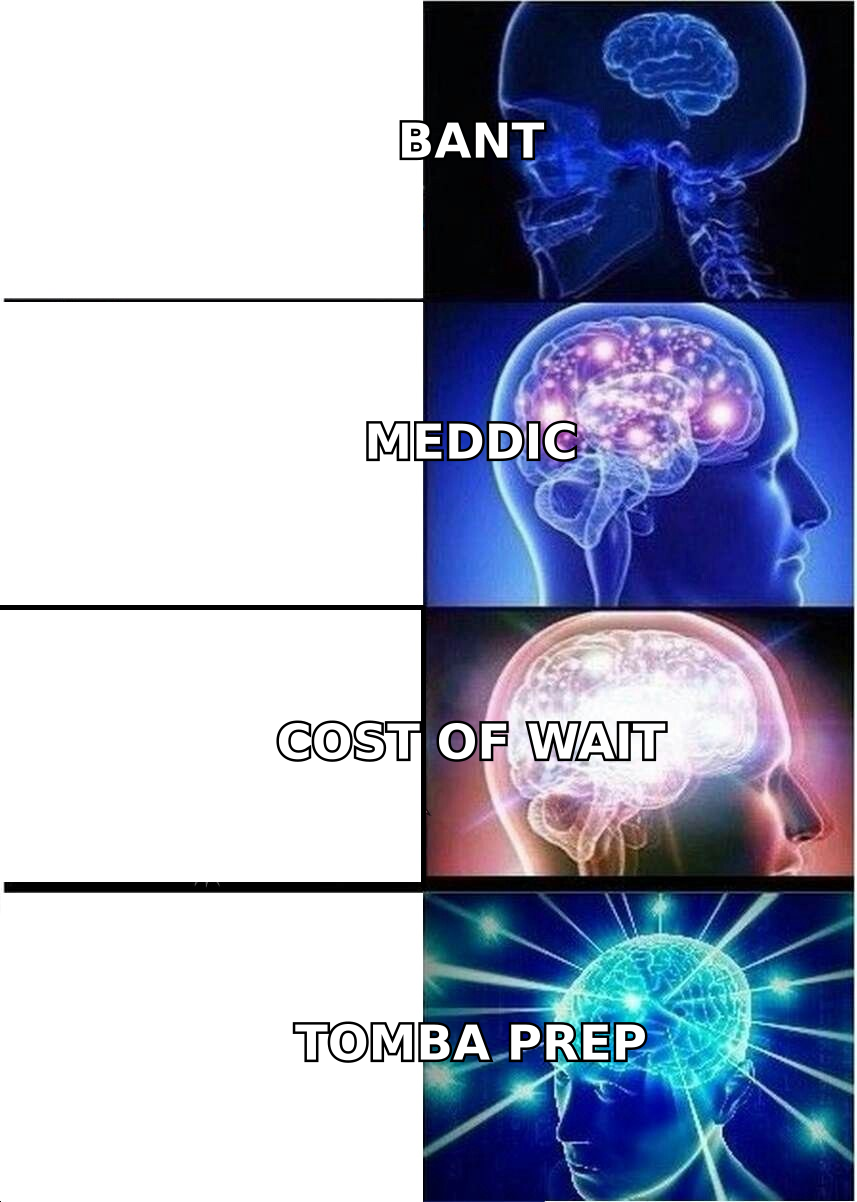
- Framework choice matters less than depth. BANT gets you a forecast; MEDDIC gets you a deal; a plain "cost of inaction" line of questioning gets you both.
- Aim for a 40-minute call with a 70/30 talk ratio in the buyer's favor, three quantified problems, one named economic buyer, and a scheduled next step before you hang up.
- Prep is the cheapest lever. Ten minutes of research on the company, the person, and the trigger event changes the quality of every question you ask.
What is a discovery call?#
A discovery call is the first substantive conversation between a seller and a prospect, where the seller diagnoses the buyer's current state, quantifies the gap between that state and a desired one, and determines whether the deal is worth pursuing. It usually runs 30 to 45 minutes and sits between the initial outreach reply and the demo or technical evaluation.
The medical analogy is overused but accurate: a doctor who prescribes before examining is committing malpractice. A rep who demos before diagnosing is doing the sales version of the same thing — pitching features against problems that may not exist, to a person who may not be able to buy.
Two things a discovery call is not:
It is not a qualification interrogation. Firing twelve BANT questions at someone in sequence turns the call into a customs checkpoint, and buyers respond by giving you the answers that end the call fastest.
It is not a demo with a short intro. If you spend minutes 5 through 35 screen-sharing, you did not run discovery. You ran a demo and labelled it discovery on the CRM record.
Why do most discovery calls fail?#
They fail quietly. The prospect is pleasant, the notes look full, the next step is "send me some information," and the opportunity dies in stage two three weeks later. Here is what actually went wrong.
Surface pain never got quantified. The buyer says "reporting takes forever." You write "reporting is slow." You never asked how many hours, how many people, how often, what decision gets delayed, or what that delay costs. Without a number, there is no business case, and no business case survives a procurement review.
You talked too much. Gong's conversation-intelligence research has consistently found that top performers listen more than they speak on early-stage calls. The exact ratio varies by dataset and deal type, but the direction is unambiguous: reps who dominate airtime on the first call close less.
There was no second stakeholder. One champion with no visible path to a budget holder is not a deal, it is a hobby. If you leave discovery without knowing who signs, you will find out at the worst possible moment.
The next step was vague. "I'll follow up next week" is not a next step. A calendar invite with a named attendee list is.
The prospect was never disqualified. Discovery is bidirectional. A call that ends in a clean, fast no is a better outcome than a call that ends in a maybe you'll chase for two quarters.
https://blog-cdn.tomba.io/content/images/2026/07/memes/2026-07-27/discovery-call-meme-1.png
What should a discovery call agenda look like?#
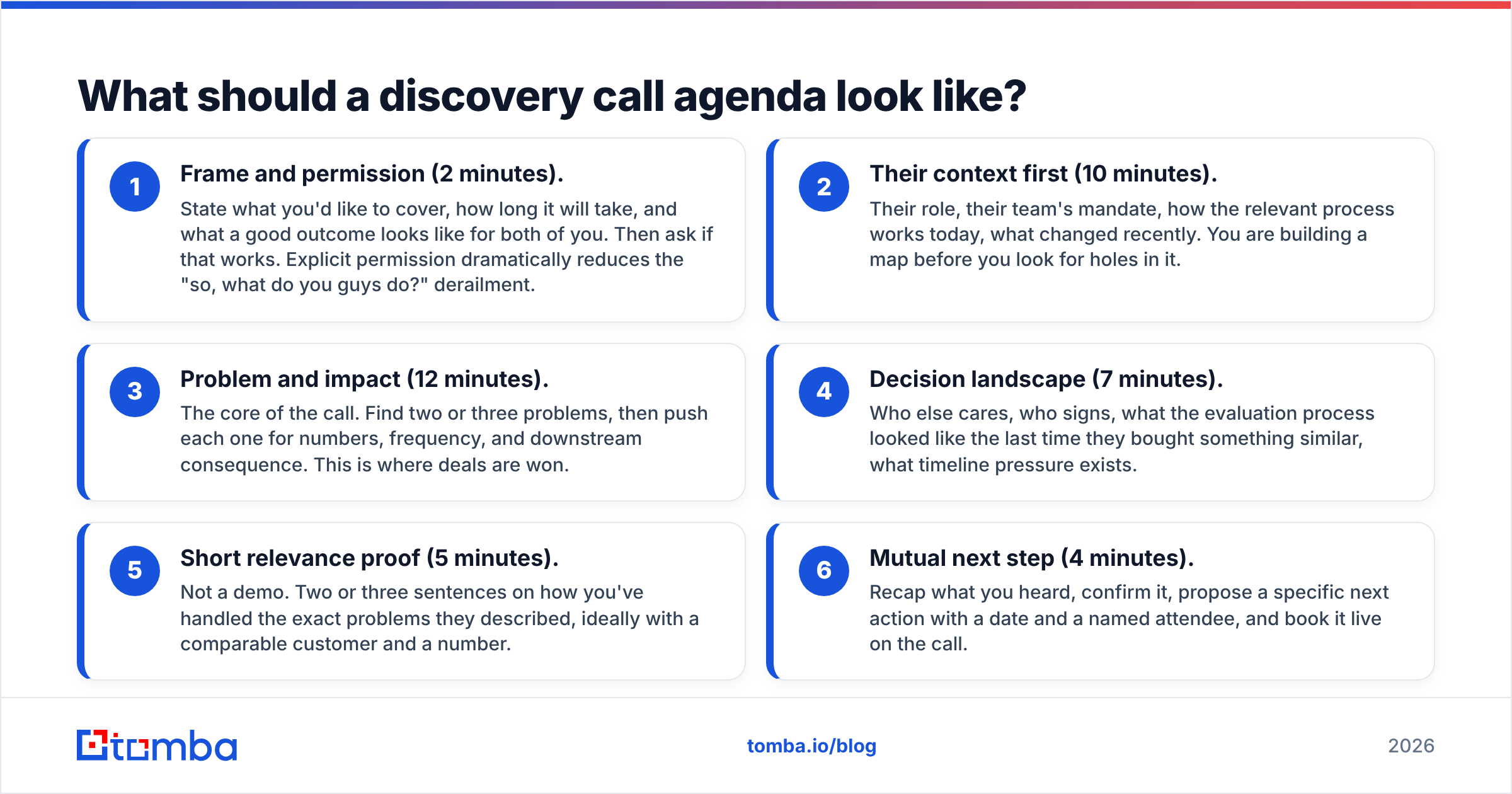
Structure buys you freedom. When the shape of the call is decided in advance, you can improvise inside it without losing the thread. Here is a 40-minute agenda that works across most B2B motions.
- Frame and permission (2 minutes). State what you'd like to cover, how long it will take, and what a good outcome looks like for both of you. Then ask if that works. Explicit permission dramatically reduces the "so, what do you guys do?" derailment.
- Their context first (10 minutes). Their role, their team's mandate, how the relevant process works today, what changed recently. You are building a map before you look for holes in it.
- Problem and impact (12 minutes). The core of the call. Find two or three problems, then push each one for numbers, frequency, and downstream consequence. This is where deals are won.
- Decision landscape (7 minutes). Who else cares, who signs, what the evaluation process looked like the last time they bought something similar, what timeline pressure exists.
- Short relevance proof (5 minutes). Not a demo. Two or three sentences on how you've handled the exact problems they described, ideally with a comparable customer and a number.
- Mutual next step (4 minutes). Recap what you heard, confirm it, propose a specific next action with a date and a named attendee, and book it live on the call.
Notice that the "us" portion is five minutes out of forty. That ratio feels wrong to most reps for the first month and obvious forever after.
Which discovery framework should you use in 2026?#
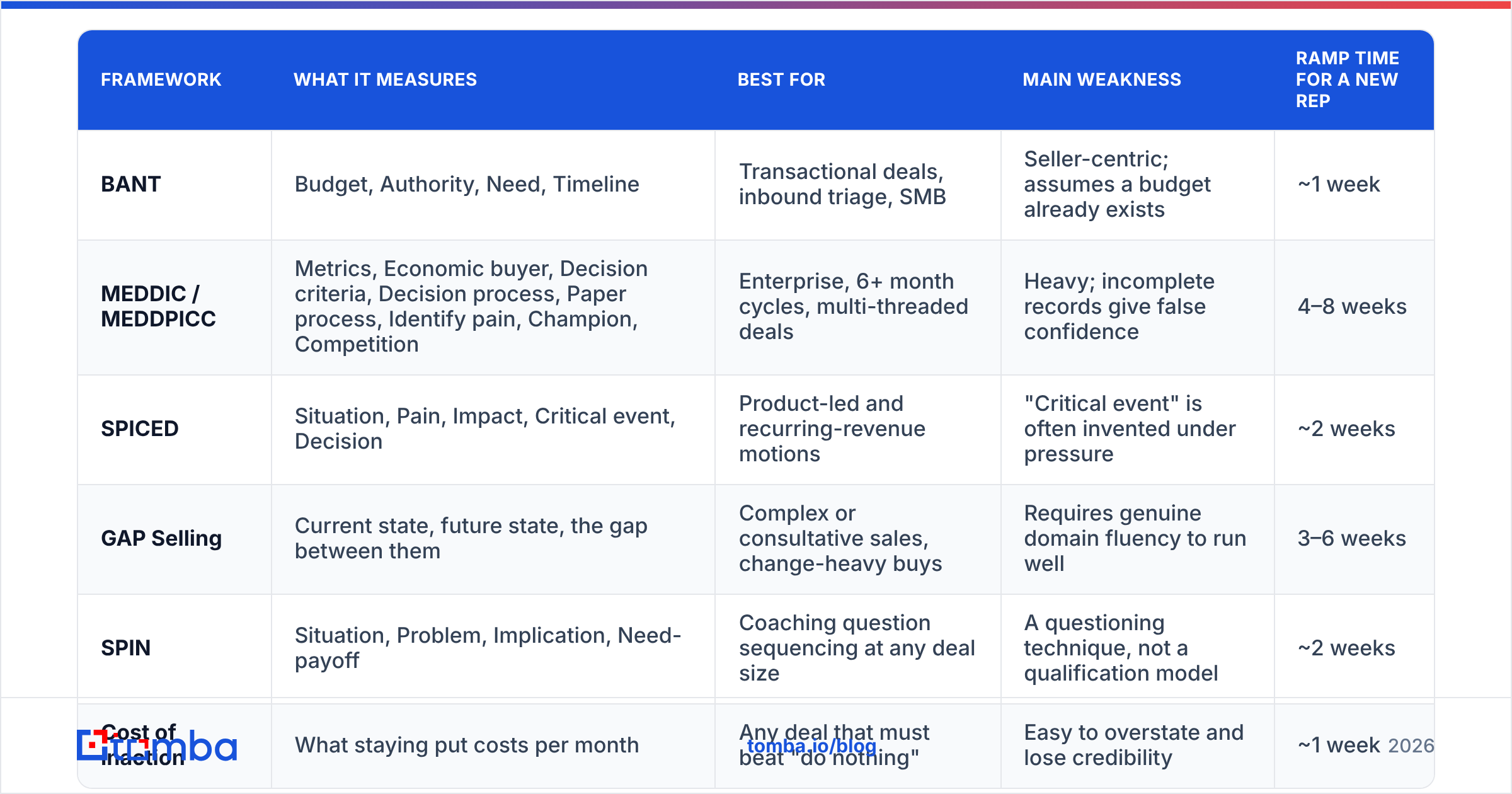
Frameworks are checklists, not scripts. The right one depends on deal size, cycle length, and how many stakeholders you have to satisfy. Here is an honest comparison.
| Framework | What it measures | Best for | Main weakness | Ramp time for a new rep |
|---|---|---|---|---|
| BANT | Budget, Authority, Need, Timeline | Transactional deals, inbound triage, SMB | Seller-centric; assumes a budget already exists | ~1 week |
| MEDDIC / MEDDPICC | Metrics, Economic buyer, Decision criteria, Decision process, Paper process, Identify pain, Champion, Competition | Enterprise, 6+ month cycles, multi-threaded deals | Heavy; incomplete records give false confidence | 4–8 weeks |
| SPICED | Situation, Pain, Impact, Critical event, Decision | Product-led and recurring-revenue motions | "Critical event" is often invented under pressure | ~2 weeks |
| GAP Selling | Current state, future state, the gap between them | Complex or consultative sales, change-heavy buys | Requires genuine domain fluency to run well | 3–6 weeks |
| SPIN | Situation, Problem, Implication, Need-payoff | Coaching question sequencing at any deal size | A questioning technique, not a qualification model | ~2 weeks |
| Cost of inaction | What staying put costs per month | Any deal that must beat "do nothing" | Easy to overstate and lose credibility | ~1 week |
If you force a choice: use MEDDPICC as the record-keeping standard in your CRM, and use GAP or SPIN as the live questioning style on the call. One is the container, the other is the conversation. Confusing them produces reps who can fill out fields but can't hold a diagnostic dialogue.
The framework that beats all of them is the one your team actually inspects in pipeline reviews. An imperfect model applied consistently produces better forecasting than a perfect model applied selectively.
What questions actually move a discovery call forward?#
Skip the question banks that give you fifty prompts. You need roughly a dozen, arranged in layers, plus the discipline to follow each answer down two more levels.
Opening the current state
- "Walk me through how your team handles [process] today, start to finish."
- "What changed in the last six months that put this on your list?"
- "Who touches this besides you?"
Finding the problem
- "Where does that process break down most often?"
- "What happens when it breaks?"
- "How often is 'most often' — weekly, daily?"
Quantifying impact (the layer most reps skip)
- "How many hours a week does your team spend on that?"
- "What does that translate to in pipeline, revenue, or headcount?"
- "If nothing changes for the next twelve months, what's the cost?"
- "Who feels that cost besides your team?"
Mapping the decision
- "The last time you bought something in this category, what did that process look like?"
- "Who besides you needs to be comfortable with this?"
- "What would have to be true for this to be funded this quarter?"
Testing seriousness (use sparingly, late)
- "Honestly, is this a top-three priority or a nice-to-have right now?"
- "What's the argument against doing anything about it?"
That last question is unreasonably effective. It gives the prospect permission to voice the internal objection you'd otherwise discover in month three, and it signals you're more interested in the truth than in the close.
How much prep does a discovery call actually need?#
Ten to fifteen minutes, and it should be the same ten minutes every time so it becomes automatic.
Before you dial, you want four things: what the company does and how it makes money, what changed recently (funding, hiring, launch, leadership), who this person is and what their role likely owns, and one specific, non-generic reason this conversation is relevant right now.
The last one is where most prep collapses. "I saw you're hiring SDRs" is fine. "You posted four SDR roles in two markets while your careers page still lists a single enablement manager" is a reason for the call.
Data quality is the invisible constraint here. If your contact record has the wrong title, a bounced address, or a person who left nine months ago, the prep is worthless before you start. Teams running high call volumes typically clean records at the source — using an email finder and data enrichment to confirm role, company, and reachability before a call is ever booked — rather than discovering the problem live. If phone is part of your motion, verifying B2B phone numbers ahead of time avoids the classic five-minute fumble at the start of a scheduled call.
How do you know if a discovery call went well?#
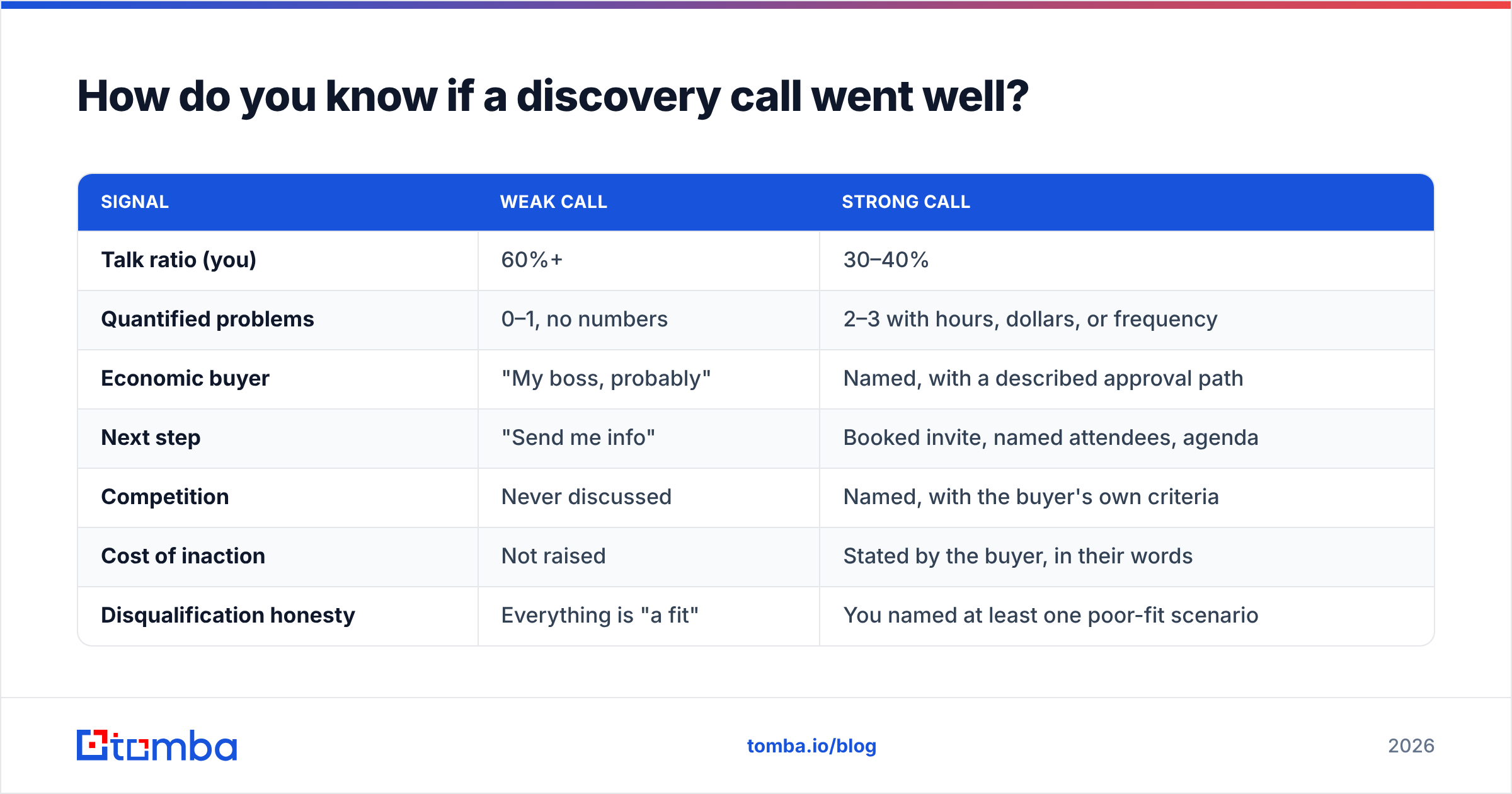
Not by how pleasant it felt. Pleasant is the default state of a call where nobody challenged anybody. Score it against observable outputs instead.
| Signal | Weak call | Strong call |
|---|---|---|
| Talk ratio (you) | 60%+ | 30–40% |
| Quantified problems | 0–1, no numbers | 2–3 with hours, dollars, or frequency |
| Economic buyer | "My boss, probably" | Named, with a described approval path |
| Next step | "Send me info" | Booked invite, named attendees, agenda |
| Competition | Never discussed | Named, with the buyer's own criteria |
| Cost of inaction | Not raised | Stated by the buyer, in their words |
| Disqualification honesty | Everything is "a fit" | You named at least one poor-fit scenario |
A useful internal rule: if you cannot write a two-sentence business case in the buyer's own language after the call, discovery is not finished. Book a second one rather than advancing a hollow opportunity to demo. Advancing weak deals is how forecast accuracy dies — and pipeline hygiene is largely a discovery-discipline problem wearing a reporting costume. Both HubSpot's sales research and buyer-review data on G2 point the same way: buyers now arrive later, more informed, and less tolerant of calls that extract information without returning insight.
What should you never do on a discovery call?#
Never open with your company story. Nobody booked time to hear your Series B narrative. Thirty seconds of context, maximum, then hand the floor over.
Never demo because they asked. When a prospect says "can you just show me the product," the correct move is "happy to — give me five minutes of context first so I only show you the parts that matter." Almost everyone agrees. The ones who refuse are telling you something useful.
Never accept the first pain. The first problem a buyer names is the socially acceptable one. The real one is usually two questions deeper and involves a person, a failed project, or a number someone is embarrassed by.
Never negotiate price. If pricing comes up, give a range and a basis, then return to scope. Discounting before you understand value guarantees you'll discount again later.
Never end without a calendar entry. The half-life of buyer enthusiasm is measured in hours.
What should happen in the 24 hours after the call?#
Send a recap the same day, and make it short: the problems you heard in their words, the impact numbers they gave you, the agreed next step with the date, and one open question you still need answered. Copy the champion's likely stakeholder if they've given you permission.
Then update the record while the memory is fresh. Fill the qualification fields honestly, including the empty ones — a blank "economic buyer" field is data, not failure. Reps who backfill MEDDPICC fields from imagination at quarter-end are the reason forecast reviews are miserable.
Finally, decide out loud whether the deal is real. Write one line in the notes: "Advancing because X" or "Parking because Y." That single habit does more for pipeline quality than any framework on the list above.
Turn better discovery into a better pipeline#
Discovery quality compounds, but only if the calls you're taking are with the right people at the right companies. Bad contact data upstream produces empty calendars and disqualified conversations downstream, no matter how sharp your question bank is.
Tomba Email Finder helps you get to the right contact before you invest 40 minutes in a call — verified professional addresses by domain, name, or company, with role and company data attached so your prep starts from facts instead of guesses. There's a free tier with 25 searches a month to test it against your own target list, and paid plans start at $49/mo; full Tomba pricing is public. Fix the input, and discovery gets easier on its own.
Related guides#
Ready to find emails that actually work?
Join 150,000+ professionals who stopped guessing and started sending. Free credits on signup — no credit card required.
Get the Tomba newsletter
Practical outbound tactics and product updates — once every two weeks.
About the author