Discovery Call Checklist: 47 Questions That Close Deals in 2026
Most discovery calls fail before the first question. Here's a field-tested discovery call checklist — pre-call research, question sequencing, qualification frameworks, and the next-step close that actually books round two.
TL;DR
- A discovery call is a qualification interview, not a pitch. If you talked more than 40% of the time, you ran a demo by accident.
- The checklist has four phases: pre-call research (10 min), framing (2 min), structured questioning (20-25 min), and an explicit next-step close (3 min). Skip the fourth and your pipeline rots.
- MEDDPICC, BANT, and SPICED are not competing religions — use BANT to disqualify fast, MEDDPICC to forecast, SPICED to run the conversation.
- The single biggest predictor of a second meeting isn't rapport. It's whether you quantified the cost of the problem in the prospect's own numbers.
- Bad contact data kills discovery before it starts. If you're calling the wrong title at the wrong company, no framework saves you.
What Is a Discovery Call, Exactly?#
A discovery call is the first real conversation where you find out whether a prospect has a problem worth solving, the authority to solve it, and a reason to solve it now. That's it. It is not a demo, not a pitch, and not a "quick intro to what we do."
Think of it like a doctor's intake appointment. A doctor who prescribes before asking where it hurts is committing malpractice. A rep who demos before understanding the pain is doing the sales equivalent — and the prospect can feel it. They ghost.
The confusion is understandable. Most reps were trained on product, then handed a calendar. So they run the call the only way they know how: talk about features, hope something lands. Gong's conversation research has repeatedly found that top performers in discovery talk substantially less than average performers and ask more questions in the first ten minutes. The pattern is consistent across industries.
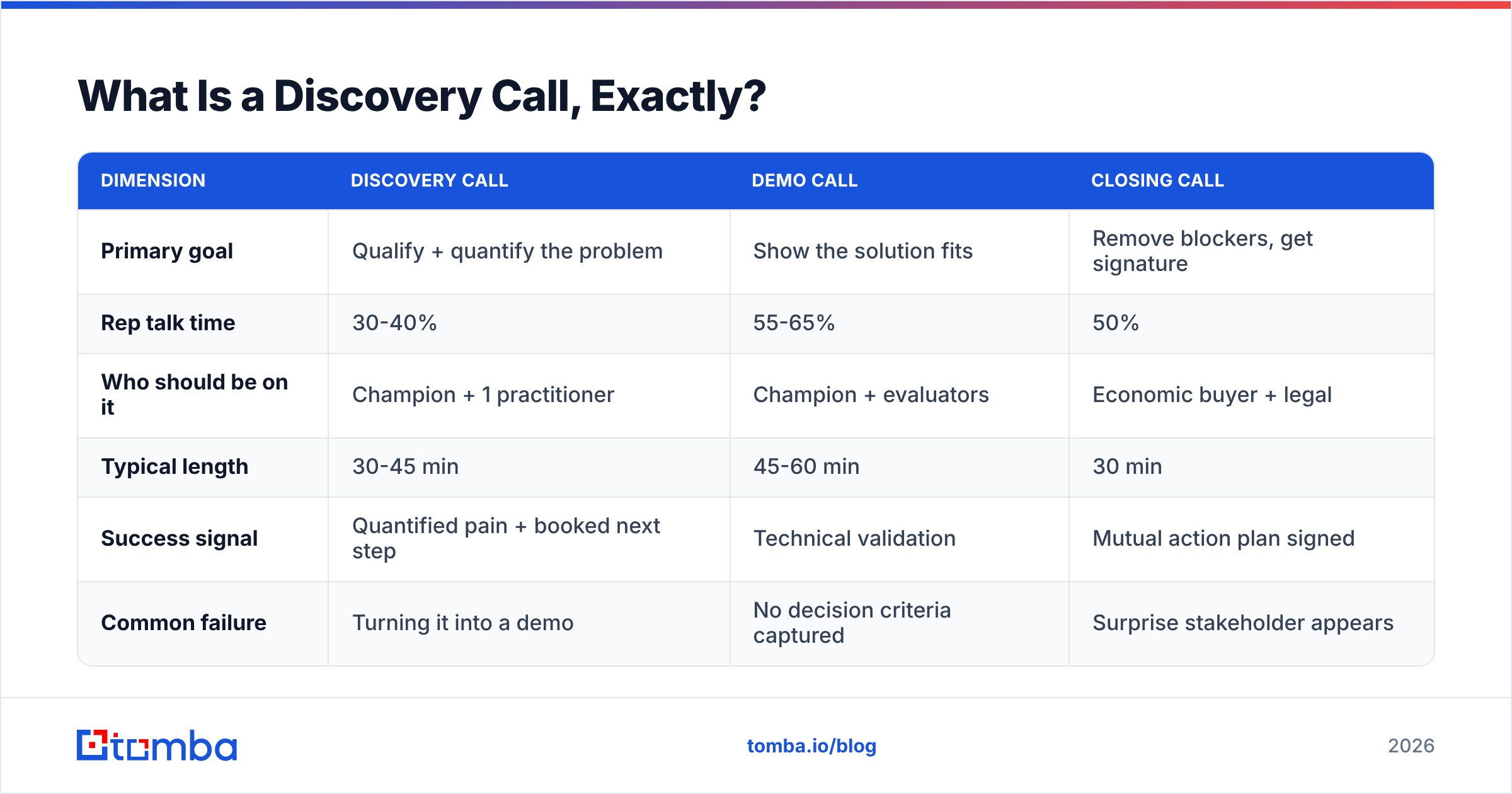
Here's the structural difference between the three call types reps conflate:
| Dimension | Discovery Call | Demo Call | Closing Call |
|---|---|---|---|
| Primary goal | Qualify + quantify the problem | Show the solution fits | Remove blockers, get signature |
| Rep talk time | 30-40% | 55-65% | 50% |
| Who should be on it | Champion + 1 practitioner | Champion + evaluators | Economic buyer + legal |
| Typical length | 30-45 min | 45-60 min | 30 min |
| Success signal | Quantified pain + booked next step | Technical validation | Mutual action plan signed |
| Common failure | Turning it into a demo | No decision criteria captured | Surprise stakeholder appears |
If you can't tell which of these three calls you're on, the prospect can't either.
What Should You Do Before the Call Even Starts?#
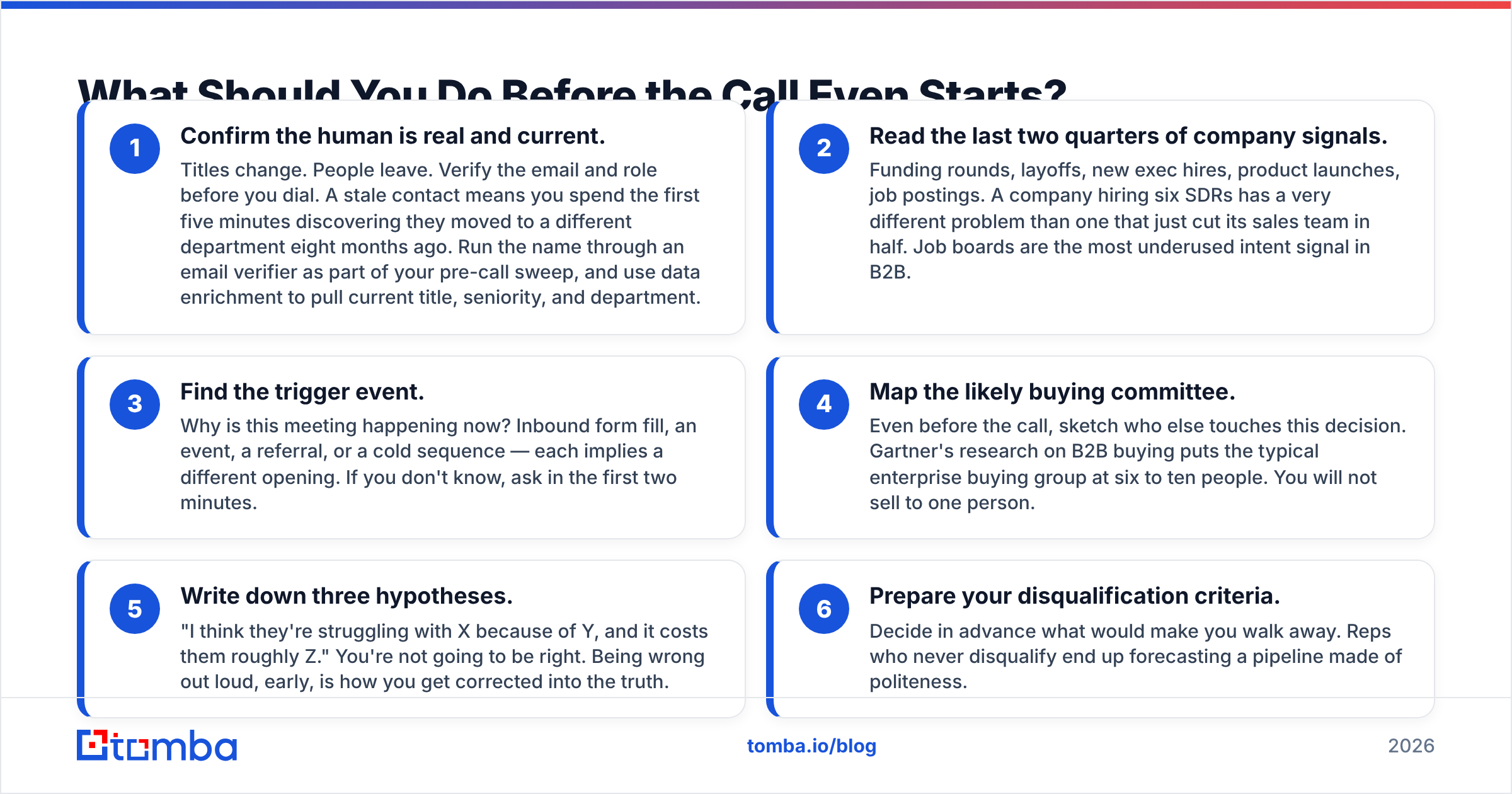
Ten minutes of research changes the entire call. Not forty — ten. Beyond that you're procrastinating.
- Confirm the human is real and current. Titles change. People leave. Verify the email and role before you dial. A stale contact means you spend the first five minutes discovering they moved to a different department eight months ago. Run the name through an email verifier as part of your pre-call sweep, and use data enrichment to pull current title, seniority, and department.
- Read the last two quarters of company signals. Funding rounds, layoffs, new exec hires, product launches, job postings. A company hiring six SDRs has a very different problem than one that just cut its sales team in half. Job boards are the most underused intent signal in B2B.
- Find the trigger event. Why is this meeting happening now? Inbound form fill, an event, a referral, or a cold sequence — each implies a different opening. If you don't know, ask in the first two minutes.
- Map the likely buying committee. Even before the call, sketch who else touches this decision. Gartner's research on B2B buying puts the typical enterprise buying group at six to ten people. You will not sell to one person.
- Write down three hypotheses. "I think they're struggling with X because of Y, and it costs them roughly Z." You're not going to be right. Being wrong out loud, early, is how you get corrected into the truth.
- Prepare your disqualification criteria. Decide in advance what would make you walk away. Reps who never disqualify end up forecasting a pipeline made of politeness.

What Is the Actual Discovery Call Checklist?#
Run these in order. The order matters more than the individual items — people answer differently depending on what they've already said out loud.
Phase 1 — Frame the call (first 2 minutes)
- State the agenda and the time box. "I've got 30 minutes on the calendar. I'd like to spend most of it understanding your setup, then if it makes sense, we'll talk about whether we're a fit. Fair?"
- Get permission to ask hard questions. This one line dramatically changes what people will tell you.
- Ask what they want out of the call. If their answer is "just seeing what's out there," you've learned something important.
- Confirm the time. If they say "actually I only have 20," restructure now, not at minute 25.
Phase 2 — Current state (8-10 minutes)
- How are you handling this today? Walk me through it.
- What tools are involved? Who touches the process?
- How long has it worked this way?
- What made you look at alternatives now?
Phase 3 — Problem and impact (8-10 minutes)
- Where does that process break down most often?
- How often does that happen — weekly, monthly?
- What does that cost you? (Push for a number. Hours, dollars, deals lost, churn.)
- Who feels that pain most? Who complains about it?
- What have you already tried to fix it?
Phase 4 — Decision process (5-7 minutes)
- If you decided to solve this, what happens next internally?
- Who else needs to weigh in?
- Is there budget allocated, or would this need to be created?
- What's your evaluation timeline, and what's driving it?
- What would make this not happen?
Phase 5 — Close the next step (3 minutes)
- Summarize what you heard, in their words, and ask if you got it right.
- State plainly whether you think there's a fit — including if there isn't.
- Book the specific next meeting on the call, with a date, attendees, and an agenda.
- Send the recap within two hours.
That last block is where most calls die. "I'll send over some information and follow up next week" is not a next step. It's a polite goodbye.
Which Qualification Framework Should You Use?#
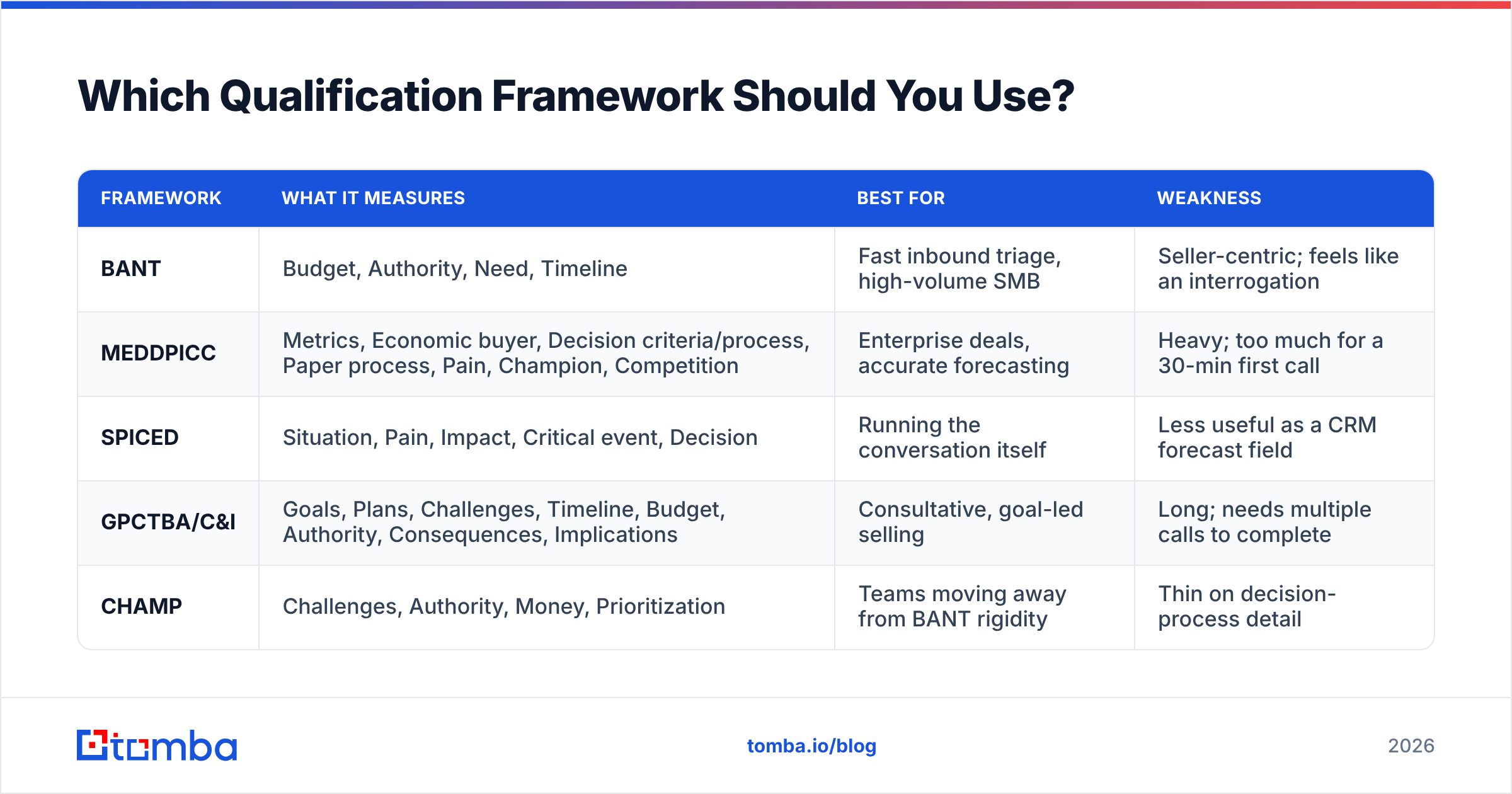
All of them, for different jobs. Frameworks are lenses, not rulebooks, and treating one as gospel is how reps end up asking "what's your budget?" in minute three of a first conversation.
| Framework | What it measures | Best for | Weakness |
|---|---|---|---|
| BANT | Budget, Authority, Need, Timeline | Fast inbound triage, high-volume SMB | Seller-centric; feels like an interrogation |
| MEDDPICC | Metrics, Economic buyer, Decision criteria/process, Paper process, Pain, Champion, Competition | Enterprise deals, accurate forecasting | Heavy; too much for a 30-min first call |
| SPICED | Situation, Pain, Impact, Critical event, Decision | Running the conversation itself | Less useful as a CRM forecast field |
| GPCTBA/C&I | Goals, Plans, Challenges, Timeline, Budget, Authority, Consequences, Implications | Consultative, goal-led selling | Long; needs multiple calls to complete |
| CHAMP | Challenges, Authority, Money, Prioritization | Teams moving away from BANT rigidity | Thin on decision-process detail |
The practical stack: use SPICED to structure what you actually say on the call, MEDDPICC as the fields you fill in your CRM afterward, and BANT as a disqualification gate before you invest a second meeting. HubSpot's sales qualification guide has a decent breakdown if you want the long form on any single one.
The mistake is picking a framework and then reading it aloud. Nobody wants to be a form you're filling out.
How Do You Quantify Pain Without Sounding Like an Auditor?#
Anchor to their metrics, not yours. The move is to ask for a number they already track, then do the multiplication with them, out loud.
Weak: "So this is a real problem for you?"
Strong: "You said your team re-verifies lists manually about twice a month. Roughly how many hours does that take? … So call it 12 hours a month across two people. At a loaded rate, that's somewhere north of $18K a year just in cleanup. Does that match how you'd think about it?"
Three things happen. You get a number for the business case. They hear themselves confirm the number, which makes it theirs, not yours. And you've given your champion a sentence they can repeat to their CFO when you're not in the room.
If they can't produce a number, that's data too. Problems nobody has measured are rarely problems anyone has funded.
A few pain-quantification prompts that work across categories:
- Time: How many hours per week does the team spend on this?
- Money: What's the direct cost — tools, headcount, agency spend?
- Risk: What happens if this breaks during your busiest quarter?
- Opportunity: What would the team do with that time instead?
- Emotion: Who on your team is most frustrated by this? (Frustration predicts urgency better than ROI models do.)
What Are the Most Common Discovery Call Mistakes?#
Demoing on the discovery call. The prospect asks "can you show me how it works?" at minute eight, you share your screen, and the call is over as a discovery call. Redirect: "I can, and I will — but if I show you the generic version I'll waste your time. Give me five more minutes of questions so the demo is actually about your setup."
Accepting the first answer. "We're just looking to improve efficiency" is not an answer. It's a reflex. Ask "efficiency in what specifically?" and wait. Silence does more work than a follow-up question.
Skipping the negative case. Ask "what would make this not happen?" Reps avoid it because it feels like inviting objections. It isn't — it's surfacing the objection now instead of in week six when the deal stalls with no explanation.
Not identifying the economic buyer. Your enthusiastic champion may have zero budget authority. Ask directly: "Who signs off on spend at this level?" It's a normal business question. Treating it as taboo is what makes it awkward.
Talking too much. Record your calls. Count. If you're above 45% talk time on discovery, the fix isn't better questions — it's shutting up after you ask them.
Terrible follow-up. The recap email is part of the call. Send it same-day, in their language, with the numbers you agreed on and the next step already on the calendar. If they forward it internally without editing, you wrote it right.
Running discovery with bad data. If your contact list is full of bounced addresses and outdated titles, you'll spend your discovery slots on people who can't buy. Clean data isn't a discovery skill, but it's a discovery prerequisite — a strong B2B database and verified contacts mean the person on the call is the person you meant to reach.
How Do You Know the Discovery Call Went Well?#
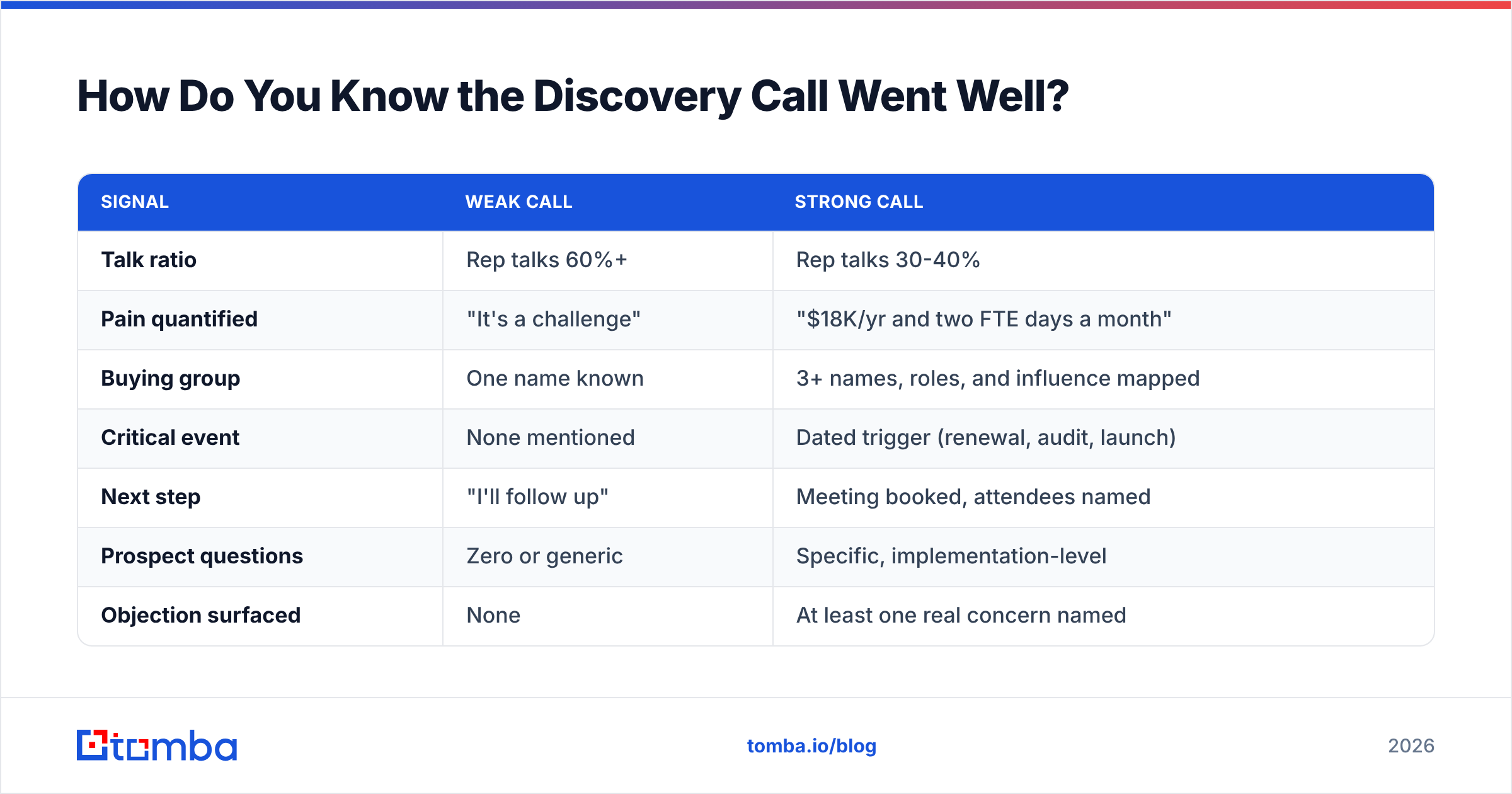
Not by how friendly it felt. Rapport is a terrible signal — pleasant calls ghost constantly. Score it against these instead:
| Signal | Weak call | Strong call |
|---|---|---|
| Talk ratio | Rep talks 60%+ | Rep talks 30-40% |
| Pain quantified | "It's a challenge" | "$18K/yr and two FTE days a month" |
| Buying group | One name known | 3+ names, roles, and influence mapped |
| Critical event | None mentioned | Dated trigger (renewal, audit, launch) |
| Next step | "I'll follow up" | Meeting booked, attendees named |
| Prospect questions | Zero or generic | Specific, implementation-level |
| Objection surfaced | None | At least one real concern named |
Four or more in the right column means run it. Two or fewer means you have a nice conversation, not an opportunity — and putting it in your forecast is how forecasts stop meaning anything.
One more test: could you write the business case for this deal, in the prospect's own numbers, without asking them another question? If not, you didn't finish discovery. Book a second call and finish it.
What Should You Do Immediately After the Call?#
Within two hours, while it's still sharp:
- Write the recap email. Their words, their numbers, the agreed next step, the date. Three short paragraphs maximum.
- Fill the CRM fields honestly. Blank MEDDPICC fields are more useful than optimistic ones. A blank "economic buyer" field tells your manager exactly what to coach.
- Map the second stakeholder. You named other people on the call — go find their contact details now, before your champion goes quiet. A domain search on the company gets you the rest of the buying committee in one query.
- Log the disqualification if it's a no. Write down why. Patterns in your losses are the cheapest sales training available.
- Schedule the internal prep. If a technical evaluator is joining round two, brief your SE now, not the morning of.
The reps who compound over a year aren't the ones with the best questions. They're the ones whose post-call discipline means nothing leaks between meeting one and meeting two.
Where Should You Start?#
Take your next five discovery calls and do only two things differently: quantify one number out loud with the prospect, and book the specific next step before you hang up. Ignore everything else on this checklist until those two are automatic. Then layer in the rest.
And fix the input problem first. Discovery frameworks assume you're talking to the right person at a company that could plausibly buy — an assumption that quietly fails when your contact data is guessed, scraped, or eighteen months stale. The Tomba Email Finder gets you verified, current contacts for the exact titles you want to run discovery with, and it plugs into the enrichment and verification steps you should already be running before every call. Free tier gives you 25 searches a month to test it against your own list; Tomba pricing starts at $49/mo on Starter when you're ready to run it across the whole team. Better inputs, better calls, shorter pipeline.
Related guides#
Ready to find emails that actually work?
Join 150,000+ professionals who stopped guessing and started sending. Free credits on signup — no credit card required.
Get the Tomba newsletter
Practical outbound tactics and product updates — once every two weeks.
About the author