34 Discovery Call Questions That Actually Qualify Buyers
Most discovery calls collect facts nobody uses. Here are 34 discovery call questions organized by call stage, plus a scoring rubric that tells you when to disqualify instead of hoping.
TL;DR
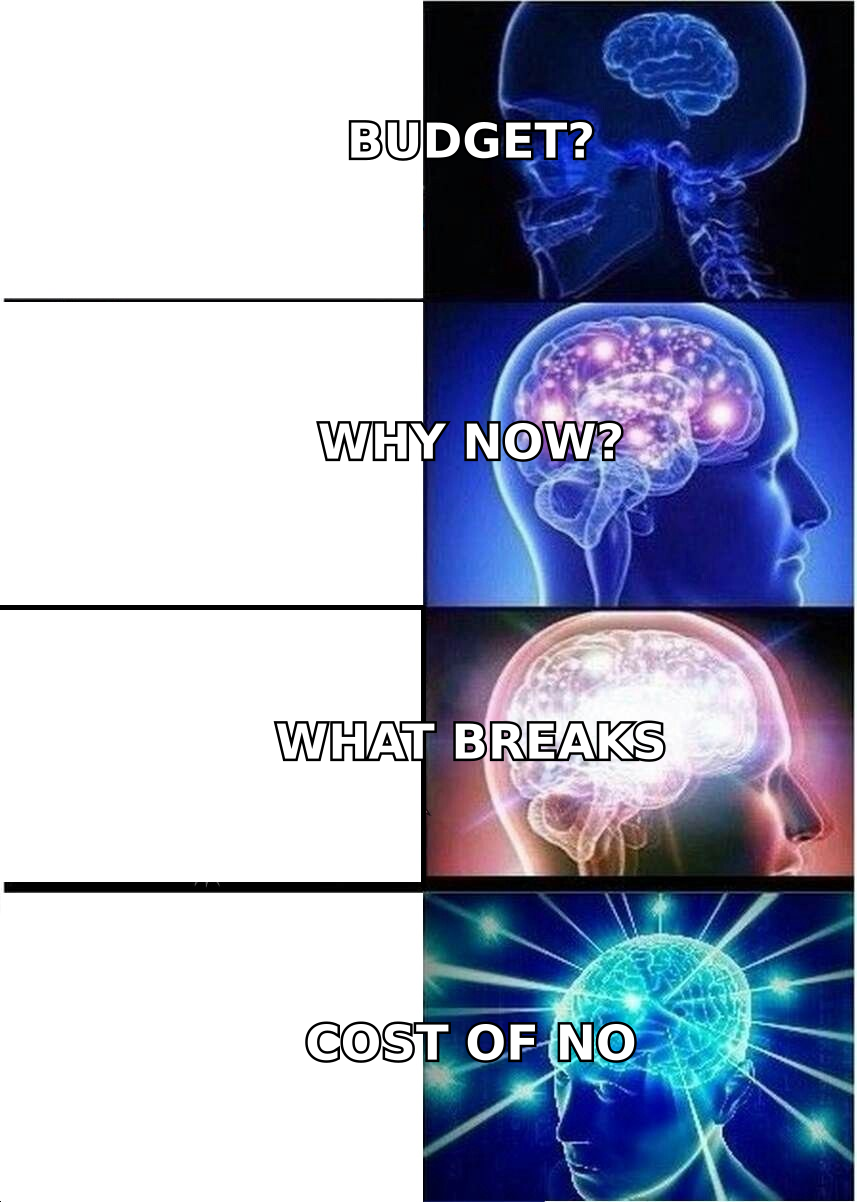
- Most discovery calls fail because reps ask questions that collect facts instead of questions that surface consequences. "What's your budget?" tells you nothing. "What happens if this stays broken through Q4?" tells you everything.
- The best discovery call questions are sequenced: situation → problem → impact → decision process → next step. Skipping straight to impact makes you sound like a script.
- Disqualification is the point. A 40-minute call that ends in "we're not a fit" is worth more than a 40-minute call that ends in a vague "send me a deck."
- Use a scoring rubric after every call. If you can't name the business consequence, the internal champion, and the decision date, you don't have an opportunity — you have a conversation.
- Bad data upstream kills good discovery downstream. Verified contacts and enriched company context let you skip the first five minutes of "so, tell me about your company."
What is a discovery call, and what is it actually for?#
A discovery call is the first substantive conversation between a seller and a prospect, where the seller's job is to determine whether a real, funded, urgent problem exists — and whether their product solves it.
Note what that definition does not include: demoing, pitching, or convincing. Those come later, and only if discovery earns them.
The most common failure mode is treating discovery as a data-collection ritual. The rep runs through a checklist — company size, tech stack, timeline, budget — fills out CRM fields, and books a demo. Nothing about that call changed how the buyer thinks. Nothing about it told the rep whether this deal will close.
Good discovery does two things at once:
- Diagnoses. You find the specific, measurable problem and quantify what it costs to leave it alone.
- Creates urgency the buyer already felt but hadn't articulated. The prospect should hang up thinking "I need to fix this," not "that was a nice chat."
Gartner's B2B buying research has consistently found that buyers spend a small fraction of their purchase journey talking to any individual vendor. Your 40 minutes are a sliver of a months-long internal process. Spend them on diagnosis, not on features.

Why do most discovery call questions fail?#
Three reasons, in order of how often they show up on recorded calls.
They're closed-ended. "Do you currently use a CRM?" gets you a yes. "Walk me through how a lead moves from form fill to first touch today" gets you a process map with three visible gaps you can sell into.
They're seller-serving, not buyer-serving. "What's your budget?" asked in minute four is a question the buyer has no reason to answer honestly, because you haven't earned it and they often don't know yet. Budget questions work in minute thirty, after impact is established.
They stop at the first answer. The prospect says "our response times are slow." A weak rep writes that down. A strong rep asks "slow compared to what?", then "what does that cost you in lost deals per month?", then "who else in the company feels that?" The third layer is where the deal lives.
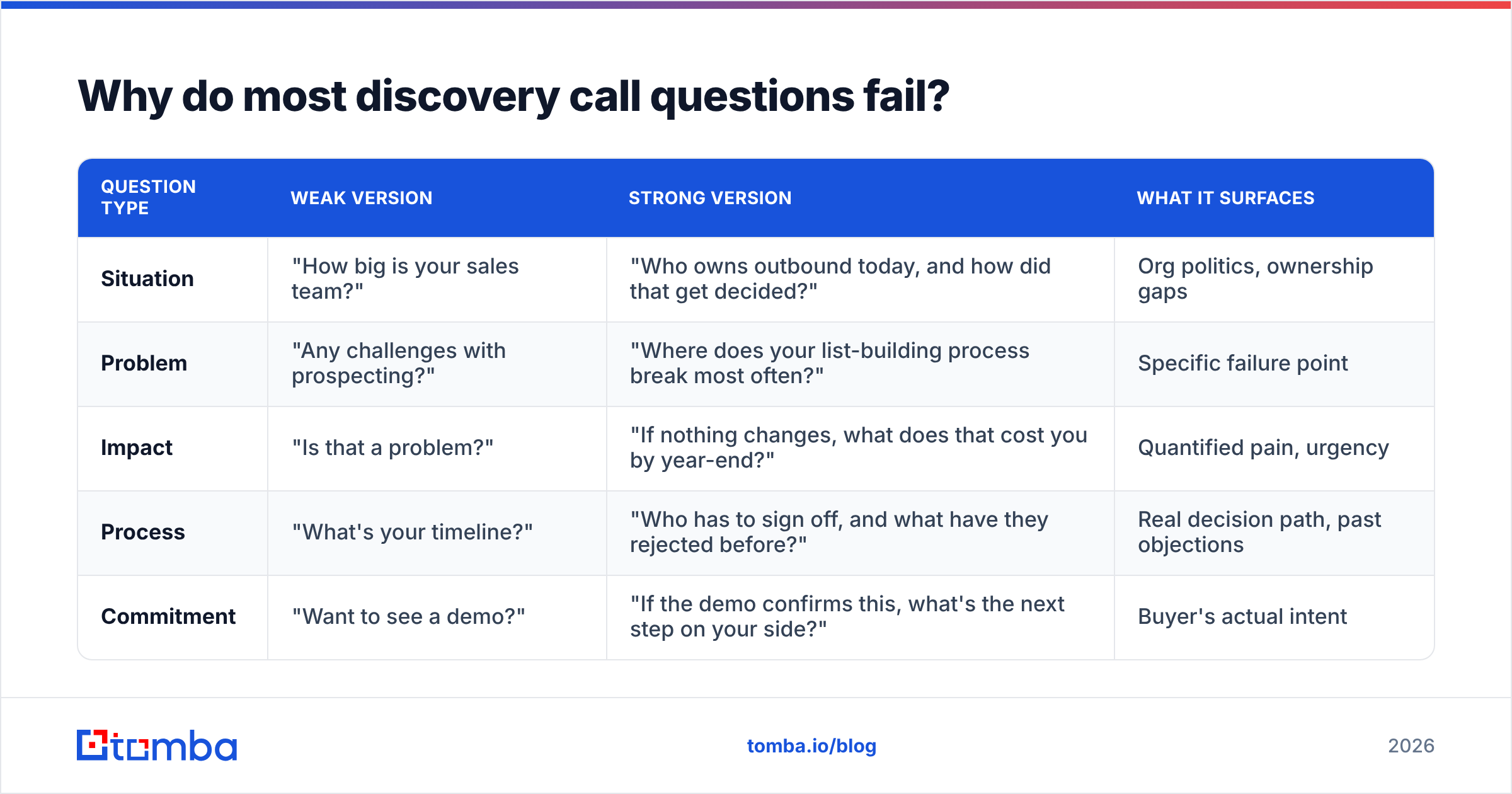
Here's the underlying shift: stop asking about the buyer's situation and start asking about the buyer's consequences.
| Question type | Weak version | Strong version | What it surfaces |
|---|---|---|---|
| Situation | "How big is your sales team?" | "Who owns outbound today, and how did that get decided?" | Org politics, ownership gaps |
| Problem | "Any challenges with prospecting?" | "Where does your list-building process break most often?" | Specific failure point |
| Impact | "Is that a problem?" | "If nothing changes, what does that cost you by year-end?" | Quantified pain, urgency |
| Process | "What's your timeline?" | "Who has to sign off, and what have they rejected before?" | Real decision path, past objections |
| Commitment | "Want to see a demo?" | "If the demo confirms this, what's the next step on your side?" | Buyer's actual intent |
What are the best discovery call questions by stage?#
Sequence matters more than the individual questions. Ask impact questions before you've established the problem and you sound manipulative. Ask process questions before you've established impact and the buyer stonewalls.
Opening and context (5–8 minutes)#
- "Before I ask anything — what made you take this call?"
- "What were you hoping to get out of the next 30 minutes?"
- "Walk me through your role. What are you measured on this quarter?"
- "How does your team handle [relevant process] today, start to finish?"
- "How long has it worked that way?"
- "What made you look at changing it now versus six months ago?"
Question 1 is the single highest-leverage question in discovery. The answer tells you the trigger event, and trigger events are the closest thing sales has to a leading indicator.
Problem identification (8–12 minutes)#
- "Where in that process do things break down most often?"
- "When it breaks, what happens next? Who has to fix it?"
- "How often does that happen — weekly, daily?"
- "What have you already tried to fix it?"
- "Why didn't that work?"
- "What's the workaround your team uses today?"
- "Who on your team complains about this the loudest?"
Question 11 is underrated. Failed prior attempts tell you the objections you'll face internally and the solutions your champion has already ruled out.
Impact and quantification (8–10 minutes)#
- "What's that costing you — in hours, in dollars, in pipeline?"
- "How did you arrive at that number?"
- "Who else in the company feels the effect of this?"
- "If this stays exactly as it is through the end of the year, what happens?"
- "What does solving it unlock that you can't do today?"
- "Is this the biggest problem on your list right now, or is it third or fourth?"
Question 19 is the disqualifier. Prospects rarely buy for problem number four. If you're not in their top two, you're building a deal that will stall at procurement.
Decision process (5–8 minutes)#
- "Who else needs to weigh in before something like this gets approved?"
- "What does the approval path look like — is there a threshold where finance gets involved?"
- "Has your team bought anything similar recently? How did that go?"
- "What would make security or legal slow this down?"
- "Is there budget allocated, or would this need to be carved out?"
- "What's the realistic date you'd want this live by, and what's driving that date?"
Competition and alternatives (3–5 minutes)#
- "Who else are you evaluating?"
- "What do you like about how they've approached it?"
- "What's the case for doing nothing?"
- "If you had to pick today with no more information, what would you pick and why?"
Question 28 matters because status quo wins more B2B deals than any named competitor. HubSpot's sales research and most enterprise win/loss data land in the same place: "no decision" is the most common loss reason.
Closing the call (3–5 minutes)#
- "Let me play back what I heard — correct me where I'm wrong."
- "What did I not ask about that I should have?"
- "On a scale where 10 is 'we're solving this quarter,' where are you?"
- "If the next call confirms what we discussed, what happens after that on your side?"
- "Can we get [decision maker] on the next call? What would make it worth their time?"
Question 31 catches the thing your framework missed. It also signals that you're listening rather than running a script, which is exactly the impression that earns the second call.
How should you structure the call itself?#
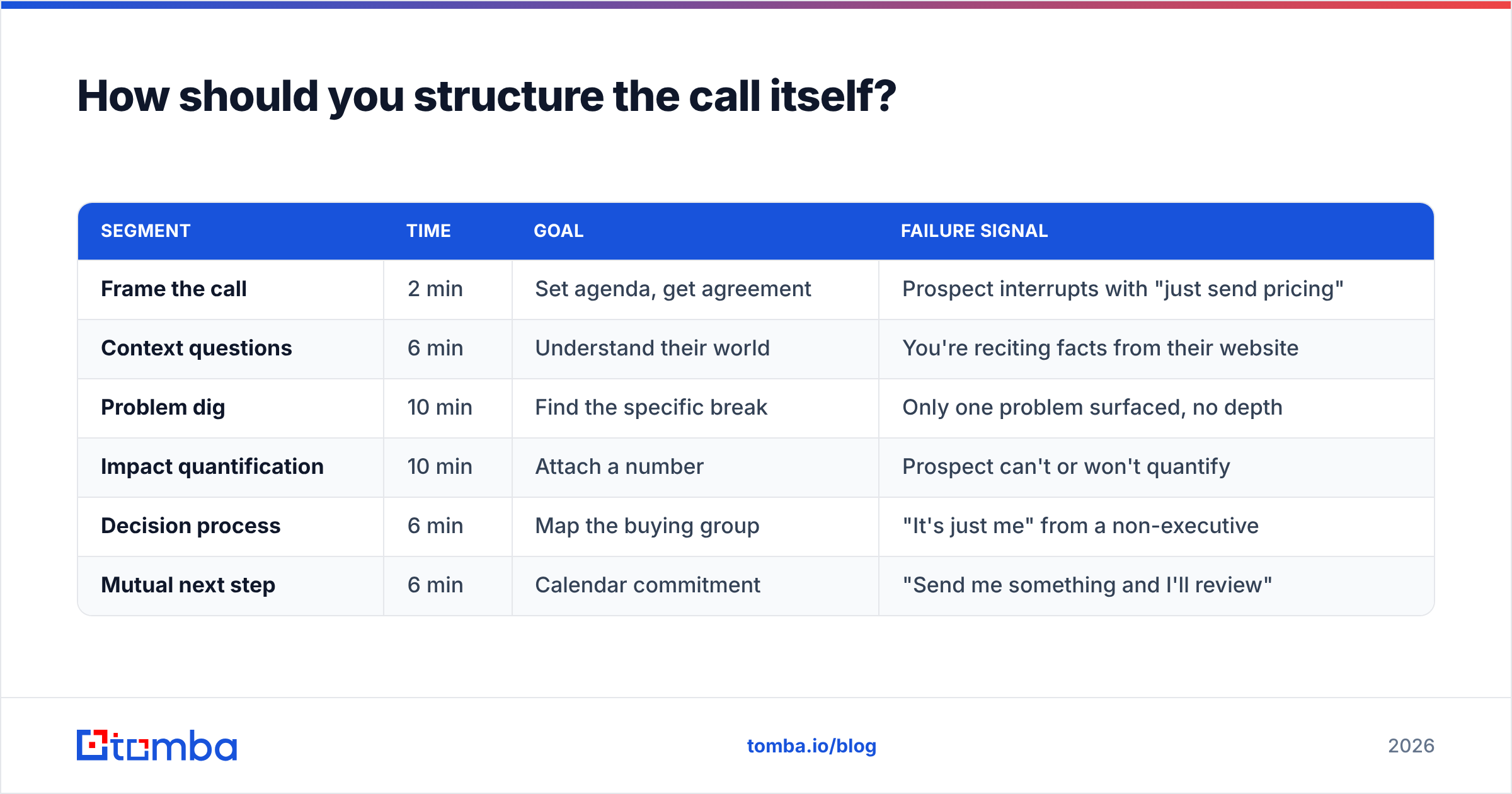
A 40-minute discovery call has a natural shape. Deviating from it costs you either rapport or information.
| Segment | Time | Goal | Failure signal |
|---|---|---|---|
| Frame the call | 2 min | Set agenda, get agreement | Prospect interrupts with "just send pricing" |
| Context questions | 6 min | Understand their world | You're reciting facts from their website |
| Problem dig | 10 min | Find the specific break | Only one problem surfaced, no depth |
| Impact quantification | 10 min | Attach a number | Prospect can't or won't quantify |
| Decision process | 6 min | Map the buying group | "It's just me" from a non-executive |
| Mutual next step | 6 min | Calendar commitment | "Send me something and I'll review" |
Two rules that hold across segments:
- Talk less than 40% of the time. Gong's conversation analytics research repeatedly puts top performers well below the average rep's talk ratio on discovery calls. If you're above half, you're pitching.
- Never answer a pricing question in minute five with a number. Answer it with "It depends on scope — let me ask two things so I don't quote you something irrelevant." Then keep going.
When should you disqualify instead of pushing forward?#
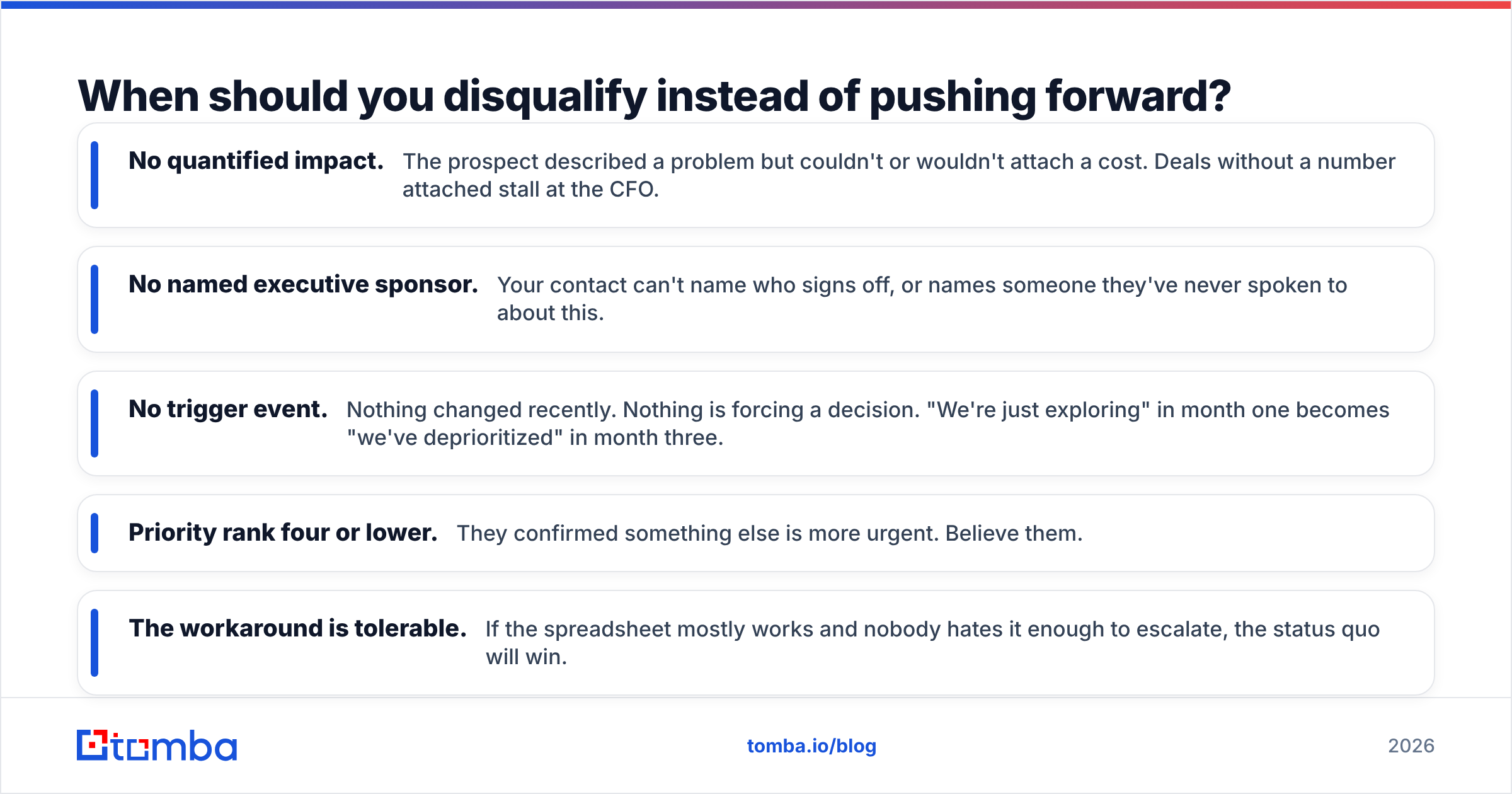
Disqualify when two or more of these are true at the end of the call:
- No quantified impact. The prospect described a problem but couldn't or wouldn't attach a cost. Deals without a number attached stall at the CFO.
- No named executive sponsor. Your contact can't name who signs off, or names someone they've never spoken to about this.
- No trigger event. Nothing changed recently. Nothing is forcing a decision. "We're just exploring" in month one becomes "we've deprioritized" in month three.
- Priority rank four or lower. They confirmed something else is more urgent. Believe them.
- The workaround is tolerable. If the spreadsheet mostly works and nobody hates it enough to escalate, the status quo will win.
Write those five into a post-call scorecard. Two or more misses means the opportunity goes to nurture, not to forecast. Reps who disqualify hard have smaller pipelines and higher win rates — that trade is almost always worth taking.
How does data quality change what you ask?#
The first five minutes of a discovery call are usually wasted on information you could have known before dialing. Company size, funding stage, tech stack, headcount growth, who owns which function — all of it is discoverable in advance.
That matters for two reasons. First, every minute spent confirming public facts is a minute not spent on impact questions. Second, showing up already informed changes the buyer's posture. "I saw you added four SDRs last quarter and moved off HubSpot Sales Hub — how's the handoff working?" opens a conversation that "so, tell me about your team" never will.
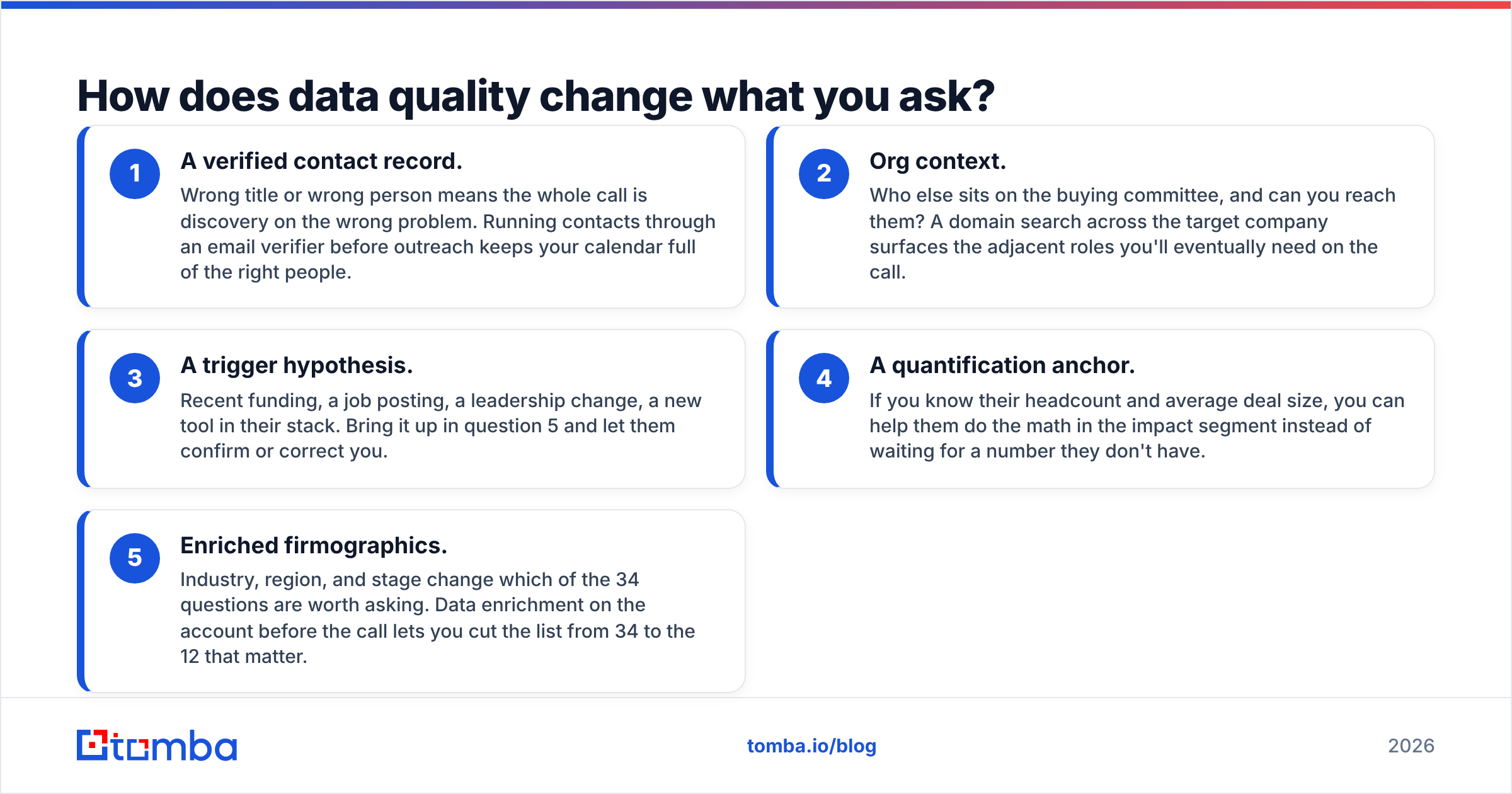
Practically, that means your pre-call routine should produce:
- A verified contact record. Wrong title or wrong person means the whole call is discovery on the wrong problem. Running contacts through an email verifier before outreach keeps your calendar full of the right people.
- Org context. Who else sits on the buying committee, and can you reach them? A domain search across the target company surfaces the adjacent roles you'll eventually need on the call.
- A trigger hypothesis. Recent funding, a job posting, a leadership change, a new tool in their stack. Bring it up in question 5 and let them confirm or correct you.
- A quantification anchor. If you know their headcount and average deal size, you can help them do the math in the impact segment instead of waiting for a number they don't have.
- Enriched firmographics. Industry, region, and stage change which of the 34 questions are worth asking. Data enrichment on the account before the call lets you cut the list from 34 to the 12 that matter.
The point isn't to interrogate less. It's to spend your questions on things only the prospect can tell you.
What separates a good discovery call from a great one?#
Three habits, all of them observable on a recording.
They summarize in the buyer's words. Great reps play back the problem using the exact phrases the prospect used, not the vendor's category language. If the buyer said "our list is garbage," don't say "data hygiene challenges."
They ask the uncomfortable follow-up. "You said budget isn't an issue — has anything at this price point been rejected in the last year?" That question is awkward and it saves quarters.
They end with a written recap and a calendar invite, sent before the end of the day. A mutual action plan in the thread — even three bullets — converts a warm call into a tracked opportunity. Reps who skip this lose deals to memory decay, not to competitors.
One more thing worth internalizing: discovery doesn't stop after the discovery call. Every subsequent conversation should add one new piece of qualifying information. If call three teaches you nothing new about the buying process, the deal is drifting.
Where should you start?#
Take the 34 questions above, cut them to the 12 that fit your motion, and put them in your call template in stage order. Then record your next five calls and check one metric: how many minutes elapsed before you asked an impact question. If the answer is more than twenty, you're doing situation discovery, not diagnosis.
The other half of the work happens before anyone picks up. Discovery calls only pay off when they're with the right person at the right company at the right moment — and that starts with accurate contact data. The Tomba Email Finder gets you verified, deliverable addresses for the specific decision makers you've mapped out, so your calendar fills with qualified conversations instead of wrong numbers and bounced invites. The free tier covers 25 searches a month if you want to test it against your current list; paid plans start at $49/mo, and you can see the full breakdown on the Tomba pricing page.
Better questions only matter if you're asking them of the right people.
Related guides#
Ready to find emails that actually work?
Join 150,000+ professionals who stopped guessing and started sending. Free credits on signup — no credit card required.
Get the Tomba newsletter
Practical outbound tactics and product updates — once every two weeks.
About the author