Discovery Call Structure: The 7-Stage Framework That Closes
Most discovery calls fail in the first four minutes. Here's a 7-stage discovery call structure with timings, questions, and exit criteria you can run tomorrow.
TL;DR
- A working discovery call structure is seven stages across 45 minutes: frame, context, current state, pain quantification, decision process, next step, recap. Skip a stage and the deal stalls later.
- The single biggest failure is demoing too early. Reps who open a product tour in the first ten minutes close at meaningfully lower rates than reps who hold it back.
- Budget is the last qualification question, not the first. Quantified pain earns you the right to ask it.
- Talk-time ratio is the cheapest diagnostic you have. Under 45% rep talk time on a discovery call correlates with more advanced deals.
- Every discovery call must end with a scheduled calendar event and a named attendee list. "I'll follow up next week" is a lost deal with a delay.
What is a discovery call, exactly?#
A discovery call is a structured diagnostic conversation where you determine whether a prospect has a problem worth solving, whether you can solve it, and who has to agree before money moves. It is not a demo. It is not a pitch. It is not a "quick intro chat."
The confusion is expensive. Most reps treat discovery as a soft rapport-building step before the real meeting — the demo. That inverts the value. Discovery is where you earn or lose the deal; the demo just confirms what discovery uncovered.
Think of it like a doctor's appointment. A doctor who prescribes before examining is committing malpractice. A rep who demos before diagnosing is doing the sales equivalent — showing features nobody asked for to solve pain nobody confirmed.
Three things separate a real discovery call from a friendly chat:
- You leave with quantified pain. Not "we struggle with lead quality" but "we waste 12 hours a week and about $4,000 a month on bad contact data."
- You leave with a named decision path. Who signs, who blocks, what the procurement steps are, how long they take.
- You leave with a booked next step. A date on a calendar with the right people invited, not a vague promise.
If a call produces none of those, it wasn't discovery. It was a conversation.
Why do most discovery calls fail in the first four minutes?#
Because the rep gives away the frame. The first four minutes set who is diagnosing whom. Open with "so, let me tell you a bit about us" and you have just volunteered to be a vendor presenting. Open with a frame — an agenda, a time check, and a stated purpose — and you are a consultant running a process.
Here's what the bad open sounds like:
"Hey Sarah, thanks for taking the time! So Tomba is a B2B email finder platform, we help teams find verified contact data at scale, and today I'd love to show you a bit of what we do and see if it's a fit."
You just spent your credibility, and Sarah has already decided you're a pitch. Compare:
"Hey Sarah — I've got us for 45 minutes. My goal is to understand how your team sources contact data today and where it breaks. If there's a fit, I'll show you exactly the piece that matters and we'll book the right next step. If there isn't, I'll tell you straight. Sound reasonable? Anything you want to make sure we cover?"
Same 25 seconds. Completely different power dynamic. The second version also does something subtle: it makes disqualification an explicitly acceptable outcome, which lowers the prospect's defenses and raises the honesty of every answer that follows.
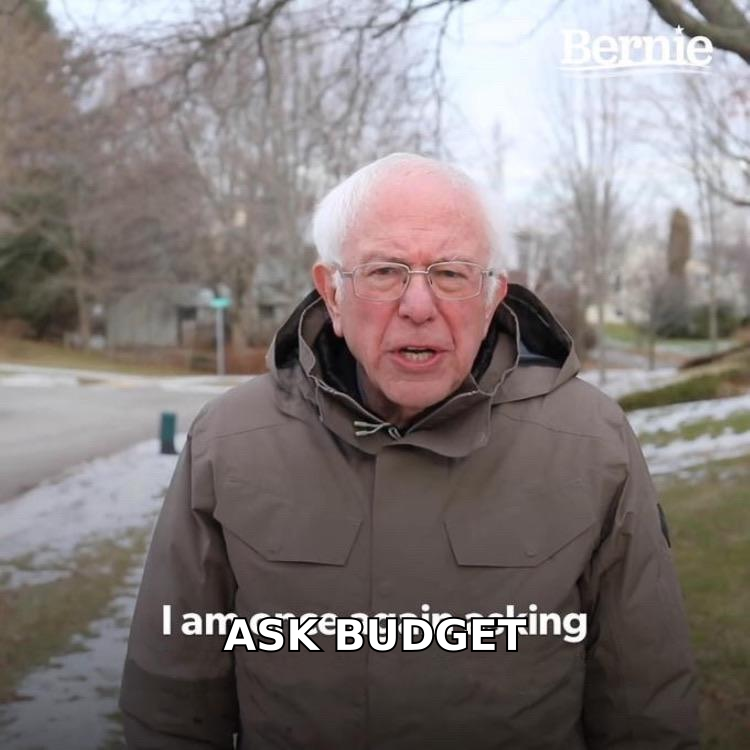
The second common failure is asking budget in minute six. Budget questions before quantified pain get you a defensive non-answer ("we don't really have one allocated"), and once that answer is on the record, the prospect will defend it. Ask it after they've told you the problem costs $48,000 a year and you'll get a real number.
What is the ideal discovery call structure?#
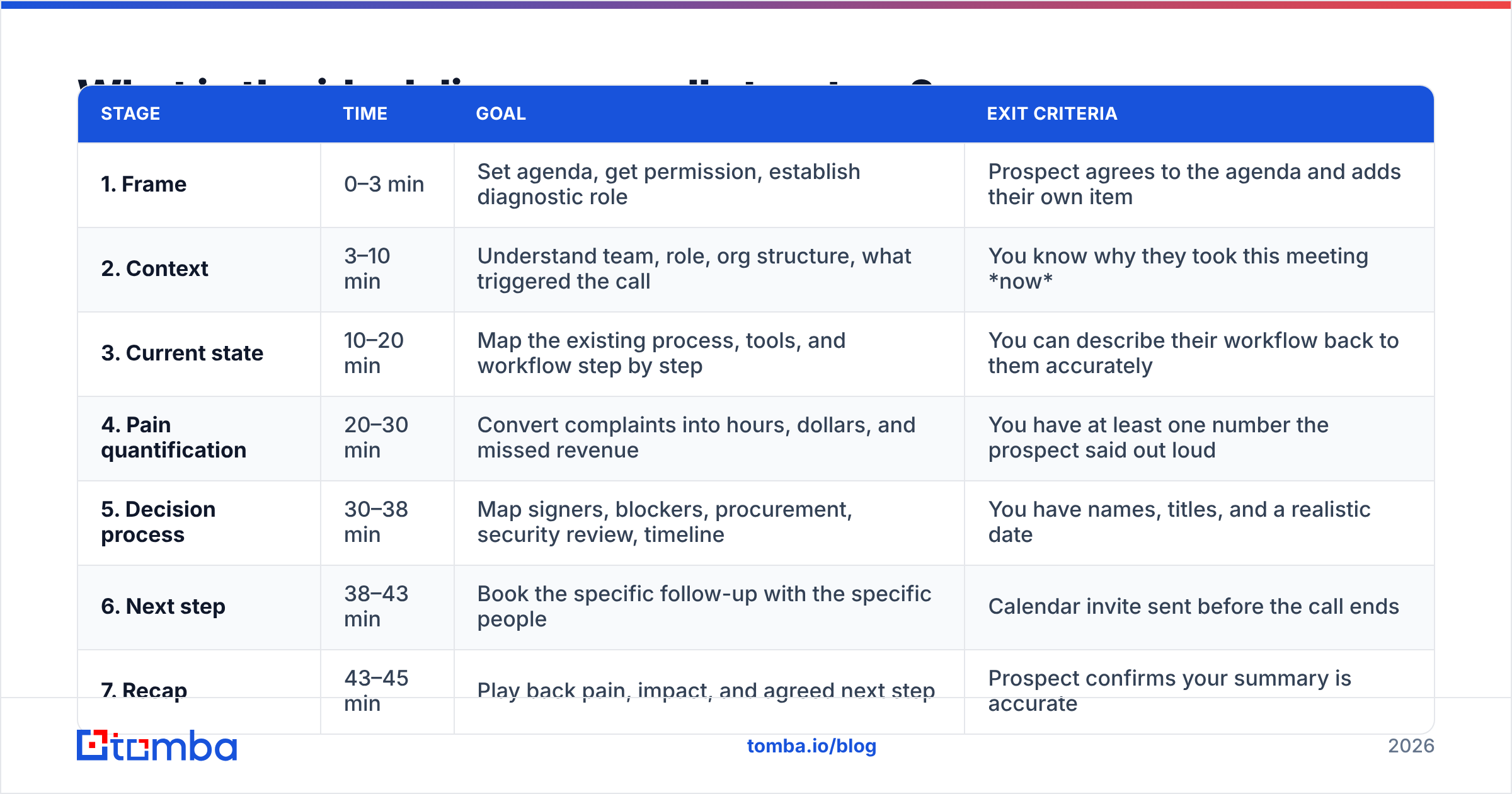
Seven stages, roughly 45 minutes. The timings below are targets, not laws — but if you're consistently blowing through stage three, that's your diagnostic.
| Stage | Time | Goal | Exit criteria |
|---|---|---|---|
| 1. Frame | 0–3 min | Set agenda, get permission, establish diagnostic role | Prospect agrees to the agenda and adds their own item |
| 2. Context | 3–10 min | Understand team, role, org structure, what triggered the call | You know why they took this meeting now |
| 3. Current state | 10–20 min | Map the existing process, tools, and workflow step by step | You can describe their workflow back to them accurately |
| 4. Pain quantification | 20–30 min | Convert complaints into hours, dollars, and missed revenue | You have at least one number the prospect said out loud |
| 5. Decision process | 30–38 min | Map signers, blockers, procurement, security review, timeline | You have names, titles, and a realistic date |
| 6. Next step | 38–43 min | Book the specific follow-up with the specific people | Calendar invite sent before the call ends |
| 7. Recap | 43–45 min | Play back pain, impact, and agreed next step | Prospect confirms your summary is accurate |
Notice what isn't in there: a product demo. If the prospect demands one, give a 90-second targeted glimpse tied to a pain they just named, then return to discovery. A full demo on a discovery call means you'll demo the wrong things to the wrong people.
Stage-by-stage, what you actually say#
Stage 1 — Frame (0–3 min). Agenda, time check, permission, and their addition. Always ask "anything you want to make sure we cover?" — it surfaces their real agenda, which is often different from what the meeting invite said.
Stage 2 — Context (3–10 min). "Walk me through your role and how your team is structured." Then the highest-leverage question in all of B2B sales: "What made you take this call now?" The word now is doing the work. Something changed — a bad quarter, a new hire, a tool that broke, a board mandate. Find it. That's your compelling event, and deals without one slip indefinitely.
Stage 3 — Current state (10–20 min). Get literal. "Walk me through what happens from the moment a rep is assigned an account to the moment the first email goes out." Take notes in their words. Ask "and then what?" four times. Most reps quit after one layer and miss the actual break point.
Stage 4 — Pain quantification (20–30 min). This is the stage that makes or breaks the deal. Three moves:
- Frequency: "How often does that happen?"
- Cost: "When it happens, what does it cost you — time, money, or a lost deal?"
- Trajectory: "What happens if this is still broken in six months?"
Then do the math out loud and let them correct you. "So five reps × four hours a week on manual list building, at a loaded cost of roughly $60/hour — that's $62,000 a year on data entry. Am I close?" If they correct you downward, great — the number is now theirs, not yours.
Stage 5 — Decision process (30–38 min). Ask it plainly: "Assuming you decide this is worth doing, walk me through what happens between that decision and a signed contract." Follow up on security review, procurement, legal, and any threshold that triggers extra approvals. Get names.
Stage 6 — Next step (38–43 min). Propose the specific meeting, propose two specific times, and send the invite while you're still on the call. Screen-shared calendar beats "I'll send something over" every time.
Stage 7 — Recap (43–45 min). "Let me play back what I heard so I don't waste your time next meeting." Then say the pain, the number, the timeline, and the next step. Ask "did I miss anything?" Their correction is free intelligence.
Which discovery framework should you use — BANT, MEDDIC, or SPICED?#
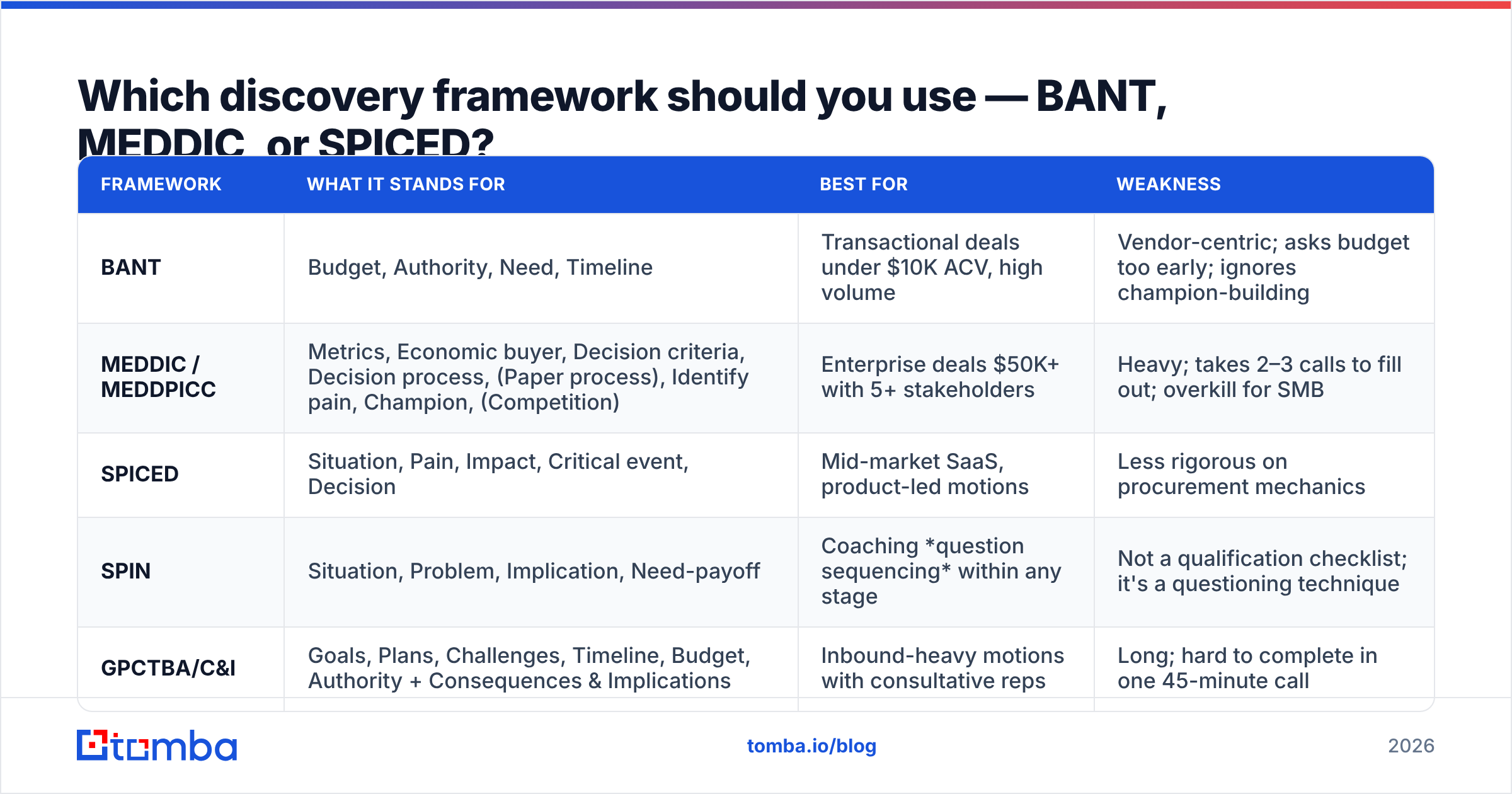
Frameworks are checklists for what to learn, not scripts for what to say. Your call structure is the container; the framework is the cargo. Pick one based on deal size and complexity.
| Framework | What it stands for | Best for | Weakness |
|---|---|---|---|
| BANT | Budget, Authority, Need, Timeline | Transactional deals under $10K ACV, high volume | Vendor-centric; asks budget too early; ignores champion-building |
| MEDDIC / MEDDPICC | Metrics, Economic buyer, Decision criteria, Decision process, (Paper process), Identify pain, Champion, (Competition) | Enterprise deals $50K+ with 5+ stakeholders | Heavy; takes 2–3 calls to fill out; overkill for SMB |
| SPICED | Situation, Pain, Impact, Critical event, Decision | Mid-market SaaS, product-led motions | Less rigorous on procurement mechanics |
| SPIN | Situation, Problem, Implication, Need-payoff | Coaching question sequencing within any stage | Not a qualification checklist; it's a questioning technique |
| GPCTBA/C&I | Goals, Plans, Challenges, Timeline, Budget, Authority + Consequences & Implications | Inbound-heavy motions with consultative reps | Long; hard to complete in one 45-minute call |
The pragmatic answer for most B2B teams in 2026: run MEDDPICC as your CRM field set and SPIN as your in-call questioning technique. One tells you what must be true to forecast the deal; the other tells you how to get the answer without sounding like an interrogation. HubSpot's breakdown of sales qualification frameworks is a solid neutral reference if you're choosing between them at the team level.
What matters more than the acronym: whichever you pick, the fields must be mandatory in your CRM before a deal can advance a stage. A framework nobody enforces is a poster.
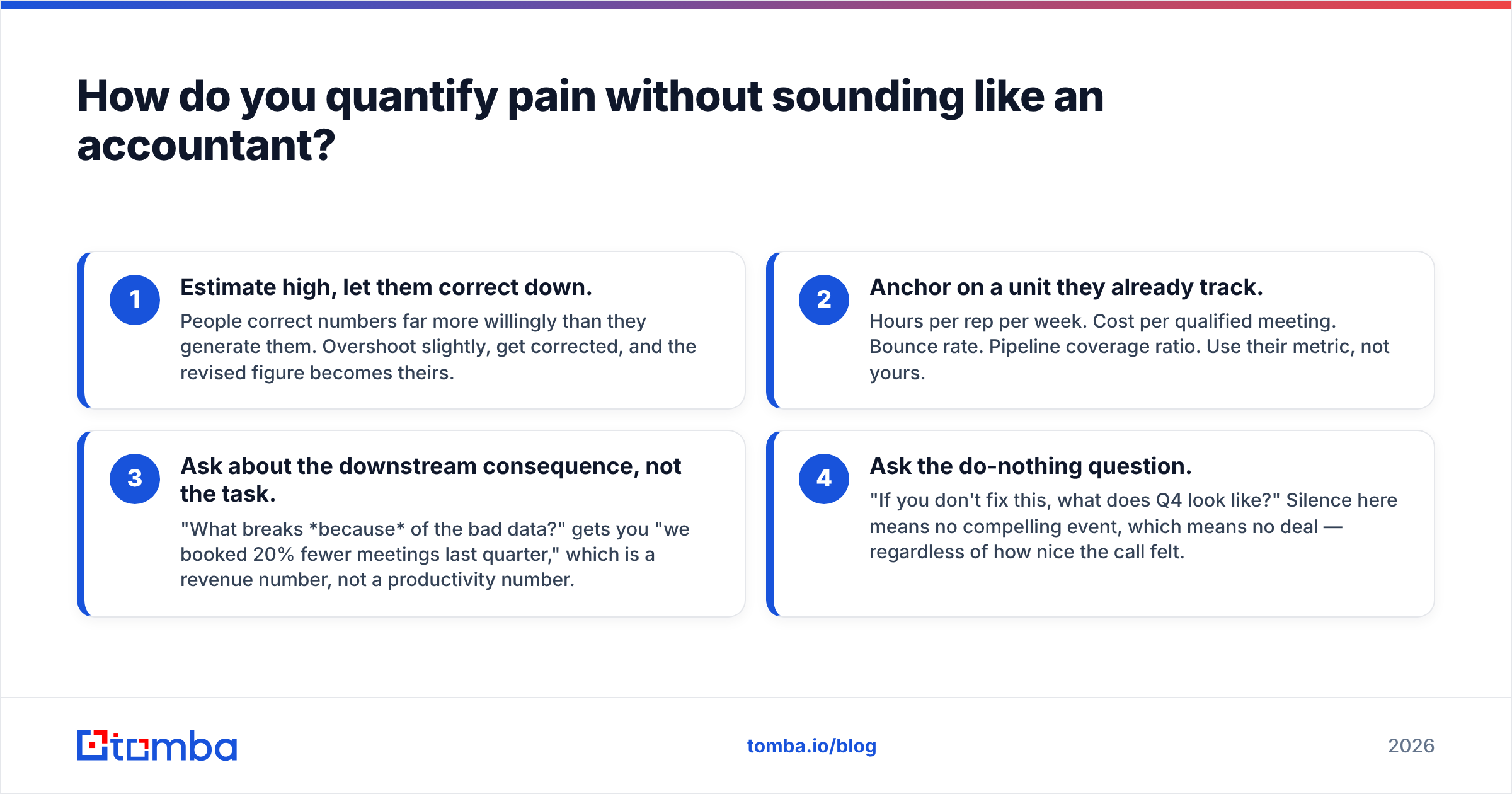
How do you quantify pain without sounding like an accountant?#
You narrate the math instead of interrogating for it. The difference between "what's the financial impact of that?" (which makes people freeze) and "so if I'm doing this right, that's about six hours a week across the team — does that track?" (which makes people correct you) is enormous.
Four techniques that consistently work:
- Estimate high, let them correct down. People correct numbers far more willingly than they generate them. Overshoot slightly, get corrected, and the revised figure becomes theirs.
- Anchor on a unit they already track. Hours per rep per week. Cost per qualified meeting. Bounce rate. Pipeline coverage ratio. Use their metric, not yours.
- Ask about the downstream consequence, not the task. "What breaks because of the bad data?" gets you "we booked 20% fewer meetings last quarter," which is a revenue number, not a productivity number.
- Ask the do-nothing question. "If you don't fix this, what does Q4 look like?" Silence here means no compelling event, which means no deal — regardless of how nice the call felt.
A concrete example from data-quality deals: a prospect says "our contact data is a mess." That's a complaint. Push it through the four techniques and you get: "We send 8,000 emails a month, roughly 14% bounce, our domain got throttled twice this quarter, and we lost about three weeks of outbound." Now you have a bounce rate, a sender reputation consequence, and a time cost. That's a business case, and it also tells you exactly which part of your product to show next — in this case an email verifier, not the whole platform.

How much should you talk on a discovery call?#
Less than half. Conversation-intelligence data consistently shows that top performers on discovery calls talk roughly 43–46% of the time, while underperformers push past 65%. The mechanism is obvious once you see it: every minute you talk is a minute you learn nothing.
Practical controls:
- Ask, then count to three. Most reps fill silence at 1.5 seconds. The best answers arrive at second four.
- Cap your answers at 30 seconds. If a prospect asks a product question, answer in one sentence and return with a question: "Yes, we handle catch-all domains — how many of your target accounts are on catch-all servers today?"
- Use "tell me more about that" as your default. It costs five words and buys you 90 seconds of intelligence.
- Record and review one call a week. Not for coaching theater — just to watch your own talk-time number. Tools like Gong or Chorus will surface it automatically, but a stopwatch works.
One more thing worth measuring: question count. Aim for 11–14 substantive questions across a 45-minute discovery call. Fewer means you pitched. Many more, and it starts to feel like a deposition.
What should happen after the discovery call?#
Three things, within two hours, in this order.
1. Send the recap email. Structure it as: the pain in their words, the quantified impact, the agreed next step with date and attendees, and one open question. That last item gives them a reason to reply, which keeps the thread alive. Keep it under 150 words — this is a document your champion will forward internally, not an essay.
2. Fill the CRM fields the same day. Not Friday. Discovery notes written 72 hours later are fiction. Log the compelling event, the economic buyer's name, the quantified number, and the procurement steps.
3. Prep the next meeting's attendee list. Your champion named three other stakeholders. Find their contact details before the follow-up so you can invite them directly instead of waiting on a forward that may never happen. This is where a domain search or a LinkedIn finder pays for itself — you got a VP of RevOps' name on the call, and you can have a verified address for them before you close your laptop.
If the call disqualified the prospect, say so in writing and say it kindly. A clean "this isn't a fit for you right now, here's what would change that" is the single most underrated pipeline-hygiene move in B2B sales — and it's the thing prospects remember when their situation changes 8 months later.
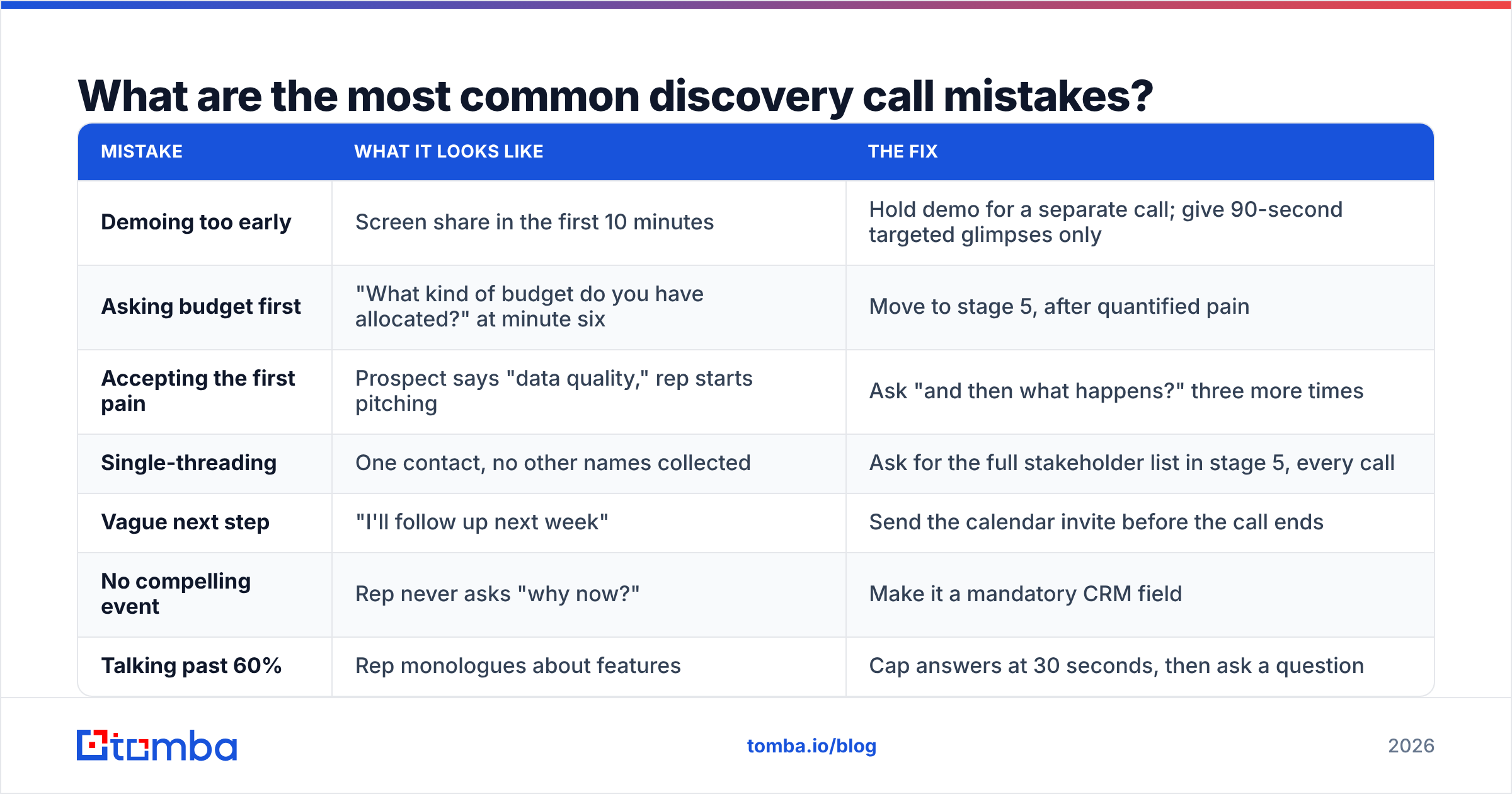
What are the most common discovery call mistakes?#
| Mistake | What it looks like | The fix |
|---|---|---|
| Demoing too early | Screen share in the first 10 minutes | Hold demo for a separate call; give 90-second targeted glimpses only |
| Asking budget first | "What kind of budget do you have allocated?" at minute six | Move to stage 5, after quantified pain |
| Accepting the first pain | Prospect says "data quality," rep starts pitching | Ask "and then what happens?" three more times |
| Single-threading | One contact, no other names collected | Ask for the full stakeholder list in stage 5, every call |
| Vague next step | "I'll follow up next week" | Send the calendar invite before the call ends |
| No compelling event | Rep never asks "why now?" | Make it a mandatory CRM field |
| Talking past 60% | Rep monologues about features | Cap answers at 30 seconds, then ask a question |
| Skipping the recap | Call ends at 45:00 with no summary | Reserve the last 2 minutes, always |
Two of these compound badly together. Single-threading plus a vague next step is how a deal that felt great in June disappears in September — your one contact changed roles and nobody else in the org ever heard your name. Every discovery call should net you at least one additional name, and you should be able to reach that person directly. G2's buyer behavior research consistently shows B2B buying groups in the 6–10 person range; a deal with one contact is a deal with a 1-in-8 information problem.
How do you adapt the structure for a 20-minute call?#
Compress stages 2 and 3, protect stages 4, 5, and 6. Twenty-minute allocation:
- Frame: 2 min
- Context + current state: 6 min (combined, one question: "walk me through how this works today and what made you look at it now")
- Pain quantification: 5 min
- Decision process: 3 min
- Next step + recap: 4 min
The temptation in a short call is to cut discovery and add a mini-demo. Do the opposite. A 20-minute call that produces a quantified number and a booked 45-minute follow-up is a win. A 20-minute call where you showed six features and got "send me some info" is a loss that looks like a win in your CRM.
Putting the structure into practice#
The seven-stage structure isn't complicated — the discipline is. Most reps know they should quantify pain and map the decision process; they just run out of time because they spent 18 minutes on rapport and features. Time-box the stages, review your talk-time weekly, and make the compelling event a required CRM field. Those three changes alone will do more for your win rate than any new framework.
And when discovery hands you a second, third, and fourth stakeholder to bring into the next meeting, don't let that intelligence rot in your notes. Use the Tomba Email Finder to turn the names you collected on the call into verified, deliverable addresses in seconds — so your multi-threading plan actually reaches inboxes instead of stalling on a forward that never happens. Start free with 25 searches a month, or check Tomba pricing if your team is running discovery at volume; plans start at $49/mo.
Related guides#
Ready to find emails that actually work?
Join 150,000+ professionals who stopped guessing and started sending. Free credits on signup — no credit card required.
Get the Tomba newsletter
Practical outbound tactics and product updates — once every two weeks.
About the author