The Discovery Call Template That Actually Books Next Steps
Most discovery calls fail before anyone joins the Zoom. Here's a discovery call template built from how real reps run the first 30 minutes — plus the frameworks, timings, and metrics that tell you it's working.
TL;DR
- A discovery call template is a repeatable call structure — not a script. It fixes the order of questions, the time budget per section, and the exit criteria, then lets you talk like a human inside that frame.
- The single biggest predictor of a good discovery call is pre-call research: correct contact, correct role, correct company context. Reps who show up cold burn the first eight minutes re-asking things the prospect already published.
- Use a 30-minute default: 3 min frame, 5 min context, 12 min problem depth, 5 min impact and money, 5 min next step. Anything longer usually means you skipped qualification.
- Pick one framework and stay in it. BANT is fast but shallow, MEDDIC is thorough but slow, SPICED sits in the middle for most SaaS teams.
- Measure the template on discovery-to-next-meeting rate, not on how good the call "felt." Below 50% and your qualification is happening too late.
What is a discovery call template?#
A discovery call template is a fixed structure for the first real conversation with a prospect: which sections you cover, in what order, how long each gets, and what has to be true before you book a next step.
Think of it like a pilot's pre-flight checklist. The pilot knows how to fly. The checklist exists because under time pressure, humans skip the boring step — and the boring step is the one that kills you. Your version of the boring step is asking "what happens if you do nothing?" Reps skip it when the call is going well, then lose the deal to no-decision four weeks later.
The template is not a word-for-word script. Word-for-word scripts fail on discovery calls because the prospect controls half the conversation. What you can control is the shape: how you open, what you must learn, and what you refuse to end the call without.
Why do most discovery calls fail?#
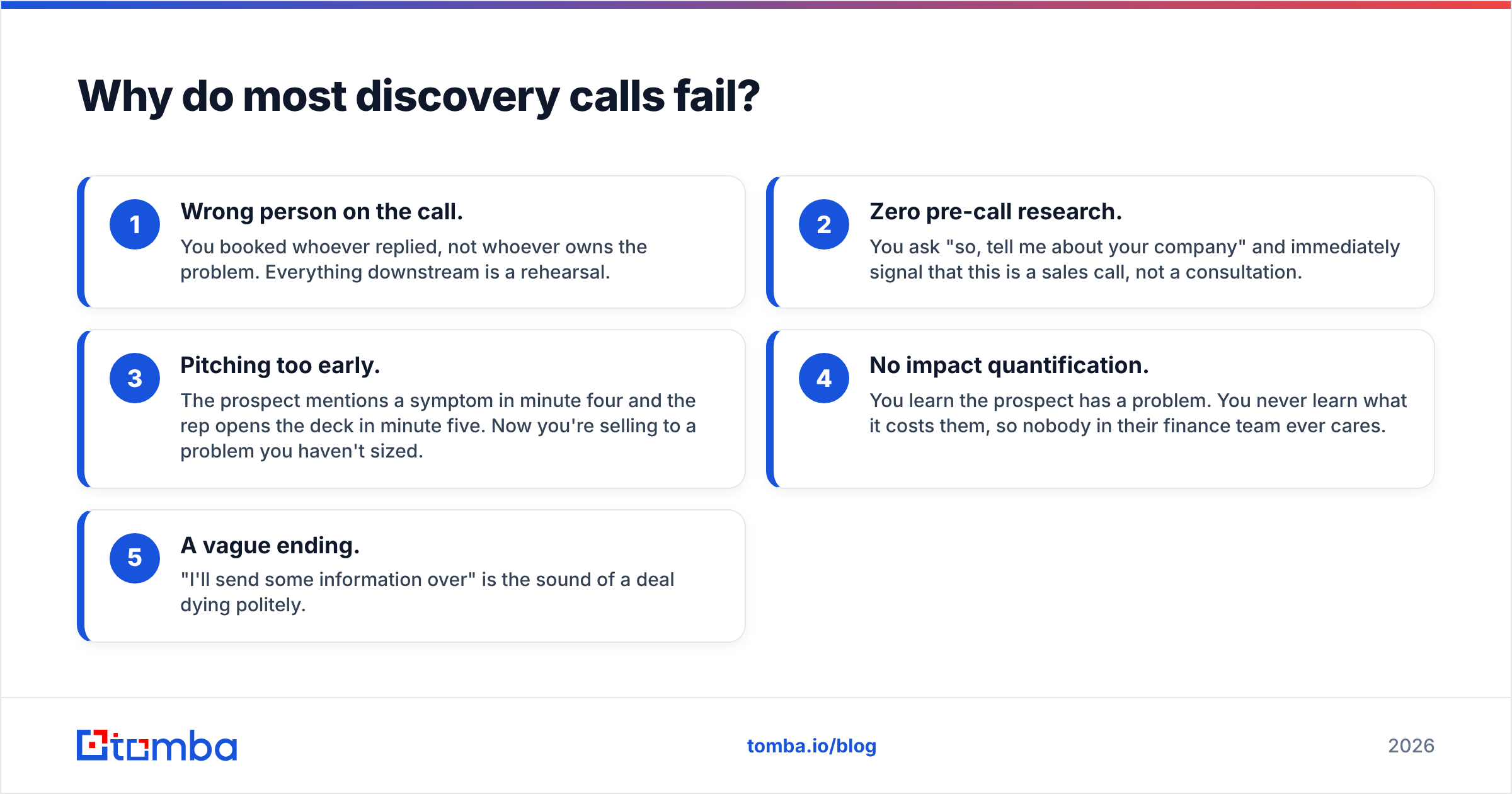
They fail in the first five minutes, and almost always for one of these reasons:
- Wrong person on the call. You booked whoever replied, not whoever owns the problem. Everything downstream is a rehearsal.
- Zero pre-call research. You ask "so, tell me about your company" and immediately signal that this is a sales call, not a consultation.
- Pitching too early. The prospect mentions a symptom in minute four and the rep opens the deck in minute five. Now you're selling to a problem you haven't sized.
- No impact quantification. You learn the prospect has a problem. You never learn what it costs them, so nobody in their finance team ever cares.
- A vague ending. "I'll send some information over" is the sound of a deal dying politely.
Gong's public research on sales conversations has repeatedly found that talk-time ratio and question sequencing correlate with outcomes more strongly than product knowledge does. That's the whole argument for using a template: it forces sequencing you'd otherwise abandon under pressure.

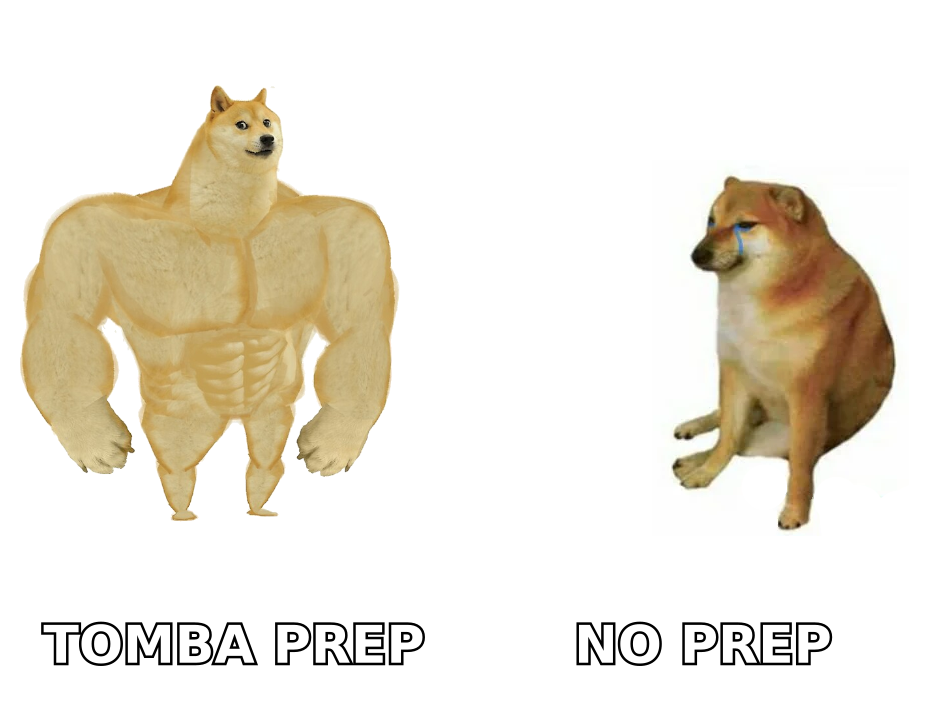
Wait — that image reference is a placeholder. Here is the actual meme:
What should a discovery call template include?#
Six components. If any one is missing, the call produces a nice conversation and no forecastable pipeline.
- Pre-call research block — verified contact details, role, tenure, company headcount, funding or growth signals, current tooling, and one specific hook you'll reference in the opener.
- The frame — 60–90 seconds where you state the agenda, the time budget, and what a good outcome looks like for both sides. This is where you earn permission to ask hard questions later.
- Current-state questions — how the thing works today, who touches it, what's manually held together.
- Problem-depth questions — what breaks, how often, who complains, what they've already tried and why it didn't stick.
- Impact and money questions — the cost of the status quo in hours, dollars, churn, or missed revenue, plus how spend actually gets approved.
- Next-step close — a specific date, a specific attendee list, and a specific thing you'll show or send.
Notice that five of the six happen before you say anything about your product. That ratio is the template.
What does the full discovery call template look like?#
Here's the 30-minute version. Adjust proportionally for 45 minutes; do not stretch a 30-minute agenda across an hour, because the extra time gets filled with product talk.
Minutes 0–3 — Frame the call
"Thanks for the time. Here's what I had in mind: I'll ask about how you're handling [area] today and what's working or not, that'll take most of our time. If it looks like we could help, I'll show you exactly how and we'll talk next steps. If not, I'll tell you that straight and point you somewhere better. Fair?"
Then one research-backed hook: "I saw you moved [team] onto [tool] last quarter — is that related to what prompted this call?"
Minutes 3–8 — Current state
- Walk me through how [process] runs today, start to finish.
- Who else touches it besides you?
- How long has it worked this way?
- What made you take this call now, specifically?
That last question is the highest-value question in discovery. "Why now" separates a real project from idle curiosity.
Minutes 8–20 — Problem depth
- Where does that process break down most often?
- How often is "often" — weekly, daily?
- What does your team do when it breaks?
- What have you already tried to fix it?
- Why didn't that work?
- Who feels it most when it goes wrong?
Stay here. This is where inexperienced reps get uncomfortable with silence and start pitching. Twelve minutes feels long. It should.
Minutes 20–25 — Impact and decision process
- If nothing changes in six months, what does that cost you?
- Is anyone tracking that number today?
- Who else would need to weigh in on a change like this?
- How have you bought similar tools before — is there a budget line or does it come out of a broader pool?
- What would make this a "not this quarter" for you?
Minutes 25–30 — Close the next step
- Summarize back what you heard in three sentences, and ask if you got it right.
- State your honest read: good fit, partial fit, or not a fit.
- Book the specific next meeting on the call, with names.
- Confirm what you'll send within 24 hours.
Which discovery question framework should you use?#
Pick one. Mixing frameworks mid-call is how reps end up asking about budget in minute six.
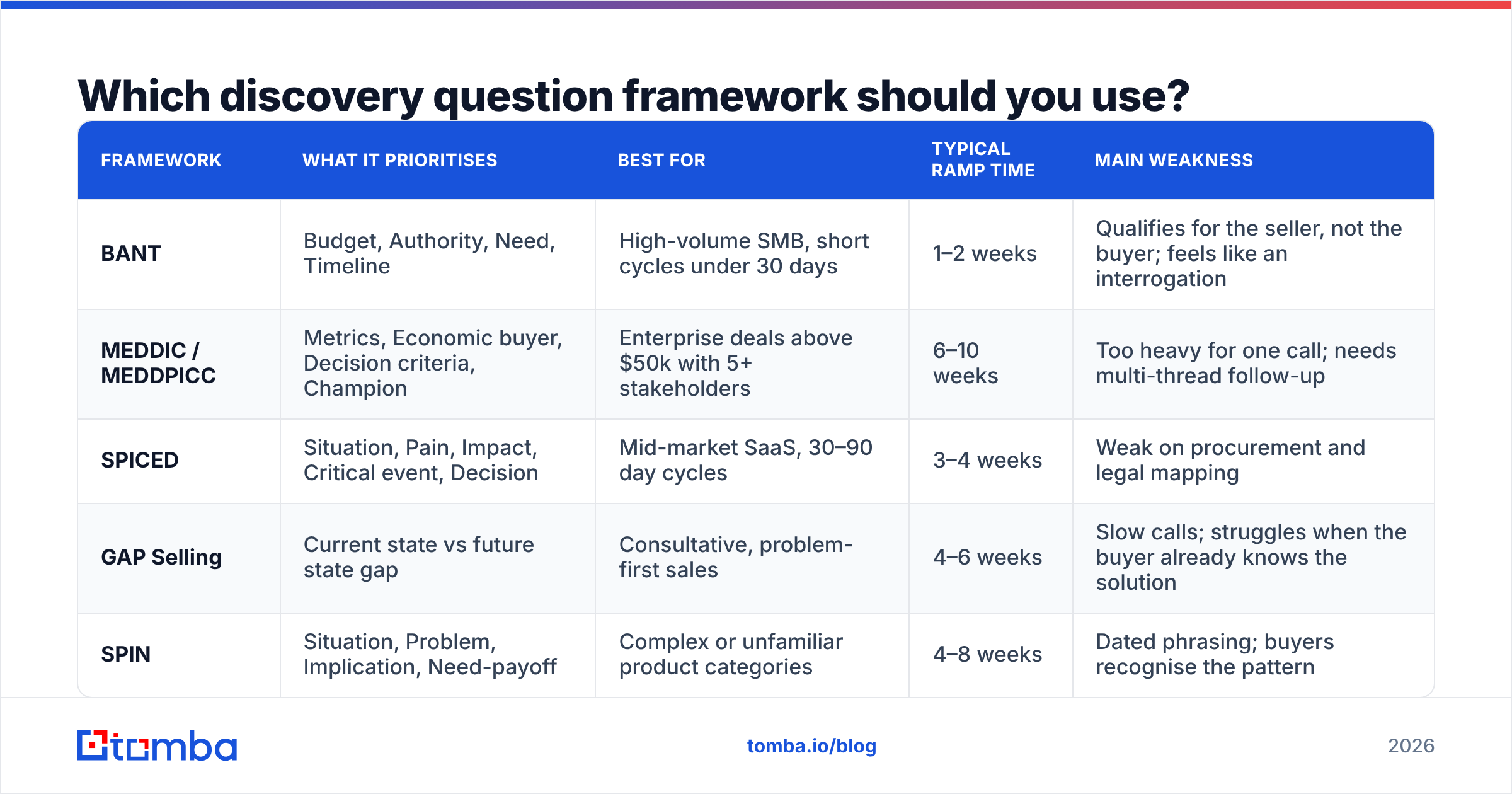
| Framework | What it prioritises | Best for | Typical ramp time | Main weakness |
|---|---|---|---|---|
| BANT | Budget, Authority, Need, Timeline | High-volume SMB, short cycles under 30 days | 1–2 weeks | Qualifies for the seller, not the buyer; feels like an interrogation |
| MEDDIC / MEDDPICC | Metrics, Economic buyer, Decision criteria, Champion | Enterprise deals above $50k with 5+ stakeholders | 6–10 weeks | Too heavy for one call; needs multi-thread follow-up |
| SPICED | Situation, Pain, Impact, Critical event, Decision | Mid-market SaaS, 30–90 day cycles | 3–4 weeks | Weak on procurement and legal mapping |
| GAP Selling | Current state vs future state gap | Consultative, problem-first sales | 4–6 weeks | Slow calls; struggles when the buyer already knows the solution |
| SPIN | Situation, Problem, Implication, Need-payoff | Complex or unfamiliar product categories | 4–8 weeks | Dated phrasing; buyers recognise the pattern |
For most B2B SaaS teams selling into mid-market, SPICED is the safest default: it captures impact and the critical event (the "why now") without demanding the full MEDDIC apparatus on call one. HubSpot's sales resources and Salesforce's sales guides both publish variants of these frameworks if you want longer treatments of each.

How long should a discovery call be?#
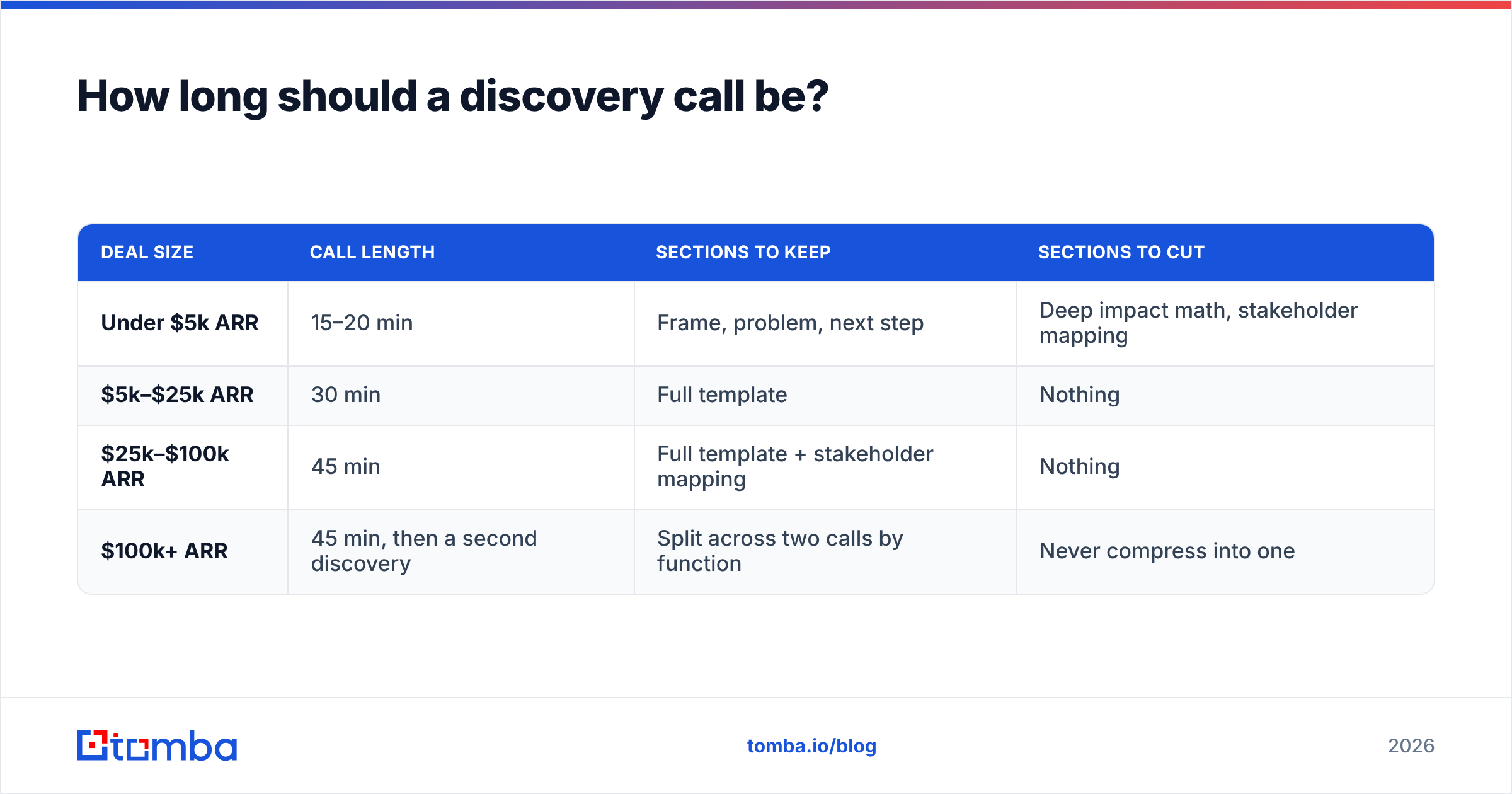
Match call length to deal size, not to your calendar defaults.
| Deal size | Call length | Sections to keep | Sections to cut |
|---|---|---|---|
| Under $5k ARR | 15–20 min | Frame, problem, next step | Deep impact math, stakeholder mapping |
| $5k–$25k ARR | 30 min | Full template | Nothing |
| $25k–$100k ARR | 45 min | Full template + stakeholder mapping | Nothing |
| $100k+ ARR | 45 min, then a second discovery | Split across two calls by function | Never compress into one |
The most common mistake is running a 60-minute discovery on a $6k deal. You will fill the time, the prospect will get demo fatigue, and the deal won't close faster.
How do you prep for a discovery call in five minutes?#
Prep is where the template stops being generic. Five minutes, four steps:
- Verify the contact. Confirm the person you're meeting is the person you think they are, at the company you think they're at, with the title you think they hold. Titles churn constantly; a stale record means you open the call by getting someone's job wrong. A quick lookup through an email finder or reverse email lookup will confirm the identity behind the calendar invite before you dial.
- Pull company context. Headcount, recent funding, hiring pattern, and current tech stack. Hiring three SDRs this quarter tells you more about their priorities than any case study will.
- Enrich the record. Push firmographics into your CRM before the call so the notes have somewhere to live. Data enrichment run in bulk the night before beats scrambling in the tab next to the Zoom window.
- Write one hook and three custom questions. Not ten. Three questions that could only be asked of this company. That's the difference between a discovery call and a survey.
If you're running discovery on inbound leads, add one more step: read what they actually filled in on the form. Reps skip this constantly and then ask a question the prospect already answered in writing.
What are the biggest discovery call mistakes?#
- Talking more than 45% of the time. If you're above that, you're presenting, not discovering.
- Accepting the first answer. "It's a bit manual" is not an answer. "Two people spend six hours a week on it" is.
- Asking about budget before establishing impact. Budget questions land as pushy when the prospect hasn't yet said out loud what the problem costs them.
- Never asking about the competition. "What else are you looking at?" asked plainly, in minute 22, gets an honest answer more often than reps expect.
- Ending without a calendar invite. If the next step isn't on both calendars before you hang up, the probability it happens drops roughly by half.
- Not recording or transcribing. You will not remember the exact phrasing of their pain point, and their exact phrasing is what you should quote back in the proposal.
How do you measure whether your discovery call template works?#
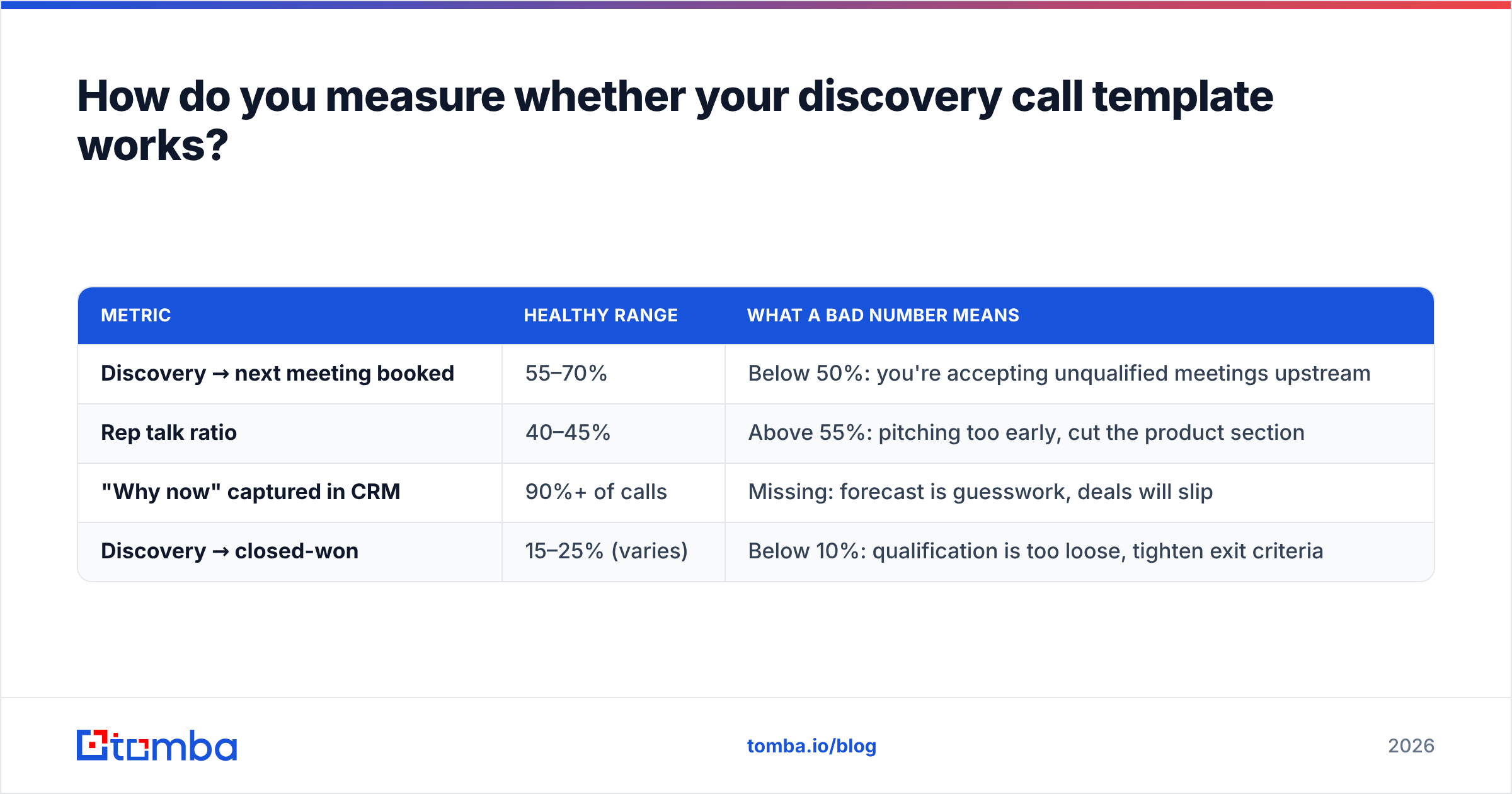
Feelings are not a metric. Track these four:
| Metric | Healthy range | What a bad number means |
|---|---|---|
| Discovery → next meeting booked | 55–70% | Below 50%: you're accepting unqualified meetings upstream |
| Rep talk ratio | 40–45% | Above 55%: pitching too early, cut the product section |
| "Why now" captured in CRM | 90%+ of calls | Missing: forecast is guesswork, deals will slip |
| Discovery → closed-won | 15–25% (varies) | Below 10%: qualification is too loose, tighten exit criteria |
Review five recorded calls per rep per month against the template's five sections. Score each section present/absent. That single exercise surfaces the pattern faster than any coaching conversation, because reps skip the same section every time — usually impact quantification.
If your discovery-to-next-meeting rate is fine but closed-won is weak, the problem isn't the call template. It's the list you're calling. Bad-fit prospects have great discovery calls and never buy.
What should you do right after the call?#
Within 24 hours, send a recap email with four things: what you heard (in their words), what you agreed the impact was, what happens next and when, and one resource that maps to their specific problem. No deck, no generic one-pager.
Then update the CRM the same day — not on Friday. The details that make a deal forecastable are the ones that decay fastest in your memory.
Where does contact data fit into all of this?#
Every element of this discovery call template assumes one thing: you're talking to the right person at a company worth talking to. That assumption is where most pipeline actually breaks. A perfect 30-minute structure run against a stale, mis-titled, or dead contact record produces a perfect nothing.
Tomba's Email Finder gives you verified professional contacts by name and domain, so the person on the invite is the person who owns the problem — and pairs with domain search when you need the rest of the buying committee before a second call. Start on the free tier at 25 searches a month, or check Tomba pricing — Starter runs $49/mo — if you're building a list your whole team will run discovery against. Get the contact right, then let the template do its job.
Related guides#
Ready to find emails that actually work?
Join 150,000+ professionals who stopped guessing and started sending. Free credits on signup — no credit card required.
Get the Tomba newsletter
Practical outbound tactics and product updates — once every two weeks.
About the author