Discovery Call Tips: 14 Questions That Actually Close Deals
Most discovery calls fail before the first question. Here are the frameworks, questions, and pre-call research habits that separate a real qualification conversation from a polite 30-minute interview.
TL;DR
- A discovery call is a qualification conversation, not a mini demo. The moment you start screen-sharing, discovery is over.
- The highest-leverage work happens before the call: 10 minutes of research on the company, the person, and their tech stack changes every question you ask.
- Frameworks (BANT, MEDDICC, SPICED, GPCTBA) are checklists, not scripts. Pick one that matches your deal size and stop there.
- Talk-to-listen ratio matters more than any single question. Aim for 40/60 or better in your favor — meaning you talk less.
- End every call with a scheduled next step and a named person who owns it. "I'll follow up next week" is how deals die.
What is a discovery call, and what is it not?#
A discovery call is the conversation where you find out whether a deal exists. That's the whole job. Not whether the prospect likes you, not whether your product is impressive — whether there's a problem worth money, a person willing to spend it, and a timeline that isn't imaginary.
Think of it like a doctor's intake appointment. A bad doctor walks in and prescribes antibiotics because you coughed once in the waiting room. A good one asks how long it's been going on, what you've already tried, what changed recently, and who else in the house is sick. Same symptoms, completely different quality of diagnosis. The prescription is the demo. Discovery is the intake.
What a discovery call is not:
- A product tour. If you demo, you lose your leverage to ask hard questions. Prospects who've already seen the product stop answering budget questions honestly.
- A rapport-building session. Warmth helps. Twelve minutes on their golf handicap does not.
- A form-filling exercise. Reading BANT questions off a card produces BANT answers off a card.
- A one-way interrogation. The best calls feel like a consultation because you're teaching while you diagnose.
The failure mode is almost always the same: the rep gets excited about a surface-level pain, skips the qualification, books a demo, and then spends six weeks chasing a champion who never had budget authority in the first place.

How do you prepare for a discovery call in 10 minutes?#
Preparation is where most of the win is banked. You cannot ask a sharp question about a company you know nothing about, and generic questions get generic answers.
Here's a 10-minute pre-call routine that works whether you're an SDR handing off or an AE running your own pipeline:
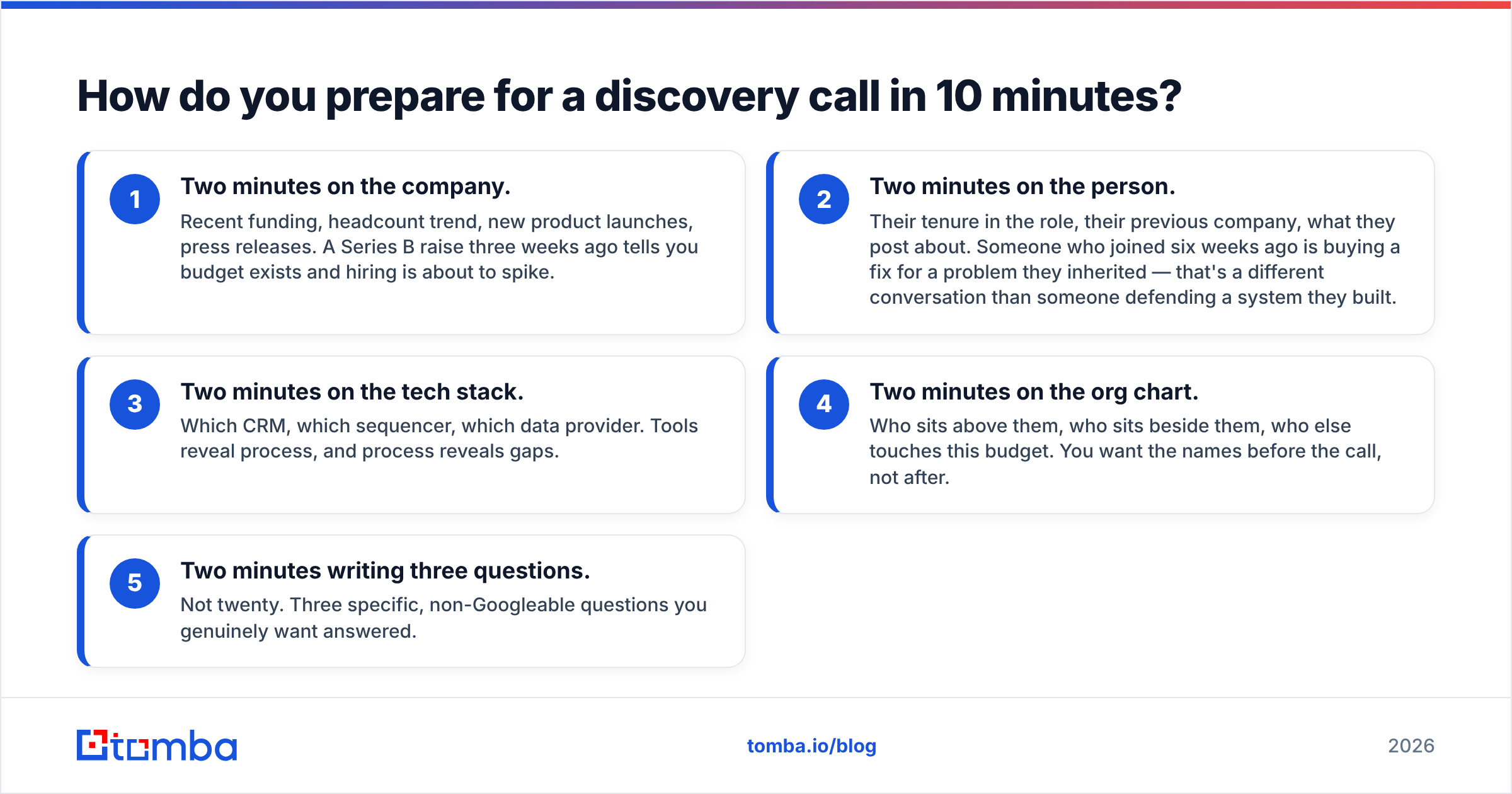
- Two minutes on the company. Recent funding, headcount trend, new product launches, press releases. A Series B raise three weeks ago tells you budget exists and hiring is about to spike.
- Two minutes on the person. Their tenure in the role, their previous company, what they post about. Someone who joined six weeks ago is buying a fix for a problem they inherited — that's a different conversation than someone defending a system they built.
- Two minutes on the tech stack. Which CRM, which sequencer, which data provider. Tools reveal process, and process reveals gaps.
- Two minutes on the org chart. Who sits above them, who sits beside them, who else touches this budget. You want the names before the call, not after.
- Two minutes writing three questions. Not twenty. Three specific, non-Googleable questions you genuinely want answered.
That last step is the one everyone skips. If your first question could have been asked of any company in the world, you wasted your prep.
Getting reliable contact and company data is the unglamorous foundation here. If your CRM record is a name, a title, and a guessed email, you have nothing to prepare with. Enrichment tools that pull firmographics, verified contact details, and org structure — a data enrichment layer sitting on top of your CRM — turn a blank record into a briefing document. Knowing the direct B2B phone numbers for the two other stakeholders on the account also means the multithreading conversation later isn't hypothetical.
Which discovery framework should you use?#
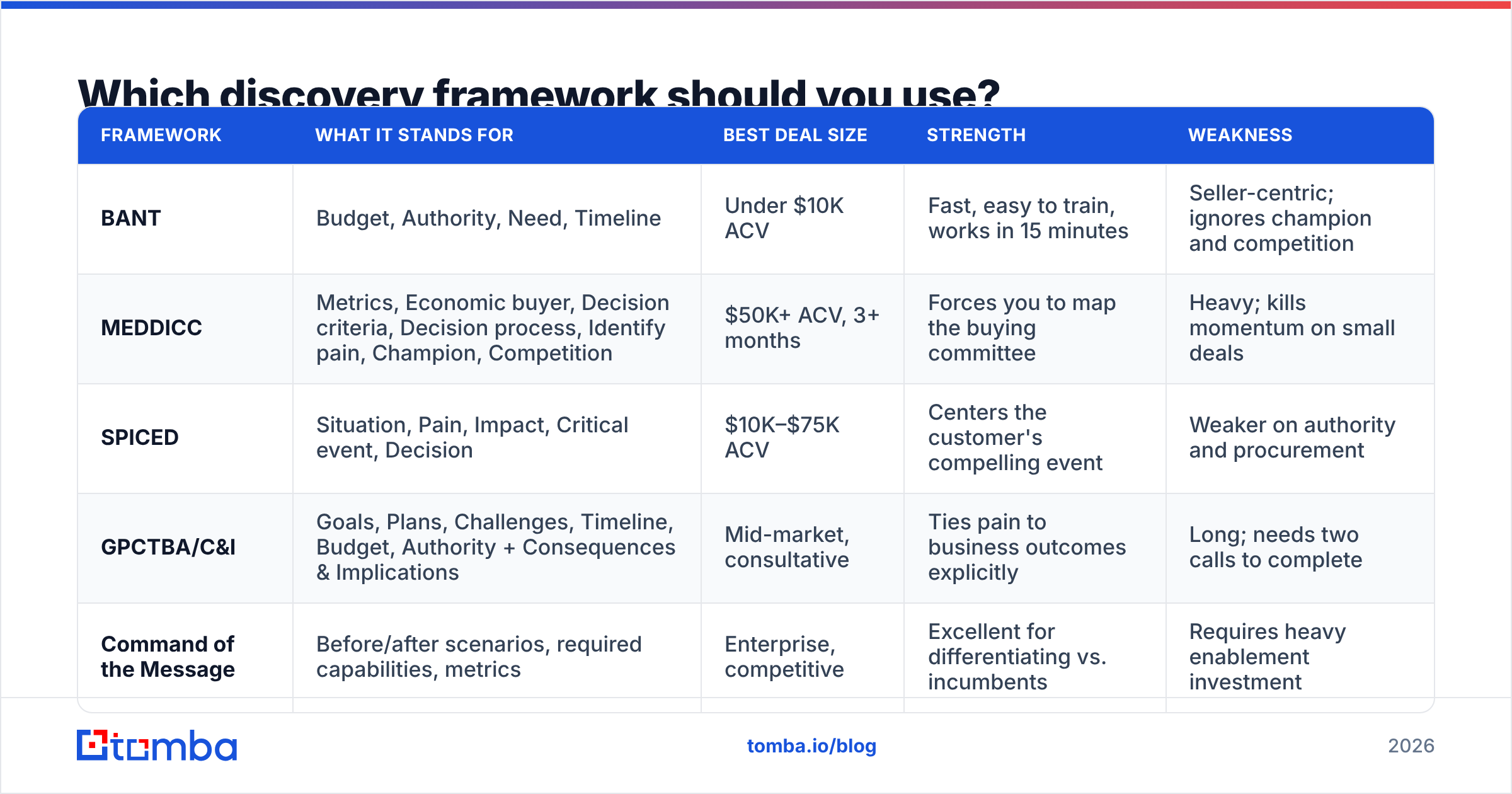
Frameworks are checklists that stop you from forgetting something expensive. They are not scripts. The main mistake is picking the heaviest framework for the lightest deal — running full MEDDICC on a $400/month self-serve product wastes everyone's time.
| Framework | What it stands for | Best deal size | Strength | Weakness |
|---|---|---|---|---|
| BANT | Budget, Authority, Need, Timeline | Under $10K ACV | Fast, easy to train, works in 15 minutes | Seller-centric; ignores champion and competition |
| MEDDICC | Metrics, Economic buyer, Decision criteria, Decision process, Identify pain, Champion, Competition | $50K+ ACV, 3+ months | Forces you to map the buying committee | Heavy; kills momentum on small deals |
| SPICED | Situation, Pain, Impact, Critical event, Decision | $10K–$75K ACV | Centers the customer's compelling event | Weaker on authority and procurement |
| GPCTBA/C&I | Goals, Plans, Challenges, Timeline, Budget, Authority + Consequences & Implications | Mid-market, consultative | Ties pain to business outcomes explicitly | Long; needs two calls to complete |
| Command of the Message | Before/after scenarios, required capabilities, metrics | Enterprise, competitive | Excellent for differentiating vs. incumbents | Requires heavy enablement investment |
Pick one. Run it for a full quarter. Changing frameworks every six weeks is a way of avoiding the harder work of getting better at questions.
For a deeper breakdown of qualification mechanics and how it fits the broader funnel, HubSpot's sales blog has one of the more grounded libraries on the subject, and Gong's research publishes call-recording data on what actually correlates with closed-won.
What are the best discovery call questions to ask?#
Good questions share three traits: they're open-ended, they're specific to this company, and they make the prospect do a little math in their head. Here are 14 that consistently earn real answers.
Situation and status quo
- "Walk me through how your team handles [process] today, start to finish." — You want the messy reality, not the org chart version.
- "How long has it worked that way?" — Recent changes mean instability. Instability means opportunity.
- "What tools are involved in that workflow?" — Reveals stack, spend, and integration requirements simultaneously.
Pain and impact
- "What happens when that breaks?" — Moves from feature talk to consequence.
- "How often does that happen in a typical month?" — Frequency turns anecdote into cost.
- "What has that cost you — in hours, in headcount, in pipeline?" — This is the number your business case is built on.
- "What have you already tried to fix it?" — Failed attempts tell you what objections are coming.
Critical event and timing
- "Why is this on your list now, versus six months ago?" — The single most predictive question in discovery. No trigger means no urgency.
- "What happens if nothing changes by [their stated deadline]?" — Tests whether the timeline is real or aspirational.
Decision process and authority
- "Who else feels this problem?" — Softer and more productive than "are you the decision maker?"
- "The last time your team bought something like this, what did the process look like?" — Procurement, legal, security review — surfaced without you asking about procurement, legal, or security review.
- "Who would need to sign off, and what would they need to see?" — Gets you the economic buyer and the decision criteria in one answer.
Fit and honesty
- "What would make this a bad fit for you?" — Prospects who trust you will actually tell you. This saves months.
- "If this works exactly as you hope, what does your team do differently in 90 days?" — Success criteria in their words, ready to be quoted back in the proposal.
Notice that none of these mention your product. That's deliberate. Every minute you spend describing features is a minute you're not learning something that could disqualify a bad deal.
How much should you talk on a discovery call?#
Less than you think. Call-recording data from multiple revenue-intelligence vendors consistently puts top-performing discovery calls at roughly a 43/57 talk ratio — the rep talking under half the time. Below-average reps invert it.
Three mechanics that fix a bad ratio immediately:
- Count to three after they stop talking. Most prospects add the important half of the answer in the silence. Reps fill it with the next question and never hear it.
- Ask one question at a time. Stacked questions ("So what's your process, and who owns it, and what's the budget?") get answered on the easiest one only.
- Use the label-and-probe. "It sounds like the reporting piece is what's really burning you — is that right?" Confirms understanding, invites correction, and costs you eight words.
The other habit worth building: take notes in the CRM during the call in the prospect's own language. When you write "manual data entry eats 6 hrs/wk per rep" instead of "efficiency pain," your proposal writes itself and your CRM becomes a real forecasting instrument instead of a graveyard.
What are the biggest discovery call mistakes?#
| Mistake | What it looks like | The fix |
|---|---|---|
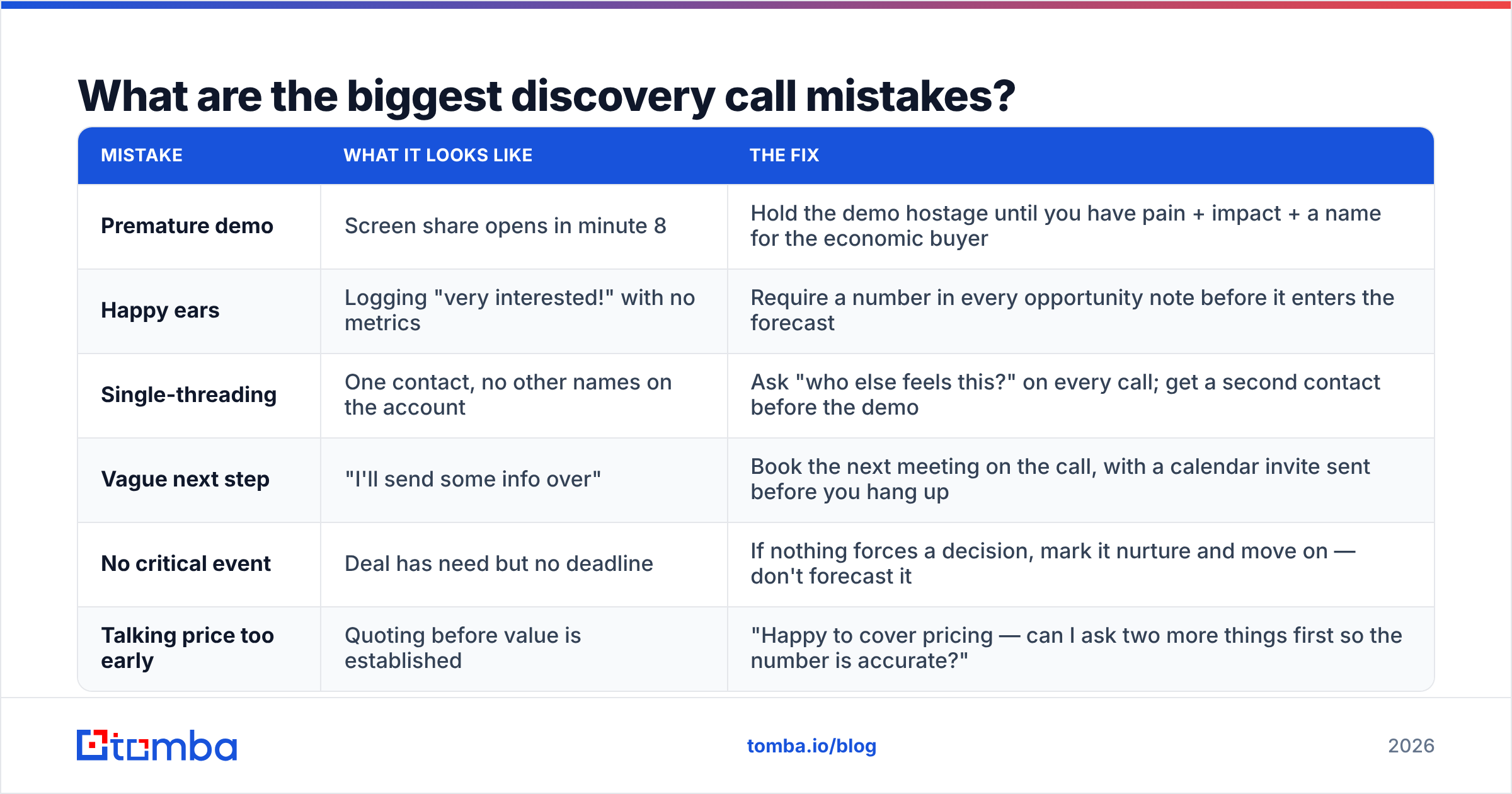
| Premature demo | Screen share opens in minute 8 | Hold the demo hostage until you have pain + impact + a name for the economic buyer |
| Happy ears | Logging "very interested!" with no metrics | Require a number in every opportunity note before it enters the forecast |
| Single-threading | One contact, no other names on the account | Ask "who else feels this?" on every call; get a second contact before the demo |
| Vague next step | "I'll send some info over" | Book the next meeting on the call, with a calendar invite sent before you hang up |
| No critical event | Deal has need but no deadline | If nothing forces a decision, mark it nurture and move on — don't forecast it |
| Talking price too early | Quoting before value is established | "Happy to cover pricing — can I ask two more things first so the number is accurate?" |
The most expensive of these is the vague next step. A deal without a scheduled follow-up isn't a deal; it's a memory. Reps who consistently book the next meeting while still on the current one run pipelines that are two to three times more predictable than reps who follow up by email, mostly because email response rates after a good call are far worse than anyone expects.

How do you structure the 30 minutes?#
A workable default, adjusted to your deal size:
- 0:00–0:02 — Frame the call. "I've got 30 minutes. I'd like to spend most of it understanding how your team runs [process] today, and if it makes sense, we can talk about whether we're a fit. Anything you want to make sure we cover?" That last clause turns a call into a shared agenda.
- 0:02–0:05 — Confirm your research. "I saw you closed a Series B in May and you're hiring five AEs — is the ramp process what's driving this?" Shows preparation, and lets them correct you cheaply.
- 0:05–0:20 — Discovery. Situation, pain, impact, critical event, decision process. Fifteen minutes of listening.
- 0:20–0:26 — Targeted teach-back. Not a demo. Two or three sentences on how other companies with this exact problem solved it, plus one screenshot or story if it's genuinely relevant.
- 0:26–0:30 — Next step. Recap what you heard, state what you'd want to show and to whom, and put the meeting on the calendar live.
If you learn in minute 12 that there's no budget, no trigger, and no authority, end the call early and honestly. Prospects remember reps who gave them their twenty minutes back, and disqualifying fast is what keeps a pipeline clean enough to forecast.
How do you make sure you're having discovery calls with the right people?#
Discovery technique has a ceiling, and that ceiling is your list. The sharpest questioning in the world doesn't help if you're on a call with a coordinator at a company that will never buy.
Three things fix this upstream:
- Fit criteria before outreach. Define the firmographic and technographic profile of your best 20 closed-won accounts, then only book calls that match.
- Verified contact data. Bounced emails and wrong-number dials aren't just wasted effort — they distort your conversion metrics and make it impossible to tell whether your discovery is improving.
- Multithreading from day one. Find two or three contacts per account before the first call, so single-threading is never the default.
That last point is where a reliable email finder earns its keep. Mapping a buying committee means finding the VP above your champion and the ops lead beside them, verifying those addresses, and putting real names in the CRM before the discovery call rather than after the deal stalls.
Ready to run discovery on accounts that can actually buy?#
Better questions only pay off when you're asking them of the right people. Use the Tomba Email Finder to build accurate, verified contact lists for the accounts that match your ICP — find the economic buyer, the champion, and the technical evaluator before your first call, not after your third follow-up goes unanswered. Start on the free tier with 25 searches a month, or check Tomba pricing if you're ready to scale: Starter runs $49/mo, Growth $99/mo, and Pro $249/mo. Spend your prep time on questions, not on guessing email formats.
Related guides#
Ready to find emails that actually work?
Join 150,000+ professionals who stopped guessing and started sending. Free credits on signup — no credit card required.
Get the Tomba newsletter
Practical outbound tactics and product updates — once every two weeks.
About the author