Discovery Meeting Guide 2026: Questions, Agenda, Framework
A discovery meeting decides whether a deal is real. Here is the agenda, the question sequence, the qualification framework comparison, and the metrics that predict which calls actually convert.
TL;DR
- A discovery meeting is the first substantive conversation where you diagnose whether a prospect has a problem worth paying to solve — not a demo, not a pitch, not a "quick intro."
- The single biggest predictor of a good discovery call is talk ratio. Top performers talk roughly 43% of the time; average reps talk closer to 65-72%.
- Use a framework (MEDDICC, SPICED, BANT) as a checklist you fill in after the call, not a script you read during it.
- Deals with a documented next step booked live on the discovery call close at materially higher rates than deals where the rep says "I'll follow up."
- Discovery quality is capped by targeting quality. If you booked a meeting with the wrong person at the wrong company, no question sequence saves it.
What is a discovery meeting?#
A discovery meeting is a structured conversation where a seller and a buyer decide together whether a problem exists that is worth spending money to fix. That's the whole job. Everything else — the demo, the pricing conversation, the security review — is downstream of whether you got this one right.
The word "discovery" gets abused. Plenty of reps run what they call discovery and what the buyer experiences as a slow-motion interrogation: 22 questions in 30 minutes, no synthesis, then a calendar link for a demo. The buyer answers politely, learns nothing, and ghosts.
Think of it like a doctor's first appointment. A bad doctor hands you a prescription in the first 90 seconds because they've seen your symptom before. A good doctor asks what changed, when it started, what you've already tried, and what happens if you do nothing. Then — and only then — they tell you what they think. The prescription lands because you watched them earn it.
The mechanical difference between the two: a bad discovery meeting collects data. A good one creates shared understanding. If your prospect hangs up knowing something about their own business they didn't know at the start, you ran a good call. If they only feel like they filled out a form, you didn't.
Why do most discovery meetings fail?#
They fail for reasons that are boringly consistent across teams:
- The rep talks too much. Conversation-intelligence vendors have published this repeatedly: successful calls skew toward the buyer speaking more. Gong's research on recorded sales calls puts top-performer talk time near the low-40s percent range, versus a majority share for average reps. You cannot diagnose while you're monologuing.
- No pre-call research. Showing up and asking "so, tell me what you do" burns your first five minutes and signals you didn't care enough to look.
- Wrong person in the room. You can run a flawless call with someone who has no budget authority and no path to it. That's a wasted hour dressed as a pipeline.
- No hypothesis. Great discovery starts with a point of view — "teams your size usually hit X problem around month six" — that the buyer can confirm or correct. A hypothesis gives them something to react to.
- No next step booked live. "I'll send some times" is where deals go to die. Book the calendar invite before you hang up.
- Feature-dumping the moment pain appears. The prospect mentions a problem, the rep lunges for the product tour. The buyer's pain wasn't fully mapped yet, so the pitch lands on an incomplete picture.
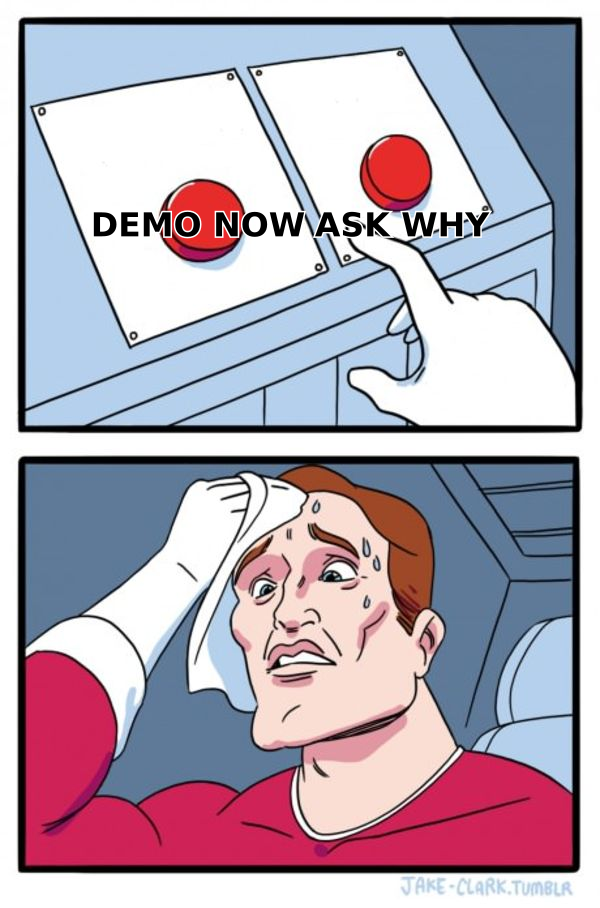
Failure mode #3 is worth dwelling on because it isn't a skills problem — it's a data problem. If your prospecting list is built on stale contacts or guessed email patterns, you'll book meetings with the wrong titles no matter how good your call skills are. Cleaning that upstream with a real email finder and title-level filtering fixes more discovery calls than any script rewrite.
What should a discovery meeting agenda look like?#
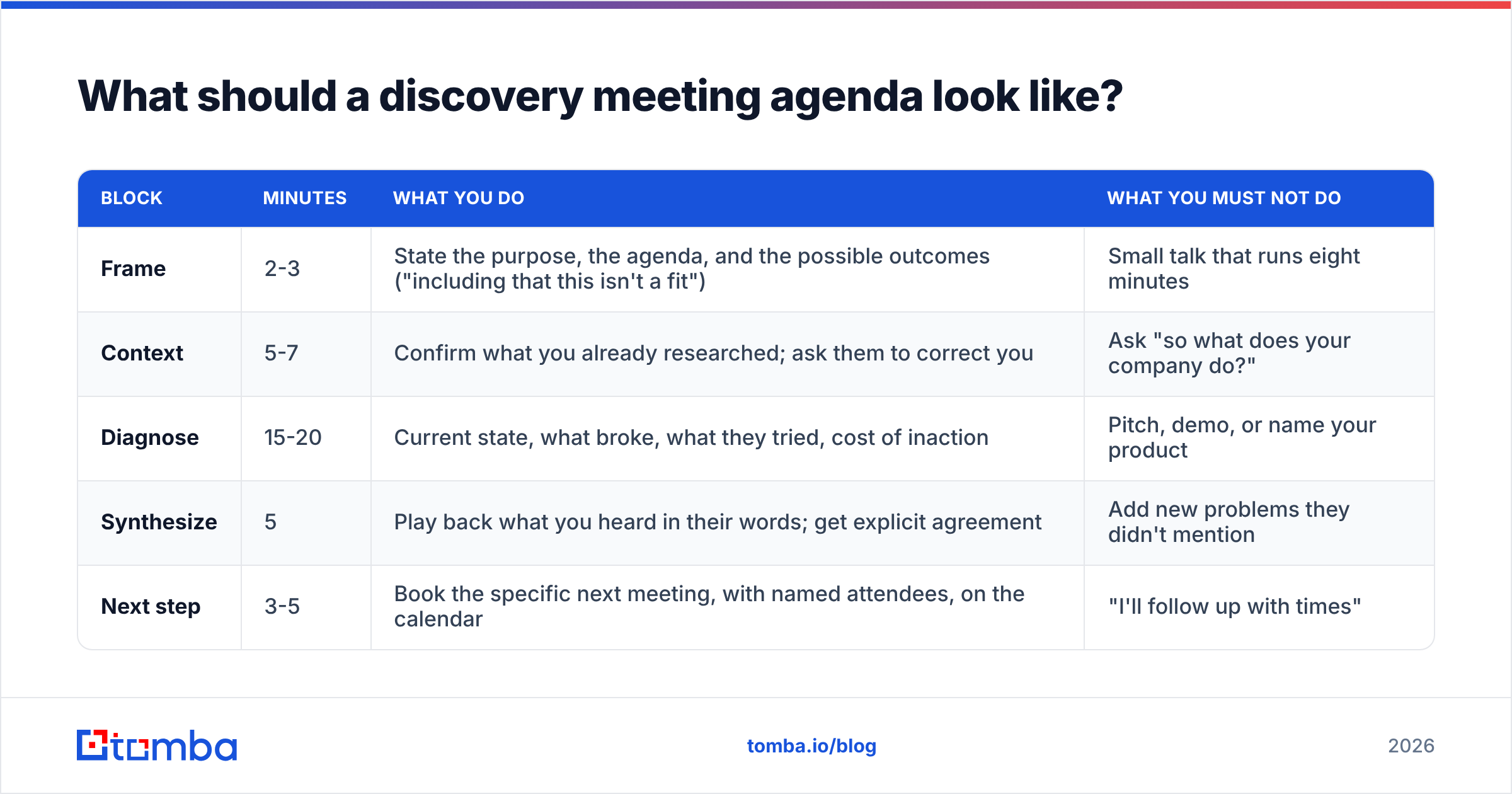
Thirty to forty-five minutes, five blocks. Time-box them.
| Block | Minutes | What you do | What you must NOT do |
|---|---|---|---|
| Frame | 2-3 | State the purpose, the agenda, and the possible outcomes ("including that this isn't a fit") | Small talk that runs eight minutes |
| Context | 5-7 | Confirm what you already researched; ask them to correct you | Ask "so what does your company do?" |
| Diagnose | 15-20 | Current state, what broke, what they tried, cost of inaction | Pitch, demo, or name your product |
| Synthesize | 5 | Play back what you heard in their words; get explicit agreement | Add new problems they didn't mention |
| Next step | 3-5 | Book the specific next meeting, with named attendees, on the calendar | "I'll follow up with times" |
The frame block is the most underrated. Explicitly giving the buyer permission to disqualify — "if by the end this doesn't look like a fit, I'd rather we both say so" — lowers their guard measurably. Buyers stop performing politeness and start telling you the truth.
The synthesize block is the one that separates good reps from great ones. Saying "so what I'm hearing is: your SDRs spend nine hours a week on manual list building, that's costing you roughly 40 conversations a month, and last quarter that gap showed up as a missed number — did I get that right?" does three things at once. It proves you listened, it converts vague complaints into quantified pain, and it gives them the language they'll use internally when they sell your deal for you.
What questions should you ask in a discovery call?#
Question sequence matters more than question content. Move from broad to narrow, from facts to feelings, from present to future.
Layer 1 — Situation (2-3 questions max). Establish the mechanics of how things work today. "Walk me through what happens after a lead fills out a form." Keep this short; you should have researched most of it.
Layer 2 — Problem. Find where the process leaks. "Where does that break down most often?" "What percentage of those leads never get a first touch?"
Layer 3 — Implication. Attach a number to the leak. "If 30% never get touched, what's that worth in pipeline per quarter?" This is where most reps stop too early. The implication layer is what makes a problem budget-worthy instead of merely annoying.
Layer 4 — Consequence of inaction. "What happens if you do nothing for another two quarters?" If the honest answer is "nothing much," you've found a deal that will stall at legal. Better to learn it now.
Layer 5 — Decision process. "Who else needs to nod before something like this gets bought?" "Walk me through how you bought the last tool in this category." The second question is dramatically better than the first because people describe history accurately and predict the future badly.
Two questions worth stealing outright:
- "What made you take this call?" Asked early, it surfaces the trigger event — a new hire, a missed quarter, a competitor win — that is the real engine of the deal.
- "What would have to be true for this to be an easy yes?" Asked late, it hands you the close criteria in the buyer's own words.
And one to retire permanently: "What keeps you up at night?" Everyone has heard it. It signals script, not curiosity.
Which discovery framework should you use?#
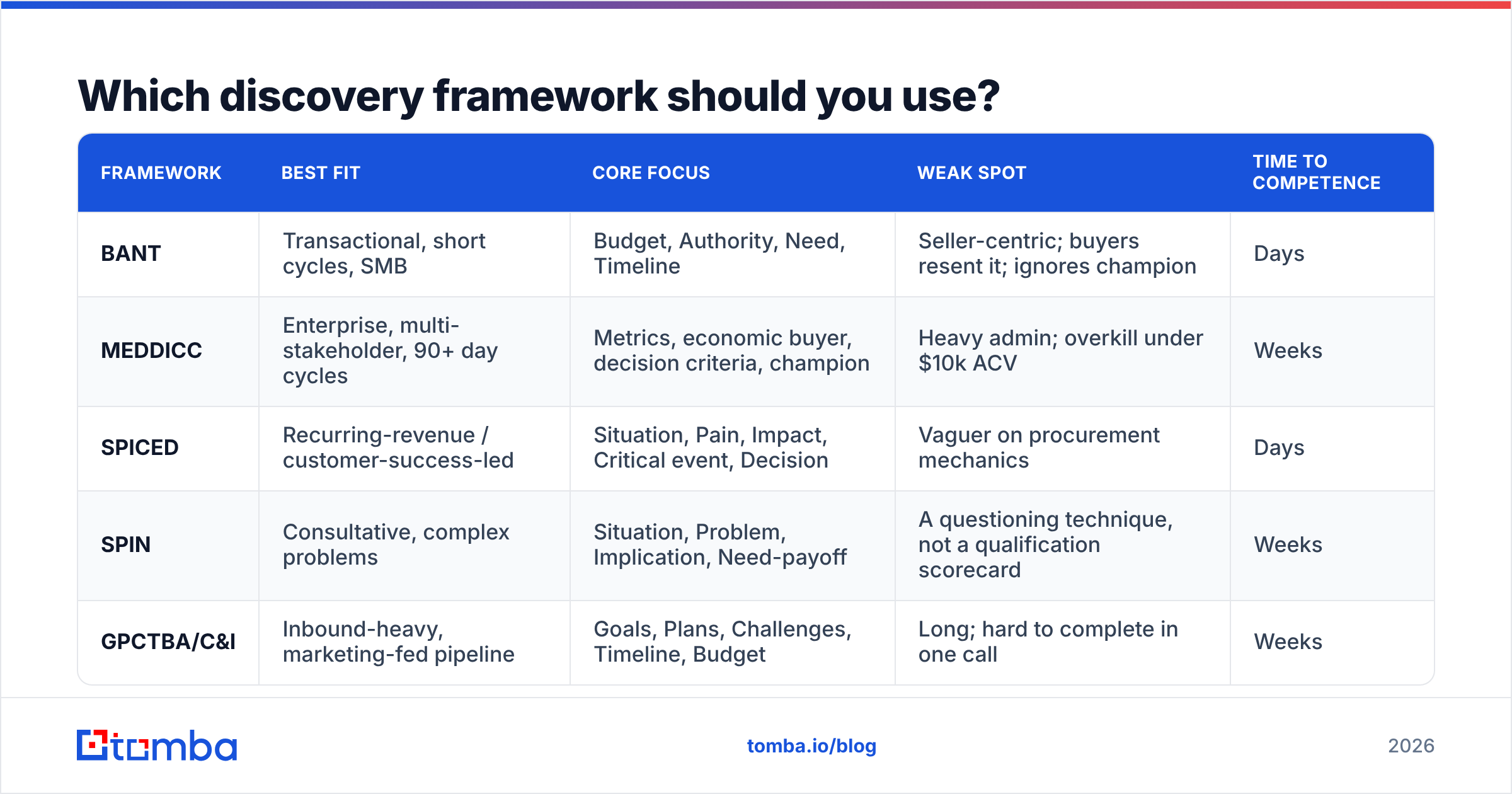
Frameworks are scorecards, not scripts. The failure mode is running the call as the acronym — nobody wants to be walked through the letters M, E, D, D, I, C, C. Fill it in after, spot the gaps, and go back for them on the next touch.
| Framework | Best fit | Core focus | Weak spot | Time to competence |
|---|---|---|---|---|
| BANT | Transactional, short cycles, SMB | Budget, Authority, Need, Timeline | Seller-centric; buyers resent it; ignores champion | Days |
| MEDDICC | Enterprise, multi-stakeholder, 90+ day cycles | Metrics, economic buyer, decision criteria, champion | Heavy admin; overkill under $10k ACV | Weeks |
| SPICED | Recurring-revenue / customer-success-led | Situation, Pain, Impact, Critical event, Decision | Vaguer on procurement mechanics | Days |
| SPIN | Consultative, complex problems | Situation, Problem, Implication, Need-payoff | A questioning technique, not a qualification scorecard | Weeks |
| GPCTBA/C&I | Inbound-heavy, marketing-fed pipeline | Goals, Plans, Challenges, Timeline, Budget | Long; hard to complete in one call | Weeks |
If you sell under $10k ACV to one or two buyers, SPICED plus SPIN questioning is enough. If you sell six figures into a buying committee, MEDDICC earns its overhead — mostly because it forces you to name an economic buyer you've actually met, which is the single most common gap in stalled enterprise deals. HubSpot's sales qualification guides and vendor comparisons on G2 are reasonable starting points if you're picking one for the first time.
The practical rule: pick one, make it the required field set in your CRM, and hold the line for two quarters. Framework-hopping is worse than any individual framework's weaknesses.
How do you prepare for a discovery meeting?#
Fifteen minutes of prep, maximum. More than that and you're procrastinating.
- Verify the person. Confirm the title and that the contact is current. Titles shift constantly, and a bounced calendar invite two days before the call is an avoidable loss. Running the address through an email verifier before you send the invite takes seconds.
- Map the org. Find two or three adjacent titles you may need later — the likely economic buyer, the likely technical evaluator. A domain search across the company gets you the org shape fast.
- Find the trigger. Funding round, new exec, product launch, hiring spree, layoff. Something changed, and that change is your opening hypothesis.
- Write one hypothesis sentence. "I think their SDR team is manually building lists because I see three SDR reqs open and no data vendor in their stack." You'll test this in minute six.
- Pre-write your synthesis skeleton. Leave blanks. You'll fill them live.
- Decide your disqualify criteria. Know in advance what you'd hear that makes you walk. Reps who never disqualify carry fake pipeline.

What metrics tell you a discovery meeting worked?#
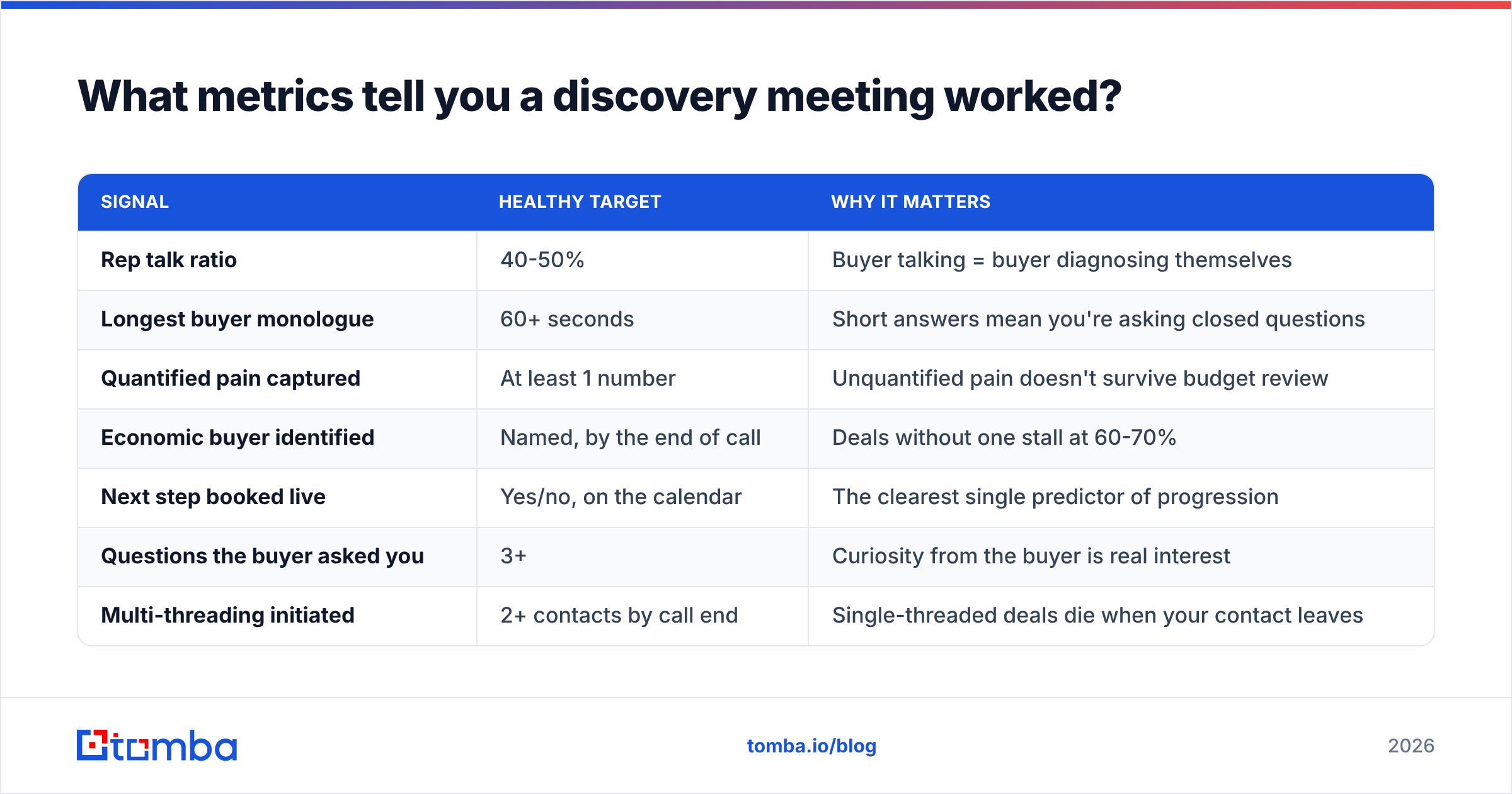
Stop grading discovery on "did it feel good." Feelings are a lagging, unreliable indicator — happy calls stall all the time. Grade on observable artifacts.
| Signal | Healthy target | Why it matters |
|---|---|---|
| Rep talk ratio | 40-50% | Buyer talking = buyer diagnosing themselves |
| Longest buyer monologue | 60+ seconds | Short answers mean you're asking closed questions |
| Quantified pain captured | At least 1 number | Unquantified pain doesn't survive budget review |
| Economic buyer identified | Named, by the end of call | Deals without one stall at 60-70% |
| Next step booked live | Yes/no, on the calendar | The clearest single predictor of progression |
| Questions the buyer asked you | 3+ | Curiosity from the buyer is real interest |
| Multi-threading initiated | 2+ contacts by call end | Single-threaded deals die when your contact leaves |
Track these in your call recording tool or your CRM. Five of the seven are binary, which makes them easy to audit at scale during pipeline reviews.
One nuance on talk ratio: it's a symptom, not a lever. Telling a rep "talk less" produces awkward silence. Telling them "ask a follow-up to their last answer before introducing a new topic" produces the same ratio improvement and a better call.
How does discovery change for inbound vs outbound meetings?#
Materially. Treating them the same is a common and expensive error.
Inbound. The buyer already has a hypothesis about you. Your job is narrowing: what specifically did they read, what triggered the search, and what internal conversation preceded the form fill. Skip the education. Ask "what were you hoping to see today?" in the first two minutes and let them drive.
Outbound. The buyer has no hypothesis. Your job is creating one, then testing it. You earn the right to ask diagnostic questions by leading with an insight — a pattern you see in companies like theirs. Outbound discovery calls run longer in the frame and context blocks and shorter in the decision-process block, because you're usually not talking to the economic buyer yet.
Referral / warm intro. Highest-converting, most often botched. Reps get comfortable and skip qualification because a trusted person made the intro. Run the same call. Warm doesn't mean qualified.
A relevant benchmark: outbound-sourced discovery meetings convert to opportunity at roughly half the rate of inbound ones across most B2B teams. That's not a reason to stop outbound — it's a reason to fix the top of the funnel so the meetings you do book are with the right titles. Better contact enrichment at the list-building stage moves this number more than call coaching does.
What should you do in the 24 hours after the call?#
The recap email is part of the discovery meeting, not an afterthought. Send it within four hours, while the conversation is still the most recent thing in their inbox.
Structure it in four blocks:
- What we heard — their words, their numbers, three bullets max
- What we agreed matters — the one or two priorities, ranked
- What happens next — the booked meeting, date, attendees, what each side brings
- One open question — gives them a reason to reply, which keeps the thread alive
Never attach a deck. Never include pricing unless they asked. The recap's job is to be forwardable — your champion will paste it into Slack to explain the call to their boss, and every extra attachment reduces the odds of that happening.
Then update the CRM the same day, with the framework fields filled and the gaps flagged. A discovery call you didn't document is a discovery call your manager can't coach and your successor can't inherit.
Common questions#
How long should a discovery meeting be? Thirty minutes for SMB, forty-five for mid-market, sixty for enterprise with multiple attendees. Ending early because you disqualified is a win, not a failure.
Should you demo during discovery? Generally no. A two-minute contextual glimpse after you've mapped pain is acceptable. A full walkthrough means you gave up on diagnosing.
What if the prospect asks for pricing in minute three? Give a range, then redirect: "Teams your size usually land between X and Y — but I'd be guessing until I understand what you're trying to fix. Can I ask two questions first?"
How many people should attend? Two from your side maximum (rep plus SE if technical). More than two from theirs is a good sign — it means they've already socialized the problem internally.
What if they won't answer implication questions? They don't trust you yet, or they don't know the answer. Try "how do you currently track that?" — often they simply haven't measured it, which is itself a finding you can use.
Where to start#
Fix the input before you fix the call. Most discovery meetings that go badly were doomed at the list-building stage — wrong title, stale contact, company that was never going to buy. A tighter question sequence can't rescue a meeting with someone who has no problem to solve.
If your discovery calendar is full of the wrong people, start upstream. The Tomba Email Finder lets you build target lists by domain, name, or company so you're booking meetings with the titles that actually own the problem — with verification built in so your invites land. The free tier includes 25 searches a month, and paid plans start at $49/mo on the Starter tier; see Tomba pricing for the Growth ($99/mo) and Pro ($249/mo) breakdown. Get the targeting right, and the discovery meeting gets easier on its own.
Related guides#
Ready to find emails that actually work?
Join 150,000+ professionals who stopped guessing and started sending. Free credits on signup — no credit card required.
Get the Tomba newsletter
Practical outbound tactics and product updates — once every two weeks.
About the author