Discovery Meeting Questions: 40 That Actually Qualify
Most discovery calls fail in the first four minutes. Here are 40 discovery meeting questions that surface real pain, budget, and authority — plus the ones that quietly kill deals.
TL;DR
- A discovery meeting is a qualification interview, not a demo. If you presented slides, you ran a pitch.
- The best discovery meeting questions are open, past-tense, and about consequences — "what happened the last time this broke?" beats "what are your goals?"
- Frameworks (BANT, MEDDPICC, SPIN, GPCTBA) are checklists for what you need to learn, not scripts for how to ask.
- Talk-to-listen ratio matters more than question count. Aim for 30% you, 70% them.
- A discovery call that ends without a named next step, a named economic buyer, and a named consequence of inaction was a nice conversation, not a sales call.
What is a discovery meeting, and what is it actually for?#
A discovery meeting is the first real conversation where you find out whether a deal exists. Not whether the prospect is polite. Not whether they liked your outbound email. Whether there is a problem, a cost to that problem, money to fix it, and a person who can sign.
Think of it like a doctor's intake appointment. Nobody wants a surgeon who walks in and starts describing the procedure before asking where it hurts. Yet that is exactly what most reps do — they open the deck at minute four and spend twenty-six minutes explaining features to someone who has not told them a single thing about their situation.
The purpose of discovery is threefold:
- Qualify or disqualify fast. A "no" in week one is worth more than a "maybe" in week nine. Disqualification is a win, and your pipeline hygiene depends on it.
- Build the business case in the prospect's own words. You are collecting quotes you will repeat back in the proposal. Their language, not yours.
- Map the buying committee. Modern B2B purchases involve six to ten stakeholders. The person on the call is rarely the only decision maker.
Everything else — rapport, product education, next-step scheduling — is secondary to those three.
What should you do before you ask a single question?#
Bad discovery meeting questions are usually the result of bad preparation. If you spend the first ten minutes asking things you could have found on the company's website, you have burned a third of the meeting proving you did not care enough to look.
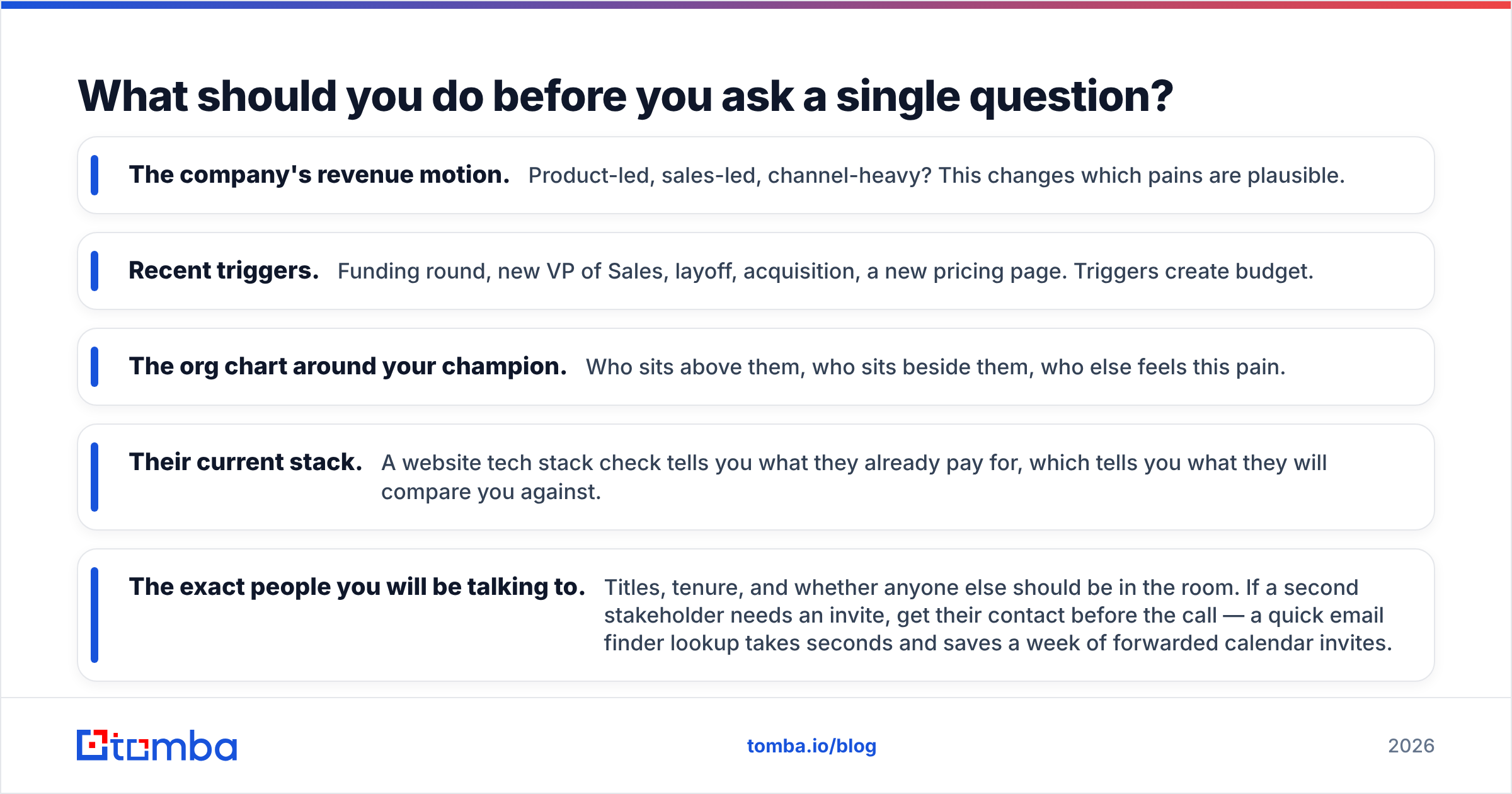
Before the call, know:
- The company's revenue motion. Product-led, sales-led, channel-heavy? This changes which pains are plausible.
- Recent triggers. Funding round, new VP of Sales, layoff, acquisition, a new pricing page. Triggers create budget.
- The org chart around your champion. Who sits above them, who sits beside them, who else feels this pain.
- Their current stack. A website tech stack check tells you what they already pay for, which tells you what they will compare you against.
- The exact people you will be talking to. Titles, tenure, and whether anyone else should be in the room. If a second stakeholder needs an invite, get their contact before the call — a quick email finder lookup takes seconds and saves a week of forwarded calendar invites.
Ten minutes of prep converts a generic discovery call into a specific one. Specific calls close.
Wait — that image reference should be plain. Here it is:
What are the best discovery meeting questions to open with?#
The first five minutes set the frame. You want permission to ask hard things later, and you get that by being direct now.
Opening and framing (ask 2–3):
- "Before we start — what made you take this call?"
- "What would make the next 30 minutes worth your time?"
- "I've got a few questions about how things run today. Is it fair if I push a bit on the details?"
- "Who else on your side lives with this problem day to day?"
- "How much of what you saw in my email actually matches your situation?"
Question 1 is the highest-leverage question in sales. The answer tells you whether you have a curiosity call or a pain call. "My boss asked me to look at options" and "our current system dropped 4,000 records last month" lead to completely different conversations.
Current-state questions (ask 4–6):
- "Walk me through how your team does this today, start to finish."
- "Which parts of that are automated, and which parts are someone's manual Tuesday?"
- "What tools are in the workflow right now?"
- "How long has it worked this way?"
- "Who owns the process — and who complains about it?"
- "How many people touch it in a given week?"
- "What does 'good' look like when it's working properly?"
Notice these are all observational. You are building a map before you critique the terrain.
Which discovery meeting questions uncover pain, budget, and authority?#
This is where most calls go soft. Reps ask "what are your challenges?" — a question so vague it invites a rehearsed non-answer — and then move on without a number attached to anything.
Pain and consequence (ask 4–6):
- "What happened the last time this broke?"
- "How often does that happen?"
- "What did it cost you — hours, dollars, or a customer?"
- "Who noticed? Did it reach your leadership?"
- "If nothing changes in the next two quarters, what happens?"
- "What have you already tried to fix it?"
- "Why didn't that work?"
Question 18 and 19 are the pair everyone skips. If they already bought a tool for this and it failed, you are not selling into a green field — you are selling against a scar. You need to know that before your proposal lands on a desk that remembers the last invoice.
Impact and quantification (ask 3–4):
- "If we fixed this tomorrow, what number on your dashboard moves?"
- "By how much, roughly, before anyone would call it a success?"
- "What's that worth annually?"
- "Is anyone else in the company measured on that number?"
Decision process and authority (ask 4–6):
- "Walk me through how a purchase like this normally gets approved here."
- "Who signs? And who can say no even if they can't say yes?"
- "Has your team bought something similar in the last year? How did that go?"
- "Is there a budget line for this already, or would it be created?"
- "What's the procurement or security review look like?"
- "What would make legal slow this down?"
- "If you and I agreed today, what's the fastest realistic path to a signature?"
Timeline and competition (ask 3–4):
- "Why now, rather than six months from now?"
- "Is there a date this needs to be live by? What's driving it?"
- "Who else are you evaluating?"
- "What would they say they do better than us?"
Closing the loop (ask 3–4):
- "What did I not ask that I should have?"
- "On a scale of one to ten, how urgent is this internally?" (Then: "What would make it a nine?")
- "What's the most likely reason this doesn't happen?"
- "Who needs to be on the next call for it to be useful?"
- "Can we put that on the calendar before we hang up?"
- "Anything about your situation that makes you skeptical this is a fit?"
Question 37 — "what's the most likely reason this doesn't happen?" — is the single most predictive question on the list. Prospects will tell you exactly how the deal dies if you make it safe to say so.
How do the major discovery frameworks compare?#
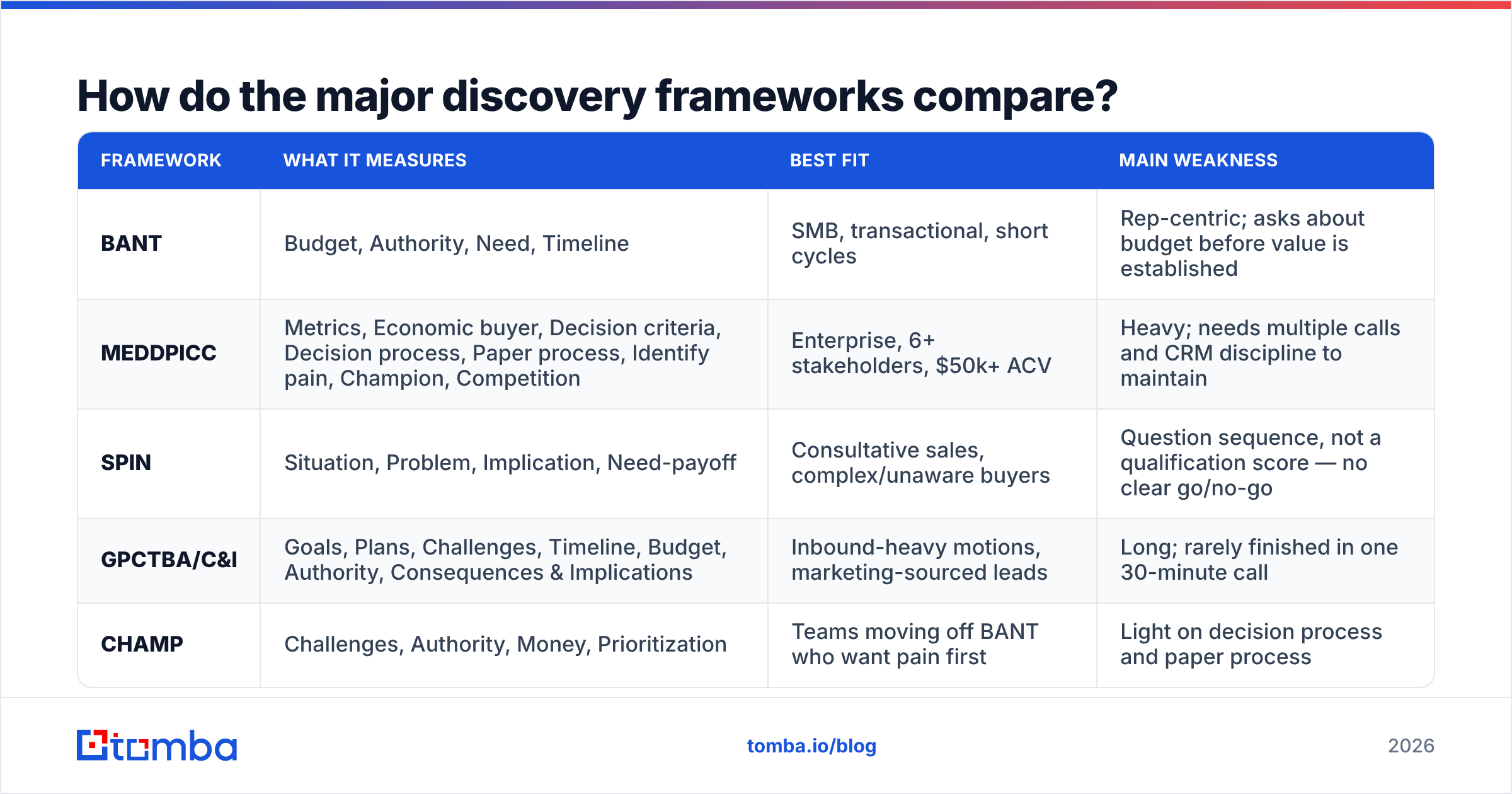
Frameworks are checklists of what you must learn, not scripts. Pick one, run it consistently, and your forecast accuracy improves because everyone on the team means the same thing by "qualified." Analyst firms including Gartner have documented for years that consistent qualification is a bigger lever on win rate than talk tracks are.
| Framework | What it measures | Best fit | Main weakness |
|---|---|---|---|
| BANT | Budget, Authority, Need, Timeline | SMB, transactional, short cycles | Rep-centric; asks about budget before value is established |
| MEDDPICC | Metrics, Economic buyer, Decision criteria, Decision process, Paper process, Identify pain, Champion, Competition | Enterprise, 6+ stakeholders, $50k+ ACV | Heavy; needs multiple calls and CRM discipline to maintain |
| SPIN | Situation, Problem, Implication, Need-payoff | Consultative sales, complex/unaware buyers | Question sequence, not a qualification score — no clear go/no-go |
| GPCTBA/C&I | Goals, Plans, Challenges, Timeline, Budget, Authority, Consequences & Implications | Inbound-heavy motions, marketing-sourced leads | Long; rarely finished in one 30-minute call |
| CHAMP | Challenges, Authority, Money, Prioritization | Teams moving off BANT who want pain first | Light on decision process and paper process |
If you run a 30-minute call with mid-market prospects, CHAMP or a trimmed MEDDPICC is realistic. If you run 60-minute enterprise calls with a solutions engineer, full MEDDPICC earns its overhead. Whatever you choose, write the fields into your CRM as required stage-gate fields, or the framework becomes a poster nobody reads.
What discovery meeting questions should you never ask?#
Some questions actively cost you credibility:
- "So, what do you know about us?" You are making them do your work. Ask what problem brought them instead.
- "What's your budget?" in minute three. Before value exists, this reads as a qualification interrogation. Move it after impact quantification.
- "Are you the decision maker?" Nobody says no. Ask how purchases get approved instead — the process reveals the people.
- Leading questions. "Wouldn't it be great if that were automated?" You already know the answer, and so do they. You learn nothing.
- Stacked questions. "How does the process work today, and what's broken, and who owns it?" They answer the last one only.
- Feature bait. "Would integrations be valuable to you?" Everything sounds valuable in the abstract. Ask what they had to do manually last week instead.
One more anti-pattern: filling silence. After a hard question, count to four. The second half of an answer is where the truth usually lives.
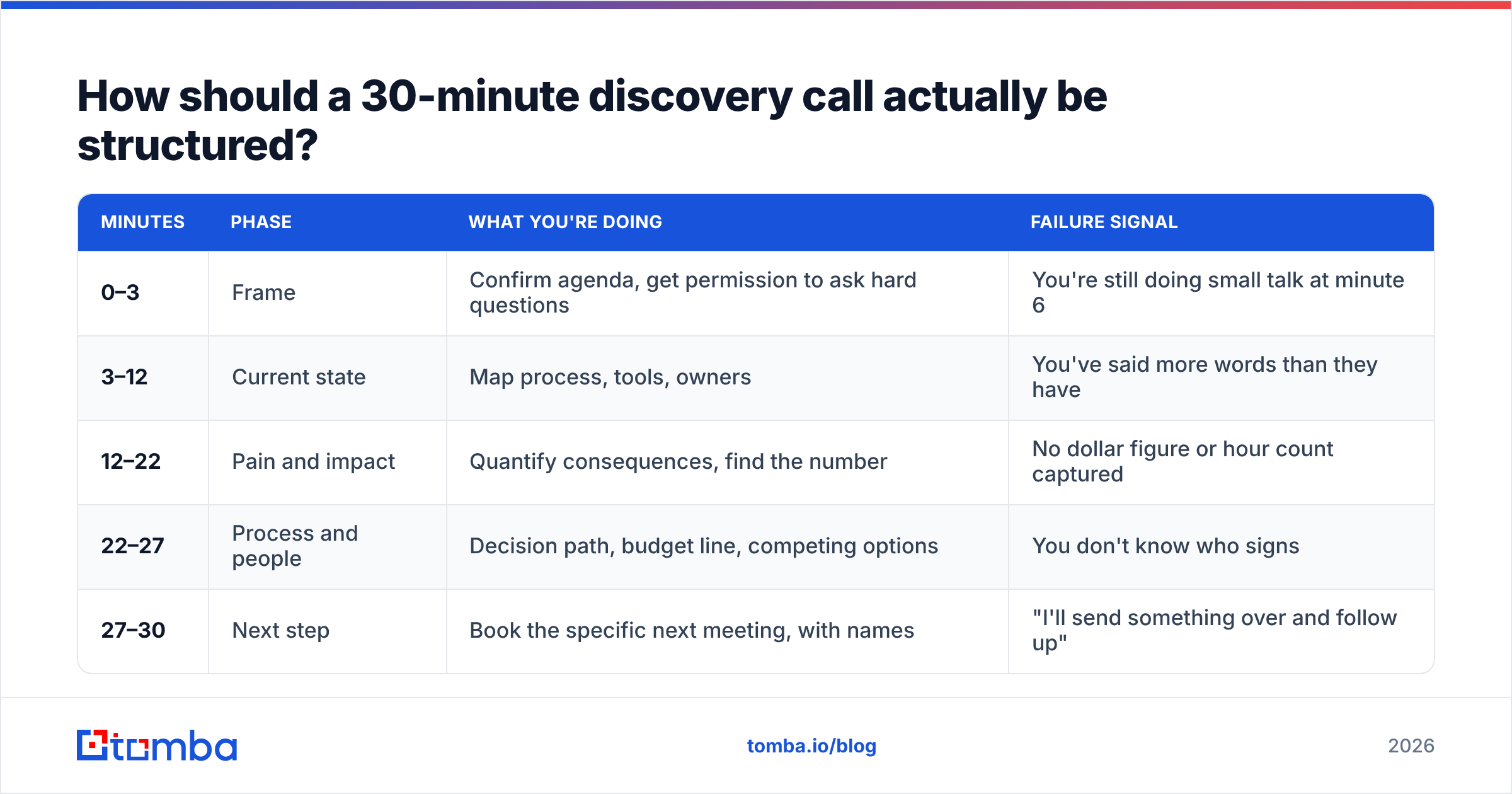
How should a 30-minute discovery call actually be structured?#
| Minutes | Phase | What you're doing | Failure signal |
|---|---|---|---|
| 0–3 | Frame | Confirm agenda, get permission to ask hard questions | You're still doing small talk at minute 6 |
| 3–12 | Current state | Map process, tools, owners | You've said more words than they have |
| 12–22 | Pain and impact | Quantify consequences, find the number | No dollar figure or hour count captured |
| 22–27 | Process and people | Decision path, budget line, competing options | You don't know who signs |
| 27–30 | Next step | Book the specific next meeting, with names | "I'll send something over and follow up" |
The most common structural failure is spending 22 minutes on current state because it feels productive and safe. It isn't. Set a mental timer.
How do you know discovery actually worked?#
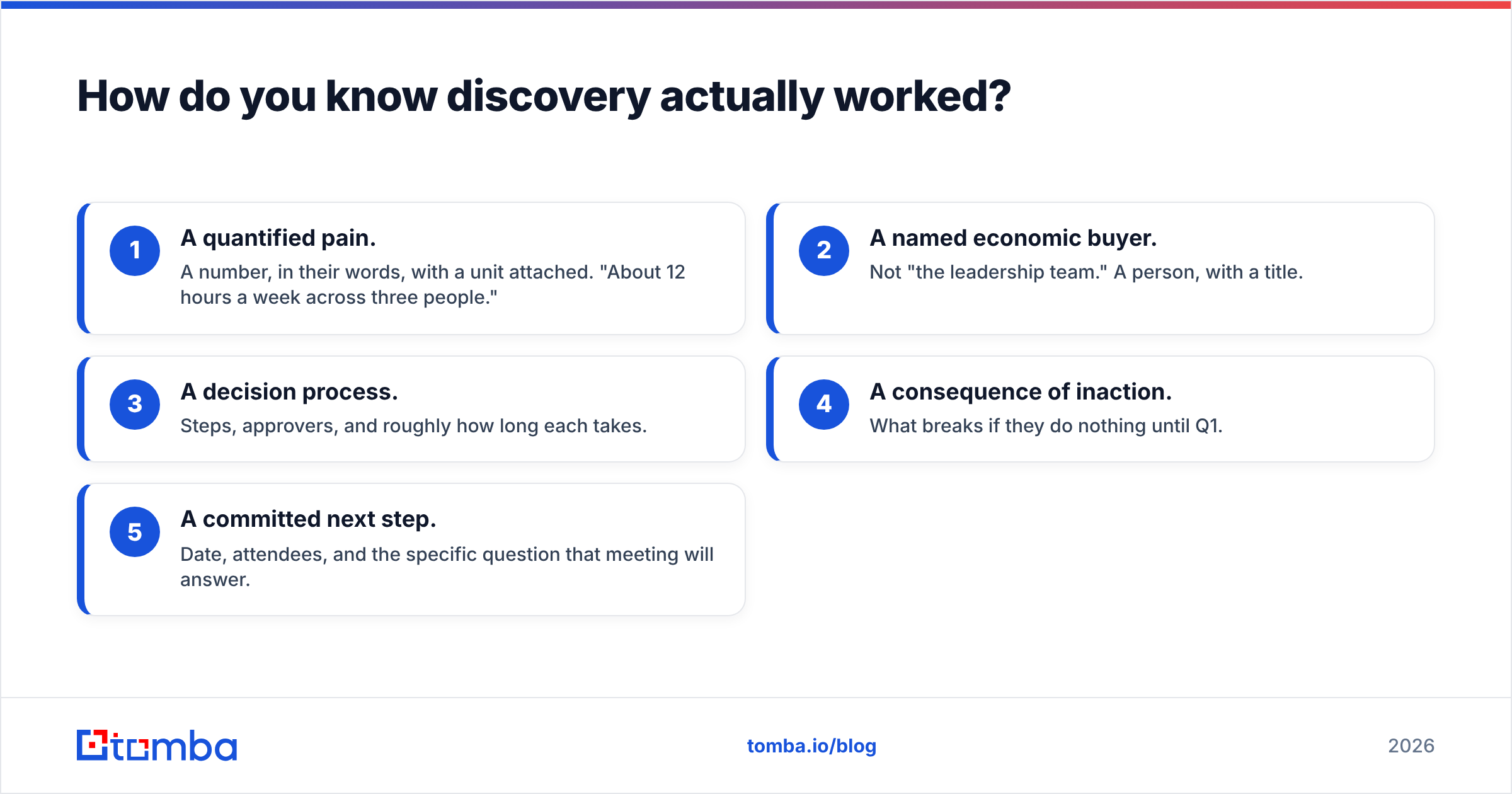
Score every call against five artifacts. If you cannot produce all five, the meeting was incomplete — book a second discovery before you demo.
- A quantified pain. A number, in their words, with a unit attached. "About 12 hours a week across three people."
- A named economic buyer. Not "the leadership team." A person, with a title.
- A decision process. Steps, approvers, and roughly how long each takes.
- A consequence of inaction. What breaks if they do nothing until Q1.
- A committed next step. Date, attendees, and the specific question that meeting will answer.
Teams that enforce this see it show up in win rate within a quarter — mostly because bad deals leave the forecast earlier, not because good deals close faster. That is the honest version of the benefit.
A note on demo pressure: if the prospect pushes for a demo mid-discovery, give them a two-minute targeted view of one screen that solves the pain they just described, then return to questions. A full demo without discovery is a product tour, and product tours do not create urgency.
How do you get enough of the right meetings to practice on?#
The best discovery meeting questions are wasted on the wrong meetings. If half your calls are with people who never had the problem, your close rate is a sourcing issue, not a questioning issue.
Two fixes worth more than any script:
- Tighten the trigger. Book meetings off observable events — a new hire in the relevant function, a tooling change, a funding round — not off a title filter alone. Vendor-neutral review sites like G2 are useful for spotting which competing tools a company already lists in its stack.
- Enrich before you dial. Walking into discovery already knowing headcount, tech stack, and reporting lines lets you skip five throwaway questions and go straight to consequences. Contact and company data enrichment does this at list level rather than one tab at a time. Sales orgs that document this handoff — including HubSpot's own sales methodology guidance — treat pre-call research as part of the meeting, not preparation for it.
Then run the same 40 questions, in the same order, on every call for a month. Consistency is what turns discovery from a personality trait into a repeatable process you can coach.
Where to start#
Pick eight questions from this list — two framing, three pain, two process, one next-step — and run them verbatim on your next five calls. Record them. Count your talk ratio. You will find at least two questions where prospects consistently give you gold, and two where they stall. Keep the gold, cut the stalls, repeat.
And before those calls exist, you need the right people in the room. Tomba Email Finder gets you verified work emails for the second and third stakeholders your champion mentions — the ones who quietly decide whether the deal survives. The free tier covers 25 searches a month, and paid plans start at $49/mo; full Tomba pricing is public. Fill the room first, then ask the better questions.
Related guides#
Ready to find emails that actually work?
Join 150,000+ professionals who stopped guessing and started sending. Free credits on signup — no credit card required.
Get the Tomba newsletter
Practical outbound tactics and product updates — once every two weeks.
About the author