Discovery Objections Cheat Sheet: 14 Replies That Work
The 14 objections that actually derail discovery calls — plus word-for-word responses, a routing table, and the diagnostic questions that stop them from showing up at all.
TL;DR
- Most discovery objections are not rejections. They are requests for information you failed to give in the first 90 seconds.
- Nine out of ten objections on a discovery call fall into five buckets: timing, budget, authority, status quo, and trust. Learn the bucket, not the script.
- The single highest-leverage move is acknowledge → isolate → reframe → re-question. Skip the isolate step and you will handle the wrong objection.
- "Send me some info" and "we already have a vendor" are the two most commonly mishandled. Both are answered with a question, never a pitch.
- A lot of what looks like objection handling is actually pre-call research. If you know the prospect's stack, headcount, and hiring signals before dialing, half the list below never comes up.
Discovery calls fail in predictable ways. The prospect agreed to 30 minutes, showed up, and then — four minutes in — said something that knocked you off your plan. You improvised. The call ended with "let's reconnect next quarter." No next step, no champion, no deal.
This is the cheat sheet for that moment. Fourteen objections, what each one actually means, and language you can use without sounding like you're reading from a card. Then the part most cheat sheets skip: how to make the objection not happen at all.
What counts as a discovery objection?#
A discovery objection is resistance raised before the prospect has agreed there is a problem worth solving. That distinction matters. Objections raised late in a deal — pricing pushback, security review, procurement friction — are negotiation objections, and they need a different playbook entirely.
Discovery objections are cheap to raise and cheap to abandon. Nobody has invested anything yet. When a prospect says "we don't have budget" 6 minutes into a first call, they are not reporting a fact from a spreadsheet. They are saying I don't yet believe this is worth the cost of finding out more. Those are different sentences and they need different responses.
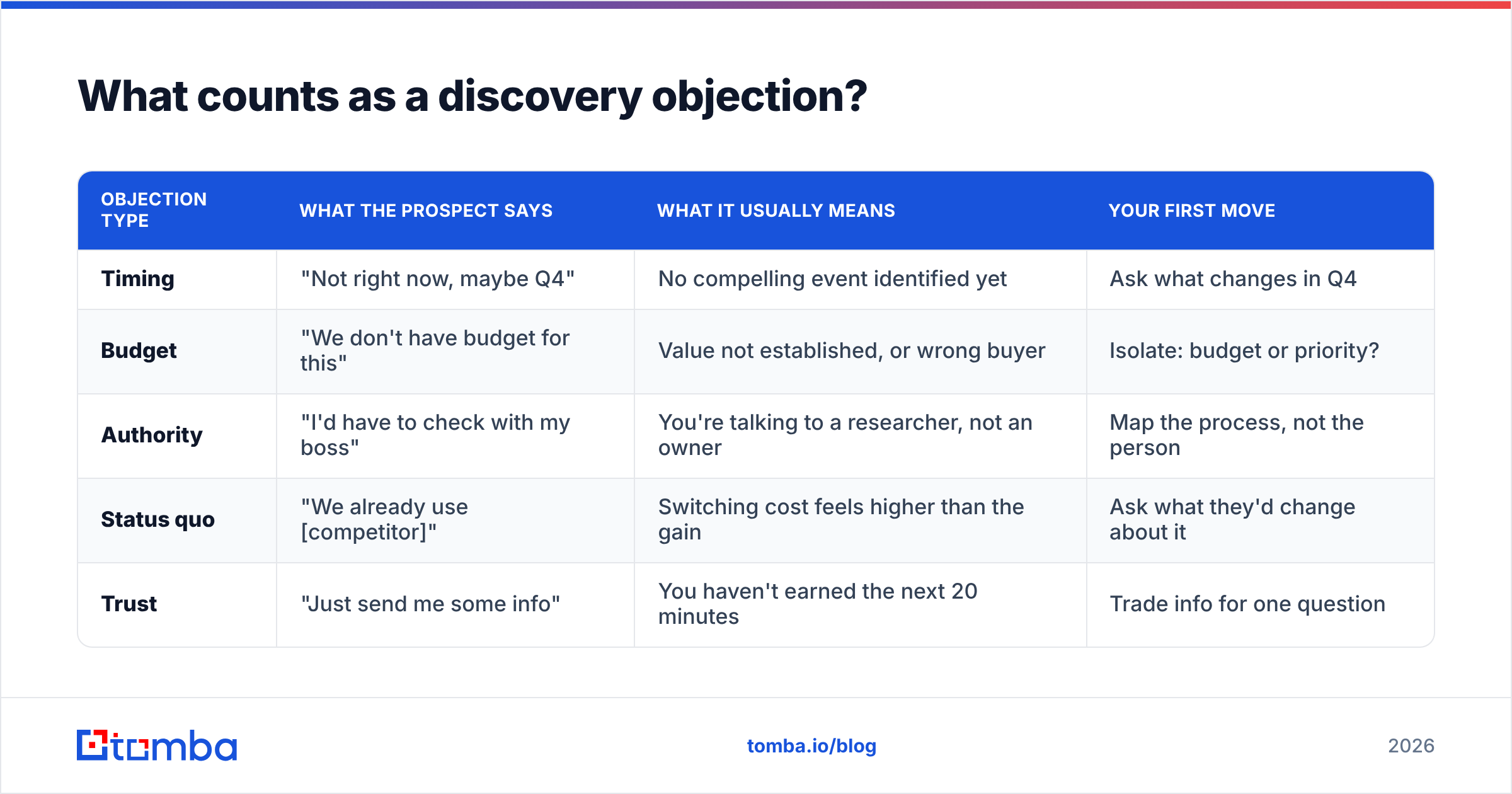
Here's the classification that actually holds up across segments:
| Objection type | What the prospect says | What it usually means | Your first move |
|---|---|---|---|
| Timing | "Not right now, maybe Q4" | No compelling event identified yet | Ask what changes in Q4 |
| Budget | "We don't have budget for this" | Value not established, or wrong buyer | Isolate: budget or priority? |
| Authority | "I'd have to check with my boss" | You're talking to a researcher, not an owner | Map the process, not the person |
| Status quo | "We already use [competitor]" | Switching cost feels higher than the gain | Ask what they'd change about it |
| Trust | "Just send me some info" | You haven't earned the next 20 minutes | Trade info for one question |
Everything below is a variation on one of those five. If you memorize nothing else, memorize the routing table — it tells you which of the four responses to reach for before your brain has finished processing what they said.
Why does the four-step frame beat memorized scripts?#
Because scripts break the moment a prospect phrases the objection slightly differently, and they always do. The frame doesn't break.
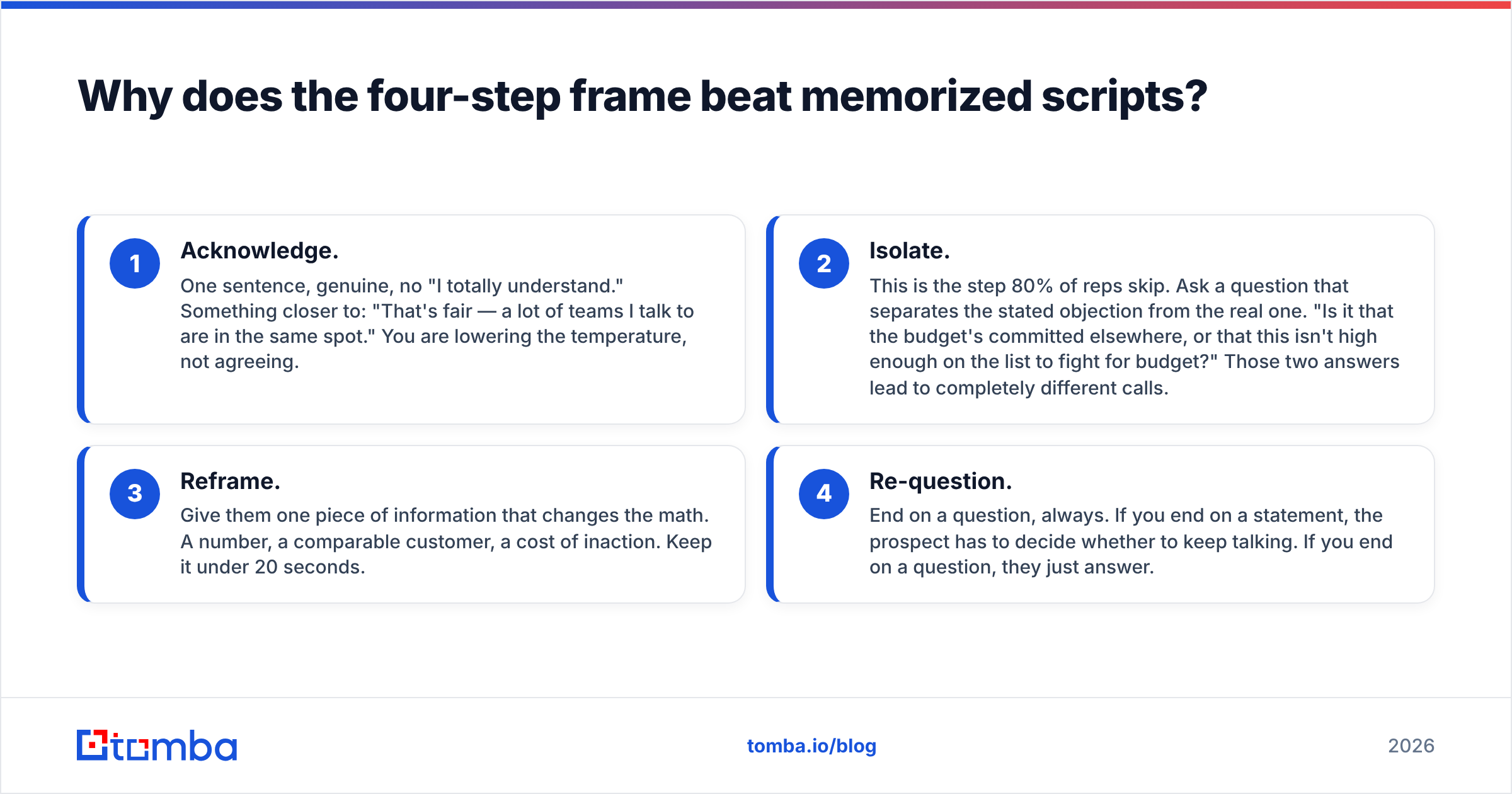
- Acknowledge. One sentence, genuine, no "I totally understand." Something closer to: "That's fair — a lot of teams I talk to are in the same spot." You are lowering the temperature, not agreeing.
- Isolate. This is the step 80% of reps skip. Ask a question that separates the stated objection from the real one. "Is it that the budget's committed elsewhere, or that this isn't high enough on the list to fight for budget?" Those two answers lead to completely different calls.
- Reframe. Give them one piece of information that changes the math. A number, a comparable customer, a cost of inaction. Keep it under 20 seconds.
- Re-question. End on a question, always. If you end on a statement, the prospect has to decide whether to keep talking. If you end on a question, they just answer.
The isolate step is what separates a discovery objections cheat sheet that works from one that produces robotic calls. You cannot respond correctly to "no budget" until you know whether that means zero dollars exist, dollars exist but are allocated, or dollars exist and are unallocated but you haven't convinced me.
What are the 14 objections and how do you answer each?#
Grouped by bucket. Each one gets the meaning and the language.
Timing objections#
1. "Now's not a great time — call me next quarter."
Meaning: no compelling event. Nothing breaks if they do nothing.
Response: "Happy to. So I make that call useful — what's different in October that isn't true today? Is there a budget cycle, a headcount change, something rolling off contract?" If they can't name anything, gently say so: "If nothing specific changes, next quarter might feel exactly like this one. What would have to happen for this to become urgent?"
2. "We're in the middle of [migration / reorg / fundraise]."
Meaning: real constraint, usually genuine. Don't fight it.
Response: "That makes sense — those eat everything. Two questions: when does that wrap, and does the new setup change what you need from [category]?" You're getting a date and a requirements update in one move.
3. "Let's revisit after the new fiscal year."
Meaning: could be budget-parking, could be real.
Response: "Understood. Is the plan to bring this into the FY27 budget, or is it a wait-and-see?" If it's a budget line, you have a live deal — start building the business case now. If it's wait-and-see, it's a timing objection wearing a budget costume.
Budget objections#
4. "We don't have budget for this."
Response: "Is the budget committed to something else, or does the line not exist yet?" Then, depending: for committed, "What would this have to beat to earn a slice?" For nonexistent, "Who creates that line when something's worth it?"
5. "That's more than we want to spend."
Note: on a discovery call, this is premature — you haven't quoted anything, or you quoted too early. Response: "We're not there yet, and I don't want to sell you something oversized. Before pricing, help me understand scale: how many people would touch this, and how often?"
6. "We can build this internally."
Meaning: they're pricing your product against engineering time they think is free.
Response: "A lot of teams can. The ones who tried usually tell me the build took a sprint and the maintenance took forever — data goes stale, sources change. If you did build it, who owns it in month six?"
Authority objections#
7. "I'd need to run this past my manager."
Response: "Of course. What does that conversation usually look like — do you present it, or do they want to hear it directly? And what does your manager care about that you and I haven't talked about yet?" You've just been handed the second stakeholder's criteria for free.
8. "This isn't really my decision."
Response: "Got it — so I'm not wasting your time: what is your role in this? Are you evaluating options, or gathering info for someone else?" Researchers are still valuable. They just need different treatment: arm them, don't pitch them.
9. "Procurement handles all vendor stuff."
Response: "Makes sense. Does procurement pick the vendor, or approve the one the team picks?" Almost always the latter. Then: "So who's the team lead who'd make the call before it hits procurement?"
Status-quo objections#
10. "We already use [competitor]."
Never disparage the incumbent. Response: "Good tool. What would you change about it if you could change one thing?" Then shut up. If they name nothing, the deal isn't there today — move to a nurture cadence. If they name something, you've got your wedge.
11. "We're happy with our current setup."
Response: "That's the best answer you can give me, honestly. Just so I know whether to stop bothering you — where does it break down? Every setup has one thing." The permission-to-stop framing gets you a truer answer than "what are your pain points."
12. "We handle this manually and it's fine."
Response: "How many hours a week does 'fine' cost?" Then quantify with them, out loud. Manual processes survive because nobody has ever put a number on them.
Trust objections#
13. "Just send me some information."
The most-fumbled objection in B2B. Sending a deck ends the deal 90% of the time.
Response: "Happy to — but I'd send you the wrong thing. One question so I send something useful: is the bigger issue [X] or [Y]?" You get a real answer, and now the "information" is a personalized follow-up with a reason to book time.
14. "How did you get my email?"
Meaning: they feel targeted, not researched. Answer plainly and immediately.
Response: "Your address follows your company's public format and I confirmed it before reaching out — I'd rather do that than guess and spam five variations. I reached out because [specific, provable signal]." Transparency defuses this in one sentence. Vagueness makes it worse. This is why sourcing contacts through a proper email verifier rather than a permutation guess matters — you can answer this question without flinching.
Which objections should you refuse to handle?#
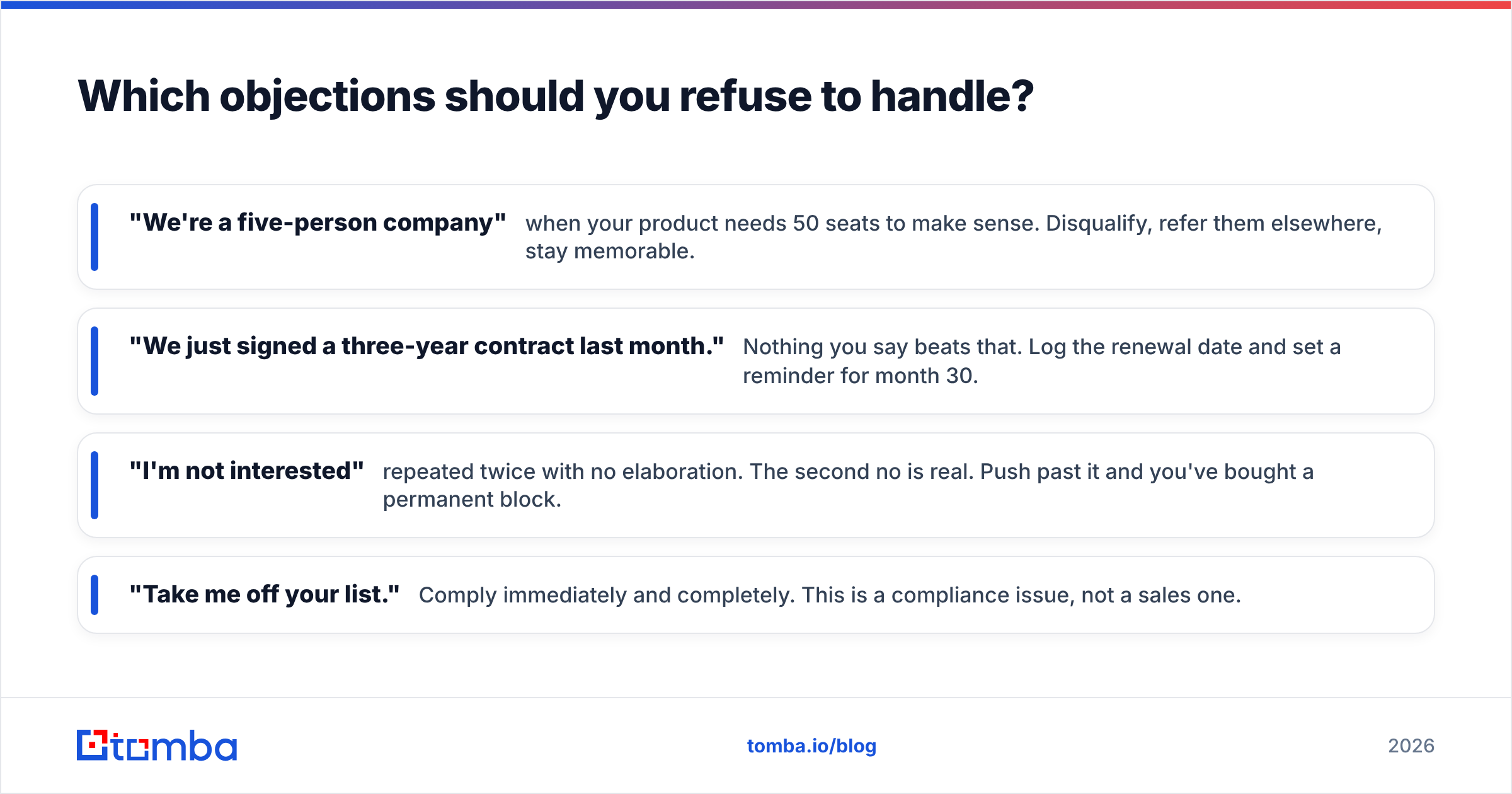
Some objections should be accepted, not overcome. Trying to overcome them burns credibility you'll want later.
- "We're a five-person company" when your product needs 50 seats to make sense. Disqualify, refer them elsewhere, stay memorable.
- "We just signed a three-year contract last month." Nothing you say beats that. Log the renewal date and set a reminder for month 30.
- "I'm not interested" repeated twice with no elaboration. The second no is real. Push past it and you've bought a permanent block.
- "Take me off your list." Comply immediately and completely. This is a compliance issue, not a sales one.
Knowing which objections are terminal is a skill. Reps who "never take no" have great activity metrics and bad win rates, because they spend their week re-litigating deals that were never deals.
How do you stop objections before the call starts?#
The uncomfortable answer: most discovery objections are self-inflicted, and the fix happens before you dial.
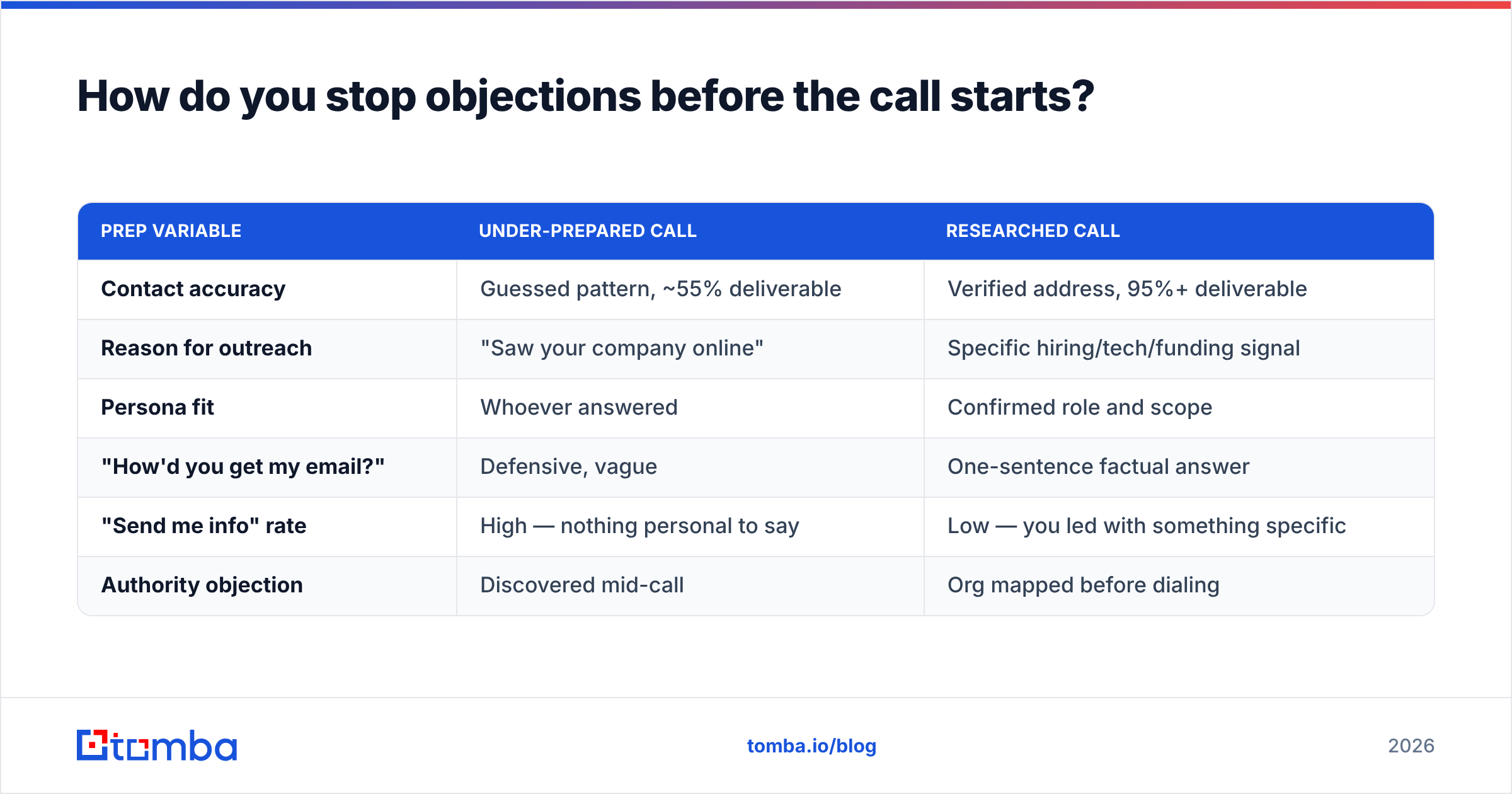
Here's the difference between an objection-heavy discovery call and a clean one, side by side:
| Prep variable | Under-prepared call | Researched call |
|---|---|---|
| Contact accuracy | Guessed pattern, ~55% deliverable | Verified address, 95%+ deliverable |
| Reason for outreach | "Saw your company online" | Specific hiring/tech/funding signal |
| Persona fit | Whoever answered | Confirmed role and scope |
| "How'd you get my email?" | Defensive, vague | One-sentence factual answer |
| "Send me info" rate | High — nothing personal to say | Low — you led with something specific |
| Authority objection | Discovered mid-call | Org mapped before dialing |
Four prep moves that remove the most objections:
- Verify the contact before you write the email. Bouncing into a spam folder is not an objection you get to handle — it's a call that never happens. Run addresses through a real verification step rather than a permutation guess; Tomba's email verifier and catch-all verifier exist for exactly this, and clean lists protect your sender reputation as a side effect.
- Map the org, not the person. Before the call, know who else touches this decision. Domain search across a target company surfaces the adjacent roles — ops, finance, the manager above your contact — so the authority objection becomes a question you ask, not one you receive.
- Find a real trigger. New role postings, a tech stack change, a funding round, a leadership hire. G2 research on B2B buying behavior consistently shows buyers engage vendors far later than sellers assume — meaning your trigger has to be theirs, not yours. HubSpot's sales statistics roundup makes the same point about response rates on untargeted outreach.
- Pre-write your isolate questions. For each of the five buckets, have one isolate question ready. Not a script — one question. That's the difference between a smooth handle and a pause.

How do you practice this without burning live calls?#
Objection handling degrades fast without reps. Three drills that work:
- Bucket-sorting. Pull 20 real objections from your call recordings. Sort them into the five buckets in under 60 seconds. If you can sort fast, you can respond fast.
- Isolate-only drills. Partner reads an objection. You respond with only the isolate question. No acknowledge, no pitch. Ten reps. This builds the muscle everyone lacks.
- Silence practice. After you ask the isolate question, count to five before speaking. Most reps break at two and answer their own question. The prospect's answer is worth more than anything you'd say in that gap.
Record the drills. Reviewing your own audio is uncomfortable and it works faster than any coaching session.
What does a good discovery call look like after this?#
Fewer objections, and the ones that come are more useful. You'll notice three changes within a month:
- Objections arrive later in the call, which means the prospect engaged before pushing back.
- "Send me info" drops sharply, because your opening 90 seconds now carries a specific, provable reason for the call.
- More clean disqualifications, which feels worse and produces a better pipeline. A short honest pipeline beats a long hopeful one.
The mechanical stuff — accurate contacts, mapped orgs, real triggers — is doing a lot of the work here. Objection handling is the last mile, not the whole road. If your discovery calls are objection-heavy across the board, the problem is upstream of the call.
That's the fix worth making first. Get contact data right, know who you're calling and why, and half this cheat sheet becomes theoretical. Start with the Tomba Email Finder — find verified addresses by name or domain, confirm the role before you dial, and answer "how did you get my email?" with a straight face. The free tier includes 25 searches a month, and paid plans start at $49/mo on Tomba pricing if you're running volume. Better inputs, fewer objections, shorter calls.
Related guides#
Ready to find emails that actually work?
Join 150,000+ professionals who stopped guessing and started sending. Free credits on signup — no credit card required.
Get the Tomba newsletter
Practical outbound tactics and product updates — once every two weeks.
About the author