Discovery Questions That Actually Qualify Deals in 2026
Most discovery calls fail because reps ask questions that feel like an interrogation. Here are the discovery questions that surface real pain, budget, and timing — plus the ones to stop asking.
TL;DR
- Discovery questions exist to disqualify fast, not to fill a CRM form. If your call notes read like a checklist, you ran an interview, not a discovery.
- The highest-yield questions are consequence questions ("what happens if you do nothing for another two quarters?") — they force the buyer to price their own pain.
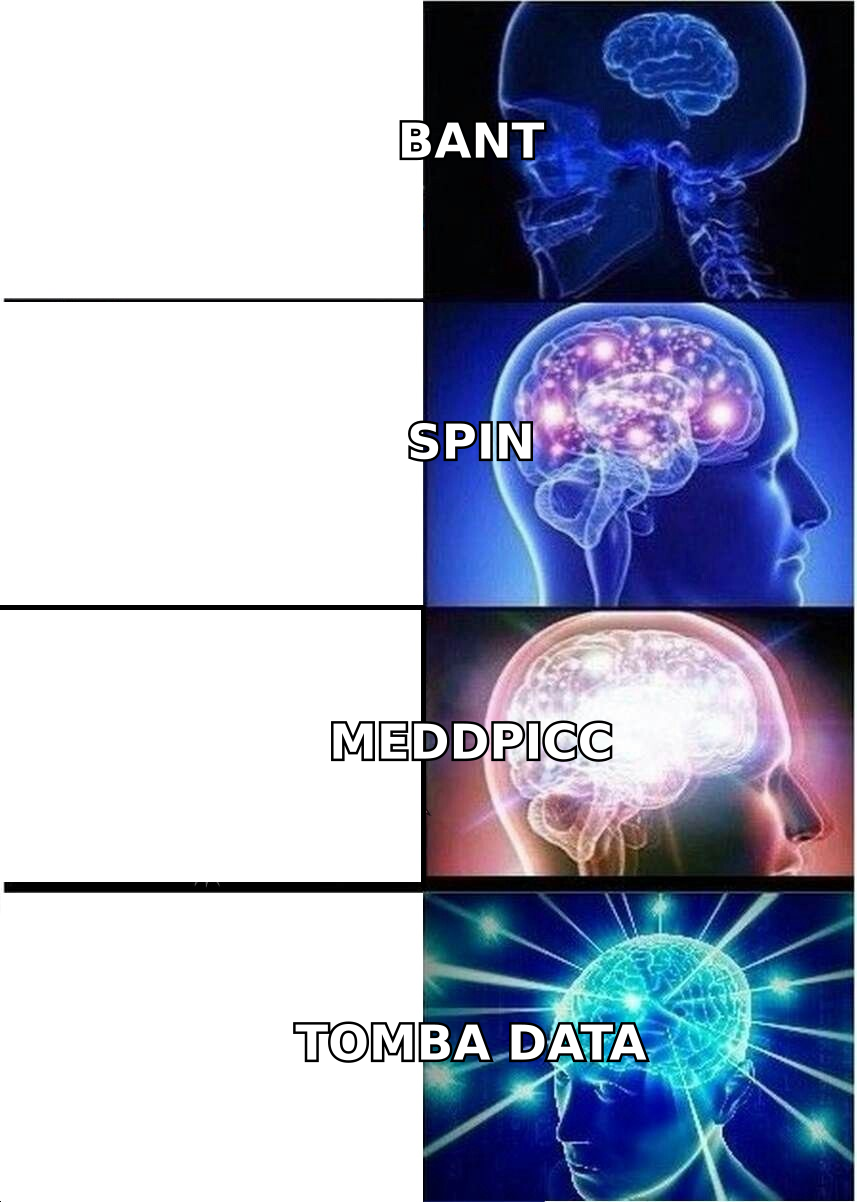
- Frameworks (BANT, SPIN, MEDDPICC, GAP) are scaffolding, not scripts. Pick one, then throw away the wording.
- Pre-call research beats clever questioning. Every minute you spend asking what's already on the buyer's website is a minute you don't spend on their actual problem.
- Score every discovery call on four axes — pain, power, process, timing. Anything under 3/4 is not a qualified opportunity, no matter how nice the call felt.
What are discovery questions, actually?#
Discovery questions are the questions you ask early in a sales conversation to figure out three things: whether the prospect has a problem worth solving, whether they have the authority and budget to solve it, and whether they intend to solve it in a timeframe that matters to you.
That's it. Everything else — rapport, product education, "so tell me about your role" — is overhead.
The mistake most reps make is treating discovery as information gathering. It isn't. It's joint diagnosis. A doctor asking where it hurts isn't filling in a form; she's narrowing a hypothesis in real time, and each answer changes the next question. If your discovery script is the same on call 1 and call 40, you're filling in a form.
Think of it like a mechanic. A bad mechanic asks "what's wrong with the car?" and writes down whatever you say. A good one asks "when does the noise happen — cold start, or after twenty minutes?" You didn't know that mattered. Now you trust him. Good discovery questions teach the buyer something about their own problem.
Why do most discovery calls fail?#
Four failure modes, in rough order of how often they show up in call recordings:
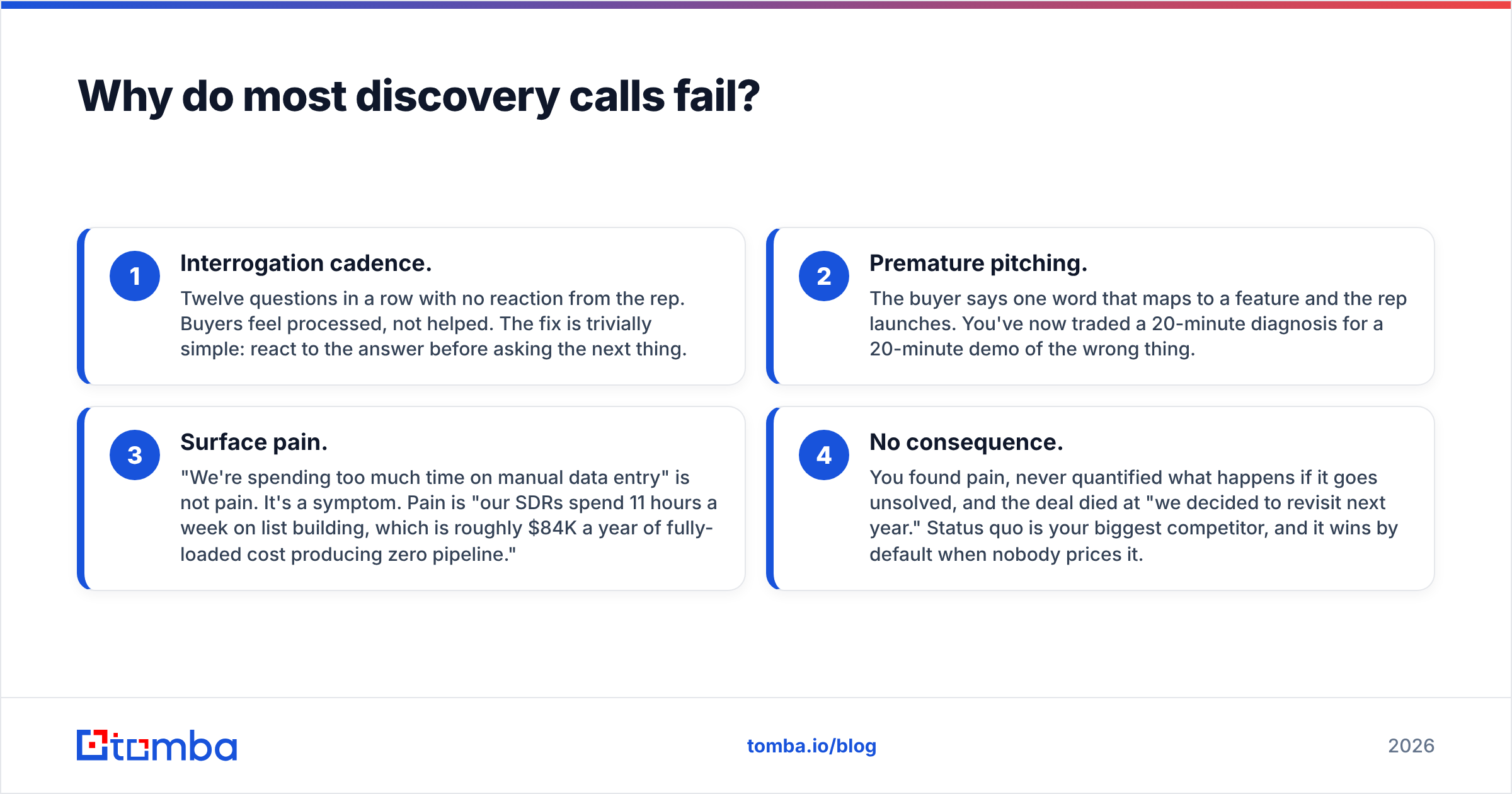
- Interrogation cadence. Twelve questions in a row with no reaction from the rep. Buyers feel processed, not helped. The fix is trivially simple: react to the answer before asking the next thing.
- Premature pitching. The buyer says one word that maps to a feature and the rep launches. You've now traded a 20-minute diagnosis for a 20-minute demo of the wrong thing.
- Surface pain. "We're spending too much time on manual data entry" is not pain. It's a symptom. Pain is "our SDRs spend 11 hours a week on list building, which is roughly $84K a year of fully-loaded cost producing zero pipeline."
- No consequence. You found pain, never quantified what happens if it goes unsolved, and the deal died at "we decided to revisit next year." Status quo is your biggest competitor, and it wins by default when nobody prices it.
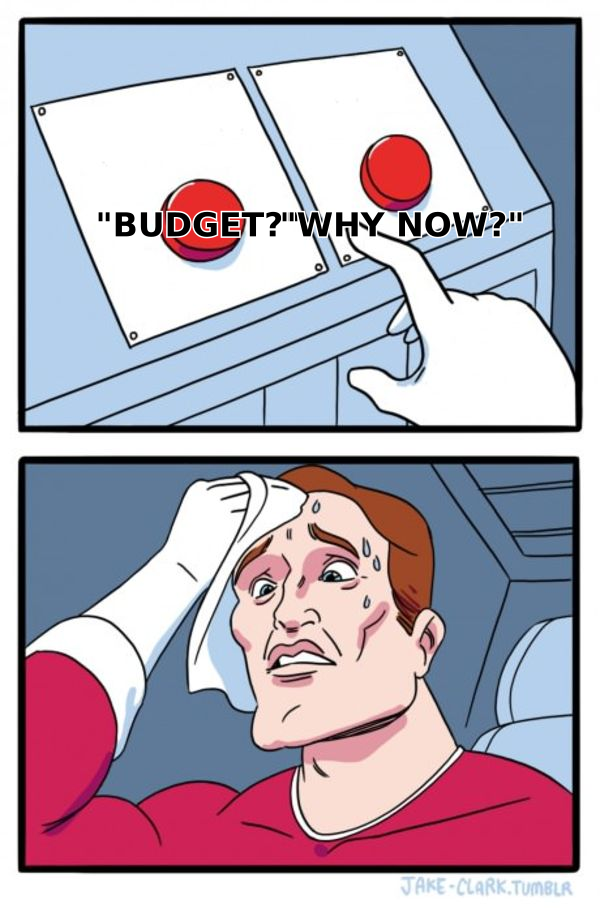
There's a fifth, quieter failure: you ran discovery on someone who was never going to buy. That's not a questioning problem, that's a targeting problem. If your list is built from scraped junk, better questions won't save you — which is why pre-call data quality is part of discovery, not separate from it.
Which discovery question framework should you use?#
Frameworks are scaffolding. They keep you from forgetting a whole category of risk. They are not scripts, and reading them aloud is how you sound like a robot.
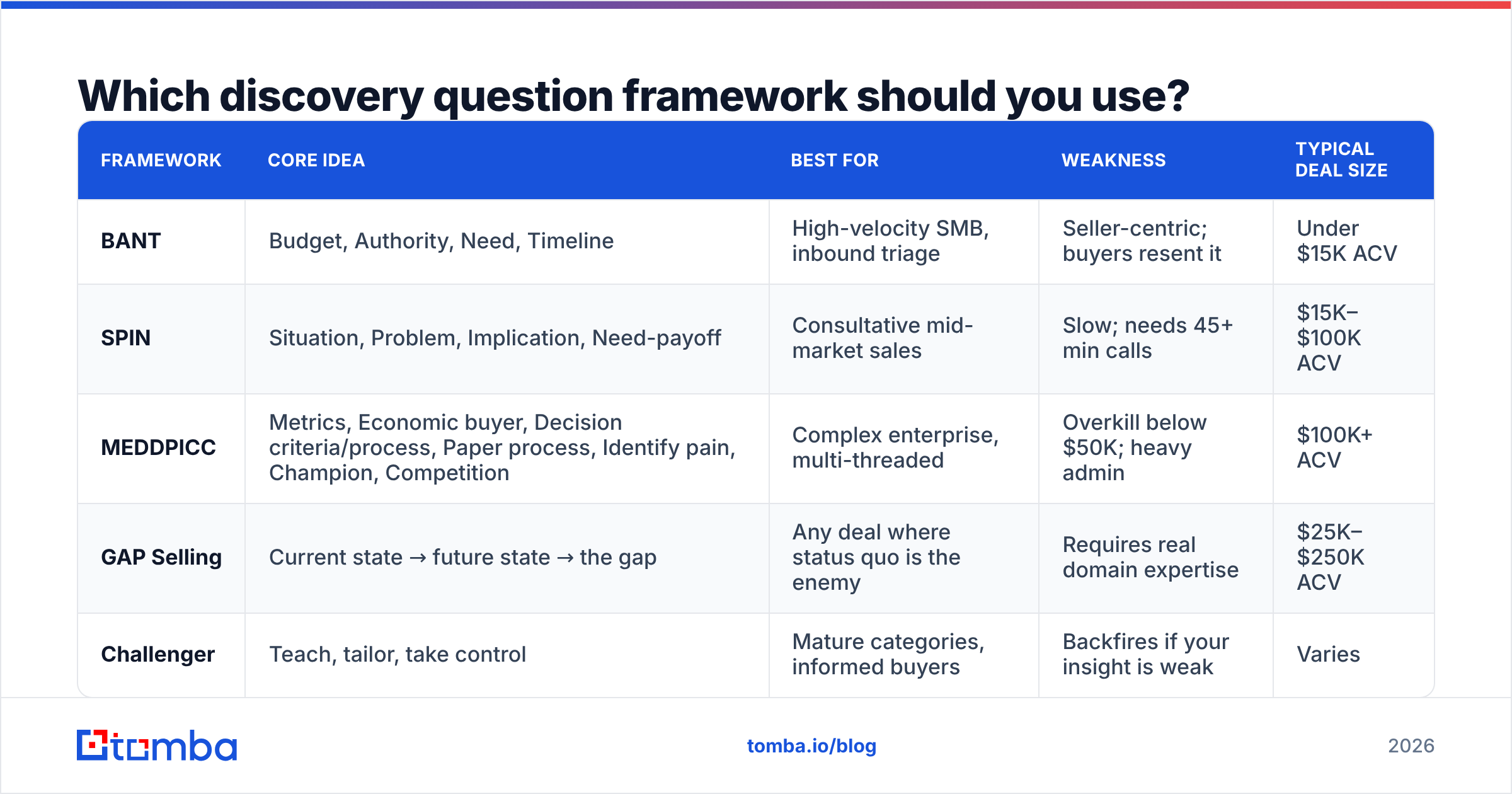
Here's how the four dominant frameworks compare in practice:
| Framework | Core idea | Best for | Weakness | Typical deal size |
|---|---|---|---|---|
| BANT | Budget, Authority, Need, Timeline | High-velocity SMB, inbound triage | Seller-centric; buyers resent it | Under $15K ACV |
| SPIN | Situation, Problem, Implication, Need-payoff | Consultative mid-market sales | Slow; needs 45+ min calls | $15K–$100K ACV |
| MEDDPICC | Metrics, Economic buyer, Decision criteria/process, Paper process, Identify pain, Champion, Competition | Complex enterprise, multi-threaded | Overkill below $50K; heavy admin | $100K+ ACV |
| GAP Selling | Current state → future state → the gap | Any deal where status quo is the enemy | Requires real domain expertise | $25K–$250K ACV |
| Challenger | Teach, tailor, take control | Mature categories, informed buyers | Backfires if your insight is weak | Varies |
Most teams over-index on MEDDPICC because it looks rigorous. If your average deal is $9K and closes in 18 days, MEDDPICC is a compliance exercise, not a qualification method. Match the framework to the deal shape.
A practical hybrid that works for most B2B teams selling between $20K and $80K ACV:
- Open with situation, but only what you couldn't research. You should already know their headcount, funding stage, tech stack, and hiring pattern before the call.
- Move to problem within four minutes. "Walk me through how your team handles X today — where does it break?"
- Quantify the implication. Time, money, headcount, or risk. Pick the one the buyer's boss cares about.
- Establish the decision process before you talk price. Not "who else is involved" — ask "the last time you bought something in this category, what did the approval path look like?"
- Test timing with a negative. "Is there a reason this has to happen this quarter, or is it more of a nice-to-have for the roadmap?" Buyers correct you when you understate urgency.
- Close the call with a mutual next step and a named date. No date, no opportunity.
What are the best discovery questions to ask in 2026?#
Grouped by what they're actually diagnosing. Steal these, then rewrite them in your own voice — copied phrasing always sounds copied.
Situation (keep to two, max)
- "How is your team structured today for [function]?"
- "What tools sit in the workflow between [A] and [B]?"
Problem
- "Where does the current process break down most often?"
- "If I asked your team what the most annoying part of their week is, what would they say?"
- "What have you already tried to fix this, and why didn't it stick?" — this one is criminally underused. The answer tells you exactly how they buy, what they've already ruled out, and who got burned last time.
Implication / consequence
- "What does that cost you in a typical month — in hours, dollars, or missed pipeline?"
- "If nothing changes for the next two quarters, what happens?"
- "Who else in the business feels this problem? Who feels it worst?"
Power and process
- "Who signs off on a purchase like this, and what do they care about that you might not?"
- "The last time your team bought a tool in this category, how long did it take from first call to contract?"
- "What would make this a no for you?"
Timing
- "What's driving the timeline — a contract renewal, a headcount plan, a board target?"
- "What else is competing for the same budget this quarter?"
Champion test
- "If this makes sense after the demo, what would you need from me to take it forward internally?"
Notice how few of these are yes/no. Notice also that none of them ask "what's your budget?" outright — that question gets an inflated or defensive answer in almost every case. Ask about the process for approving spend instead; you'll learn more and irritate less.
How do you research before a discovery call?#
Conclusion first: the best discovery call is the one where you barely have to ask situational questions at all, because you already know.
Fifteen minutes of pre-call research changes the whole shape of the conversation. Instead of "so tell me about your company," you open with "I saw you brought on three enterprise AEs in Q1 and moved to a hybrid PLG motion — I'm guessing lead routing got messy fast. Is that fair?" That's a discovery question disguised as an observation, and it earns you the right to ask ten more.
What to collect before every call:
- Trigger events — funding, exec hires, product launches, office openings, layoffs. Crunchbase and the company's own newsroom cover most of this.
- Tech stack — what they already run tells you their budget tolerance and integration constraints. A quick website tech stack check takes thirty seconds.
- Org shape — who reports to whom, and who else you'll need to reach. A domain search surfaces the team around your contact so you're not single-threaded from call one.
- Peer review signals — what buyers in this segment actually complain about. G2 category reviews are more honest than any vendor page.
- Public commitments — earnings calls, investor updates, job postings. A job posting for "Revenue Operations Manager — must own data hygiene" is a discovery question written for you.
This is where most of the leverage lives, and it's the part reps skip because it isn't on the call recording. Nobody grades you on research. Everybody grades you on the call it produces.
If you're building the list itself, the same principle applies: bad contact data means you're running discovery on the wrong person. Verified contacts from an email finder plus a quick pass through an email verifier means the calendar invite actually lands, and the person on the other end is the one with the problem.
What questions should you stop asking?#
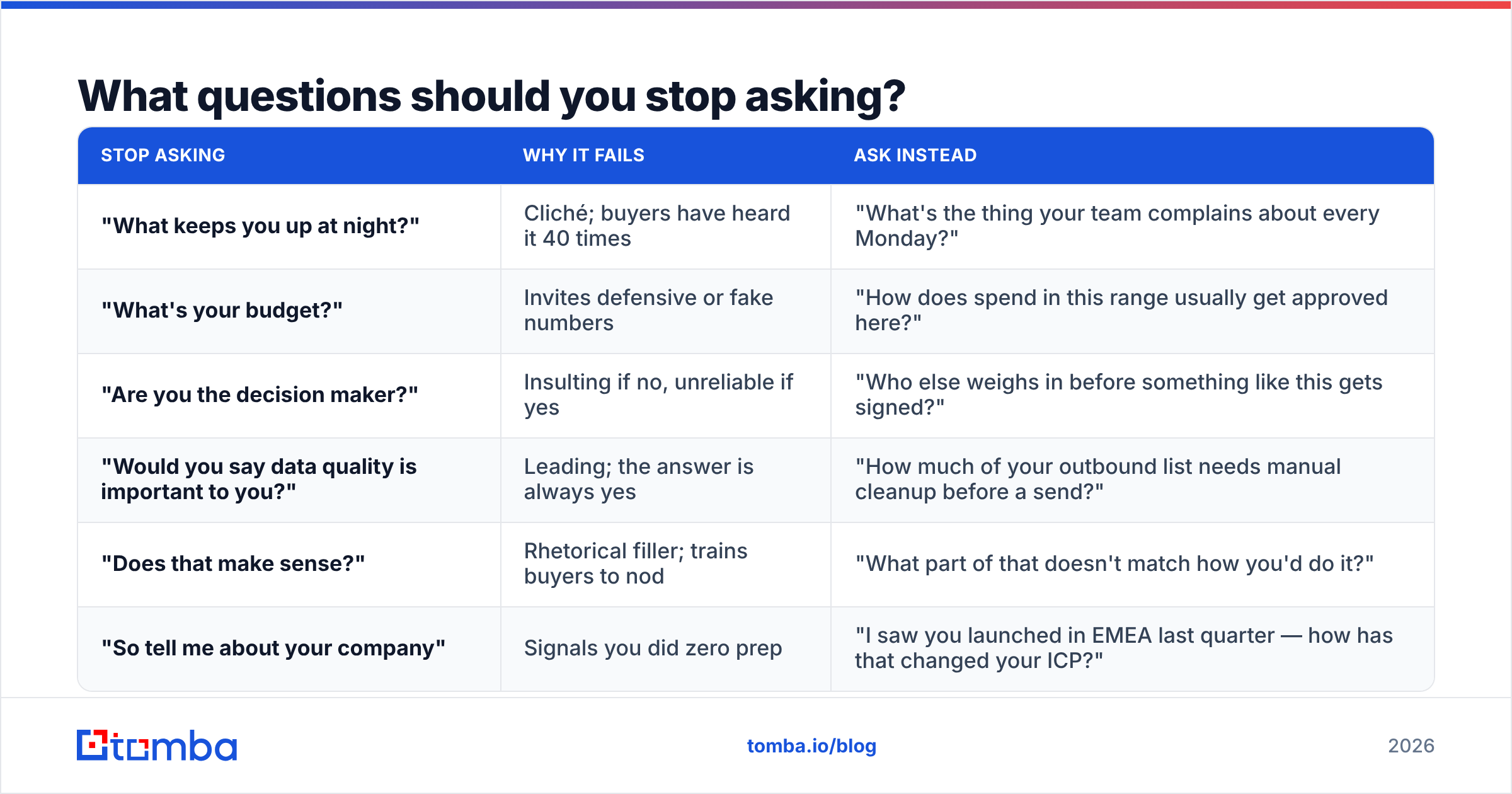
Some questions are worse than silence.
| Stop asking | Why it fails | Ask instead |
|---|---|---|
| "What keeps you up at night?" | Cliché; buyers have heard it 40 times | "What's the thing your team complains about every Monday?" |
| "What's your budget?" | Invites defensive or fake numbers | "How does spend in this range usually get approved here?" |
| "Are you the decision maker?" | Insulting if no, unreliable if yes | "Who else weighs in before something like this gets signed?" |
| "Would you say data quality is important to you?" | Leading; the answer is always yes | "How much of your outbound list needs manual cleanup before a send?" |
| "Does that make sense?" | Rhetorical filler; trains buyers to nod | "What part of that doesn't match how you'd do it?" |
| "So tell me about your company" | Signals you did zero prep | "I saw you launched in EMEA last quarter — how has that changed your ICP?" |
The pattern: replace closed, leading, or lazy questions with open, specific, research-backed ones. Every question you ask should be one the buyer couldn't answer in a survey.
How do you score a discovery call?#
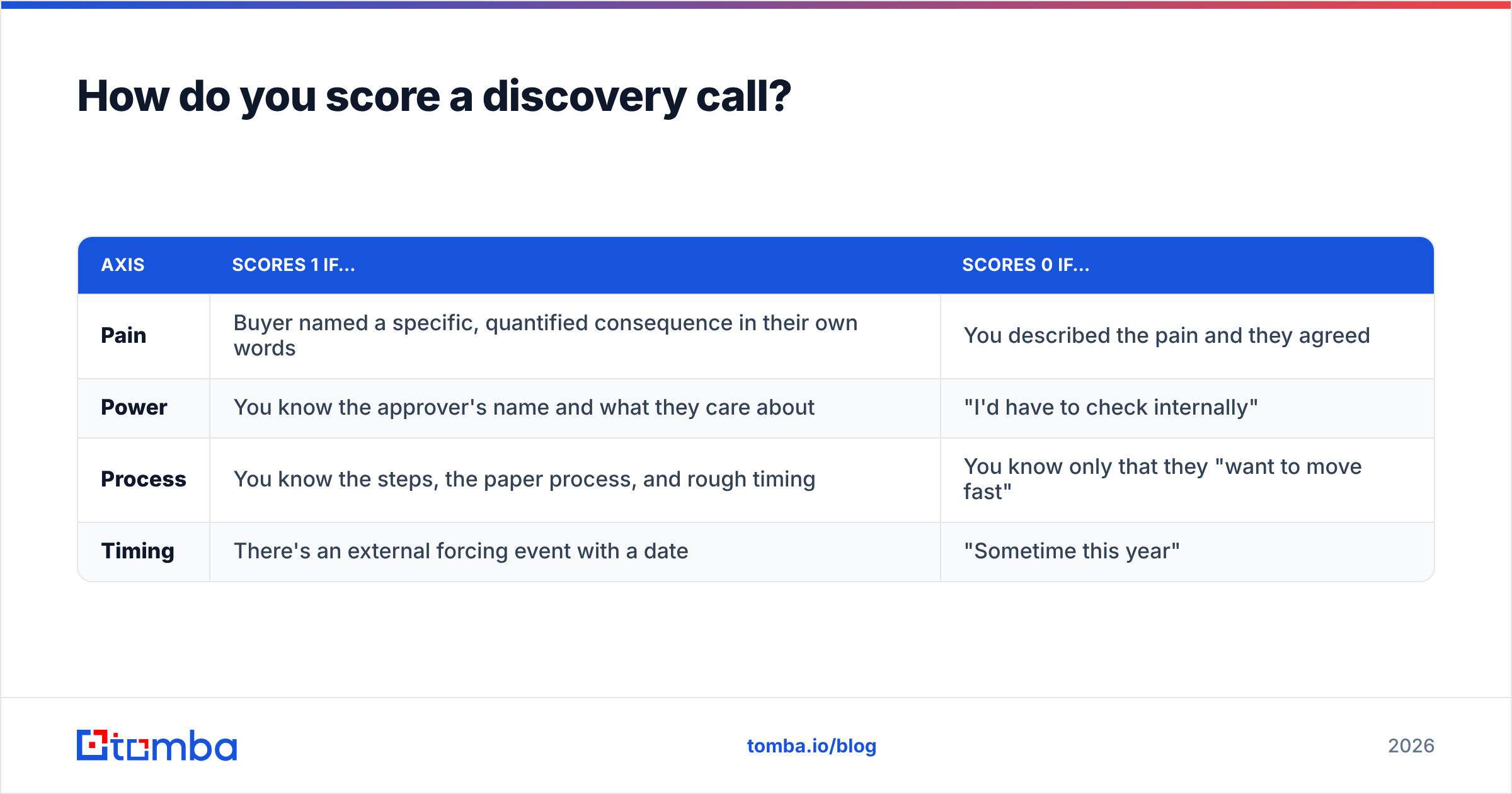
Feelings are not qualification. A call can feel fantastic and be worth nothing. Score every discovery call on four axes, 0–1 each, immediately after hanging up while it's fresh:
| Axis | Scores 1 if… | Scores 0 if… |
|---|---|---|
| Pain | Buyer named a specific, quantified consequence in their own words | You described the pain and they agreed |
| Power | You know the approver's name and what they care about | "I'd have to check internally" |
| Process | You know the steps, the paper process, and rough timing | You know only that they "want to move fast" |
| Timing | There's an external forcing event with a date | "Sometime this year" |
Score 4/4: real opportunity, forecast it. Score 3/4: workable, but name the gap in the CRM and plan the next call around it. Score 2/4 or below: it's a lead, not an opportunity, and putting it in the pipeline is how forecasts rot. This maps closely to how most sales process hygiene guides define stage entry criteria — and it's the single cheapest thing you can add to a weekly pipeline review.
Two things to do with the score:
- Review the 0s in your weekly one-on-ones. Patterns show up fast. A rep who consistently scores 0 on Power is single-threading; a rep who scores 0 on Timing is happy-earing.
- Never advance a deal on Pain alone. Pain without power and timing is the most common source of "closed lost — no decision," which in most B2B pipelines is a bigger bucket than losses to competitors. HubSpot's sales research has been making this point for years and it still doesn't stick.
How many discovery questions is too many?#
Roughly: if you're talking less than 30% of the time, you're probably in interrogation territory rather than diagnosis. Good discovery calls sit somewhere near a 40/60 or 45/55 rep-to-buyer talk ratio, with the rep's share spent mostly on reactions, reframes, and short insight drops — not monologues.
Practical caps for a 30-minute first call:
- 8–12 substantive questions. More than that and you're collecting, not diagnosing.
- Two situational questions max. Research covers the rest.
- At least three consequence questions. This is where deals are won or quietly lost.
- One explicit next-step question. Always the last one.
And leave silence after the hard questions. When you ask "what happens if nothing changes for two quarters?" and the buyer pauses for six seconds, that pause is the most valuable moment of the call. Don't fill it.
Ready to run better discovery calls?#
Better questions only work on the right people. If half your discovery calls are with contacts who were never going to buy — wrong role, wrong company, wrong stage — no framework will fix that.
Start upstream. Use Tomba Email Finder to build accurate, verified contact lists from the companies that actually match your ICP, then layer in data enrichment so you walk into every call already knowing headcount, stack, and role. The free tier gives you 25 searches a month to test it; paid plans start at $49/mo on Starter and $99/mo on Growth — full Tomba pricing is public, no sales call required.
Do the research. Ask the eight questions that matter. Score the call honestly. That's the whole job.
Related guides#
// get started
Find, verify and enrich your first contacts today
Start on the free plan with 25 searches a month, then scale when your team is ready.
Free plan · No credit card required · GDPR & CCPA
// about the author