Discovery Questions for Phone Sales: 31 Proven Examples
Most phone discovery fails in the first 90 seconds. Here are 31 discovery questions for phone sales, organized by call stage, plus the frameworks, timing data, and follow-ups that separate a real qualification call from an interrogation.
TL;DR
- Phone discovery is not a questionnaire. The best calls average 11–14 questions spread across the conversation, not 25 fired in sequence.
- Open with a problem-anchored question, not a permission question. "What's driving the way you handle X today?" outperforms "Is now a bad time?"
- BANT is a scoring rubric, not a call script. Use SPIN or GPCTBA/C&I for the conversation and let BANT-style facts fall out of it.
- Budget questions work best in the back third of the call, framed as range validation, not as an interrogation.
- Bad data kills discovery before you dial. If the phone number or title is wrong, no question set saves the call.
What makes a phone discovery question different from an email one?#
Latency. On email, your prospect gets unlimited time to construct an answer, so you can ask broad, layered questions and still get something useful. On the phone, every question competes with the prospect's urge to end the call. You have roughly 8–14 minutes of real attention in a first conversation, and each question either buys you more time or spends it.
That changes the design constraints in three ways:
- Questions must be short enough to hold in working memory. If your question has two clauses and a qualifier, the prospect answers the last clause only. "What does your current process look like, and how long has it been that way, and who owns it?" gets you an answer about ownership and nothing else.
- Every question needs an obvious payoff for the prospect. They will answer "what breaks most often in your renewal process?" because it's interesting to them. They will not answer "what's your annual budget for this category?" thirty seconds into a cold call, because that question only benefits you.
- Silence is a tool, not a failure. On the phone you cannot read a face, so a 3-second pause after an answer is your only mechanism for signaling "keep going." Reps who fill that gap lose the second half of every answer — usually the half that contains the actual pain.
Gong's conversation research has consistently found that successful discovery calls contain more talk-time balance and more question depth (follow-ups on the same topic) than unsuccessful ones. Depth beats breadth. Three follow-ups on one problem tell you more than eight one-touch questions across eight topics.
What should you ask in the first 90 seconds?#
The first 90 seconds decide whether you get a discovery call or a polite exit. Your goal here is not qualification — it's earning the right to qualify.
Three openers that work on outbound phone calls:
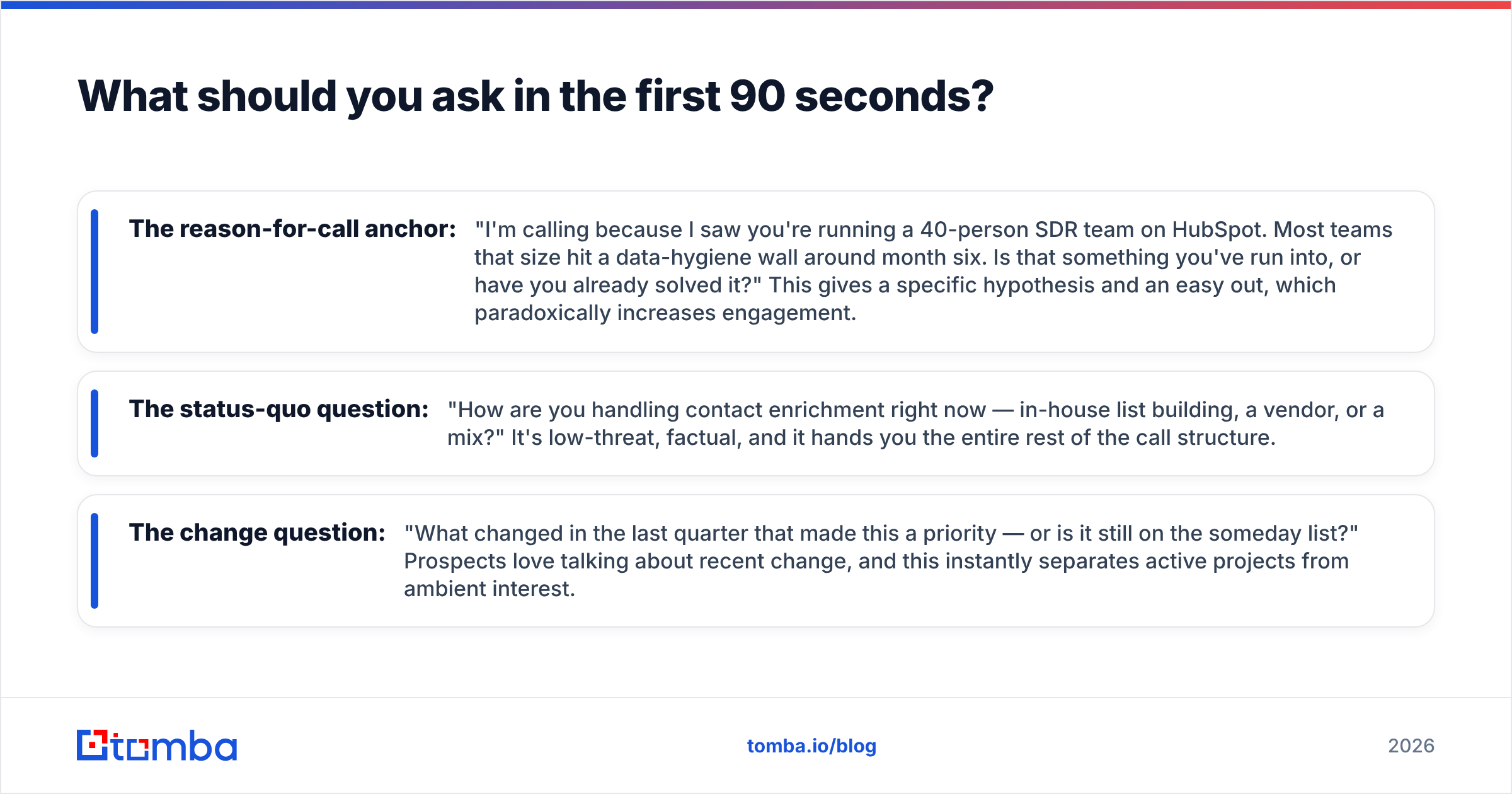
- The reason-for-call anchor: "I'm calling because I saw you're running a 40-person SDR team on HubSpot. Most teams that size hit a data-hygiene wall around month six. Is that something you've run into, or have you already solved it?" This gives a specific hypothesis and an easy out, which paradoxically increases engagement.
- The status-quo question: "How are you handling contact enrichment right now — in-house list building, a vendor, or a mix?" It's low-threat, factual, and it hands you the entire rest of the call structure.
- The change question: "What changed in the last quarter that made this a priority — or is it still on the someday list?" Prospects love talking about recent change, and this instantly separates active projects from ambient interest.
What does not work in the first 90 seconds: "How are you today?", "Did I catch you at a bad time?", and any question containing the words challenges or pain points. They're transparently scripted, and prospects have been trained to hang up on them.
Which discovery framework should you use on the phone?#
Most reps inherit BANT because it's easy to score in a CRM. That's a reporting decision, not a conversation decision. Here's how the main frameworks actually behave on a live phone call.
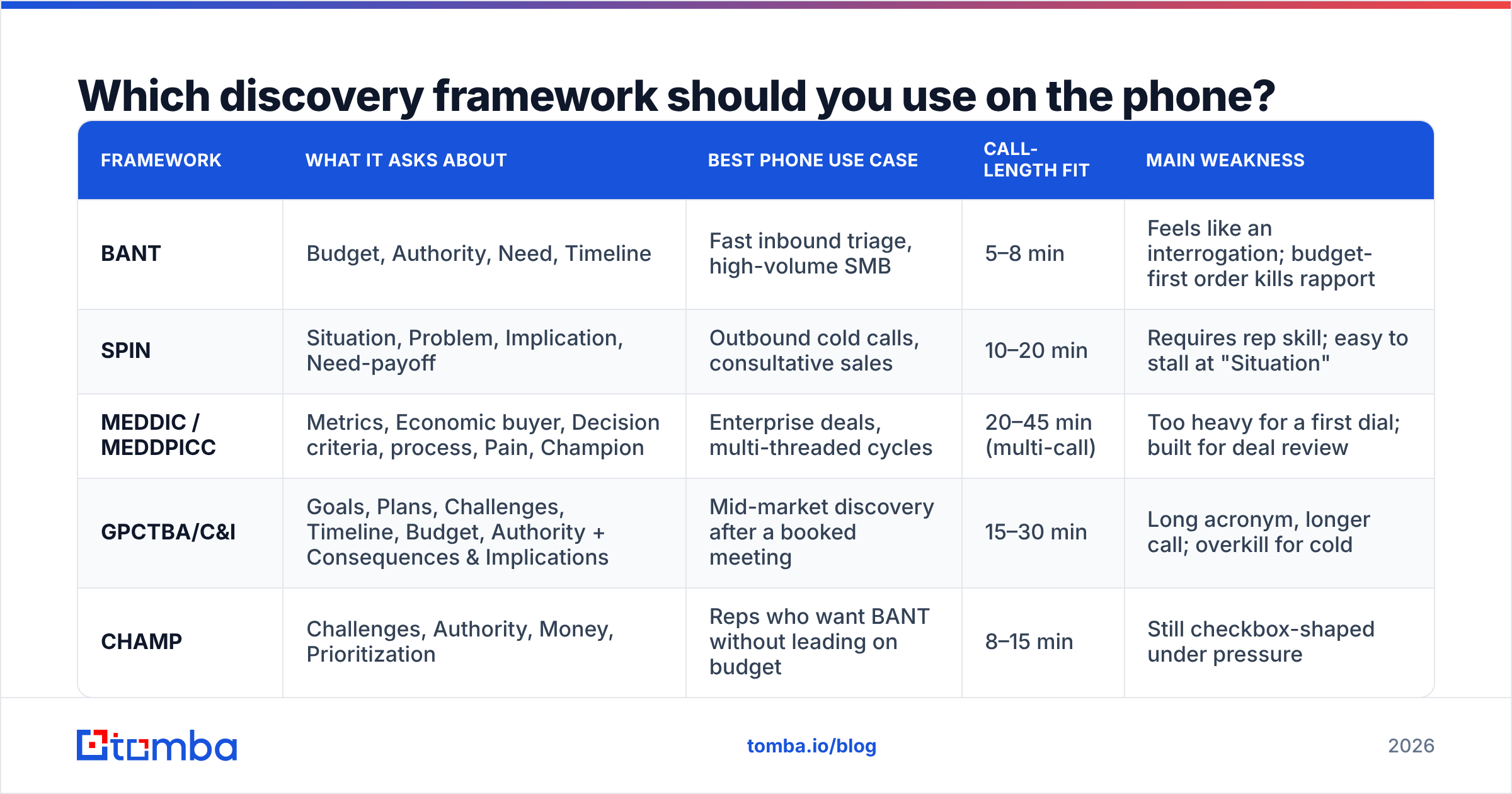
| Framework | What it asks about | Best phone use case | Call-length fit | Main weakness |
|---|---|---|---|---|
| BANT | Budget, Authority, Need, Timeline | Fast inbound triage, high-volume SMB | 5–8 min | Feels like an interrogation; budget-first order kills rapport |
| SPIN | Situation, Problem, Implication, Need-payoff | Outbound cold calls, consultative sales | 10–20 min | Requires rep skill; easy to stall at "Situation" |
| MEDDIC / MEDDPICC | Metrics, Economic buyer, Decision criteria, process, Pain, Champion | Enterprise deals, multi-threaded cycles | 20–45 min (multi-call) | Too heavy for a first dial; built for deal review |
| GPCTBA/C&I | Goals, Plans, Challenges, Timeline, Budget, Authority + Consequences & Implications | Mid-market discovery after a booked meeting | 15–30 min | Long acronym, longer call; overkill for cold |
| CHAMP | Challenges, Authority, Money, Prioritization | Reps who want BANT without leading on budget | 8–15 min | Still checkbox-shaped under pressure |
The practical answer for cold phone work: run SPIN in the conversation, record BANT in the CRM. SPIN's sequence — situation, then problem, then implication, then payoff — matches how a human conversation naturally escalates. BANT fields get filled in as a byproduct, and your pipeline reporting stays intact. HubSpot's sales library has good breakdowns of each if you want the long form.

What are the best discovery questions by call stage?#
Here are 31 questions organized by where they belong. Do not use all of them in one call. Pick 3–4 per stage based on what the prospect gives you.
Stage 1 — Situation (understand the current state)#
- "Walk me through how your team handles [process] today, start to finish."
- "Who owns that end-to-end — is it one person or split across teams?"
- "What tools are in the stack for this right now?"
- "How long has it worked this way?"
- "How many people touch that workflow in a given week?"
- "What made you pick your current approach originally?"
- "Roughly what volume are you running through it monthly?"
The last one matters more than it looks. Volume is the single fastest way to size a deal on the phone without asking about money.
Stage 2 — Problem (find the friction)#
- "Where does that process break down most often?"
- "If you could delete one step from it, which one goes?"
- "What's the part your team complains about in standups?"
- "When it goes wrong, how do you usually find out — someone reports it, or you catch it in a report?"
- "How often does that happen — weekly, monthly, once a quarter?"
- "What have you already tried to fix it?"
- "Why didn't that work?"
Question 14 is the highest-leverage question in this entire list. The answer tells you exactly what objection you'll face later, and it's usually delivered honestly because the prospect is describing someone else's failure, not defending their own.
Stage 3 — Implication (make the cost real)#
- "What does that cost you in hours per week?"
- "If nothing changes over the next two quarters, what happens?"
- "Does that affect anyone outside your team — sales, finance, support?"
- "Has leadership noticed, or is this still a below-the-radar problem?"
- "What's the revenue impact when a lead sits unrouted for three days?"
- "Is this the biggest problem on your list right now, or number four?"
Question 20 is your honest prioritization check. A prospect who says "honestly, it's about number four" has just saved you three months of forecast pollution — and they'll respect you for asking.
Stage 4 — Need-payoff and decision mechanics#
- "If you cut that error rate in half, what would that free up?"
- "Who else would need to see this before it moves forward?"
- "What does the approval path look like at your company for a tool in this range?"
- "Have you bought anything similar in the last year? How did that go?"
- "What would need to be true for you to say yes in the next 30 days?"
- "What's your timeline — is there a date this needs to be live by, or is it flexible?"
- "What would make this a no?"
Question 27 is the negative-reverse. Asking for the failure condition out loud gets you objections early, while you still have call time to handle them.
Stage 5 — Close of call (protect the next step)#
- "Based on what you've described, does it make sense to look at this together for 25 minutes next week?"
- "Should anyone else be on that call?"
- "Between now and then, what would be most useful for me to prepare?"
- "If something comes up and you need to move it, what's the best way to reach you directly?"
That last question quietly gets you a direct line and a mobile number without sounding like a data-collection exercise.
How do you ask about budget without killing the call?#
Move budget to the back third and convert it from an open question into a range validation. Compare:
- Weak: "What's your budget for this?" — Prospect either doesn't know or won't say, and now the call feels transactional.
- Strong: "Teams your size usually land somewhere between $12K and $40K a year on this, depending on seat count. Does that range fit where you'd need to be, or is it way off?"
The second version gives information before asking for it, gives the prospect a low-effort binary response, and surfaces sticker shock immediately instead of on the proposal call. If the answer is "way off," you've lost five minutes instead of five weeks.
Two more budget-adjacent questions worth memorizing:
- "Is this coming out of an existing line item, or would it be new spend?" Existing line item means a competitor is being replaced and the money is already approved. New spend means a business case, which means a longer cycle.
- "Who signs off once you've picked a direction?" Softer than "are you the decision maker," and it gets the same answer without insulting anyone.
What are the most common phone discovery mistakes?#
- Asking questions you could have researched. "So what does your company do?" burns credibility instantly. Company size, funding stage, tech stack, and headcount are all knowable before you dial.
- Stacking questions. Two questions in one breath means one gets answered. Ask, stop, wait.
- Accepting the first answer. "It's fine, mostly" is not an answer. "Mostly?" is a complete follow-up sentence and it works every time.
- Pitching mid-discovery. The moment you say "so what we do is…", discovery is over. Prospects switch from disclosing to evaluating, and you don't get them back.
- Skipping the recap. Sixty seconds of "let me make sure I heard this right" at the end of the call does more for your next-step conversion than any closing technique.
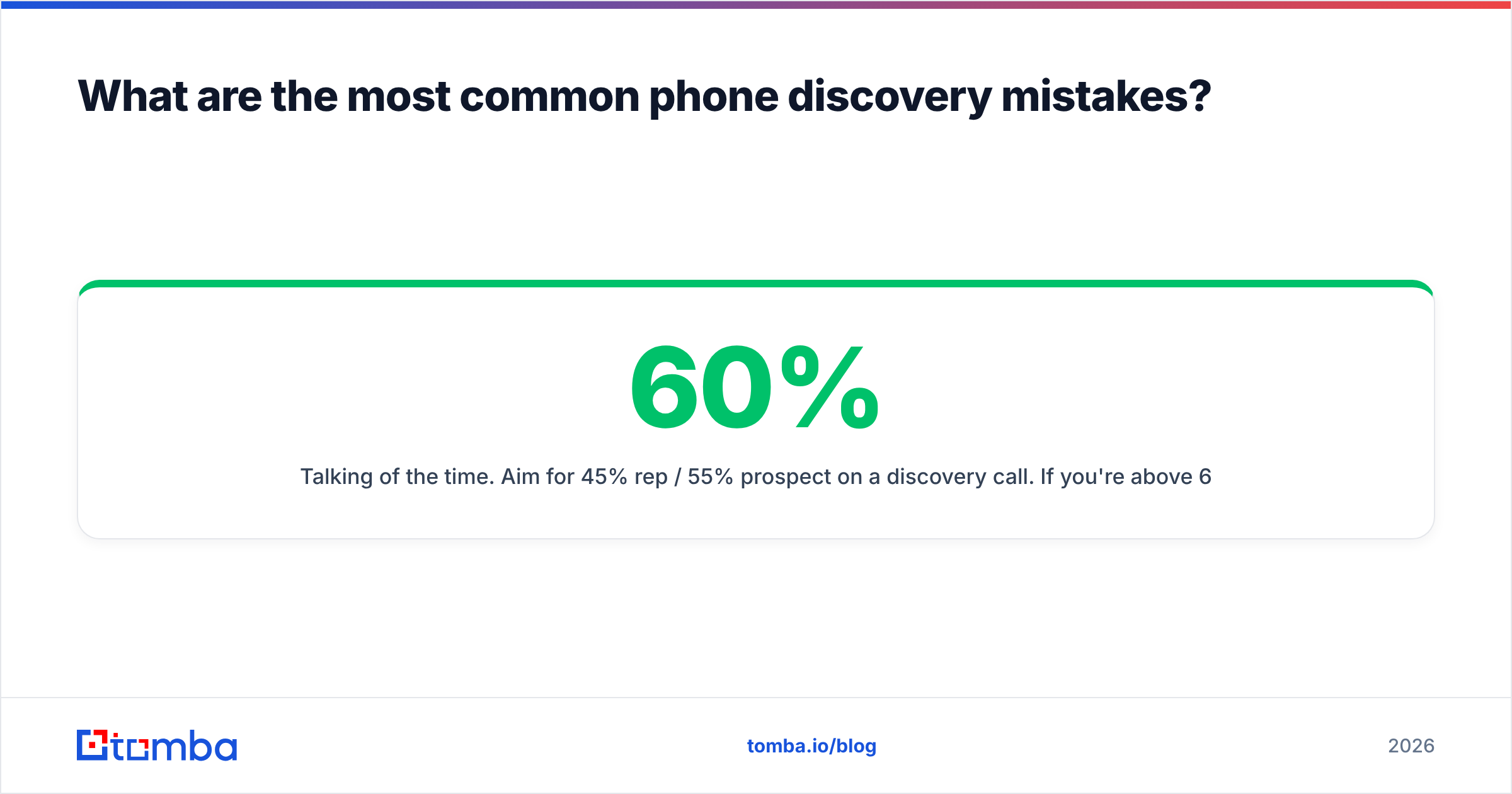
- Talking 60% of the time. Aim for 45% rep / 55% prospect on a discovery call. If you're above 60%, you ran a pitch, not a discovery.
How do you prep before dialing?#
Everything above assumes you reached a human at the right company in the right role. That assumption fails more often than most teams admit — wrong direct dials, stale titles, and reassigned mobile numbers quietly eat 20–30% of dial capacity.
A workable pre-call checklist:
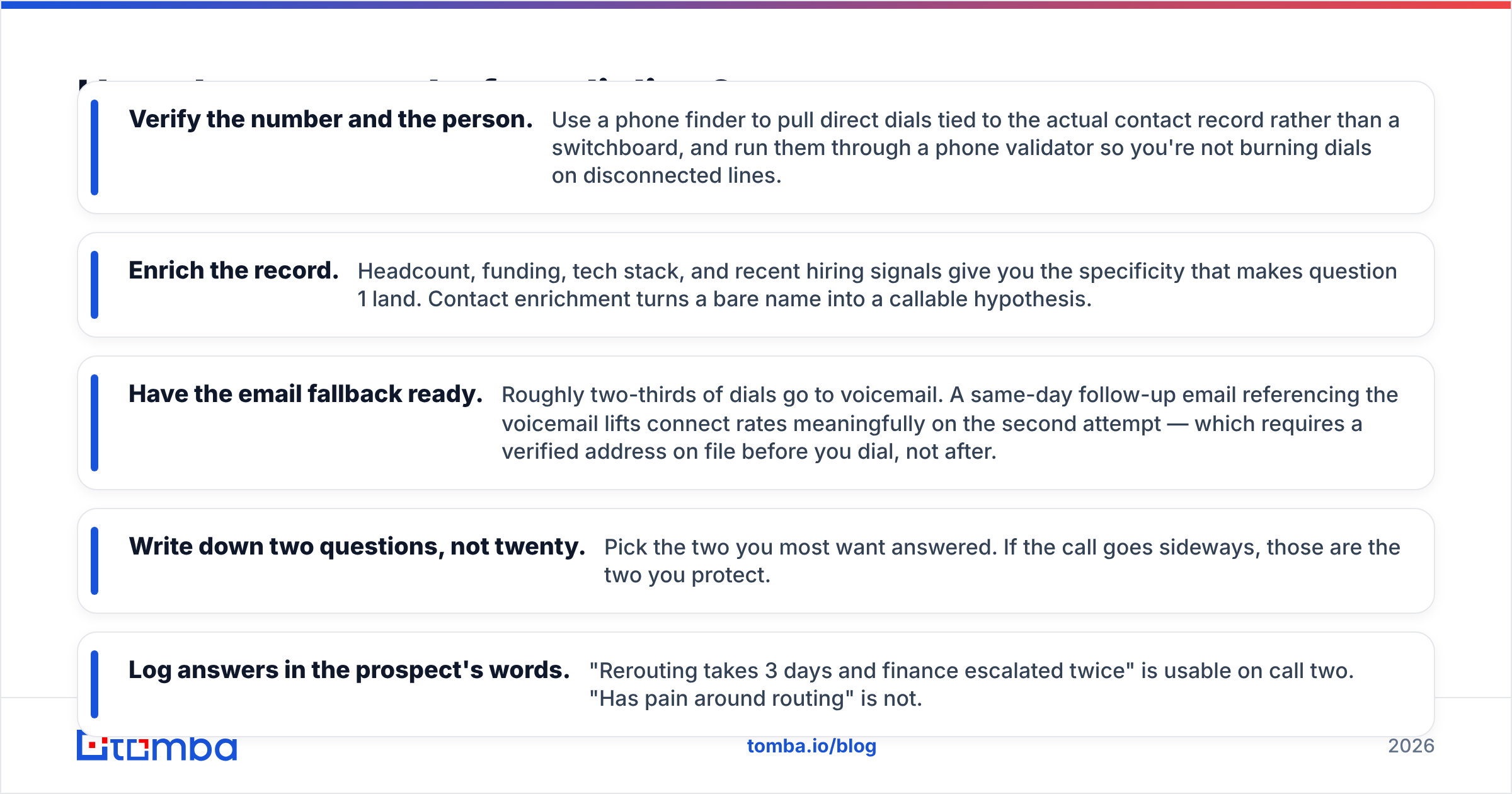
- Verify the number and the person. Use a phone finder to pull direct dials tied to the actual contact record rather than a switchboard, and run them through a phone validator so you're not burning dials on disconnected lines.
- Enrich the record. Headcount, funding, tech stack, and recent hiring signals give you the specificity that makes question 1 land. Contact enrichment turns a bare name into a callable hypothesis.
- Have the email fallback ready. Roughly two-thirds of dials go to voicemail. A same-day follow-up email referencing the voicemail lifts connect rates meaningfully on the second attempt — which requires a verified address on file before you dial, not after.
- Write down two questions, not twenty. Pick the two you most want answered. If the call goes sideways, those are the two you protect.
- Log answers in the prospect's words. "Rerouting takes 3 days and finance escalated twice" is usable on call two. "Has pain around routing" is not.
For teams building the call list itself, Salesforce's sales resources and peer reviews on G2 are reasonable places to sanity-check tooling before you commit budget to a data vendor.
What does a good discovery call actually sound like?#
Short version: it sounds like a conversation where one person is unusually curious and takes notes. The prospect talks more than you. You ask four or five questions about a single problem instead of one question about five problems. You say "why didn't that work?" at least once. You state a budget range before asking about budget. You end by repeating what you heard and booking a specific next step with a named attendee.
If you can do that consistently, the framework you picked barely matters. If you can't, no framework saves you.
Get the contact data right before you script the call. The best discovery questions for phone sales are worthless if the number goes to a former employee or the title on your list is two promotions stale. Tomba's Email Finder gives you verified professional emails to pair with your dials — so every voicemail has a same-day follow-up waiting, and every call list starts from a real person instead of a guess. The free tier covers 25 searches a month; paid plans start at $49/mo, with full Tomba pricing if you're scaling a full outbound team.
Related guides#
Ready to find emails that actually work?
Join 150,000+ professionals who stopped guessing and started sending. Free credits on signup — no credit card required.
Get the Tomba newsletter
Practical outbound tactics and product updates — once every two weeks.
About the author