Discovery Sales in 2026: The Complete Discovery Call Guide
Most discovery calls fail before they start — bad data, generic questions, no next step. Here's the 2026 framework for running discovery that actually qualifies, plus the metrics and tooling that make it repeatable.
TL;DR
- Discovery sales is the qualification stage where you diagnose a buyer's problem, quantify its cost, and decide whether a deal is real — before you demo anything.
- The single biggest failure mode is treating discovery as a checklist interrogation (BANT rapid-fire) instead of a diagnostic conversation. Buyers detect it in under three minutes.
- Good discovery has four outputs: a quantified problem, a named decision process, a confirmed timeline, and a mutually agreed next step. Missing any one means the call was incomplete.
- Discovery quality is measurable. Track stage-2-to-close conversion, no-decision rate, and average deal cycle by rep — bad discovery shows up as inflated pipeline and late-stage ghosting.
- Discovery starts before the call. Ten minutes of pre-call research on the account, the person, and their tech stack changes the entire conversation.
What is discovery sales?#
Discovery sales is the phase of a B2B sales cycle where you find out whether a prospect has a problem worth solving, whether they can act on it, and whether your product is the right fix. It's the diagnostic appointment before the prescription.
Think of it like a doctor's intake. A bad doctor hears "my back hurts" and immediately recommends surgery. A good one asks how long, what triggers it, what you've already tried, how it affects your work, and who else is involved in the decision — then decides whether surgery is even the right conversation. Discovery is that intake. The demo is the prescription.
Technically, discovery sits between qualification-lite (did this lead match our ICP?) and the solution phase (here's how we'd fix it). In most pipelines it's stage 2 of 5 or 6. It is the highest-leverage stage in the funnel, because every downstream stage inherits the quality of the information you gathered here. A deal that reaches "proposal" on bad discovery is a deal that dies at procurement.
Two things discovery is not:
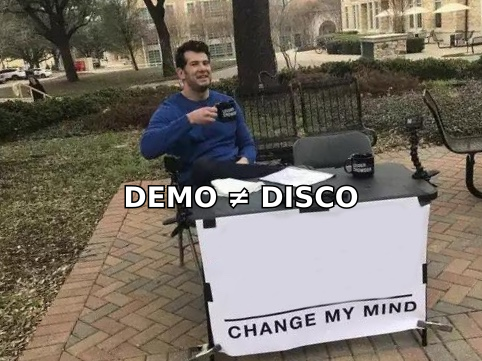
- A demo. If you're screen-sharing in the first 15 minutes, you're guessing at what matters to the buyer.
- A pitch. The buyer should talk 60–70% of the time. If your talk ratio is above 50%, you learned nothing.
Why do most discovery calls fail?#
They fail for reasons that have nothing to do with the questions asked. Here are the five patterns that show up most consistently in call reviews:
- No pre-call research. The rep asks "So, tell me what your company does" — burning the buyer's goodwill in the first 60 seconds. That answer is on the website.
- Interrogation format. Twelve questions in a row with no reaction, no reframe, no insight offered back. The buyer feels processed, not understood.
- Surface-level problem capture. "We need more leads" is a symptom, not a problem. The rep never gets to "our SDR team wastes 11 hours a week on bad data and quota attainment is 43%."
- No quantification. Without a dollar figure attached to the pain, there is no business case, and the deal loses to "do nothing" — which is still the most common competitor in B2B.
- No next step booked live. "I'll send over some times" is where 40% of deals quietly end. Book the calendar slot on the call.
There's a sixth, upstream failure that gets blamed on the rep unfairly: the meeting was booked with the wrong person because the contact data was wrong. If your prospecting stack is guessing at titles and emails, discovery is doomed before anyone dials. Clean, verified contact and role data — the kind you get from a proper email verifier and data enrichment layer — is a discovery input, not a marketing detail.
What questions should you ask in a discovery call?#
Structure beats scripts. Use a four-layer question stack, moving from broad to specific, and let the buyer's answers dictate depth.
Layer 1 — Situation (2–3 questions max). Establish the current state without wasting time on what you could have researched. "You're running outbound with a team of six SDRs — is that split by region or by segment?"
Layer 2 — Problem. Get to the mechanism of failure. "Where does the process break down today?" then "What happens when that breaks?" Follow every answer with one more layer of why.
Layer 3 — Impact. Attach numbers. "What does that cost you per month?" "How many hours does the team lose to it?" "What did missing that target mean for the quarter?" If the buyer can't quantify it, you help them: "Rough math — if 30% of your list bounces and each rep sends 400 a week, that's..."
Layer 4 — Process and priority. "Who else feels this problem?" "What's the approval path for something in this price range?" "What happens if you don't solve this by Q4?" This is where you learn whether the deal is real.
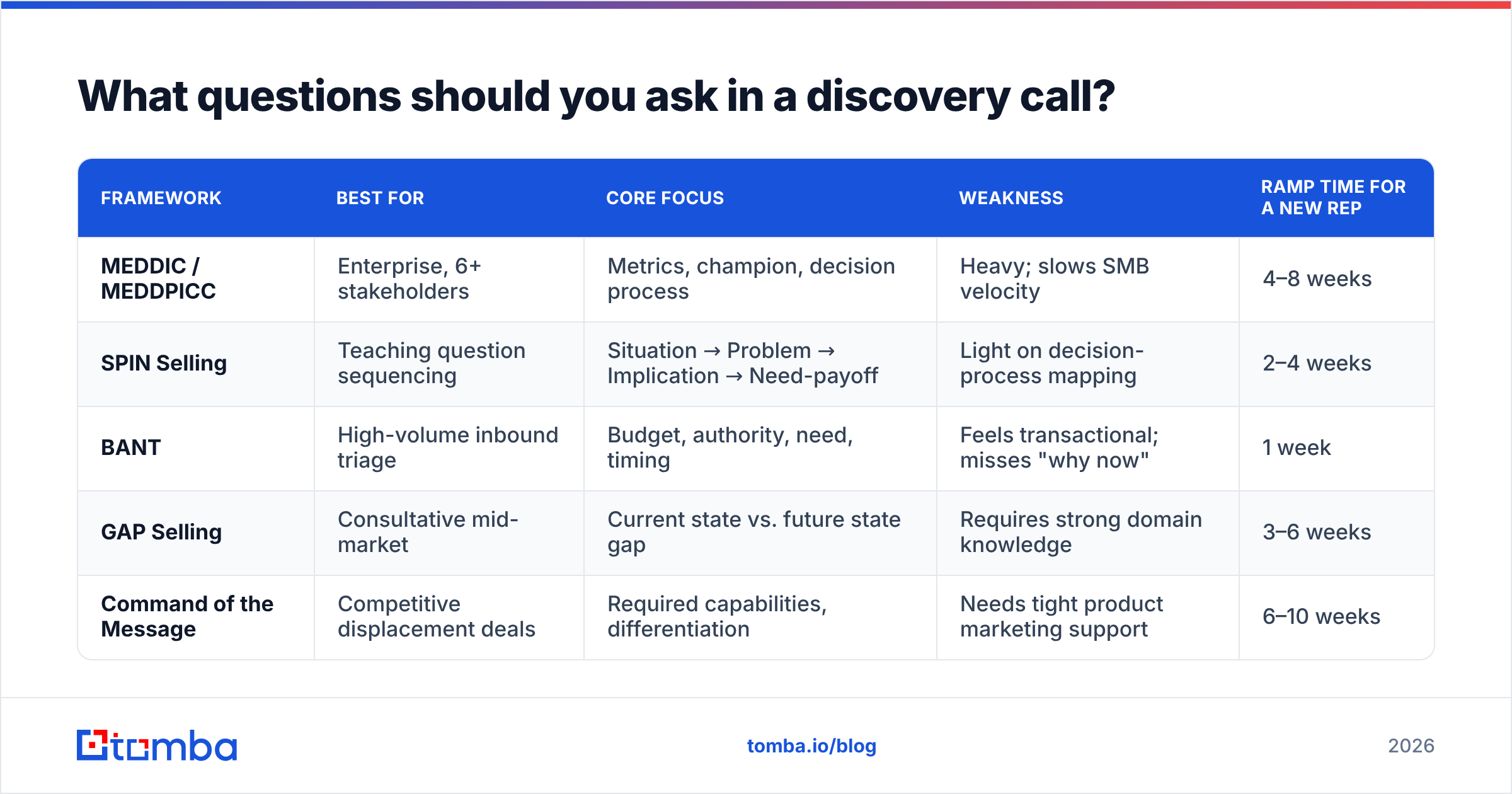
The best-known frameworks — MEDDIC, SPIN, BANT, GAP — all map onto these layers. MEDDIC is strongest for enterprise deals with complex buying committees; SPIN is strongest for teaching reps how to sequence questions; BANT is fast but blunt and increasingly disliked by buyers who feel screened rather than helped. Pick one, run it consistently, and score against it.
| Framework | Best for | Core focus | Weakness | Ramp time for a new rep |
|---|---|---|---|---|
| MEDDIC / MEDDPICC | Enterprise, 6+ stakeholders | Metrics, champion, decision process | Heavy; slows SMB velocity | 4–8 weeks |
| SPIN Selling | Teaching question sequencing | Situation → Problem → Implication → Need-payoff | Light on decision-process mapping | 2–4 weeks |
| BANT | High-volume inbound triage | Budget, authority, need, timing | Feels transactional; misses "why now" | 1 week |
| GAP Selling | Consultative mid-market | Current state vs. future state gap | Requires strong domain knowledge | 3–6 weeks |
| Command of the Message | Competitive displacement deals | Required capabilities, differentiation | Needs tight product marketing support | 6–10 weeks |
How do you prepare for a discovery call?#
Ten focused minutes. Not thirty. Here's the checklist that actually moves outcomes:
- The company: last funding round, recent headcount changes on LinkedIn, current job postings (hiring 5 SDRs = they're scaling outbound = your window), and any product launch in the last 90 days.
- The person: tenure in role. Someone 90 days into a VP seat is buying change; someone six years in is defending the status quo. Their prior company often predicts which tools they'll champion.
- The tech stack: what they run today tells you the integration questions and the likely incumbent. A website tech stack lookup takes seconds.
- The trigger: why is this meeting happening now? Inbound form, cold email reply, referral, event — each implies a different opening.
- Your hypothesis: one sentence you'll test on the call. "I think their SDR ramp time is the real constraint, not lead volume." Being wrong is fine. Having nothing to test is not.
Write three questions you could not have answered from research. Those are your real discovery questions. Everything else is filler.
What does a good discovery call look like end to end?#
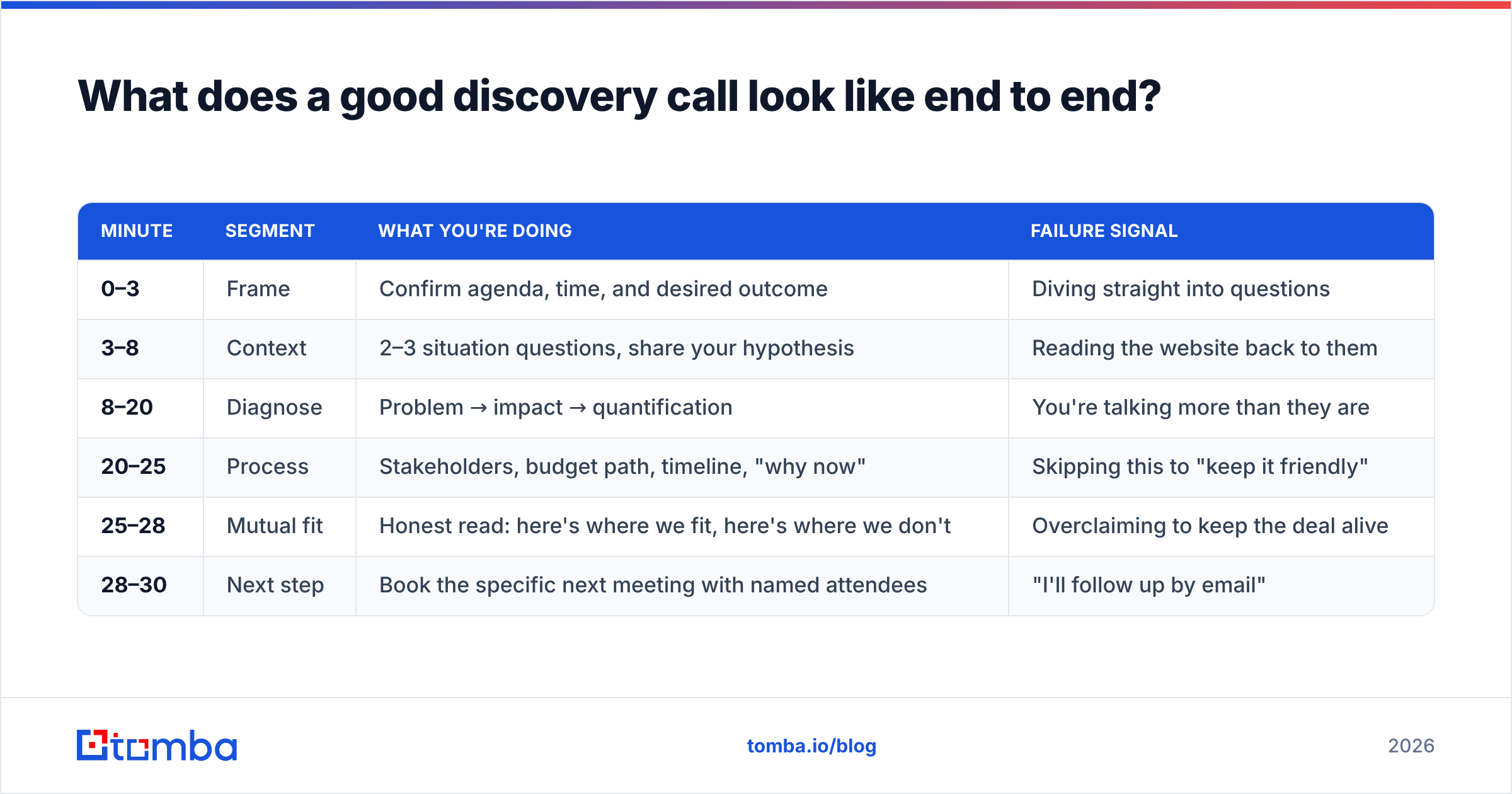
A 30-minute structure that holds up across segments:
| Minute | Segment | What you're doing | Failure signal |
|---|---|---|---|
| 0–3 | Frame | Confirm agenda, time, and desired outcome | Diving straight into questions |
| 3–8 | Context | 2–3 situation questions, share your hypothesis | Reading the website back to them |
| 8–20 | Diagnose | Problem → impact → quantification | You're talking more than they are |
| 20–25 | Process | Stakeholders, budget path, timeline, "why now" | Skipping this to "keep it friendly" |
| 25–28 | Mutual fit | Honest read: here's where we fit, here's where we don't | Overclaiming to keep the deal alive |
| 28–30 | Next step | Book the specific next meeting with named attendees | "I'll follow up by email" |
The mutual-fit segment is the one most reps skip, and it's the one buyers remember. Saying "based on what you've described, if your main constraint is enrichment coverage in APAC, we're average there — you'd want to test that specifically" builds more trust than any case study. It also disqualifies deals that would have died in month four anyway.
How do you measure discovery quality?#
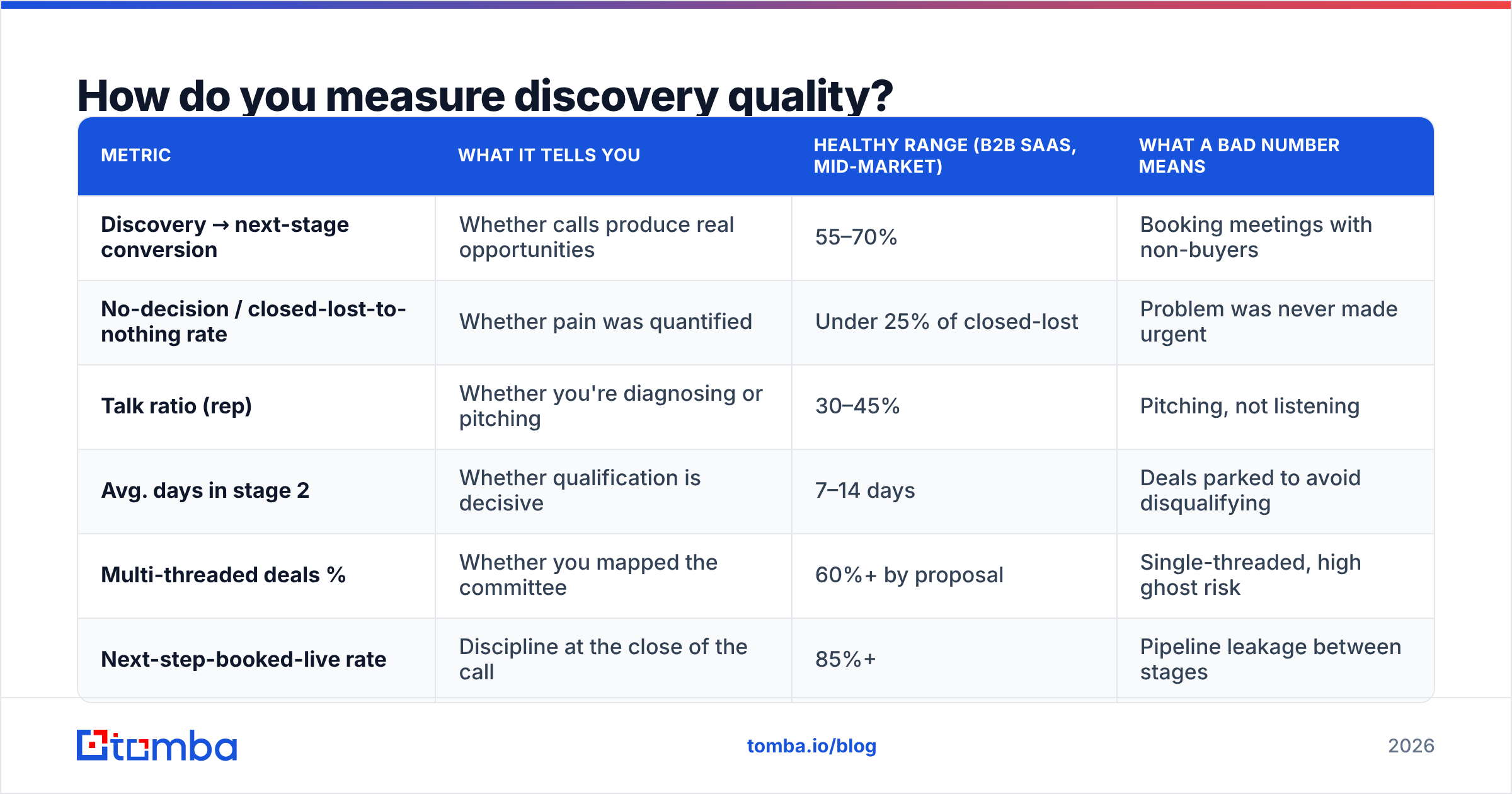
Discovery is the easiest stage to fake and one of the easiest to measure — if you look at the right numbers. Reps hide bad discovery behind activity metrics (calls booked, meetings held). Look at outcome metrics instead.
| Metric | What it tells you | Healthy range (B2B SaaS, mid-market) | What a bad number means |
|---|---|---|---|
| Discovery → next-stage conversion | Whether calls produce real opportunities | 55–70% | Booking meetings with non-buyers |
| No-decision / closed-lost-to-nothing rate | Whether pain was quantified | Under 25% of closed-lost | Problem was never made urgent |
| Talk ratio (rep) | Whether you're diagnosing or pitching | 30–45% | Pitching, not listening |
| Avg. days in stage 2 | Whether qualification is decisive | 7–14 days | Deals parked to avoid disqualifying |
| Multi-threaded deals % | Whether you mapped the committee | 60%+ by proposal | Single-threaded, high ghost risk |
| Next-step-booked-live rate | Discipline at the close of the call | 85%+ | Pipeline leakage between stages |
Pull these from your CRM by rep, not just by team. Team averages hide the two people dragging the number down. Conversation-intelligence platforms like Gong make talk ratio and question count trivially auditable; if you don't have one, manual review of two calls per rep per week gets you 80% of the value.
What tools support the discovery process in 2026?#
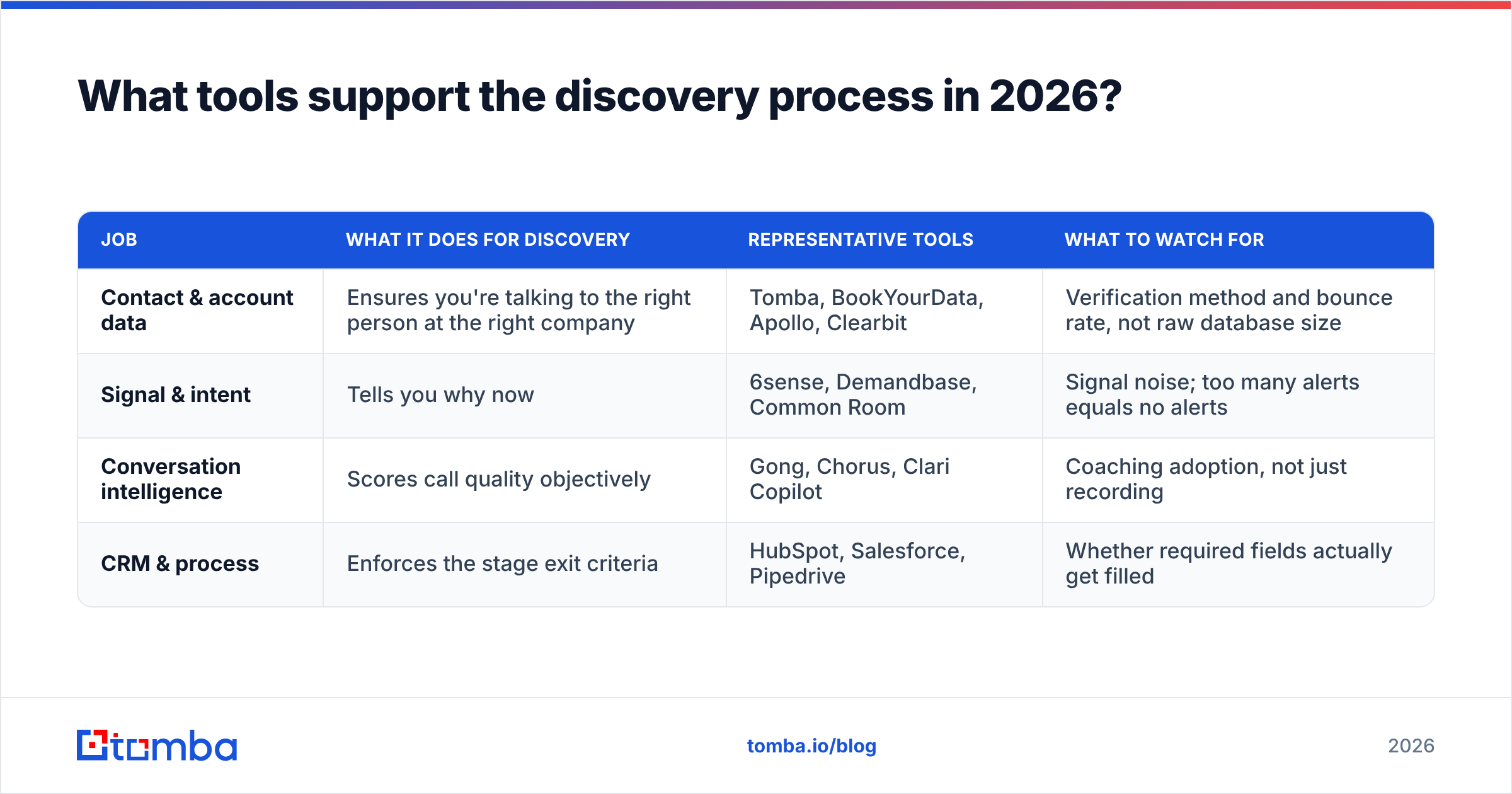
Discovery tooling splits into four jobs. Buying one platform that claims all four usually means being mediocre at three of them.
| Job | What it does for discovery | Representative tools | What to watch for |
|---|---|---|---|
| Contact & account data | Ensures you're talking to the right person at the right company | Tomba, BookYourData, Apollo, Clearbit | Verification method and bounce rate, not raw database size |
| Signal & intent | Tells you why now | 6sense, Demandbase, Common Room | Signal noise; too many alerts equals no alerts |
| Conversation intelligence | Scores call quality objectively | Gong, Chorus, Clari Copilot | Coaching adoption, not just recording |
| CRM & process | Enforces the stage exit criteria | HubSpot, Salesforce, Pipedrive | Whether required fields actually get filled |
On the data layer specifically: discovery quality is bounded by whether the meeting is with someone who owns the problem. That's a data problem before it's a selling problem. Tools differ mainly on verification rigor and pricing model. Tomba runs a free tier at 25 searches/month, with Starter at $49/mo, Growth at $99/mo, and Pro at $249/mo — and pairs the email finder with a verifier and catch-all handling so you're not booking calls against guessed addresses. BookYourData takes a different approach with prepaid, verified list purchasing, which suits teams that want a bulk contact drop rather than an ongoing API. Both are reasonable; pick based on whether your motion is continuous enrichment or periodic list-building. Check current Tomba pricing against your monthly contact volume rather than your headcount — that's where the cost actually lands.
For evaluating any of these, G2's sales intelligence category is more useful than vendor pages because it segments reviews by company size, which is the variable that most changes the verdict.
How does discovery change by deal size?#
The framework holds; the depth doesn't.
- SMB (under $10k ACV): one call, one stakeholder, 20 minutes. Skip formal decision-process mapping — the person on the call is the buyer. Focus on problem, cost, and speed to value. Over-qualifying kills velocity here.
- Mid-market ($10k–$100k ACV): one to two calls, 2–4 stakeholders. Full impact quantification is mandatory. Multi-thread by the second call or expect a stall.
- Enterprise ($100k+): three-plus discovery conversations, run separately per persona. Economic buyer, technical evaluator, and end user each have a different problem. Running one joint discovery call to "save time" produces a lowest-common-denominator understanding and a champion who can't sell internally.
The most common error is applying enterprise rigor to SMB deals — reps run 45-minute MEDDIC interrogations on a $6k deal and lose it to a competitor who sent a trial link on day one. Match the ceremony to the check size.
How do you fix discovery across a whole team?#
Individual coaching doesn't scale past about eight reps. Three systemic fixes do:
- Written stage-exit criteria. A deal cannot move from discovery to solution unless four fields are populated: quantified impact, named decision process, confirmed timeline, and next meeting booked. Enforce it in the CRM, not in the forecast call.
- Call scorecards, not vibes. A five-item rubric scored on two calls per rep per week. Question depth, talk ratio, quantification, process mapping, next step. Score it, chart it, review the trend monthly.
- A shared question bank. Not a script — a library of the ten best questions per persona, sourced from your top performers' actual calls. New reps ramp on this faster than on any training deck.
The fourth fix is upstream. If your reps are spending an hour a day hunting for contact details and cleaning lists, that's an hour not spent on pre-call research. Push that work to the data layer — bulk lookup, verification, and enrichment through the Tomba API or a bulk email finder run — and reps get their prep time back. HubSpot's research on sales productivity has consistently put non-selling admin work at roughly a third of a rep's week; discovery prep is the first thing sacrificed when that number climbs.
What's the fastest way to improve your next discovery call?#
Do three things:
- Write your one-sentence hypothesis before you dial, and open the diagnostic section by testing it out loud.
- Ask "what does that cost you?" at least twice, and don't move on until you have a number.
- Book the next meeting on the call, with named attendees, before you say goodbye.
That's it. Those three habits move discovery-to-next-stage conversion more than any framework certification.
Discovery breaks down when the person on the call isn't the person with the problem — and that's a targeting failure, not a technique failure. If your reps are burning discovery slots on wrong-fit contacts or bounced invites, start with the data. Tomba's Email Finder gets you verified, role-accurate contacts by domain, name, or company, with a free tier at 25 searches per month so you can test coverage on your own ICP before paying for anything. Fix the input, and discovery gets easier before you change a single question.
Related guides#
Ready to find emails that actually work?
Join 150,000+ professionals who stopped guessing and started sending. Free credits on signup — no credit card required.
Get the Tomba newsletter
Practical outbound tactics and product updates — once every two weeks.
About the author