How to Disqualify Leads Faster: A 2026 Sales Playbook
Most reps lose the quarter to deals that were never real. Here is the criteria, scripts, and data checks that let you disqualify leads in the first 10 minutes instead of the fourth call.

Most reps disqualify leads three calls too late. This guide shows how to spot a dead deal in the first ten minutes, what to say, and where to file it next.
TL;DR
- To disqualify leads is not to reject people. It is a choice to stop spending selling hours on an account that cannot buy.
- The cheapest cut happens before the first call: bad email, wrong company size, no tech match, no budget owner on the record.
- Use hard knockouts before the call. Use soft signals after it. Teams that mix the two move far too slowly.
- A rep who cuts 40% of their pipeline in week one often closes more. Their remaining hours go to real buyers.
- Track time to no next to win rate. If it takes four calls to say no, the process is broken, not the rep.
What does it mean to disqualify leads?#
To disqualify leads is to drop a prospect from your live pipeline on purpose. They fail your criteria. You log the reason, and you move on early.
Think of it like triage in an emergency room. Nobody is punished when a nurse sends a sprained ankle to the waiting room. The nurse is making sure the chest pain gets the doctor. Your calendar is the doctor. Every hour you give a lead who will never sign is an hour a real buyer never got.
Two things people mix up:
- Dropped is not lost. Lost means you competed and someone else won. Dropped means you never should have competed at all.
- Dropped is not forever. A 12-person startup may fail your seat floor today and pass it in 18 months. It is a routing call, not a blacklist.
The CRM side matters too. If dead deals sit there as lost, your win rate looks awful and your forecast learns from junk. Give this status its own name and its own reason codes.
Why does failing to disqualify leads cost more than a lost deal?#
A lost deal at least gave you information. A deal that was never real gave you nothing and ate everything.
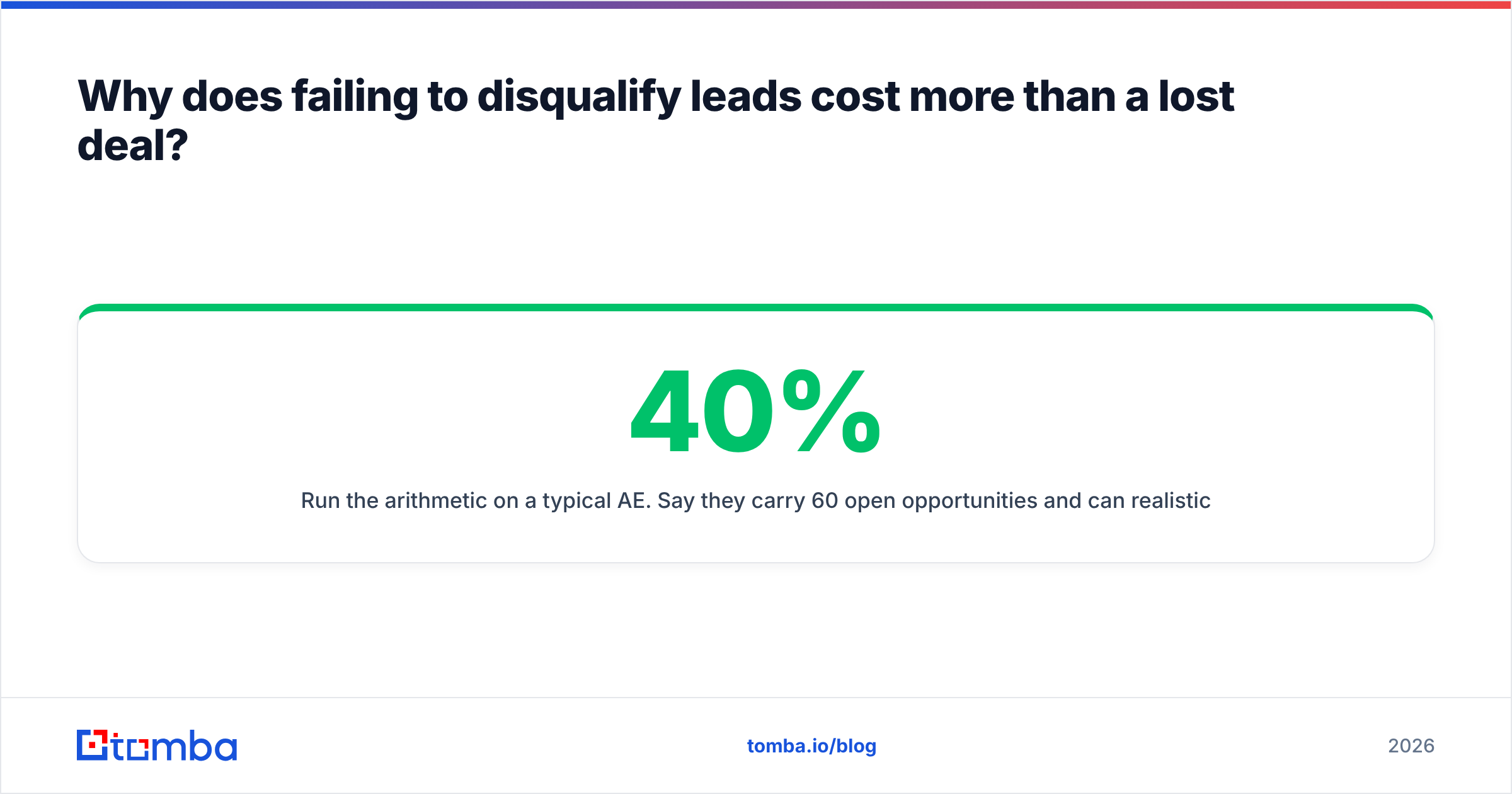
Run the math on one AE. Say they carry 60 open deals. They can run maybe 15 real evaluations in a quarter. Now say 40% of that pipeline has no budget, no buyer, and no deadline. That rep spends about six weeks a quarter writing emails nobody planned to answer.
The second cost is the forecast. Teams that never cut dead deals show 3x coverage on paper and 1.2x in real life. Every RevOps team knows the quarter-end scramble that follows.
The third cost is delivery. Sequence after sequence to bad contacts drives bounces and spam complaints. In time it damages your sender reputation. Weak qualification is not just a time problem. It is an inbox problem.

What criteria actually hold up?#
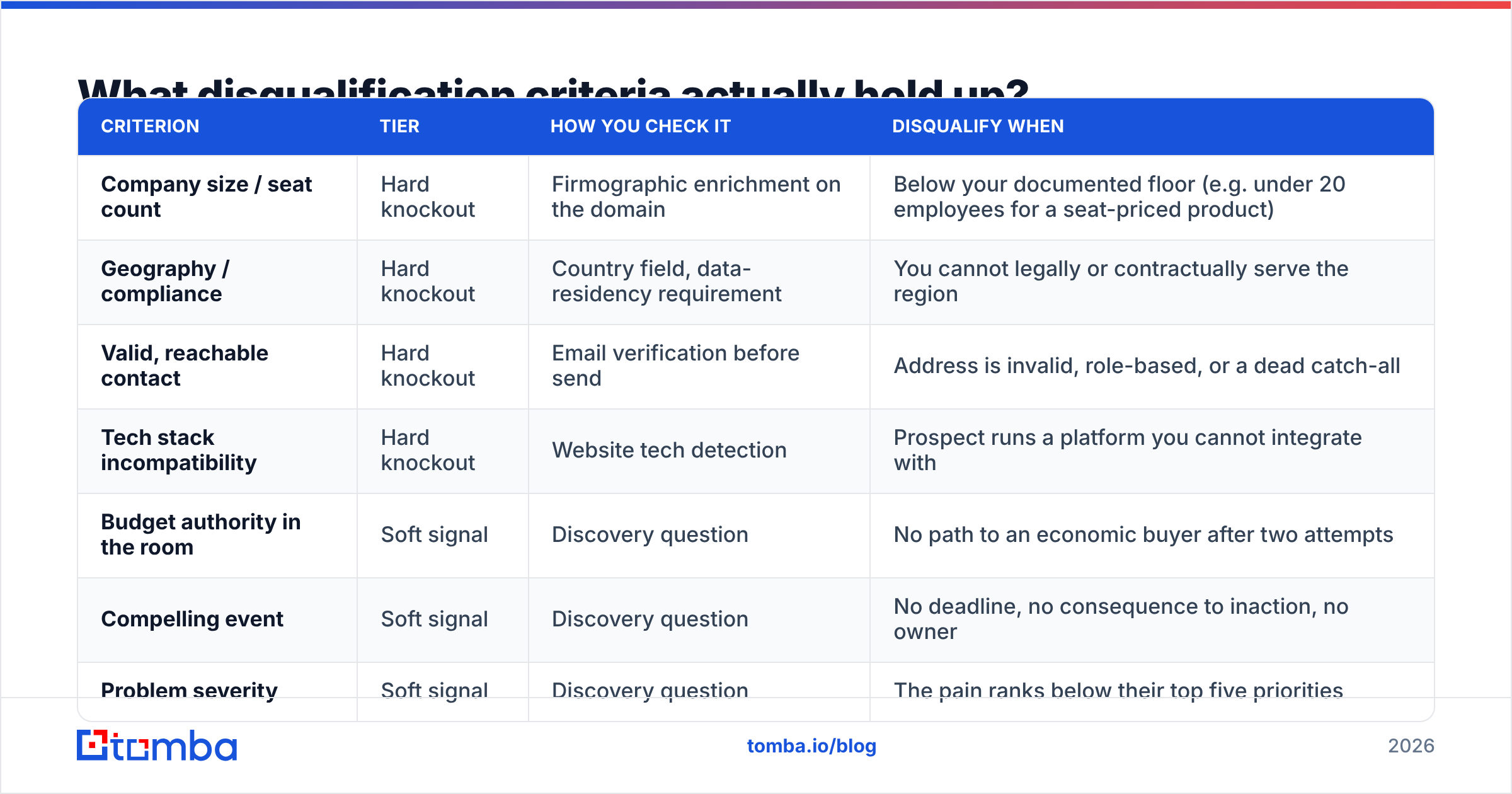
Split your criteria in two. Hard knockouts are binary, and a script can check them. Soft signals need a conversation, so you weight them.
| Criterion | Tier | How you check it | Cut when |
|---|---|---|---|
| Company size / seats | Hard knockout | Enrich the domain | Below your floor, say under 20 staff |
| Region / compliance | Hard knockout | Country and data rules | You cannot serve that region |
| Valid contact | Hard knockout | Email verification | Invalid, role-based, or dead catch-all |
| Tech stack | Hard knockout | Website tech detection | They run a platform you cannot support |
| Budget owner | Soft signal | Discovery question | No path to the buyer after two tries |
| Compelling event | Soft signal | Discovery question | No deadline, no cost of doing nothing |
| Problem severity | Soft signal | Discovery question | The pain sits below their top five |
| Timeline | Soft signal | Discovery question | Maybe next year, with no trigger |
Hard knockouts let you disqualify leads before anyone picks up the phone. If a rep learns on a call that the firm has 8 people and your floor is 20, that is an ops failure. Enrich the record first. Filter second. Call third. That is the job contact enrichment does.
Soft signals belong on a scorecard, not a gate. A prospect can fail one and still be a great deal. Failing three is a talk about walking away.
Is BANT still good enough, or do you need MEDDICC?#
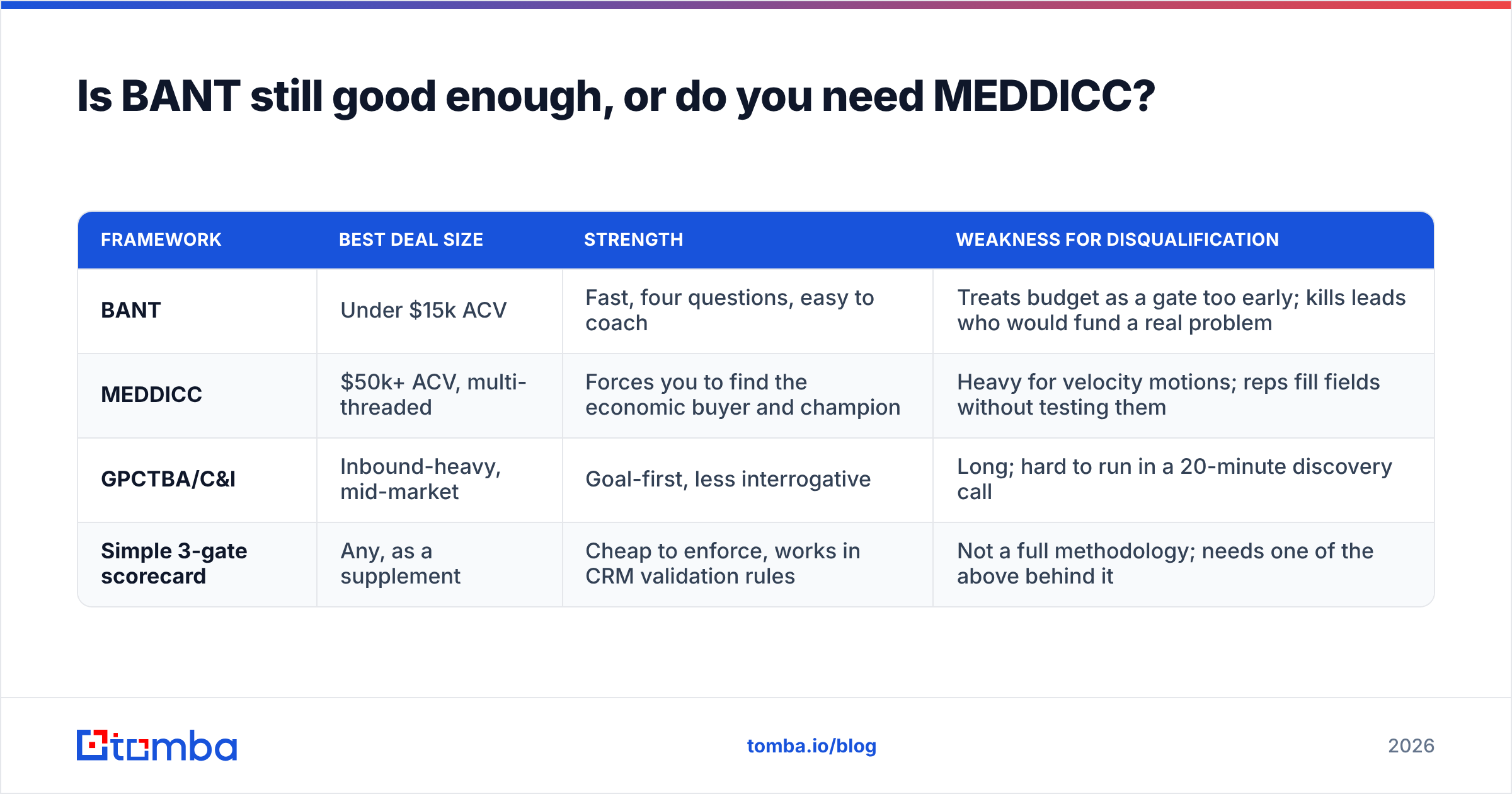
Both work. Both help you disqualify leads. They fail in different places, and deal size decides which one fits.
| Framework | Best deal size | Strength | Where it fails |
|---|---|---|---|
| BANT | Under $15k ACV | Fast, four questions, easy to coach | Gates on budget too early |
| MEDDICC | $50k+ ACV | Forces you to find the buyer and champion | Heavy for high-velocity teams |
| GPCTBA/C&I | Inbound mid-market | Goal first, less like an interview | Too long for a 20-minute call |
| 3-gate scorecard | Any, as a add-on | Cheap to enforce in CRM rules | Not a full method on its own |
Here is where most teams land. Run hard knockouts before the call. Run a short MEDDICC on deals above your ACV line. Use a three-gate scorecard, fit and pain and path to buyer, on the rest. HubSpot's sales qualification guidance is a fine starting template. Still, the criteria have to be yours. Copy another firm's seat floor and you will cut your best segment by mistake.
One rule survives every framework. If you cannot name the person who signs, and the date something bad happens if they don't, you do not have a deal. You have a chat.
How do you disqualify leads without burning the relationship?#
Delivery matters as much as criteria. Done badly, it reads as you are too small. Done well, it reads as respect for their time.
In the call:
- Ask the hard question early. Most teams who get value here have at least 20 people sending outbound. Where are you today? That is not rude. It saves you both three meetings.
- State the mismatch, not the verdict. The ROI would be thin until you pass 20 seats lands better than you are not a fit.
- Give them something anyway. A template, a benchmark, a free tool. People treated well when you said no come back later, and they refer.
After the call:
- Name the trigger to talk again. If you cross 25 people, that is when this pays off. Can I check back then? Now a dead lead is a dated task.
- Log the reason code. One field. Fixed list. Required. No budget. Below size floor. No event. Bad data. Under contract.
- Route, don't delete. Not now goes to nurture. Never goes to a suppression list, so nobody sequences them again.
Point six is where teams leak. With no suppression list, your own SDRs email the same dead contacts every two quarters. Bounce and complaint rates creep up.
What signals should trigger an instant no?#
Some things need no scorecard. These signals let you disqualify leads on the spot:
- The email does not resolve. If it comes back invalid, you have a string, not a lead. Run every list through an email verifier before you send.
- Only generic addresses. info@, sales@, contact@. Nobody who signs reads those at scale.
- The company is gone. Defunct, acquired, or in liquidation. Fresh firmographics catch this. Stale CRM data does not.
- Locked with a rival for 18 months, with a happy champion. Set a task for month 14 and move on.
- They need a feature you do not have, and they have said it is non-negotiable.
- No reply after a full sequence and two manual touches. At some point, silence is the answer.

How do you disqualify leads before a human touches them?#
The cheapest no is the one a script makes. Build the filter in this order.
Stage 1 — Existence. Does the domain resolve? Is the company still trading? Is there a real, deliverable contact in the role you need? A dead domain is a no, full stop.
Stage 2 — Fit. Employee count, industry, region, funding stage, tech stack. All of it is available before a call. If your floor is 20 people, this stage should drop every smaller account on its own. No rep discretion.
Stage 3 — Reach. Do you have a verified email for a decision maker, or just for an intern? A domain search that returns department heads beats fifty generic contacts. If the only way in is a catch-all with no clear pattern, mark it low confidence.
Stage 4 — Timing. Recent hiring in the team you sell to. A new tool in the stack. A funding round. A new leader. No trigger is not a no by itself. Paired with a weak soft signal, it usually is.
Only leads that clear all four stages should reach a rep's calendar. Teams that run this filter drop 30–50% of raw list volume before the first touch. Reply rates then tend to double. The people left are real buyers with a real problem.
It also helps to agree on terms across teams. Line up what counts as a marketing qualified lead and what counts as sales accepted. Half of all bad lead quality fights are really vocabulary fights.
How do you know the process is working?#
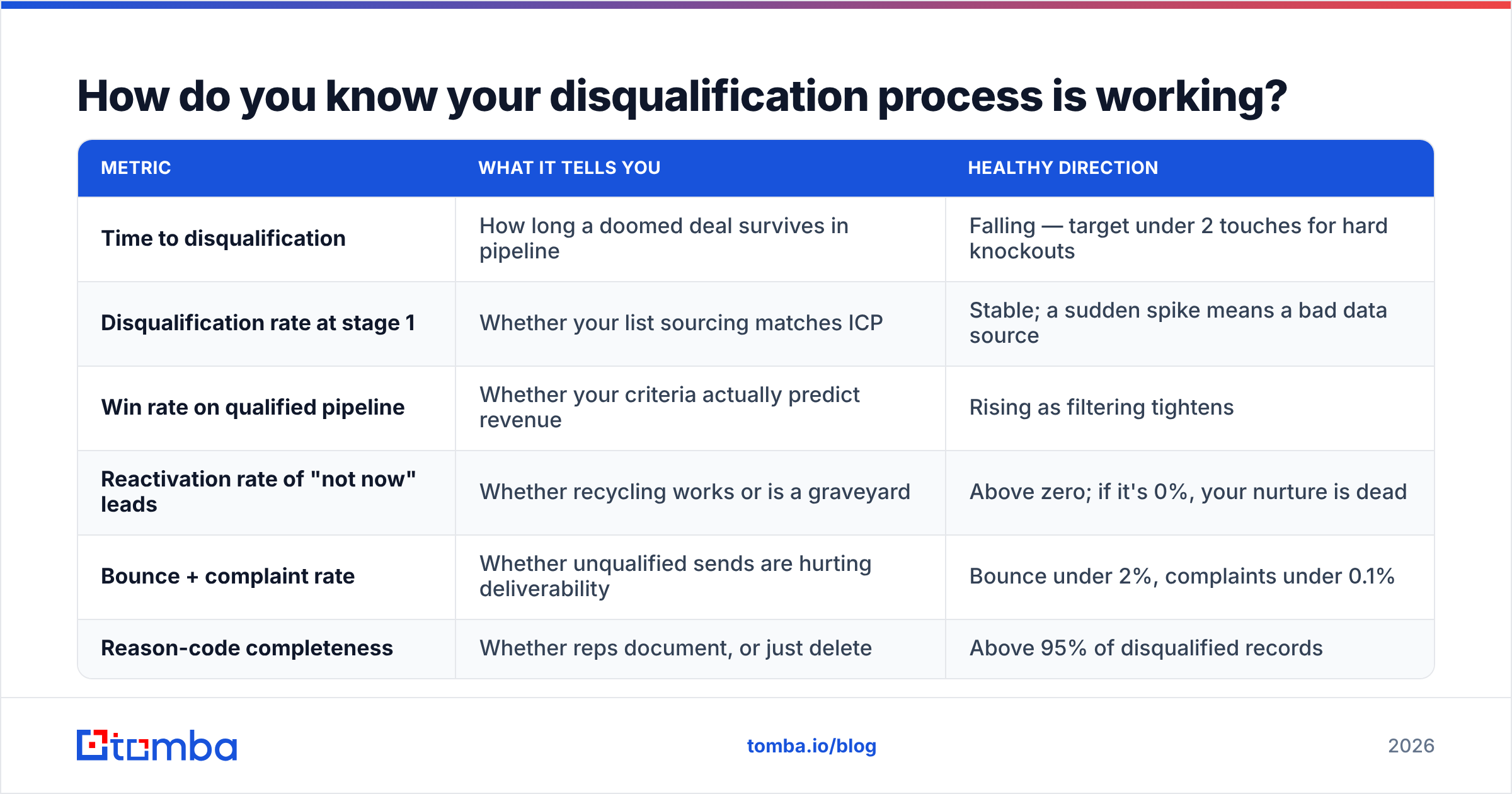
Measure it. Otherwise cut faster is just a slogan.
| Metric | What it tells you | Healthy direction |
|---|---|---|
| Time to no | How long a doomed deal survives | Falling; under 2 touches for knockouts |
| Stage 1 cut rate | Whether your list source matches ICP | Stable; a spike means a bad source |
| Win rate on live pipeline | Whether your criteria predict revenue | Rising as the filter tightens |
| Not now revival rate | Whether recycling works at all | Above zero; 0% means dead nurture |
| Bounce and complaint rate | Whether bad sends hurt delivery | Bounce under 2%, complaints under 0.1% |
| Reason-code fill rate | Whether reps document or just delete | Above 95% of dropped records |
One caution. If you disqualify leads faster but win rate stays flat, you are not filtering better. You are filtering at random. Reps sometimes drop hard deals instead of dead ones. Audit a sample each month. Ask whether a stronger rep would have kept them. Gartner's sales research is clear here. Process rules only lift results when they track real buying behavior, not rep comfort.
What do you do with the leads you drop?#
Three buckets, three homes:
- Gone for good (wrong product, dead company, bad contact) → suppression list. Never send again.
- Not now (too small, budget cycle, under contract) → a dated task plus slow nurture, with the trigger written down.
- Wrong offer, right buyer (wrong product line or tier) → route it inside the team instead of dropping it.
Bucket two is where lost revenue comes back. Companies grow. Contracts end. Champions move and take your product with them. A dropped lead with a trigger and a verified contact is a warm re-entry in 12 months. One with no notes is a stranger.
Keep those records clean. Contacts decay by 2–3% a month as people change jobs. A recycling list you never re-verify turns into fiction.
Where to start this week#
Pick one thing. Write down your hard knockouts. Three to five binary rules, no adjectives, checkable without a call. Then run them on your next list before a single email goes out.
That step needs accurate contact data. It is where most processes quietly fail. Reps drop good accounts on stale records, or burn a week on a firm that closed last year. Run your target domains through the Tomba Email Finder to see who works there now and which addresses are deliverable. Verify the results. Then let the bad records rule themselves out before a rep ever calls. The free tier gives you 25 searches a month. Check Tomba pricing when you are ready to filter at list scale; Starter is $49/mo.
Disqualify leads early. Write down why. Spend the hours you win back on the deals that were always going to close.
Related guides#
Ready to find emails that actually work?
Join 150,000+ professionals who stopped guessing and started sending. Free credits on signup — no credit card required.
Get the Tomba newsletter
Practical outbound tactics and product updates — once every two weeks.
About the author