Ditlead Pricing in 2026: Plans, Real Costs, and Limits
A neutral breakdown of Ditlead pricing in 2026: what each tier actually includes, where the sticker price stops telling the truth, and how the total cost compares to running a separate data layer.
TL;DR
- Ditlead sells itself on unlimited-style sending: one subscription, many connected mailboxes, and LinkedIn plus email sequencing in the same workspace. That framing is what makes its entry tier look cheap next to per-seat platforms.
- The published sticker price is not your real cost. Contact/credit ceilings, mailbox warmup, extra workspaces, and — most often — the lead data you feed it are what move the monthly bill.
- Sending tools and data tools are priced on different logic. Sequencers charge for volume and seats; data providers charge for verified records. Buying both from one vendor almost always means overpaying for one of them.
- For most teams under 10 reps, the cheapest viable stack in 2026 is a volume-priced sequencer plus a separate, accuracy-first email finder — not an all-in-one that bundles mediocre data.
- Always price a tool against the campaign you actually run: 2,000 verified contacts a month is a completely different budget line than 20,000 scraped ones.
Pricing pages are marketing documents. This one is a third-party read of Ditlead pricing — the structure, the ceilings vendors don't put in the headline, and the point at which a different stack gets cheaper for the same output.
What is Ditlead, and who is it for?#
Ditlead is a multichannel sales engagement platform: cold email sequencing, LinkedIn automation, a light CRM/pipeline view, shared inbox, and mailbox warmup, sold as one subscription. You can check the current plan lineup directly at ditlead.com and read practitioner reviews on G2 before committing.
The positioning is aimed squarely at agencies and lean outbound teams who got tired of paying per seat for sales automation and separately for a LinkedIn tool. If you run five client workspaces and 40 connected mailboxes, per-seat pricing punishes you brutally. Volume-based pricing does not.
That's the honest appeal. The question is whether the total cost of running outbound on it beats the alternatives once you add the pieces the subscription doesn't cover.

How much does Ditlead cost in 2026?#
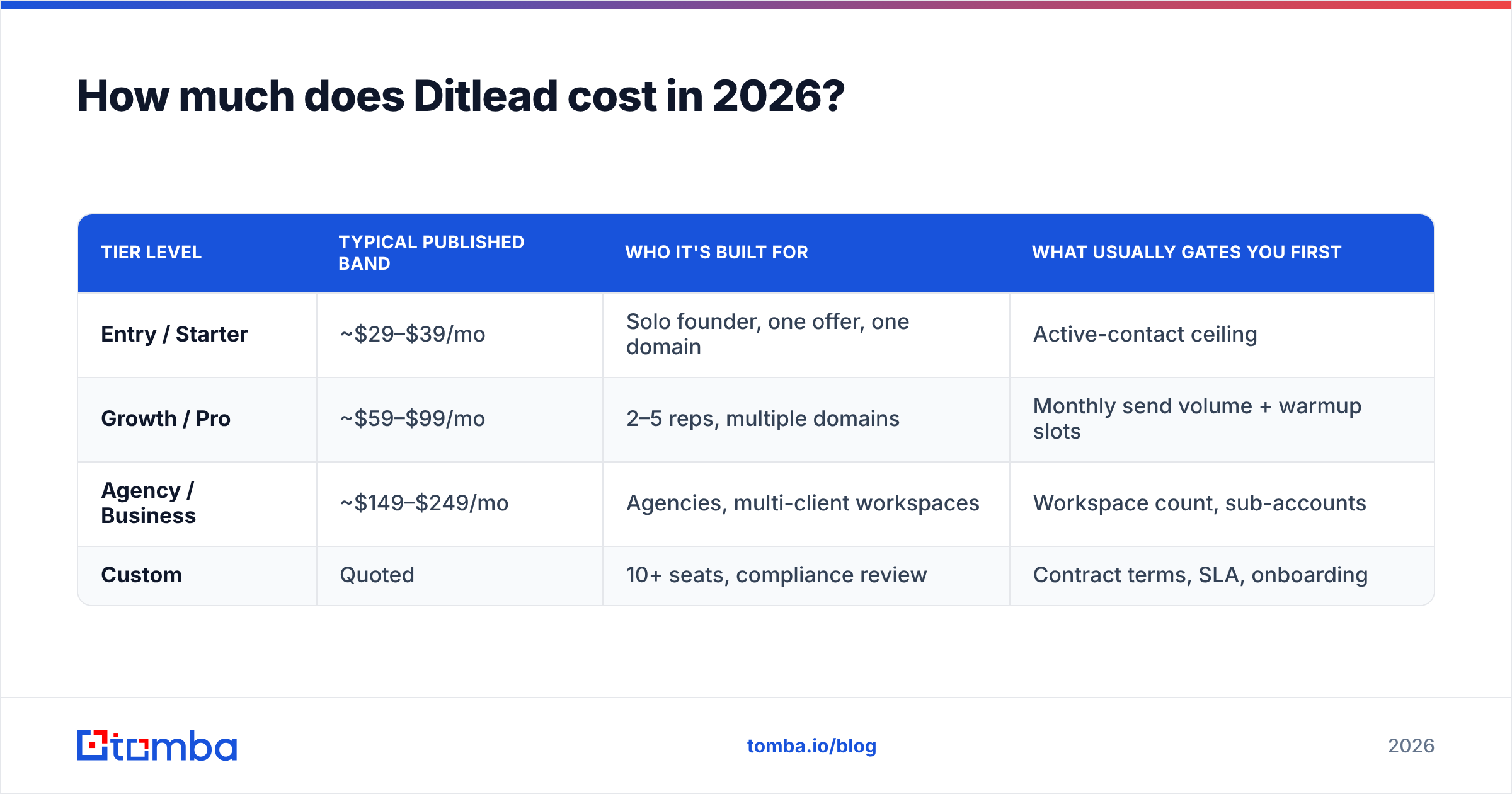
Ditlead uses a tiered subscription model rather than per-seat licensing. Tiers scale on the things that actually cost the vendor money: number of active contacts/leads in the system, monthly sending volume, connected mailboxes, and workspace count.
Vendors in this category change numbers frequently — Ditlead has repriced more than once, and anyone quoting an exact figure from a blog post six months old is quoting a dead number. Verify on the vendor's own pricing page before you buy. What's stable is the shape:
| Tier level | Typical published band | Who it's built for | What usually gates you first |
|---|---|---|---|
| Entry / Starter | ~$29–$39/mo | Solo founder, one offer, one domain | Active-contact ceiling |
| Growth / Pro | ~$59–$99/mo | 2–5 reps, multiple domains | Monthly send volume + warmup slots |
| Agency / Business | ~$149–$249/mo | Agencies, multi-client workspaces | Workspace count, sub-accounts |
| Custom | Quoted | 10+ seats, compliance review | Contract terms, SLA, onboarding |
Two structural notes that matter more than the exact dollar figure:
Annual billing carries a real discount. Like most tools in this bracket, Ditlead prices annual plans well below 12× monthly. That's fine if you've already validated the channel. It's a trap if you're still testing whether cold email works for your offer — you'll be paying for months 4 through 12 of a channel you abandoned in month 2.
"Unlimited" always has a governor. Unlimited mailboxes with a hard cap on monthly emails is a volume plan wearing a costume. Unlimited sending with a contact ceiling is a database plan wearing a costume. Find the governor before you sign, because that's the number that determines your renewal upgrade.
What do you actually get on each Ditlead plan?#
Rather than list features, look at what changes as you climb the tiers. This is where most buyers misprice themselves:
- Active contacts, not total contacts. Most platforms count leads currently enrolled in a sequence, not everything you've ever imported. If you archive finished campaigns you stay under the ceiling for longer. If you don't, you'll hit an upgrade prompt six weeks in for no operational reason.
- Connected mailboxes and warmup. Warmup is usually included, but "included warmup" and "warmup that meaningfully protects sender reputation" are different claims. Assume you still need proper SPF, DKIM, and DMARC setup regardless of what the plan includes.
- Workspaces / sub-accounts. The single biggest agency cost driver. One client per workspace is the clean way to run it, and workspace count is usually a paid axis. Price this before you sign a client, not after.
- LinkedIn automation seats. Multichannel is the differentiator, but LinkedIn actions are tied to real logged-in accounts. More accounts almost always means a higher tier, and LinkedIn's own limits cap what any tool can do safely.
- API access and integrations. Native CRM sync (HubSpot, Pipedrive, Salesforce) versus Zapier-only is frequently a tier gate. If your revenue reporting depends on activity landing in the CRM, verify this is on the plan you're actually buying.
- Lead data. Usually not included in a meaningful quantity, or included as a low-quality bundled database. This is the line item that breaks budgets.
That last point deserves its own section.
Where does Ditlead pricing get more expensive than the sticker price?#
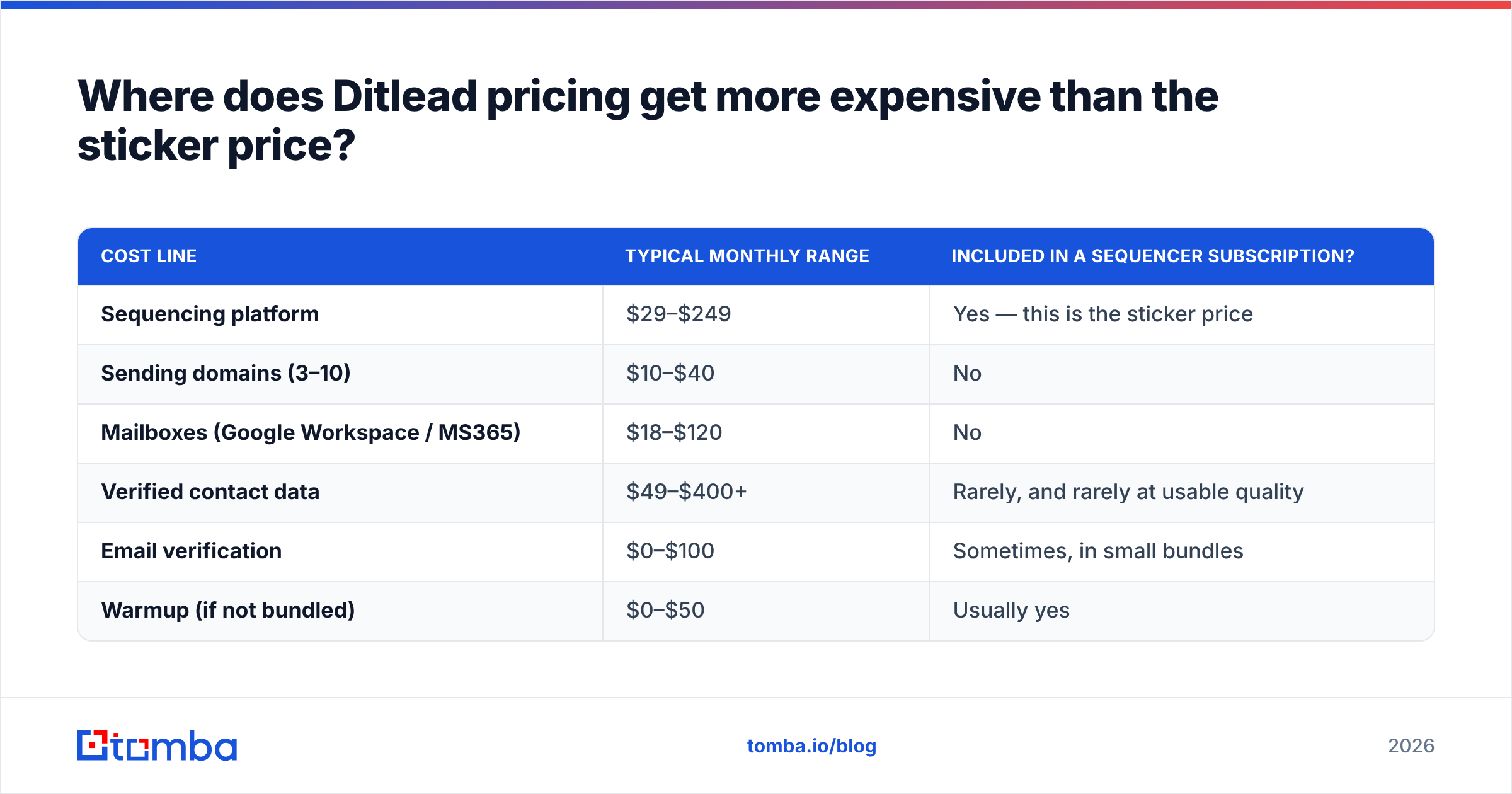
The subscription is rarely the biggest number on the invoice. Here's the honest full-stack cost of running outbound in 2026, with the sequencer as just one line:
| Cost line | Typical monthly range | Included in a sequencer subscription? |
|---|---|---|
| Sequencing platform | $29–$249 | Yes — this is the sticker price |
| Sending domains (3–10) | $10–$40 | No |
| Mailboxes (Google Workspace / MS365) | $18–$120 | No |
| Verified contact data | $49–$400+ | Rarely, and rarely at usable quality |
| Email verification | $0–$100 | Sometimes, in small bundles |
| Warmup (if not bundled) | $0–$50 | Usually yes |
A $39/mo plan sitting inside a $400/mo stack is not a $39/mo decision. And the largest, most variable line is data — which is exactly the line all-in-one vendors are weakest on, because building an accurate contact dataset is a fundamentally different engineering problem than building a sequencer.
Bundled databases inside sending tools tend to be resold, aged, or thinly verified. You feel it as bounce rate, and bounce rate is not a cosmetic metric — sustained hard bounces above roughly 2% degrade email deliverability across every domain you own. Google and Yahoo's bulk sender requirements made that failure mode significantly more expensive than it was a few years ago; the practical guidance from providers like HubSpot and every major ESP is now the same: verify before you send, every time.
So the real question isn't "what does Ditlead cost?" It's "what does Ditlead plus a data source that doesn't burn my domains cost?"
How does Ditlead pricing compare to other sales engagement tools?#
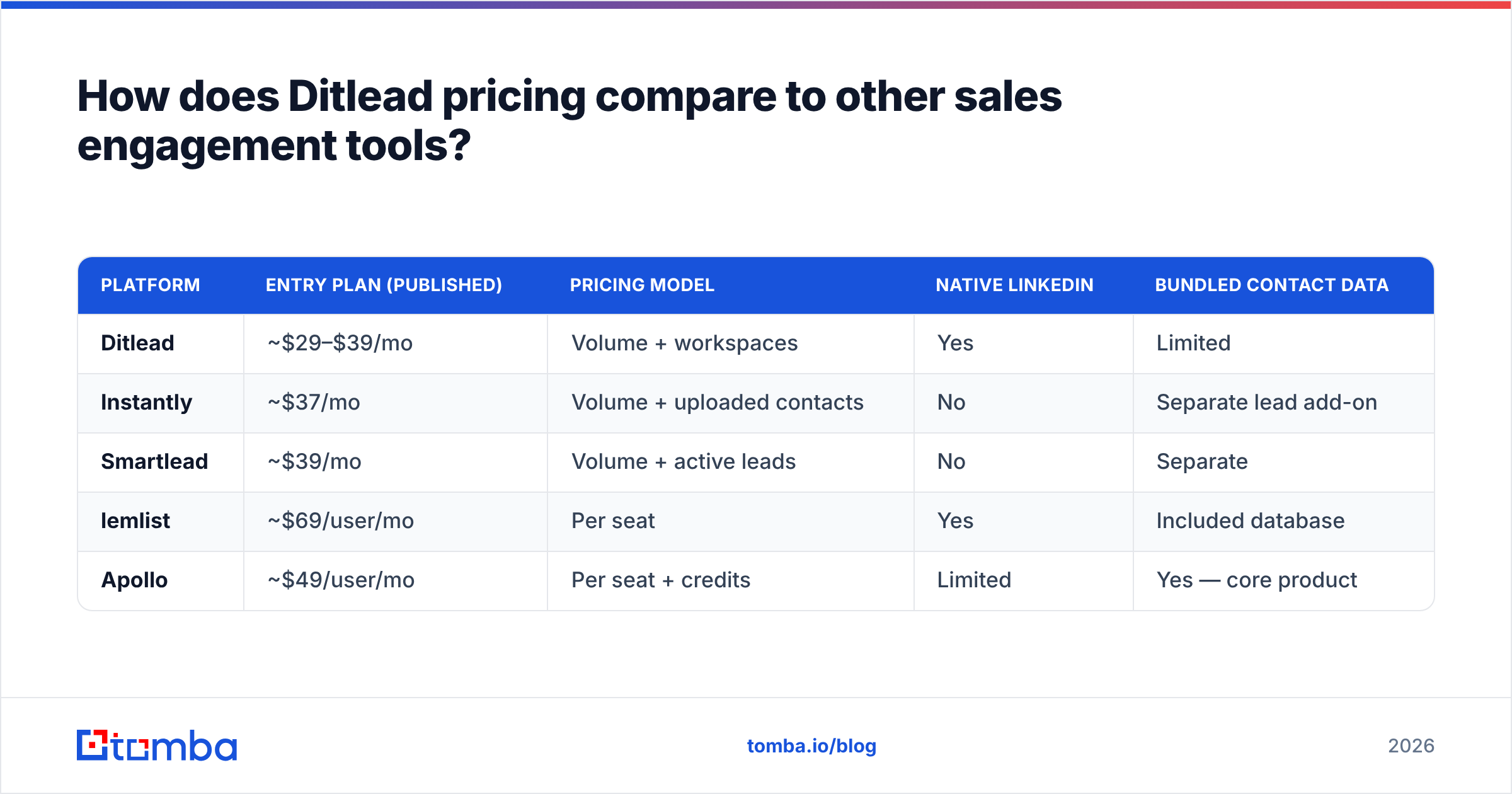
Here's the entry-tier landscape as published at the time of writing. Confirm every figure on the vendor's own page — this category reprices constantly.
| Platform | Entry plan (published) | Pricing model | Native LinkedIn | Bundled contact data |
|---|---|---|---|---|
| Ditlead | ~$29–$39/mo | Volume + workspaces | Yes | Limited |
| Instantly | ~$37/mo | Volume + uploaded contacts | No | Separate lead add-on |
| Smartlead | ~$39/mo | Volume + active leads | No | Separate |
| lemlist | ~$69/user/mo | Per seat | Yes | Included database |
| Apollo | ~$49/user/mo | Per seat + credits | Limited | Yes — core product |
Read that table by pricing model, not by price:
- Per-seat tools (Apollo, lemlist) get expensive linearly with headcount and cheap-ish with volume. Good for a growing SDR team with modest sending needs.
- Volume tools (Ditlead, Instantly, Smartlead) get expensive with sending scale and stay flat as you add operators. Good for agencies and small teams running high volume across many domains.
- Data-first tools charge per verified record. That cost tracks your prospecting output, not your headcount or your send volume.
Ditlead's genuine edge in this set is LinkedIn plus email in one volume-priced subscription. If multichannel matters and you're allergic to per-seat billing, that's a defensible reason to pick it. If you only send email, its differentiator is one you're paying for and not using.
Is Ditlead worth it for your team size?#
Verdict by profile, stated plainly:
Solo founder / consultant (1 sender, <2,000 emails/mo): Probably overkill unless you specifically want LinkedIn sequencing. A cheaper sender plus a solid data source covers you.
Agency running 3+ client workspaces: This is the strongest fit in the lineup. Volume pricing plus multi-workspace is exactly the shape of an agency's cost curve, and per-seat competitors will cost multiples of it.
Small in-house team, 2–6 reps: Competitive, but compare against Instantly and Smartlead on total cost including the data layer. If you don't use LinkedIn automation, you're paying a premium for a channel you've turned off.
Enterprise / 10+ seats with compliance review: Look elsewhere or negotiate hard. Security review, SSO, audit logs, and data-processing terms are where the smaller multichannel tools thin out. Analyst coverage from Gartner on sales engagement platforms is a better starting point at this tier.
What's the cheapest way to build the same outbound stack?#
Unbundle. Buy sending from a sending specialist and data from a data specialist. Concretely:
- Sequencer — pick on pricing model, not features. Volume-priced if you run many mailboxes; per-seat if you have few senders and high touch.
- Data layer — an accuracy-first email finder that returns a confidence score, not a guessed pattern. This is where campaign performance is actually decided.
- Verification — run every list through an email verifier before import, including anything the sequencer's bundled database gave you. Catch-all domains need catch-all verification specifically, since standard SMTP checks return "unknown" and most tools quietly pass them through as valid.
- Infrastructure — domains, mailboxes, DNS records. Non-negotiable and not included anywhere.
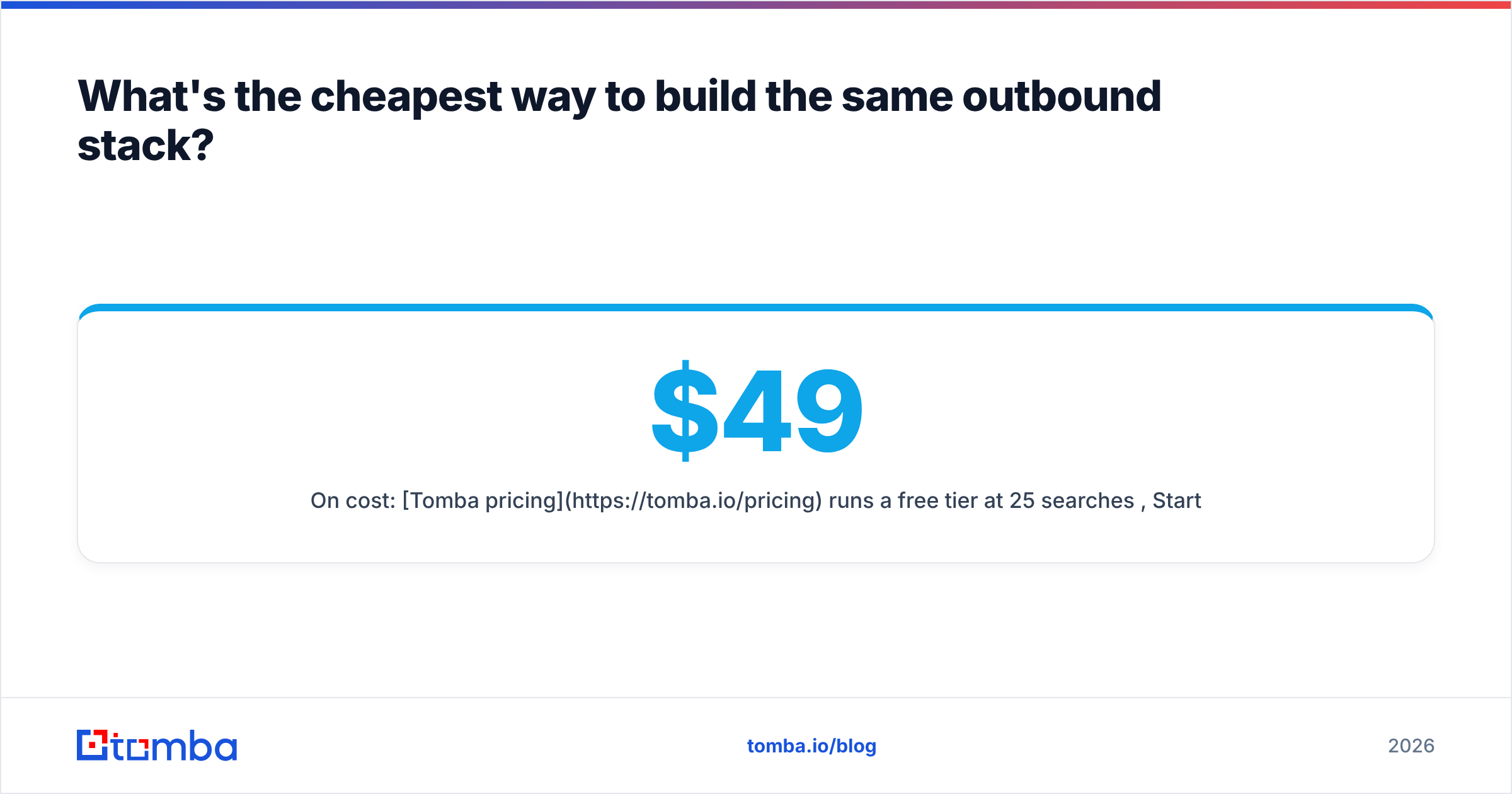
On cost: Tomba pricing runs a free tier at 25 searches/mo, Starter at $49/mo, Growth at $99/mo, and Pro at $249/mo, with Enterprise quoted. Put a $49/mo data layer next to a $39/mo sequencer and you have a complete, defensible outbound stack under $90/mo — with the data half handled by a vendor whose entire business is data accuracy rather than a bundled afterthought.
That split also survives vendor churn. When you outgrow your sequencer, you migrate sequences and keep your contact pipeline intact. When your data is locked inside the sending tool, switching costs you both.
What should you check before you buy any sequencer?#
Run this list against Ditlead or anything else on the shortlist:
- What's the hard ceiling on my plan — active contacts, monthly sends, or mailboxes? Which one will I hit first at my real volume?
- Is warmup included, and for how many mailboxes?
- Does the bundled data have a published accuracy or bounce guarantee? No number means no guarantee.
- Is native CRM sync on my tier, or Zapier-only?
- What's the refund and downgrade policy on annual? Most vendors in this bracket offer a short window and nothing after.
- Can I export contacts and sequence data cleanly? Test this in trial, not at renewal.
If a vendor can't answer the first and third questions in writing, that's your signal.
The bottom line on Ditlead pricing#
Ditlead is fairly priced for what it is: a volume-billed multichannel sequencer that undercuts per-seat platforms for agencies and small teams. The entry tier is genuinely competitive, the LinkedIn integration is a real differentiator, and the workspace model matches how agencies bill.
What it doesn't solve — what no sequencer solves — is where your verified contacts come from. That line item is bigger than the subscription, it determines your bounce rate, and it's the one place where buying from a specialist pays for itself in the first campaign.
Start there. Build a clean, verified list with the Tomba Email Finder — free tier included, no credit card, 25 searches to test the accuracy against a domain you already know — then pick whichever sequencer's pricing model fits your team shape. Good data makes a cheap sequencer look great. Bad data makes an expensive one look broken.
Related guides#
Ready to find emails that actually work?
Join 150,000+ professionals who stopped guessing and started sending. Free credits on signup — no credit card required.
Get the Tomba newsletter
Practical outbound tactics and product updates — once every two weeks.
About the author