Ditlead vs Jeeva AI 2026: Full Comparison and Our Pick
One is a low-cost multichannel sequencer you drive yourself. The other is an autonomous AI SDR that drives itself. Here's how Ditlead and Jeeva AI actually differ on pricing, data, deliverability, and control.
TL;DR
- Ditlead is a budget multichannel sequencer: email, LinkedIn, calls, and a light CRM in one workspace, with unlimited-mailbox pricing and a history of lifetime deals. You do the thinking; it does the sending.
- Jeeva AI is an autonomous AI SDR: it sources contacts, writes copy, sequences, and replies with minimal human input. You supervise; it does the thinking (or tries to).
- The price gap is the headline. Ditlead sits in the tens-of-dollars-per-month band. Jeeva is priced like a headcount replacement — expect four figures a month once you're past a pilot.
- Neither is a data company. Ditlead ships almost no native contact data; Jeeva's bundled data is convenient but opaque. Both improve dramatically when you feed them verified emails from a dedicated source.
- Our pick: Ditlead if you have an SDR (or a founder) who can write and wants control over spend. Jeeva if you have budget but no headcount and you're comfortable auditing an agent's output weekly.
What are Ditlead and Jeeva AI, exactly?#
They solve the same business problem — get more qualified conversations — from opposite ends of the automation spectrum.
Ditlead is a sales engagement platform. Think sequences, mailbox rotation, warmup, LinkedIn steps, a dialer, a unibox, and a lightweight pipeline view. It competes on price and breadth rather than intelligence. The pitch is: everything Outreach or Salesloft does for outbound execution, at a fraction of the cost, with unlimited sending accounts instead of per-seat gouging.
Jeeva AI is an AI SDR platform. You give it an ICP definition and a value proposition; its agents identify accounts, find contacts, personalize messaging from signals (job changes, funding, tech stack, website visits), run the cadence, and handle inbound replies until a meeting is booked or the lead is disqualified. The pitch is: replace the repetitive 80% of an SDR's day.
That distinction matters more than any feature checkbox. Ditlead is a tool. Jeeva is a worker. Tools are cheap and predictable. Workers are expensive and need management.
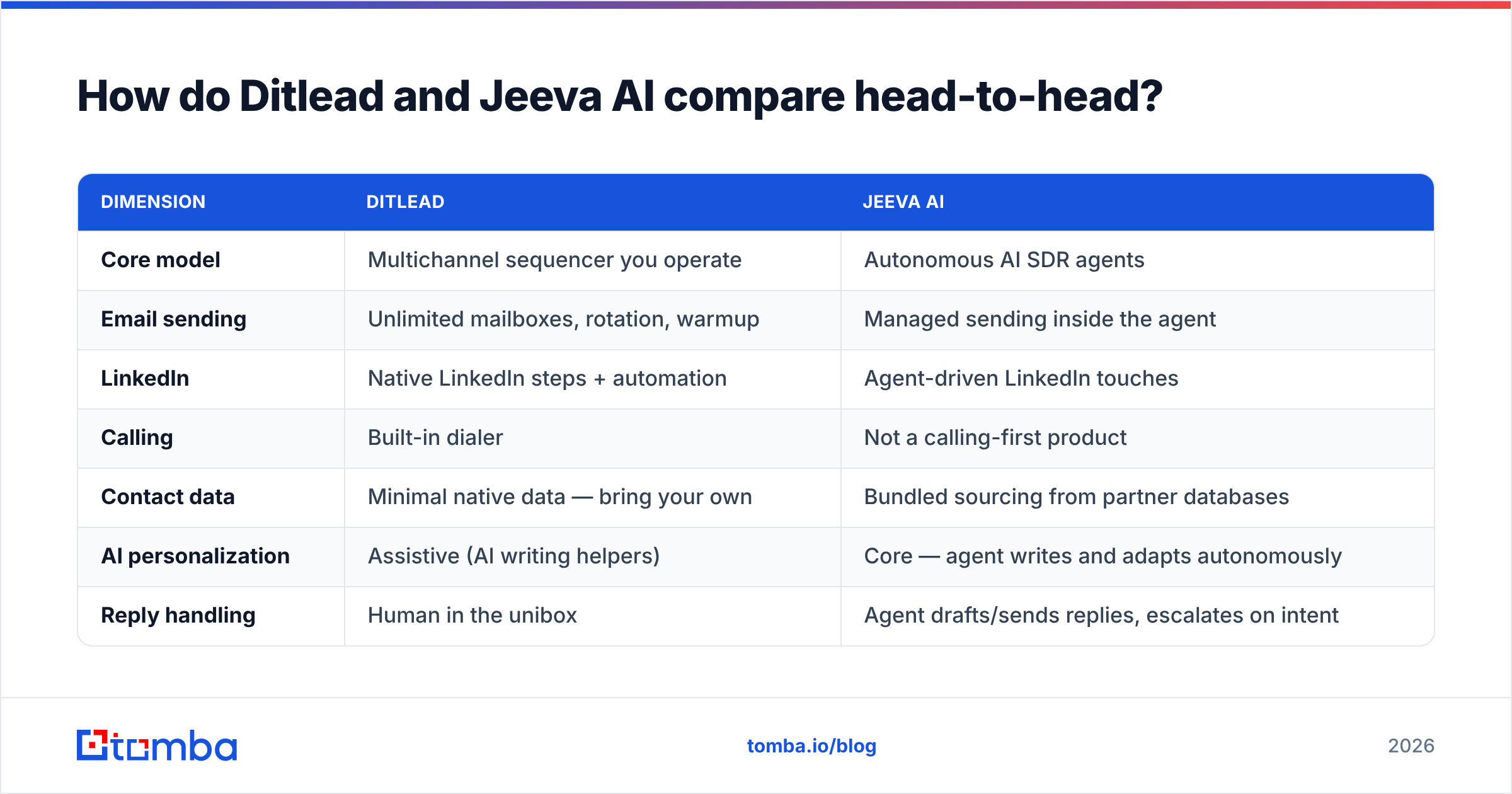
How do Ditlead and Jeeva AI compare head-to-head?#
| Dimension | Ditlead | Jeeva AI |
|---|---|---|
| Core model | Multichannel sequencer you operate | Autonomous AI SDR agents |
| Email sending | Unlimited mailboxes, rotation, warmup | Managed sending inside the agent |
| Native LinkedIn steps + automation | Agent-driven LinkedIn touches | |
| Calling | Built-in dialer | Not a calling-first product |
| Contact data | Minimal native data — bring your own | Bundled sourcing from partner databases |
| AI personalization | Assistive (AI writing helpers) | Core — agent writes and adapts autonomously |
| Reply handling | Human in the unibox | Agent drafts/sends replies, escalates on intent |
| CRM | Light native CRM + integrations | Integrates into HubSpot/Salesforce |
| Entry price band | Tens of dollars per month | Four figures per month at team scale |
| Time to first send | Hours | Days (ICP training + guardrails) |
| Best for | Founders, agencies, lean SDR teams | Funded teams replacing SDR headcount |
Two rows drive almost every buying decision here: contact data and price band. We'll come back to both.

What does Ditlead do well?#
Unlimited mailboxes at a flat price. Most sequencers charge per sending account or per seat. Ditlead's model lets you connect a wide pool of domains and inboxes without a linear cost curve. If your outbound motion depends on volume spread thin across many domains — which, post-Google-and-Yahoo bulk sender rules, it should — this is a real structural advantage.
Three channels in one sequence. Email step, LinkedIn connect, LinkedIn message, call task, wait, branch. You don't need Ditlead plus a LinkedIn tool plus a dialer plus a spreadsheet. For a two-person team, consolidation is worth more than best-in-class anything.
Predictable cost. You know exactly what next month costs. That sounds trivial until you've watched a credit-based platform triple its bill because someone enriched 40,000 rows in a bulk job.
Where it falls short: the data layer is thin, and personalization is only as good as the operator. Ditlead will happily blast a mediocre sequence to a list you didn't verify — and it will do it fast enough to torch a domain. It's a power tool without a blade guard.
What does Jeeva AI do well?#
It compresses the research step. The genuinely hard part of outbound is not sending; it's knowing who to contact, why now, and what to say. Jeeva's agents watch signals and assemble a reason-to-reach-out automatically. When it works, a 15-minute research task becomes a background process.
It doesn't sleep. Reply handling is where most outbound leaks. A lead answers at 9:40pm, gets a response at 11am the next day, and the momentum is gone. An agent that drafts a contextual reply in minutes recovers meetings a human queue loses.
It scales without a hiring cycle. No ramp, no territory carving, no attrition. For a Series A team that needs pipeline before it can justify two SDR hires, that math is legitimately attractive.
Where it falls short: autonomy is a liability without review. AI SDRs produce copy that is grammatical, on-brand, and occasionally hallucinated — a funding round that didn't happen, a "congrats on the new role" to someone who's been there four years. Every AI SDR deployment we've seen work has a human reviewing samples weekly. Budget for that time, or the tool becomes a reputation risk.
Also worth noting: agent platforms are opaque about where contact records come from. If you sell into the EU or UK, ask for the lawful-basis documentation before you send a single message. G2 reviews are useful for sentiment, but they will not answer your DPO's questions.
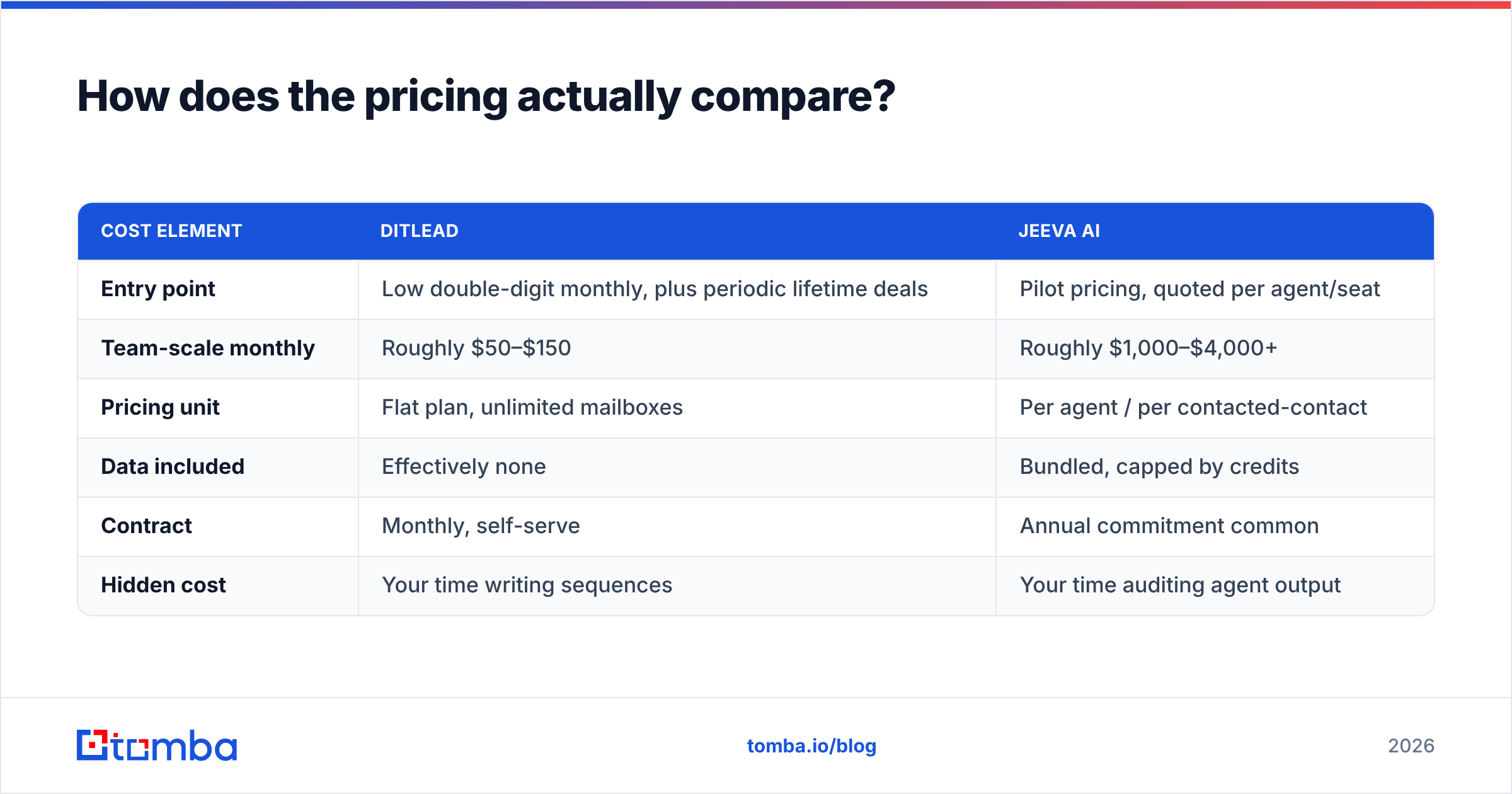
How does the pricing actually compare?#
Vendors move pricing constantly, so treat these as bands rather than quotes and confirm on the vendor's own page before you budget.
| Cost element | Ditlead | Jeeva AI |
|---|---|---|
| Entry point | Low double-digit monthly, plus periodic lifetime deals | Pilot pricing, quoted per agent/seat |
| Team-scale monthly | Roughly $50–$150 | Roughly $1,000–$4,000+ |
| Pricing unit | Flat plan, unlimited mailboxes | Per agent / per contacted-contact |
| Data included | Effectively none | Bundled, capped by credits |
| Contract | Monthly, self-serve | Annual commitment common |
| Hidden cost | Your time writing sequences | Your time auditing agent output |
The honest framing: Ditlead's cost is your labor. Jeeva's cost is your cash. Neither is free. A founder with 10 hours a week and no budget should pick the first. A VP Sales with $40k and no headcount req should pilot the second.
Which one fits your team?#
Match the tool to your actual constraint, not to the demo you liked:
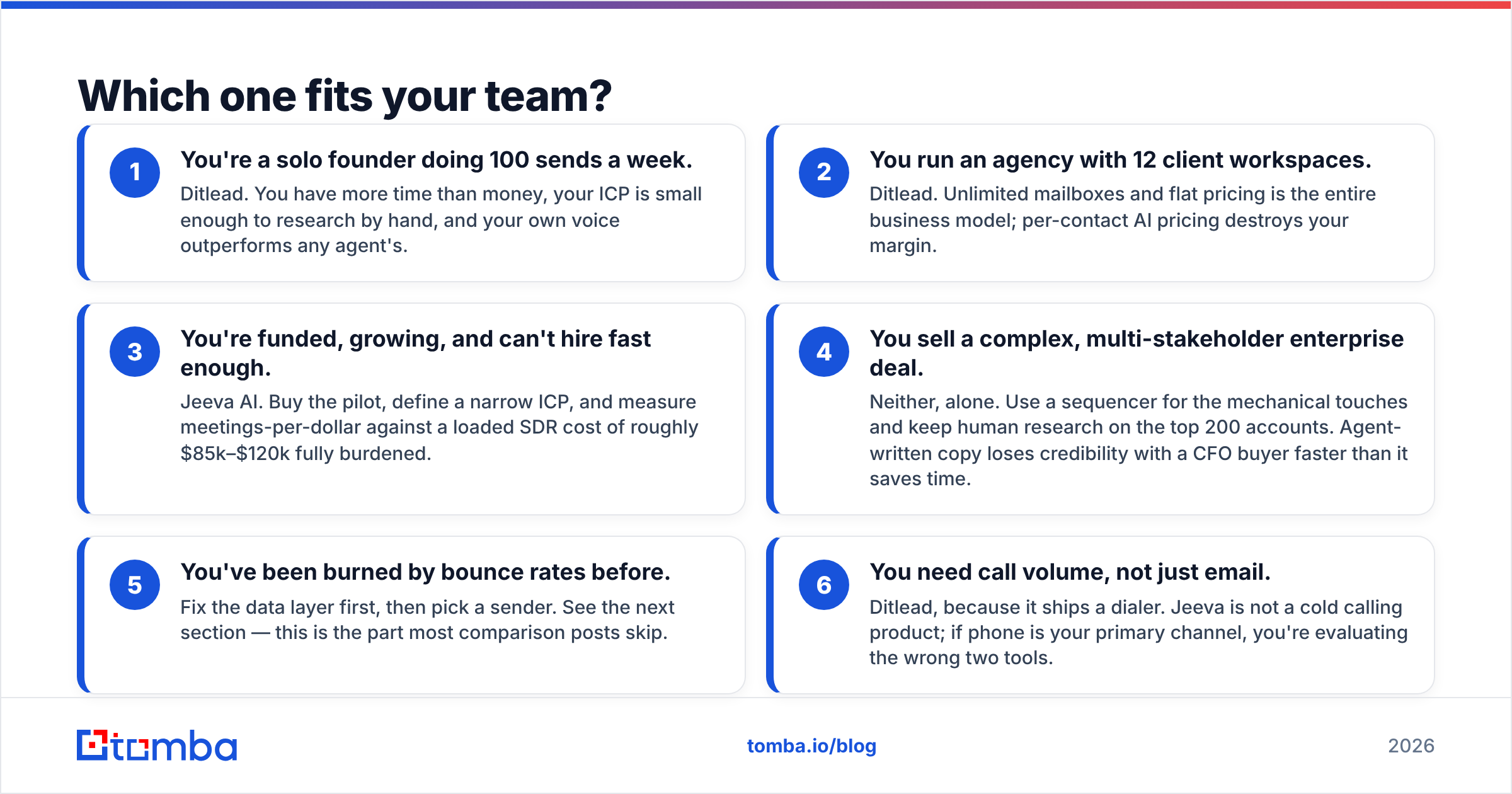
- You're a solo founder doing 100 sends a week. Ditlead. You have more time than money, your ICP is small enough to research by hand, and your own voice outperforms any agent's.
- You run an agency with 12 client workspaces. Ditlead. Unlimited mailboxes and flat pricing is the entire business model; per-contact AI pricing destroys your margin.
- You're funded, growing, and can't hire fast enough. Jeeva AI. Buy the pilot, define a narrow ICP, and measure meetings-per-dollar against a loaded SDR cost of roughly $85k–$120k fully burdened.
- You sell a complex, multi-stakeholder enterprise deal. Neither, alone. Use a sequencer for the mechanical touches and keep human research on the top 200 accounts. Agent-written copy loses credibility with a CFO buyer faster than it saves time.
- You've been burned by bounce rates before. Fix the data layer first, then pick a sender. See the next section — this is the part most comparison posts skip.
- You need call volume, not just email. Ditlead, because it ships a dialer. Jeeva is not a cold calling product; if phone is your primary channel, you're evaluating the wrong two tools.
Where do both tools leave the same gap?#
Contact data quality. This is the unglamorous variable that decides whether either platform produces pipeline.
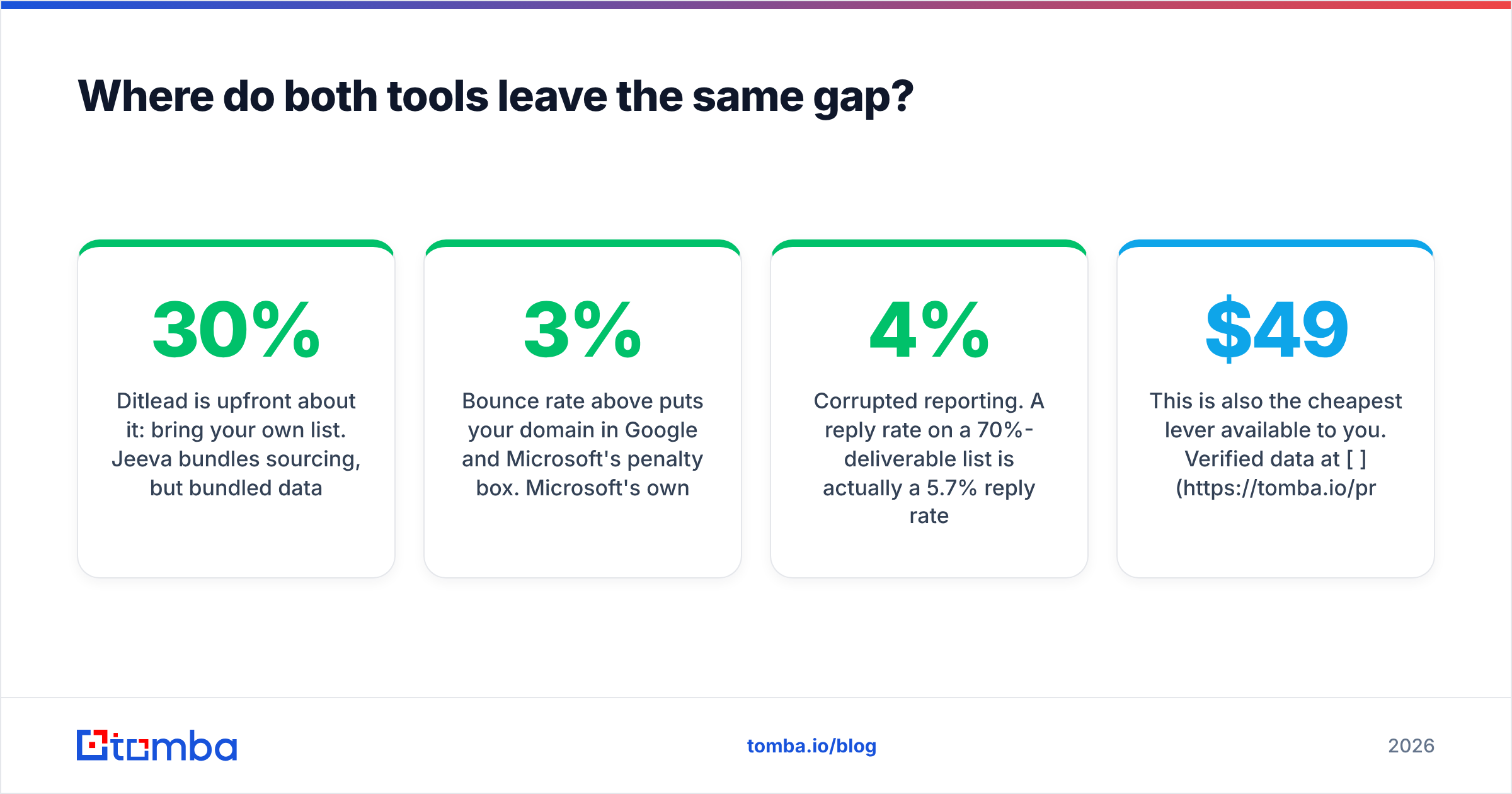
Ditlead is upfront about it: bring your own list. Jeeva bundles sourcing, but bundled data is generally licensed from aggregators, refreshed on the aggregator's schedule, and not verified at send time. B2B contact records decay at roughly 25–30% per year — people change jobs, companies rebrand, mailboxes get retired. A record that was accurate in January is a coin flip by November.
What that costs you in practice:
- Bounce rate above 3% puts your domain in Google and Microsoft's penalty box. Microsoft's own sender guidance and Google's bulk sender requirements both treat high bounce and complaint rates as spam signals.
- Wasted agent credits. If you're paying per contacted-contact, every dead address is money spent on a bounce.
- Corrupted reporting. A 4% reply rate on a 70%-deliverable list is actually a 5.7% reply rate on real humans. You'll optimize the wrong things.
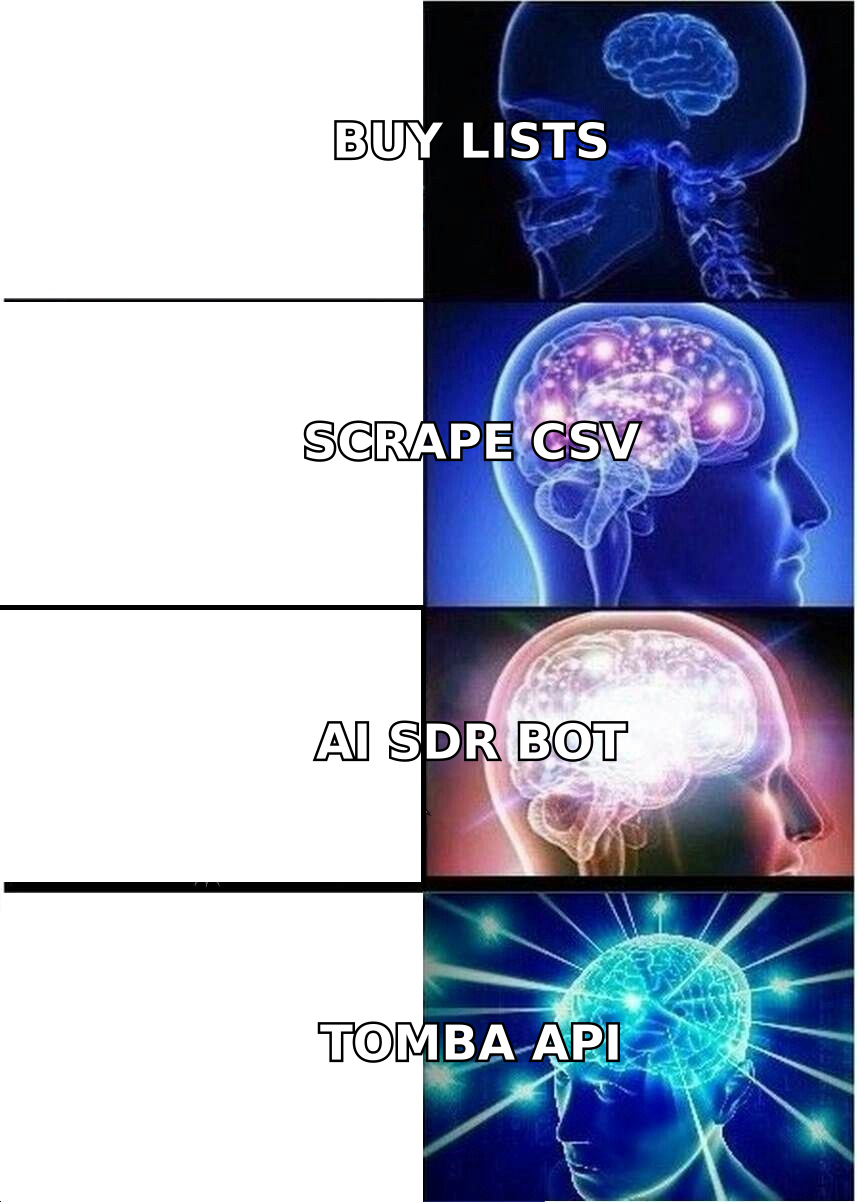
The fix is boring and it works: source and verify contacts in a dedicated layer, then push clean records into whichever sender you chose. Run a domain search to map an account's contactable roles, use an email verifier as a pre-send gate, and check ambiguous domains with a catch-all verifier rather than guessing. If you're moving volume, the Tomba API sits in front of either platform so verification happens before a contact ever enters a sequence.
This is also the cheapest lever available to you. Verified data at $49/month improves outcomes on a $50 sequencer and a $3,000 AI SDR equally — it just looks more dramatic on the expensive one, because you're protecting a bigger spend.
What about deliverability and domain safety?#
Ditlead gives you the controls: mailbox rotation, warmup, sending limits, and custom tracking domains. It does not stop you from misusing them. If you connect 30 inboxes on one root domain and push 2,000 sends a day, the platform will comply and your domain will burn.
Jeeva manages more of this for you, which is safer by default and less transparent by design. You'll have less granular visibility into per-mailbox reputation, which matters when something goes wrong and you need to isolate the cause.
Regardless of platform, the non-negotiables are the same: authenticate with SPF, DKIM, and DMARC on every sending domain; keep bounce rate under 2%; use separate domains for outbound so a mistake never touches your primary; and monitor sender reputation rather than assuming silence means health. HubSpot's deliverability documentation is a reasonable free primer if you're setting this up for the first time.
Verdict: Ditlead or Jeeva AI in 2026?#
Pick Ditlead if outbound is a channel you operate rather than a function you outsource. It's the better value per dollar, the faster setup, and the safer bet for anyone under $2M ARR. Its weakness — no data — is fully solvable with a separate, cheaper data provider, and you'd want that anyway.
Pick Jeeva AI if you have a defined ICP, real budget, and a genuine headcount constraint. Run a 90-day pilot with a narrow segment, review 20 agent-written messages a week, and hold it to the same meetings-per-month bar you'd hold a new SDR to. If it clears that bar, the economics work. If you can't commit to the weekly audit, don't buy it — unsupervised AI SDRs generate volume, not pipeline.
Pick neither yet if your list is unverified. No sequencer and no agent can outrun a 20% bounce rate. Fix the input before you shop for a machine to process it.
One more thing worth saying plainly: these two products will converge. Sequencers are adding agents; agent platforms are adding sequencer-grade controls. What won't converge is the data layer — accurate, sourced, verifiable contact records remain a separate discipline, and the platforms that bundle them do so as a convenience feature, not a core competency.
Get the data layer right first#
Whichever platform you land on, its output is capped by the quality of the contacts you put into it. Tomba Email Finder finds verified professional email addresses by domain, name, or company, with confidence scoring and SMTP-level verification before anything reaches your sequencer. Start free with 25 searches a month, or run bulk enrichment on the Starter plan at $49/month — less than the difference between a good week and a burned domain.
Related guides#
Ready to find emails that actually work?
Join 150,000+ professionals who stopped guessing and started sending. Free credits on signup — no credit card required.
Get the Tomba newsletter
Practical outbound tactics and product updates — once every two weeks.
About the author