Ditlead vs Snovio (2026): Which Sales Engagement Tool Wins?
Ditlead sells unlimited sending seats and multichannel sequencing. Snov.io sells a lead database plus campaigns. We break down pricing, data quality, deliverability controls, and who each one actually fits in 2026.
Ditlead vs Snovio comes down to one question: is your bottleneck sending capacity or contact data? Answer that, and the choice makes itself.
TL;DR
- Ditlead is a sending machine. Unlimited email accounts on most plans, inbox rotation, unified inbox, LinkedIn steps, and a light CRM. It is built for volume and for agencies running many clients.
- Snov.io is a data-plus-campaigns bundle. Email finder, verifier, drip campaigns, and a basic CRM in one subscription, metered by credits and recipients.
- They compete on different axes. If you already have a list, Ditlead is usually cheaper per sending seat. If you need contacts and sequences from one vendor, Snov.io covers more of the job.
- Neither is a best-in-class data provider. Both bundle finding and verification as a feature, not as their core engineering focus. That is why most serious teams pair either one with a dedicated email finder.
- Pick by bottleneck: sending capacity → Ditlead. All-in-one convenience → Snov.io. Data accuracy → neither alone.
Ditlead vs Snovio: what is each tool, exactly?#
They get compared constantly, but they started from opposite ends of the outbound stack.
Ditlead is a multichannel sales engagement platform. Its pitch is capacity: connect as many mailboxes as you want, rotate sends across them, warm them up, and run email + LinkedIn + call steps from one sequence builder. It also ships a unified inbox, a deal pipeline, and white-label options aimed at agencies who resell outbound as a service.
Snov.io started as an email finder and verifier, then grew a campaign layer on top. Today it sells a bundle: search a database for contacts, verify them, drop them into a drip sequence, and track replies in a lightweight CRM. Everything is metered in credits (for finding and verifying) and recipients (for sending).
So the honest framing is not "which tool is better." It is: do you have a data problem or a sending problem?
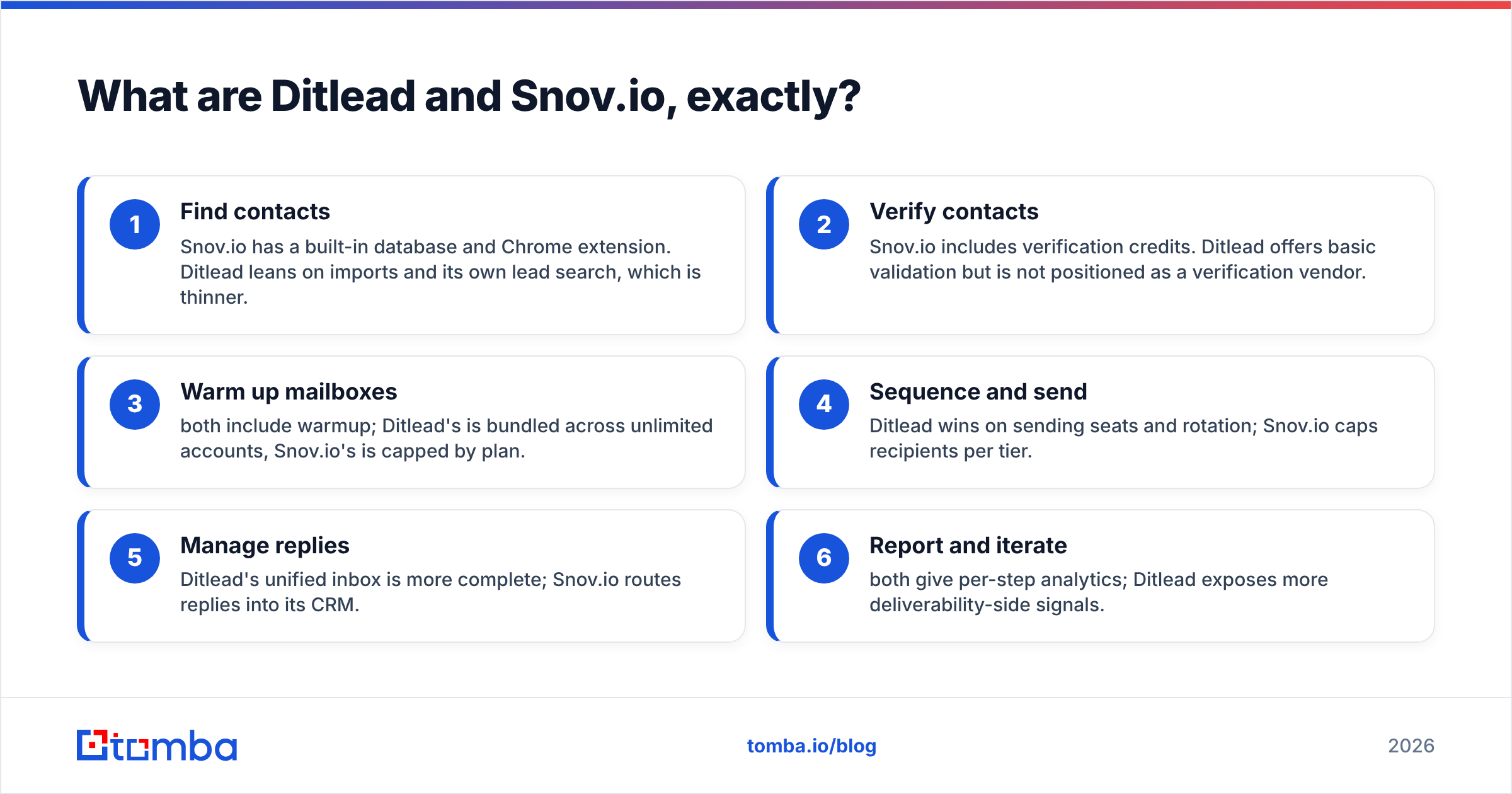
Here is how the two split across the outbound workflow:
- Find contacts — Snov.io has a built-in database and Chrome extension. Ditlead leans on imports and its own lead search, which is thinner.
- Verify contacts — Snov.io includes verification credits. Ditlead offers basic validation but is not positioned as a verification vendor.
- Warm up mailboxes — both include warmup; Ditlead's is bundled across unlimited accounts, Snov.io's is capped by plan.
- Sequence and send — Ditlead wins on sending seats and rotation; Snov.io caps recipients per tier.
- Manage replies — Ditlead's unified inbox is more complete; Snov.io routes replies into its CRM.
- Report and iterate — both give per-step analytics; Ditlead exposes more deliverability-side signals.
How do Ditlead and Snov.io compare feature by feature?#
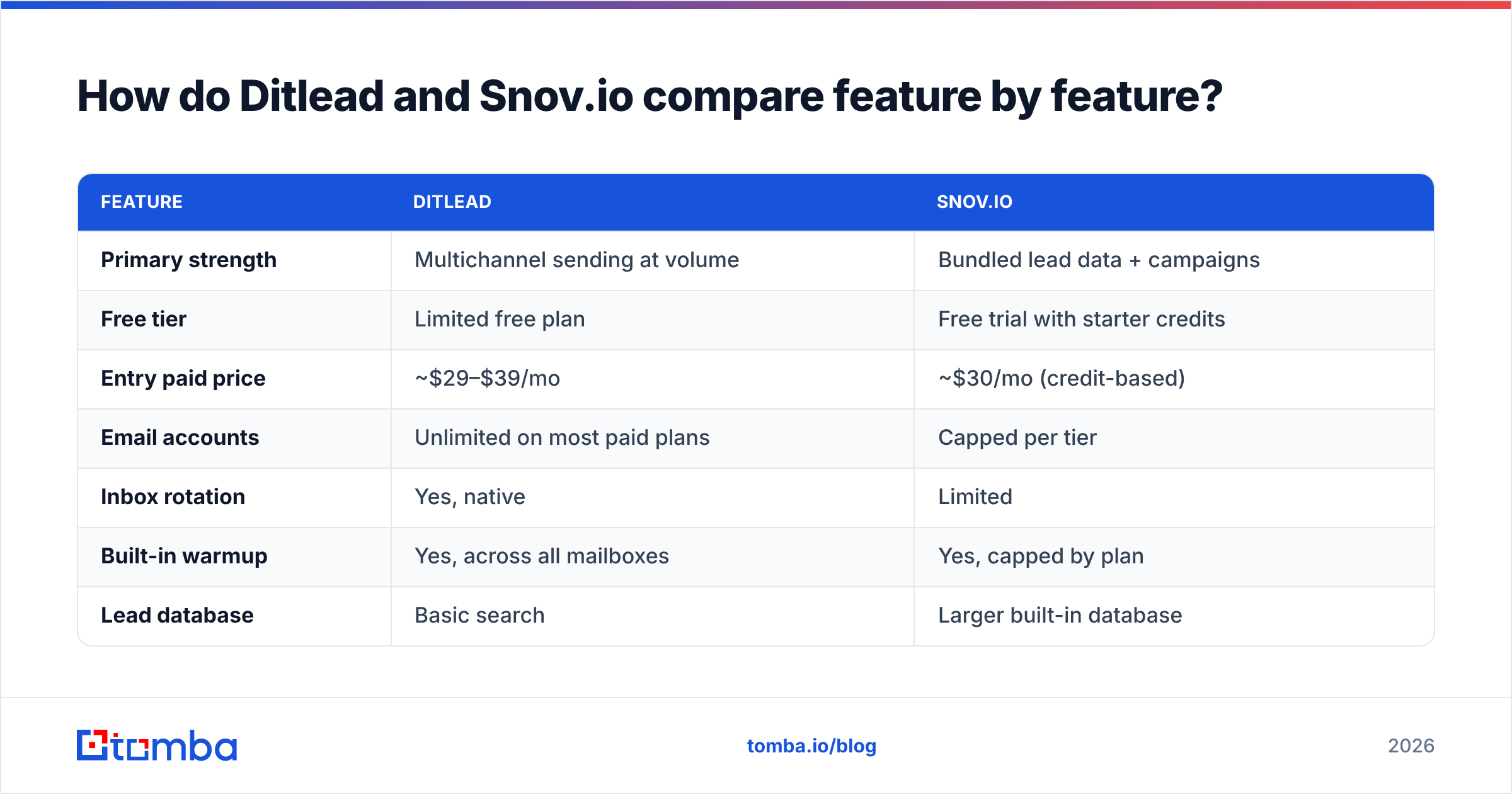
Prices below reflect publicly listed monthly rates at the time of writing. Both vendors change packaging often, so confirm on their pricing pages before you buy.
| Feature | Ditlead | Snov.io |
|---|---|---|
| Primary strength | Multichannel sending at volume | Bundled lead data + campaigns |
| Free tier | Limited free plan | Free trial with starter credits |
| Entry paid price | ~$29–$39/mo | ~$30/mo (credit-based) |
| Email accounts | Unlimited on most paid plans | Capped per tier |
| Inbox rotation | Yes, native | Limited |
| Built-in warmup | Yes, across all mailboxes | Yes, capped by plan |
| Lead database | Basic search | Larger built-in database |
| Email verification | Basic | Included, credit-metered |
| LinkedIn automation | Native steps in sequence | Extension-assisted, lighter |
| Calling / dialer | Yes | No |
| CRM / pipeline | Yes, deal stages included | Yes, lightweight |
| White label for agencies | Yes | No |
| API access | Yes | Yes |
| Best fit | Agencies, high-volume SDR teams | Solo founders, small sales teams |
Two rows deserve a longer look.
Unlimited email accounts. This is Ditlead's headline, and it earns its keep at scale. The standard playbook for cold outreach is many low-volume domains, not one mailbox pushing 500 sends a day. On Snov.io, adding sending capacity means moving up tiers. If you run twenty mailboxes, that gap compounds fast.
Credits. Snov.io's credit model is the thing people misjudge. A "credit" covers a find or a verify, and recipients are billed separately. Teams that prospect heavily burn credits faster than recipient allowance, then top up mid-month. Model your real monthly contact volume before you assume the entry tier holds.
Which one gives you better lead data?#
Snov.io, if you are forced to choose between the two. But the gap between either bundled database and a dedicated provider is wider than the gap between them.
The reason is structural. A sequencer's core engineering budget goes into deliverability, sending infrastructure, and inbox management. Data freshness is a separate, expensive discipline: re-crawling sources, retiring contacts who changed jobs, handling catch-all domains without guessing. Vendors who bundle data as a side feature ship decent coverage on large, well-documented companies. Coverage gets much thinner on SMBs, non-English markets, and anyone who changed roles last quarter.
Three symptoms tell you your bundled data is under-performing:
- Bounce rate above 3–5% on a "verified" list. Verification that only checks syntax and MX records will pass addresses that no longer accept mail.
- Lots of
info@andcontact@fallbacks. That is the tool telling you it could not find the person, packaged as a result. - Catch-all domains marked "unknown" and then sent to anyway. Catch-all handling is where cheap verification quietly fails. A dedicated catch-all verifier resolves a meaningful share of those instead of dumping the risk on your sender reputation.
If you are seeing any of the three, the fix is not switching sequencers. It is separating the data layer from the sending layer.
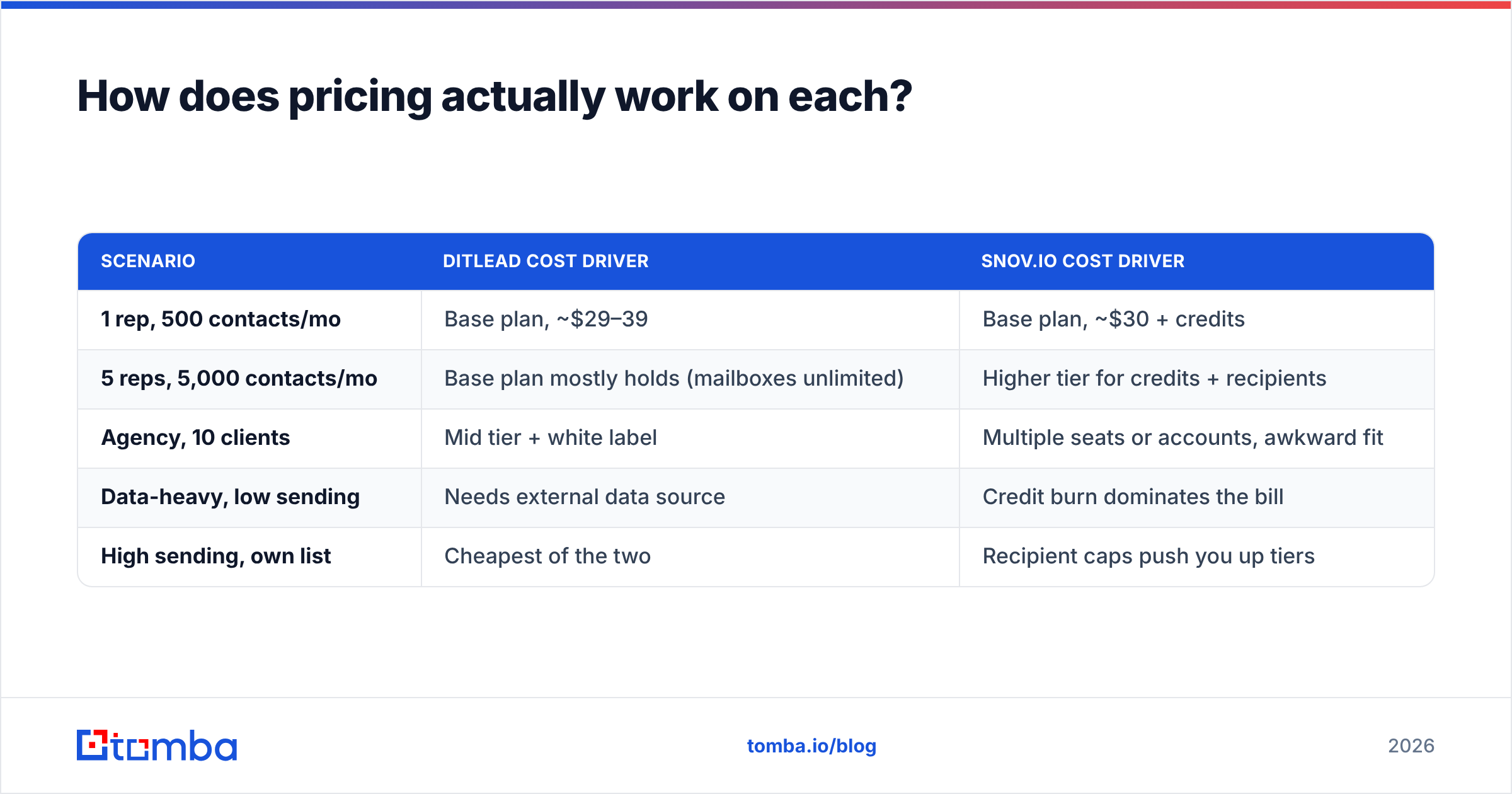
How does pricing actually work on each?#
Both look cheap at the entry tier. They diverge at scale for different reasons.
| Scenario | Ditlead cost driver | Snov.io cost driver |
|---|---|---|
| 1 rep, 500 contacts/mo | Base plan, ~$29–39 | Base plan, ~$30 + credits |
| 5 reps, 5,000 contacts/mo | Base plan mostly holds (mailboxes unlimited) | Higher tier for credits + recipients |
| Agency, 10 clients | Mid tier + white label | Multiple seats or accounts, awkward fit |
| Data-heavy, low sending | Needs external data source | Credit burn dominates the bill |
| High sending, own list | Cheapest of the two | Recipient caps push you up tiers |
The Ditlead vs Snovio pricing pattern is simple: Ditlead's bill scales with clients and features; Snov.io's bill scales with contacts touched. If your team prospects a lot and sends a little, Snov.io gets expensive. If you send a lot from a list you already own, Ditlead has the better unit economics.
One more line item people forget: neither price includes the cost of a bad list. A 10% bounce rate on 5,000 sends does not just waste 500 emails. It damages sender reputation across every mailbox in that domain group, which suppresses the other 4,500. That is the most expensive thing in your outbound budget, and it never appears on an invoice.

Is Ditlead better than Snov.io for cold email at scale?#
For pure sending mechanics, yes — with one caveat.
Ditlead's advantages at volume are concrete. Unlimited mailboxes let you spread 3,000 daily sends across 60 accounts at 50 each, instead of hammering 6 accounts at 500 each. Native rotation distributes the load automatically. Bundled warmup keeps dormant accounts credible. The unified inbox stops replies from getting lost across sixty logins. That is the real operational failure mode most teams hit at this scale.
Snov.io can run cold email well, but it was designed around a different shape of user: one or two mailboxes, a few thousand contacts a month, prospecting and sending from the same screen. Push it toward agency-scale sending and you fight the packaging.
The caveat: sending capacity amplifies whatever list quality you feed it. Sixty warm mailboxes sending to a 12%-bounce list will burn sixty domains instead of six. Volume infrastructure only pays off when the data underneath it is clean. So the "unlimited sending" pitch should push you to tighten verification standards, not relax them. Run every import through an email verifier before it touches a sequence. Then check the deliverability basics — SPF, DKIM, DMARC — on each sending domain.
Where does each tool fall short?#
Ditlead's weak spots:
- Lead search is thin. Plan on importing lists from elsewhere rather than sourcing in-app.
- Verification is basic. It will not save you from a stale list.
- The feature surface is wide — sequencer, CRM, dialer, LinkedIn, white label — and breadth usually means some modules are shallower than the specialists.
- Smaller ecosystem and fewer third-party integrations than incumbents like Snov.io or the enterprise sequencers.
Snov.io's weak spots:
- Credits create billing anxiety. Teams ration prospecting to protect the allowance, which is exactly backwards.
- Sending caps make it awkward for agencies or any team running many domains.
- No dialer, so multichannel means email + LinkedIn only.
- Data coverage is decent in North America and Western Europe, noticeably thinner elsewhere.
Neither list is disqualifying. Both are reasonable products in their lane. The mistake is buying either one expecting it to solve a problem it was not built for.
Which one should you pick?#
Most Ditlead vs Snovio decisions come down to your actual bottleneck:
- You run an agency with multiple client domains → Ditlead. White label plus unlimited mailboxes is the whole reason it exists.
- You are a solo founder doing 300 emails a month → Snov.io. One subscription covers finding, verifying, and sending; the credit model is generous at that volume.
- You have a 50,000-row list already and need to send it → Ditlead, paired with real verification before import.
- You prospect constantly and send selectively → Snov.io, but budget for credit top-ups, or move data sourcing to a dedicated provider and keep Snov.io for campaigns.
- Your bounce rate is your main problem → neither. Fix the data layer first; the sequencer is not the variable.
- You need contact data inside an existing stack (HubSpot, Sheets, your own app) → skip both and go API-first, then choose a sequencer later.
That last case is more common than people admit. If your CRM is the system of record, you do not need a bundled CRM from your outreach tool. You need an email finder API that enriches records where they already live.
Can you use a dedicated email finder alongside either one?#
Yes, and it is the setup most teams land on after a year of running either tool solo.
The architecture is simple: data layer → verification layer → sending layer. Source contacts from a provider whose only job is contact data. Verify with a tool that handles catch-alls and role accounts properly. Then push clean, deduplicated rows into Ditlead or Snov.io and let it do the one thing it is genuinely good at.
In practice: run domain search to map everyone at a target account. Verify in bulk with a bulk email finder workflow. Then sync the survivors into your sequencer via API or CSV. This is usually cheaper than upgrading a sequencer tier just to unlock more credits. Tomba pricing starts free at 25 searches a month, with Starter at $49/mo, Growth at $99/mo, and Pro at $249/mo. Those credits go to finding and verifying, not split against a sending allowance.
The separation also protects you from vendor lock-in. Sequencers get acquired, repriced, and repackaged constantly. Your contact data should not be trapped inside one.
Frequently asked questions#
Is Ditlead a Snov.io alternative? Partly. It replaces Snov.io's campaign and inbox layer well, but not its lead database. Switching from Snov.io to Ditlead usually means adding a separate data source.
Which has better deliverability? Ditlead gives you more levers — rotation, unlimited warmed mailboxes, per-domain controls. But deliverability is mostly set by list quality and domain authentication, not by which sequencer sends the mail.
Do either of them offer a free plan? Ditlead offers a limited free plan; Snov.io offers a trial with starter credits. Both are enough to test the interface, not enough to judge data quality at scale. Run the same 100 known-good contacts through each and compare hit rate.
Can I use both? Some agencies do — Snov.io for prospecting, Ditlead for sending. It works, but you pay two subscriptions for a workflow that a dedicated data provider plus one sequencer handles more cleanly.
The practical next step#
Before you commit to either subscription, find out whether your bottleneck is sending or data. Take 100 target contacts you can independently verify. Run them through each tool's finder. Count how many resolve to a real, current, personal address — not a catch-all, not info@.
If the hit rate is above 90%, your bottleneck is sending, and Ditlead's capacity model is probably the better buy. If it is below 70%, no sequencer will fix your numbers.
For that second case, start with the data layer. Tomba Email Finder resolves professional addresses by domain, name, or company, with catch-all handling and verification built into the same workflow. It plugs into Ditlead, Snov.io, or whatever sequencer you land on via API, Sheets, or CSV. Test it free at 25 searches a month, run your 100-contact benchmark, and let the hit rate decide the rest of your stack.
Related guides#
Ready to find emails that actually work?
Join 150,000+ professionals who stopped guessing and started sending. Free credits on signup — no credit card required.
Get the Tomba newsletter
Practical outbound tactics and product updates — once every two weeks.
About the author