DNC Checker Guide 2026: Stay Compliant When Cold Calling
A DNC checker screens your call list against Do Not Call registries before you dial. Here's how scrubbing actually works, what it costs, and where teams still get fined.
TL;DR
- A DNC checker screens phone numbers against the federal National Do Not Call Registry, state registries, wireless/litigator lists, and your own internal suppression list before you dial.
- Federal registry access is free for sellers, but the raw data is a flat file with no API-grade matching — commercial scrubbers exist because the free path is operationally painful.
- TCPA statutory damages run $500–$1,500 per violating call. One unscrubbed 5,000-record list is a bet-the-quarter risk.
- Scrubbing is not the same as consent. A number can be absent from every registry and still be illegal to call without express written consent in some contexts.
- The best setup is layered: verified phone data at the source, a DNC scrub before every campaign, and an internal DNC list that never gets purged.
Cold calling still works. What no longer works is dialing a list you bought, scraped, or exported without checking whether the people on it have told the government to leave them alone. A DNC checker is the piece of infrastructure that sits between "we have 8,000 numbers" and "we can legally dial 8,000 numbers." This guide covers what these tools actually do, where they fail, what they cost, and how to build a compliance layer that survives an audit.
What is a DNC checker?#
A DNC checker is software that compares a list of phone numbers against one or more Do Not Call databases and flags — or removes — the numbers you are not permitted to call.
Think of it like a bouncer with a clipboard at the door of a private club. Your call list is the line outside. The clipboard has several pages: the federal registry, thirteen-plus state registries, a known-litigator list, wireless numbers, and your own list of people who already told you to stop. The bouncer checks each name against every page. Anyone on any page does not get in.
The technical work is unglamorous: normalize the number to E.164, hash or index it, match against multi-hundred-million-row datasets, return a status, log the result with a timestamp. That last part matters more than most teams realize — the log is your defense. If you cannot prove you scrubbed on a specific date, you effectively did not scrub.
The four layers a real DNC check covers:
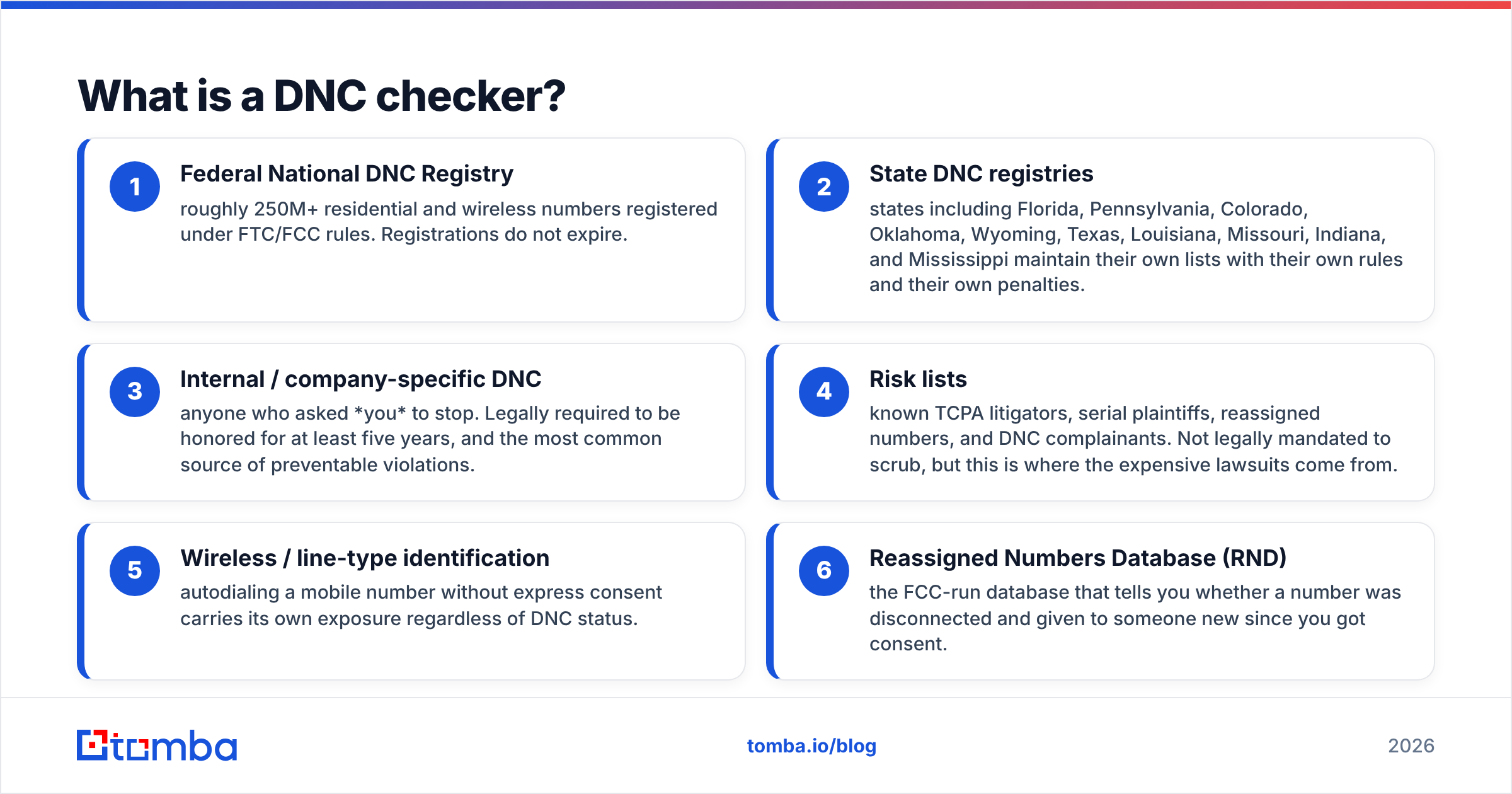
- Federal National DNC Registry — roughly 250M+ residential and wireless numbers registered under FTC/FCC rules. Registrations do not expire.
- State DNC registries — states including Florida, Pennsylvania, Colorado, Oklahoma, Wyoming, Texas, Louisiana, Missouri, Indiana, and Mississippi maintain their own lists with their own rules and their own penalties.
- Internal / company-specific DNC — anyone who asked you to stop. Legally required to be honored for at least five years, and the most common source of preventable violations.
- Risk lists — known TCPA litigators, serial plaintiffs, reassigned numbers, and DNC complainants. Not legally mandated to scrub, but this is where the expensive lawsuits come from.
- Wireless / line-type identification — autodialing a mobile number without express consent carries its own exposure regardless of DNC status.
- Reassigned Numbers Database (RND) — the FCC-run database that tells you whether a number was disconnected and given to someone new since you got consent.
Why do B2B teams think they are exempt — and why are they wrong?#
The most persistent myth in outbound sales is that B2B calls are exempt from Do Not Call rules. That is roughly half true, and the half that is false is expensive.
The federal DNC registry applies to residential subscribers. Pure business-to-business telemarketing calls to a business line are generally outside its scope. But three things break that comfort:
Mobile numbers blur the line. A direct dial for a VP of Sales is frequently a personal cell that they registered on the DNC list years ago. Once that number rings on a personal device the "business line" defense weakens considerably, and courts have not been uniformly kind to callers on this point.
Sole proprietors and home offices count as residential. A significant slice of any SMB-targeted list is legally residential. If you are calling contractors, agencies, consultants, or franchisees, you are calling homes.
State law does not always mirror federal law. Several state statutes are broader than the federal rule and do not carve out B2B as cleanly. Florida's Telephone Solicitation Act in particular caused a wave of litigation.
Add the TCPA's separate rules on autodialers, prerecorded messages, and calling-time windows, and the "we're B2B, we're fine" position becomes a bet rather than a policy. Read the FTC's own National Do Not Call Registry guidance for sellers and telemarketers before you decide your team is exempt.
What does a DNC violation actually cost?#
Statutory damages under the TCPA are $500 per violation, trebled to $1,500 for willful or knowing violations. There is no cap. Class actions aggregate.
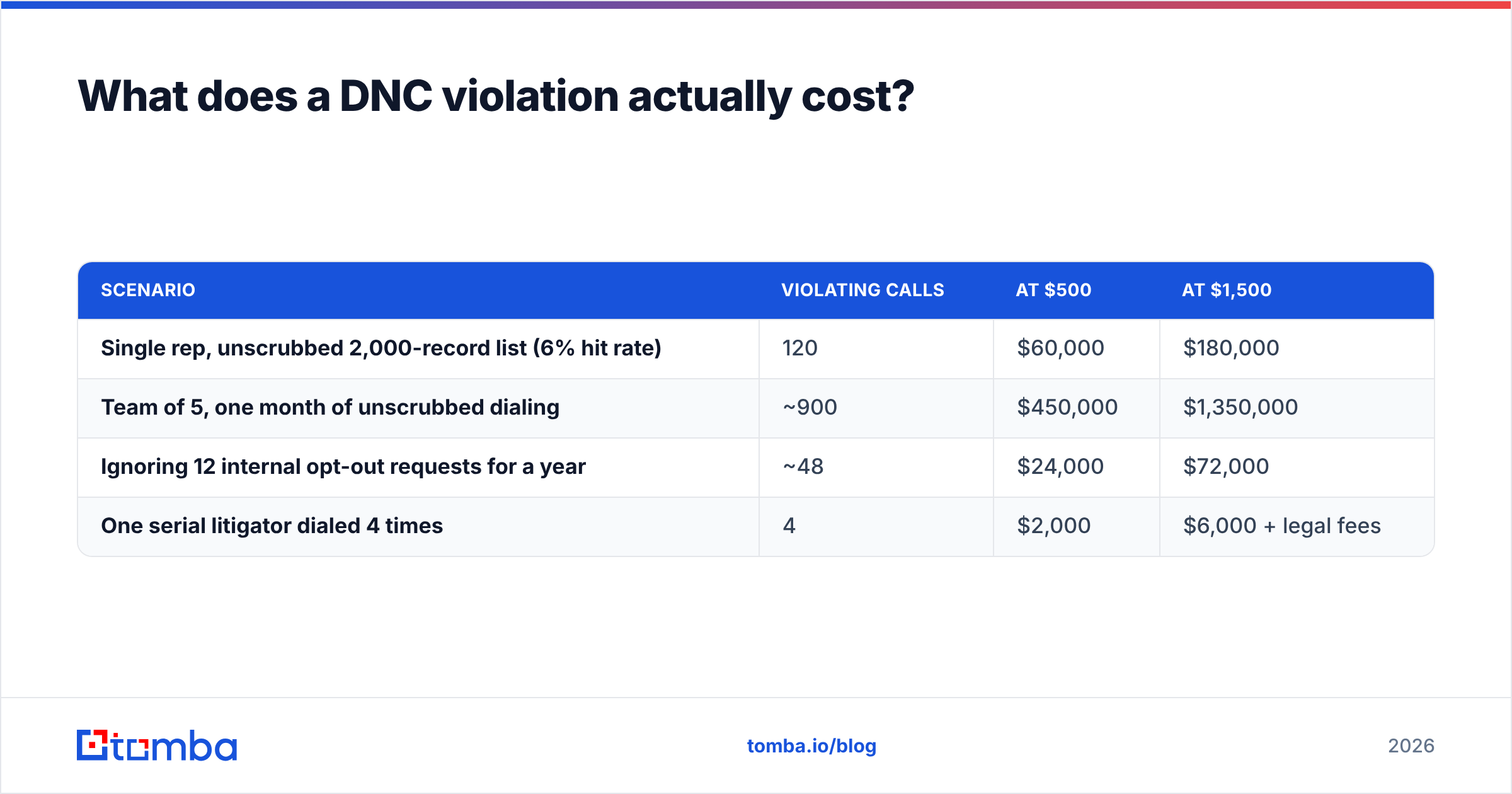
Run the arithmetic on a modest mistake. A 2,000-record list where 6% of numbers are registered means 120 violating calls. At $500 each that is $60,000. At $1,500 it is $180,000. That is one campaign, one afternoon, one rep who exported a list without running it through the scrubber.
| Scenario | Violating calls | At $500 | At $1,500 |
|---|---|---|---|
| Single rep, unscrubbed 2,000-record list (6% hit rate) | 120 | $60,000 | $180,000 |
| Team of 5, one month of unscrubbed dialing | ~900 | $450,000 | $1,350,000 |
| Ignoring 12 internal opt-out requests for a year | ~48 | $24,000 | $72,000 |
| One serial litigator dialed 4 times | 4 | $2,000 | $6,000 + legal fees |
The last row is the one that catches teams by surprise. Professional TCPA plaintiffs seed their numbers into lead-generation ecosystems specifically to receive calls. They document meticulously. A single such contact can generate more legal cost than a year of scrubbing subscriptions.
How do DNC checkers compare in 2026?#
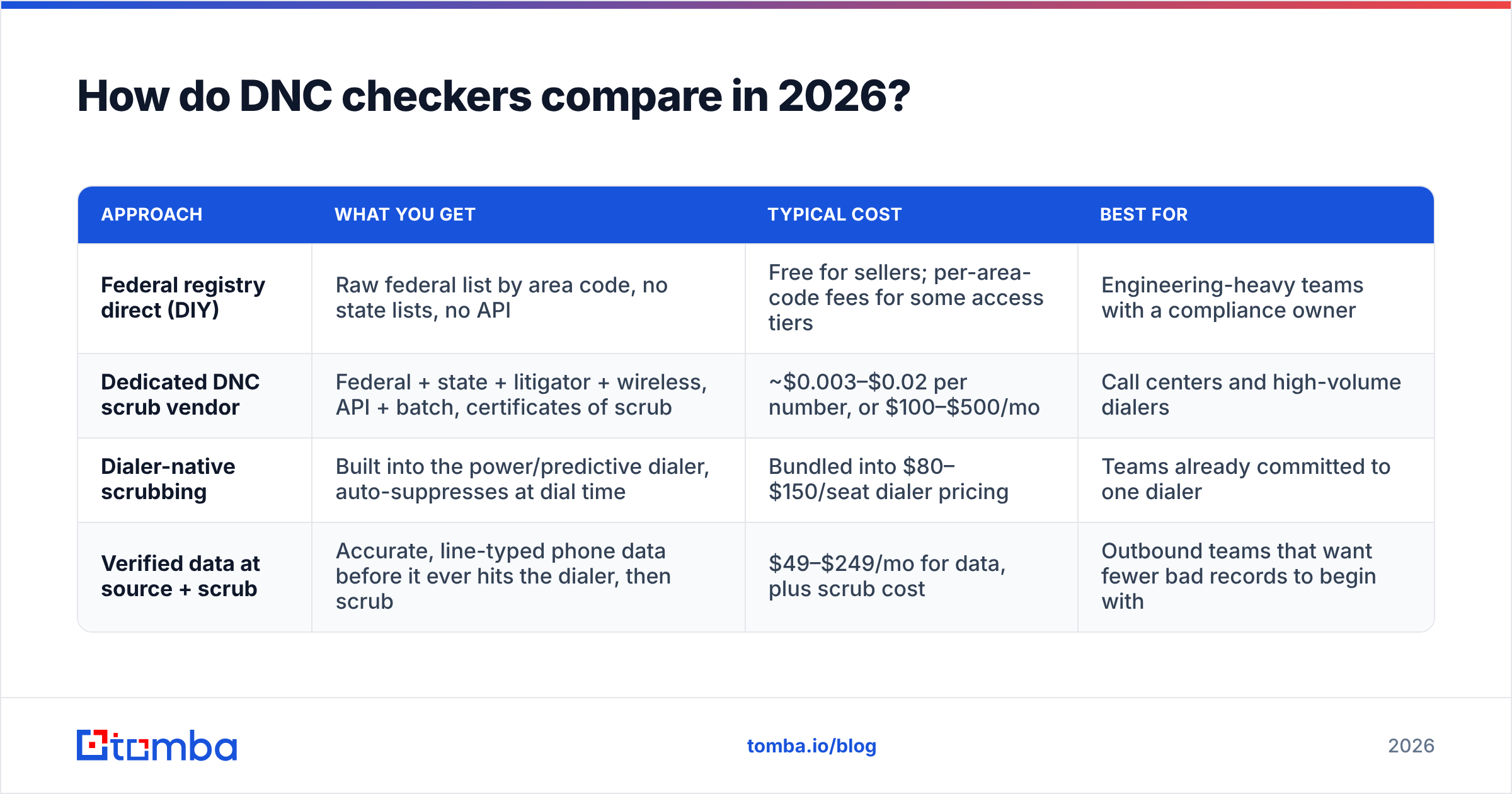
There are four practical approaches, and most teams end up combining two of them. The federal registry itself is free to access for sellers who register through telemarketing.donotcall.gov, but "free" means downloading area-code-partitioned flat files and building your own matching layer.
| Approach | What you get | Typical cost | Best for |
|---|---|---|---|
| Federal registry direct (DIY) | Raw federal list by area code, no state lists, no API | Free for sellers; per-area-code fees for some access tiers | Engineering-heavy teams with a compliance owner |
| Dedicated DNC scrub vendor | Federal + state + litigator + wireless, API + batch, certificates of scrub | ~$0.003–$0.02 per number, or $100–$500/mo | Call centers and high-volume dialers |
| Dialer-native scrubbing | Built into the power/predictive dialer, auto-suppresses at dial time | Bundled into $80–$150/seat dialer pricing | Teams already committed to one dialer |
| Verified data at source + scrub | Accurate, line-typed phone data before it ever hits the dialer, then scrub | $49–$249/mo for data, plus scrub cost | Outbound teams that want fewer bad records to begin with |
The fourth row is underrated. Most DNC exposure is downstream of bad data. If your list is full of stale, misattributed, or recycled numbers, you are paying to scrub records that should never have entered the pipeline. Sourcing clean, current direct dials with a phone finder and running numbers through a phone validator reduces both the scrub bill and the risk surface before compliance tooling ever runs.
For vendor-by-vendor evaluation, G2's telemarketing compliance category is the least biased public comparison set — it aggregates verified reviews rather than vendor claims.
What should a DNC compliance workflow look like?#
Five steps, in order, every campaign:
- Source clean numbers. Pull direct dials from a provider that tracks line type and recency, not a five-year-old scraped CSV.
- Validate the number is live and correctly typed. Disconnected and reassigned numbers are both compliance and productivity problems.
- Scrub against federal + applicable state registries + litigator lists. Do this per campaign, not per quarter. Registrations are added daily.
- Merge your internal DNC. This must be a permanent, append-only list. Never purge it during a CRM migration — that is how five-year-old opt-outs come back to haunt you.
- Log everything. Timestamp, list ID, scrub vendor, result counts, and who ran it. Store it for at least five years.
The failure point is almost always step 4 during a system change. A team migrates from one CRM to another, the suppression list does not map cleanly, and 300 people who opted out in 2023 get dialed in 2026. The FCC treats that as a willful violation because you had the record and lost it.
If you are also running email alongside calls, keep the suppression logic unified. There is no legal requirement that DNC and email opt-outs share a list, but operationally, a prospect who told you to stop calling does not want your sequence either. Feeding both channels from one clean B2B database makes that far easier than reconciling two systems.
Is a free DNC checker good enough?#
For a solo operator dialing under a few hundred numbers a month in a single state, possibly. For anyone else, no — and the reason is coverage, not price.
Free and low-cost checkers typically cover the federal registry only. That leaves you exposed on state registries (which carry independent penalties), litigator lists (where the real lawsuits originate), and the reassigned numbers database (where "but we had consent" defenses die).
What free tools usually miss:
- State registries — Florida alone generated a documented surge in telemarketing suits after its 2021 statute.
- Litigator and complainant lists — the highest-risk 0.1% of any list.
- Reassigned Numbers Database checks — consent does not transfer to the new subscriber.
- Scrub certificates — documentation you can hand to a regulator or opposing counsel.
- API access — manual CSV upload workflows get skipped under quota pressure, and skipped scrubs are the actual root cause of most violations.
That last point is the real argument for paying. A compliance step that requires a human to remember to do it will eventually not get done. An API call inside your list-build pipeline runs every time.
How does data quality reduce DNC risk?#
Fewer junk records means fewer scrub hits, fewer wrong-number conversations, and fewer chances to dial someone who never should have been in your CRM.
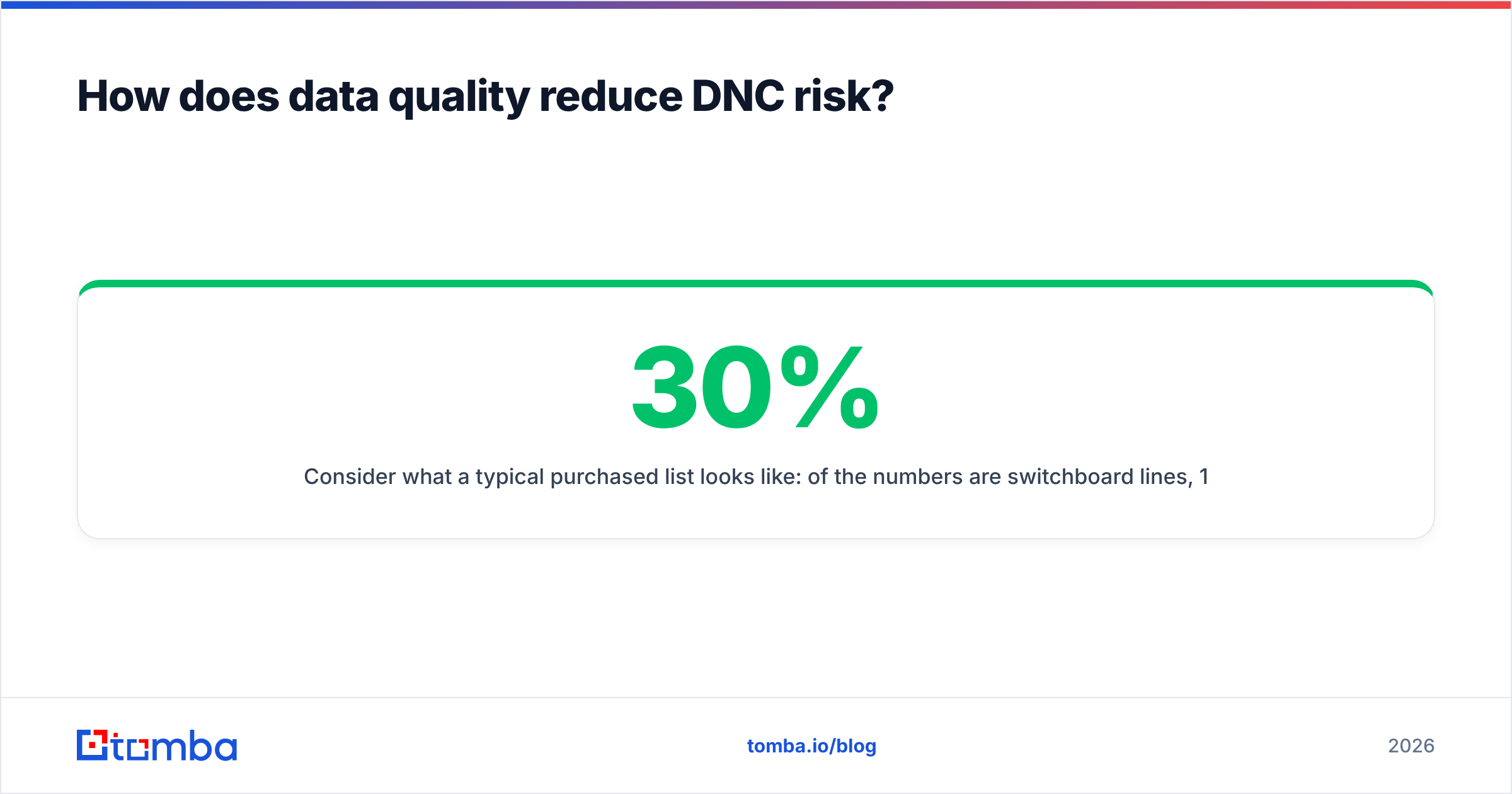
Consider what a typical purchased list looks like: 30% of the numbers are switchboard lines, 15% are disconnected, 10% belong to people who left the company, and an unknown slice are personal cells registered on the DNC list. You scrub it, remove 6%, and dial the rest — most of which still fail. The compliance tool did its job. The list was the problem.
Building lists from current, verifiable sources changes the math. Start from the company domain, identify the actual decision-maker, then resolve contact details. A domain search that returns current employees at a target account produces a fundamentally different list than a static database export from an unknown vintage. Pair it with data enrichment to fill in role, seniority, and line type so your reps know before they dial whether they are calling a desk phone or someone's personal mobile at 7pm.
Tomba's own data sources documentation covers how records are compiled and refreshed, which is the question you should be asking every data vendor you evaluate — including the ones that promise compliance as a feature.
What are the most common DNC mistakes?#
Scrubbing once, dialing for months. Registry additions happen daily. A list scrubbed in January and dialed in April has drifted. Re-scrub before each campaign; 31 days is the widely used maximum interval.
Treating internal DNC as optional. It is not. Company-specific opt-outs must be honored regardless of whether the number is on any government registry, and the obligation persists for years.
Assuming your vendor scrubbed it. "Compliance-ready leads" is a marketing phrase, not a legal guarantee. The seller bears the liability, not the list broker. Ask for the scrub certificate. If it does not exist, assume it was not done.
Relying on the caller to notice. Reps under quota pressure do not check. Automate the suppression at the dialer level so a DNC number is physically not dialable.
Ignoring calling-time windows and state-specific rules. Federal rules restrict calls to 8am–9pm local time. Several states are stricter. A perfectly scrubbed number called at 7:15am is still a violation.
Forgetting the internal list during migrations. Covered above, worth repeating — it is the single most common source of willful-violation findings.
Do you still need a DNC checker if you use email instead?#
Different rules, same discipline. DNC obligations govern phone calls; email is governed by CAN-SPAM in the US and GDPR/ePrivacy in the EU. Neither requires DNC scrubbing, but both require honest sender information, functioning opt-outs, and — under GDPR — a lawful basis for processing.
The practical overlap is suppression hygiene. Whatever system holds your do-not-contact records should be channel-agnostic, permanent, and hard to accidentally delete. Teams that get this right treat opt-out as a first-class data object rather than a checkbox on a CRM record.
If your outbound motion is shifting more toward email because the compliance overhead on calling keeps rising, the same data-quality principle applies. Clean, verified contact data reduces bounces, protects sender reputation, and keeps you out of the spam-complaint spiral that functions as email's version of a DNC violation. HubSpot's outbound compliance overview and its accompanying documentation are a reasonable starting point for teams building a unified policy across both channels.
Which DNC checker should you choose?#
Pick based on volume and where your risk actually sits:
| Your situation | Recommended setup |
|---|---|
| Under 500 calls/month, single state, B2B only | Federal registry direct + a disciplined internal DNC list |
| 500–5,000 calls/month, multi-state | Dedicated scrub vendor with API, monthly subscription tier |
| High-volume call center, predictive dialer | Dialer-native scrubbing + independent third-party scrub as a second check |
| Mixed email + phone outbound | Verified data provider upstream, scrub vendor downstream, one shared suppression list |
| Heavy SMB/sole-proprietor targeting | Full state coverage + litigator list, no exceptions — this segment is functionally residential |
Whatever you choose, the non-negotiables are: coverage beyond the federal list, API access so the check cannot be skipped, retained scrub logs, and an internal DNC list that outlives your CRM.
Start with data that does not create the problem#
The cheapest compliance strategy is not calling people you should not have had in your CRM to begin with. DNC scrubbing is a mandatory backstop — but it is a backstop. Every record it catches is a record that cost you money to acquire, store, and process.
Build lists from current, verifiable, role-matched contact data instead of aging bulk exports, and both your scrub hit rate and your connect rate improve at the same time. Tomba's Email Finder and its phone-side tooling let you build targeted lists from company domains and real names rather than buying someone else's stale file — starting free with 25 searches a month, with paid plans from $49/mo. Check the full Tomba pricing breakdown, then wire it into your compliance pipeline through the Tomba API so clean data and DNC scrubbing run as one automated step rather than two things someone has to remember.
Related guides#
Ready to find emails that actually work?
Join 150,000+ professionals who stopped guessing and started sending. Free credits on signup — no credit card required.
Get the Tomba newsletter
Practical outbound tactics and product updates — once every two weeks.
About the author