Does Cold Calling Work in 2026? Data, Benchmarks, Verdict
Cold calling isn't dead, but the version most teams run is. Here's what connect rates, dial volumes, and multichannel data actually show in 2026 — plus when the phone beats email.
TL;DR
- Cold calling still works, but the math has changed: connect rates on unscreened mobile lists sit in the 2-5% range, and it takes roughly 60-100 dials to book one meeting in most B2B segments.
- The single biggest variable isn't your script — it's whether the number belongs to the right person. Bad phone data destroys more pipeline than bad talk tracks.
- Cold calling beats cold email on speed-to-conversation and objection handling; email beats calling on cost per touch and scale. Teams that run both outperform teams that pick one.
- Spam labeling, mobile screening, and STIR/SHAKEN attestation now decide whether your call is even displayed as a real number. Ignoring this is why "calling stopped working" for a lot of teams.
- The honest verdict: calling works for deals above roughly $10K ACV, in industries where the buyer still answers a phone, when it's the second or third touch — not the first.
Does cold calling work in 2026, or is it dead?#
Cold calling works. What died is the assumption that you can buy a list, hand it to five SDRs, and expect the same output you got in 2015.
Three things changed at once. Mobile carriers started flagging high-volume outbound numbers as "Spam Likely." Buyers moved to remote work, so the direct-dial desk phone that used to be your best asset now rings in an empty office. And the average B2B buyer added two more people to the buying committee, which means one good conversation no longer moves the deal by itself.
None of that makes the phone useless. It makes the phone expensive to use badly. The teams still getting results from calling have narrowed their lists, verified their numbers, and repositioned the call as a mid-sequence touch rather than a cold open.
Here's the practical framing: a cold call is the highest-bandwidth, highest-cost touch you own. A single connected conversation gives you qualification, objection data, and a next step in four minutes — something no email sequence delivers. But you pay for that bandwidth in rep hours. Your job is to spend those hours on contacts who can actually be reached and who plausibly have the problem you solve.
What are realistic cold calling benchmarks?#
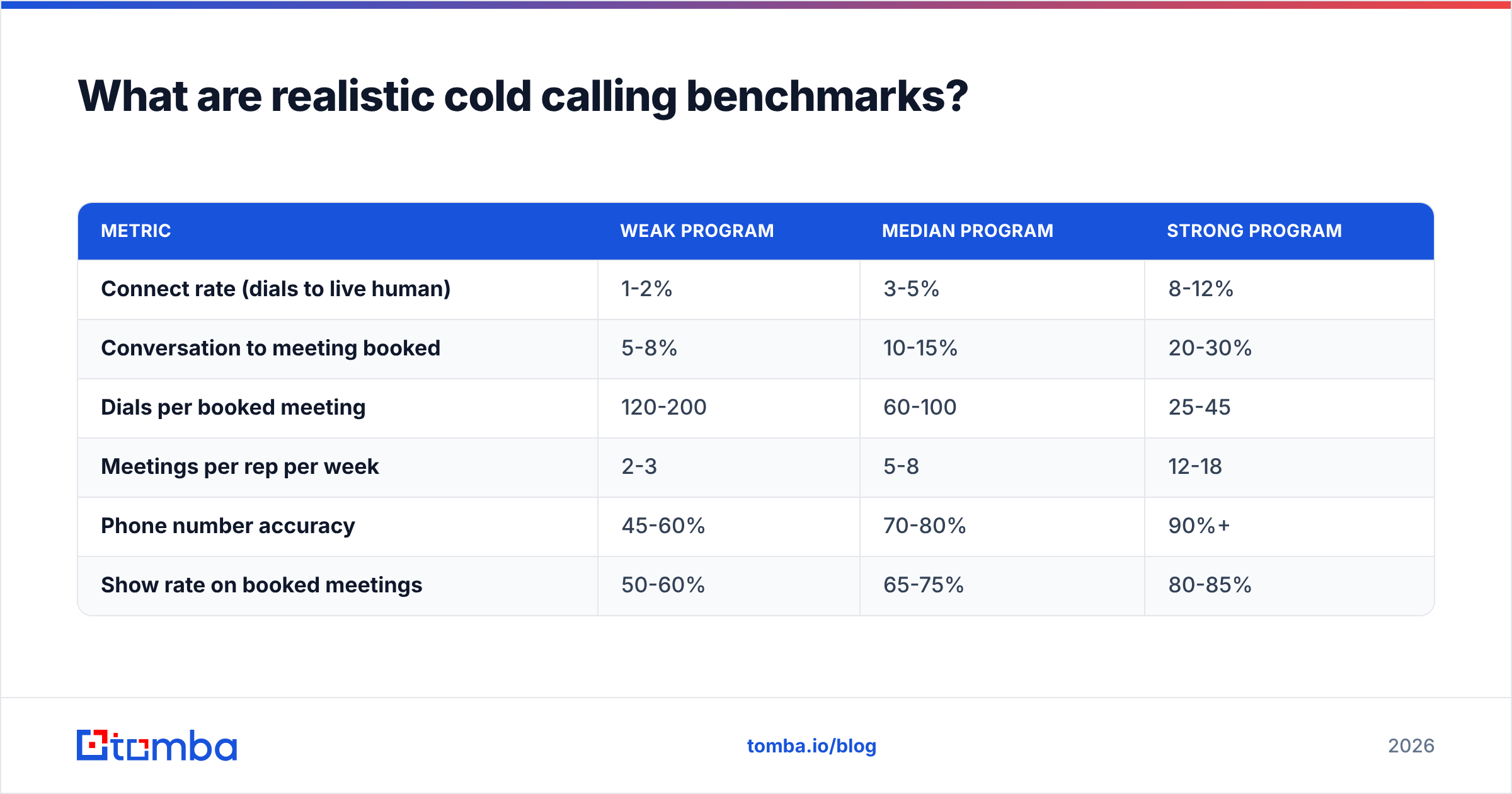
Benchmarks vary enormously by segment, so treat the table below as a planning range rather than gospel. The numbers reflect commonly reported B2B SaaS and services outbound performance, and your own dashboard should be the tiebreaker.
| Metric | Weak program | Median program | Strong program |
|---|---|---|---|
| Connect rate (dials to live human) | 1-2% | 3-5% | 8-12% |
| Conversation to meeting booked | 5-8% | 10-15% | 20-30% |
| Dials per booked meeting | 120-200 | 60-100 | 25-45 |
| Meetings per rep per week | 2-3 | 5-8 | 12-18 |
| Phone number accuracy | 45-60% | 70-80% | 90%+ |
| Show rate on booked meetings | 50-60% | 65-75% | 80-85% |
Two rows in that table do most of the work.
Phone number accuracy is the multiplier on everything else. If 40% of your numbers are wrong, your rep spends 40% of their calling block dialing disconnected lines and reaching the wrong person. That doesn't just cut output proportionally — it demoralizes the rep, which cuts output again. Sourcing verified B2B phone numbers and running them through a phone validator before a calling block is the cheapest performance improvement available to most teams.
Connect rate is the second lever, and it's mostly a function of who you're calling and when. Directors and VPs in operational roles answer more than C-suite. Mid-market answers more than enterprise. Companies under 200 employees answer more than companies over 5,000.
Why does cold calling fail for most teams?#
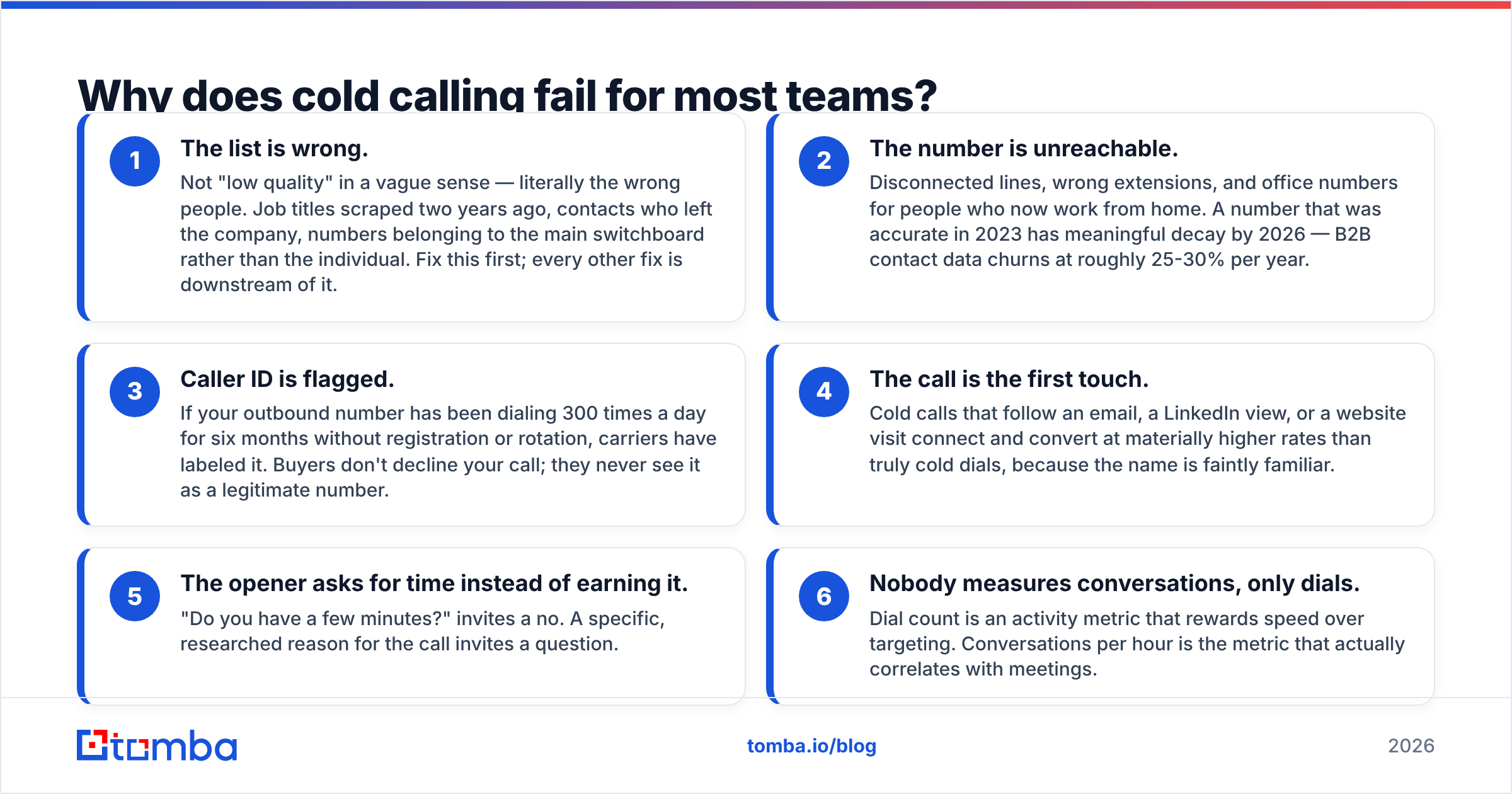
It fails for six reasons, in roughly this order of frequency:
- The list is wrong. Not "low quality" in a vague sense — literally the wrong people. Job titles scraped two years ago, contacts who left the company, numbers belonging to the main switchboard rather than the individual. Fix this first; every other fix is downstream of it.
- The number is unreachable. Disconnected lines, wrong extensions, and office numbers for people who now work from home. A number that was accurate in 2023 has meaningful decay by 2026 — B2B contact data churns at roughly 25-30% per year.
- Caller ID is flagged. If your outbound number has been dialing 300 times a day for six months without registration or rotation, carriers have labeled it. Buyers don't decline your call; they never see it as a legitimate number.
- The call is the first touch. Cold calls that follow an email, a LinkedIn view, or a website visit connect and convert at materially higher rates than truly cold dials, because the name is faintly familiar.
- The opener asks for time instead of earning it. "Do you have a few minutes?" invites a no. A specific, researched reason for the call invites a question.
- Nobody measures conversations, only dials. Dial count is an activity metric that rewards speed over targeting. Conversations per hour is the metric that actually correlates with meetings.
Notice that four of six are data and infrastructure problems, not skill problems. Most teams respond to poor calling results by buying a new script or a new coach. The higher-leverage move is usually fixing the list.
Is cold calling better than cold email?#
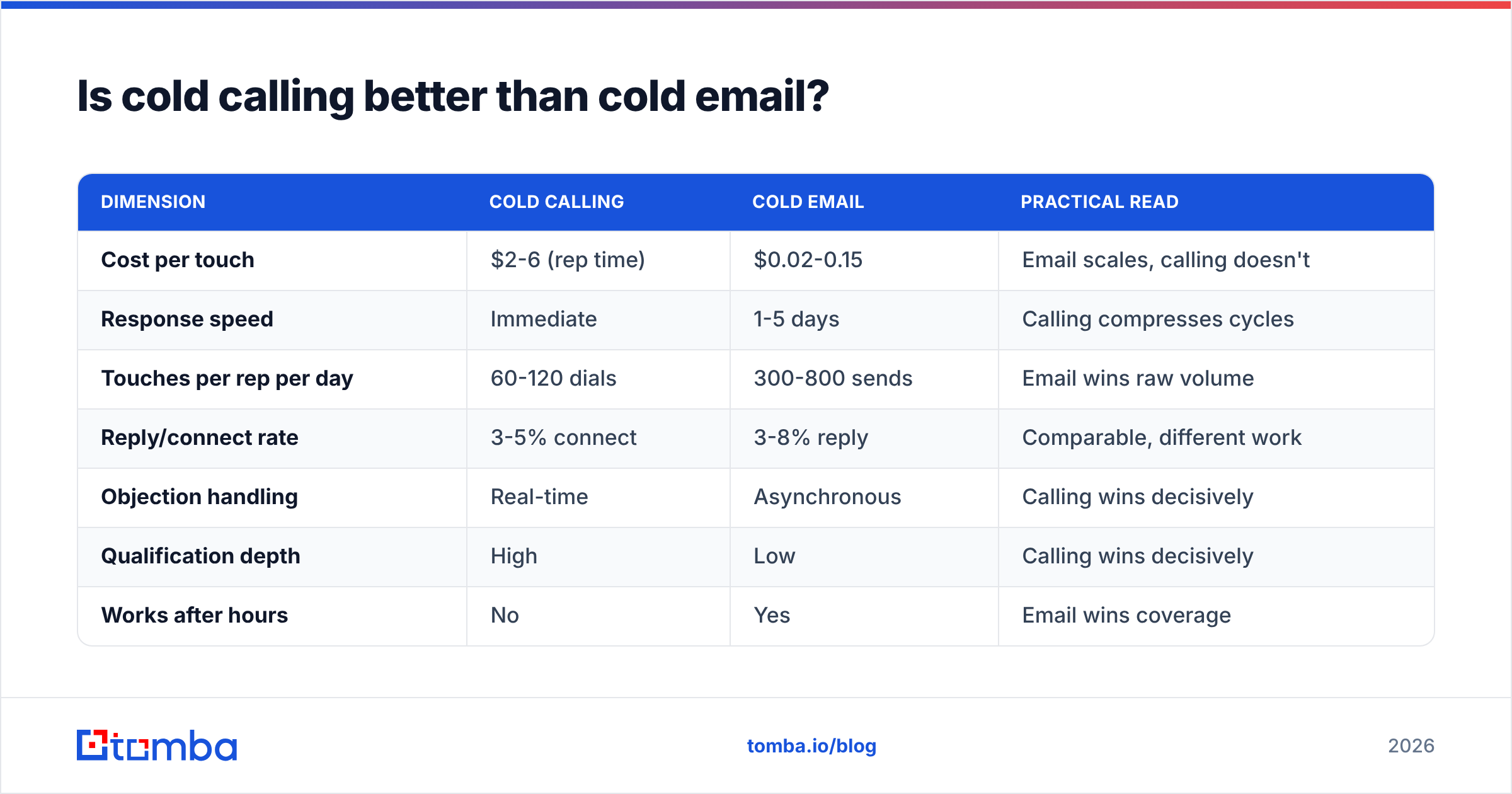
Neither wins outright. They fail in different places, which is why the combination outperforms either alone.
| Dimension | Cold calling | Cold email | Practical read |
|---|---|---|---|
| Cost per touch | $2-6 (rep time) | $0.02-0.15 | Email scales, calling doesn't |
| Response speed | Immediate | 1-5 days | Calling compresses cycles |
| Touches per rep per day | 60-120 dials | 300-800 sends | Email wins raw volume |
| Reply/connect rate | 3-5% connect | 3-8% reply | Comparable, different work |
| Objection handling | Real-time | Asynchronous | Calling wins decisively |
| Qualification depth | High | Low | Calling wins decisively |
| Works after hours | No | Yes | Email wins coverage |
| Gatekeeper risk | High | Low | Email wins access |
| Deliverability risk | Spam labeling | Spam folder, domain damage | Both need infrastructure |
| Best deal size | $10K+ ACV | Any | Calling needs margin |
The economics are the thing to internalize. At $2-6 per dial in loaded rep cost and 60-100 dials per meeting, a cold-call-sourced meeting costs somewhere between $150 and $500 in labor. That's fine if your average contract is $40,000. It's ruinous if you sell a $29/month product.
Cold email flips the ratio: cheap per touch, but slower, easier to ignore, and dependent on email deliverability infrastructure that takes weeks to warm up. The sequences that work best in 2026 typically look like: email → LinkedIn view → call → email referencing the call attempt → call again. The phone isn't the opener; it's the accelerator.
For a broader picture of how buyers actually want to be contacted, HubSpot's sales research and G2's buyer behavior reports are both worth reading against your own data.
When should you use the phone instead of email?#
Use the phone when at least three of these are true:
- Your ACV clears $10,000. Below that, the labor cost per meeting eats the margin.
- The buyer's role is operational, not executive. Ops managers, IT directors, plant managers, and finance controllers answer their phones far more than CROs.
- The problem is urgent or compliance-driven. Urgency converts on the phone in a way it never does in an inbox.
- You have a specific, verifiable trigger. A funding round, a job posting, a tech-stack change, a regulatory deadline. "I saw you're hiring three warehouse supervisors" is a call. "I wanted to introduce our platform" is not.
- Your email channel is saturated or blocked. If the domain is already sequencing that account, the phone is your only remaining unfatigued channel.
- The deal has stalled in email. A single call to a stalled thread revives more deals than four more emails.
Skip the phone when you're selling low-ticket self-serve software, when your buyer is a developer or designer (they will not answer), or when your list is unverified. That last one is worth repeating: calling an unverified list is worse than not calling at all, because you burn rep morale and caller-ID reputation simultaneously.
How do you build a cold call list that actually connects?#
The list build is the program. Here's the sequence that produces callable data rather than a spreadsheet of hope.
1. Define the account trigger before the contact. Start from a reason the account should care right now — headcount growth, a new tool in the stack, a leadership change. Accounts without a trigger produce calls without a reason.
2. Find the humans at those accounts. Use domain search to pull the contact map for each target company, then filter by department and seniority rather than exact title strings. Title taxonomies are inconsistent across companies; department plus seniority travels better.
3. Verify the email before you enrich the phone. A contact whose work email bounces is very likely gone from the company entirely. Running the list through an email verifier is a fast, cheap way to detect departures before you waste dials.
4. Enrich to direct dials, not switchboards. A main company number routes you to a gatekeeper. A direct dial or mobile routes you to the buyer. If your data provider returns mostly main lines, your connect rate is capped no matter how good your rep is.
5. Validate line type and status. Check whether the number is mobile or landline, and whether it's active. Mobile numbers connect better but require more care around calling hours and consent rules in your jurisdiction.
6. Segment by callability, not alphabetically. Group your list into "verified mobile," "verified direct dial," and "switchboard only." Call the first two segments. Route the third to email and LinkedIn.
What about compliance and caller ID reputation?#
This is the part most "is cold calling dead" articles skip, and it's the part that quietly kills programs.
Caller ID labeling. US carriers apply analytics to outbound numbers. High volume, short average call duration, and low answer rates all push a number toward a "Spam Likely" label. Once labeled, your connect rate collapses regardless of list quality. Mitigations: register your numbers with the major analytics providers, rotate a pool of numbers rather than hammering one, keep per-number daily volume moderate, and use local presence sparingly and honestly.
Attestation. Under STIR/SHAKEN, carriers sign outbound calls with an attestation level. Calls placed through carriers that give you full attestation are less likely to be flagged. If your dialer vendor can't tell you what attestation your calls carry, that's a real question to ask them.
Consent and DNC. Requirements differ sharply by jurisdiction. In the US, B2B calls to business lines have more latitude than consumer calls, but mobile numbers and automated dialing introduce additional obligations. In the EU and UK, GDPR and PECR create a legitimate-interest analysis you should document rather than assume. In Canada, CASL and the National DNCL apply. This is not legal advice — get a real opinion for your markets before you scale volume.
Recording. Two-party consent states and most European jurisdictions require disclosure. Build it into the opener rather than bolting it on.
The practical upshot: treat phone infrastructure the way good email teams treat sender reputation. It's an asset that degrades under abuse and takes time to rebuild.
What does a cold call program that works actually look like?#
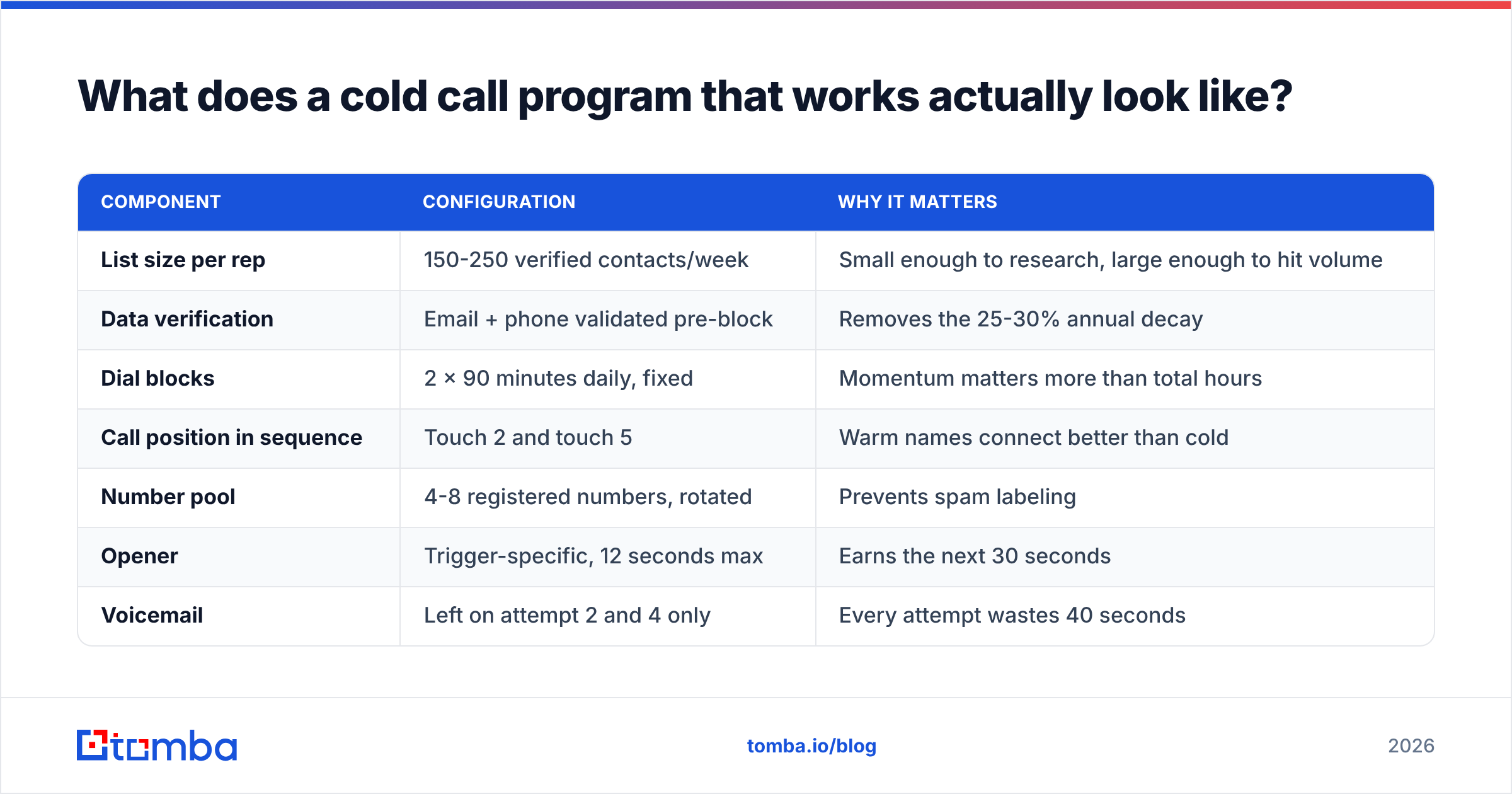
Concretely, here's a configuration that produces predictable results at mid-market ACVs:
| Component | Configuration | Why it matters |
|---|---|---|
| List size per rep | 150-250 verified contacts/week | Small enough to research, large enough to hit volume |
| Data verification | Email + phone validated pre-block | Removes the 25-30% annual decay |
| Dial blocks | 2 × 90 minutes daily, fixed | Momentum matters more than total hours |
| Call position in sequence | Touch 2 and touch 5 | Warm names connect better than cold |
| Number pool | 4-8 registered numbers, rotated | Prevents spam labeling |
| Opener | Trigger-specific, 12 seconds max | Earns the next 30 seconds |
| Voicemail | Left on attempt 2 and 4 only | Every attempt wastes 40 seconds |
| Follow-up email | Sent within 5 minutes of every attempt | Converts the miss into a touch |
| Measurement | Conversations/hour, not dials/day | Rewards targeting over speed |
The sequencing detail matters more than it looks. A call attempt followed immediately by a short email that references the attempt ("Tried you just now about the three warehouse roles you're hiring for") converts far better than either touch alone, because it explains the missed call and gives the buyer an easy asynchronous reply path.
For volume list building, batch the work: bulk verify contacts once a week rather than one-off lookups mid-block. Reps should never be researching during a dial block.
What's the honest verdict on cold calling?#
Cold calling works when three conditions hold at once: your data is verified, your deal size justifies the labor cost, and the call sits inside a multichannel sequence rather than standing alone. Remove any one of those and the economics stop working — which is exactly what happened to the teams now declaring the channel dead.
If you're deciding whether to invest, run a 30-day test with honest instrumentation. Build one clean list of 400 verified contacts with direct dials. Assign one rep, two 90-minute blocks a day, calls positioned as touch 2 and touch 5. Measure conversations per hour and cost per booked meeting, not dials. If your cost per meeting lands under 15% of your average deal value, scale it. If it doesn't, the problem is almost certainly the list, not the channel — rebuild the data and test once more before you write off the phone.
The teams who quit calling in 2024 and came back in 2026 nearly all say the same thing: nothing about the phone changed. Their list did.
Start with the data layer. Before you buy another dialer or hire another coach, make sure the names and numbers your reps are dialing belong to real people who still work there. Tomba's Email Finder maps the contacts at any target domain, and the surrounding toolkit — verification, phone lookup, and enrichment — turns that map into a callable list. The free tier gives you 25 searches a month to test the accuracy on your own accounts; paid plans start at $49/month on Tomba pricing when you're ready to run it at volume.
Related guides#
Ready to find emails that actually work?
Join 150,000+ professionals who stopped guessing and started sending. Free credits on signup — no credit card required.
Get the Tomba newsletter
Practical outbound tactics and product updates — once every two weeks.
About the author