Dolibarr vs SugarCRM: Which Open-Source CRM Wins in 2026?
Dolibarr is a free, self-hosted ERP with CRM attached. SugarCRM is a paid, sales-first platform that dropped its community edition. Here is the honest breakdown of cost, depth, and effort.
TL;DR
- Dolibarr is a free, GPL-licensed ERP that includes CRM modules. You self-host it, you pay nothing for the software, and you absorb the setup and maintenance yourself.
- SugarCRM is a commercial, sales-first CRM. Its open-source Community Edition was retired in 2018 — today it is a per-seat SaaS product with per-user pricing that starts in the $49–$85/user/month range depending on tier.
- Pick Dolibarr if you need invoicing, stock, purchase orders, and a lightweight contact database in one box and have someone technical on staff.
- Pick SugarCRM if pipeline forecasting, sales automation, and reporting are the point, and you want a vendor on the hook for uptime.
- Neither tool finds or verifies contact data. Whichever you choose, the CRM is only as useful as the emails you load into it.
What exactly are Dolibarr and SugarCRM?#
They are not the same category of product, and that is the single most important thing to understand before comparing them.
Dolibarr is an open-source ERP and CRM suite written in PHP, first released in 2003. It is modular: you switch on the modules you want (third parties, proposals, orders, invoices, stock, projects, HR, ticketing) and leave the rest off. The CRM piece — contacts, leads, opportunities, proposals — is one slice of a much wider business-management platform. The software costs nothing. You run it on your own server, or you pay a hosting partner to run it for you.
SugarCRM started life in 2004 as the open-source alternative to Salesforce. That is the version most people still remember. It is gone. Sugar retired the Community Edition in 2018 and moved entirely to a commercial, cloud-delivered model split across Sugar Sell (sales), Sugar Serve (service), and Sugar Market (marketing automation). What you buy in 2026 is a per-seat SaaS CRM with AI-assisted forecasting, not a downloadable open-source project.
So the real comparison is: a free ERP with CRM features versus a paid CRM with ERP integrations. That framing decides most of the answers below.
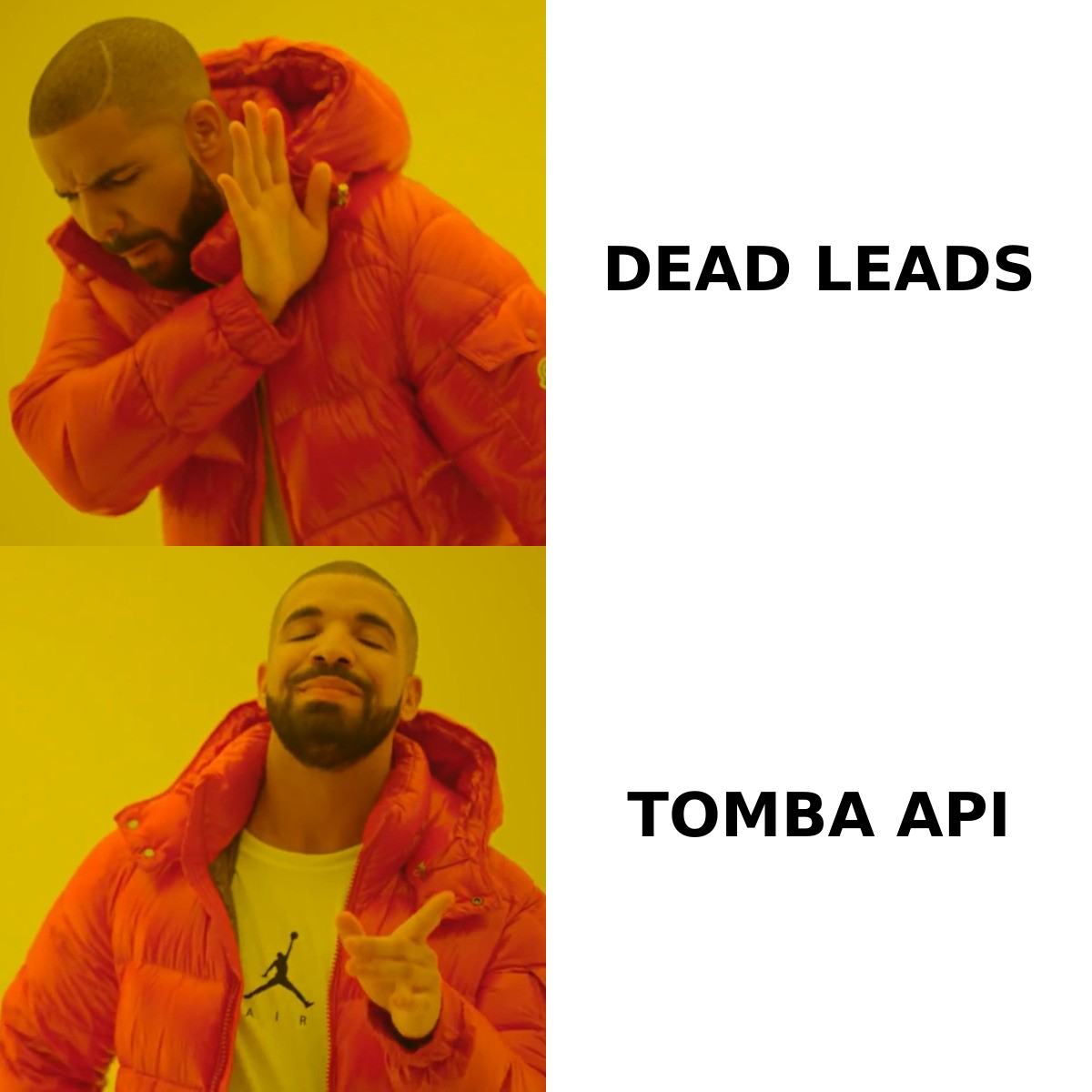
How do Dolibarr and SugarCRM compare head-to-head?#
| Attribute | Dolibarr | SugarCRM |
|---|---|---|
| License | GPL v3, fully open source | Proprietary, commercial |
| Entry cost | $0 self-hosted (hosting ~$10–40/mo) | ~$49/user/mo (Sell Essentials tier, 3-user minimum) |
| Mid tier | Paid cloud hosting via partners, ~$10–25/user/mo | ~$85/user/mo (Advanced) |
| Top tier | No vendor tier — you scale your own infra | ~$135/user/mo (Premier) |
| Primary strength | Invoicing, quotes, stock, accounting links | Pipeline forecasting, sales automation, reporting |
| CRM depth | Basic: contacts, leads, opportunities, proposals | Deep: territory rules, quota tracking, AI scoring |
| Deployment | Self-hosted, Docker, or partner cloud | Vendor cloud (private cloud on higher tiers) |
| Customization | PHP modules, hooks, full source access | Studio + SugarBPM, REST API, no source access |
| Mobile app | Community-built, patchy | First-party iOS and Android |
| Marketplace | ~2,000 modules on Dolistore | Sugar Outfitters + standard integrations |
| Support | Community forums, paid partners | Contracted vendor SLA |
| Best for | SMBs running the whole business in one tool | 10–200 seat sales teams with real pipeline process |
Pricing on both sides moves. Treat those numbers as the shape of the market, not a quote — check the vendor page before you budget, and read current buyer reviews on G2 for what teams actually pay after negotiation.
Is Dolibarr a real CRM or an ERP with a CRM tab?#
Honestly? It sits closer to the second, and that is fine if your process is simple.
Dolibarr gives you third parties (companies), contacts, prospect status, opportunities with a weighted amount, commercial proposals, and follow-up events. You can move a prospect from "never contacted" through "contact in progress" to "contact done," attach a proposal, and convert it to an order and invoice without leaving the system. For a consultancy or a distributor with a two-stage sale, that is genuinely enough.
What you do not get natively:
- Forecast rollups by rep and territory. Dolibarr's opportunity reporting is thin. You will end up exporting to a spreadsheet or building a custom module.
- Sequenced outreach. No native cadences, no email sequencing, no reply detection. You bolt on an external sending tool.
- Lead scoring. No behavioral or fit scoring engine. Prospect status is a manual dropdown.
- Activity capture. Emails and calls are logged when someone remembers to log them. No automatic sync from a mailbox out of the box.
- Duplicate management at scale. Dolibarr will happily hold three versions of the same company if three people import three lists.
SugarCRM has all five, because that is the product. Sugar's SugarPredict scoring, SugarBPM workflow engine, and revenue intelligence reporting exist specifically to answer "which deals close this quarter and why." If you are running a real sales org where a manager needs a defensible number on Monday, that gap matters more than the license fee.
Is SugarCRM still open source?#
No — and this trips up a lot of buyers who last looked in 2015.
The Community Edition was discontinued in 2018. The open-source lineage continued through SuiteCRM, a fork of Sugar CE maintained by SalesAgility, which remains free and GPL-licensed. If someone recommends "Sugar, the free one," they almost certainly mean SuiteCRM.
That matters for the Dolibarr comparison in two ways. First, if free-and-open-source is a hard requirement, your real shortlist is Dolibarr vs SuiteCRM, not Dolibarr vs SugarCRM. Second, if you are willing to pay, the question becomes whether Sugar's per-seat cost buys enough over a supported Dolibarr deployment — and for a 5-person team, ten seats of Sugar Advanced runs past $10,000 a year while Dolibarr on a $30/month VPS runs under $400.
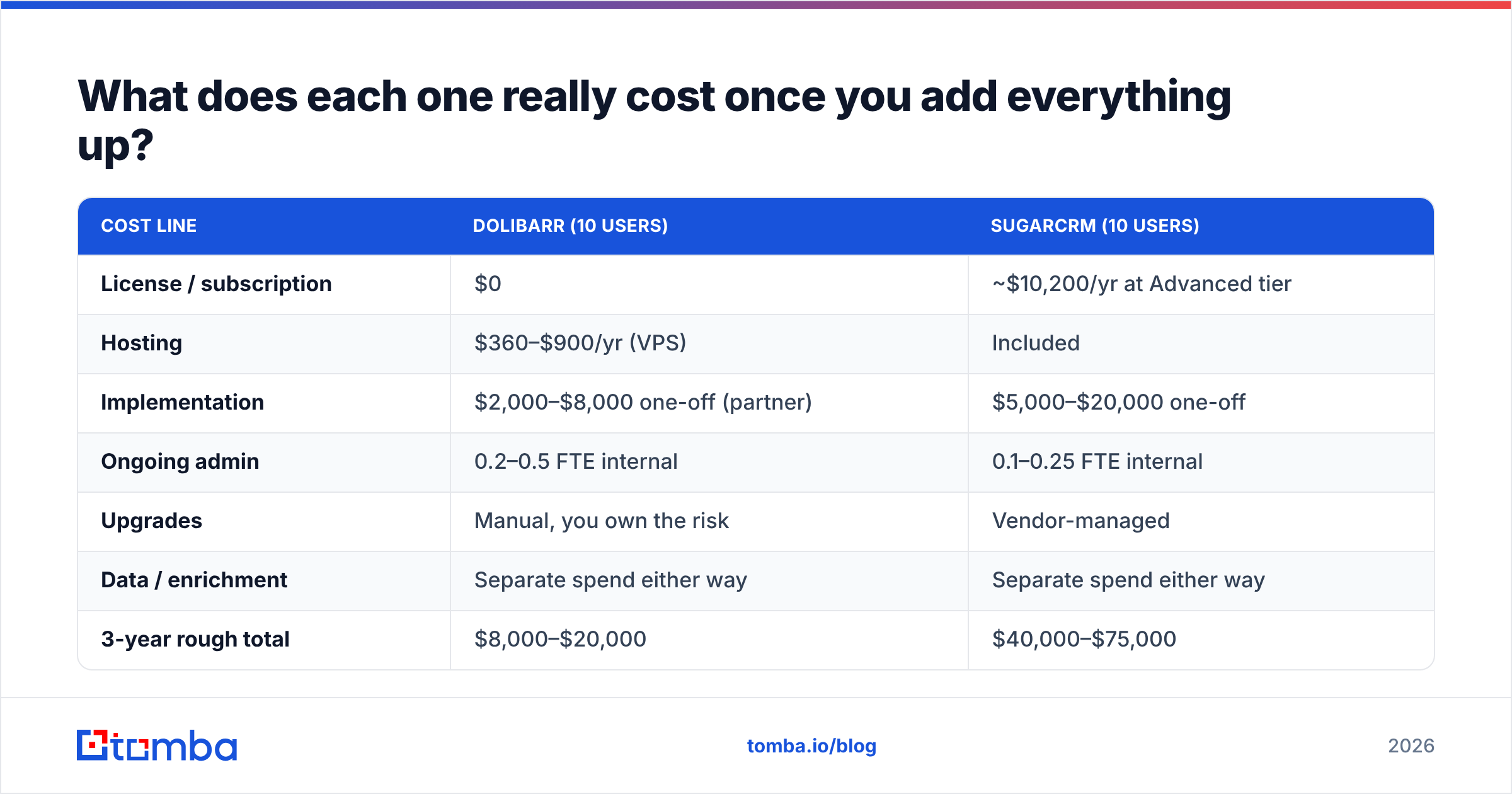
What does each one really cost once you add everything up?#
Software price is the smallest line item in both cases.
| Cost line | Dolibarr (10 users) | SugarCRM (10 users) |
|---|---|---|
| License / subscription | $0 | ~$10,200/yr at Advanced tier |
| Hosting | $360–$900/yr (VPS) | Included |
| Implementation | $2,000–$8,000 one-off (partner) | $5,000–$20,000 one-off |
| Ongoing admin | 0.2–0.5 FTE internal | 0.1–0.25 FTE internal |
| Upgrades | Manual, you own the risk | Vendor-managed |
| Data / enrichment | Separate spend either way | Separate spend either way |
| 3-year rough total | $8,000–$20,000 | $40,000–$75,000 |
The honest read: Dolibarr is dramatically cheaper in cash and meaningfully more expensive in attention. Somebody has to patch PHP, test module updates against your customizations, and answer questions at 9pm when invoicing breaks. If that person exists and enjoys the work, Dolibarr wins on economics by a wide margin. If they do not, you will discover that "free" has a payroll cost.
Which one should you pick for your situation?#
- You run a product or trading business under 25 people. Dolibarr. One system for quotes, stock, invoices, and the customer record beats stitching a CRM to an accounting package.
- You have a dedicated sales team with quotas. SugarCRM. Forecast accuracy and pipeline hygiene are worth the seat price once you have five or more reps whose commission depends on the numbers.
- You are in the EU and care about data residency. Both work. Dolibarr self-hosted gives you absolute control; Sugar offers regional cloud instances on higher tiers.
- Your requirement is "open source, no vendor." Dolibarr or SuiteCRM. SugarCRM is out.
- You need deep customization and have developers. Dolibarr's full source access wins. Sugar's Studio is powerful but you are always inside the vendor's sandbox.
- You are replacing spreadsheets and want it live in two weeks. SugarCRM, or frankly a lighter cloud CRM. Dolibarr rewards patience.
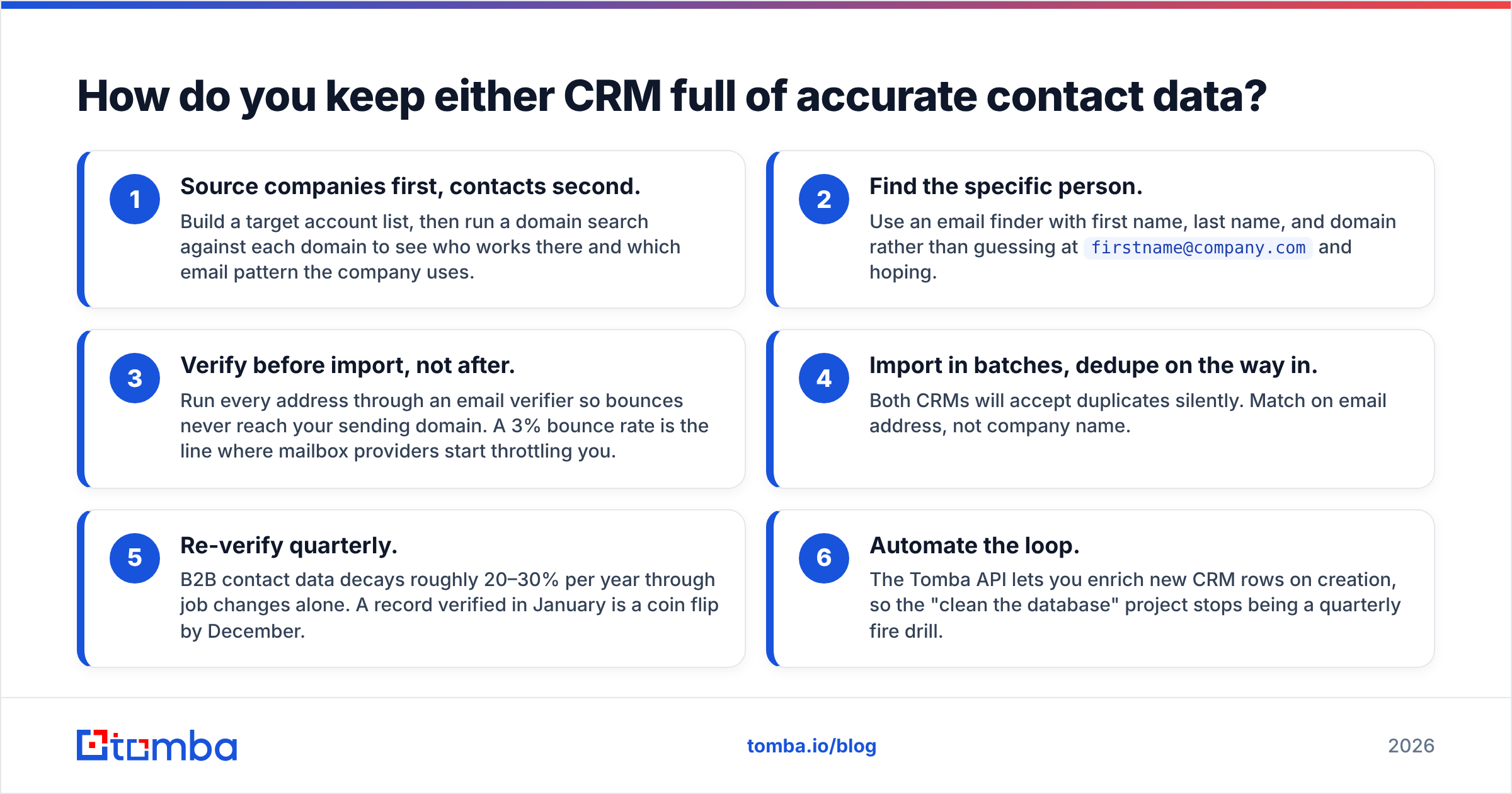
How do you keep either CRM full of accurate contact data?#
This is the part both comparisons skip, and it is the part that determines whether the CRM earns its keep.
Dolibarr and SugarCRM are both systems of record. Neither one finds a prospect's email address, neither one tells you when a contact leaves the company, and neither one stops a bad list from poisoning your sender reputation. A CRM full of stale rows is a very expensive filing cabinet.
The workflow that actually holds up looks like this:
- Source companies first, contacts second. Build a target account list, then run a domain search against each domain to see who works there and which email pattern the company uses.
- Find the specific person. Use an email finder with first name, last name, and domain rather than guessing at
firstname@company.comand hoping. - Verify before import, not after. Run every address through an email verifier so bounces never reach your sending domain. A 3% bounce rate is the line where mailbox providers start throttling you.
- Import in batches, dedupe on the way in. Both CRMs will accept duplicates silently. Match on email address, not company name.
- Re-verify quarterly. B2B contact data decays roughly 20–30% per year through job changes alone. A record verified in January is a coin flip by December.
- Automate the loop. The Tomba API lets you enrich new CRM rows on creation, so the "clean the database" project stops being a quarterly fire drill.
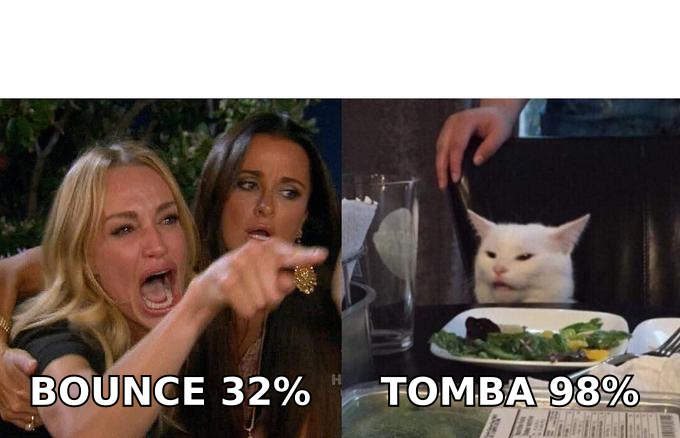
Step three is where most teams lose money. Sending to an unverified list does not just waste credits — it damages the sender reputation that every future campaign depends on, including the ones from your perfectly clean lists. Google and Microsoft both tightened bulk-sender enforcement in the last two years, and neither cares that your CRM was self-hosted.
What about migration and lock-in?#
Dolibarr's lock-in is close to zero on paper: it is your server, your MySQL database, your data. In practice the lock-in is your customizations. Every custom module and every hook you wrote is a reason not to move, and none of it ports anywhere.
SugarCRM's lock-in is contractual and structural. You get a full REST API and can export your data, but the SugarBPM workflows, Studio field logic, and report definitions do not translate to another CRM. Budget for a rebuild, not a migration, if you leave.
Both accept CSV import, which is the practical path in either direction. Prepare the file properly before you touch either system: deduplicate rows, normalize company domains, and validate every email column. A migration is the cheapest moment you will ever have to clean your database, because you are touching every row anyway. Use a bulk email finder run to fill the gaps in the export before you load it, rather than importing 4,000 rows with 1,100 blanks in the email column and calling it a CRM.
Which one wins?#
There is no universal winner, but there is a clear split.
Dolibarr wins on total cost, breadth, and control. If your business runs on quotes, orders, invoices, and stock — and the CRM is there so nobody loses a customer's phone number — it is the better buy, by a lot. Zero license cost, full source access, and one system instead of four.
SugarCRM wins on sales depth and accountability. If your revenue depends on managing a pipeline rather than fulfilling orders, Sugar's forecasting, automation, and reporting are in a different class, and having a vendor SLA is worth real money when the system is down on the last day of the quarter.
The mistake is picking Dolibarr to save money and then spending nine months building the sales features Sugar ships on day one — or paying Sugar seat prices to store a contact list you could have kept in a spreadsheet.
Whichever way you go, budget separately for the data layer. Tomba's Email Finder finds verified professional email addresses by name and domain, so the records you push into Dolibarr or SugarCRM are ones that actually reach a human. The free tier covers 25 searches a month, and paid plans start at $49/month with bulk processing, verification, and API access — check Tomba pricing to size it against your list volume. Get the contacts right, and either CRM starts earning its keep in the first quarter.
Related guides#
Ready to find emails that actually work?
Join 150,000+ professionals who stopped guessing and started sending. Free credits on signup — no credit card required.
Get the Tomba newsletter
Practical outbound tactics and product updates — once every two weeks.
About the author