Done For You Lead Generation in 2026: What You Actually Get
Done-for-you lead gen sells you meetings and hides the mechanics. Here's the real cost breakdown, the four delivery models, and the questions that expose a weak provider before you sign.
TL;DR
- Done for you lead generation means an external team owns some or all of your top-of-funnel: data sourcing, list building, copy, sending infrastructure, and sometimes booking. You pay for outcomes or activity, not software.
- Real market pricing in 2026 runs $2,000–$5,000/mo for list-and-copy retainers, $5,000–$12,000/mo for full outbound management, and $250–$900 per booked meeting on pay-per-appointment deals.
- The single biggest quality variable is data. Most underperforming DFY engagements fail on list quality and verification, not on copy.
- Four delivery models exist — data-only, managed outbound, appointment setting, and hybrid enablement. They are not interchangeable, and vendors rarely tell you which one they actually run.
- If your ACV is under $5,000 or your ICP is under 2,000 accounts, an in-house stack built on a solid email finder plus a sending tool usually beats a retainer on cost per meeting.
What is done for you lead generation?#
Done for you lead generation is outsourcing the mechanical parts of pipeline creation to a vendor who executes on your behalf. You supply the ICP, the offer, and the calendar. They supply the labor, the data, the tooling, and — in the better arrangements — the strategy.
Think of it like hiring a contractor to build a deck versus buying lumber and a saw. The contractor already owns the tools, knows which permits you need, and has built forty decks. You are not paying for wood. You are paying to skip the learning curve and the weekends.
The catch is that a deck is visible when it's finished. Outbound isn't. A vendor can send 40,000 emails, burn two of your domains, book four meetings from a list that was 38% invalid, and present it as a "learning quarter." Which is why the mechanics below matter more than the pitch deck.
Here's what a complete done-for-you engagement typically covers:
- ICP definition and account sourcing — building the target account list from firmographic filters, intent signals, hiring data, or tech-stack detection. This is where a good provider earns their fee.
- Contact data acquisition and verification — finding the right person at each account and confirming the email actually resolves. Bounce rates above 3% start damaging your sender reputation.
- Infrastructure setup — secondary sending domains, SPF/DKIM/DMARC records, mailbox provisioning, and a warmup schedule before the first real send.
- Copy and sequence design — subject lines, a 3–5 touch sequence, and variant testing. Most vendors reuse a house framework and swap in your value prop.
- Send execution and inbox management — running the campaign, handling replies, filtering out-of-office noise, and routing genuine interest.
- Reporting and iteration — open, reply, positive-reply, and meeting-booked rates by segment, with a monthly rework of whatever underperformed.
Not every vendor does all six. Many quietly do two and charge for six.
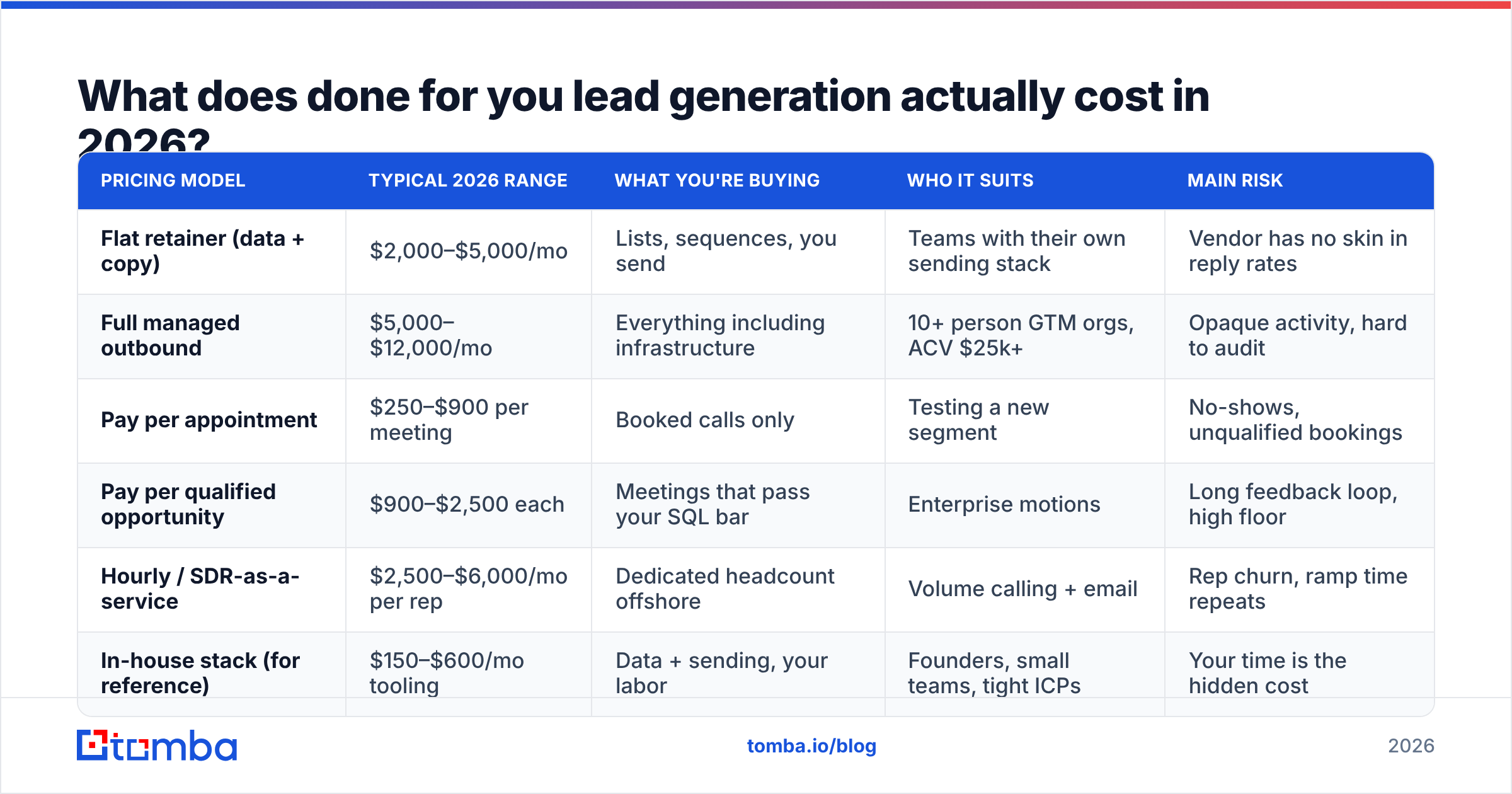
What does done for you lead generation actually cost in 2026?#
Pricing splits into three shapes, and the shape tells you more about incentive alignment than the number does.
| Pricing model | Typical 2026 range | What you're buying | Who it suits | Main risk |
|---|---|---|---|---|
| Flat retainer (data + copy) | $2,000–$5,000/mo | Lists, sequences, you send | Teams with their own sending stack | Vendor has no skin in reply rates |
| Full managed outbound | $5,000–$12,000/mo | Everything including infrastructure | 10+ person GTM orgs, ACV $25k+ | Opaque activity, hard to audit |
| Pay per appointment | $250–$900 per meeting | Booked calls only | Testing a new segment | No-shows, unqualified bookings |
| Pay per qualified opportunity | $900–$2,500 each | Meetings that pass your SQL bar | Enterprise motions | Long feedback loop, high floor |
| Hourly / SDR-as-a-service | $2,500–$6,000/mo per rep | Dedicated headcount offshore | Volume calling + email | Rep churn, ramp time repeats |
| In-house stack (for reference) | $150–$600/mo tooling | Data + sending, your labor | Founders, small teams, tight ICPs | Your time is the hidden cost |
Two notes on that table. First, pay-per-appointment sounds like the safest deal and is usually the worst one — the vendor's incentive is a booked slot, not a real buyer, and you will spend sales hours on people who agreed to a call to end a conversation. Second, the in-house row is not a fair apples-to-apples comparison on effort. It's a fair comparison on cost, which is the number that gets budget approved.
Benchmark the retainer against a simple unit: cost per booked meeting. If a $6,000/mo managed program books nine meetings, you paid $667 each. If your in-house motion books six meetings on $400 of tooling and 20 hours of an SDR's month, you paid roughly $67 in hard cost plus labor. Whether that trade is good depends entirely on whether that SDR had something better to do.
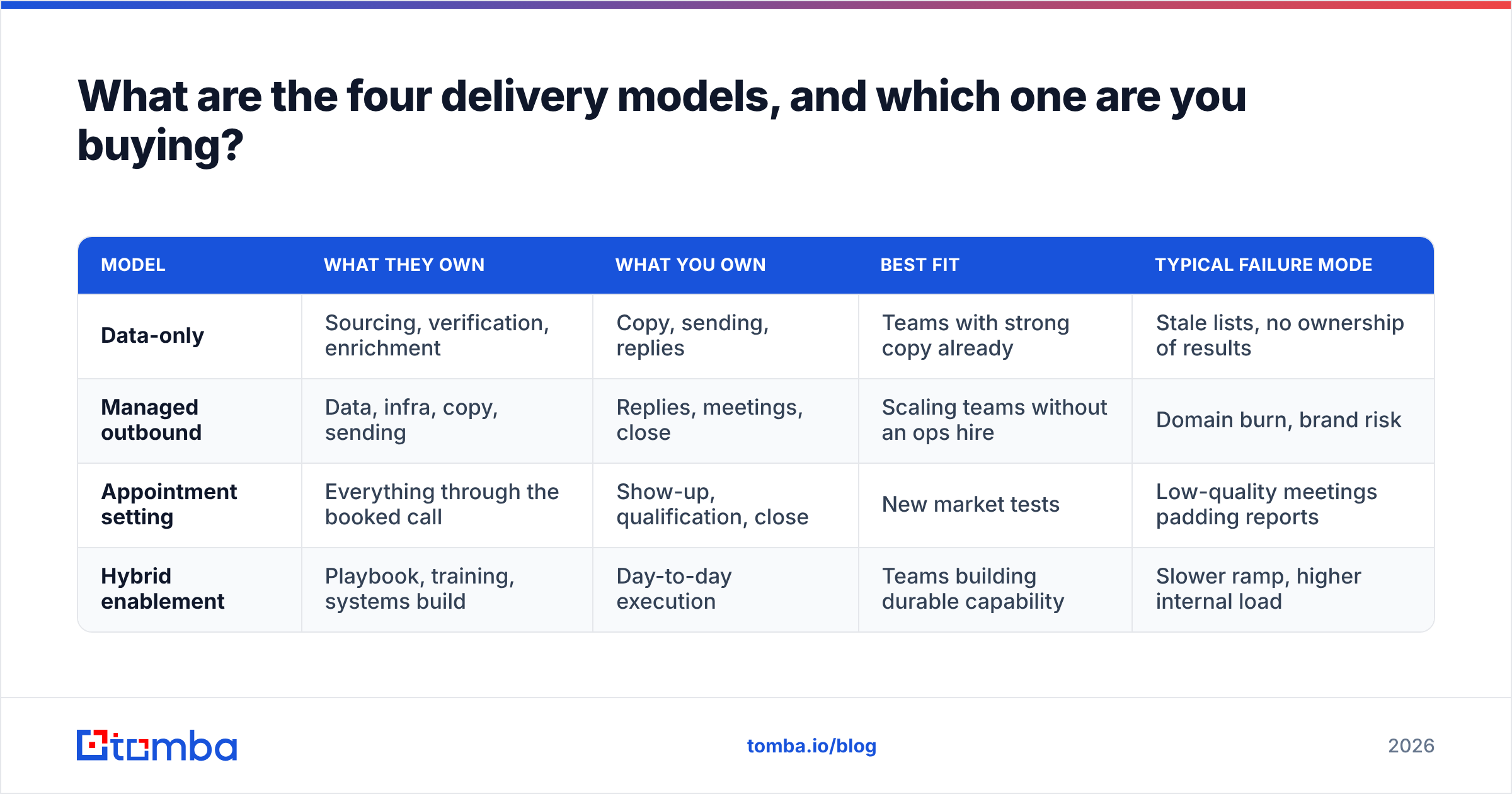
What are the four delivery models, and which one are you buying?#
Vendors describe themselves in outcome language ("we build pipeline") when the operational reality falls into one of four buckets. Ask which one before you ask about price.
| Model | What they own | What you own | Best fit | Typical failure mode |
|---|---|---|---|---|
| Data-only | Sourcing, verification, enrichment | Copy, sending, replies | Teams with strong copy already | Stale lists, no ownership of results |
| Managed outbound | Data, infra, copy, sending | Replies, meetings, close | Scaling teams without an ops hire | Domain burn, brand risk |
| Appointment setting | Everything through the booked call | Show-up, qualification, close | New market tests | Low-quality meetings padding reports |
| Hybrid enablement | Playbook, training, systems build | Day-to-day execution | Teams building durable capability | Slower ramp, higher internal load |
Data-only is the model most companies should start with, because it isolates the variable that fails most often. If a vendor hands you a list of 3,000 verified contacts and your own proven sequence converts at 1.8% positive reply, you've learned something clean. If a full managed program returns 0.4%, you have no idea whether the data, the copy, the infrastructure, or the offer was the problem.
Pure data providers are worth evaluating separately from execution shops. Vendors like BookYourData sell verified B2B contact lists on a pay-as-you-go basis, which is a genuinely different purchase from a managed retainer — you get the raw material and keep full control of the send. That model is often the cheapest path to a clean test, and it's easier to audit: you can sample 100 records, run them through an email verifier, and know within an hour whether the data holds up.
Is done for you lead generation better than building in-house?#
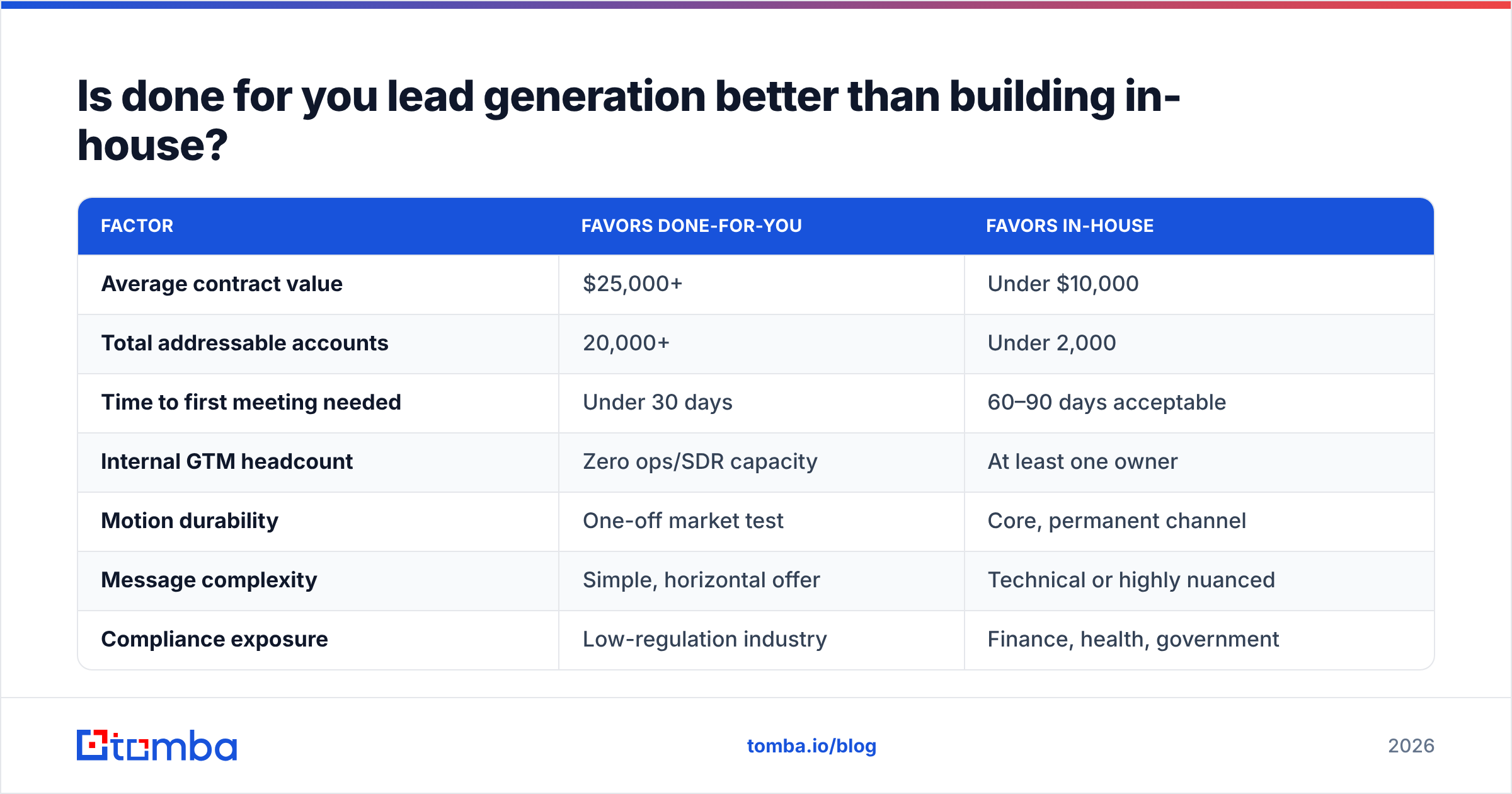
Neither wins universally. The decision comes down to four inputs: deal size, ICP size, internal bandwidth, and how long you plan to run this motion.
| Factor | Favors done-for-you | Favors in-house |
|---|---|---|
| Average contract value | $25,000+ | Under $10,000 |
| Total addressable accounts | 20,000+ | Under 2,000 |
| Time to first meeting needed | Under 30 days | 60–90 days acceptable |
| Internal GTM headcount | Zero ops/SDR capacity | At least one owner |
| Motion durability | One-off market test | Core, permanent channel |
| Message complexity | Simple, horizontal offer | Technical or highly nuanced |
| Compliance exposure | Low-regulation industry | Finance, health, government |
The pattern that shows up repeatedly: DFY is excellent for testing a hypothesis fast and mediocre for owning a channel forever. Twelve months into a retainer, most companies have spent $70,000+ and still have no internal knowledge of what works, no owned data asset, and no ability to run a campaign next Tuesday without a vendor call.
If your ICP is genuinely narrow — say 800 accounts in a vertical — DFY is close to indefensible. Eight hundred accounts is one person's afternoon with a domain search tool and a spreadsheet, not a $6,000 monthly retainer. Vendors thrive on volume; narrow ICPs have none.
What separates a good provider from an expensive one?#
The good ones behave in specific, checkable ways. Use this as a diligence list.
- They lead with data methodology, not case studies. Ask where contacts come from. "Proprietary database" is not an answer. Real answers involve crawling, pattern inference, SMTP-level verification, and a stated freshness window. Vendors who publish their data sources methodology are easier to trust than ones who won't.
- They quote a bounce guarantee in writing. Under 3% hard bounce, with credits or replacement for overages. If they won't put a number on it, the number is bad.
- They separate positive reply rate from reply rate. Any list generates replies. "Take me off this list" is a reply. Ask for positive-reply-to-meeting conversion by segment on their last three accounts.
- They insist on secondary domains. A provider willing to send cold volume from your primary domain is either inexperienced or indifferent to your risk. This is disqualifying.
- They cap volume deliberately. Providers pushing 100,000 sends a month across five domains are optimizing for their reporting, not your inbox placement. Google and Microsoft's 2024 bulk-sender rules made spray-and-pray structurally unprofitable, and the enforcement has only tightened since.
- They hand back the data. At the end of the engagement, you should own the contact records, the sequences, and the performance data. Providers who treat your list as their asset are building switching costs, not pipeline.

Check public review sources before you commit — the lead generation services category on G2 surfaces the cancellation complaints that never appear in a sales call, and the pattern of one-star reviews is more informative than the pattern of five-star ones.
What questions should you ask before signing?#
Bring these to the second call, not the first. The first call is theater.
- "Which of my competitors are you currently running?" Agencies frequently run four vendors in the same category, sending near-identical messages to the same 5,000 contacts. Your prospect's inbox is the shared resource being depleted.
- "Show me a real sequence you sent last month, unedited." Not a template from the deck. If the copy is generic "I noticed you're the VP of Sales at {{company}}," you're buying volume, not relevance.
- "What's your verification process, and what's the bounce rate on your last five deliveries?" Ask for the raw number. Then sample it yourself.
- "Who writes the copy — the person on this call, or an offshore team?" Neither is wrong. Being lied to about it is.
- "What happens to the data if we cancel in month three?" Get the answer in the contract.
- "What's the ramp period before I should expect meetings?" Honest answer is 4–8 weeks including warmup. Anyone promising meetings in week one is either skipping warmup or reselling a stale list.
On question three: you can verify their claims independently in about fifteen minutes. Take a random sample of 200 delivered contacts, run them through a bulk verify pass, and compare the invalid rate to what they promised. This single check has ended more bad engagements than any reference call.
When does building it yourself actually win?#
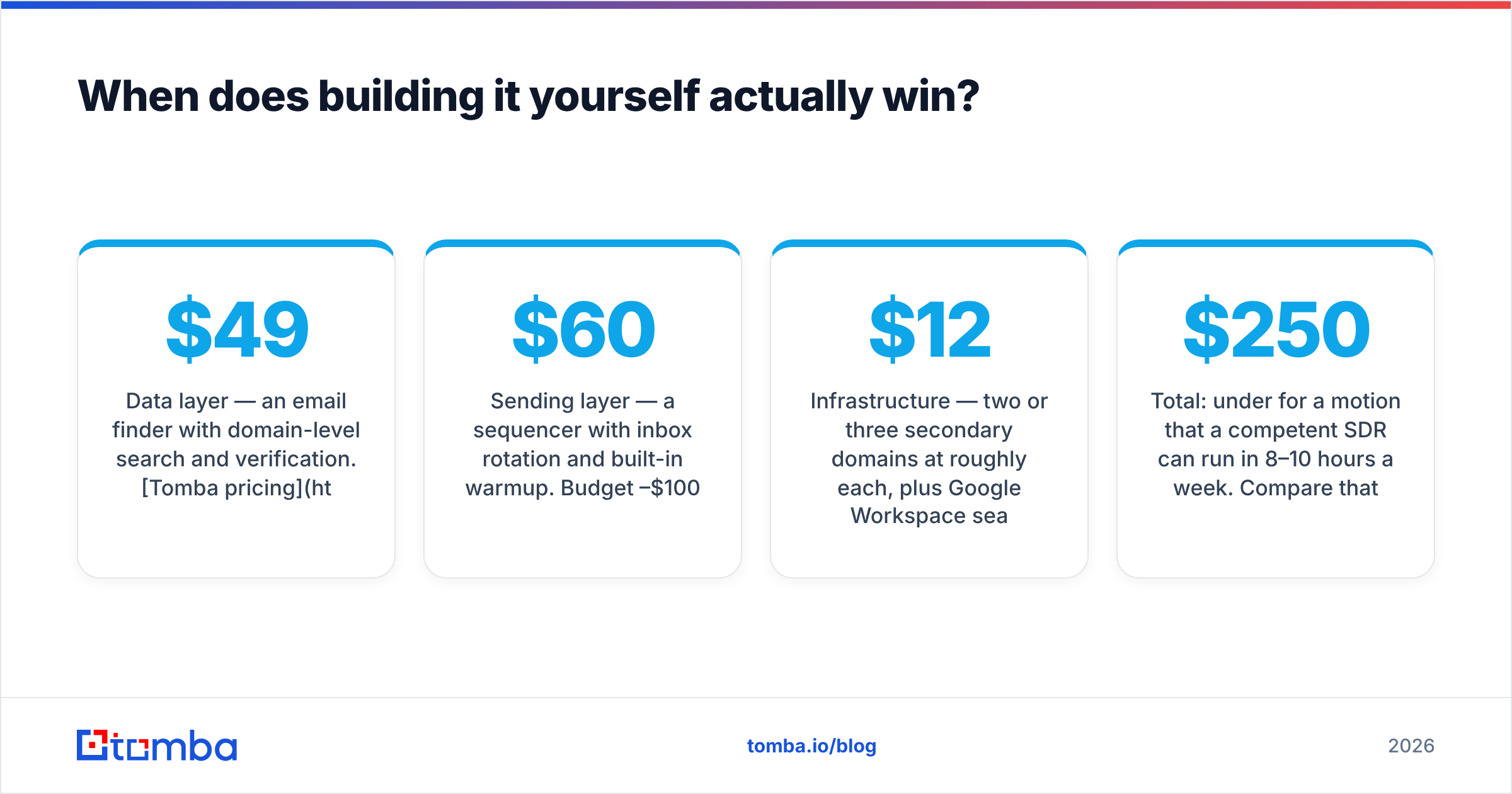
DIY wins when your ICP is knowable and your offer is specific. The modern stack is cheaper and simpler than it was three years ago:
- Data layer — an email finder with domain-level search and verification. Tomba pricing starts free at 25 searches/mo, then $49/mo for Starter, $99/mo Growth, and $249/mo Pro, which covers most teams sending under 5,000 emails a month.
- Sending layer — a sequencer with inbox rotation and built-in warmup. Budget $60–$100/mo.
- Infrastructure — two or three secondary domains at roughly $12/year each, plus Google Workspace seats.
- Automation — a Tomba API call or a Sheets add-on that enriches new accounts as they enter your CRM, so list building stops being a recurring manual task.
Total: under $250/mo for a motion that a competent SDR can run in 8–10 hours a week. Compare that to a $6,000 retainer and the math only favors DFY when your time is worth more than $700/hour or when you genuinely have nobody to assign it to.
The honest middle path most teams land on: buy data externally, run execution internally. You skip the hardest part (finding accurate contacts at scale) and keep the part that compounds (knowing what message works on your buyers). See how tools stack up in HubSpot's overview of lead generation strategy if you want a framework for the messaging side.
What should you do next?#
Run a 30-day controlled test before committing to any retainer. Pick 500 accounts inside your tightest ICP segment. Source and verify the contacts yourself. Write four emails. Send them from a warmed secondary domain. Measure positive reply rate.
If that test produces meetings, you've just proven your offer works — and you now have a baseline to hold any DFY vendor against. If it doesn't, no retainer was going to fix it, and you've saved yourself $18,000 finding out.
For the data half of that test, start with the Tomba Email Finder. It finds verified professional email addresses by domain, name, or company, with a free tier of 25 searches to validate accuracy on your own ICP before you spend anything. Run 25 known contacts through it, check the hit rate against what you already know, and let the numbers decide whether you need a vendor at all.
Related guides#
Ready to find emails that actually work?
Join 150,000+ professionals who stopped guessing and started sending. Free credits on signup — no credit card required.
Get the Tomba newsletter
Practical outbound tactics and product updates — once every two weeks.
About the author