Double Funnel Explained: The 2026 B2B GTM Playbook
One funnel captures demand. The other creates it. Here's how the double funnel model actually works, what it costs to run, and how to build one without doubling your team.
TL;DR
- The double funnel is a GTM model that splits your revenue engine into two tracked systems: a demand-creation funnel (dark social, content, community, ads with no capture intent) and a demand-capture funnel (search, review sites, direct, inbound requests).
- It exists because attribution software credits the last click and starves the channels that made the click happen. The double funnel measures creation by cohort-level lift, not per-lead source.
- Running it well needs three things most teams lack: a self-reported attribution field, an outbound layer that can reach people who never fill in a form, and clean contact data to make that outbound land.
- It is not free. Expect 2-4 quarters before creation-side spend shows up in capture-side pipeline, and expect finance to ask hard questions in month three.
- Small teams should not run a full double funnel. Under roughly $3M ARR, run one funnel and instrument self-reported attribution — that's 80% of the benefit for 10% of the overhead.
What is a double funnel?#
A double funnel treats demand creation and demand capture as two separate funnels with separate metrics, separate budgets, and separate definitions of success — instead of one linear funnel where every touch is forced into a single attribution chain.
Think of it like a restaurant. The demand-creation funnel is everything that makes someone hungry and aware your restaurant exists: the smell drifting down the street, the friend who mentioned it, the review they half-remember. The demand-capture funnel is the sign on the door and the person taking the reservation. If you only measure the sign on the door, you will conclude that signage drives 100% of your business and cut the kitchen's ventilation budget.
That's essentially what happened to B2B marketing between 2018 and 2024. Attribution platforms got very good at tracking the last few clicks, so budget flowed to the channels that owned those clicks — branded search, retargeting, gated content. Meanwhile the channels that actually created the intent were unmeasurable and got defunded.
The double funnel is the correction. It says: stop trying to attribute demand creation. Measure it differently.
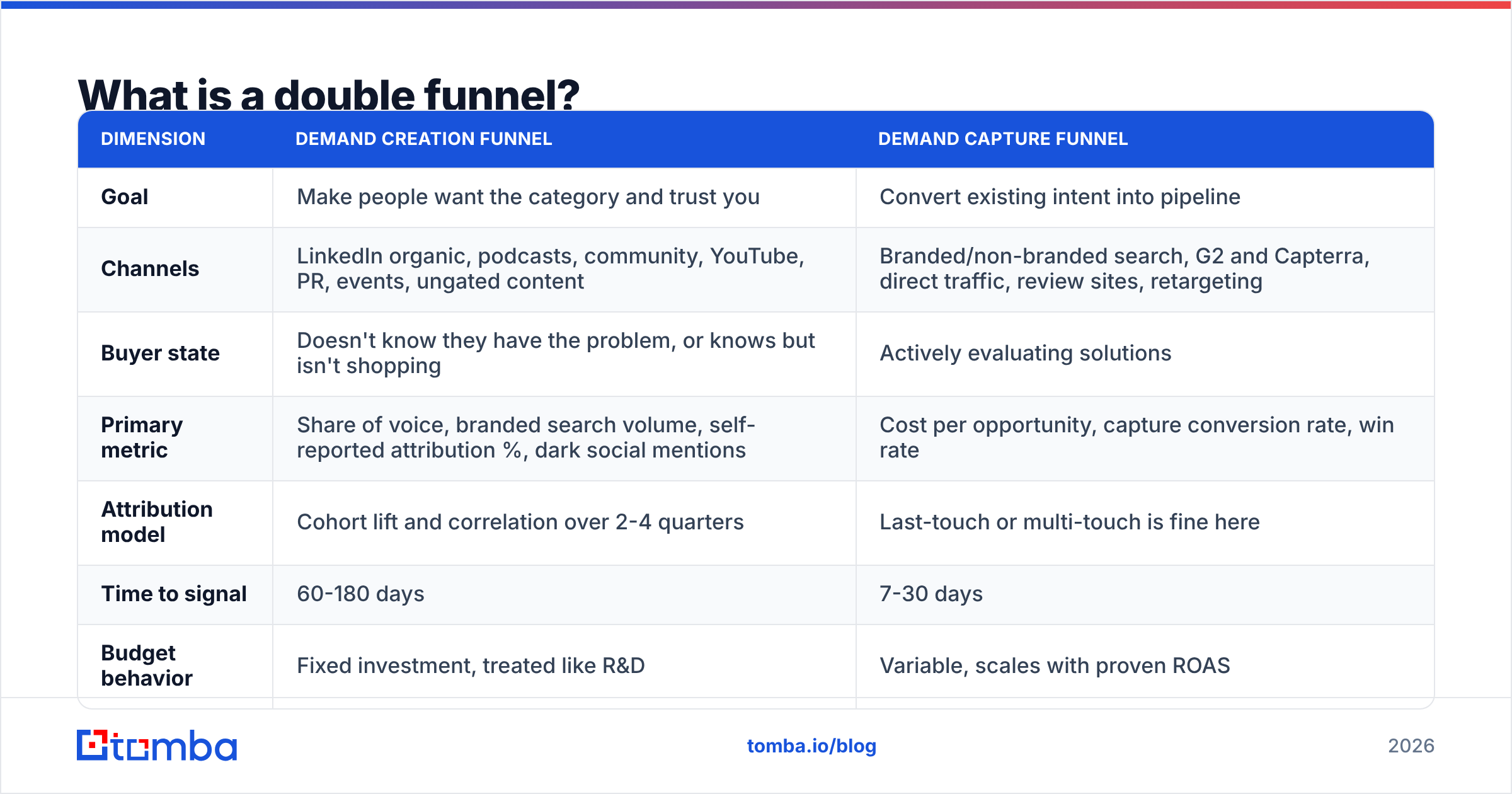
| Dimension | Demand creation funnel | Demand capture funnel |
|---|---|---|
| Goal | Make people want the category and trust you | Convert existing intent into pipeline |
| Channels | LinkedIn organic, podcasts, community, YouTube, PR, events, ungated content | Branded/non-branded search, G2 and Capterra, direct traffic, review sites, retargeting |
| Buyer state | Doesn't know they have the problem, or knows but isn't shopping | Actively evaluating solutions |
| Primary metric | Share of voice, branded search volume, self-reported attribution %, dark social mentions | Cost per opportunity, capture conversion rate, win rate |
| Attribution model | Cohort lift and correlation over 2-4 quarters | Last-touch or multi-touch is fine here |
| Time to signal | 60-180 days | 7-30 days |
| Budget behavior | Fixed investment, treated like R&D | Variable, scales with proven ROAS |
| Failure mode | Cut too early because it "isn't converting" | Saturates — you run out of in-market buyers to capture |
The critical insight is in that last row. Capture channels have a ceiling. There are only so many people searching "best email finder" this month. Once you own that SERP and those review pages, incremental spend buys nothing. Growth then has to come from expanding the number of people who search in the first place — which is the creation funnel's job.
Why did the single-funnel model break?#
Three things broke it, and none of them are going to reverse.
1. Buyers stopped filling in forms. Gartner's B2B buying research has consistently found that buyers spend a minority of the purchase cycle with any vendor's sales team — most of the journey happens in channels you cannot see. By the time someone requests a demo, they have often already picked a favorite. The form fill is a receipt, not a lead.
2. Dark social became the default research channel. Slack communities, private LinkedIn DMs, podcast recommendations, and word of mouth leave no UTM. Your analytics tool files all of it under "direct" or "organic search — branded." So the report says SEO is winning when SEO is just the last hop of a journey that started in a Slack channel.
3. MQL volume stopped predicting revenue. When you optimize for form fills, you get form fills. Ebook downloaders, webinar tourists, and competitors' interns. Teams that hit MQL targets and missed pipeline targets in the same quarter — repeatedly — eventually stop trusting the metric.
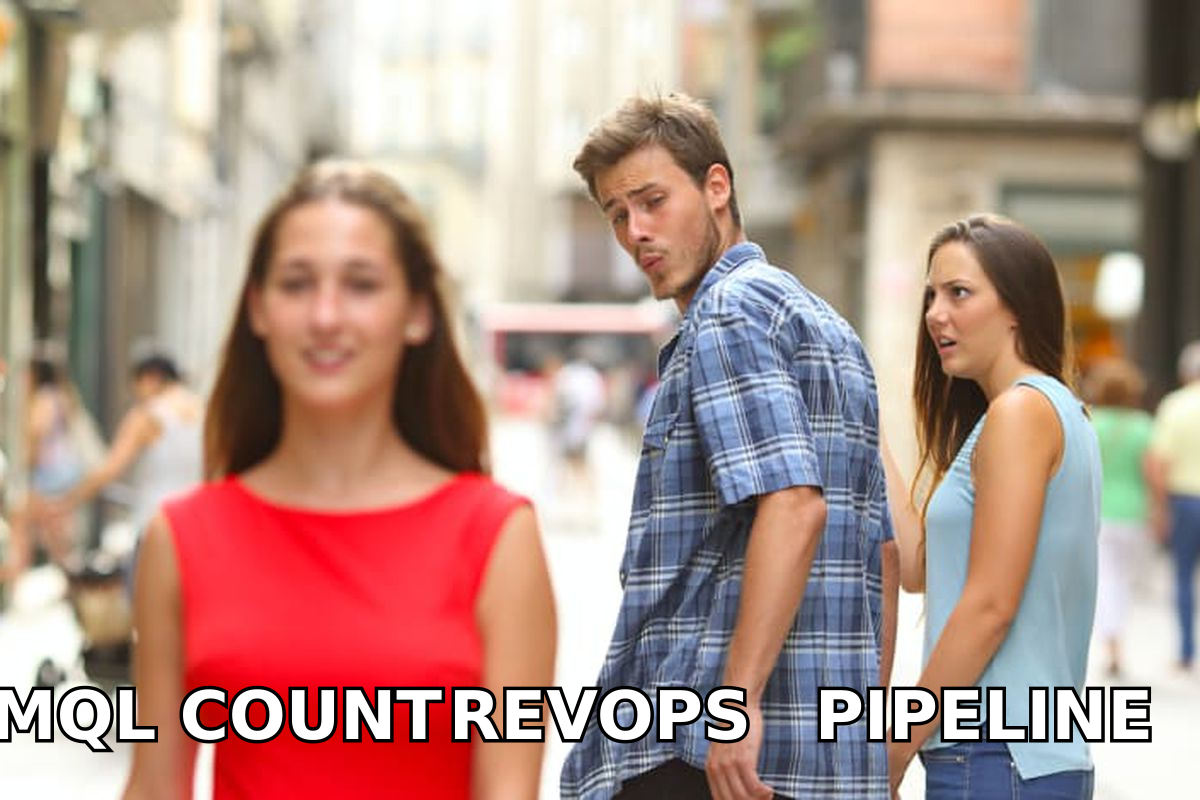
The double funnel doesn't fix attribution. It accepts that demand creation is unattributable at the individual-lead level and switches to a different measurement contract: creation gets judged on leading indicators and cohort trends, capture gets judged on efficiency.
How do you actually measure the creation funnel?#
You measure it four ways at once, and you never let any single one of them make the budget decision.
- Self-reported attribution. Add one required open-text or dropdown field to every demo request and signup: "How did you hear about us?" This is the single highest-ROI instrumentation change available to a B2B team, and it takes an afternoon. It routinely surfaces podcasts, communities, and individual creators that your analytics stack reports as zero.
- Branded search volume. Track month-over-month growth in searches for your brand name and "brand + review", "brand + pricing", "brand + vs". Creation spend that works shows up here 60-120 days later. Flat branded search after two quarters of heavy content investment means the content isn't landing.
- Direct traffic to high-intent pages. Not homepage traffic — pricing page, comparison pages, and docs. Someone typing your URL and going straight to pricing is a creation-funnel graduate.
- Cohort win-rate and deal-size lift. Segment closed-won deals by whether the account had any recorded creation-side touch (event attendee, community member, podcast listener, content subscriber). Compare win rate, cycle length, and ACV against accounts with none. Sustained lift is your proof.
- Qualitative sales feedback. "They came in already knowing what we do" is a real signal. Log it. Ask AEs on every won-deal debrief whether the buyer arrived warm or cold.
None of these are precise. All of them together are directionally reliable, which is the honest ceiling for demand-creation measurement in 2026. Anyone selling you per-dollar creation-side ROI is selling you a model, not a measurement.
How does the capture funnel change under a double funnel model?#
It gets narrower and more aggressive, which is the part teams underestimate.
Once creation is a separate line item, the capture funnel is no longer responsible for education. Its only job is to intercept people who are already looking. That means:
- Content changes. Capture-side content is bottom-of-funnel and unapologetically commercial: comparison pages, alternatives pages, pricing explainers, integration docs, "how to do X with [product]". Creation-side content is ungated, opinionated, and often doesn't mention your product at all.
- Paid changes. Capture-side paid targets category and competitor keywords, review-site placements, and retargeting. Creation-side paid buys attention — podcast reads, newsletter sponsorships, LinkedIn thought-leadership ads — with no expectation of a same-week conversion.
- Outbound moves. This is the part that surprises people. In a double funnel, outbound sits on the capture side, but its targeting is fed by the creation side. You are not cold-emailing random ICP accounts; you are reaching out to accounts showing creation-side engagement that never converted — the podcast listener, the community lurker, the person who read three blog posts and left.
That last motion is where most double-funnel implementations die, because the accounts showing creation-side signal are usually anonymous. You know a company visited. You don't know who. Closing that gap means going from company-level signal to a named, reachable person, which is a data problem before it's a sales problem. A domain search across the engaged account plus a role filter turns "someone at Acme read our stuff" into three named contacts with verified addresses. Tools like visitor identification and enrichment sit precisely at this seam between the two funnels.
What does a double funnel cost to run?#
More than the frameworks admit. Here's a realistic comparison of the three common configurations.
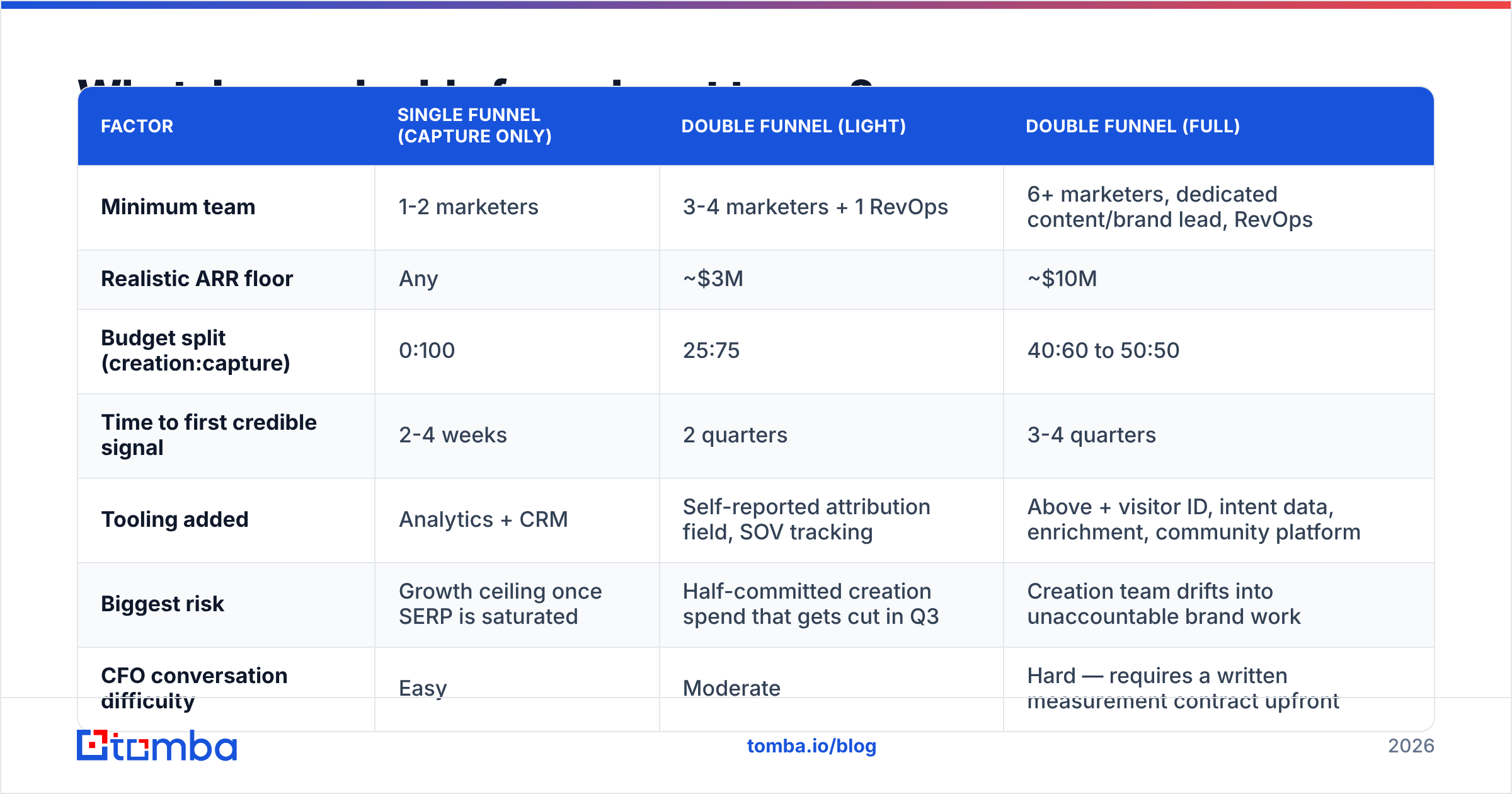
| Factor | Single funnel (capture only) | Double funnel (light) | Double funnel (full) |
|---|---|---|---|
| Minimum team | 1-2 marketers | 3-4 marketers + 1 RevOps | 6+ marketers, dedicated content/brand lead, RevOps |
| Realistic ARR floor | Any | ~$3M | ~$10M |
| Budget split (creation:capture) | 0:100 | 25:75 | 40:60 to 50:50 |
| Time to first credible signal | 2-4 weeks | 2 quarters | 3-4 quarters |
| Tooling added | Analytics + CRM | Self-reported attribution field, SOV tracking | Above + visitor ID, intent data, enrichment, community platform |
| Biggest risk | Growth ceiling once SERP is saturated | Half-committed creation spend that gets cut in Q3 | Creation team drifts into unaccountable brand work |
| CFO conversation difficulty | Easy | Moderate | Hard — requires a written measurement contract upfront |
The "double funnel (light)" column is where most companies should live. It means one person or one meaningful budget line owned by creation, self-reported attribution instrumented, and a written agreement with finance that creation gets four quarters before judgment. That's it. You do not need an intent-data contract to start.
The full configuration only makes sense when your capture funnel is genuinely saturated — you own page one for your core terms, you're on the relevant G2 grids, your branded search converts well, and pipeline is still flat. That's a signal the market's in-market segment is fully harvested and you need a bigger market.
Which stage of sophistication are you at?#
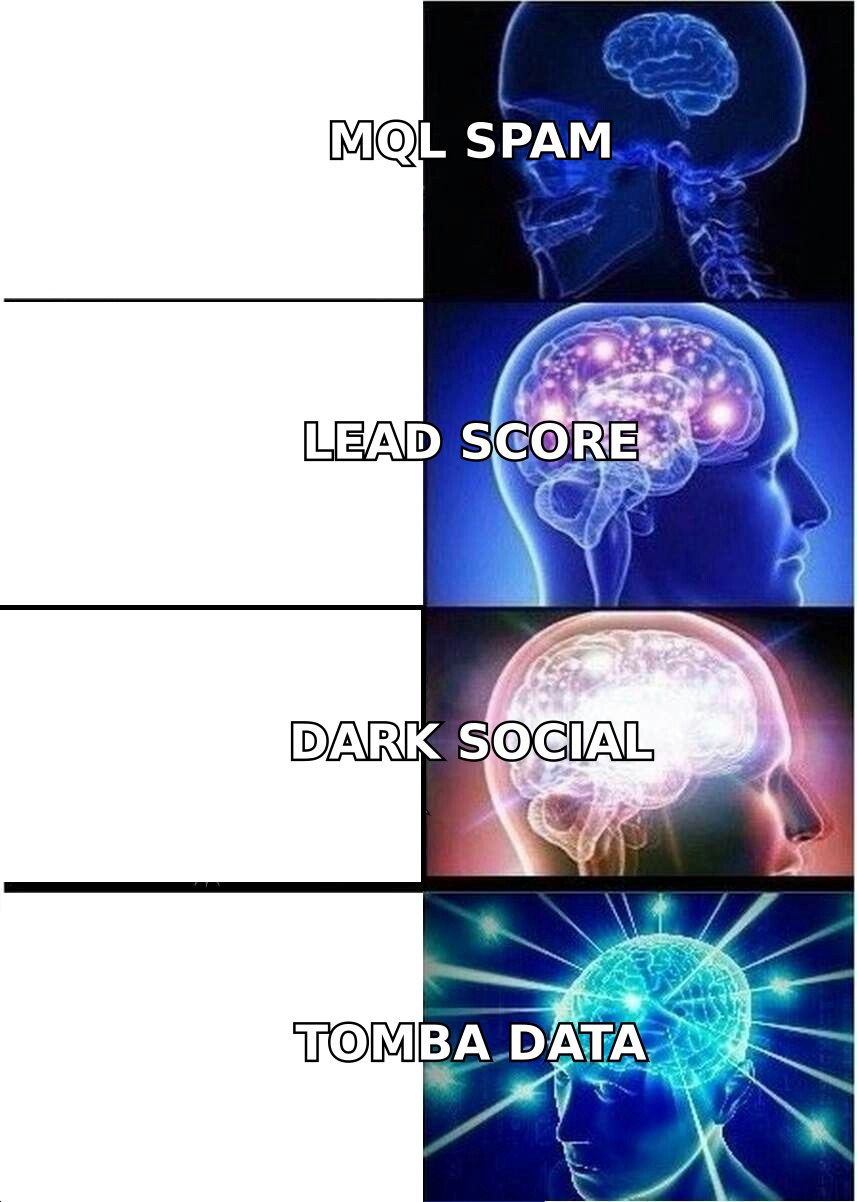
Most teams progress through four stages, and skipping ahead usually fails.
Stage 1 — Volume. You count MQLs. Marketing hits its number, sales complains about quality, nobody agrees on why. Fix: define a shared qualified-opportunity metric before touching anything else.
Stage 2 — Scoring. You add lead scoring and routing. Quality improves marginally. You discover that scoring reorders a bad list rather than fixing it. Fix: instrument self-reported attribution and see what your scores are missing.
Stage 3 — Creation visibility. You start tracking dark social, branded search, and self-reported sources. You find out that 30-40% of your best pipeline credits a channel your analytics reported as zero. This is where the double funnel becomes obvious rather than theoretical.
Stage 4 — Two funnels, two budgets. Creation and capture have separate owners, separate metrics, and separate review cadences. Outbound is fed by creation-side signal and powered by clean contact data. Pipeline forecasting improves because you can see both the near-term capture number and the leading indicator behind next quarter's.
The jump from 3 to 4 is where data quality becomes the bottleneck. Acting on creation-side signal requires reaching specific humans, and bounce rates above 5% will kill both your sender reputation and the credibility of the whole model with your sales team. Run every list through an email verifier before it touches a sequence — a double-funnel outbound motion that lands in spam proves nothing except that the model "didn't work."
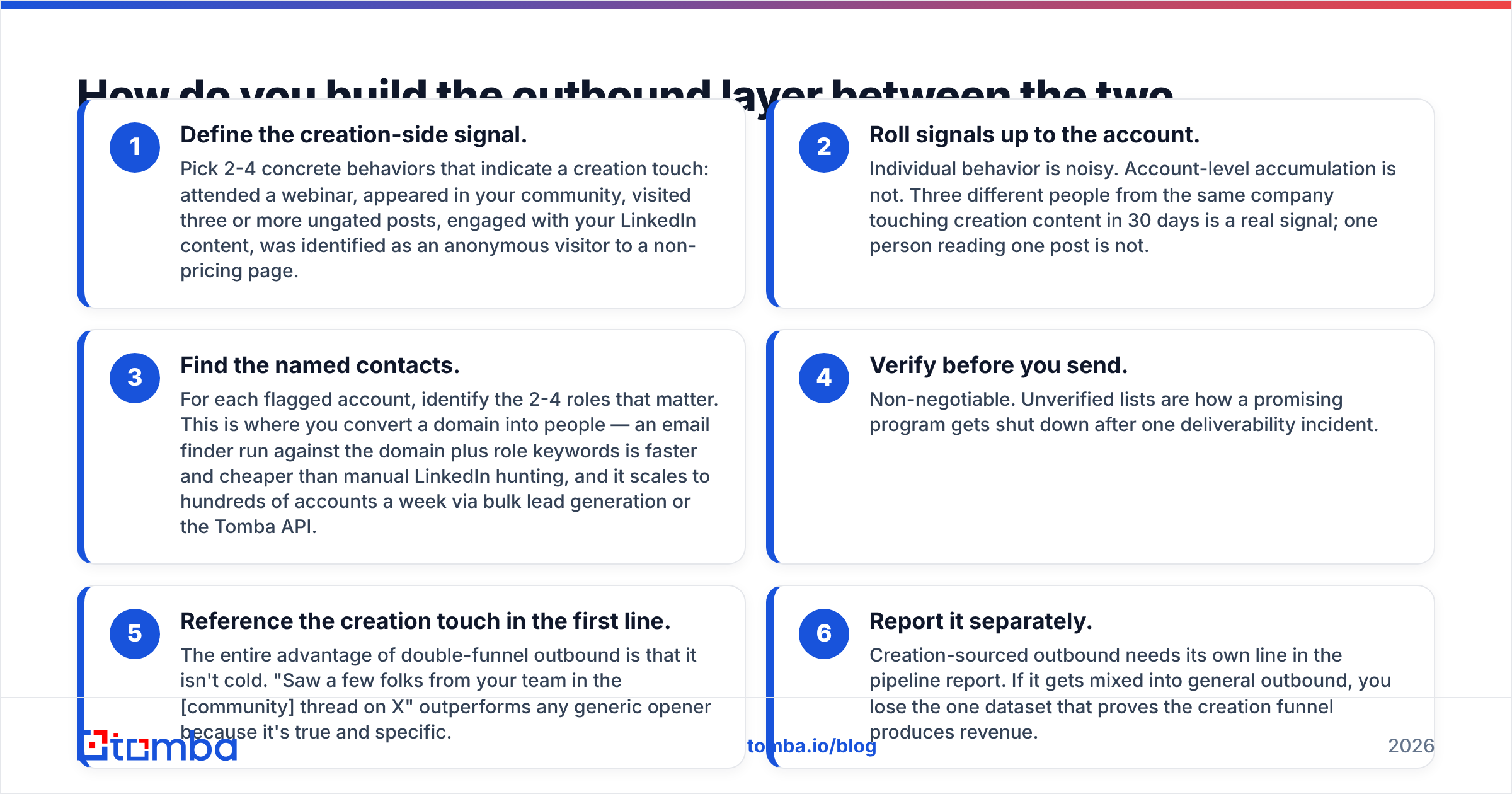
How do you build the outbound layer between the two funnels?#
Six steps, in order. Skipping any of them produces the "we tried the double funnel and it didn't work" postmortem.
- Define the creation-side signal. Pick 2-4 concrete behaviors that indicate a creation touch: attended a webinar, appeared in your community, visited three or more ungated posts, engaged with your LinkedIn content, was identified as an anonymous visitor to a non-pricing page.
- Roll signals up to the account. Individual behavior is noisy. Account-level accumulation is not. Three different people from the same company touching creation content in 30 days is a real signal; one person reading one post is not.
- Find the named contacts. For each flagged account, identify the 2-4 roles that matter. This is where you convert a domain into people — an email finder run against the domain plus role keywords is faster and cheaper than manual LinkedIn hunting, and it scales to hundreds of accounts a week via bulk lead generation or the Tomba API.
- Verify before you send. Non-negotiable. Unverified lists are how a promising program gets shut down after one deliverability incident.
- Reference the creation touch in the first line. The entire advantage of double-funnel outbound is that it isn't cold. "Saw a few folks from your team in the [community] thread on X" outperforms any generic opener because it's true and specific.
- Report it separately. Creation-sourced outbound needs its own line in the pipeline report. If it gets mixed into general outbound, you lose the one dataset that proves the creation funnel produces revenue.
Step 6 is the political step and it matters more than the tactical ones. The double funnel survives budget season only if someone can show a chart where creation-influenced pipeline converts better than cold pipeline.
Is the double funnel right for your team?#
Run it if: your capture channels are saturated, your sales cycle is longer than 45 days, your ACV justifies brand investment, your buyers research in communities, and you have executive patience measured in quarters rather than months.
Skip it if: you're pre-product-market-fit, under roughly $3M ARR, selling a low-ACV self-serve product, or your leadership changes marketing strategy every two quarters. In those cases, run one funnel, instrument self-reported attribution anyway (it's free), and revisit in a year.
The honest failure mode is worth naming. Plenty of teams adopt the double funnel because it provides cover for spend that can't be justified. "It's a creation investment, you can't measure it directly" is a true statement that is also the perfect excuse for a brand budget with no accountability. Guard against this by writing the measurement contract before the first dollar is spent: which four indicators will be tracked, what threshold constitutes success, and on what date the decision gets made. Put it in a doc. Get finance to sign it.
For a deeper read on how the model developed, HubSpot's research on the flywheel and modern buyer behavior and Gartner's B2B buying journey research are both worth your time — they arrive at the same conclusion from different directions. Peer reviews on G2 are also a useful check on which capture-side channels actually influence buyers in your category.
Where does contact data fit into all of this?#
At the exact point where the creation funnel hands off to the capture funnel — and that handoff is only as good as the data behind it.
The double funnel generates a specific, valuable asset: a list of accounts that have shown warm, non-form-fill interest. That asset is worthless until it becomes a list of named, verified, reachable people. That's the conversion no framework diagram shows, and it's where most implementations quietly stall.
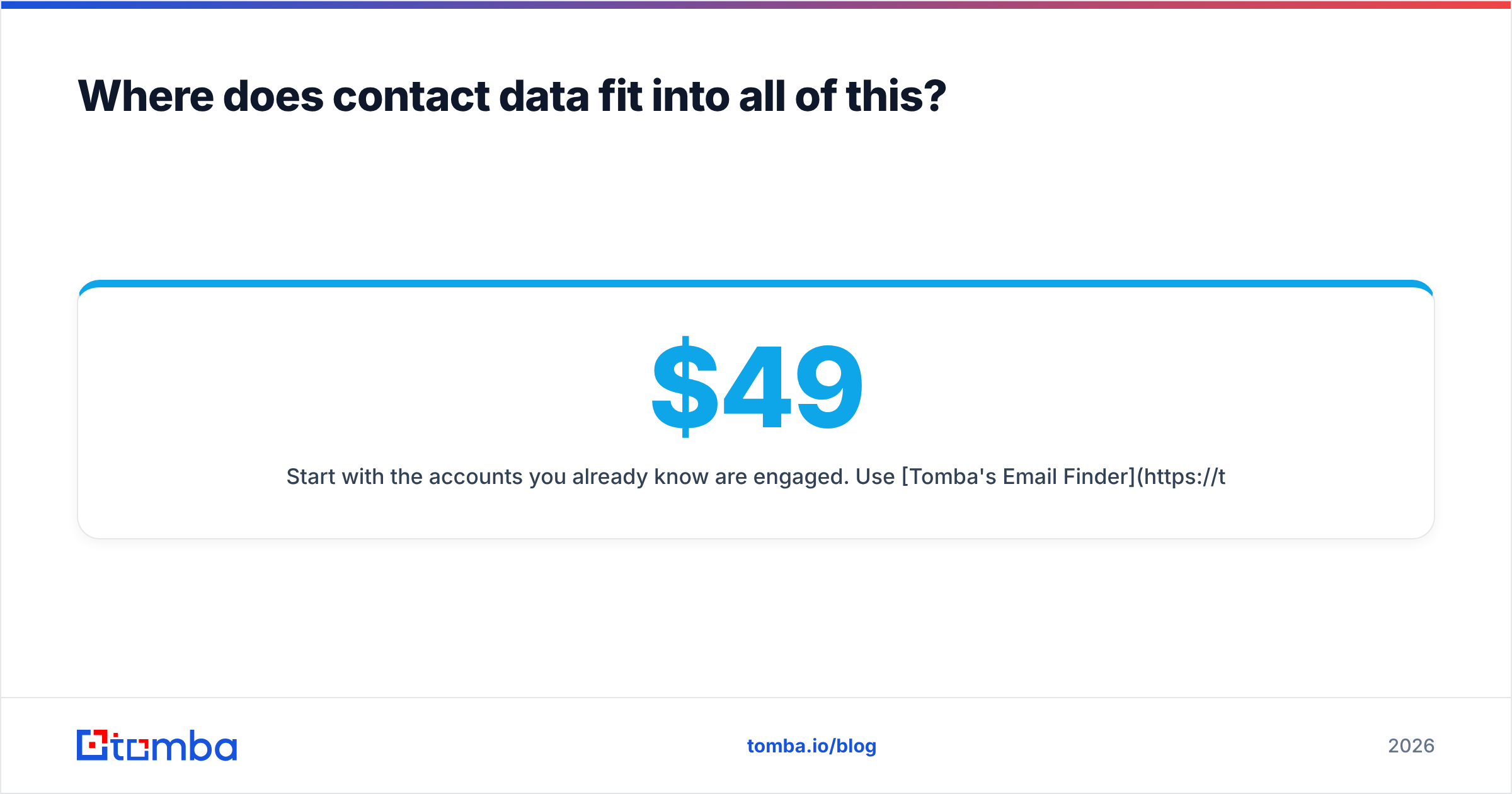
Start with the accounts you already know are engaged. Use Tomba's Email Finder to turn each domain into named contacts with verified professional addresses, filter by the roles that match your ICP, and push them into the sequence that references the creation touch. The free tier gives you 25 searches a month to test the motion on a handful of accounts before committing; paid plans start at $49/mo, with Tomba pricing scaling to Growth at $99/mo and Pro at $249/mo when the volume justifies it. Prove the handoff works on twenty accounts, then scale it — that sequencing is what turns the double funnel from a slide into a pipeline number.
Related guides#
Ready to find emails that actually work?
Join 150,000+ professionals who stopped guessing and started sending. Free credits on signup — no credit card required.
Get the Tomba newsletter
Practical outbound tactics and product updates — once every two weeks.
About the author