9 Best Dreamdata Alternatives in 2026 for B2B Attribution
Dreamdata is strong B2B attribution software, but the pricing, data-model rigidity, and setup effort push plenty of teams to look elsewhere. Here are nine alternatives ranked by who they actually fit.
TL;DR
- Dreamdata is a legitimately good B2B revenue attribution platform — the complaints are about cost, contract length, and how much CRM hygiene it demands before the dashboards mean anything.
- If you want the same account-level attribution with more flexibility, look at HockeyStack, Factors.ai, and Attribution.
- If your real problem is "our pipeline data is a mess," a warehouse-native setup (Snowflake + dbt + Hightouch) or a cheaper mid-market tool beats buying a second dashboard.
- Self-serve and budget-conscious teams should shortlist Attribution, Ruler Analytics, and Factors.ai before committing to an annual contract.
- Attribution only works if the contact and company records feeding it are accurate — enrichment and email hygiene are upstream prerequisites, not afterthoughts.
What is Dreamdata and what does it actually do?#
Dreamdata is a B2B revenue attribution platform. It pulls data from your CRM, ad platforms, website, product, and marketing automation, stitches anonymous website sessions to known contacts, rolls those contacts up to accounts, and then assigns revenue credit across every touchpoint in the buying journey.
The core promise is account-level attribution. In B2B, five to twelve people from one company touch your marketing before a deal closes, and lead-level attribution tools built for e-commerce fall apart on that shape of data. Dreamdata was built specifically for it, and it does the account rollup well.
The stack looks roughly like this:
- Ingestion — connectors for HubSpot, Salesforce, Google Ads, LinkedIn Ads, Meta, Segment, and a JavaScript tracker on your site.
- Identity resolution — anonymous sessions get matched to known contacts via form fills, email clicks, and IP-based company identification.
- Account modeling — contacts group into accounts; accounts map to CRM opportunities.
- Attribution — first-touch, last-touch, linear, U-shaped, W-shaped, and a data-driven model split credit across the journey.
- Activation — audiences and revenue-weighted signals push back into ad platforms and your CRM.
That's a genuinely hard pipeline to build in-house. So why do teams shop for alternatives?
Why do teams look for Dreamdata alternatives?#
Five reasons come up repeatedly in G2 reviews and RevOps communities:
Price relative to company stage. Dreamdata's paid tiers start in the low four figures per month and scale with tracked accounts and data volume. For a Series A company with $2M ARR, that's a meaningful line item against a marketing budget that might be $40k/month total.
Annual contracts. Most serious attribution vendors sell annually. If you're not certain attribution is the problem you need to solve this year, a twelve-month commitment is a big bet.
Garbage-in reality. Attribution software cannot fix broken CRM data. If your opportunities have no close dates, your contacts have no company associations, and half your leads have bounced email addresses, Dreamdata will faithfully model garbage. Teams buy the tool expecting clarity and get a very expensive mirror.
Model rigidity. The attribution models are configurable but not arbitrary. Teams with unusual sales motions — PLG with a sales-assist overlay, channel partnerships, multi-product cross-sell — sometimes find the account model doesn't bend the way they need.
Overlap with what they already own. If you already run Snowflake or BigQuery with a dbt layer, a chunk of Dreamdata's value is pipeline work you've partly done. Some teams would rather finish it than pay a vendor for it.

What are the best Dreamdata alternatives in 2026?#
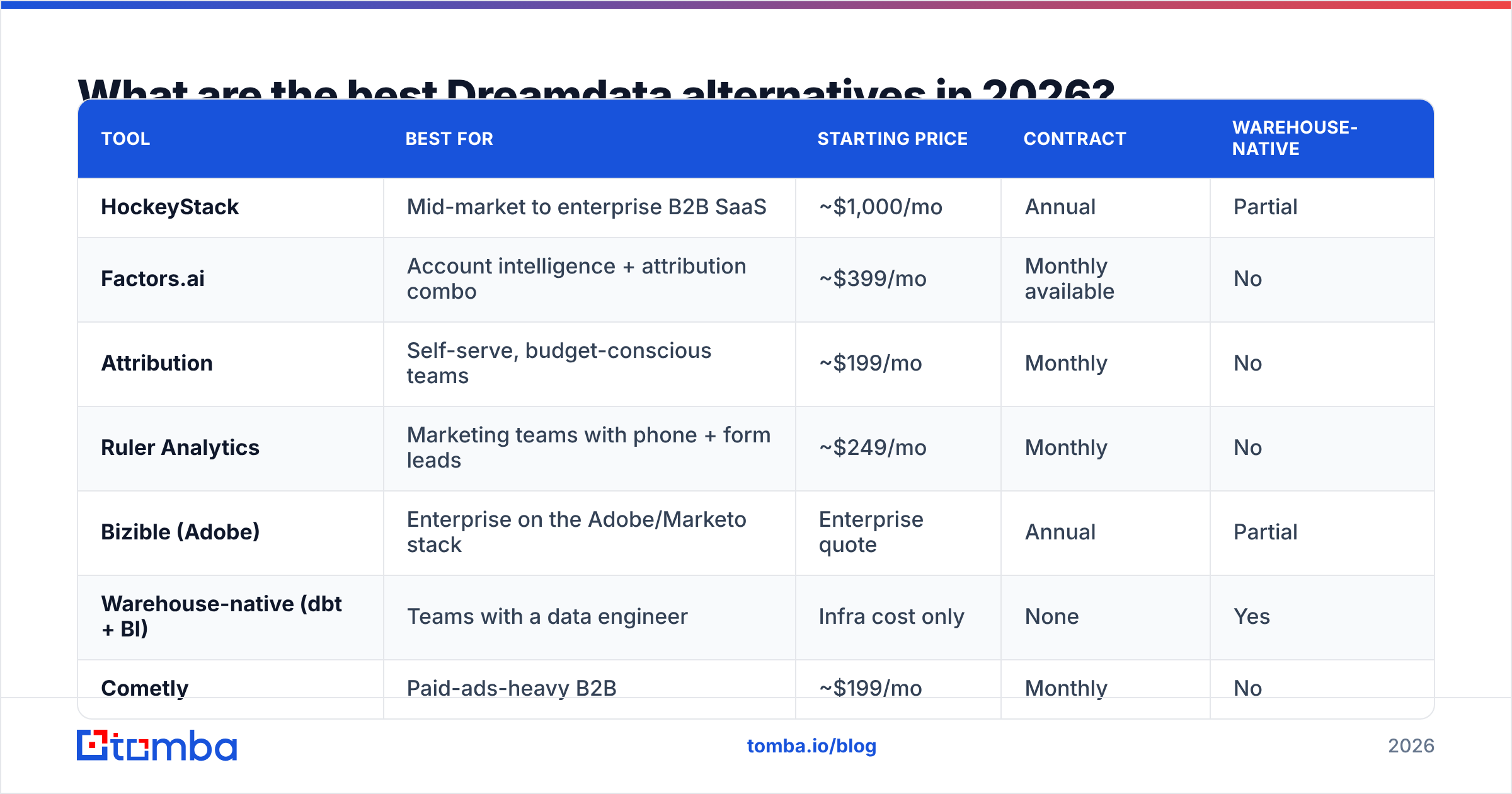
Here's the shortlist, then the detail on each.
| Tool | Best for | Starting price | Contract | Warehouse-native |
|---|---|---|---|---|
| HockeyStack | Mid-market to enterprise B2B SaaS | ~$1,000/mo | Annual | Partial |
| Factors.ai | Account intelligence + attribution combo | ~$399/mo | Monthly available | No |
| Attribution | Self-serve, budget-conscious teams | ~$199/mo | Monthly | No |
| Ruler Analytics | Marketing teams with phone + form leads | ~$249/mo | Monthly | No |
| Bizible (Adobe) | Enterprise on the Adobe/Marketo stack | Enterprise quote | Annual | Partial |
| Warehouse-native (dbt + BI) | Teams with a data engineer | Infra cost only | None | Yes |
| Cometly | Paid-ads-heavy B2B | ~$199/mo | Monthly | No |
| Usermaven | Product-led SaaS | ~$49/mo | Monthly | No |
| Northbeam | Hybrid B2B/B2C with heavy paid spend | ~$1,000/mo | Annual | Partial |
HockeyStack#
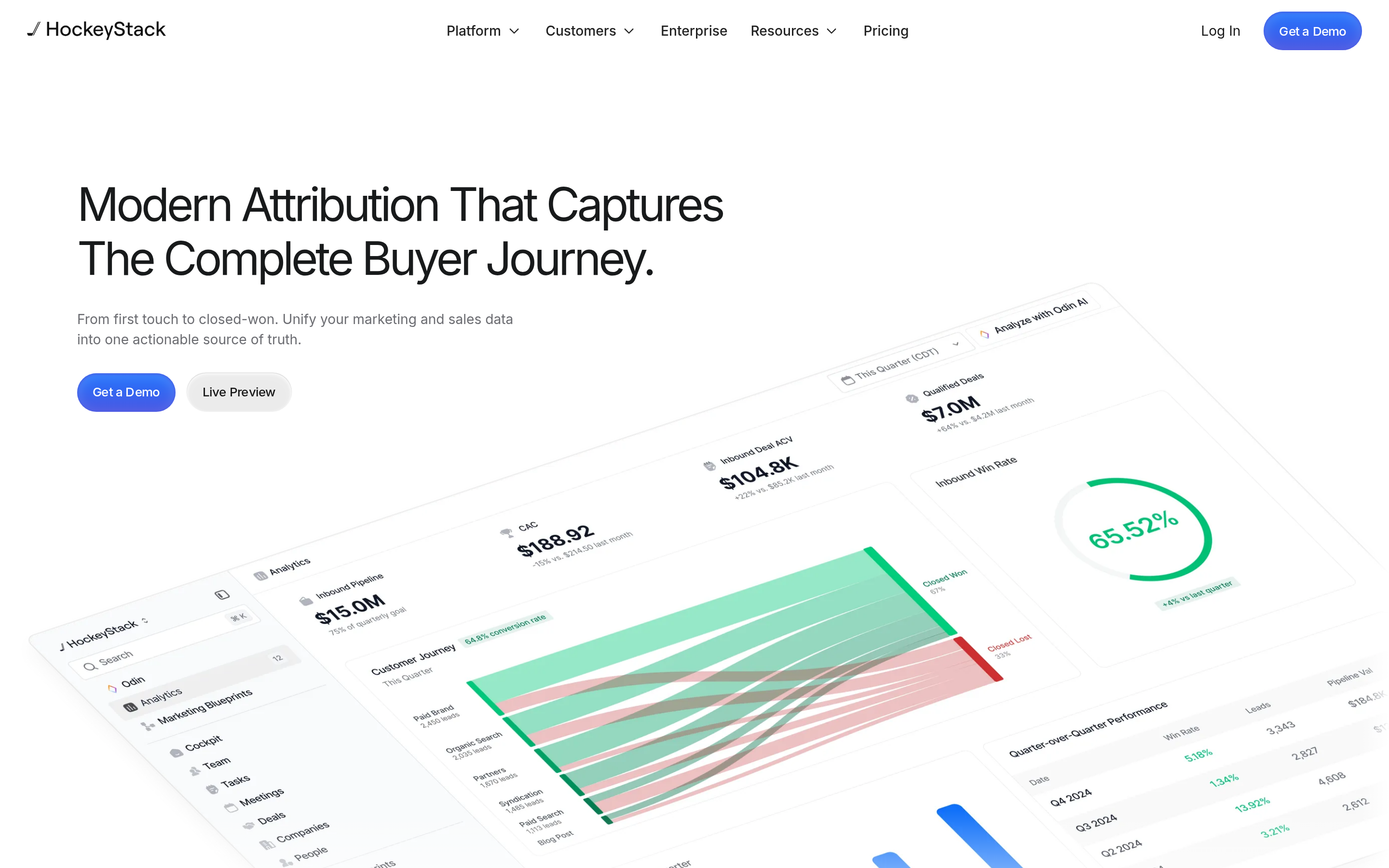
The closest head-to-head competitor. HockeyStack does B2B account-level attribution with a stronger emphasis on the full-funnel view — it pulls in product usage, sales activity from Gong or Outreach, and marketing touches into one timeline per account. Its "Odin" AI layer generates narrative insights rather than making you build the dashboard yourself.
Pick it over Dreamdata if you want more out-of-the-box analysis and less dashboard construction. Expect similar pricing and a similar annual commitment.
Factors.ai#
Factors bundles attribution with account identification — it tells you which companies are visiting your site and how those visits contributed to pipeline. If you were also evaluating a separate intent tool, this collapses two line items into one.
The attribution modeling is less deep than Dreamdata's. But for teams whose real question is "which accounts are in-market and what did we do to influence them," the trade is often worth it.
Attribution (attributionapp.com)#
The budget pick that still does real multi-touch modeling. Self-serve signup, monthly billing, and a UI simple enough that a marketing manager can own it without a RevOps hire. It's weaker on account rollup and on B2B-specific journey stitching than Dreamdata.
Good fit: seed to Series A, $50k–$150k/mo ad spend, one marketer who needs to defend channel budget.
Ruler Analytics#
Ruler's differentiator is offline conversion tracking — phone calls, live chat, and form fills all get tied back to the original session and pushed into your CRM and ad platforms. If a meaningful share of your pipeline starts with someone calling a number on your site, most attribution tools lose that thread and Ruler doesn't.
Bizible / Adobe Marketo Measure#
The enterprise incumbent. If you're already on Marketo and the broader Adobe stack, Measure is the path of least resistance and your data team probably already has the connectors. It's expensive, it's slow to implement, and the UI shows its age — but it's proven at scale and procurement will not fight you.
The warehouse-native build#
Snowflake or BigQuery for storage, Fivetran or Airbyte for ingestion, dbt for modeling, Hightouch for reverse ETL, and Looker or Metabase for the visualization layer. You own the attribution logic completely, and it costs infrastructure dollars rather than SaaS dollars.
The catch is real: you need at least one analytics engineer who will treat this as an ongoing product, not a one-time project. Identity resolution alone — the anonymous-to-known stitching Dreamdata does for you — is a multi-month problem. Budget six months to parity.
Cometly, Usermaven, Northbeam#
Three narrower picks. Cometly is built around paid ad attribution with server-side conversion APIs, which matters as browser tracking degrades. Usermaven is product analytics with attribution attached, best for PLG motions where the signup is the conversion. Northbeam came from DTC and has the strongest media-mix modeling of the group — relevant if you're spending seven figures a year on ads and want incrementality, not just credit assignment.
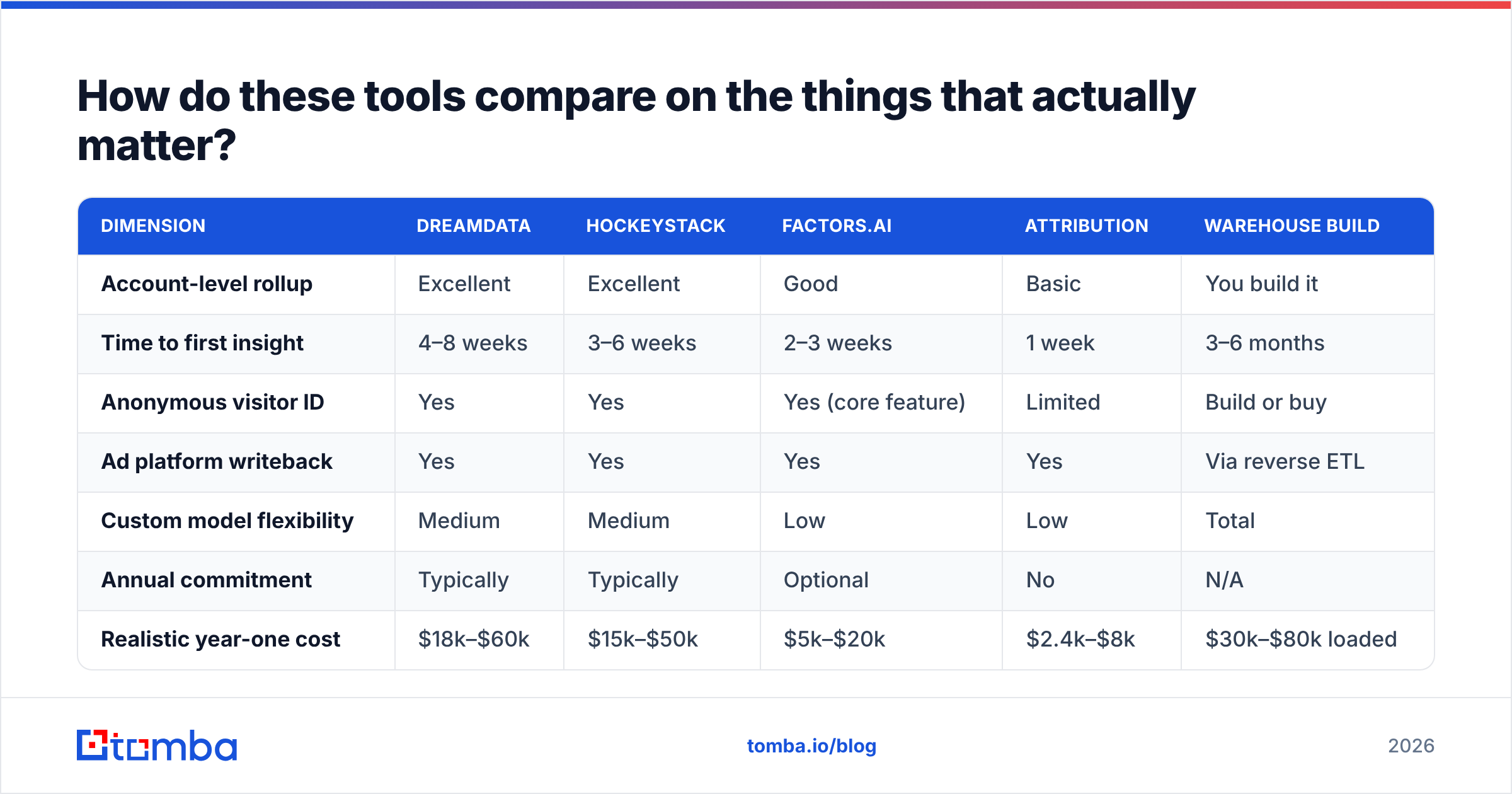
How do these tools compare on the things that actually matter?#
Feature lists don't decide this. Four dimensions do.
| Dimension | Dreamdata | HockeyStack | Factors.ai | Attribution | Warehouse build |
|---|---|---|---|---|---|
| Account-level rollup | Excellent | Excellent | Good | Basic | You build it |
| Time to first insight | 4–8 weeks | 3–6 weeks | 2–3 weeks | 1 week | 3–6 months |
| Anonymous visitor ID | Yes | Yes | Yes (core feature) | Limited | Build or buy |
| Ad platform writeback | Yes | Yes | Yes | Yes | Via reverse ETL |
| Custom model flexibility | Medium | Medium | Low | Low | Total |
| Annual commitment | Typically | Typically | Optional | No | N/A |
| Realistic year-one cost | $18k–$60k | $15k–$50k | $5k–$20k | $2.4k–$8k | $30k–$80k loaded |
Note the last row. The warehouse build is not free — a fully loaded analytics engineer plus infrastructure usually costs more in year one than the SaaS tool you were trying to avoid. It wins on year three, when the pipeline serves ten use cases instead of one.
Four questions that narrow the list fast:
- Do you have a data engineer with spare capacity? No means buy, not build. This isn't close.
- Is your ACV above $25k? Below that, the buying journey is short enough that simple first-touch/last-touch modeling in your CRM gets you 80% of the answer.
- Does anonymous traffic matter to your funnel? If most pipeline comes from outbound and referrals, you're paying for identity resolution you won't use.
- Can you name the decision this data will change? "Cut LinkedIn spend or double it" is a decision. "Understand our funnel better" is not, and no tool fixes that.
Why does attribution break before the software even runs?#
Because attribution is a data-quality problem wearing an analytics costume.
Every one of these tools joins on the same fragile keys: email address, company domain, and CRM record ID. When those keys are wrong, the model is wrong, and the dashboard doesn't tell you that — it just shows you a confident number.
The three failure modes, in order of how often they show up:
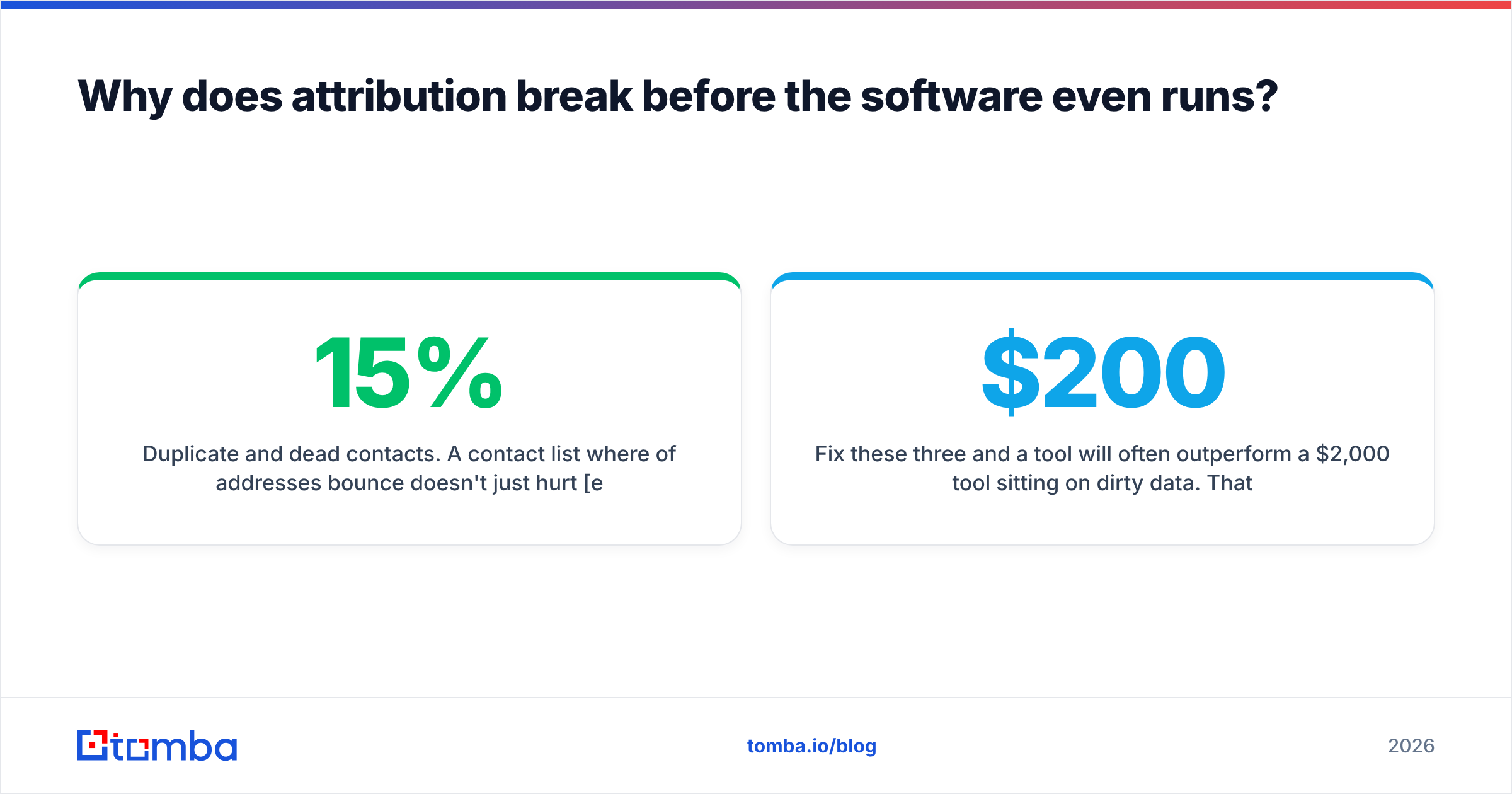
Duplicate and dead contacts. A contact list where 15% of addresses bounce doesn't just hurt email deliverability — it fragments the account rollup. Two records for the same buyer means two journeys, each with half the touchpoints, neither of which reflects reality. Running your list through an email verifier before it hits the CRM removes a whole class of attribution noise.
Missing company associations. Free-mail addresses (gmail.com, outlook.com) can't be matched to a company domain, so those contacts never join an account. In some CRMs, a third of contacts have no company link at all. Contact enrichment that appends the work domain, job title, and company data fixes the join key at the source.
Ungoverned form fields. If your demo form lets people type their company name freely, you get "Acme", "Acme Inc", "Acme Inc.", and "acme" as four separate accounts. Domain-based identification instead of self-reported company names solves this permanently.
Fix these three and a $200/month tool will often outperform a $2,000/month tool sitting on dirty data. That's the uncomfortable version of the advice, and it's the one most RevOps leads confirm after their second attribution implementation.

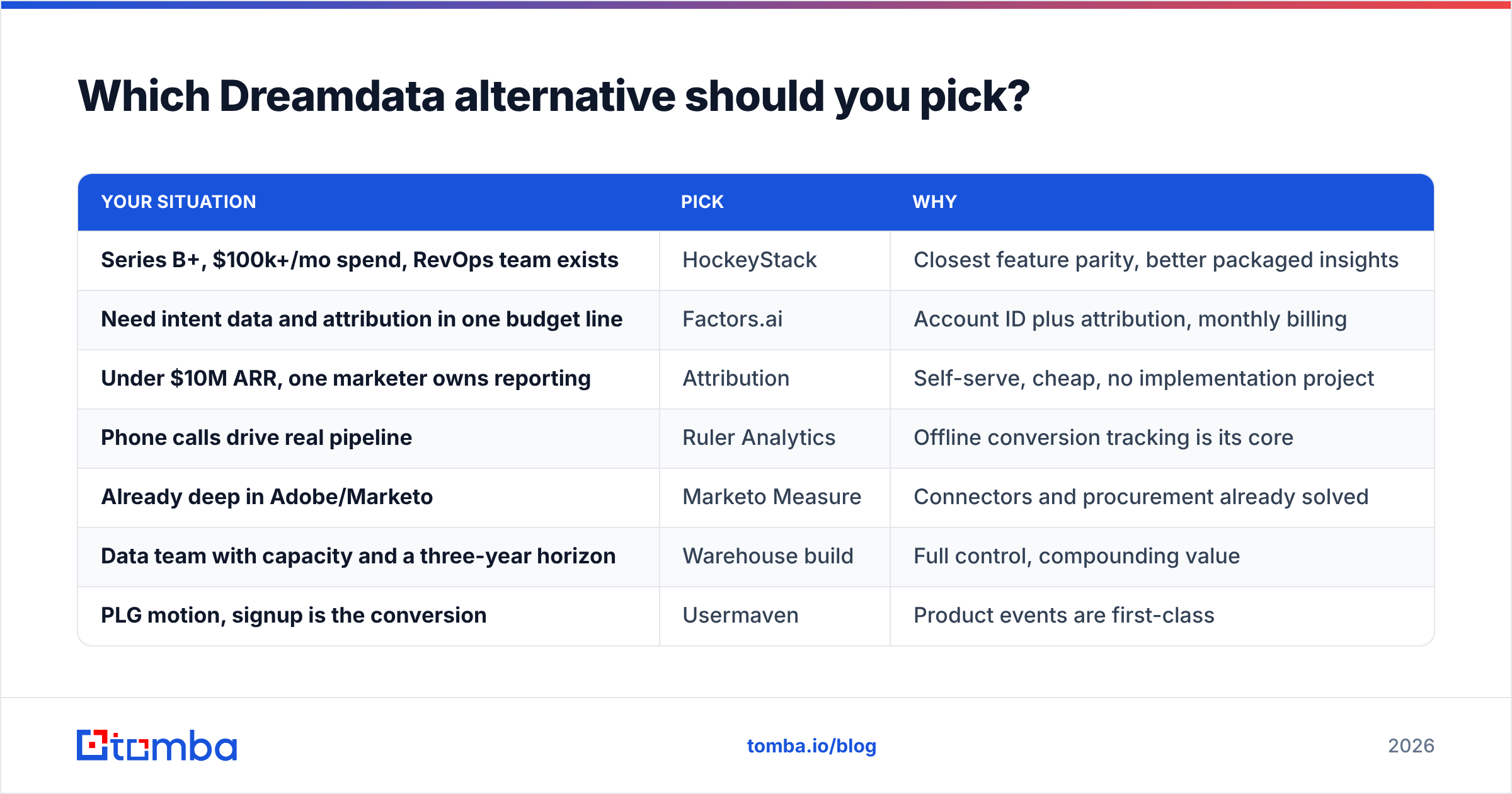
Which Dreamdata alternative should you pick?#
Match the tool to your situation rather than to the feature matrix.
| Your situation | Pick | Why |
|---|---|---|
| Series B+, $100k+/mo spend, RevOps team exists | HockeyStack | Closest feature parity, better packaged insights |
| Need intent data and attribution in one budget line | Factors.ai | Account ID plus attribution, monthly billing |
| Under $10M ARR, one marketer owns reporting | Attribution | Self-serve, cheap, no implementation project |
| Phone calls drive real pipeline | Ruler Analytics | Offline conversion tracking is its core |
| Already deep in Adobe/Marketo | Marketo Measure | Connectors and procurement already solved |
| Data team with capacity and a three-year horizon | Warehouse build | Full control, compounding value |
| PLG motion, signup is the conversion | Usermaven | Product events are first-class |
| Your CRM data is genuinely dirty | Fix data first | No tool survives bad join keys |
One more consideration: exit cost. Warehouse-native setups keep your modeled data in your own storage. SaaS attribution tools generally don't hand back their identity graph when you leave, so a switch two years from now means rebuilding history. If you expect to change vendors, weight that.
What should you check before you sign anything?#
Run this before the contract, not after.
- Ask for a data audit during the trial. Any decent vendor will tell you what percentage of your CRM opportunities they can actually model. If it's under 70%, the problem is your data.
- Test the identity match rate on your own traffic. Vendors quote match rates from their best customers. Yours will be lower. Ask for the number on your pixel data.
- Confirm the ad platform writeback works with your ad accounts. LinkedIn's conversion API and Google's offline conversion imports have real constraints. Get it demoed live.
- Check the CRM sync direction. Some tools read from your CRM only; some write attribution fields back. The second is what lets sales see it, and sales visibility is usually what makes the tool stick.
- Get pricing at 2x your current volume. Attribution pricing scales with tracked accounts. Know what year two costs before you sign year one.
Compare vendors on the Capterra marketing attribution category as a sanity check on pricing claims, and read the vendor's own docs on identity resolution — Dreamdata's documentation is unusually transparent about its methodology, which is a fair benchmark to hold competitors to.
Fix the inputs before you buy the dashboard#
Every attribution platform on this list runs on the same fuel: accurate contact records tied to the right company domain. If that layer is broken, you're buying a very expensive way to be confidently wrong.
Start upstream. Use the Tomba Email Finder to build clean, verified contact records with the correct work domain attached from the start — so contacts roll up to the right accounts, opportunities join to the right companies, and whichever attribution tool you pick has something real to model. Pair it with domain search to map every relevant contact at a target account, and check Tomba pricing — the free tier covers 25 searches a month, and Starter is $49/mo if you want to test the workflow before scaling it.
Clean data first. Attribution second. That order is not negotiable.
Related guides#
Ready to find emails that actually work?
Join 150,000+ professionals who stopped guessing and started sending. Free credits on signup — no credit card required.
Get the Tomba newsletter
Practical outbound tactics and product updates — once every two weeks.
About the author