Drift vs HubSpot 2026: Which Conversational Sales Tool Wins?
Drift is a conversation-first buyer engagement layer. HubSpot is a full CRM suite with chat attached. Here is the honest breakdown of pricing, data, and which one actually fits your pipeline in 2026.
TL;DR
- Drift (now part of Salesloft) is a conversation layer: chatbots, live chat, conversational landing pages, and buyer intent routing. It does not replace your CRM.
- HubSpot is a full CRM suite — contacts, deals, marketing email, ticketing — with chat and chatflows bundled into Sales Hub and Service Hub.
- If your website already generates meaningful traffic and you need to route hot visitors to reps in under 60 seconds, Drift is the sharper instrument. If you need one system of record, HubSpot wins on TCO.
- Pricing is the real dividing line: HubSpot's chat is included at $0 on the free tier, while Drift's conversational stack has historically started in the four-figures-per-month range with annual contracts.
- Neither tool sources contact data. Both depend on inbound traffic or a separate enrichment layer to fill the top of your pipeline.
Drift and HubSpot get compared constantly, and it's a slightly unfair fight — like comparing an espresso machine to a full restaurant kitchen. Both make coffee. Only one of them also serves dinner. This post breaks down where each tool genuinely wins, what the pricing actually looks like once you're two years in, and where the "conversational marketing" pitch quietly runs out of road.
What is Drift and what problem does it actually solve?#
Drift built its name on a single premise: the B2B lead form is a conversion killer. Instead of making a visitor fill in seven fields and wait three days for a rep to email back, Drift puts a chat widget on the page that qualifies the visitor in real time and books a meeting straight into a rep's calendar.
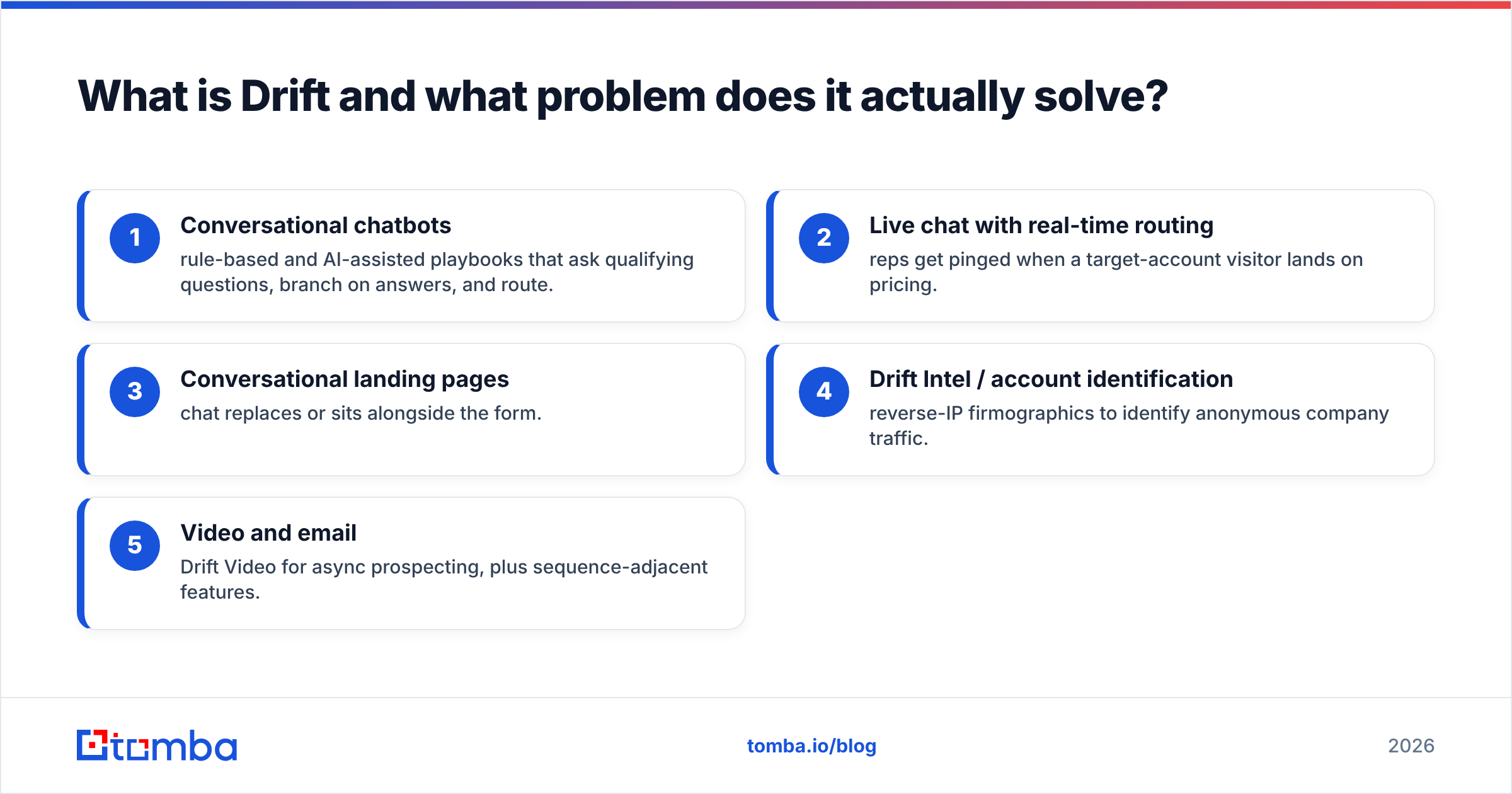
The product stack breaks into a few pieces:
- Conversational chatbots — rule-based and AI-assisted playbooks that ask qualifying questions, branch on answers, and route.
- Live chat with real-time routing — reps get pinged when a target-account visitor lands on pricing.
- Conversational landing pages — chat replaces or sits alongside the form.
- Drift Intel / account identification — reverse-IP firmographics to identify anonymous company traffic.
- Video and email — Drift Video for async prospecting, plus sequence-adjacent features.
Drift was acquired by Salesloft in 2024, which folded the conversation layer into a broader revenue-orchestration platform. Practically, this means Drift is now more likely to be sold to you as part of a Salesloft bundle than as a standalone SKU. Check the current Drift product pages before assuming legacy pricing still holds.
The honest framing: Drift is demand capture, not demand generation. It converts traffic you already have. If 400 people visit your site a month, a conversational layer will not save you.
What does HubSpot bring that Drift doesn't?#
HubSpot is a CRM first. Chat is a feature inside it, not the product. That single architectural fact explains most of the differences.
With HubSpot you get:
- A real CRM — contacts, companies, deals, pipelines, custom objects on higher tiers.
- Chatflows and live chat — included even on the free tier, with a HubSpot-branded widget.
- Marketing Hub — email campaigns, landing pages, forms, workflows.
- Service Hub — tickets, knowledge base, shared inbox.
- Reporting across the whole funnel — because the data never leaves the system.
HubSpot's chatbot builder is less sophisticated than Drift's playbooks. It handles branching logic, meeting links, and ticket creation well. It is weaker at intent-scored routing and account-based personalization — the things Drift optimized for over years of singular focus.
The trade is straightforward. HubSpot's chat is 70% as good and costs nothing extra. Drift's chat is best-in-class and costs a line item that a CFO will ask about.
For a broader view of how vendors position, G2's live chat category is a reasonable neutral read on where each sits in buyer sentiment.
Drift vs HubSpot: how do they compare feature by feature?#
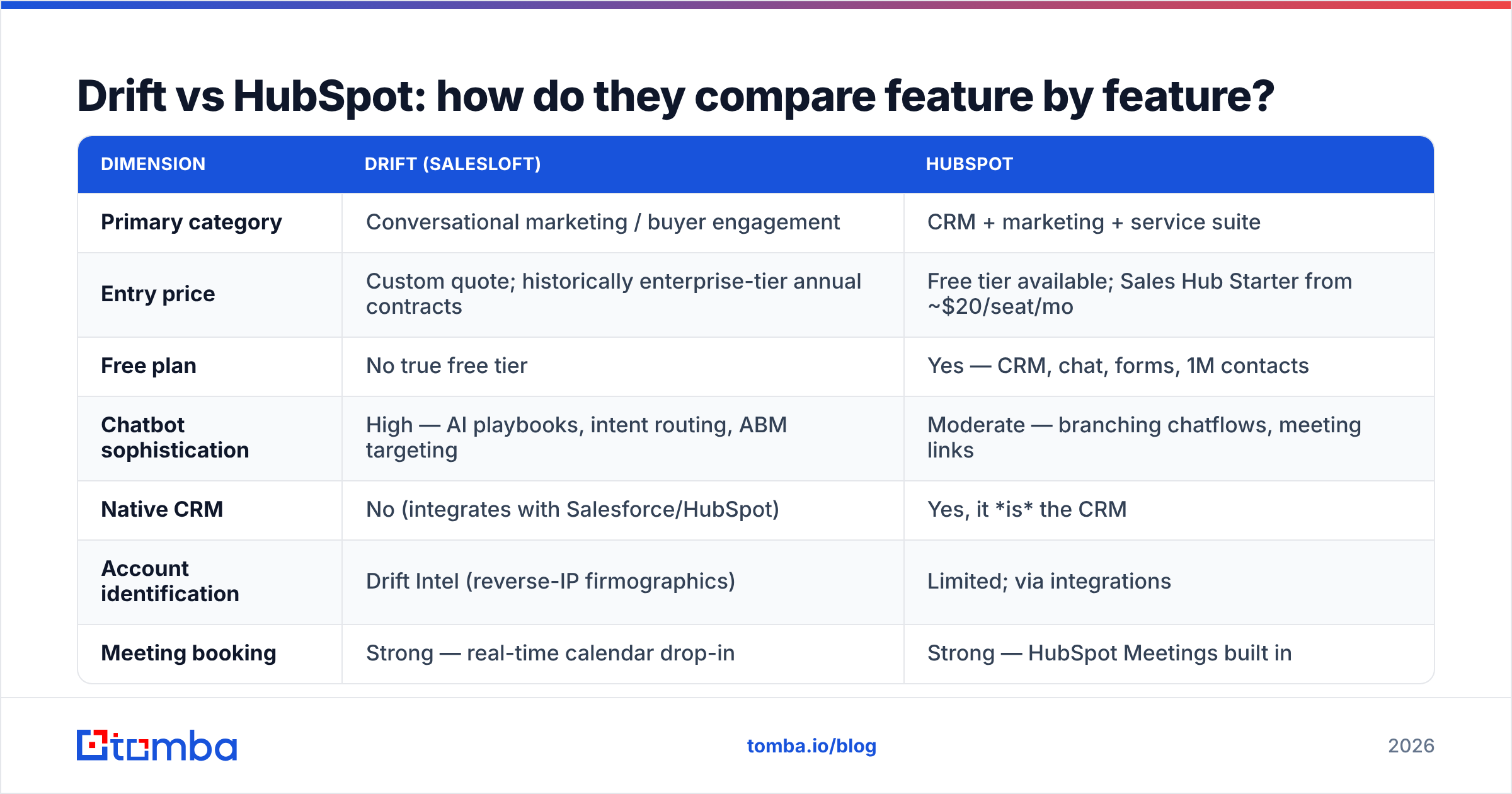
| Dimension | Drift (Salesloft) | HubSpot |
|---|---|---|
| Primary category | Conversational marketing / buyer engagement | CRM + marketing + service suite |
| Entry price | Custom quote; historically enterprise-tier annual contracts | Free tier available; Sales Hub Starter from ~$20/seat/mo |
| Free plan | No true free tier | Yes — CRM, chat, forms, 1M contacts |
| Chatbot sophistication | High — AI playbooks, intent routing, ABM targeting | Moderate — branching chatflows, meeting links |
| Native CRM | No (integrates with Salesforce/HubSpot) | Yes, it is the CRM |
| Account identification | Drift Intel (reverse-IP firmographics) | Limited; via integrations |
| Meeting booking | Strong — real-time calendar drop-in | Strong — HubSpot Meetings built in |
| Email marketing | Limited | Full Marketing Hub |
| Contract terms | Annual, sales-led | Monthly or annual, self-serve available |
| Best for | 50k+ monthly visitors, ABM motions, enterprise deals | Teams wanting one system of record |
| Biggest complaint | Cost relative to volume of chats | Chat depth; per-seat costs escalate |
The table hides one thing worth saying out loud: these are not mutually exclusive. A large share of Drift customers run HubSpot as the CRM underneath. The real question is rarely "which one" — it's "do I need the specialist layer on top of the suite I already pay for?"
Which one is cheaper once you account for hidden costs?#
HubSpot, in almost every scenario under 100 employees. But the sticker price is not the whole story for either vendor.
HubSpot's cost creep comes from three places. First, seats — Sales Hub and Service Hub charge per paid seat, and it multiplies fast. Second, the marketing contact tiers — your Marketing Hub bill scales with how many contacts you're actively marketing to, so a bloated database is literally an invoice. Third, onboarding fees on Professional and Enterprise, which are one-time but not small.
Drift's cost creep comes from conversation volume and seat count, plus the fact that Drift Intel and advanced ABM features have typically sat in higher packages. Because it's a sales-led annual contract, the negotiated number varies wildly between two companies of the same size. Ask for the renewal uplift clause in writing.
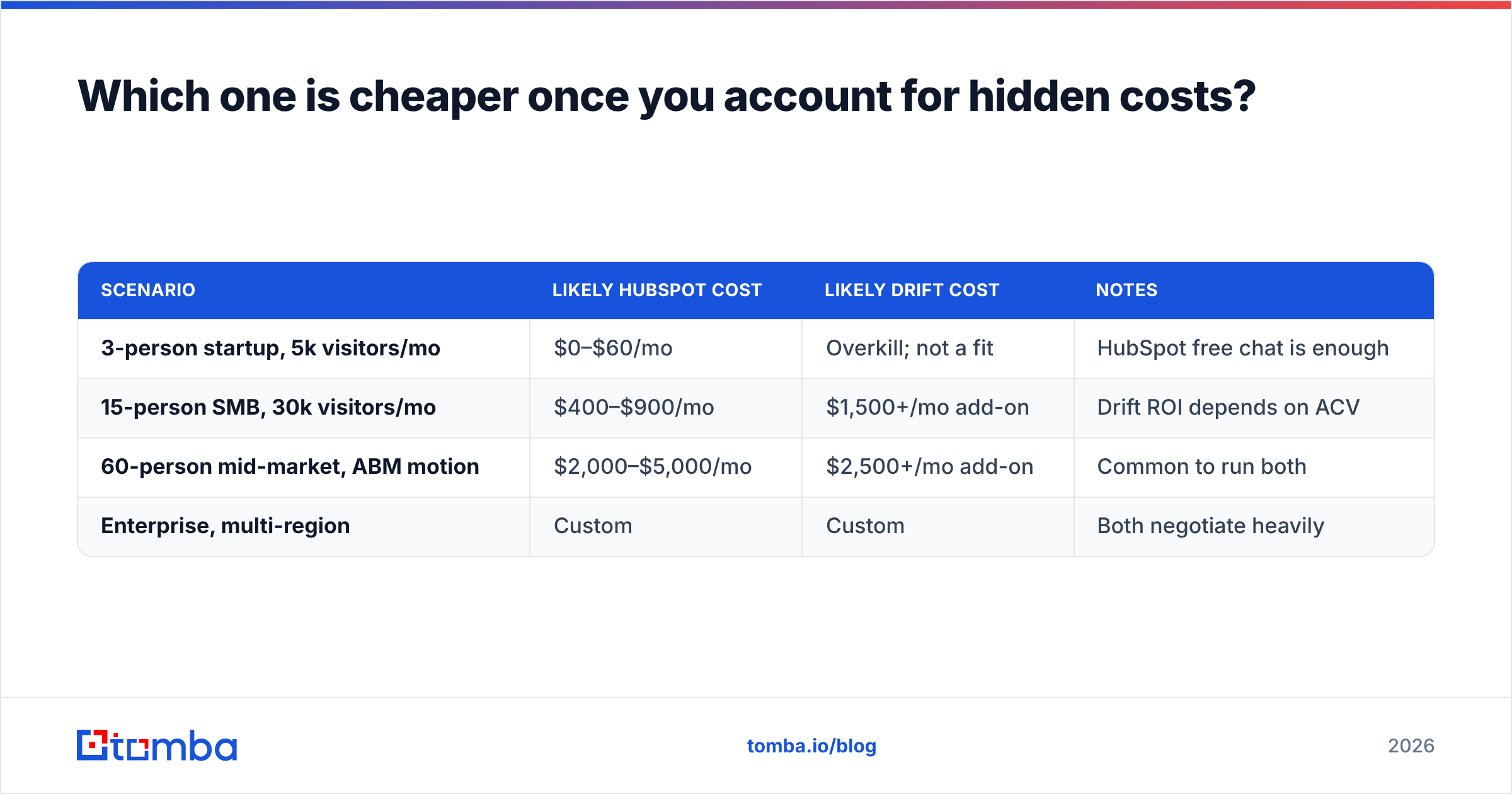
Here's the practical budgeting comparison:
| Scenario | Likely HubSpot cost | Likely Drift cost | Notes |
|---|---|---|---|
| 3-person startup, 5k visitors/mo | $0–$60/mo | Overkill; not a fit | HubSpot free chat is enough |
| 15-person SMB, 30k visitors/mo | $400–$900/mo | $1,500+/mo add-on | Drift ROI depends on ACV |
| 60-person mid-market, ABM motion | $2,000–$5,000/mo | $2,500+/mo add-on | Common to run both |
| Enterprise, multi-region | Custom | Custom | Both negotiate heavily |
Treat these as ranges to anchor a negotiation, not quotes. Both vendors discount, and both publish list pricing that few customers actually pay. HubSpot's public pricing page is the reliable starting point; Drift's requires a conversation with sales.
Is conversational marketing still worth it in 2026?#
Yes, but the ROI window has narrowed, and the reason is uncomfortable: buyers got tired of chatbots.
Three things changed since the category peaked:
- Bot fatigue is real. A widget that opens unprompted with "Hi! 👋 How can I help?" now reads as noise to a large chunk of B2B buyers. The playbooks that win are the ones triggered by specific, high-intent behavior — someone on the pricing page for their third visit — not a blanket greeting.
- AI assistants raised the floor. Generic LLM chat is now cheap. The moat is no longer "we have a bot"; it's the routing, the intent data, and the CRM write-back quality.
- Traffic got more expensive. Paid CPCs kept climbing, which means fewer teams have the volume to justify a conversation layer as a standalone spend.
The teams still getting strong returns from Drift share a profile: high-ticket ACV (typically $25k+), meaningful organic or paid traffic, and a sales team that can respond within minutes during business hours. If a chat sits unanswered for 40 minutes, you've bought an expensive contact form.
What neither Drift nor HubSpot solves for you?#
Neither tool fills the top of your funnel with contacts. This is the gap that surprises teams six months in.
Drift converts visitors who already found you. HubSpot stores and nurtures contacts who already opted in. If your addressable market is 4,000 companies and 60 of them visit your site this quarter, both tools are optimizing the wrong 1.5%.
That's where outbound data sits, and it's a completely separate purchase:
- Finding contacts at target accounts. A domain search pulls every discoverable role-based and named email at a company, which is how you build a list of the 3,940 accounts that haven't visited yet.
- Verifying before you send. Bounces above 3% start damaging email deliverability, which then quietly suppresses the HubSpot marketing emails you're paying for. Running the list through an email verifier first is basic hygiene.
- Enriching what's already in the CRM. Half-filled HubSpot records — no phone, no title, no company size — break your routing rules and your lead scoring. Contact enrichment fills them.
- Reversing the anonymous traffic Drift Intel flags. Drift can tell you Acme Corp visited. It can't always hand you the VP of Ops' email at Acme. A reverse email lookup or a domain-level search closes that loop.

The pattern to notice: chat tools and CRMs both assume the contact already exists. Data tools create the contact. Budgeting for one while ignoring the other is why pipelines stall in month four.
Which should you choose for your team?#
Pick based on where your bottleneck actually is.
Choose HubSpot if:
- You don't have a CRM yet, or you're on spreadsheets and regret.
- Your monthly traffic is under ~20,000 visitors.
- You want marketing email, forms, chat, and deals in one bill.
- Your team is under 30 people and you value setup speed over depth.
Choose Drift if:
- You already have a CRM (Salesforce or HubSpot) and it's working.
- Traffic is meaningful and your ACV justifies a five-figure annual add-on.
- You run account-based marketing and need target-account visitors routed instantly.
- Your reps can genuinely respond in real time.
Run both if:
- HubSpot is your system of record and Drift is the conversion layer on high-intent pages only. This is the most common mature setup, and it works — as long as you've mapped the field sync carefully, because duplicate contact creation between the two is the most reported integration headache.
Choose neither, for now, if:
- Your problem is that not enough of the right people know you exist. In that case the money belongs in outbound data and sequencing, not in a widget that converts traffic you don't have yet.
How do you make the pilot actually prove something?#
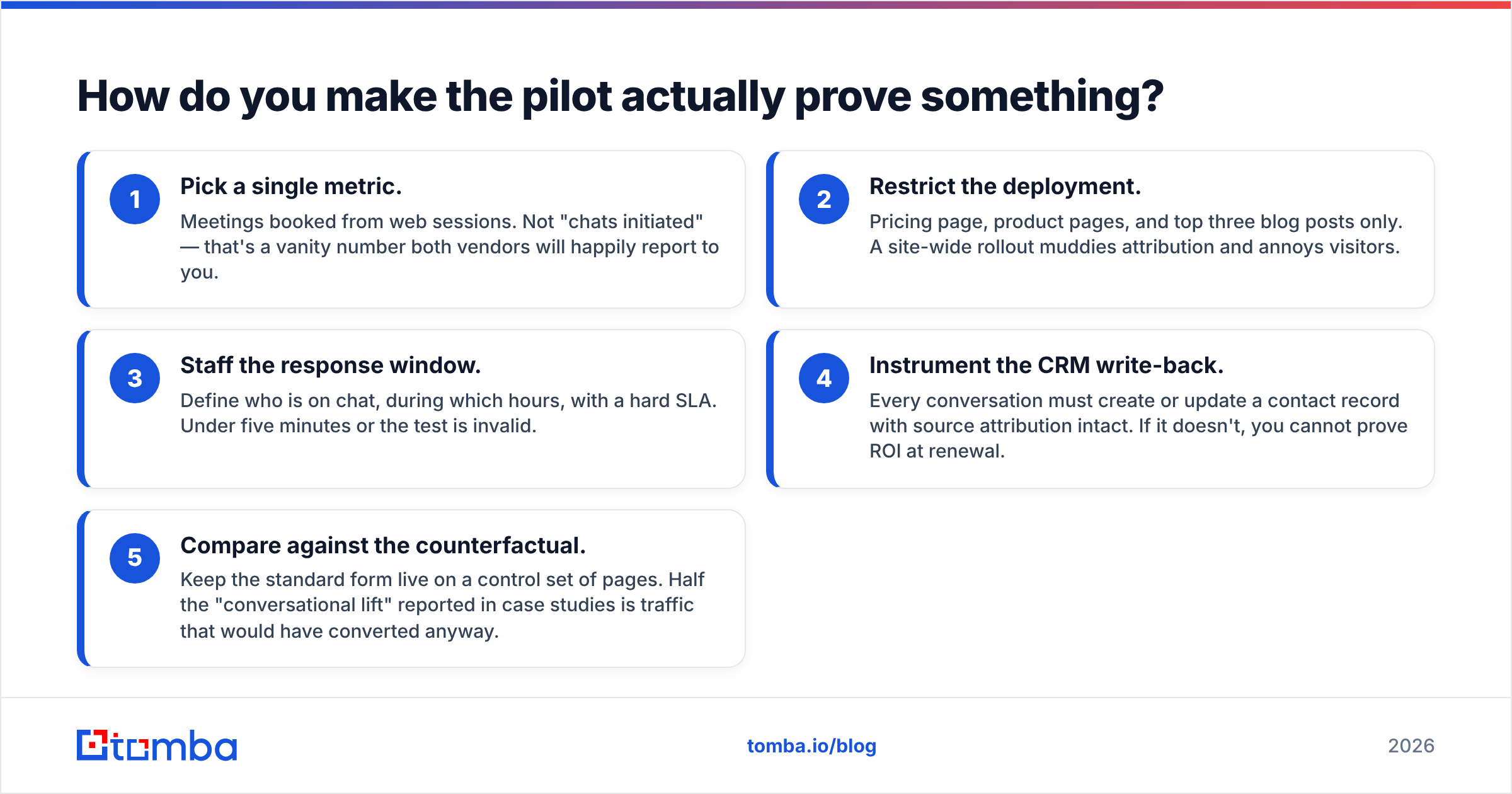
Run a 60-day test with one number defined before you start.
- Pick a single metric. Meetings booked from web sessions. Not "chats initiated" — that's a vanity number both vendors will happily report to you.
- Restrict the deployment. Pricing page, product pages, and top three blog posts only. A site-wide rollout muddies attribution and annoys visitors.
- Staff the response window. Define who is on chat, during which hours, with a hard SLA. Under five minutes or the test is invalid.
- Instrument the CRM write-back. Every conversation must create or update a contact record with source attribution intact. If it doesn't, you cannot prove ROI at renewal.
- Compare against the counterfactual. Keep the standard form live on a control set of pages. Half the "conversational lift" reported in case studies is traffic that would have converted anyway.
If the pilot produces fewer than 10 qualified meetings in 60 days, the specialist layer isn't your constraint — your pipeline volume is. Check Tomba pricing against what a Drift contract would cost and reallocate accordingly; at $49/mo for the Starter plan versus a four-figure monthly add-on, the math on testing outbound first is not subtle.
Fill the pipeline these tools assume you already have#
Drift and HubSpot are both good at what they do. Neither one creates a prospect out of thin air — they convert and organize demand that already exists. If your bottleneck is the number of qualified companies in your list rather than the conversion rate on the ones who show up, start upstream.
The Tomba Email Finder gives you verified, deliverable contacts at the accounts you actually want, by domain, name, or company. Start free with 25 searches a month, push the results into HubSpot, and let Drift convert the traffic that follows. The order matters: build the list, verify it, then spend on the conversation layer.
Sources: HubSpot Pricing, Salesloft (Drift), G2 Live Chat Category
Related guides#
Ready to find emails that actually work?
Join 150,000+ professionals who stopped guessing and started sending. Free credits on signup — no credit card required.
Get the Tomba newsletter
Practical outbound tactics and product updates — once every two weeks.
About the author