Dropcontact Pricing 2026: Reviews, Pros and Cons Explained
A neutral look at what Dropcontact actually costs in 2026: how credits burn, what reviewers praise, where the GDPR-first model helps, and when a flat-rate email finder is the cheaper call.
TL;DR
- Dropcontact sells credits, not seats, and its list plans start in the low tens of euros per month for roughly a thousand enrichment requests. The headline number is rarely what you end up paying.
- Its differentiator is real: Dropcontact is GDPR-first and does not resell a scraped contact database. That matters enormously if you sell into the EU and almost not at all if you sell into the US.
- Reviewers consistently praise the CRM integrations (HubSpot, Pipedrive, Salesforce) and consistently complain about credit consumption on rows that return nothing useful.
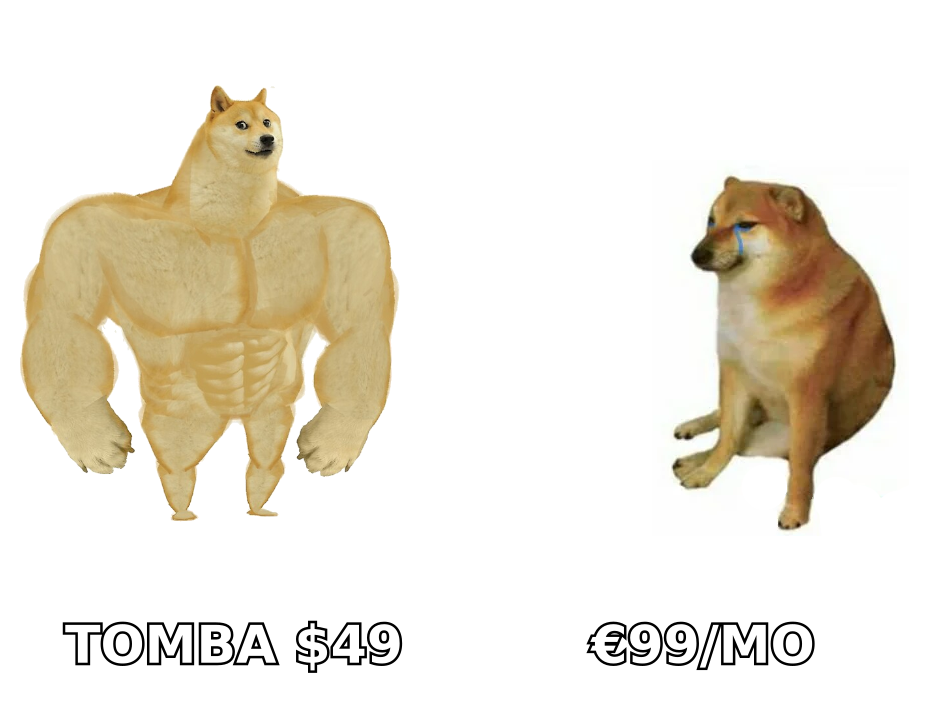
- Cost per verified, usable email is the only number worth comparing. On that metric, flat-credit finders like Tomba's Starter plan at $49/mo often land cheaper for pure prospecting.
- Buy Dropcontact if you need compliant, continuous CRM hygiene in Europe. Skip it if you mostly need to find and verify new addresses at volume.
What is Dropcontact and who is it actually for?#
Dropcontact is a French B2B enrichment engine that takes partial contact records and completes them: name plus company becomes a verified professional email, a job title, a LinkedIn URL, a company size, a SIREN number for French entities. The official product site leads with the thing that makes it structurally different from most of the market: there is no contact database behind it.
That distinction is the whole pitch. Most enrichment vendors maintain a warehouse of scraped or contributed personal data and query it on your behalf. Dropcontact generates and validates candidate data on the fly from public sources, then discards what it does not need. Under GDPR, the difference between "we sell you a copy of someone's record from our database" and "we algorithmically deduced and verified a business address" is not cosmetic. It changes who the data controller is and what disclosure you owe.
So the honest audience segmentation looks like this:
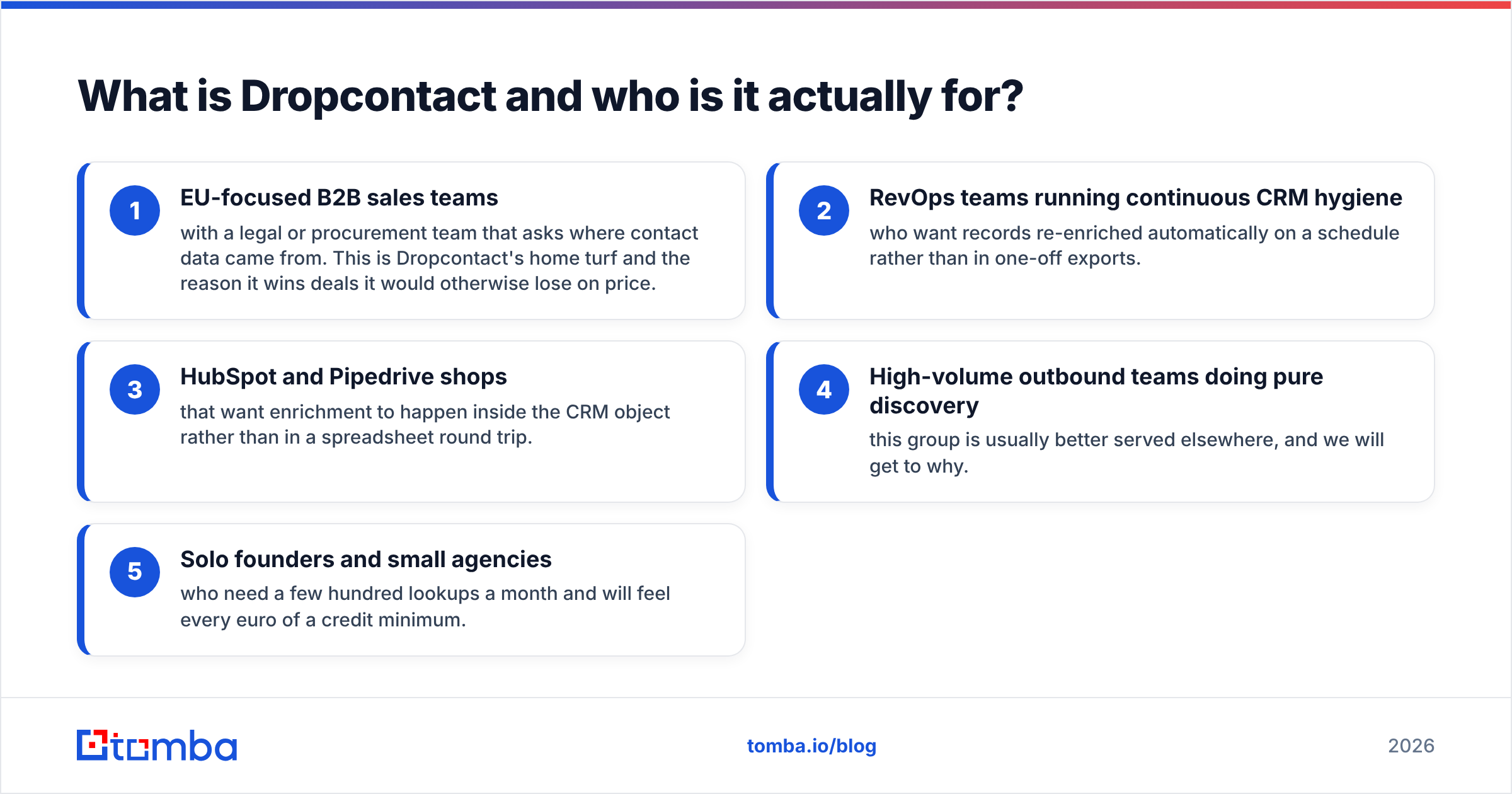
- EU-focused B2B sales teams with a legal or procurement team that asks where contact data came from. This is Dropcontact's home turf and the reason it wins deals it would otherwise lose on price.
- RevOps teams running continuous CRM hygiene who want records re-enriched automatically on a schedule rather than in one-off exports.
- HubSpot and Pipedrive shops that want enrichment to happen inside the CRM object rather than in a spreadsheet round trip.
- High-volume outbound teams doing pure discovery — this group is usually better served elsewhere, and we will get to why.
- Solo founders and small agencies who need a few hundred lookups a month and will feel every euro of a credit minimum.
How does Dropcontact pricing actually work in 2026?#
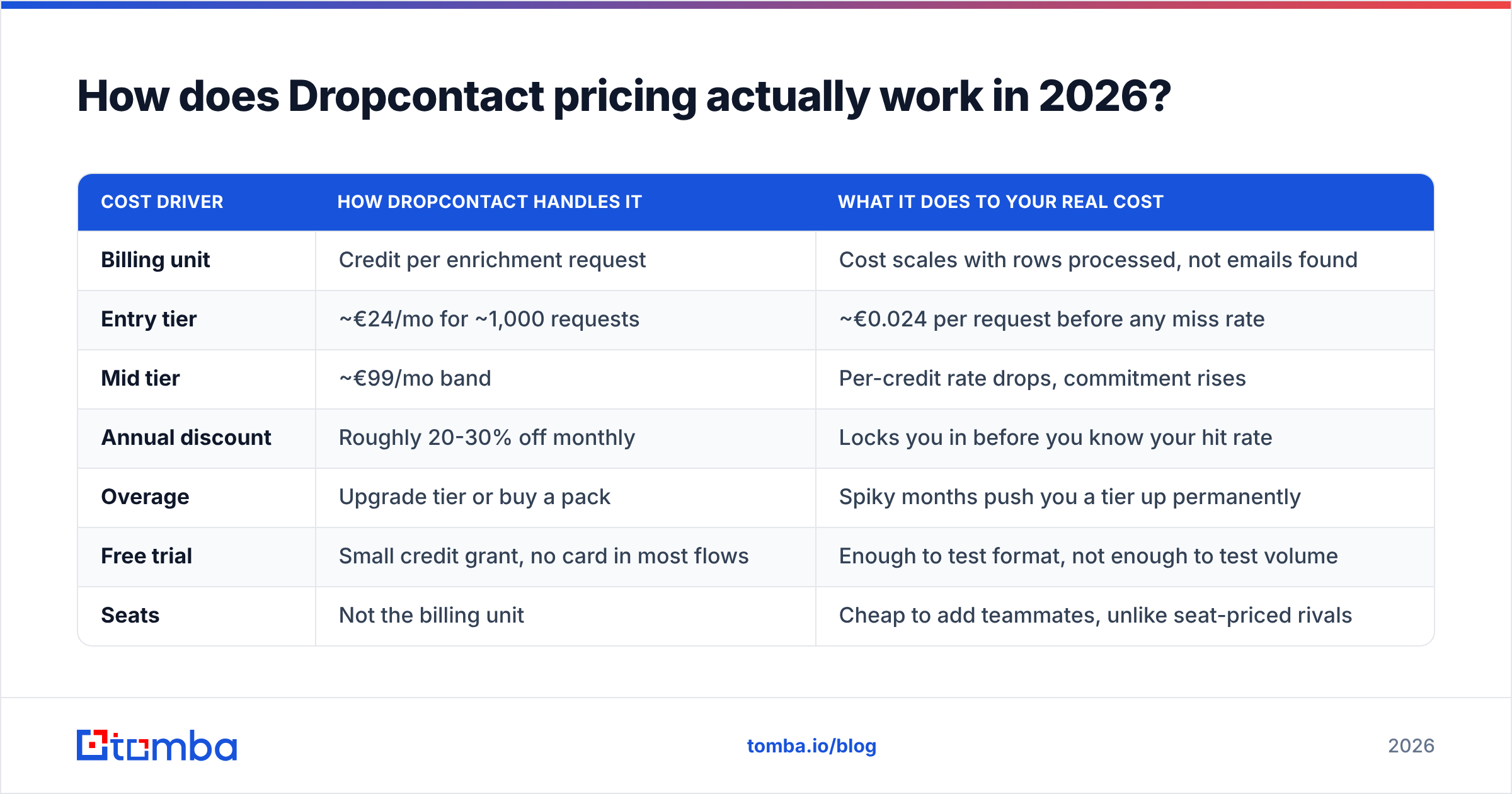
Dropcontact prices on credits, billed monthly or annually, with the annual commitment discounting the monthly rate by a meaningful margin. Entry-level plans start around €24/month for roughly 1,000 requests and scale up through mid-tier plans in the €99/month range before hitting custom enterprise pricing. Because vendors adjust tiers frequently, treat every figure below as a shape rather than a quote and confirm the current numbers on the vendor's own page before you sign anything.
The shape matters more than the exact euro figure anyway. Here is what actually drives your bill:
| Cost driver | How Dropcontact handles it | What it does to your real cost |
|---|---|---|
| Billing unit | Credit per enrichment request | Cost scales with rows processed, not emails found |
| Entry tier | ~€24/mo for ~1,000 requests | ~€0.024 per request before any miss rate |
| Mid tier | ~€99/mo band | Per-credit rate drops, commitment rises |
| Annual discount | Roughly 20-30% off monthly | Locks you in before you know your hit rate |
| Overage | Upgrade tier or buy a pack | Spiky months push you a tier up permanently |
| Free trial | Small credit grant, no card in most flows | Enough to test format, not enough to test volume |
| Seats | Not the billing unit | Cheap to add teammates, unlike seat-priced rivals |
The line that surprises people is the second one. If you upload 1,000 rows and Dropcontact returns solid data on 550 of them, your effective cost per usable contact is not €0.024. It is closer to €0.044. That is still reasonable, but it is nearly double the number you did the math on when you picked the plan.
Run the arithmetic in the other direction before you commit. Take a representative sample of 200 rows from your actual target market, push them through the trial, and count how many produced a verified, deliverable, correctly-titled contact. Divide the plan price by that hit rate. That number is your real cost per contact, and it is the only figure that lets you compare Dropcontact fairly against anything else. If you want a baseline to compare against, Tomba pricing publishes flat credit counts per tier — Free at 25 searches/month, Starter at $49/mo, Growth at $99/mo, and Pro at $249/mo — so the same sample-and-divide exercise takes ten minutes.
What do Dropcontact reviews say?#
Aggregate sentiment on G2 and comparable review sites is genuinely positive, and the praise clusters tightly around three themes: the CRM integrations work without engineering help, support responds in hours rather than days, and the compliance story survives contact with a legal team.
The criticism clusters just as tightly:
- Credit consumption on unproductive rows. This is the single most repeated complaint across review platforms, and it is a design consequence rather than a bug. Confirm the exact consumption rules for your workflow against your own test batch, because they differ by operation type.
- Coverage outside Europe. Dropcontact's data generation is strongest where its sources are strongest. North American and APAC coverage is workable but not its best work, and reviewers who sell into the US frequently say so.
- Interface depth. The dashboard is functional rather than rich. Teams used to a full prospecting workspace with filters, saved searches, and sequences find it thin, because it is not trying to be that product.
- Pricing opacity at the margins. Understanding exactly how overages, re-enrichment of previously enriched records, and multi-field lookups consume credits takes more reading than it should.
None of these are disqualifying. They are the predictable trade-offs of a product that optimized hard for compliance and integration rather than for breadth and browsing.
What are the real pros and cons?#
Pros
- Genuine GDPR positioning. No stored personal-data warehouse means a cleaner answer when a prospect exercises a data-subject request or your legal team asks for provenance. Read the GDPR overview on Wikipedia if you need to brief a stakeholder on why controller-versus-processor language shows up in enrichment contracts at all.
- Native CRM enrichment. Records update in place, on a schedule, without a CSV round trip. For RevOps teams this is the buying reason, full stop.
- Seat-agnostic billing. Adding a rep costs nothing. Compare that to per-seat platforms where headcount growth is a pricing event.
- Strong French and wider EU coverage, including company registry identifiers that most US-built tools simply do not carry.
- A clean API for teams that want to wire enrichment into their own pipeline rather than a vendor's UI.
Cons
- Cost per usable record is opaque until you test. The list price understates your real spend by whatever your miss rate is.
- Weaker outside Europe, which makes it a poor single vendor for globally-targeted outbound.
- Not a prospecting tool. There is no meaningful "find me 400 heads of engineering at Series B SaaS companies" motion. You bring the list; it completes the list.
- Annual commitments arrive early in the sales conversation, before you have enough data to know your hit rate.
- Catch-all domains remain hard, as they do for every vendor. If a large share of your targets sit behind catch-all mail servers, budget for a dedicated catch-all verifier regardless of which enrichment vendor you choose.
Is Dropcontact accurate enough to justify the price?#
Accuracy claims in this category are close to unfalsifiable as marketed. Every vendor quotes a headline percentage, and every vendor computes it differently — some on found records only, some on all rows submitted, some excluding catch-all domains that they could not conclusively verify.

The practical test is boring and reliable. Take 100 contacts you can independently confirm — current customers, past colleagues, people whose addresses appear in their own email signatures — strip the emails out, and run the list. Then score three things separately:
- Coverage: how many rows returned any address at all.
- Precision: of those returned, how many exactly matched the known-good address.
- Deliverability: of the returned addresses you could not independently confirm, how many survive an independent email verifier pass without landing in "risky" or "unknown."
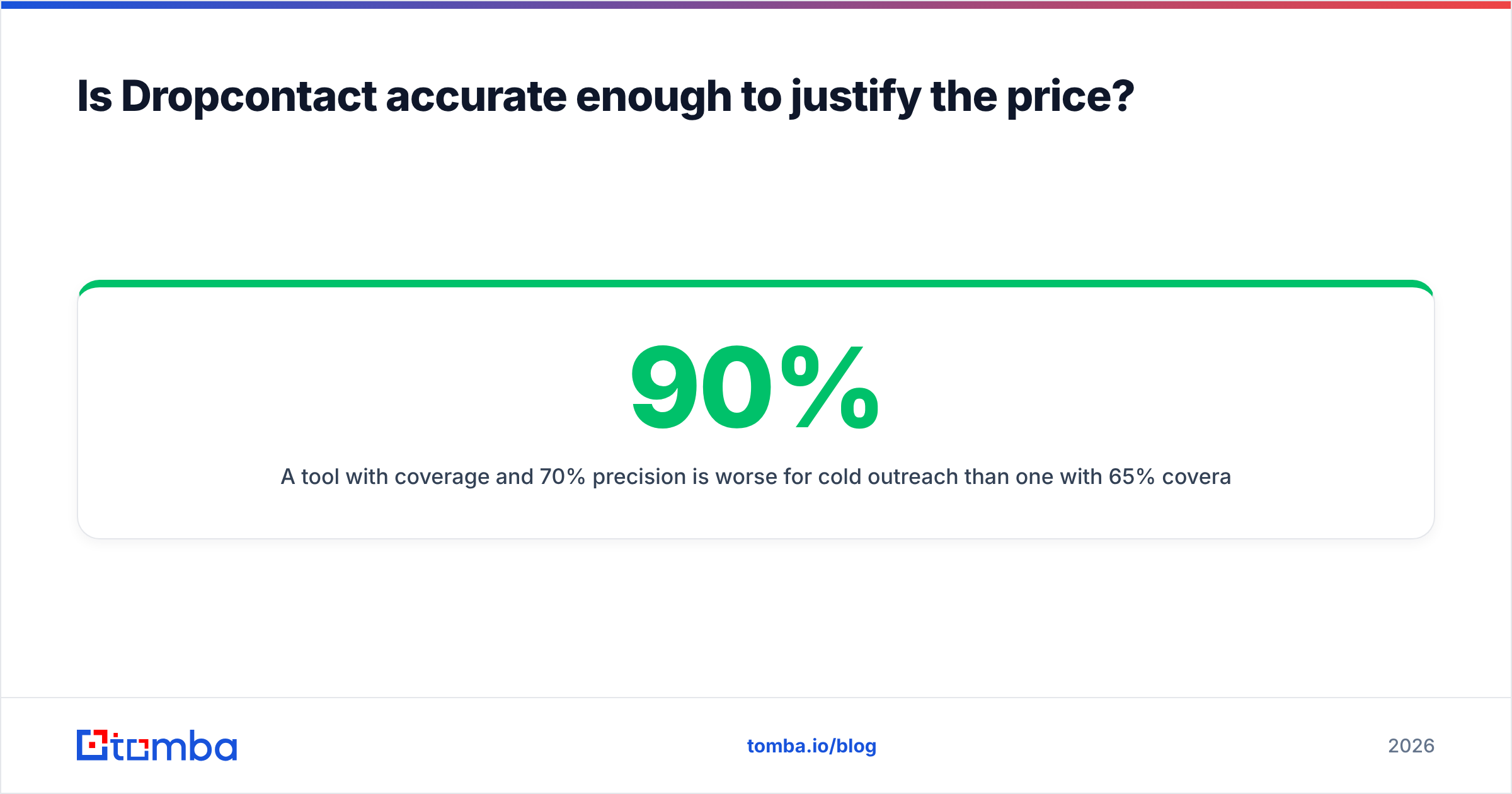
A tool with 90% coverage and 70% precision is worse for cold outreach than one with 65% coverage and 96% precision, because bounced sends damage sender reputation in a way that missing rows never do. Dropcontact generally scores well on precision in EU-heavy lists — that is the direct consequence of generating and validating rather than pulling from a stale warehouse — and less well on coverage for non-EU targets.
How does Dropcontact compare to other tools?#
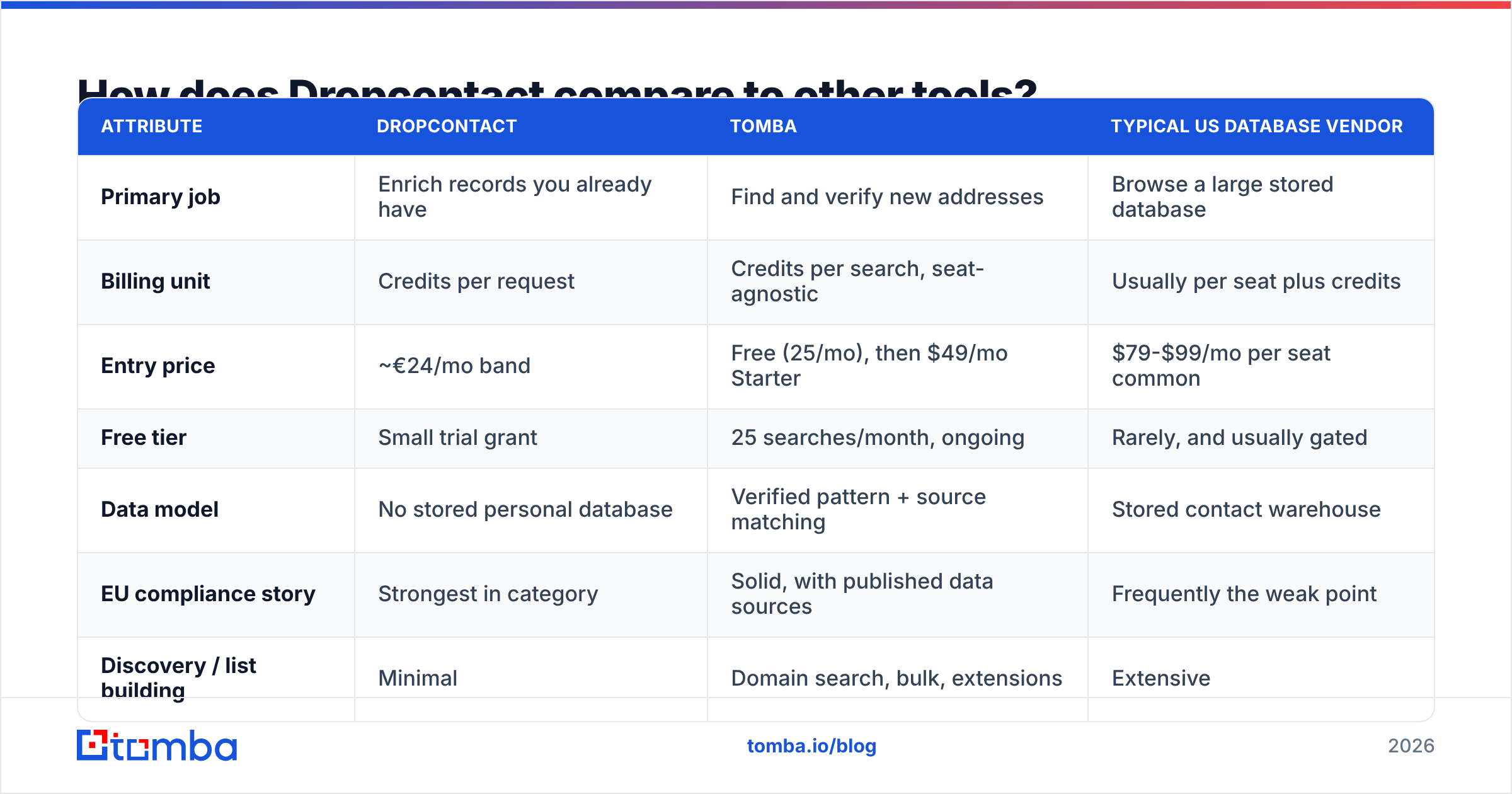
The comparison only makes sense if you split the job. Dropcontact and a discovery-first email finder are not really the same product, and the pricing structures reflect that.

| Attribute | Dropcontact | Tomba | Typical US database vendor |
|---|---|---|---|
| Primary job | Enrich records you already have | Find and verify new addresses | Browse a large stored database |
| Billing unit | Credits per request | Credits per search, seat-agnostic | Usually per seat plus credits |
| Entry price | ~€24/mo band | Free (25/mo), then $49/mo Starter | $79-$99/mo per seat common |
| Free tier | Small trial grant | 25 searches/month, ongoing | Rarely, and usually gated |
| Data model | No stored personal database | Verified pattern + source matching | Stored contact warehouse |
| EU compliance story | Strongest in category | Solid, with published data sources | Frequently the weak point |
| Discovery / list building | Minimal | Domain search, bulk, extensions | Extensive |
| Native CRM write-back | Yes, a core strength | Via integrations and API | Yes |
| Best for | EU RevOps and CRM hygiene | Cold outbound and list building | US enterprise territory planning |
Read that table as a routing decision rather than a scoreboard. If your CRM already holds 40,000 half-complete records and your problem is that 30% of them have stale titles and dead addresses, Dropcontact is close to purpose-built for you and the price is fair. If your CRM holds 400 records and your problem is that you need 4,000 more, you are buying the wrong shape of tool, and a discovery-first email finder with domain search and bulk processing will cost you less per contact acquired.
Plenty of teams run both, and that is a legitimate answer. Discovery tool fills the top of the funnel, enrichment engine keeps the CRM honest, and neither one is asked to do the other's job badly.
Who should buy Dropcontact, and who should not?#
Buy it if you sell primarily into France, Benelux, DACH or the broader EU; your legal or procurement function asks provenance questions; your core pain is CRM decay rather than list acquisition; and you run HubSpot, Pipedrive or Salesforce as your system of record.
Skip it if your ICP is majority North American; your monthly volume is under a few hundred lookups and the plan minimum dominates your spend; you need list building rather than list completion; or you need phone numbers as a first-class output rather than an occasional bonus, in which case a dedicated phone finder belongs in the stack anyway.
Test before committing if you are on the fence. Run the 200-row sample, compute cost per usable contact, and compare it against one flat-credit alternative and one incumbent you already pay for. That test costs an afternoon and routinely changes the decision.
What should you do next?#
Price is downstream of hit rate, and hit rate is downstream of your ICP. Nobody can tell you what Dropcontact costs you without running your list. So run it — through Dropcontact's trial, and through at least one alternative on the same rows, on the same day, scored the same way.
If that test shows your real bottleneck is finding addresses rather than completing records, start with the Tomba Email Finder. The free tier gives you 25 searches a month to benchmark against your control list at zero cost, Starter is $49/mo when you are ready to scale, and every result comes with sourcing you can show a compliance reviewer. Run both tools on the same 200 rows, compare cost per verified email, and let the spreadsheet make the call.
Related guides#
Ready to find emails that actually work?
Join 150,000+ professionals who stopped guessing and started sending. Free credits on signup — no credit card required.
Get the Tomba newsletter
Practical outbound tactics and product updates — once every two weeks.
About the author