Dubsado vs HoneyBook (2026): Which CRM Actually Wins?
Dubsado and HoneyBook both promise to run your client workflow end to end. One is a build-it-yourself automation engine, the other is a fast-setup payments-first CRM. Here is where each one wins in 2026.
TL;DR
- Dubsado is the deeper automation engine. Conditional workflows, multi-step forms, and granular templates beat HoneyBook on flexibility, but you pay for it in setup hours.
- HoneyBook is the faster path to a signed contract and a paid invoice. Cleaner UI, better mobile app, stronger payments layer, less to configure.
- Price gap is real: Dubsado's Premier tier runs roughly half of HoneyBook's mid tier at list price, and Dubsado's trial is client-limited rather than time-limited.
- Neither tool finds you clients. Both start working after someone fills in your inquiry form, which is the single biggest gap for anyone doing outbound.
- Pick Dubsado if your process has branches. Pick HoneyBook if your process is book-sign-pay-deliver and you want it live this week.
What are Dubsado and HoneyBook, exactly?#
Both are client-management platforms built for service businesses — photographers, designers, consultants, coaches, small agencies. They sit in the same category, and they solve the same core problem: replacing the mess of Google Docs contracts, PayPal invoices, Calendly links, and half-remembered follow-ups with one system.
Dubsado launched as a workflow tool first. Its identity is the automation builder: you define a trigger, chain actions to it, add conditions, and let the system move clients through your process without you touching anything. That makes it powerful and genuinely fiddly.
HoneyBook launched as a payments-and-proposals tool first. Its identity is the smart file — a single document that bundles a proposal, contract, and invoice into one client-facing flow. It automates too, but linearly. Trigger fires, steps run in order.
Think of it like kitchens. Dubsado hands you a professional range with six burners and no instructions. HoneyBook hands you a well-designed countertop appliance that does eight things beautifully and refuses to do the ninth.
That framing explains almost every difference below.
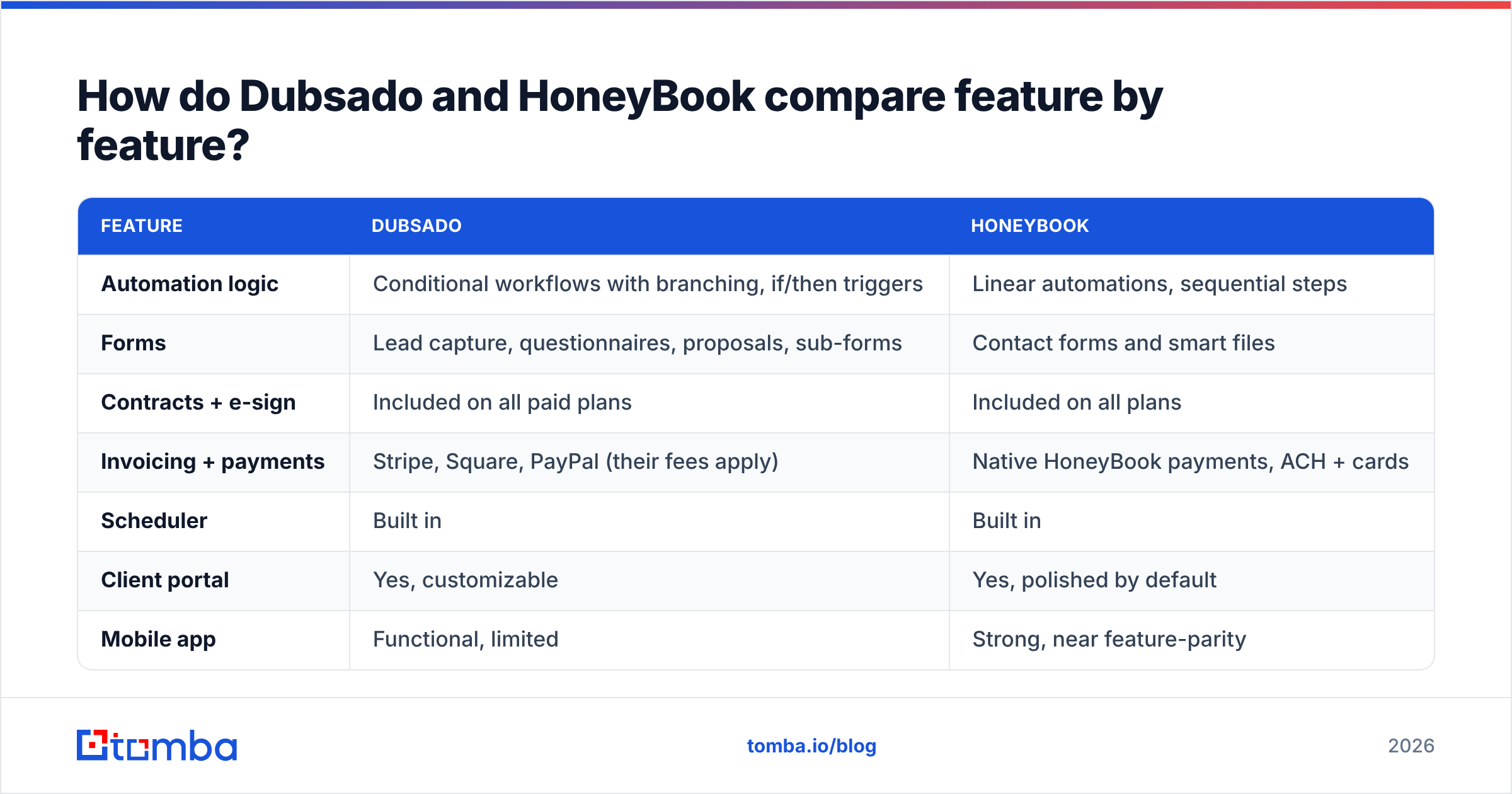
How do Dubsado and HoneyBook compare feature by feature?#
| Feature | Dubsado | HoneyBook |
|---|---|---|
| Automation logic | Conditional workflows with branching, if/then triggers | Linear automations, sequential steps |
| Forms | Lead capture, questionnaires, proposals, sub-forms | Contact forms and smart files |
| Contracts + e-sign | Included on all paid plans | Included on all plans |
| Invoicing + payments | Stripe, Square, PayPal (their fees apply) | Native HoneyBook payments, ACH + cards |
| Scheduler | Built in | Built in |
| Client portal | Yes, customizable | Yes, polished by default |
| Mobile app | Functional, limited | Strong, near feature-parity |
| Time tracking | Yes | No |
| Bookkeeping / expense tracking | Basic income + expense reporting | Expense tracking + profit reporting |
| Template marketplace | Community-driven, large | Official template library |
| Learning curve | Steep — plan 8-20 hours to configure | Shallow — usable in an afternoon |
| Best for | Multi-branch processes, agencies, retainers | Solo creatives, event pros, fast onboarding |
The honest summary: Dubsado wins on capability, HoneyBook wins on time-to-value. Read the G2 category listings for either and you will see that split reflected in review sentiment — Dubsado reviews praise power and complain about onboarding; HoneyBook reviews praise ease and complain about ceilings.
What does each one actually cost in 2026?#
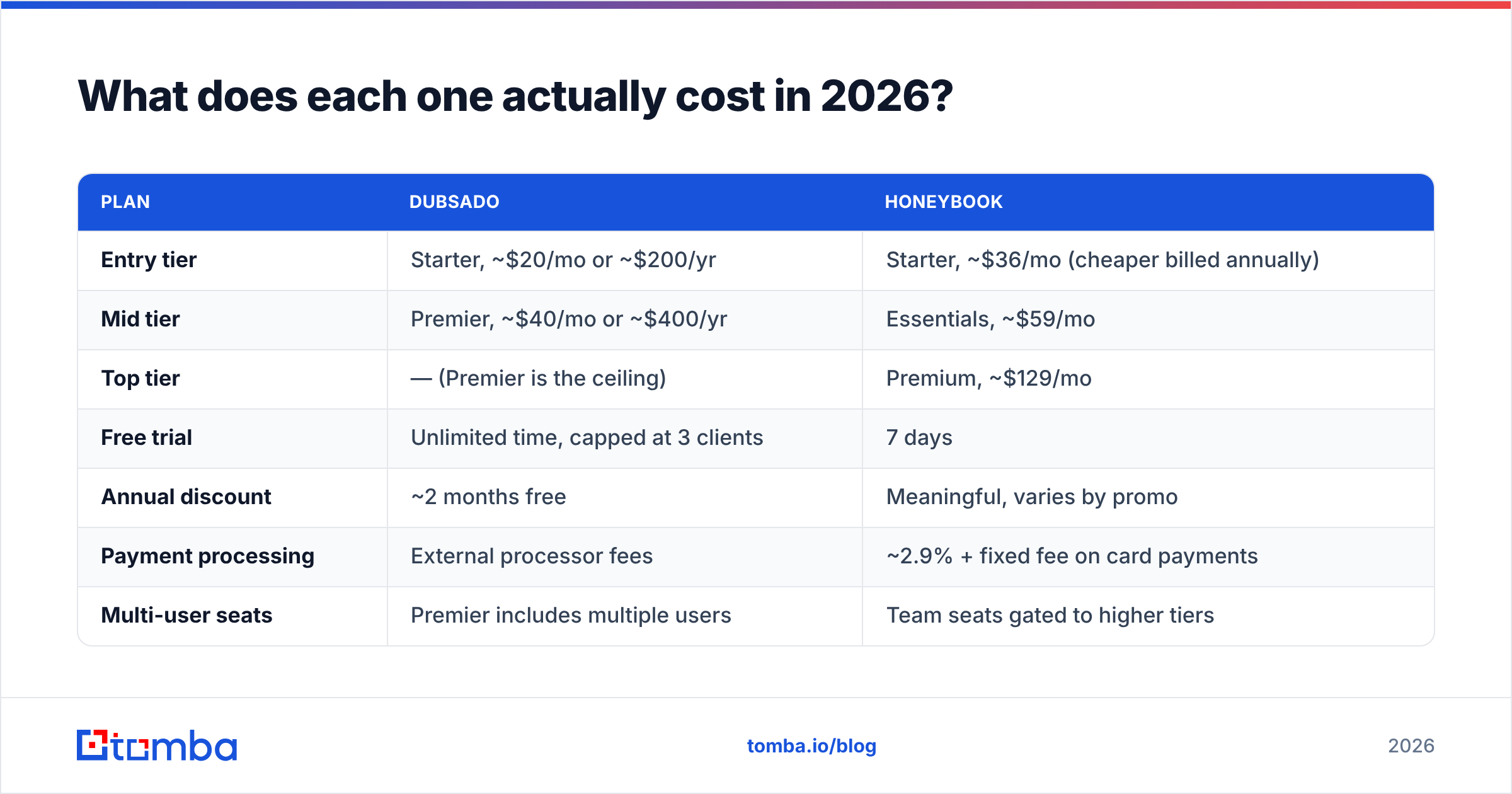
List pricing shifts, so verify on the vendor sites before you buy. As of this writing:
| Plan | Dubsado | HoneyBook |
|---|---|---|
| Entry tier | Starter, ~$20/mo or ~$200/yr | Starter, ~$36/mo (cheaper billed annually) |
| Mid tier | Premier, ~$40/mo or ~$400/yr | Essentials, ~$59/mo |
| Top tier | — (Premier is the ceiling) | Premium, ~$129/mo |
| Free trial | Unlimited time, capped at 3 clients | 7 days |
| Annual discount | ~2 months free | Meaningful, varies by promo |
| Payment processing | External processor fees | ~2.9% + fixed fee on card payments |
| Multi-user seats | Premier includes multiple users | Team seats gated to higher tiers |
Two things to flag.
First, Dubsado's trial is the most underrated thing in this comparison. You can build your entire workflow, onboard three real clients, and only pay when you outgrow it. HoneyBook's seven days is not enough time to test a real client cycle.
Second, HoneyBook's processing layer is convenient and priced like convenience. If you run $20,000/month through it, the percentage matters more than the subscription. Dubsado pushing you to Stripe or Square is not a feature, but it does mean you shop your own rate.
Is Dubsado better than HoneyBook for automation?#
Yes, if your process branches. No, if it does not.
Here is the concrete difference:
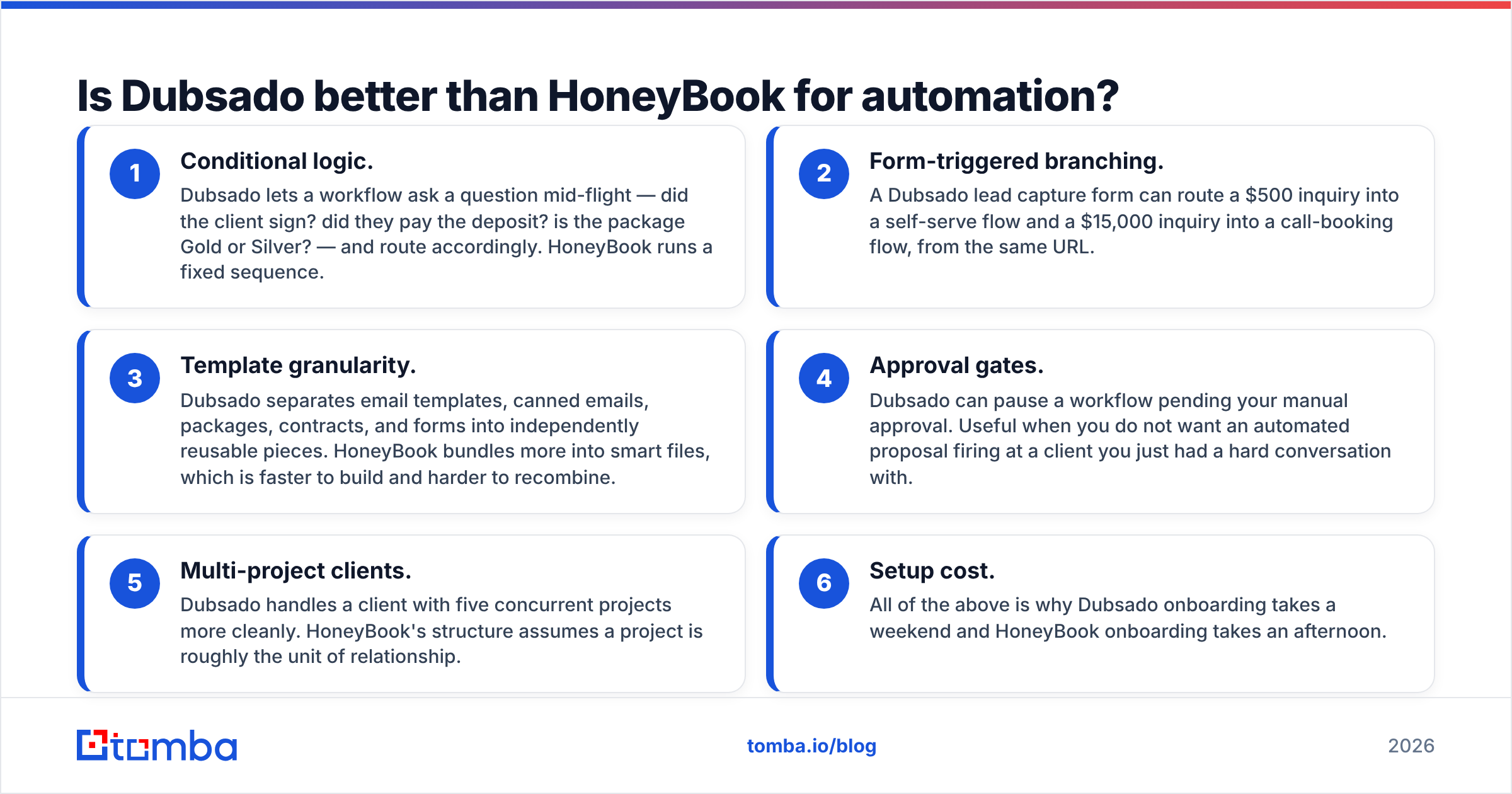
- Conditional logic. Dubsado lets a workflow ask a question mid-flight — did the client sign? did they pay the deposit? is the package Gold or Silver? — and route accordingly. HoneyBook runs a fixed sequence.
- Form-triggered branching. A Dubsado lead capture form can route a $500 inquiry into a self-serve flow and a $15,000 inquiry into a call-booking flow, from the same URL.
- Template granularity. Dubsado separates email templates, canned emails, packages, contracts, and forms into independently reusable pieces. HoneyBook bundles more into smart files, which is faster to build and harder to recombine.
- Approval gates. Dubsado can pause a workflow pending your manual approval. Useful when you do not want an automated proposal firing at a client you just had a hard conversation with.
- Multi-project clients. Dubsado handles a client with five concurrent projects more cleanly. HoneyBook's structure assumes a project is roughly the unit of relationship.
- Setup cost. All of the above is why Dubsado onboarding takes a weekend and HoneyBook onboarding takes an afternoon.
If your business is "inquiry comes in, I send a proposal, they sign, they pay, I deliver," Dubsado's advantage is theoretical. You will pay in setup hours for branches you never use.
Which one is easier to actually live in day to day?#
HoneyBook, by a clear margin — and this is where most switching stories come from.
The interface is calmer. The mobile app is genuinely usable for approving a proposal from a parking lot. Client-facing documents look designed rather than assembled. When a client opens a HoneyBook smart file, it reads as a professional artifact. When they open an unstyled Dubsado proposal, it reads as a form.
Dubsado's client-facing polish is achievable, but it is achievable the way a custom website is achievable: with time, CSS tinkering, and a tolerance for template debugging.
Where Dubsado pulls back ahead is in the back office. Time tracking exists. Reporting is more granular. If you bill hourly or run retainers, you will hit a wall in HoneyBook that Dubsado does not have.
Where do both tools fall short?#
Both are excellent at managing demand and useless at creating it.
That distinction matters more than any feature row above. Dubsado and HoneyBook are both inbound-shaped: they assume a lead lands in your inbox or fills your form, and everything downstream gets automated. Neither has a prospecting layer, neither has a contact database, and neither will tell you the email address of the marketing director at the agency you want to subcontract for.
For a referral-heavy photography business, that is fine. For a consultant, agency, or B2B service provider trying to build a pipeline deliberately, it is a hole you fill somewhere else.
The practical stack looks like this:
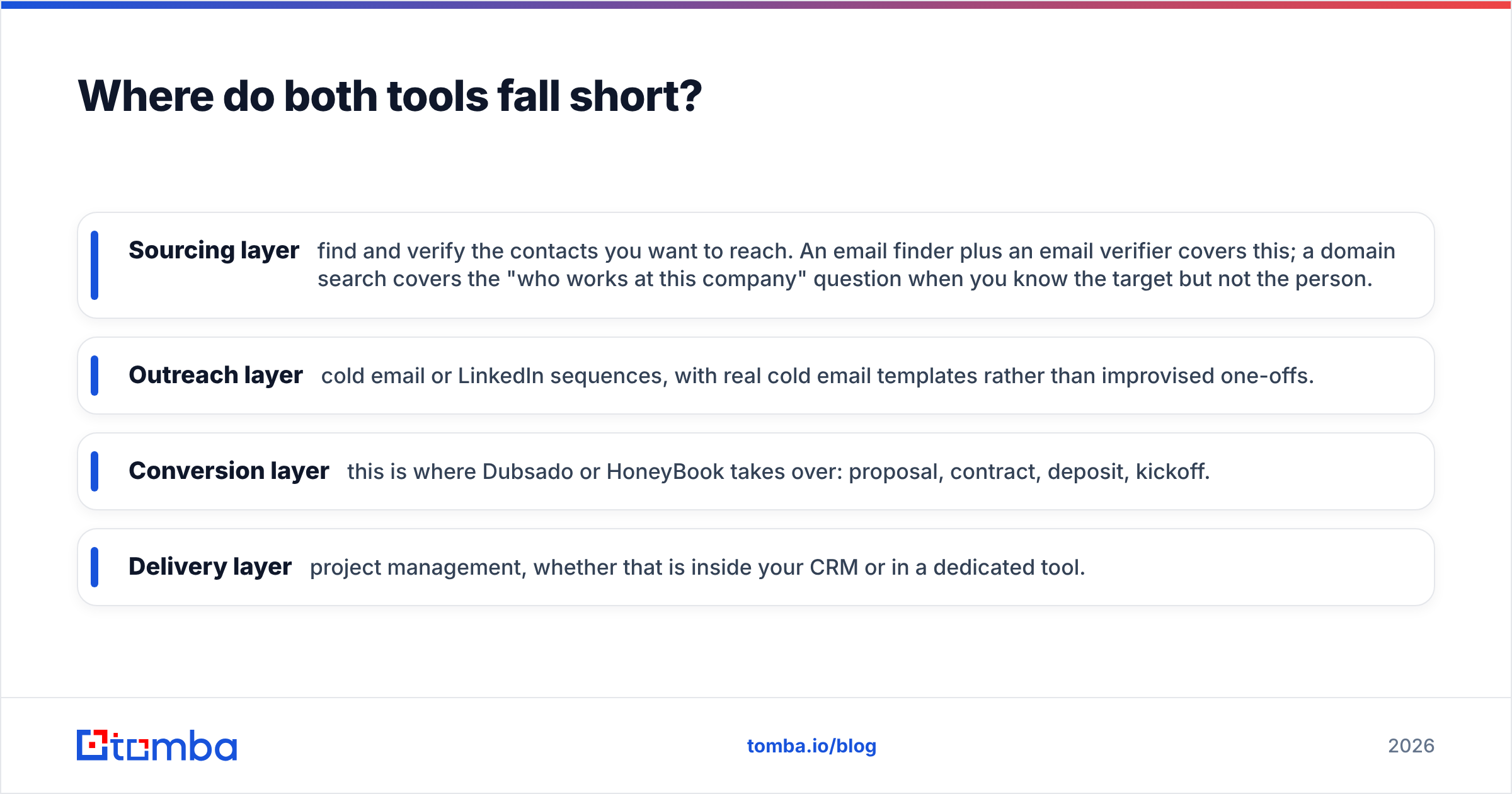
- Sourcing layer — find and verify the contacts you want to reach. An email finder plus an email verifier covers this; a domain search covers the "who works at this company" question when you know the target but not the person.
- Outreach layer — cold email or LinkedIn sequences, with real cold email templates rather than improvised one-offs.
- Conversion layer — this is where Dubsado or HoneyBook takes over: proposal, contract, deposit, kickoff.
- Delivery layer — project management, whether that is inside your CRM or in a dedicated tool.
Treating your client-management platform as your whole CRM is the mistake. It is the second half of the funnel, not the whole thing.
Who should pick Dubsado?#
Choose Dubsado if two or more of these are true:
- Your intake process genuinely branches by budget, service type, or client tier.
- You bill hourly or on retainer and need time tracking inside the same system.
- You have multiple concurrent projects per client.
- You want the lowest monthly cost and will trade setup hours for it.
- You already have a Stripe or Square account with negotiated rates.
- You are comfortable building a system rather than adopting one.
The Premier plan at roughly $400/year for multi-user access is, feature for feature, the better value on paper. "On paper" is doing real work in that sentence — the value only materializes if you finish the build.
Who should pick HoneyBook?#
Choose HoneyBook if two or more of these are true:
- You need to be live within a week, not a month.
- Your client-facing documents are part of your brand and you do not want to design them from scratch.
- You take payments on mobile, at events, or on the move.
- Your process is essentially linear.
- You would rather pay a higher subscription than lose two weekends to configuration.
- You value a polished mobile experience over back-office depth.
Most solo creatives who switch from Dubsado to HoneyBook cite the same reason: they never finished setting Dubsado up. That is a real cost, and it does not appear on any pricing page.
What about switching between them?#
Migration is manual in both directions. There is no clean export-import bridge for workflows, templates, or contract structures. Contacts export as CSV; everything else gets rebuilt.
Before you switch, do three things:
- Export your contact list and clean it. Dead addresses accumulate fast in an old CRM — run the list through bulk verification before importing so you are not migrating bounces.
- Screenshot your live workflows in the old tool. Nobody remembers step 11 of a sequence they built 18 months ago.
- Rebuild one workflow first, run three real clients through it, then migrate the rest. Big-bang migrations of client-facing systems fail loudly and in front of customers.
Which one wins overall?#
There is no single winner, and any post claiming otherwise is selling an affiliate link.
Dubsado wins on power and price. If your process is complex and you will actually do the setup work, it does more for less money, and its trial lets you prove that before paying.
HoneyBook wins on execution and speed. If your process is straightforward and your time is worth more than the price delta, it gets you to a signed contract faster and looks better doing it.
The real risk is neither choice. It is spending three weeks evaluating client-management software while your pipeline stays empty. Both tools automate what happens after a lead exists. Neither creates the lead.
Build the pipeline before you automate it#
If your inquiry form is quiet, no CRM comparison will fix that. Start upstream: identify the companies you want to work with, find the decision-maker, verify the address, and send something worth replying to.
Tomba's Email Finder does the first part — verified professional email addresses by name, company, or domain, with a free tier at 25 searches per month and paid plans starting at $49/mo. Full Tomba pricing is public, and there is a Chrome extension if you prospect while browsing. Fill the top of the funnel first, then let Dubsado or HoneyBook handle everything after the yes.
Related guides#
Ready to find emails that actually work?
Join 150,000+ professionals who stopped guessing and started sending. Free credits on signup — no credit card required.
Get the Tomba newsletter
Practical outbound tactics and product updates — once every two weeks.
About the author