9 Best Dun Bradstreet Alternatives in 2026 (Tested & Ranked)
D&B owns firmographics and credit risk, but most revenue teams need contacts, not DUNS numbers. Here are 9 Dun & Bradstreet alternatives compared on price, coverage, contact accuracy, and the use case each one actually wins.
Looking for Dun Bradstreet alternatives? We tested nine of them. Here is what each one costs, what it finds, and who it fits.
TL;DR
- Dun & Bradstreet is a company-data and credit-risk database first. If you just need a name, a title, and a working email, you are paying enterprise money for the wrong layer of the stack.
- The nine tools below split into three groups: company/risk data (Creditsafe, Moody's Orbis, Crunchbase), contact + intent platforms (ZoomInfo, Cognism, Apollo), and contact-data infrastructure (Tomba, Clearbit/Breeze, BookYourData).
- Budget check: D&B Hoovers and ZoomInfo are quote-based annual contracts in the five figures. Tomba starts at $49/mo. BookYourData sells prepaid credits with no subscription at all.
- Most teams do not replace D&B with one tool. They buy a cheap company-data source plus a contact-finding API. That cuts 70–90% of the contract value.
- Ask one question before you sign. Do you need to check whether a company pays its bills, or do you need to sell to it? The answer picks your vendor in about thirty seconds.
What does Dun & Bradstreet actually do?#
Dun & Bradstreet is a 180-year-old business data bureau. Its core asset is the DUNS Number. That is a nine-digit ID given to each business location worldwide. Attached to it sits a credit and risk file: payment behaviour, Paydex scores, who owns whom, legal filings, and company facts across hundreds of millions of records.
That history explains both the strengths and the price tag. D&B is built for buyers vetting suppliers, credit teams setting payment terms, and compliance teams running KYB checks. D&B Hoovers, the sales product, adds prospecting tools on top of that risk database.
Here is the mismatch most sales teams hit. You bought Hoovers to find buyers. You got a system built to judge whether a company pays its invoices. Those are different products under one brand.
Why do teams look for Dun Bradstreet alternatives?#
Four complaints come up again and again in G2 reviews and renewal calls:
1. Thin contact data. The company file is excellent. The people file is not. Direct dials, verified work emails, and current job titles lag behind contact-first vendors. Reps notice within a week.
2. Quote-only annual pricing. There is no public price list. Deals are quoted, tied to seats, and usually locked for 12 months. Teams often report five figures a year for D&B Hoovers. If you only enrich 4,000 leads a quarter, that math never works.
3. Record and export limits. Caps mean the data you paid for sits behind a UI. You cannot automate against it without a separate API contract.
4. Slow refresh on people data. Company registration data changes slowly. Job titles change every 18 months on average. A database tuned for the first will always lag on the second.
None of this makes D&B bad. It makes it specialised. The real question is simple. Are you paying for the specialty you actually use?
How should you evaluate a Dun Bradstreet replacement?#
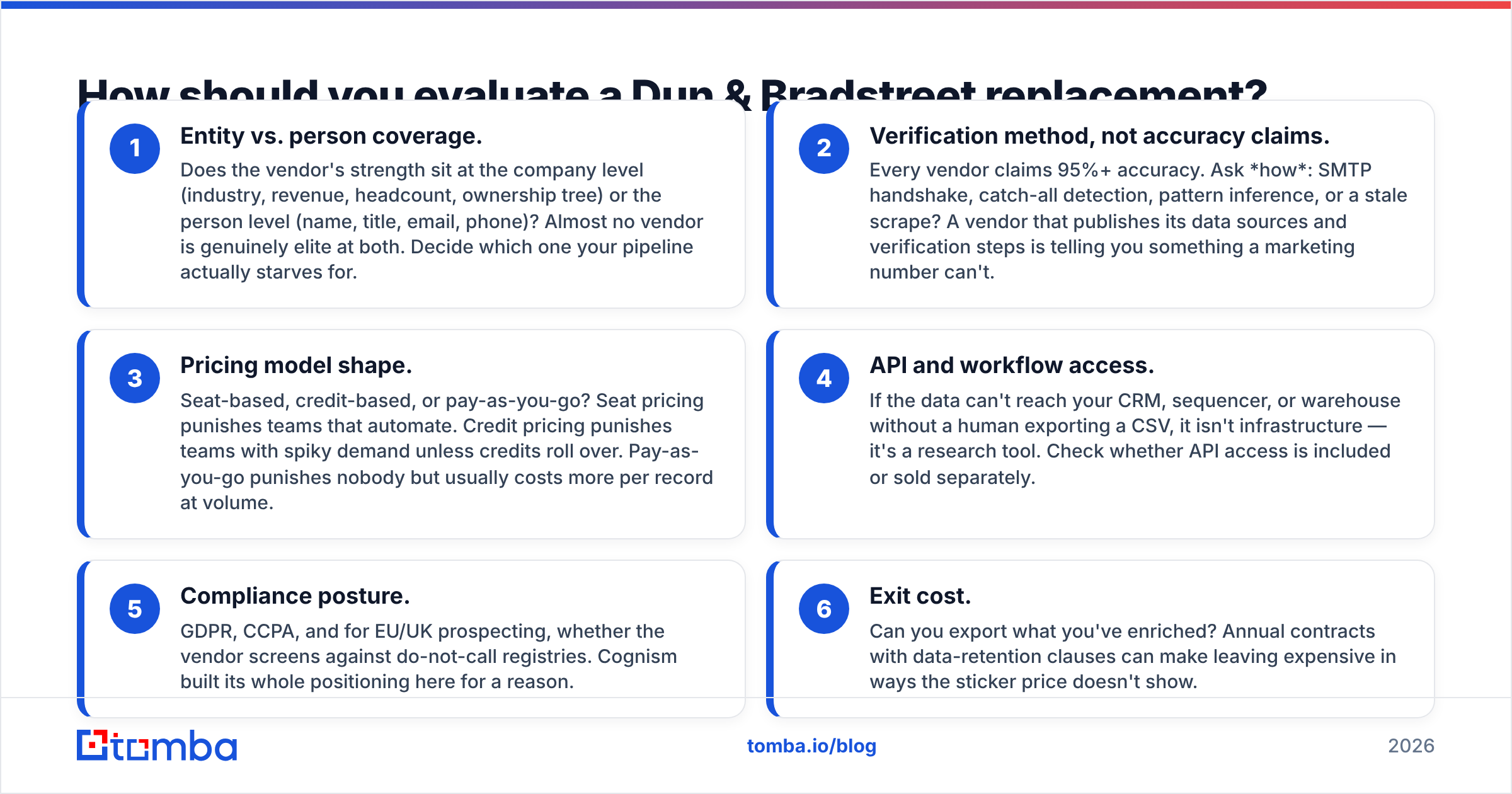
Score every candidate on these six points before you book a demo. Teams skip this step. Then they end up with two overlapping contracts.
Company data or people data. Is the vendor strong at the company level (industry, revenue, headcount, ownership) or at the person level (name, title, email, phone)? Almost no vendor is great at both. Pick the one your pipeline actually lacks.
Verification method, not accuracy claims. Every vendor claims 95%+ accuracy. Ask how. SMTP check, catch-all detection, pattern guessing, or an old scrape? A vendor that publishes its data sources and its checks tells you more than a marketing number can.
Pricing shape. Seats, credits, or pay-as-you-go? Seat pricing punishes teams that automate. Credit pricing punishes spiky demand unless credits roll over. Pay-as-you-go punishes nobody, but it costs more per record at volume.
API and workflow access. Can the data reach your CRM, sequencer, or warehouse on its own? If a human has to export a CSV, it is a research tool, not infrastructure. Check whether API access is included or sold separately.
Compliance. GDPR, CCPA, and, for EU and UK outbound, do-not-call screening. Cognism built its whole pitch here for a reason.
Exit cost. Can you export what you enriched? Annual deals with data-retention clauses make leaving expensive in ways the sticker price hides.
What are the 9 best Dun Bradstreet alternatives in 2026?#
1. Tomba — best for contact data at infrastructure pricing#
Tomba is a contact-data layer, not a full company-intelligence suite. Give it a domain, a name, or a LinkedIn profile. It returns verified work email addresses with a confidence score and the sources it matched. The domain search endpoint returns every address it can find at a company, plus the email pattern it detected. That is the single most useful building block for outbound at scale.
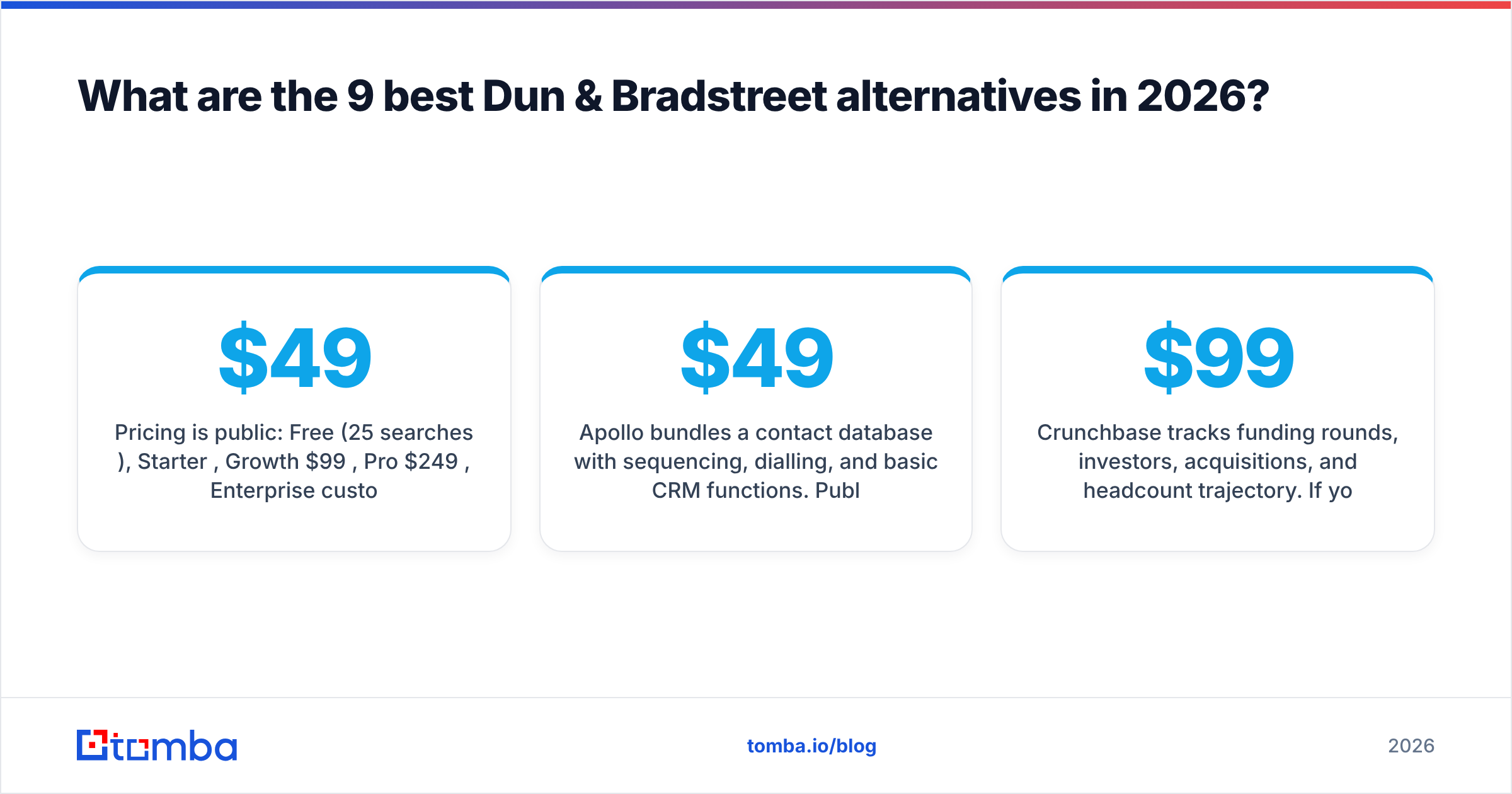
Pricing is public: Free (25 searches/mo), Starter $49/mo, Growth $99/mo, Pro $249/mo, Enterprise custom. Full Tomba pricing is on the site. No quote call needed.
Best for: teams that already know their target accounts and need the people inside them. Weak spot: it is not a credit-risk or company database. Pair it with one.
2. ZoomInfo — best for enterprise GTM breadth#

This is the closest like-for-like swap if you want one vendor for everything: company data, contacts, intent signals, call recording, and workflow automation. Coverage of North American mid-market and enterprise contacts is the deepest on the market.
The cost is the cost. Contracts are quote-based. Once you add intent and seats, they often land in the mid-five figures a year. You are trading D&B's contract shape for a very similar one.
3. Cognism — best for EU and UK compliance#
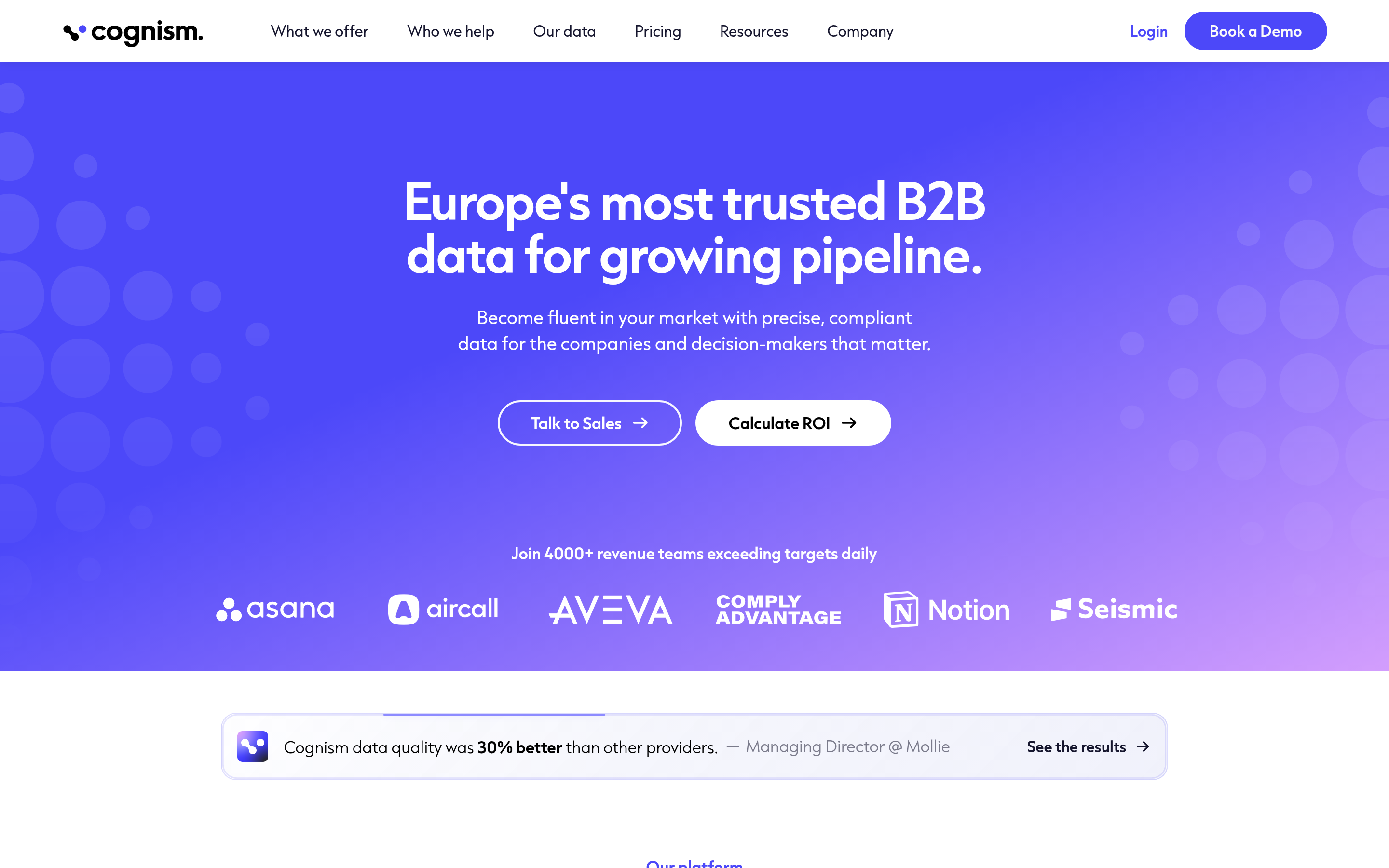
Cognism's edge is Diamond Data. Phone numbers are checked by humans against do-not-call lists across major European markets. The GDPR notification process is documented. If your outbound touches Germany, France, or the UK, that cuts your legal risk compared with scraped data.
Pricing is quote-based. Deals are usually annual, with a platform fee plus a licence per seat.
4. Apollo.io — best all-in-one for SMB sales teams#
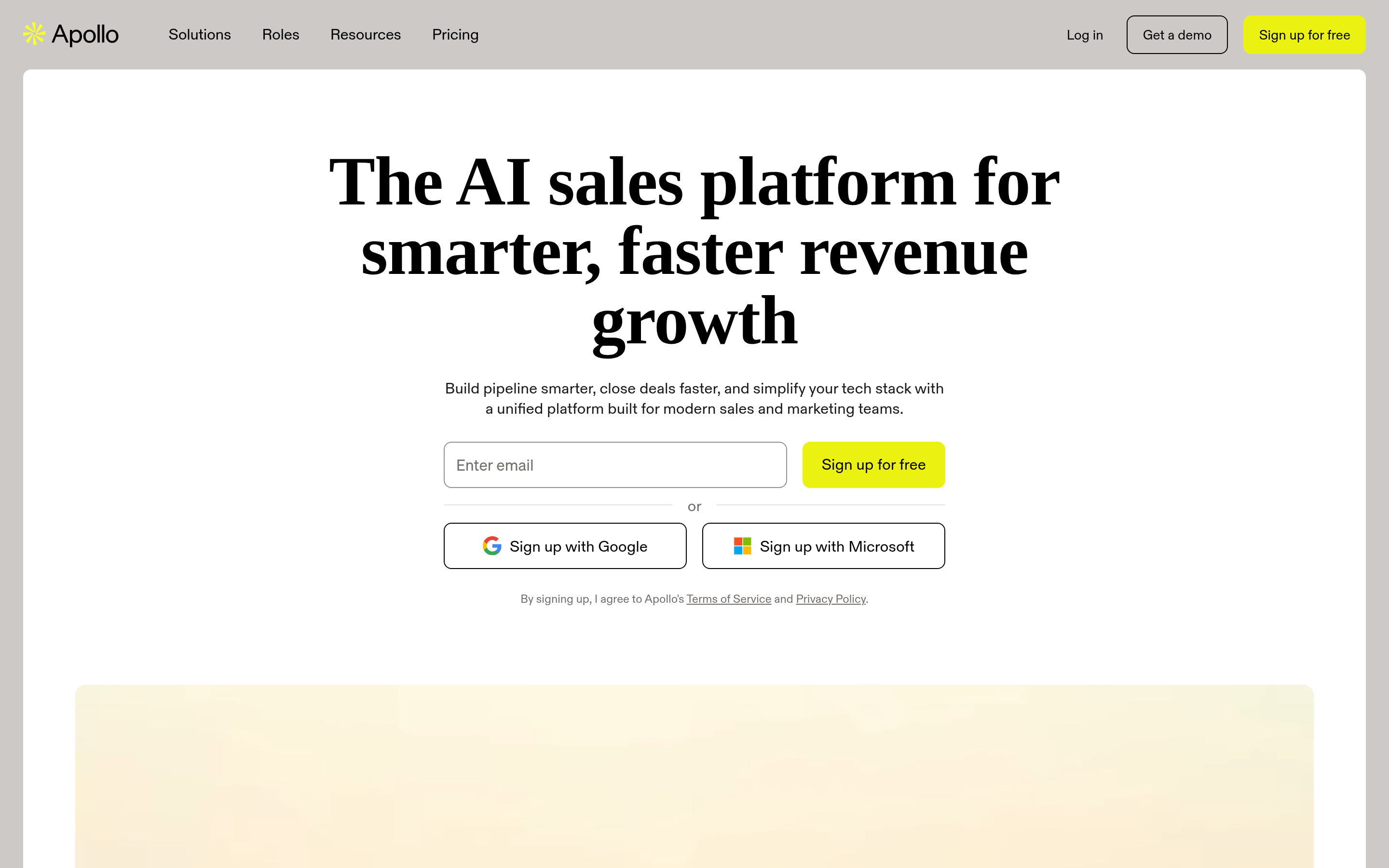
Apollo bundles a contact database with sequencing, dialling, and light CRM features. Published plans start around $49/user/month, and the free tier is usable. For a five-person team that wants prospecting and sending in one tab, the price is hard to beat.
Data quality is the trade-off. Records come from the community, so bounce rates vary by segment. Many teams use Apollo to find leads and a dedicated email verifier before they send. If you are weighing it up, the Apollo alternative breakdown covers the gaps.
5. Creditsafe — best pure credit-risk swap#
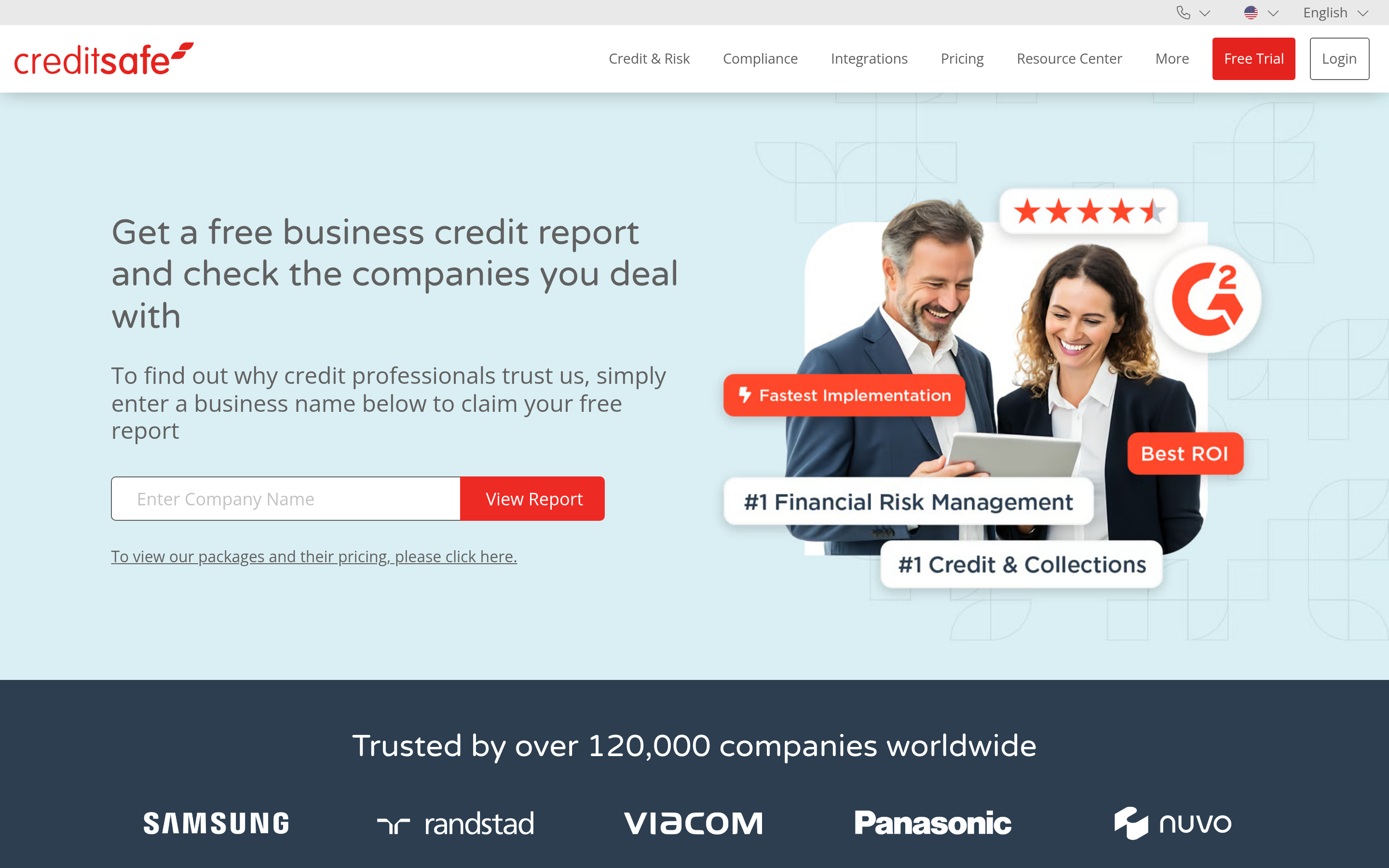
If you keep D&B for credit decisions rather than selling, Creditsafe is the obvious head-to-head. You get business credit scores, financial statements, and company reports across 160+ countries. The price is usually lower than an equivalent D&B risk subscription. There are no prospecting features, which is the point.
6. Moody's Orbis (Bureau van Dijk) — best for ownership and entity resolution#
Orbis holds detailed private-company financials. It also maps ownership structures, so you can see who ultimately owns a subsidiary. That matters for KYB, sanctions screening, and account-hierarchy mapping. On international private-company depth, it matches or beats D&B. Expect enterprise pricing and an enterprise buying cycle.
7. Clearbit (HubSpot Breeze Intelligence) — best for inbound enrichment#
Clearbit is now part of HubSpot's Breeze Intelligence. Its strength was always real-time enrichment. A visitor lands on your site or fills in a form, and the record is enriched before it reaches your CRM. If you already run HubSpot, this is the shortest path. If you do not, the standalone story is weaker than it was. See the Clearbit alternative comparison for the current picture.
8. Crunchbase — best for funding and growth signals#
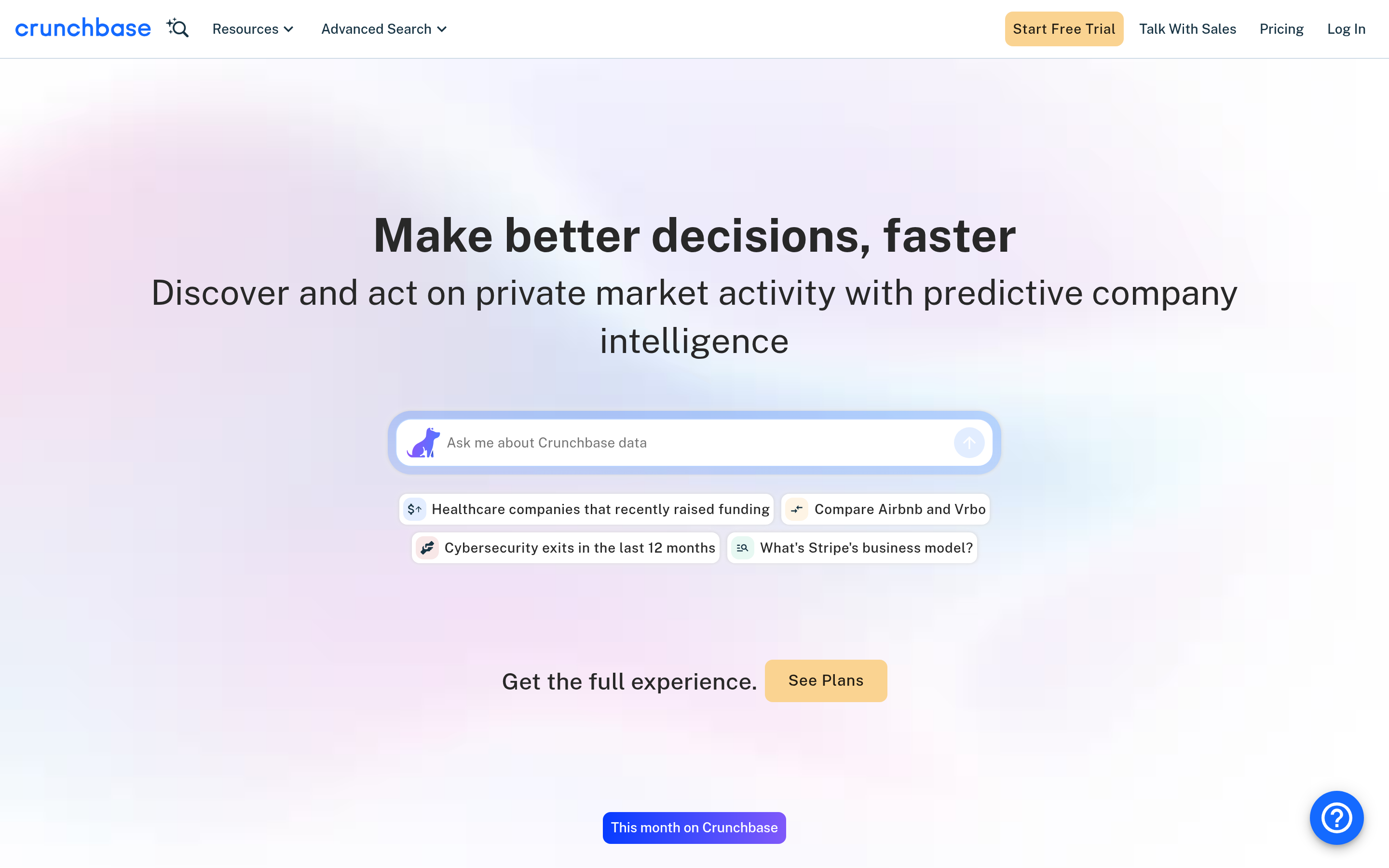
Crunchbase tracks funding rounds, investors, acquisitions, and headcount trends. Say your ICP is Series A and B companies that raised in the last 90 days. Crunchbase is a far better trigger source than D&B will ever be. Pro plans start around $99/month. Contact data is minimal.
9. BookYourData — best for prepaid, no-commitment lists#
BookYourData sells verified B2B contact lists on prepaid credits, with no subscription and a bounce guarantee on delivered records. Some teams need a defined list once or twice a year, not a constant data feed. For them, prepaid credits skip the annual-contract problem entirely. It is a different way to buy, and for one-off campaigns that difference is the feature.
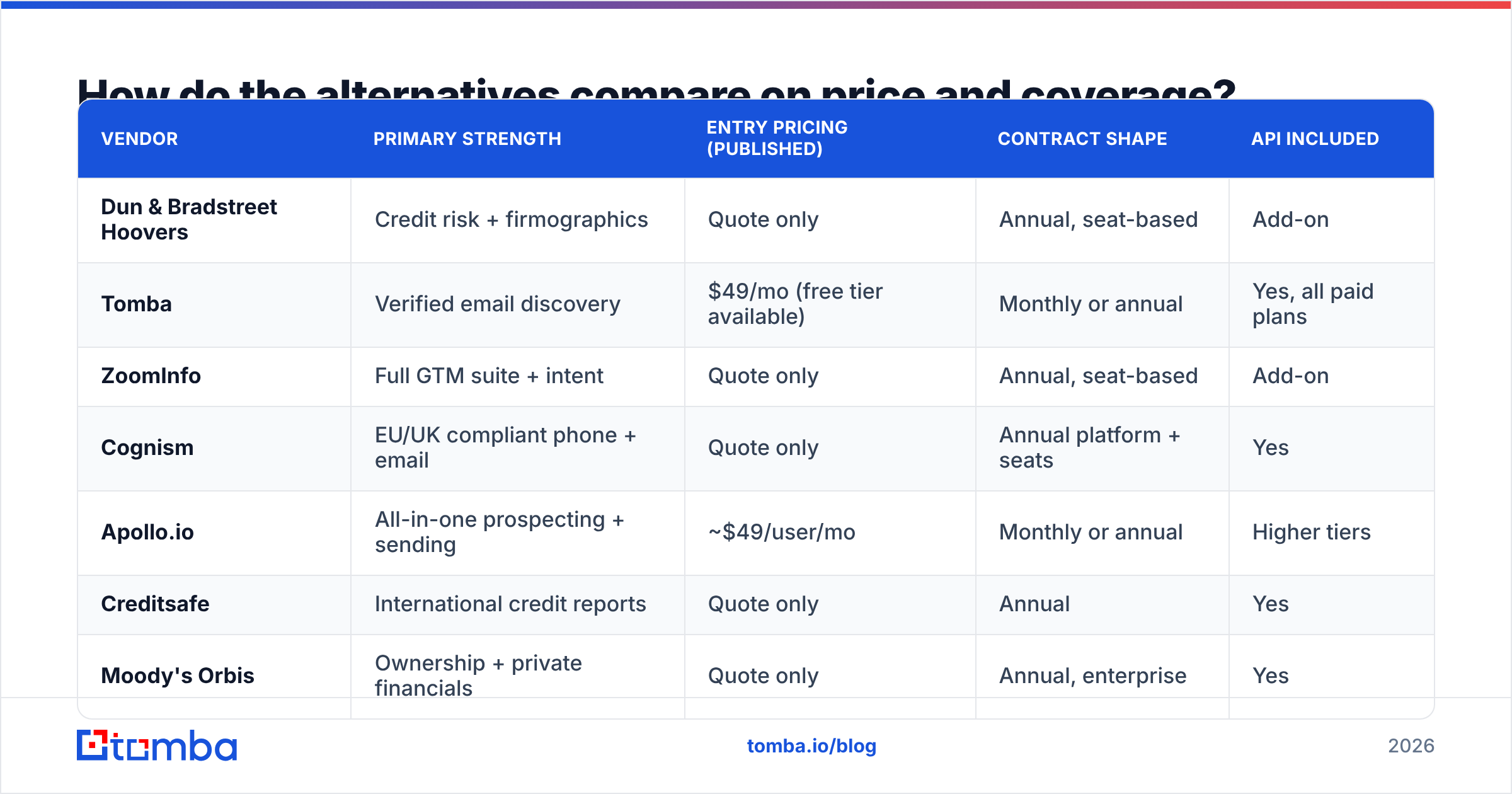
How do the alternatives compare on price and coverage?#
| Vendor | Primary strength | Entry pricing (published) | Contract shape | API included |
|---|---|---|---|---|
| Dun & Bradstreet Hoovers | Credit risk + firmographics | Quote only | Annual, seat-based | Add-on |
| Tomba | Verified email discovery | $49/mo (free tier available) | Monthly or annual | Yes, all paid plans |
| ZoomInfo | Full GTM suite + intent | Quote only | Annual, seat-based | Add-on |
| Cognism | EU/UK compliant phone + email | Quote only | Annual platform + seats | Yes |
| Apollo.io | All-in-one prospecting + sending | ~$49/user/mo | Monthly or annual | Higher tiers |
| Creditsafe | International credit reports | Quote only | Annual | Yes |
| Moody's Orbis | Ownership + private financials | Quote only | Annual, enterprise | Yes |
| Crunchbase | Funding and growth triggers | ~$99/mo | Monthly or annual | Business tier |
| BookYourData | Prepaid verified lists | Pay-as-you-go credits | No subscription | Yes |
Published prices reflect vendor sites at the time of writing. Quote-based prices move a lot with volume and term length. Treat the shape of the contract as the signal, not any one number.
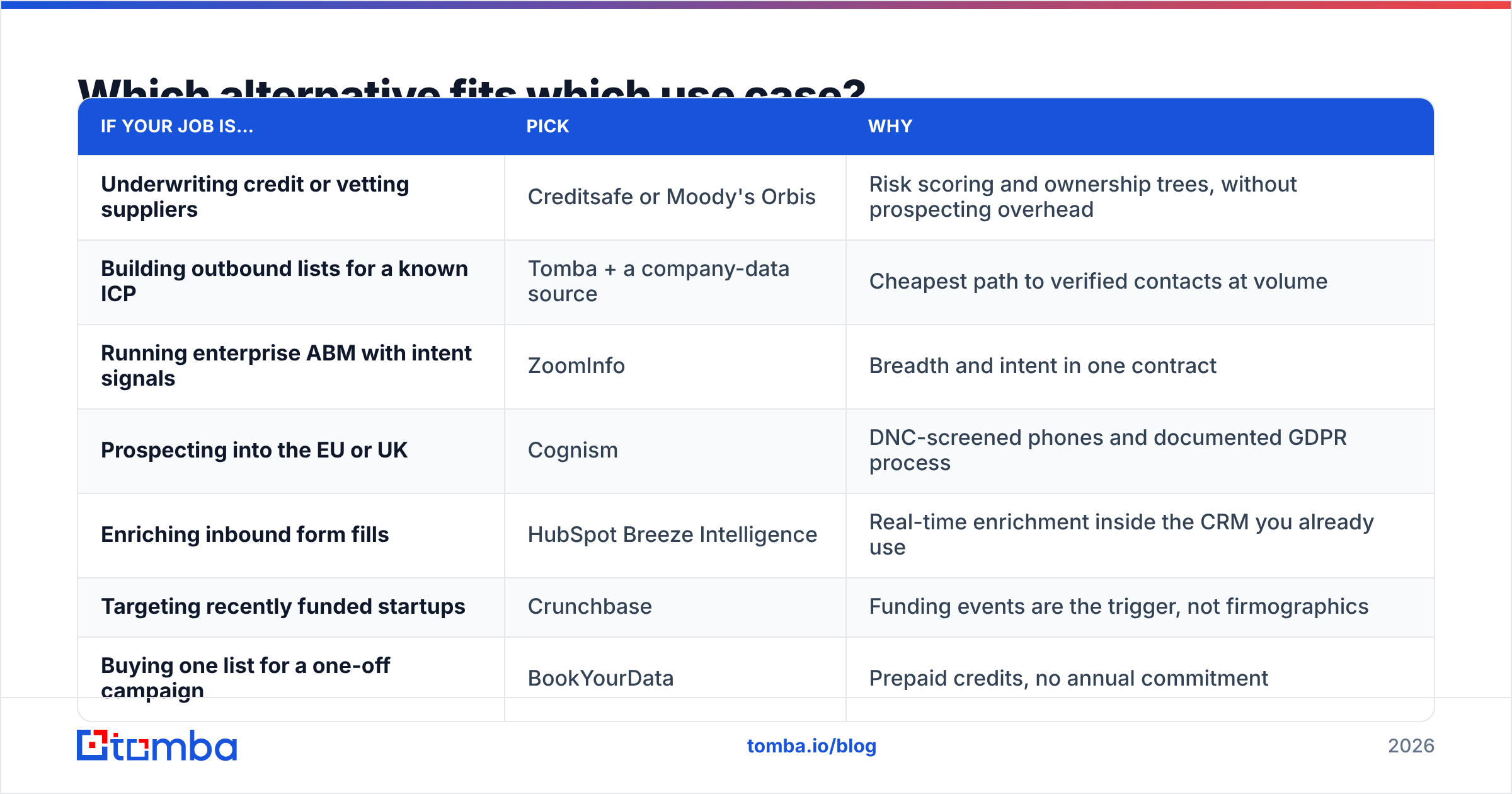
Which alternative fits which use case?#
| If your job is… | Pick | Why |
|---|---|---|
| Checking credit or vetting suppliers | Creditsafe or Moody's Orbis | Risk scores and ownership trees, with no prospecting overhead |
| Building outbound lists for a known ICP | Tomba + a company-data source | Cheapest path to verified contacts at volume |
| Running enterprise ABM with intent signals | ZoomInfo | Breadth and intent in one contract |
| Prospecting into the EU or UK | Cognism | Screened phones and a documented GDPR process |
| Enriching inbound form fills | HubSpot Breeze Intelligence | Real-time enrichment inside the CRM you already use |
| Targeting recently funded startups | Crunchbase | Funding events are the trigger, not company facts |
| Buying one list for a one-off campaign | BookYourData | Prepaid credits, no annual commitment |
| Running everything from one tab on a small team | Apollo.io | Database plus sequencer at SMB pricing |

Can you replace D&B with a stack instead of a single vendor?#
Usually yes, and usually for less money. The unbundling looks like this:
- Company list and firmographics → Crunchbase, Creditsafe, or a public dataset if your ICP is narrow.
- Contact discovery → an email finder API called from your enrichment job, not a person clicking in a UI.
- Verification before send → a separate check, including catch-all handling, so bounce rate stays under 2%.
- Risk and compliance → only if you truly need it. Most sales orgs do not, and this is where the D&B premium lives.
Here is a concrete example. A 12-rep team enriches 20,000 records a year. On a quote-based enterprise contract, that is usually a five-figure commitment with seat limits. On a $99/mo Growth plan plus a company-data subscription, the same volume costs a few thousand dollars a year, with API access included and no seat math.
The catch is integration work. One vendor means one contract, one support channel, and one place to point when the data is wrong. Two or three vendors means you own the glue. If your ops team is one person doing three jobs, the bundle may be worth its premium. Be honest about that instead of only optimising the invoice.
What do you lose when you leave Dun & Bradstreet?#
Three things. Price them before you switch.
The DUNS Number as a join key. Your finance, procurement, or ERP systems may key on DUNS. Pull D&B out and those systems lose their shared ID. Matching records across them becomes a project. This is the most underestimated migration cost.
Corporate linkage. D&B's global family-tree data covers parent, domestic ultimate, and global ultimate. It is genuinely hard to copy. Orbis is the closest substitute. Most GTM tools do not even try.
Payment behaviour data. Paydex and trade-payment history come from a contributor network built over decades. No prospecting vendor has it. None is trying.
If none of those three show up in your real workflows, you are paying a bureau premium for a sales tool. If even one of them is load-bearing, keep D&B for that job and buy contact data separately.
Is there a free Dun Bradstreet alternative?#
Nothing free replaces the risk file. The prospecting half is a different story. Apollo has a free tier, Crunchbase has limited free search, and Tomba's free plan gives you 25 searches a month. Want to know whether a data source can find your buyers? Twenty-five searches against 25 known-good contacts beats any vendor demo. Run the same list through two or three tools and compare hit rate and bounce rate yourself.
That is the honest test. Bring your own 50-contact list where you already know the answers, run it through every finalist, and score each one on found-and-verified rate. Vendor accuracy claims are averages across a database that may look nothing like your ICP.
Where to start#
Most teams leave D&B for one reason. Their reps cannot find working email addresses. If that is you, start at the contact layer and keep the company data you already have. Run Tomba Email Finder against 25 accounts on the free plan. Check the verified-hit rate against your own known-good list. Then decide whether $49/mo replaces a line item that costs 100x that today. If it does, you will know in an afternoon rather than a procurement cycle.
Related guides#
Ready to find emails that actually work?
Join 150,000+ professionals who stopped guessing and started sending. Free credits on signup — no credit card required.
Get the Tomba newsletter
Practical outbound tactics and product updates — once every two weeks.
About the author